
16 Photos and videos













A thoughtful analogy from our very own @spjoleh. An invitation to understand better what we are building and get nerdsniped by @deltadotnetwork.
25 Aug 2025

1/ We’re using zkVMs wrong. We’ve fixated on zkEVM‑style re‑execution, when the real win is proving invariants, not execution.
x.com/spjoleh/status/1959992…
2
146
iorulezz retweeted

5 Aug 2025
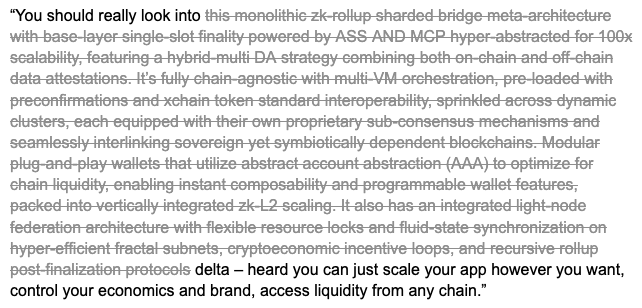
Smoothing out the boundary between onchain and real-world is this enormous problem that no one is thinking about (except us… and… ripple)
2
12
1,828

Using git's workflow as an analogy for [delta] 's
@deltadotnetwork
>>>
>>>
>>> git commit -m "delta workflow"
>>>
>>>
Let’s assume there’s a project whose master branch [account state] lives in a monorepo [single state].
A developer [server as domain operator] writes code [operator orders and executes user transactions], resulting in code changes [state diffs]. Alternatively, some devs like to work in groups [decentralized network as a domain operator] and come up with code changes after they have reached consensus.
Subsequently, they create a branch and push these code changes to it [submit SDL; SDL is included in the state as a result].
Once they are ready [have produced a proof for the submitted SDL], they open a PR [submit SDL proof]. The code reviewers [validators] review the changes [verify the submitted proof].
If approved, the code changes receive the required number of approvals per branch protection rules [at least quorum-many validators attest to the proof’s validity]. As a result, the code changes are merged into the codebase [diffs included in the SDL are applied to the account state].
Moreover, let’s assume that, for this repo, merge conflicts must be prevented [double-spending risk must be eliminated]. Thus, each file [vaults registered under the same domain] can only be modified by a single dev [can only spend through their associated domain].
This is [delta].
3
5
26
5,222
Please find more details in our recent tech overview article:
x.com/deltadotnetwork/status…
23 Oct 2024

Here is the first article in a series on the technology underlying delta
delta.network/articles/delta…
This article is itself an overview, so we will only briefly summarize the key points below 👇
1
6
480
iorulezz retweeted

23 Oct 2024
Here is the first article in a series on the technology underlying delta
delta.network/articles/delta…
This article is itself an overview, so we will only briefly summarize the key points below 👇
4
14
69
8,818
iorulezz retweeted
15 Oct 2024
The ultimate goal is a single global state machine in which vastly different types of applications live side by side across interoperable domains.
Centralized and decentralized; general-purpose, vertical-specific, and app-specific; protocol and business.
This is delta
2
6
43
7,184
iorulezz retweeted
9 Oct 2024
delta's design is exceedingly simple. To get there, you can start with a rollup stack and just delete stuff:
- Remove the need for bridges and 3rd party interoperability services by having all the "rollups" (domains) share state
- Integrate the execution layer with the base layer to further simplify interop by making all tokens "L1-native" by default, regardless of where they're deployed
- Remove ordering consensus
zk settlement enables completely heterogenous execution environments within the global state machine.
Our view is that the ideal permissionless system consists of a minimal, neutral base layer which provides censorship resistance and extreme scale, combined with highly opinionated, customized execution environments.
This system is delta.
8
5
62
11,057
iorulezz retweeted

9 Oct 2024
We're super excited to announce our investment into @deltadotnetwork! Having co-led the pre-seed and doubled down in the seed, it is only fair we give an overview of exactly why we're excited.
The marriage of monolithic and modular;
x.com/deltadotnetwork/status…
9 Oct 2024
Introducing delta, a network of networks with shared state
delta is an integrated system, built from the ground up to break the trade-off between sovereignty and interoperability for developers
We’re thrilled to announce $11M in funding to realize this vision
2
4
56
5,762
iorulezz retweeted

9 Oct 2024
NEW: Starting from scratch: A new architecture looks to challenge incumbents
by @yeluacaM
blockworks.co/news/delta-new…
2
7
13,901
iorulezz retweeted
7 Oct 2024
Don't burden the global with that which can be taken care of locally
2
4
25
1,401

iorulezz retweeted
24 Sep 2024
In this article @riabhutoria and I explore the global financial system of the (near) future, as some tbd very cool tech innovations get out there
1
6
35
2,876
iorulezz retweeted

25 Sep 2024
1/ "An organization that could globally guarantee and transfer monetary information in the form of arranged electrons and photons would have a market, every exchange of value in the world"—Dee Hock
This was the dream of Visa's founder. But the rise of the internet and an all-pervasive atmosphere of information has not given us a similar atmosphere for scarce information—money and assets
1
7
37
4,953
A blockchain ecosystem should
A. Vertically scale to physical limits, within a composable domain
B. Horizontally scale by allowing more composable domains, without compromising security or interoperability
Ethereum has done B and is adding A
Solana has done A and is adding B
[Redacted] is doing both A and B from the get go
16
7
63
8,794
iorulezz retweeted
29 Aug 2024
We believe the future of the web is glocal: a minimal global state with local, highly customizable execution domains
9
19
81
17,149
> the “best” modular architecture includes central sequencers, horizontally scaled DA, fast censorship resistance guarantee, instantaneous economically secured validity (and eventual zk verification) that give instant confirmation.
Take the above and add interoperability (shared settlement / sequencing), application-specific sequencing, streamlined devtools (for the prior two items), zk, validating or consensus bridges to major L1s, (and probably privacy features like onchain confidential compute), we will get the pretty much the endgame ecosystem.
Either Ethereum and the modular ecosystem become this or there will be disruptors.
(And no, other L1 ecosystems like Solana cannot compete here, as none of them can horizontally scale without compromising on security yet.)
29 Aug 2024

I think @jayendra_jog point is: take whatever modular system you maybe running, vertically integrate it and then optimize and call it a new monolithic system - this latter monolithic system canNOT be worse than the modular system.
This argument is theoretically accurate.
My reactions
First this is easier said than done - it is extremely difficult to build each one of these systems and humans / teams thrive in specialization, especially when each of those components have incentives.
Secondly the “best” modular architecture includes central sequencers, horizontally scaled DA, fast censorship resistance guarantee, instantaneous economically secured validity (and eventual zk verification) that give instant confirmation. NO existing monolithic architecture follows this spec.
Based sequencing is @drakefjustin idea to bring this architecture as close to L1 as possible providing trust guarantees from L1 validators without changing the slick UX of L2s while bringing value accrual and MEV back to Ethereum L1.
So Ethereum is the closest monolithic architecture to this design.
3
7
47
11,290
iorulezz retweeted
22 Aug 2024
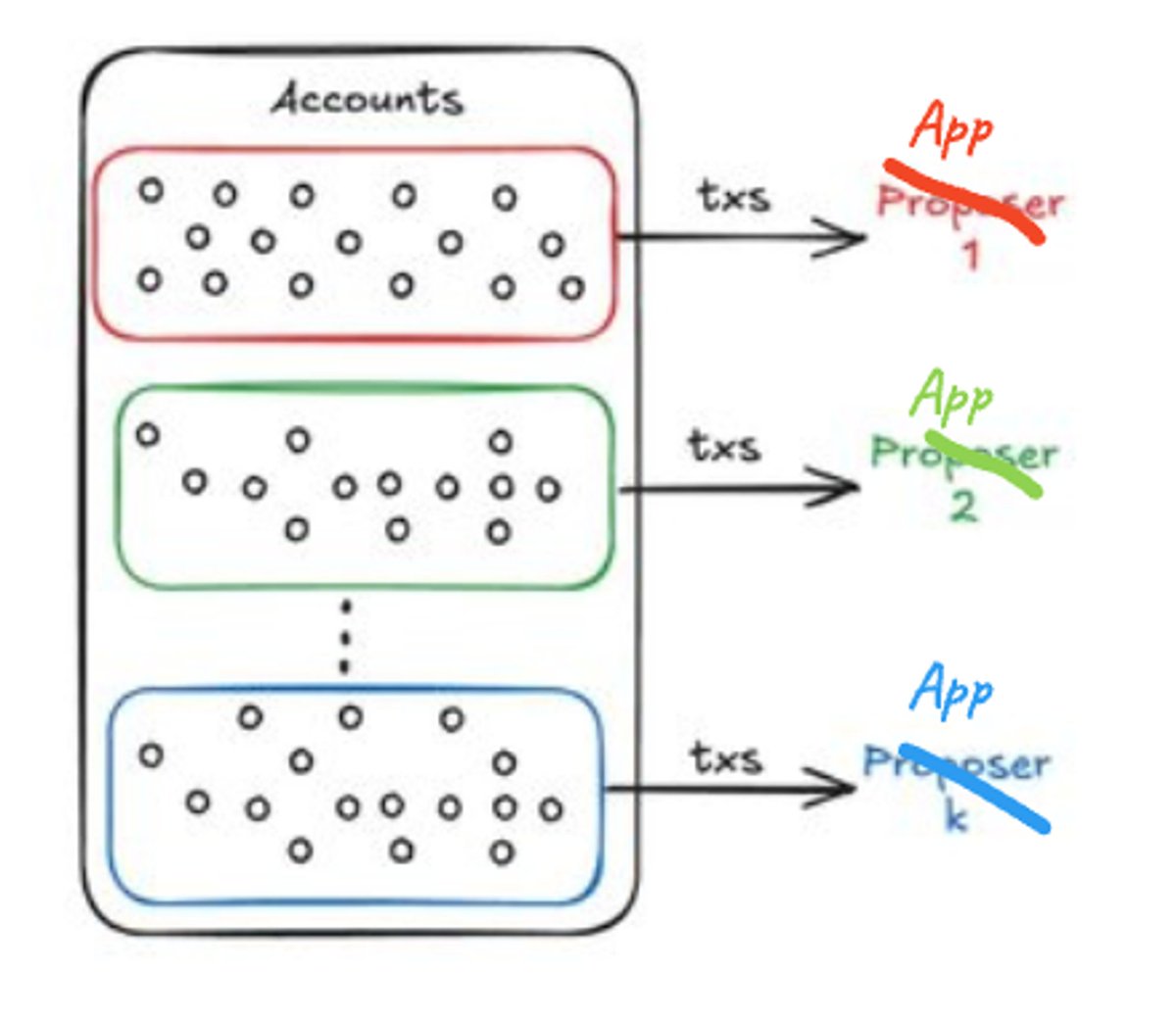
ASS Is All You Need
App-specific sequencing (ASS) refers to applications themselves ordering the transactions touching their state.
Appchains and app-specific rollups trivially have ASS, but the lack of global state introduces new problems
Let's do better 👇
8
19
130
22,254
iorulezz retweeted

15 Sep 2022
And we finalized!
Happy merge all. This is a big moment for the Ethereum ecosystem. Everyone who helped make the merge happen should feel very proud today.
9,012
40,072
172,548