
Human-Computer Interaction. Creator of Cryptographic Cards®
Joined February 2009
- Tweets 4,752
- Following 2,142
- Followers 1,066
- Likes 2,608
75 Photos and videos













Jun 15
Today’s minimum required reading

5
Jun 3
Using time travel and Yahoo Mail I've read a mail that hasn't arrived yet.
1
17
Diarmad McNally retweeted

May 24
When you stop drinking, something happens that most people never get to experience:
You find out what good health actually feels like.
You have sharper mornings, better energy, and a body that talks to you instead of screaming at you.
When you drink again after a long break, the hangover is a signal.
You’re feeling the real cost for the first time because your standard of health has elevated.
Everyone is dunking on Steven for “being soft” but he’s just found a new ceiling for his health and he wants to keep it.
May 23

Steven Bartlett says a few glasses of wine ruined the next 3 days of his life
“It's one of those areas where you don't understand the hidden cost until you really give it up for a while. I stopped drinking at 30 years old. I'm now 33. When I was 31, I thought, I'll have a drink again because now I could really A/B test it. I had a year of not drinking, decided to have a drink again”
“It ruined three days of my life. I had a couple of glasses of wine, didn't get drunk. It ruined three days of my life because of the domino effect it caused”
“I got worse sleep that night, and then because I got worse sleep that night, I ate more poorly the next day because my dopamine system or whatever, the cortisol system was all messed up. I podcasted worse. I didn't go to the gym that day or the day after because I felt really bad. I then slept worse, and I could track all of this on my Whoop”
206
35
619
198,214
Diarmad McNally retweeted

May 18
Excellent as ever from Jesus
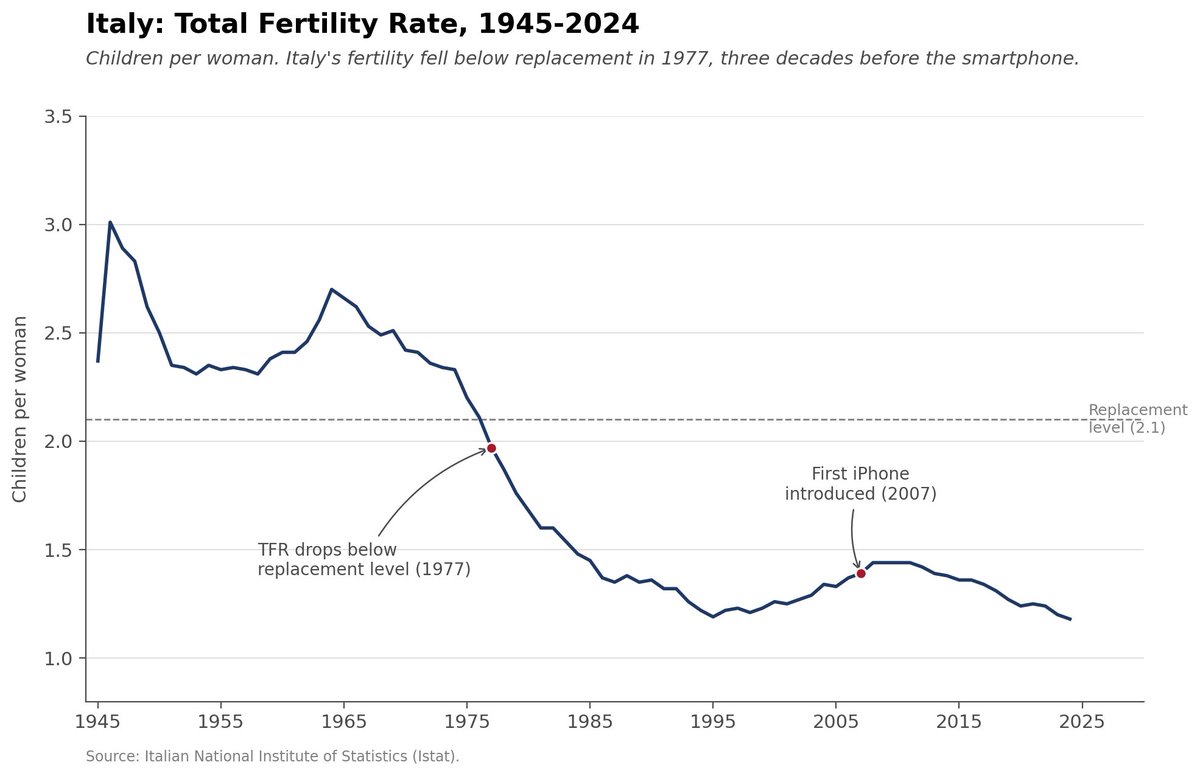
Some overlap w/ the thesis set out in my piece — that smartphones and social media are in large part accelerants, amplifiers and ‘internationalisers’ of social/cultural shifts that have been slowly unfolding for decades if not longer.

Smartphones are not the explanation for the recent decline in fertility. Instead, they are an accelerator of deeper forces already at work.
Let’s start with the facts. Fertility is falling almost everywhere: in rich, middle-income, and poor countries; in secular and religious countries; and in countries with high and low levels of gender equality.
The decline accelerated around 2014. So, no country-specific explanation will work unless you are willing to believe that 200 distinct country-specific explanations arrived at roughly the same time.
Smartphones look like the obvious candidate: the first iPhone was released in 2007, and global adoption has been astonishingly fast.
Economists understand the first major decline in fertility in advanced economies, from 6 or 7 children per woman throughout most of human history to about 1.8, that occurred between the early 1800s and roughly 1970, well before smartphones. The main drivers were a sharp fall in child mortality (effective fertility was rarely above 3 and often close to 2) and the shift from a low-skill, rural agrarian economy to a high-skill, urban industrial one. We have quantitative models that fit these facts well.
Country-specific factors mattered too, of course. Proximity to low-fertility neighbors accelerated Hungary’s decline, while fragmented landowning structures accelerated France’s. But these were second-order mechanisms.
This is also why most economists long considered Paul Ehrlich’s doom scenarios implausible. We forecast that fertility in middle- and low-income economies would follow the same path as in the rich, probably faster, because reductions in child mortality reached India or Africa at lower income levels (medical technology is nearly universal, and most gains come from handwashing and cheap antibiotics, not Mayo Clinic-level care). Much of what we see in Africa or parts of Latin America today is still that old story.
But in the 1980s, a new pattern appeared. Japan and Italy fell below 1.8, the level we had thought was the new floor. By 1990, Japan was at 1.54 and Italy at 1.36.
This second fertility decline began in Japan and Italy earlier than elsewhere, driven by country-specific factors, but the underlying dynamics were widespread: secularization, an education arms race, expensive housing, the dissolution of old social networks, and the shift to a service economy in which women’s bargaining power within the household is higher. The U.S. lagged because secularization came later, suburban housing remained relatively cheap, and African American fertility was still high. U.S. demographic patterns are exceptional and skew how academics (most of whom are in the U.S.) and the New York Times see the world.
My best guess is that, without smartphones, Italy’s 2025 fertility rate would be about 1.24 rather than 1.14. I doubt anyone will document an effect larger than 0.1-0.2. Italy was at 1.19 in 1995, not far from today’s 1.14. The TFR is cyclical due to tempo effects, so I do not read too much into the rise between 1995 and 2007 or the decline from 1.27 in 2019 to 1.14 today. The direct effect of smartphones is not zero, but it is not, by itself, that large.
Where social media, in general, and smartphones, in particular, matter is in the diffusion of social norms. What would have taken 25 years now happens in 10. Social media are not the cause of fertility decline; modernity is. But they are a very fast accelerator.
That is why social media are a major part of the story behind Guatemala (yes, Guatemala) going from 3.8 children per woman in 2005 to 1.9 in 2025. Without them, Guatemala would also have reached 1.9, just 20 years later.
Modernity, in its current form, is incompatible with replacement-level fertility. By modernity, I do not mean capitalism: fertility fell earlier and faster in socialist economies than in market economies. Socialist Hungary fell below replacement in 1960, and socialist Czechoslovakia in 1966 (both experienced small, short-lived baby booms in the mid-1970s). By modernity, I mean a society organized around rational, large-scale systems and formalized knowledge.
Countries will not converge to the same fertility rate. East Asia is likely stuck near 1, possibly below, given its unbalanced gender norms and toxic education systems. Latin America faces the same gender problem plus weak growth prospects, so I expect something around 1.2. Northern Europe has more egalitarian family structures and might hold near 1.5. The very religious societies are probably the only ones that will sustain 1.8.
All of this could change with AI or changes in population composition. We will see. But on the current evidence, deep sub-replacement fertility is the “new new normal.” Unless we reorganize our societies, better learn to handle it as best we can.
20
104
579
177,971
May 15
Enjoying the new/old @ModRetro Chromatic. The family were laughing while playing it.
Funnily enough, it took me straight back to the pre-smartphone 90s, when there was always one of us playing a Game Boy or similar while only half watching the TV.
Second screening isn’t new!
2
53
Diarmad McNally retweeted

May 4
The idea that EV batteries age poorly is a misconception – and a new report has found they often outlive the cars themselves newscientist.com/article/mg2…
4
36
76
15,354
Diarmad McNally retweeted

I am proud to announce my first bill with the ambition to legalise nuclear energy in Ireland. 101 years ago, Ireland broke ground on the Shannon Hydroelectric Scheme. In our past we had an ambition to do what was necessary. Now we must do so again.
businesspost.ie/politics/new…
214
162
1,506
163,858
Diarmad McNally retweeted

Apr 18
🚨Tesla Akku aus einem Model 3 als Hausspeicher? Geht!
Insgesamt 79kWh!
Geladen mit 11kW Solarstrom.
Ein richtig schönes Beispiel dafür, dass Batterien aus Elektroautos nach dem Einsatz im Fahrzeug nicht einfach ausgedient haben, sondern als Speicher ein zweites Leben bekommen können.

172
258
3,265
458,664
Diarmad McNally retweeted

Apr 16
For the first time in Norwegian history, a bus will carry passengers in regular traffic without any human behind the wheel. The first pilot without a safety driver was tested Friday, and if all goes as planned, anyone can ride driverless buses starting in May.
461
951
4,919
2,598,694
Diarmad McNally retweeted

Apr 13
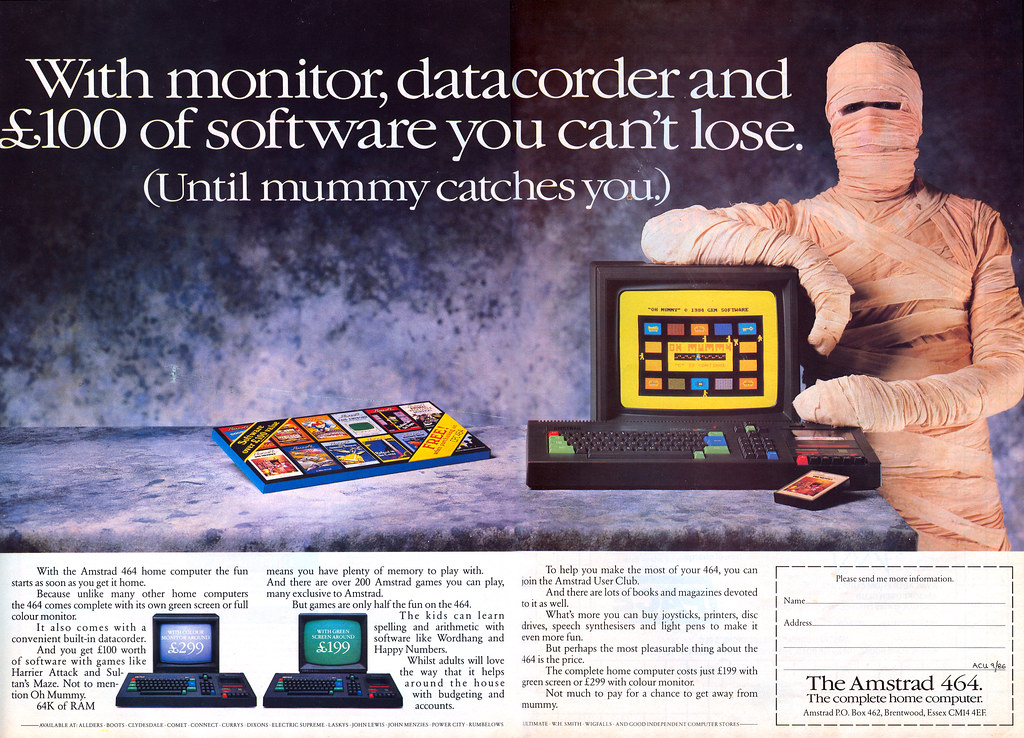
42 YEARS AGO! On 11 Apr 1984 I launched the Amstrad CPC464 - the first affordable all-in-one home computer. On other computers you had to use your home TV as a monitor and also plug in a cassette player. The CPC464 had it all. Read all about it here 👉youtube.com/watch?v=NbMDN_5t…
86
46
418
36,267
Apr 9
I am Jack’s total lack of surprise
Apr 9

OpenAI is pausing its Stargate infrastructure project in the UK, citing the high cost of energy and regulatory environment.
9
Diarmad McNally retweeted

Proud to be a long-time gadget. Helping astronauts write space history since 1968. Thanks for the recognizing us @thegadgeteer
Apr 3

8 Pieces of Tech the Artemis II Crew Is Taking to the Moon dlvr.it/TRrcSY
1
1
110
Diarmad McNally retweeted

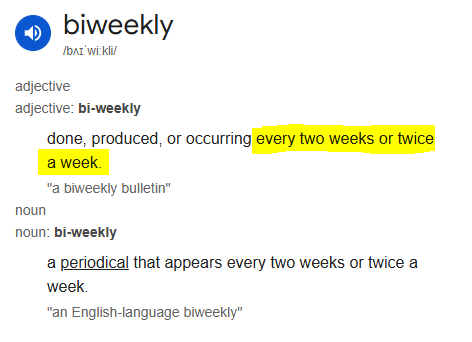
We have a standing meeting about this word twice a week every two weeks.

263
1,796
30,014
890,178
Diarmad McNally retweeted

Apr 4
There is a cafe in Cumbria, England where a large indoor sandpit allows customers to operate remote-controlled construction trucks and excavators from their seats. x.com/fluxfolio_/status/2040…
181
864
10,966
1,018,584
Apr 1
My wife has many qualities but has no concept of the level of monitoring this situation demands 😀

The Artemis II crew is boarding Orion.
Reid, Victor, Christina, and Jeremy are taking their seats atop the most powerful manned rocket ever built. They have trained for years for this moment, and now they are preparing to execute a mission that will take us back around the Moon and begin the next chapter of human space exploration.
21
Diarmad McNally retweeted

Mar 27
The 37 early version of Microsoft Office installation disks.
57
160
1,139
64,129
Diarmad McNally retweeted

Mar 27
I hated the minimalism on the 3 and Y, it was one of the turn offs from buying one. After nearly a year of owning my first Tesla, i can’t go back. Traditional Dash feels and looks too busy. It’s like looking at an old blackberry vs touchscreen phone.
3
2
71
8,451
Mar 8
Watched Hijack on Apple TV and they’re still using the 1960s Mission Impossible trope of a bomb with a flashing LED that beeps every second.
Same with car trackers in films, blinking away just as in Goldfinger 1964. Lazy filmmaking.
37
Mar 5
Conversations about Morrissey, Musk, Rowling etc. are as toxic and uncivil as anything here. The targets are different, not the vitriol. Still very little engagement by comparison and no Community Notes equivalent.

If you haven't checked us out in a while, we've been busy. Doing work to make conversations less toxic and more civil, and adding new ways to help you find your friends on Bluesky. See what you've been missing: bsky.app
72