
Executive Director, Ibec Global. Passionate about international business, the economy and inclusive growth. Opinions expressed are my own.
Joined September 2010
- Tweets 1,863
- Following 433
- Followers 722
- Likes 2,745
99 Photos and videos



Jackie King retweeted

Absolutely beautiful St Patrick’s Day video from the all team at DFA HQ #Bród 🫶🏻 🇨🇦🇮🇪
Mar 12

At a time of global turmoil and great challenge, we look for signs of hope in the everyday.
To Irish people and friends of Ireland everywhere, we wish you a very happy St Patrick’s Day!
Lá Fhéile Pádraig sona daoibh.
5
11
43
2,923

16 Jan 2025
👉Excited to share our new edition of The Global Compass: Cracking the Code: Unlocking Competitiveness in a Complex Geopolitical Matrix.
💡This report below provides valuable insights to help leaders navigate these challenges and unlock new opportunities for competitiveness.
16 Jan 2025

🚀 We just launched the latest edition of the Global Compass!
📖 Cracking the Code: Unlocking Competitiveness in a Complex Geopolitical Matrix
💡This new edition explores 5 key insights that are essential to cracking the ever-changing
competitiveness code.
Access the report here: ibec.ie/ibec-global/insights…
@ibec_irl @jackieaking
#Competitiveness #GlobalBusiness #Innovation #IbecGlobal
350
Jackie King retweeted

16 Jan 2025
🚀 We just launched the latest edition of the Global Compass!
📖 Cracking the Code: Unlocking Competitiveness in a Complex Geopolitical Matrix
💡This new edition explores 5 key insights that are essential to cracking the ever-changing
competitiveness code.
Access the report here: ibec.ie/ibec-global/insights…
@ibec_irl @jackieaking
#Competitiveness #GlobalBusiness #Innovation #IbecGlobal
1
1
544
Jackie King retweeted
19 Dec 2024
The AI Alliance Network – A strategic move in the global tech race
The announcement of the AI Alliance Network by Russia and BRICS nations signals a strategic reorganization of the global tech landscape. The network aims to strengthen collaboration among BRICS members, enhance AI capabilities in emerging markets, and provide an alternative to Western-centric AI ecosystems. This major global initiative brings new challenges, opportunities, and potential risks for the global AI scenario.
Here are 5 considerations to keep in mind as global powers fight for AI control:
➡ A Challenge to the U.S. position: The U.S. and China dominates AI leadership through advanced private sectors and state-led initiatives, but the AI Alliance Network within BRICS aims to create a broader platform for emerging economies. By combining China’s AI expertise with India’s IT infrastructure and Brazil’s expanding markets, the Network seeks to deliver tailored AI solutions for agriculture, healthcare, and education. This effort focuses on diversifying AI applications globally while addressing overlooked markets and needs, with success depending on resource integration and overcoming infrastructure gaps.
➡ BRICS’ geopolitical statement: This alliance represents a geopolitical assertion by several nations aiming to influence AI regulations and standards in ways that reflect their developmental priorities. It challenges Western-centric frameworks, providing emerging markets with alternatives that align with their specific challenges and ambitions. Moreover, by targeting underserved regions like Africa and Southeast Asia, the Network expands its geopolitical reach. The Network’s geopolitical play strengthens the influence of BRICS on global AI policies, but its ability to translate rhetoric into meaningful technological leadership remains uncertain.
➡Risk of global AI fragmentation: By developing parallel AI ecosystems and standards, the AI Alliance Network could exacerbate the fragmentation of the global tech landscape. Much like decoupling trends in semiconductors and 5G, the emergence of competing AI frameworks may increase complexity for multinational corporations, forcing them to navigate divergent regulations and standards in key markets. Fragmentation could limit interoperability, raise costs for businesses, and widen the gap between Western and non-Western AI ecosystems.
➡Internal disparities within BRICS remain a challenge: Tortoise Media’s Global AI Rankings highlight significant gaps among BRICS members. While China ranks as a leader, Russia lags at 28th, and India stands at 24th, reflecting challenges in talent development, infrastructure, and investment. Without bridging these internal disparities, the Network risks uneven progress, with China dominating and others struggling to contribute meaningfully.
➡Broader Implications for Global Business: For businesses, the AI Alliance Network presents both opportunities and challenges. Emerging markets could become more competitive AI hubs, creating new avenues for growth. However, the fragmentation of AI standards and localized approaches might complicate operations, requiring firms to adapt strategies across regions. Businesses must monitor how this initiative unfolds and prepare for a more complex, regionalized AI landscape, balancing opportunities in emerging markets with the challenges of navigating fragmented ecosystems.
@ibec_irl @jackieaking
1
1
137
Jackie King retweeted
18 Dec 2024
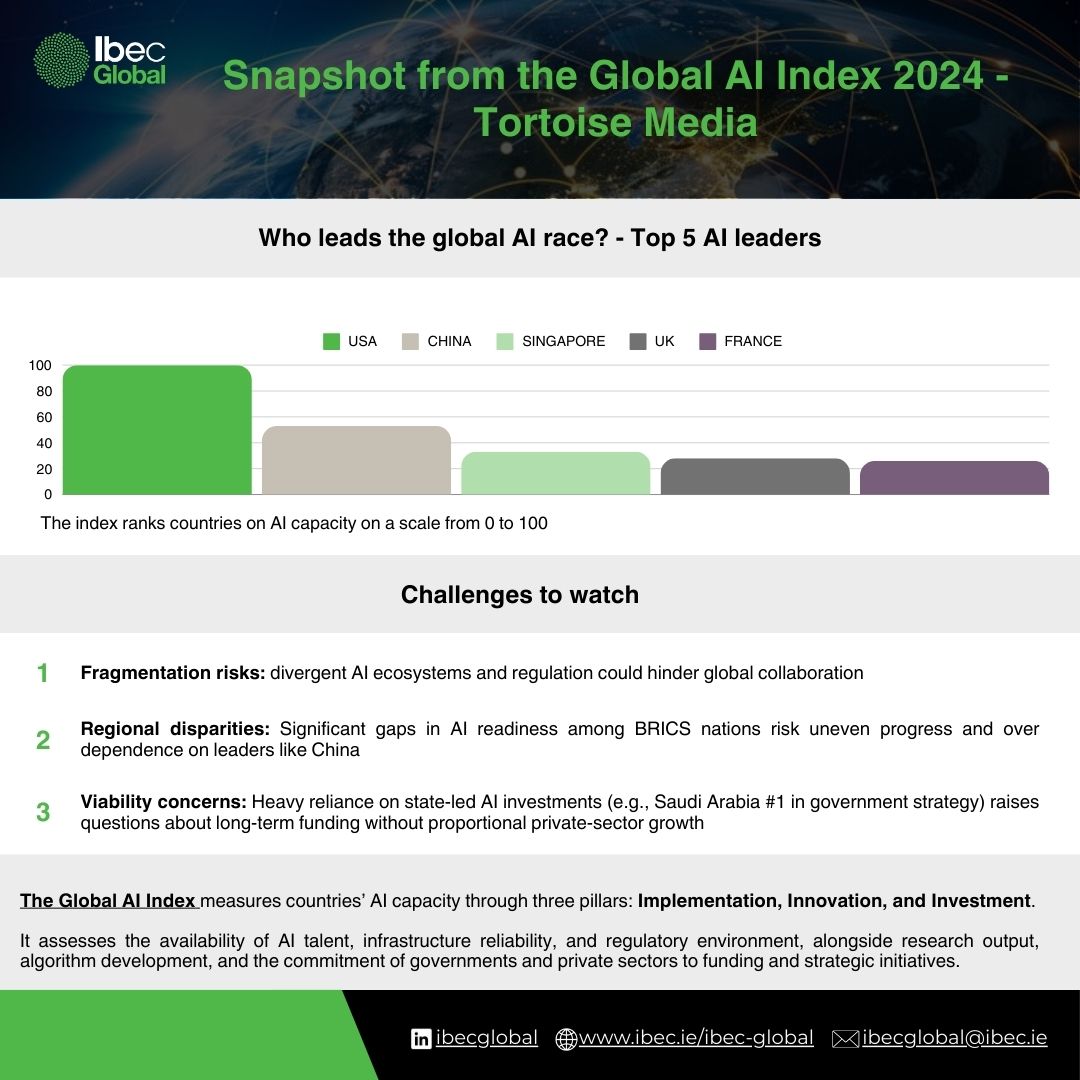
This week we wanted to share a snapshot of the “The Global AI Index” developed by @tortoise.
📊 This interactive tool is the first to benchmark nations on their investment, innovation, and implementation of artificial intelligence. Check it out here: tortoisemedia.com/intelligen…
🌟 The results shed light on who is leading the AI race and why, based on the analysis of over 120 indicators, collected from different public and private data sources, and over 80 governments.
⚙️ In a world where supply chains are reconfigured, critical industries are subject to subsidies and sanctions, and alliances are constantly shifting, only those who integrate data and technology into their strategies will be able to anticipate and lead.
Stay tuned for the release of our Global Compass in January 2025, where we will also highlight the relevance of embracing AI and digital transformation as a key component of the future of competitiveness.
#GlobalCompetitiveness #DigitalTransformation #AI #Leadership #IbecGlobal
@ibec_irl @jackieaking
2
2
316
Jackie King retweeted
13 Dec 2024
Navigating a World in Flux: What It Means for Competitiveness
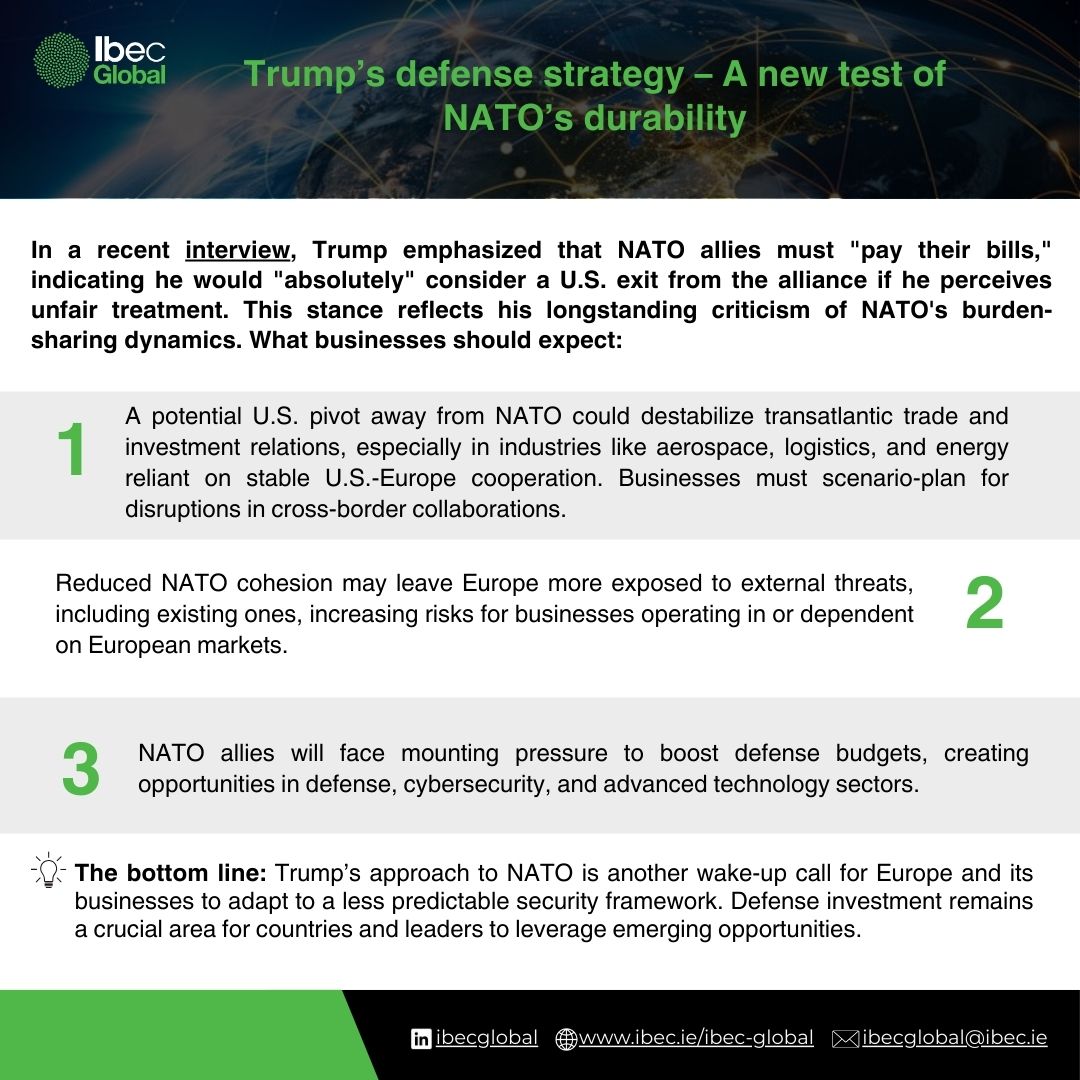
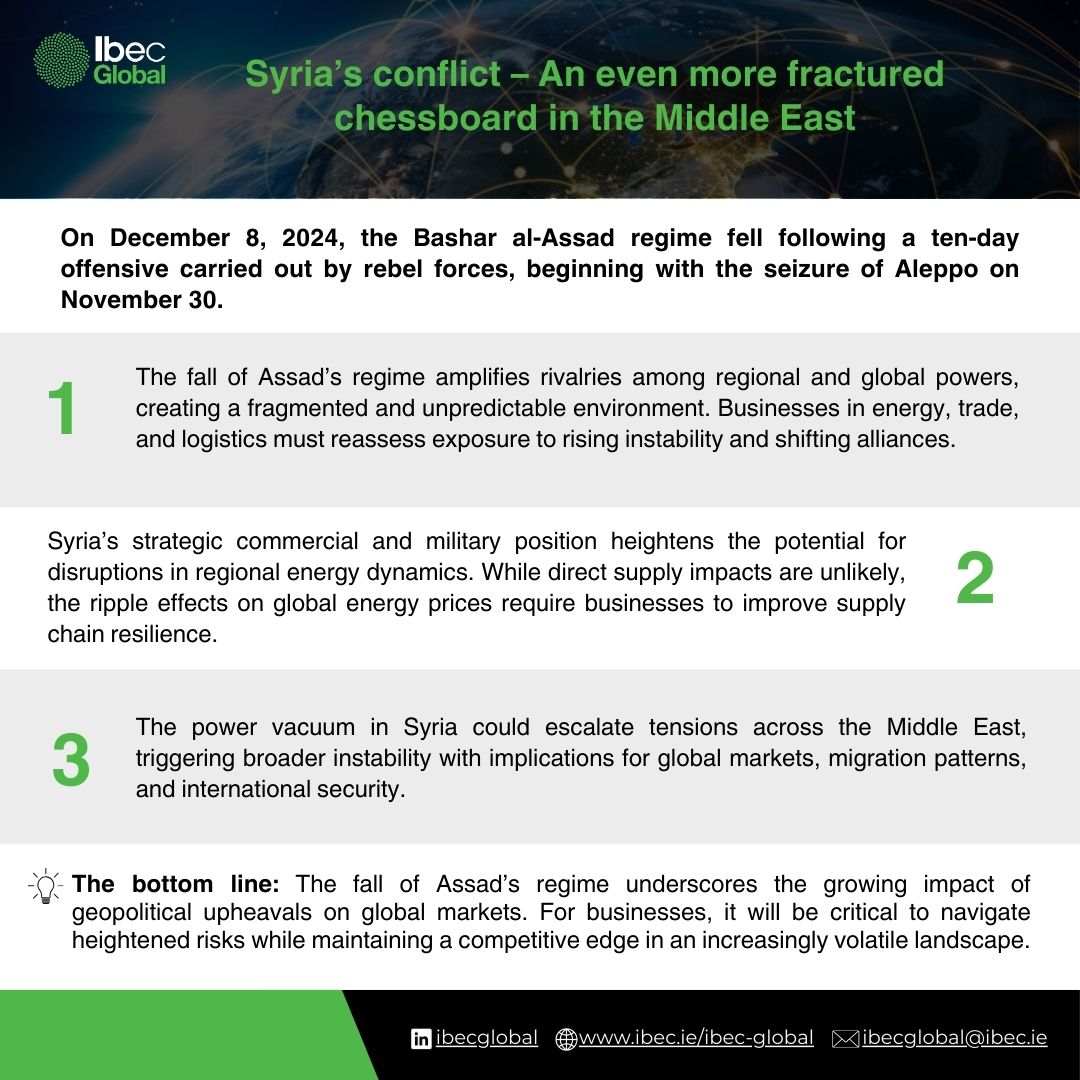
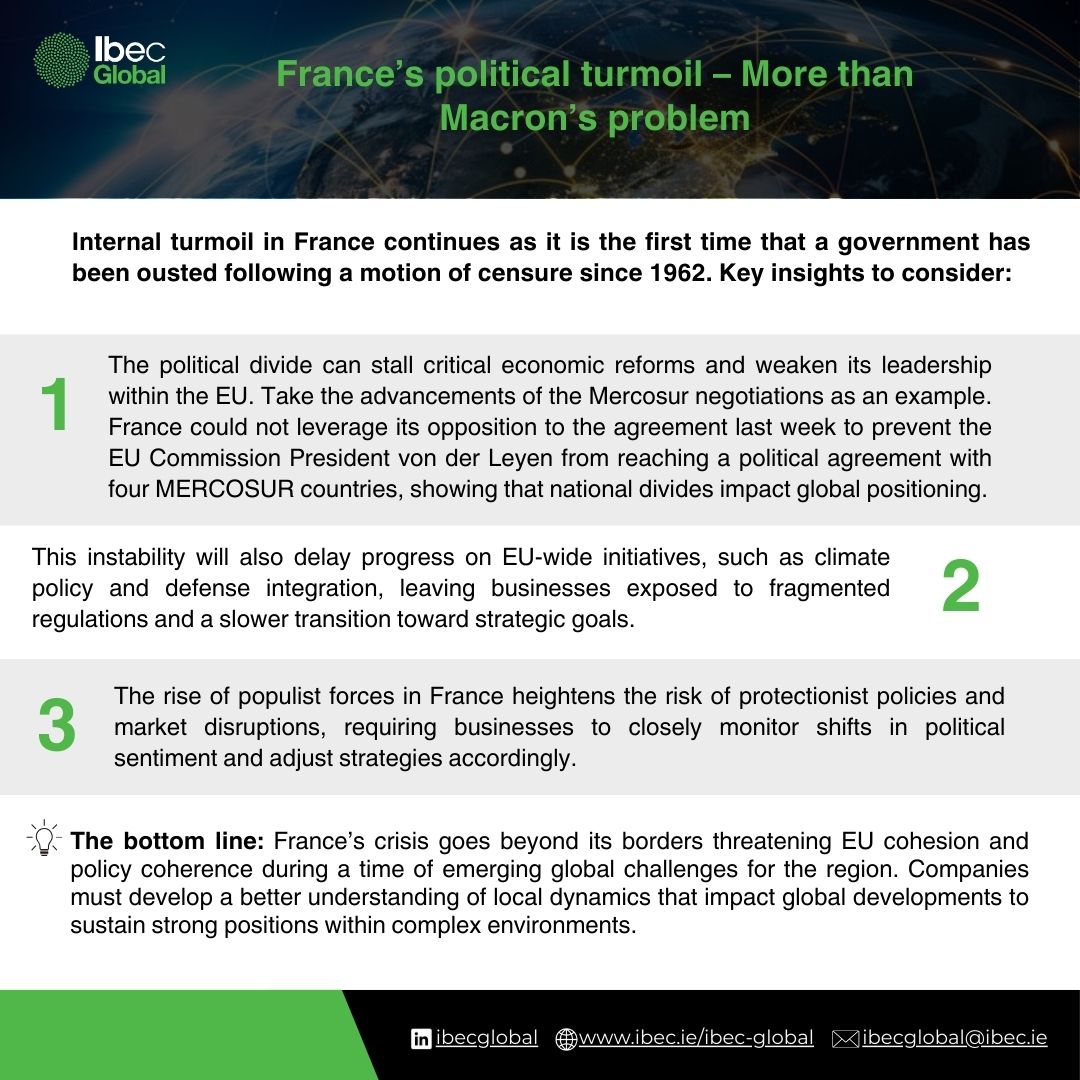
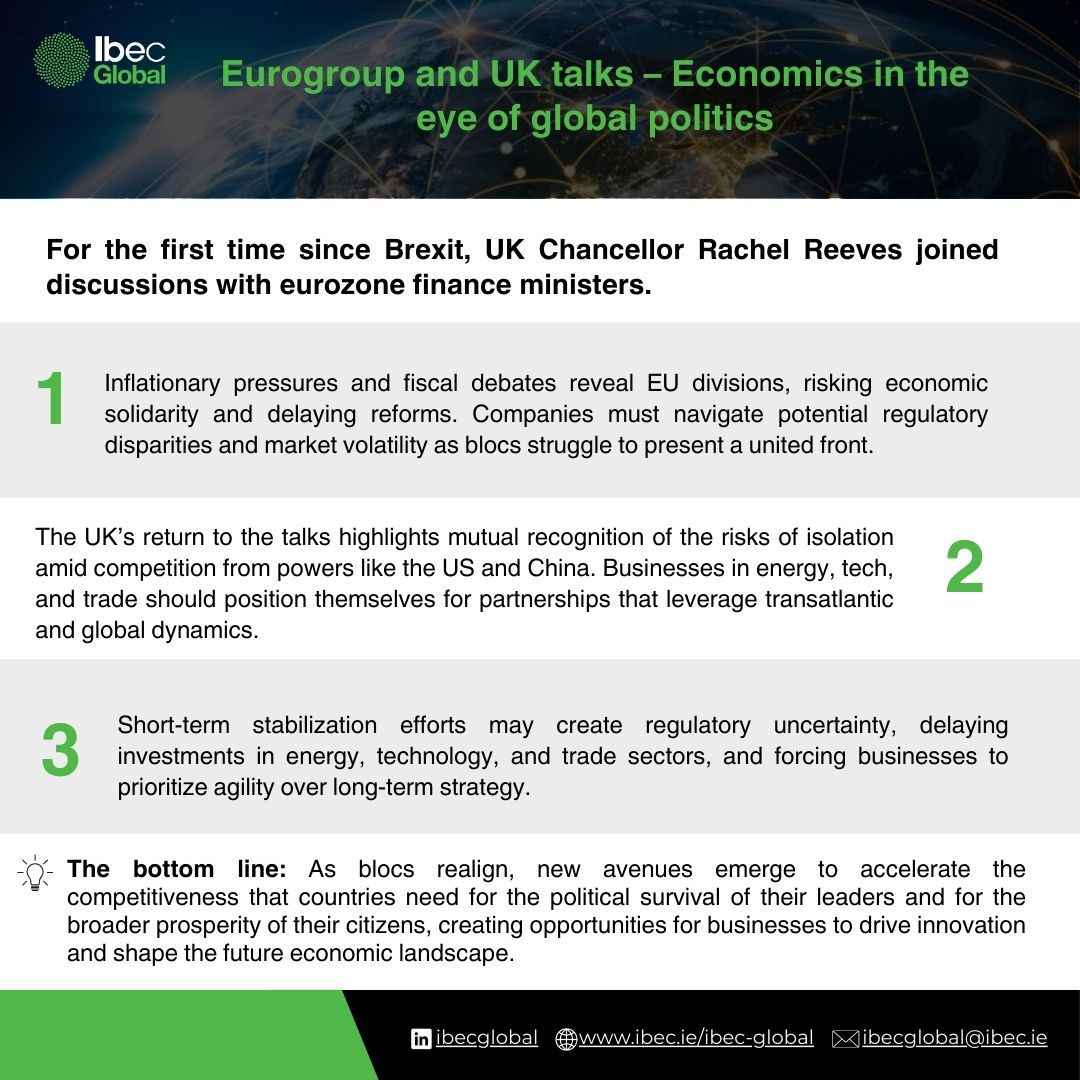
Syria’s upheaval, France’s political turmoil, Trump’s latest comments on NATO, and the recent Eurogroup-UK talks have one theme in common: they show a global recalibration of alliances and power dynamics.
At Ibec Global, we’re unpacking how these shifts reshape the competitiveness of nations and businesses alike. Whether it’s the implications of defense fragmentation, the ripple effects of a redefining EU leadership, or the pressing need for cohesive regulatory frameworks, the message is clear: global politics and economic strategies are more intertwined than ever.
Stay tuned for the release of our Global Compass in January 2025, where we’ll decode these dynamics and provide actionable insights to help leaders stay ahead in a fast-changing world.
#GlobalCompetitiveness #Geopolitics #Leadership #IbecGlobal
@ibec_irl @jackieaking
1
2
118
Jackie King retweeted
12 Dec 2024
In this Week in Focus, Executive Director Jackie King GCB.D outlines below how two recent developments, the evolving EU–Mercosur trade agreement and the latest Eurogroup meeting, are impacting businesses with operations or interests tied to Europe.
#Mercusor #Eurogroup #GlobalBusiness #IbecGlobal
@ibec_irl @jackieaking
1
2
413
Jackie King retweeted
5 Dec 2024
Week in Focus: Global Plastics Treaty Negotiations & The Road Ahead
The latest round of negotiations for a legally binding global plastics treaty wrapped up last week in Busan, South Korea, without consensus and no treaty for the moment. Tensions remain high between the High Ambition Coalition (100 countries, including France, Mexico, and the EU) pushing for production caps and binding phase-out lists and the Like-Minded Countries (China, Russia, Saudi Arabia) preferring a waste management recycling-focused approach.
For readers who are not entirely familiar with this process, it represents the most significant multilateral environmental agreement in the making since the 2015 Paris Accords to tackle climate change. But countries keep failing to reach a substantive convergence.
During last week it was clear that the positions were almost impossible to bridge. Despite the efforts of the Chair of the negotiations, countries fought over creating a globally binding treaty, targeting production and phase-out of problematic plastics, or a nationally driven agreement focused on recycling and waste management. These entrenched positions on key provisions have pushed the process to a new round of negotiations in 2025. “No treaty is better than a weak treaty” remains the mantra of ambitious countries like Norway, Rwanda, and Panama, and that´s exactly what happened as the “Like-minded coalition” was not willing to break their red lines, particularly on production caps. Now they will have an extra round to agree on new terms, but within this context convergence seems extremely difficult to achieve.
Meanwhile, the battle can move to the local and regional arena. Ambitious countries are doubling down, pushing for regulatory action through measures to build momentum from the bottom up. Once again, in the coming months, the contentious topics will be the new battlegrounds not only for the treaty, but also for the domestic regulations on which many countries are relying to develop their positions. The treaty itself may be delayed, but each round of negotiations sets the political and regulatory machinery in motion in regional and local markets. Another fitting example of the global and local dynamics working parallelly to drive political and regulatory actions.
There are many considerations at stake from this ongoing global debate as both plastics producers and end users could see significant shifts in their day-to-day operations stemming from the potential treaty outcomes. After two years and five rounds of negotiations, the outcome remains uncertain, and business leaders should maintain this treaty as a key global policy development to watch as we go into 2025.
@ibec_irl @jackieaking
#UN #GlobalPlasticsTreaty #Sustainability #GlobalBusiness
1
1
98
Jackie King retweeted
28 Nov 2024
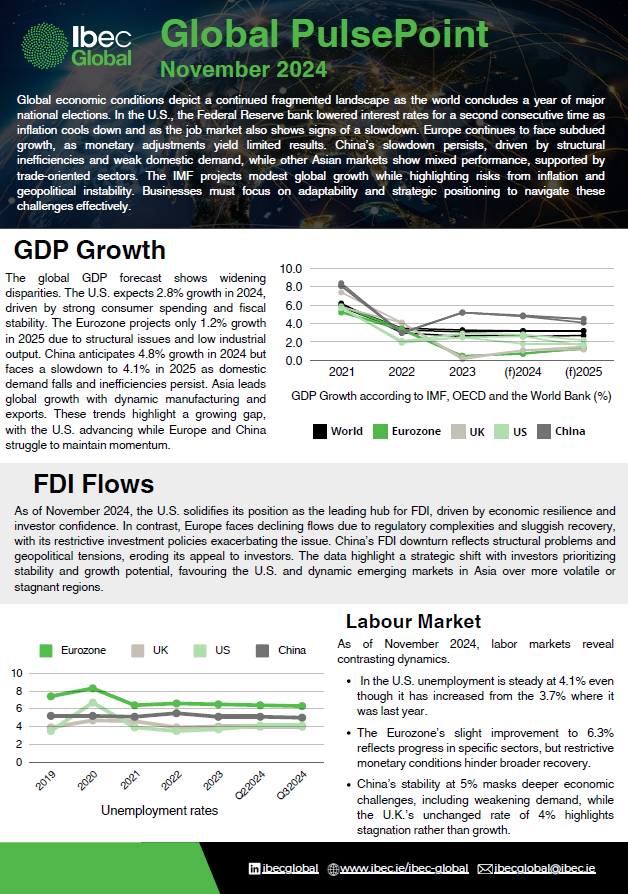
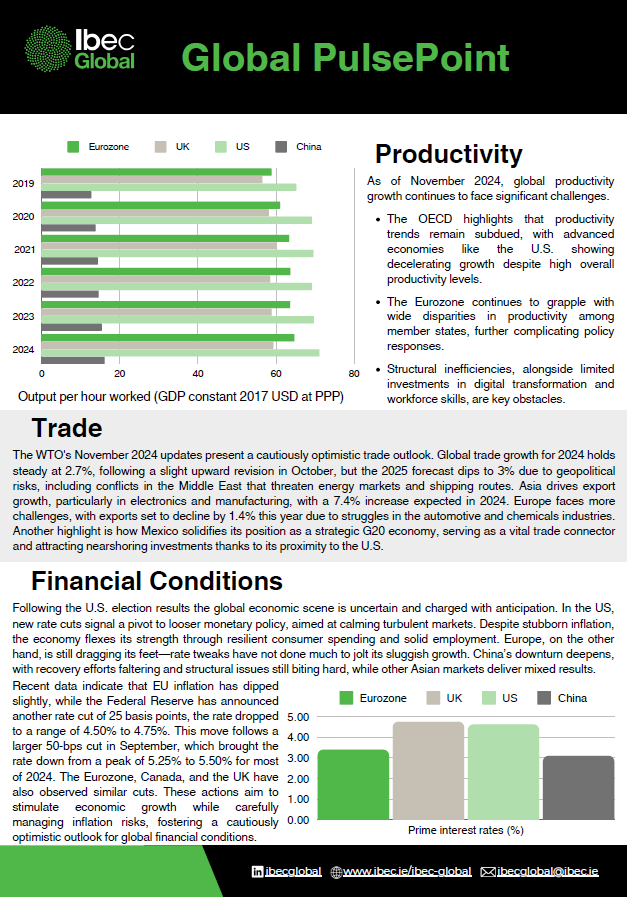
As the world concludes a year of major national elections, our latest Global PulsePoint data show how current global economic conditions continue to depict a fragmented landscape. By comparing key global growth and economic productivity indicators across the US, Europe, China and the UK, it is clear that businesses must focus on adaptability and strategic positioning to navigate future challenges effectively.
➡ Access the full Global PulsePoint here: lnkd.in/e2sib5EB
⬇ See our latest Global PulsePoint briefing below.
@ibec_irl @jackieaking
#GlobalBusiness #GlobalGrowth #InterestRates #Inflation #CEOSentiment #Productivity #US #China #Europe #UK
1
2
101
Jackie King retweeted
7 Nov 2024
In this Week in Focus, Executive Director @jackieaking shares key insights for businesses following this week's US presidential election which sees a second Trump administration return to the White House early next year.
#USElection2024 #GlobalBusiness #BusinessLeaders
@ibec_irl
1
2
160
Jackie King retweeted
5 Nov 2024
In the past week, the European Commission's High Representative/Vice-President Josep Borrell, and Minister for Foreign Affairs of Japan, Takeshi Iwaya, held the first EU-Japan Strategic Dialogue in Tokyo and announced the EU-Japan Security and Defence Partnership. Japan is now the first country in the Indo-Pacific to adopt such a political framework for enhanced cooperation on security and defence with the EU.
The new framework emphasizes the strategic importance of deepened EU-Japan cooperation in security and defence to address complex global challenges and improve economic resilience. Both parties will cooperate further on relevant defence initiatives through information exchange, maritime security coordination, and expanding the EU-Japan Cyber Dialogue with shared threat intelligence, coordinated responses, and studies on hybrid threats.
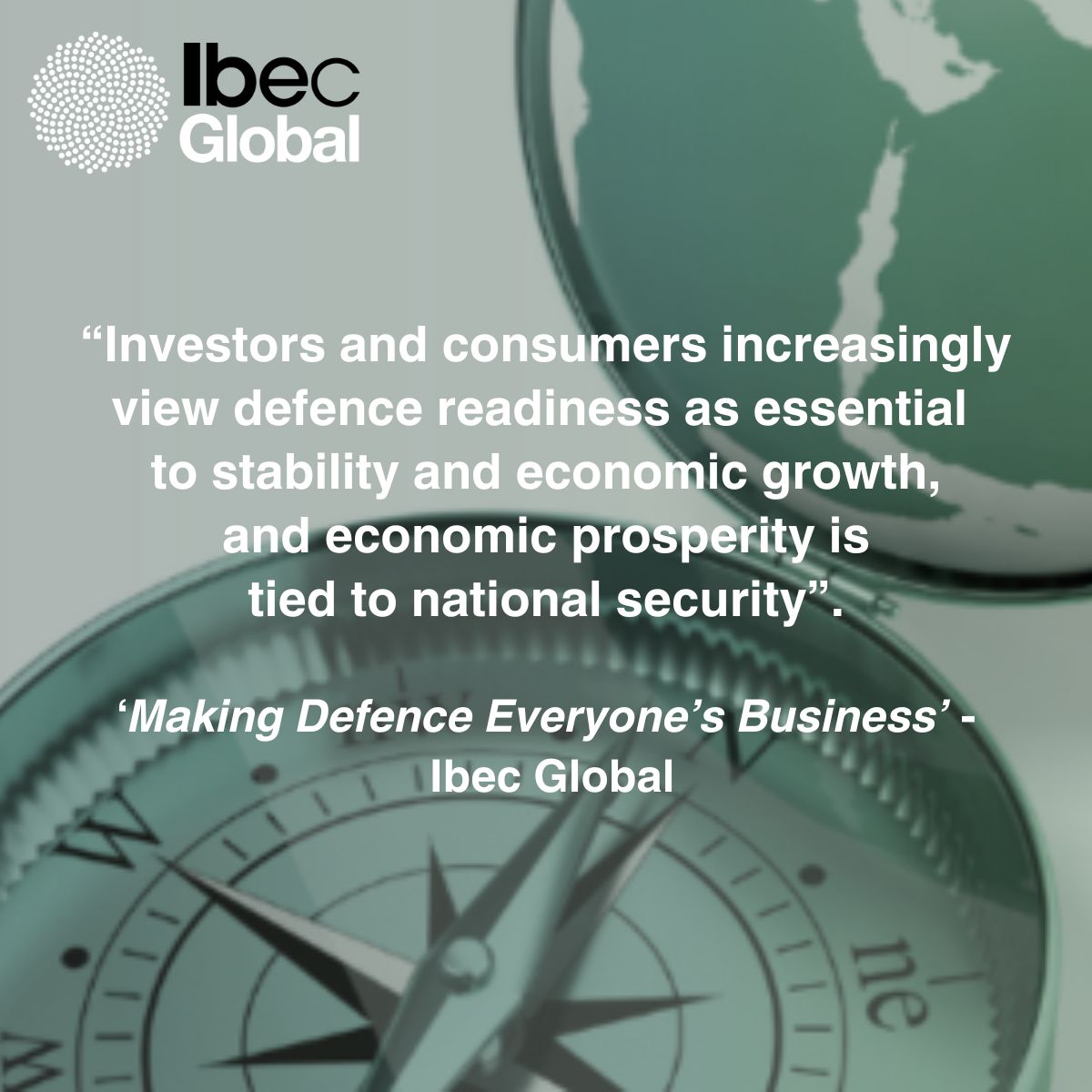
Our latest Global Compass highlights that investors and consumers increasingly view defence readiness as essential to stability and economic growth as economic prosperity is tied to national security, which is echoed in the new EU-Japan framework. This is significant for business leaders as defence is no longer a reactive endeavour, it requires strategic, proactive investment which can safeguard their businesses' future while catalysing innovation and economic growth. In 'Making Defence Everyone's Business', we explore also how business leaders can capitalize on such related opportunities, including the critical role public-private partnerships play in making defence a shared responsibility for all.
➡ For more insights on security and defence, see our latest edition of the Global Compass: ibec.ie/ibec-global/insights…
@ibec @jackieaking
#EUDefence #Japan #Defence #Security #BusinessLeaders

1
2
162
Jackie King retweeted
29 Oct 2024
Read the latest issue of our Global Compass, “Making Defence Everyone’s Business”, a succinct thought piece for business leaders to help them steer their executive teams towards business success. For the latest edition, we zoom in on five observations to elevate the conversation around defence. Please share your thoughts and engage with us below.
Access here: ibec.ie/ibec-global/insights…
@Ibec @jackieaking
#Defence #GlobalBusiness #BusinessLeaders
1
1
94
24 Oct 2024
World Economic Outlook Highlights - October 2024: What Businesses Need to Know
The latest @IMFNews update of the World Economic Outlook Report outlines crucial insights that businesses should keep on their radar. (1/11)
See below four key takeaways to consider:
1
1
2
125
24 Oct 2024
Staying informed on these trends can help businesses make strategic decisions, manage risks, and capitalize on opportunities in a shifting global economic landscape. (10/11)
1
35
24 Oct 2024
Want to learn more?
➡ Check our Global PulsePoint for more insights on global macroeconomic conditions: ibec.ie/ibec-global/insights…
➡ Discover why we need to make defence everyone’s business: ibec.ie/ibec-global/insights…
(11/11)
35