
88 Photos and videos



Jun 11
A lot of the reaction this week around Claude Fable 5 points to something bigger in the market.
Enterprises are getting less willing to accept the same familiar bundle of tradeoffs: rising cost, deeper dependency on a single model family, less clarity around data handling and controls, and less flexibility in how they shape their AI architecture.
For a while, many teams tolerated those tradeoffs because the capability curve was moving so quickly. If the model got materially better, people were willing to overlook a lot.
That is starting to change.
As AI moves from experimentation into real coding, coworking, analysis, and autonomous workflows, buyers are looking past benchmark performance. They want to understand:
- What is the token yield and ROI when usage scales?
- How much control do we actually have over our data and AI architecture?
- What governance, data retention, and platform tradeoffs come with these new capabilities?
- Are we getting pulled into provider lock-in at the expense of our broader platform strategy?
Those are the right questions. In enterprise AI, the biggest mistake is usually not choosing the wrong model. It is building on the wrong foundation.
The best enterprise AI platforms give customers more leverage, not less: better economics, more model choice, stronger governance, and less dependence on any single vendor’s roadmap.
That’s also how we think about it at @Glean. Enterprises need control over their data and AI architecture, with the flexibility to choose the right models and apply governance consistently. It’s why we offer full model choice and availability without giving up visibility or governance through Glean’s Model Hub.
It’s also what more buyers are starting to demand, and for good reason.
2
5
49
4,116
Jun 10
We described this in our Work AI Index report: botsitting. As agents absorb tasks and work – and when agents don't have strong context – people spend significant time supervising, directing, handling exceptions, and cleaning up bad outputs.
glean.com/work-ai-institute/…
Jun 10

wondering why I feel exhausted. maybe: the agents do all the easy stuff, and I have to work through the leftover hard bits, which means I'm perpetually locked in. and as the models get better, "my" work just gets harder and harder, until I'm basically underqualified to do the work (which... is better than the alternative, there's nothing left for me to do, and I'm paperclipped).
2
4
17
3,214
Jun 10
Today, @Glean's Work AI Institute published the inaugural Work AI Index, based on 6,000 digital workers across the U.S., U.K., and Australia.
One of the clearest findings is that AI is creating a new layer of work inside the enterprise. We call it botsitting.
AI was supposed to remove tedious work. In too many organizations, it has created more of it: feeding systems the right context, checking outputs, catching mistakes, and cleaning up work that looked finished but was not.
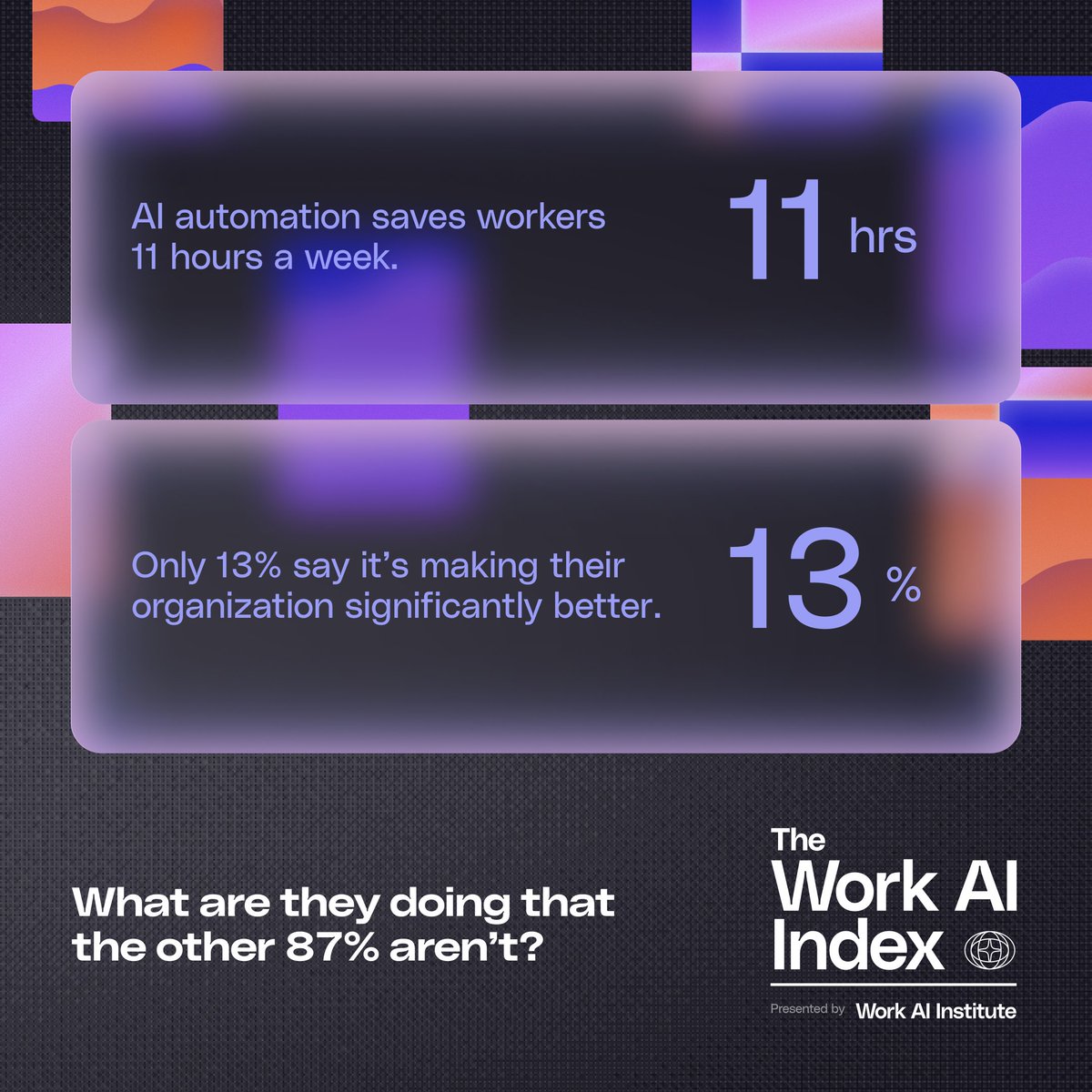
Digital workers report spending 6.4 hours a week on that hidden labor.
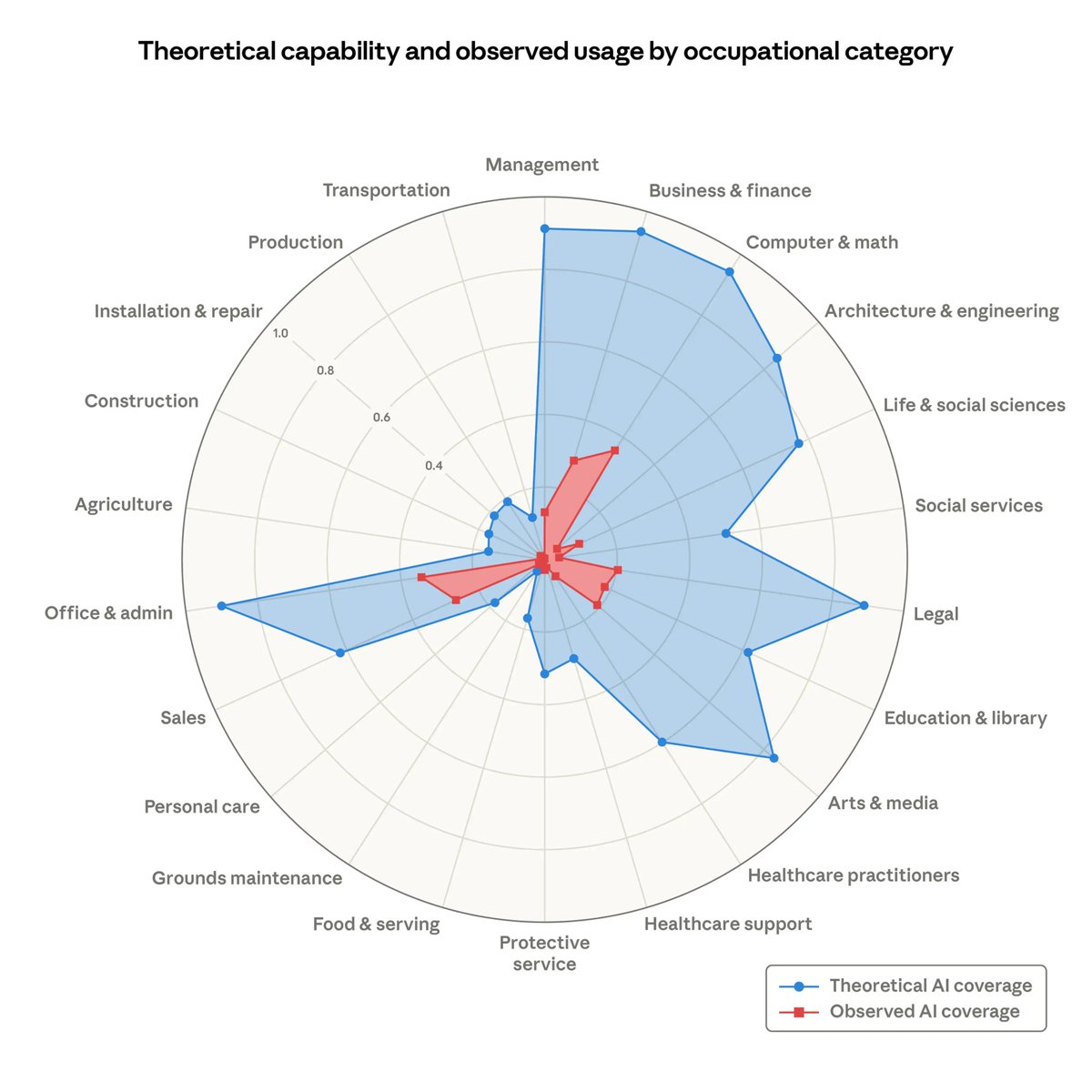
That helps explain one of the biggest gaps in enterprise AI right now. 87% of digital workers use AI at work. 75% say it makes them more productive. But only 13% say their organization is performing significantly better as a result.
That’s the gap between AI usage and AI impact. Too much of the value is being absorbed by supervision, rework, and cleanup.
The companies that get this right will not just deploy more AI or better models. They will redesign work to reduce botsitting—so AI gets the context it needs, people stay accountable for judgment, and the gains show up at the organizational level, not just in one employee’s prompt window.
Read the Work AI Index here: glean-it.com/4vJ0InG
2
6
27
2,325
Jun 9
Meetings have long been one of the most broken parts of work. Not because they aren’t important, but because critical context gets created in meetings and then gets lost.
People should not have to sit in every meeting just to stay informed. If a meeting matters, its output should be easy to find, trust, and build on.
This week, we’re announcing @Glean meeting notes. They do more than capture a transcript. They turn meetings into usable company context: key takeaways, decisions, action items, next steps, and open questions, all as a first-class artifact in Glean.
That means the meeting doesn’t stay trapped in a siloed note-taking tool or in one person’s memory. If shared, it becomes searchable and referenceable alongside your docs, messages, tickets, CRM records, and the rest of your enterprise context.
A transcript records what was said. Enterprise context helps the company decide what to do next.

Say hello to meeting notes that actually pull their weight.
Glean meeting notes captures the convo, summarizes decisions action items, and makes them easy to find later in Glean.
Try meeting notes in your next standup.
1
2
10
3,792
Jun 4
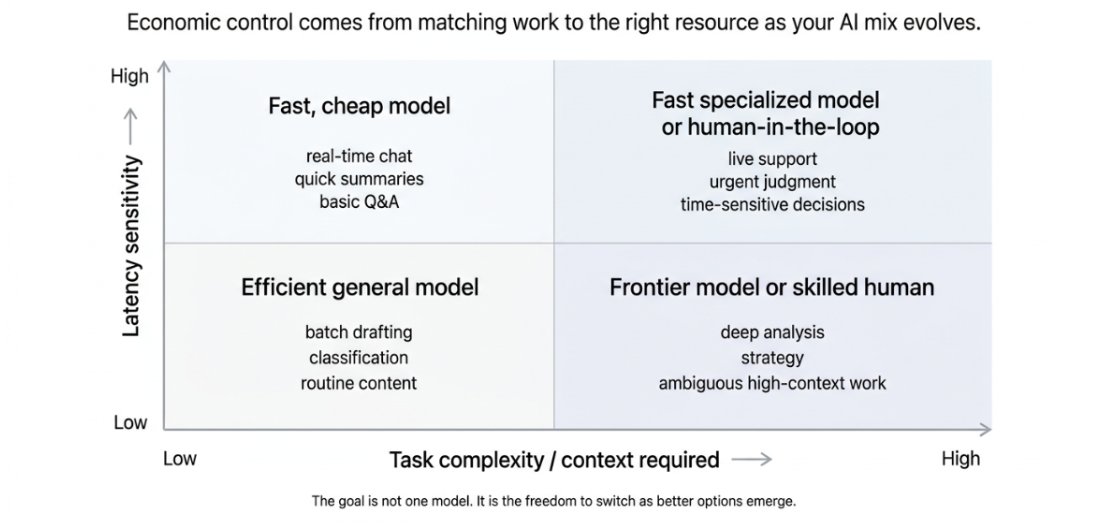
The future of enterprise AI is giving enterprises the ability to match the right model to the right kind of work. That’s why I’m excited that @NVIDIA Nemotron 3 Ultra is coming soon to @Glean.
Nemotron 3 Ultra is a strong option for everyday work. It delivers 91% of frontier-model completeness on key metrics, with the cost profile and flexibility of an open model.
As AI moves from experimentation into everyday work, cost and model choice become architecture decisions, not just product decisions. This is the broader shift I’m seeing: enterprises want the freedom to use frontier models where they matter most, and open models where they can drive scale more efficiently. They don’t want to bet the future of their AI stack on a single model family.
With Glean, customers can choose from 30 open and proprietary models and route work to the best model for the job across Assistant and Agents.
Thanks to the NVIDIA team for the collaboration.
7
3
55
6,160
Jun 1
AI architecture discipline is AI cost discipline.
Standardizing on a single AI platform can feel appealing because it seems simpler. Over time, though, it often becomes more expensive, more constraining, and harder to govern.
To control AI costs:
- Use the right model for the right job
- Invest in a horizontal context layer
- Centralize governance instead of pushing it to the edge
8
3
36
2,688
Jun 1
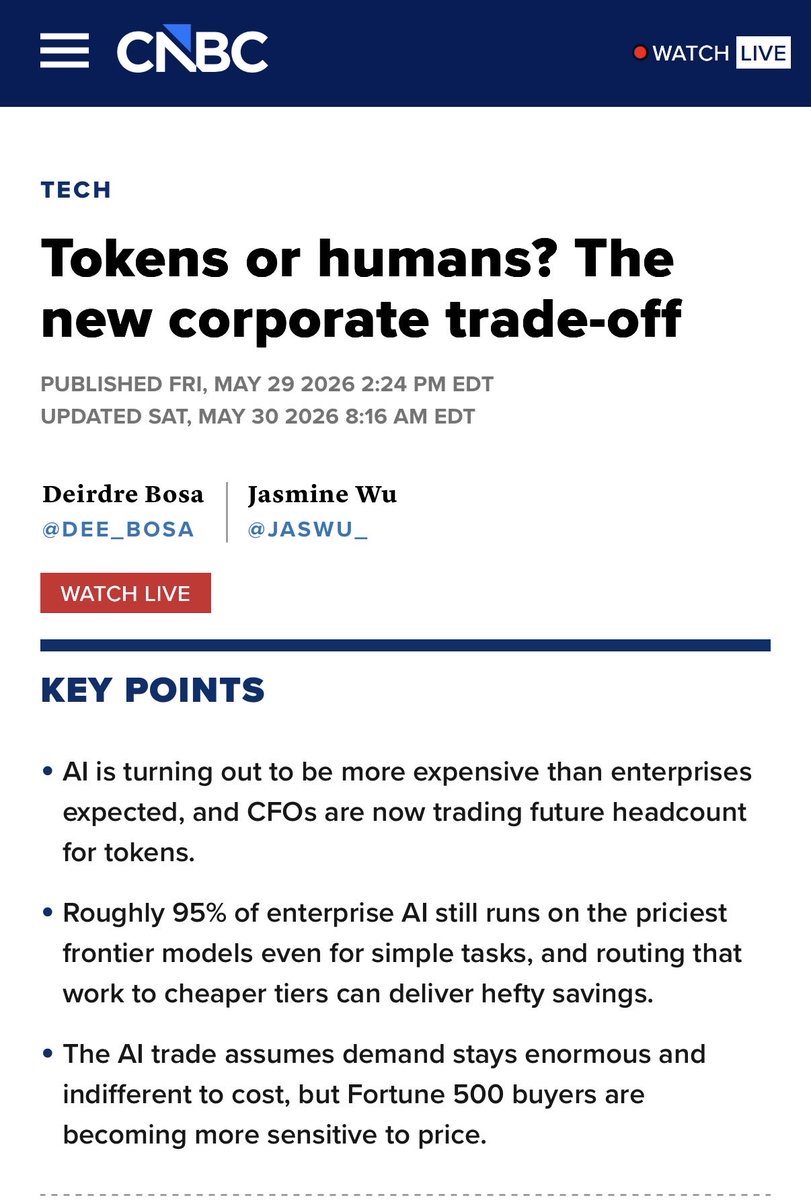
For decades, software was priced like seats. AI is starting to look more like labor. That changes how leaders need to think about architecture, ROI, and which work should be done by people vs. tokens.
May 30

"This is the first time ever that I can remember that technology costs the same as people, and you're making that comparison: choose tech or people”-@jainarvind
7
5
12
5,739
Jun 1
This is why enterprise AI is not just a model problem. If AI does not understand your company’s people, systems, workflows, and permissions, it will not create much value.
Context is what turns intelligence into useful work.
May 30

Imagine replacing 90% of your employees with a team of geniuses who have no idea how your company operates.
Total chaos. Nothing works.
That’s what AI feels like today.
The missing piece is extracting all the domain knowledge from people’s heads and providing that as structured context to the models.
5
3
47
5,748
Arvind Jain retweeted

May 28
LIVE at 12p PT / 3p ET: The AI bill is coming due
@glean CEO @jainarvind breaks a milestone with us and tells us what CFOs are saying about tokenmaxxing
@FactoryAI CEO @matanSF on model routing and cutting AI bills without cutting capability
Watch here:
youtube.com/watch?v=tAQOO438…
2
3
24
12,938
May 28
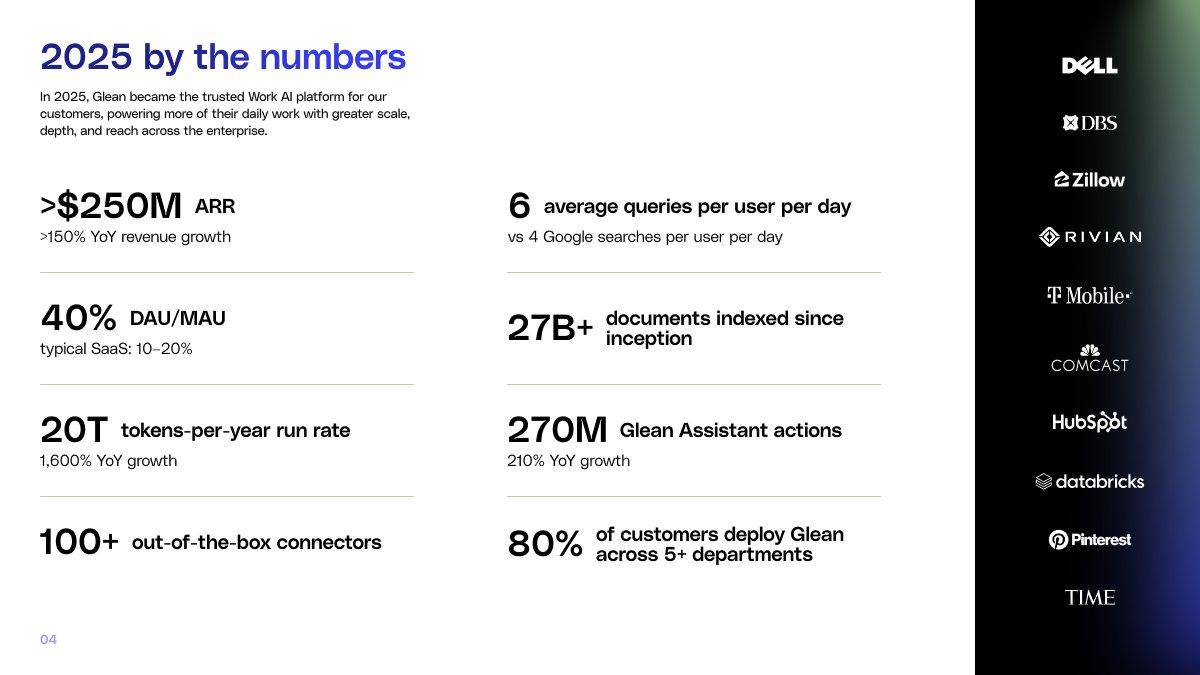
I'm proud to share that @Glean has surpassed $300M ARR, just five months after crossing $200M and growing ~3x over the past 15 months. This is an exciting milestone for Glean, and it's a signal about where the enterprise AI market is heading.
We’ve long believed the real challenge in enterprise AI is not access to models. It is grounding AI in how a company actually works: its people, knowledge, workflows, permissions, and systems.
That’s even clearer now. The companies creating real value with AI are not just adopting better models. They are building systems that understand their business well enough to deliver reliable outcomes at scale. That is the real moat, and it is what we’ve been building at Glean: an unrivaled context layer for enterprise AI.
That context has to work across the business, not just inside a single team or use case. We see that in how customers adopt Glean: more than 85% use it across five or more job functions.
It also has to meet the security and governance demands of complex enterprises. We see that in who is choosing Glean: our Fortune 500 customer count nearly doubled year over year.
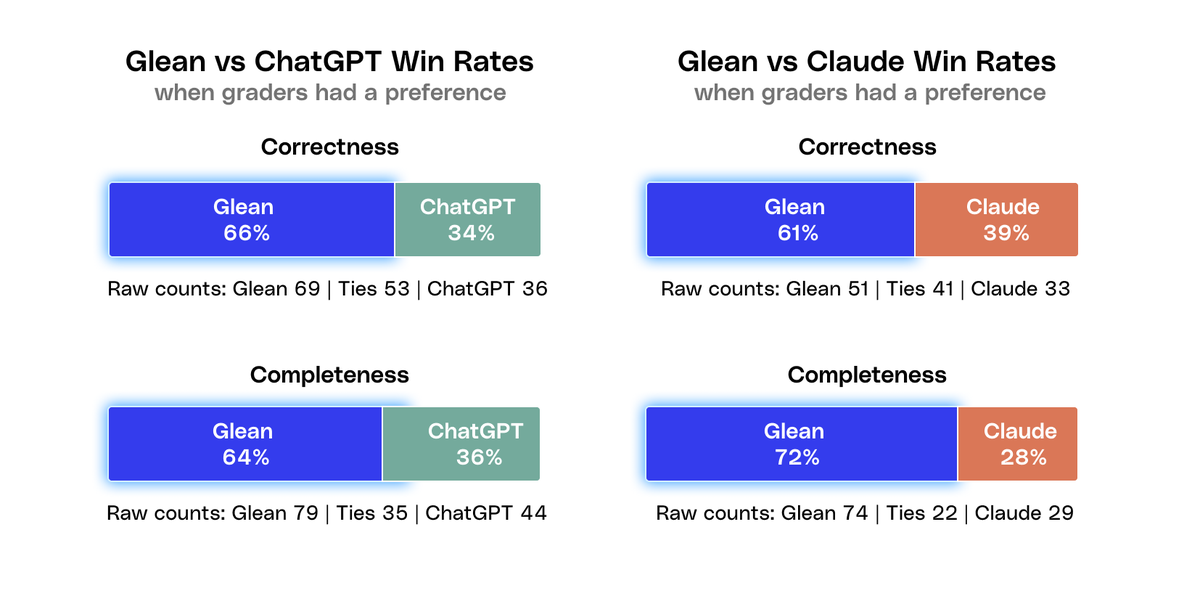
And it has to make economic sense as usage grows. In our recent benchmark with Claude Cowork, Glean was preferred roughly 2.5x as often as off-the-shelf MCP tools and used 30% fewer tokens on average. Better context improves both quality and efficiency.
I enjoyed talking with @CNBC's @dee_bosa about this broader shift. In enterprise AI, the winners will not be defined by better models alone. They will be defined by who builds the strongest foundation for enterprise context.
Thank you to our customers, partners, and team for helping us build the future of enterprise AI.
54
43
924
278,733
May 27
Can your AI answer these questions?
- Who owns this customer escalation?
- What changed on this project after last week's review?
- Why did we decide to push the launch?
@glean's Enterprise Graph connects people, projects, docs, and customers so AI can reason across how work actually gets done, instead of starting cold every time. More effective, less expensive.
For a long time, people have asked us if they could actually see the graph. Now you can.
May 21

We've talked about @Glean's Enterprise Knowledge Graph since 2019. People kept asking to see it, so we built a demo.
Ask Glean something like: "show me my manager's projects and the team behind them," and watch it traverse the graph in real time, mapping work and people across the org. Very cool!
3
4
37
11,493
May 22
AI is becoming a real budget line in the enterprise.
The question isn’t who deployed the most copilots. It’s who gets the most useful work per token.
As AI becomes more agentic, token efficiency becomes an architecture issue.
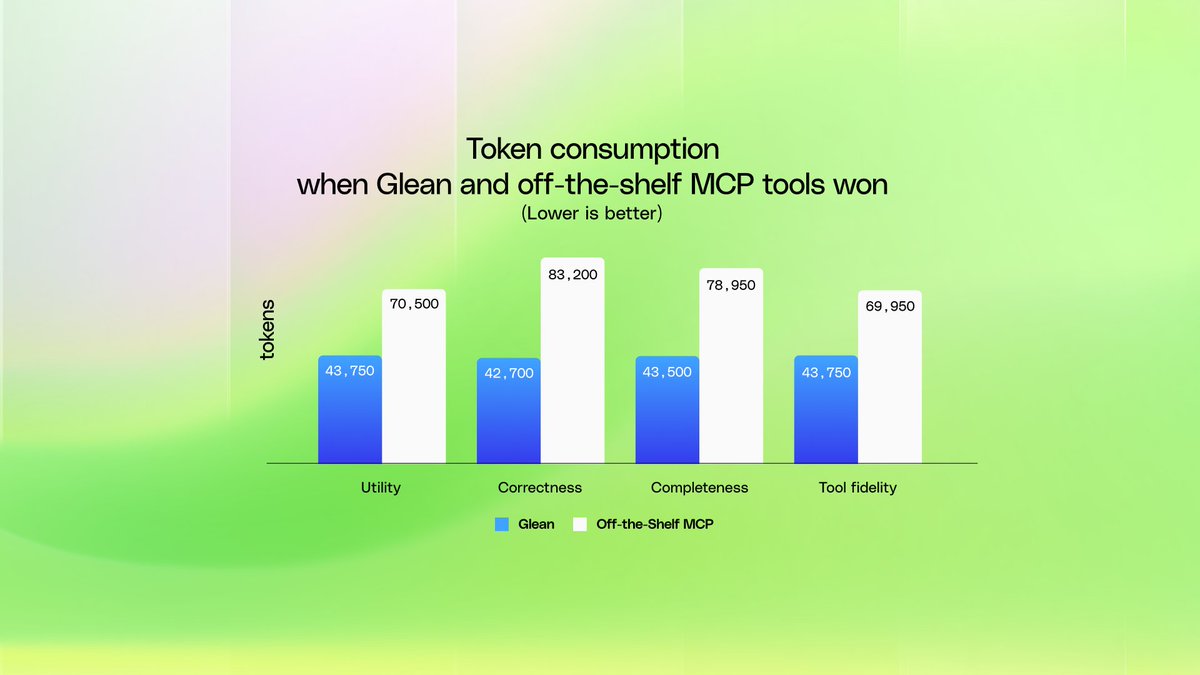
In our benchmark testing with Claude Cowork, Glean’s remote MCP server was preferred ~2.5x more often than off-the-shelf MCP tools. Those tools used ~30% more tokens on average — and on winning outcomes, nearly 2x more: ~83K vs. ~43K.
The goal isn’t less AI. It’s more useful work per token.
4
1
19
1,529
May 22
Our team wrote a guide to token efficient AI architectures here: glean-it.com/42QT7a9
1
1
492
May 21
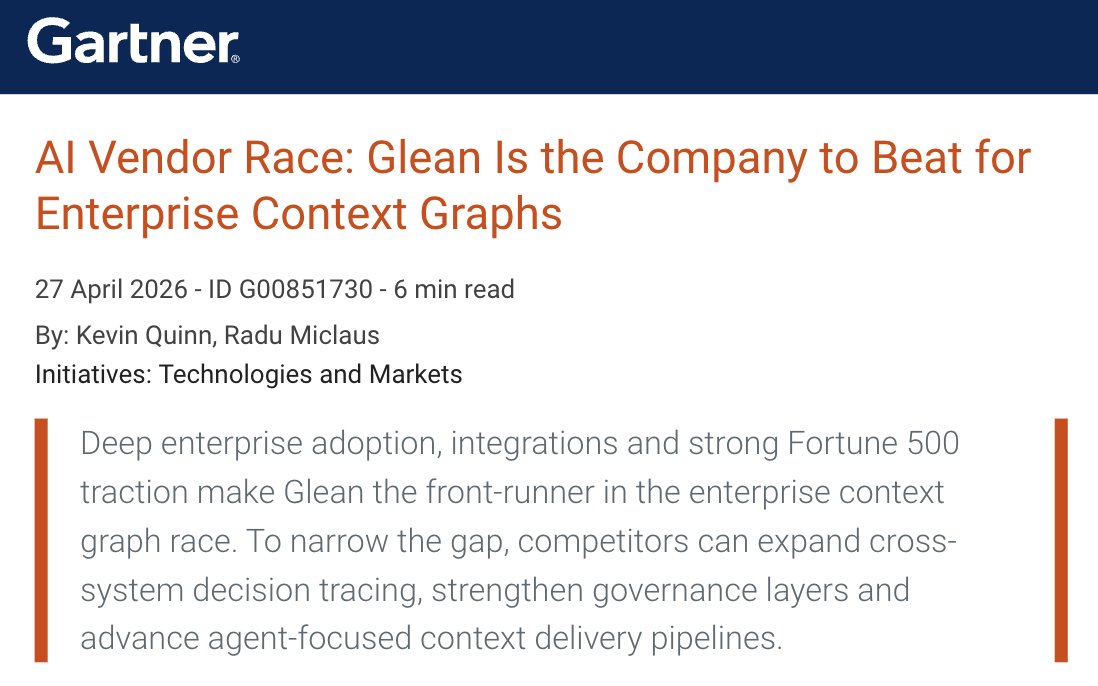
In a recent @Gartner note, Kevin Quinn and Radu Miclaus call @Glean “the company to beat” in enterprise context graphs.
Appreciate the rigor of the analysis, as this market is moving fast.
What stood out in Glean: strong enterprise adoption, deep integrations, and a trusted layer that unifies fragmented enterprise systems for AI agents.
Customers don’t want impressive demos. They want AI that understands how work actually gets done, respects permissions, and drives real outcomes.
Grateful for the recognition and for the customers pushing us forward.
4
1
19
1,885
May 19
Honored to see Glean named to @CNBC’s 2026 Disruptor 50.
What makes this recognition meaningful is what it reflects: companies using technology to challenge incumbents, create new categories, and reshape industries.
In the enterprise, the challenge is making AI actually useful. Grounded in company context, connected across fragmented systems, and trusted in real workflows. That’s the problem we’ve been focused on from day one at Glean.
Congrats as well to our customers @databricks, @vanta, @Whatnot, @Canva, @Cursor, and @AbnormalAI, plus our partners @AnthropicAI and @OpenAI. Thanks to CNBC for the recognition.
5
1
12
1,151
May 14
The center of gravity is shifting from the model layer to the operating layer around the model.
But inside real companies, the primary bottleneck is rarely raw model capability. It’s getting AI to operate reliably across fragmented data environments, inconsistent processes, permission structures, legacy systems, and workflows shaped as much by tacit knowledge as formal policy.
The competitive advantage is the context and operating layer that lets companies orchestrate, govern, and swap models without losing value.
12
17
100
9,524
May 13
When MCP took off, a lot of people assumed plugging models into tools would be enough. A year later, enterprise teams are realizing that off-the-shelf MCP servers still miss basic context, and also burn too much budget.
We wanted to test this directly. So we benchmarked @glean's MCP server against off-the-shelf MCP tools in Claude Cowork across ~175 queries. The harness was the same, and so were the queries. The difference was the context layer behind them.
Glean was preferred ~2.5x as often, and off-the-shelf MCP setups used ~30% more tokens (median token usage: 44k vs. 57k).
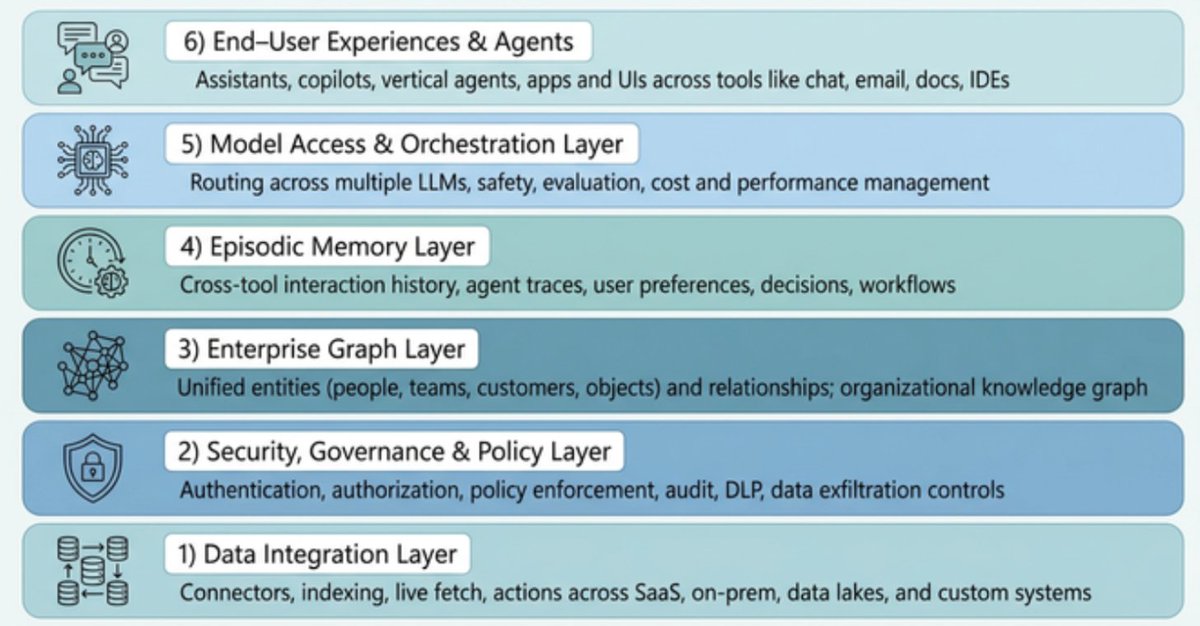
MCP is a protocol, not a context layer. It standardizes how models call tools. It does not solve ranking, permissions, memory, identity, or cross-system understanding. When MCP is wired directly to a set of tools, the model has to search across systems and assemble context on its own. When MCP sits on top of a unified context layer (connectors, indexes, enterprise graph, permissions, memory), it can draw from a consistent view of the company and return better results. And it’s a lot less expensive. When systems have to brute-force their way through fragmented context, they need more tool calls, more reasoning loops, and more tokens to produce a usable answer.
That’s the motivation behind Glean’s MCP server. It brings the same context layer behind Glean Assistant into tools like Claude, ChatGPT, and coding environments, without asking teams to rebuild retrieval and permissions from scratch, or pay the hefty token cost of reconstructing context over and over.
3
10
81
21,500