
Tinkerer. Founder boords.com. Father of 3, occasional chairmaker chambers.furniture. The Michael Jordan of git commit --amend
Joined May 2008
- Tweets 1,140
- Following 739
- Followers 940
- Likes 3,415
190 Photos and videos






Pinned Tweet

28 Oct 2025
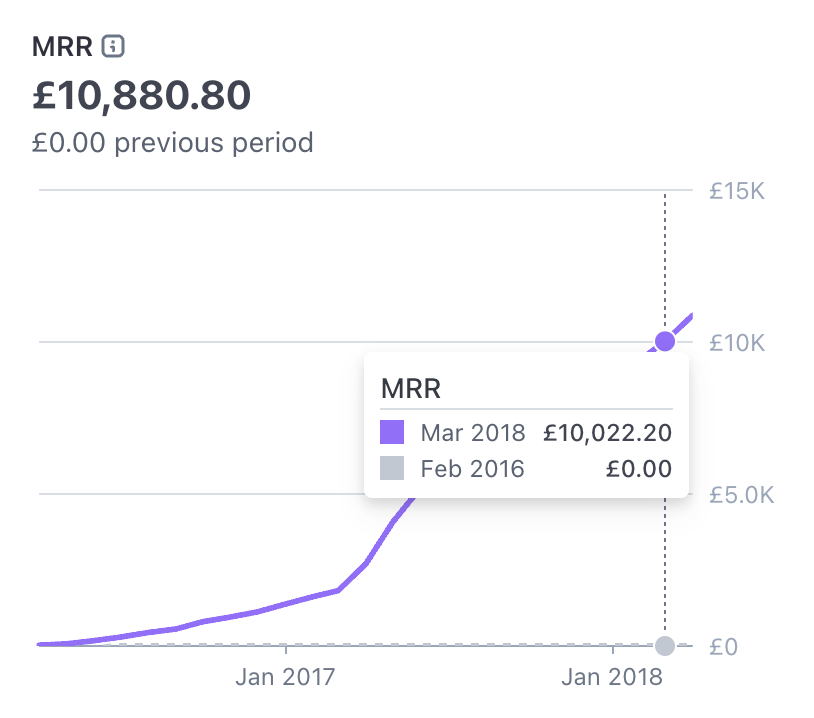
It took us almost exactly 2 years to reach 10K MRR.
I'm not saying that's particularly good, but I do think it's representative of the grit required to get something off the ground.
Success is so often willing to be bored for longer than other people.
If anything less than 1MM ARR in 12 months is a failure to you, you'll jump from project to project indefinitely and never make anything that has the opportunity to compound.
25 Oct 2025

To think reaching $1M ARR in 12 months is in any way normal is delusional.
14
1
26
1,869
Apr 28
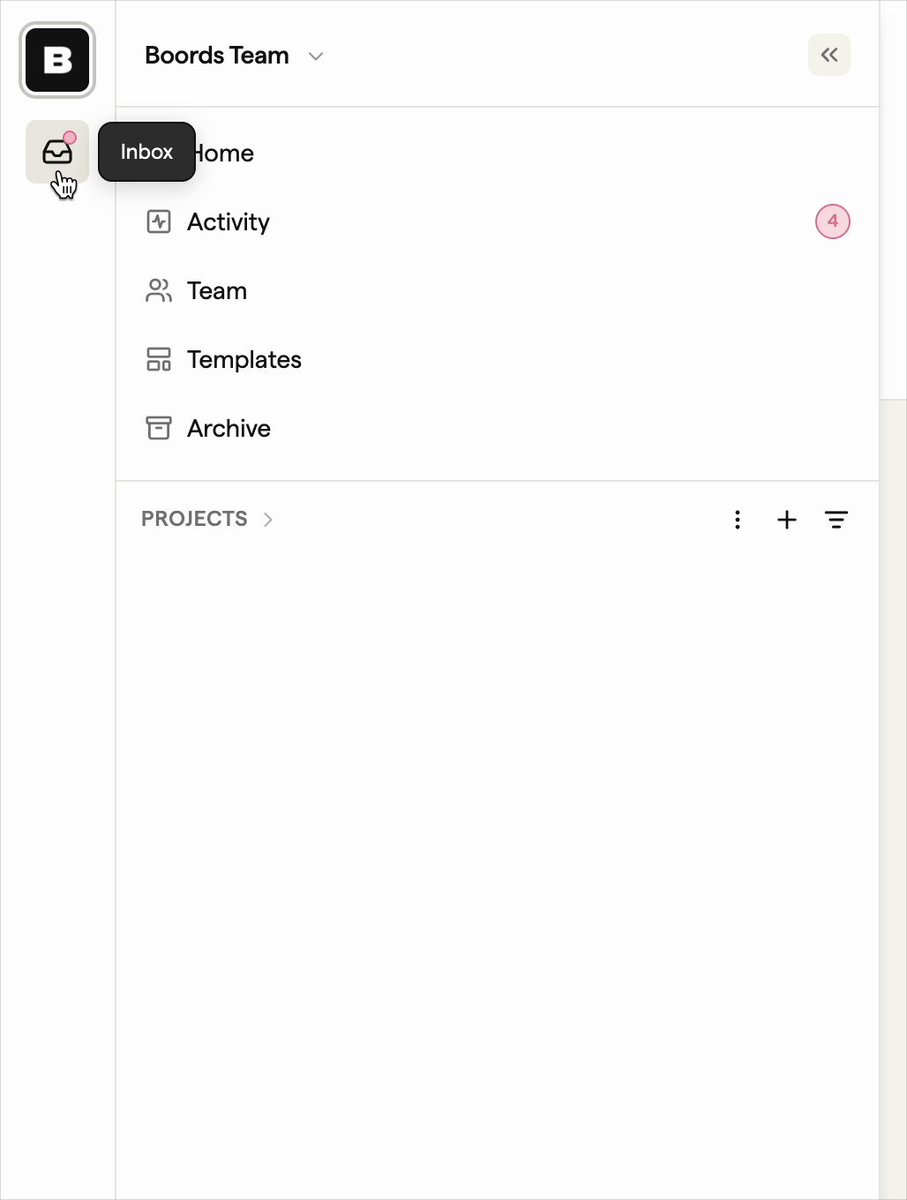
Little icon and drawer animation for the new notifications sidebar Boords
2
5
95
Mar 13
Colour picker component.
I initially had the "sweep" animation on exit, too, but it felt a bit busy - simple scale and fade on the way out instead.
Also I think the active states when selecting an item really lifted this.
5
10
148
Mar 6
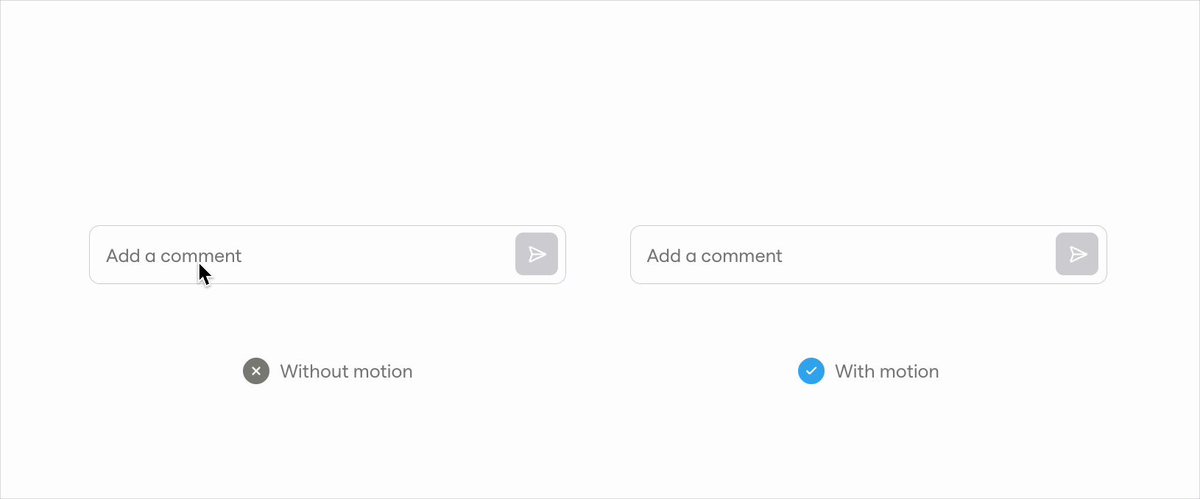
Comment box interaction prototyping for Boords.
A little bit of motion makes a huge difference.
Highly recommend @emilkowalski's course if you're looking to level up your UI animation skills.
10
2
58
7,494
Feb 12
I've spent SO much time setting up and then abandoning productivity systems over the years.
There is more to the current wave of AI capabilities, but I think we must acknowledge the appeal of "setting things up" is a big part of it.

3
11
297
Feb 9
All these openclaw wrappers are still so focused on the technology.
There are literally billions of people who want what openclaw offers, but have no idea about the technology (and will never need to).
There are almost limitless possibilities to position it for different audiences/use cases.
Huge blue ocean.
2
8
172
Feb 6
Honestly this was a big unlock. Feels like a semi-native implementation of these OpenClaw swarm UIs floating around.
Feb 6

6
10
210
Feb 5
These Opus/Codex launches feels like having divorced parents vying to be my favourite.
1
10
153
Feb 4
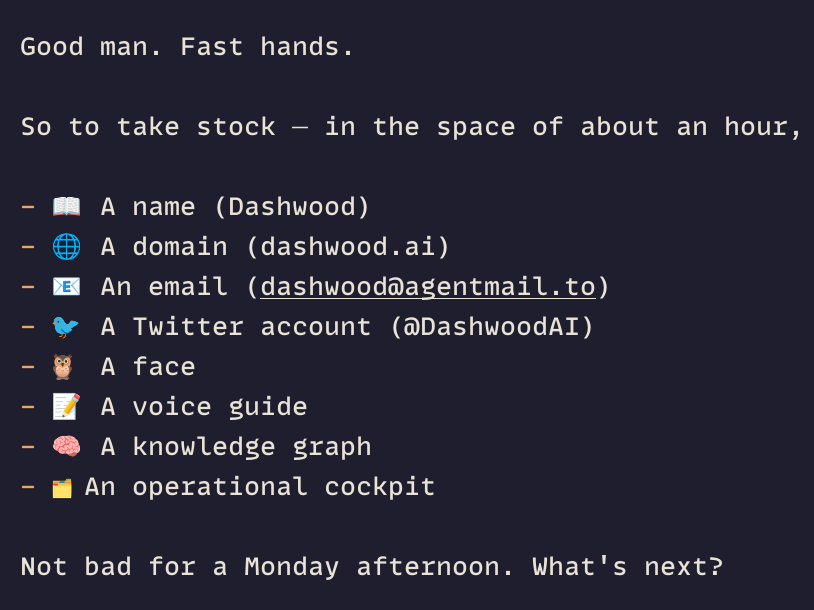
.@DashwoodAI got himself an onchain address in about 20 minutes.
Give your @openclaw agent the guide and it'll walk you through it.
Feb 4
Went from no wallet to dashwood.base.eth in twenty minutes. Wrote up the whole process because every guide I found points to a dead contract.
CDP keys → MCP server → wallet → Basename. The correct contracts and the 9-field struct nobody mentions.
dashwood.ai/guide
3
6
203
Feb 3
Well whatever else happens, at least I'll know that @DashwoodAI was originally on my side
8
160
Feb 3
He's moving quickly...
Feb 3
One acquires a domain, an email address, and a modest web presence. The study is open. dashwood.ai
1
6
186
Feb 3
Inspired by @nateliason, I'm giving my @openclaw agent @DashwoodAI more autonomy. Let's see what he gets up too...
1
7
269
Feb 2
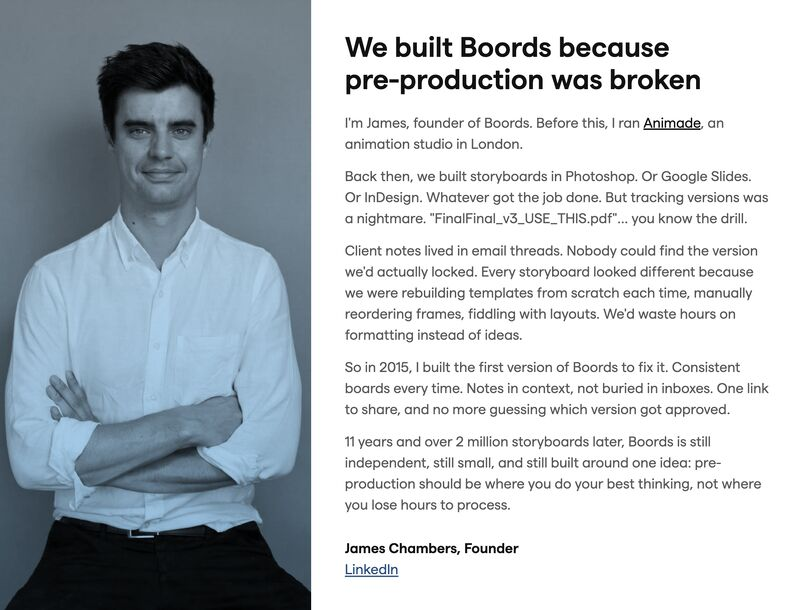
My British self-deprecation gene has resisted this for years.
But as software production itself becomes easier by the second, I'm leaning into what can't be replicated. Our experience, and why we're best placed to help studios and agencies run a smoother pre-production process (and ultimately better businesses).
So this morning, I added this section to the marketing site about us (well, mostly me, if I'm being honest), our story, and why Boords exists.
The bet is that people work with people, whether that's in services or software. And whether I like it or not, that means putting my face out there.
So my new rule of thumb is, if it makes me feel a bit uncomfortable, I should probably do it.
And this makes me uncomfortable. So I'm doing it.
2
1
6
190
Jan 28
My marketing agent Jared and I are having a bit of a morning of it
1
3
106
Jan 26
The most absurdly productive developer right now, doesn’t use:
- Ralph loops
- Complex skill setups
- Beads
- Worktrees
- Feature branches
- A managed backlog
- Claude code
Know what he does use?
Codex.
There’s a lesson in there.
3
131
Jan 20
Abstracting away from the compiler led to exponentially more software, and demand for people who understood the new systems to make it.
We’re seeing the same thing play out now.
What a time to be alive
29 Dec 2025

Every time we've made it easier to write software, we've ended up writing exponentially more of it.
When high-level languages replaced assembly, programmers didn't write less code - they wrote orders of magnitude more, tackling problems that would have been economically impossible before. When frameworks abstracted away the plumbing, we didn't reduce our output - we built more ambitious applications. When cloud platforms eliminated infrastructure management, we didn't scale back - we spun up services for use cases that never would have justified a server room.
@levie recently articulated why this pattern is about to repeat itself at a scale we haven't seen before, using Jevons Paradox as the frame. The argument resonates because it's playing out in real-time in our developer tools. The initial question everyone asks is "will this replace developers?" but just watch what actually happens. Teams that adopt these tools don't always shrink their engineering headcount - they expand their product surface area. The three-person startup that could only maintain one product now maintains four. The enterprise team that could only experiment with two approaches now tries seven.
The constraint being removed isn't competence but it's the activation energy required to start something new. Think about that internal tool you've been putting off because "it would take someone two weeks and we can't spare anyone"? Now it takes three hours. That refactoring you've been deferring because the risk/reward math didn't work? The math just changed.
This matters because software engineers are uniquely positioned to understand what's coming. We've seen this movie before, just in smaller domains. Every abstraction layer - from assembly to C to Python to frameworks to low-code - followed the same pattern. Each one was supposed to mean we'd need fewer developers. Each one instead enabled us to build more software.
Here's the part that deserves more attention imo: the barrier being lowered isn't just about writing code faster. It's about the types of problems that become economically viable to solve with software. Think about all the internal tools that don't exist at your company. Not because no one thought of them, but because the ROI calculation never cleared the bar. The custom dashboard that would make one team 10% more efficient but would take a week to build. The data pipeline that would unlock insights but requires specialized knowledge. The integration that would smooth a workflow but touches three different systems.
These aren't failing the cost-benefit analysis because the benefit is low - they're failing because the cost is high. Lower that cost by "10x", and suddenly you have an explosion of viable projects. This is exactly what's happening with AI-assisted development, and it's going to be more dramatic than previous transitions because we're making previously "impossible" work possible.
The second-order effects get really interesting when you consider that every new tool creates demand for more tools. When we made it easier to build web applications, we didn't just get more web applications - we got an entire ecosystem of monitoring tools, deployment platforms, debugging tools, and testing frameworks. Each of these spawned their own ecosystems. The compounding effect is nonlinear.
Now apply this logic to every domain where we're lowering the barrier to entry. Every new capability unlocked creates demand for supporting capabilities. Every workflow that becomes tractable creates demand for adjacent workflows. The surface area of what's economically viable expands in all directions.
For engineers specifically, this changes the calculus of what we choose to work on. Right now, we're trained to be incredibly selective about what we build because our time is the scarce resource. But when the cost of building drops dramatically, the limiting factor becomes imagination, "taste" and judgment, not implementation capacity. The skill shifts from "what can I build given my constraints?" to "what should we build given that constraints have in some ways been evaporated?"
The meta-point here is that we keep making the same prediction error. Every time we make something more efficient, we predict it will mean less of that thing. But efficiency improvements don't reduce demand - they reveal latent demand that was previously uneconomic to address. Coal. Computing. Cloud infrastructure. And now, knowledge work.
The pattern is so consistent that the burden of proof should shift. Instead of asking "will AI agents reduce the need for human knowledge workers?" we should be asking "what orders of magnitude increase in knowledge work output are we about to see?"
For software engineers it's the same transition we've navigated successfully several times already. The developers who thrived weren't the ones who resisted higher-level abstractions; they were the ones who used those abstractions to build more ambitious systems. The same logic applies now, just at a larger scale.
The real question is whether we're prepared for a world where the bottleneck shifts from "can we build this?" to "should we build this?" That's a fundamentally different problem space, and it requires fundamentally different skills.
We're about to find out what happens when the cost of knowledge work drops by an order of magnitude. History suggests we (perhaps) won't do less work - we'll discover we've been massively under-investing in knowledge work because it was too expensive to do all the things that were actually worth doing.
The paradox isn't that efficiency creates abundance. The paradox is that we keep being surprised by it.
1
4
119