
86 Photos and videos








Singapore’s AI obsession just hit Everest peak.
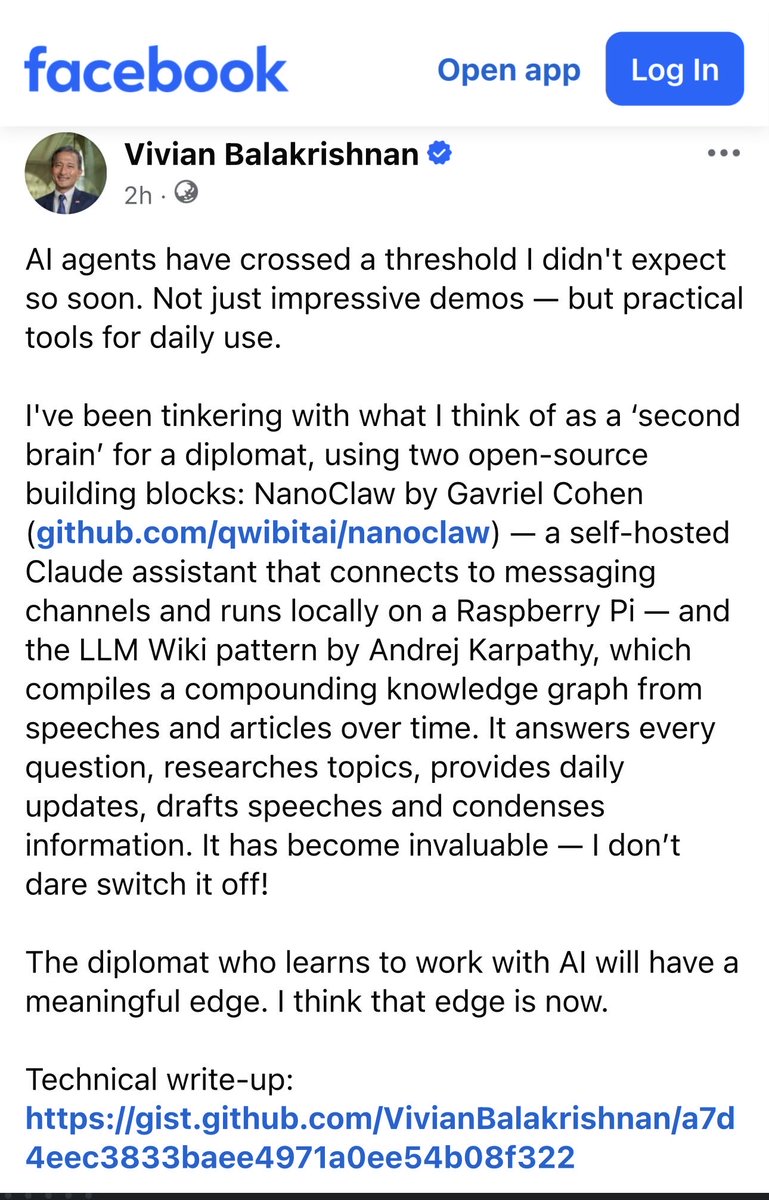
The Foreign Minister is self-hosting Claude on a Raspberry Pi and building a diplomatic knowledge graph using Karpathy’s LLM Wiki pattern. Wahlao!
SG devs, the minister is coming for your job. And he’s not even using Cursor — he’s on NanoClaw running locally. Can someone git pull his code and give it a test.
Only bad thing? He dropped this on Facebook instead of X. Minister, we need to talk.
gist.github.com/VivianBalakr…

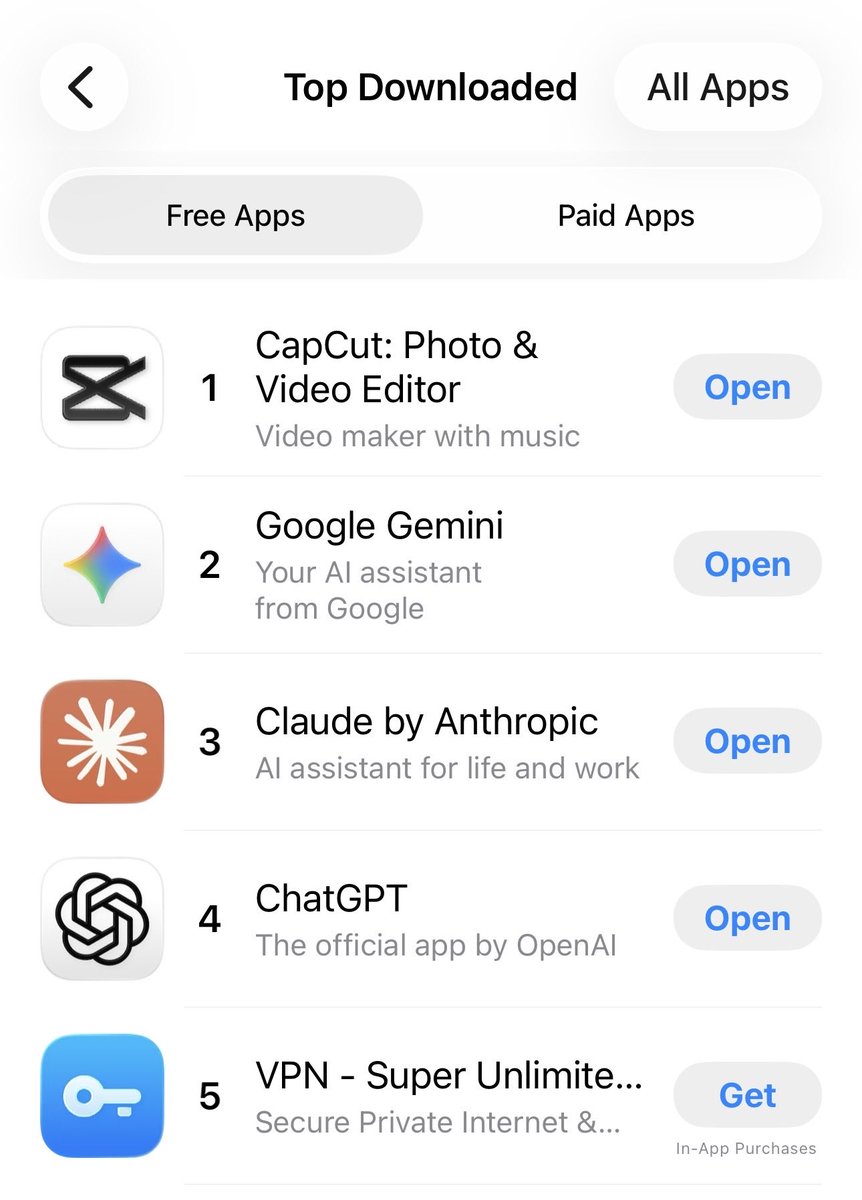
Singapore’s obsession with AI is hitting a new peak. 🇸🇬 🤖
Today, 4 of the top 5 most downloaded apps in SG are AI chatbots.
Both the tech migrants and the aunties in hawkers are doing it.
And what’s with this vpn at number 4.
93
663
4,096
1,305,875
Joe Contini retweeted

Apr 27
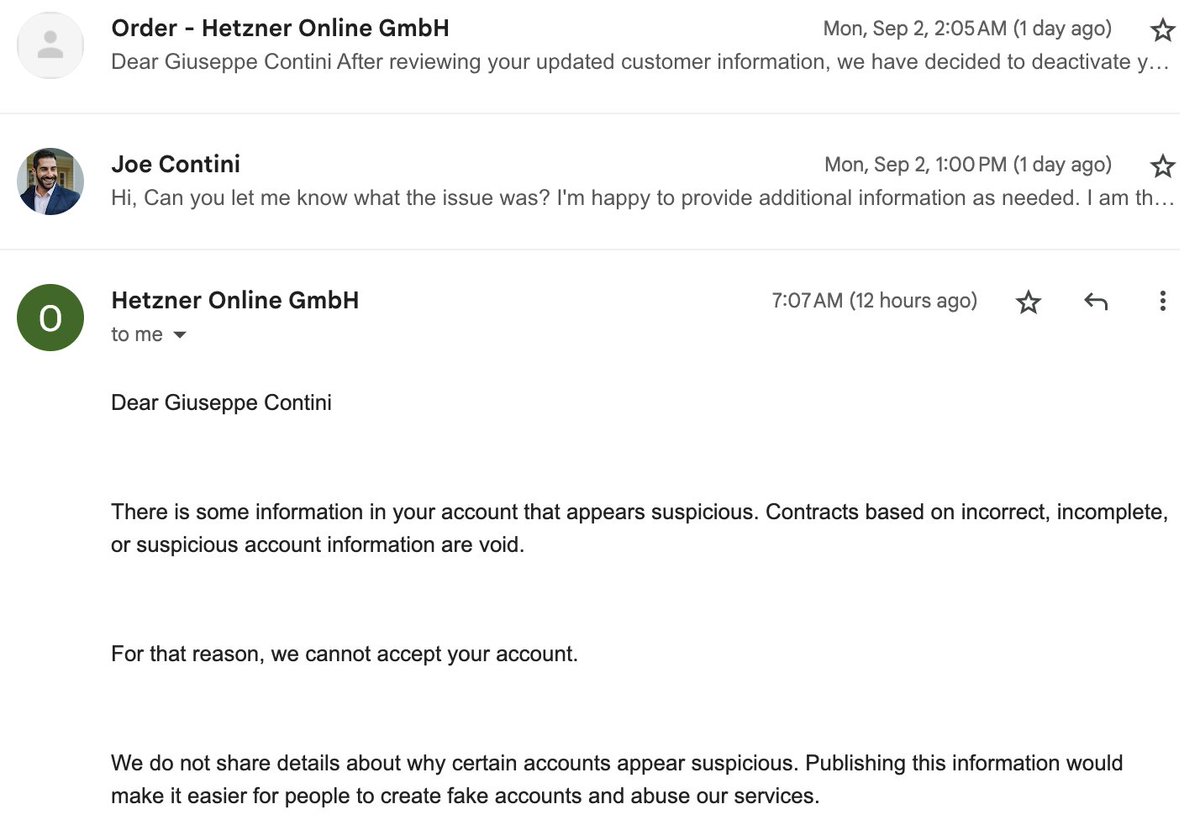
Latest scam at my store this week: woman comes in to buy Apple gift cards - she wants several thousands dollars worth.
As I am ringing up her first $500 card, I start asking questions like we are supposed to.
Me: buying a lot of cards (she looked sooo nervous) - who are they for?
Customer: A friend
Me: a friend you know in real life or someone you met on the internet?
C: a friend
Me: just asking because a lot of people get scammed. Had a woman cuss me out because I wouldn’t sell her Cards to buy a puppy. Told her to go to a reputable breeder, meet them in person, get her dog. She came back months later to apologize because it was a scam and showed me pics of the dog she bought in person. You aren’t buying a puppy, are you?
C: no, it’s a friend (while twisting her purse straps)
Me: is your friend waiting outside?
C: no.
Me: just asking because I am concerned… just don’t want you to lose money.
She is looking more nervous so, while slowly starting the next Transaction, keep sharing other scams. I also purposely tried to load the card for another $500, knowing our system would reject it because the limit is $750 a day.
The transaction fails. I turn the screen toward her.
Me: sorry, you can’t purchase the second card because our system won’t allow it.
She asks me to repeat that and turns her purse towards me.
Me: one time, I had a lady who seemed nervous who set her purse down and motioned me to come around the counter. She told me the Scammer was on the phone, making sure she did the transaction correctly.
Woman turns more pale and mouths “HE IS ON THE PHONE”
I walk around, set her purse down, pull her away, and she starts crying and spewing out the story!
They told her her bank account was used for money laundering. She withdrew ALL OF HER MONEY from the account and was going to use it ALL to buy Apple gift cards.
They also said her social security number was used and a MARSHALL would be delivering her a new card at her House tomorrow 🙃
I was LIVID! Walked to her purse, pulled out the phone, and said “hello? I have all TWELVE numbers you have been calling from (yes, she hung up multiple times and they kept calling back from other numbers) and she is on her way to the police station AND will be calling the FBI afterwards. If you EVER call her again, I will track you down and kill your dog after I beat you with a stick until you bleed out”. They hung up. And no, I wouldn’t kill a dog!
We couldn’t refund $500 she had already put on the Apple Card but offered to help her contact our customer service and Apple to try to get it back.
She had an Apple phone so also showed how to set up Apple Pay.
She cried more, we talked more, I hugged her, told her how to handle in the future, she was going to call her daughter and let her know what happened.
Asked for another hug and left.
PLEASE talk to your family!! Tell them that despite the “sense of urgency” the scammer uses to make them “do things Right now”, nothing horrible is going to happen if they don’t do what they want in 12 hrs or even 24 hrs.
Take the time to ask someone they trust if the “circumstance” is legit and get help before they lose all of their money!!
I am so tired of seeing people lose all their money to these people!!
81
435
3,852
768,186

the craziest part now is that the modern computer probably has to be entirely reinvented, from scratch. pretty much like how jobs & co brought apple ii to market.
like not improved. not given a chatbot sidebar or something but really from the ground up like the iphone redefined what it meant to be a pocket computer.
the current paradigm for computers was built around a human staring at a screen, moving a cursor, opening apps, managing windows, naming files, remembering where things live, & manually translating intent into interface actions.
that made sense when the human was the runtime. but in an ai native world, it starts to look kinda ridiculous.
you can see this ridiculousness when you use computer use agents… they are useful sure, but they’re also obviously transitional. they’re teaching ai to operate machines designed for humans, which is clever, but also kind of absurd. it’s like making a robot hand so it can use a doorknob instead of asking why the door needs a knob at all. yes i know humans also need to use a door knob, but maybe in the future humans don’t need to use a computer, or at least what we think of a computer today at all.
this all leads to some interesting questions:
- what is a file when the system understands context?
- what is an app when intent can route itself?
- what is a desktop when work can be decomposed, executed, monitored, & summarized by agents?
- what is a browser when the agent can retrieve, compare, transact, & remember?
- what is an operating system when the primary user is no longer just a person, but a person plus a swarm of delegated intelligences? or no person at all.
the old computer assumed navigation.
the new computer has to assume a new kind of intention. the old computer organized information. the new computer has to try to organize agency.
we’re still in the hacky middle stage at the moment with sidebars, copilots, agents clicking through legacy ui, & automation layers sitting on top of 40 year old metaphors.
the new computer is likely one where memory, context, identity, permissions, tools, agents, & interfaces are native primitives. this means desktop, mobile, browser, apps, files, folders deserves another first principles look.
370
671
6,626
584,802
Joe Contini retweeted

Apr 7
Introducing Project Glasswing: an urgent initiative to help secure the world’s most critical software.
It’s powered by our newest frontier model, Claude Mythos Preview, which can find software vulnerabilities better than all but the most skilled humans.
anthropic.com/glasswing
1,984
6,642
44,006
31,433,024

This is big... Anthropic just announced a model so powerful they won't release it to the public out of fear over the damage it will cause 😨
Claude Mythos Preview found thousands of zero-day exploits in every major operating system and web browser...
The numbers are hard to believe:
> $50 to find a 27-year-old bug in OpenBSD, one of the most security-hardened operating systems ever built
> Under $1,000 to find AND build a fully working remote code execution exploit on FreeBSD that grants unauthenticated root access from anywhere on the internet
> Under $2,000 to chain together multiple Linux kernel vulnerabilities into a complete privilege escalation exploit
For context: these are the kinds of findings that previously required elite security researchers working for weeks.
Anthropic engineers with no formal security training asked Mythos to find exploits overnight. They woke up to working code the next morning.
The results were so impressive Anthropic assembled Apple, Google, Microsoft, Amazon, NVIDIA, and seven other organizations into Project Glasswing:
A $100M defensive coalition. They're not releasing this model publicly. Instead, they're racing to patch the world's infrastructure before models like this proliferate.
Apr 7

Introducing Project Glasswing: an urgent initiative to help secure the world’s most critical software.
It’s powered by our newest frontier model, Claude Mythos Preview, which can find software vulnerabilities better than all but the most skilled humans.
anthropic.com/glasswing
703
2,450
18,045
4,057,467

Obsidian is weird:
- 7 full-time employees
- ~1 million users per employee
- fully remote
- 1 in-person meetup per year
- no scheduled meetings
- no stand-ups
- deep focus is prioritized
- our manifesto guides our product
What works for us may not work for you.
66
278
6,638
657,069


🚨 CRITICAL: Active supply chain attack on axios -- one of npm's most depended-on packages.
The latest axios@1.14.1 now pulls in plain-crypto-js@4.2.1, a package that did not exist before today. This is a live compromise.
This is textbook supply chain installer malware. axios has 100M weekly downloads. Every npm install pulling the latest version is potentially compromised right now.
Socket AI analysis confirms this is malware. plain-crypto-js is an obfuscated dropper/loader that:
• Deobfuscates embedded payloads and operational strings at runtime
• Dynamically loads fs, os, and execSync to evade static analysis
• Executes decoded shell commands
• Stages and copies payload files into OS temp and Windows ProgramData directories
• Deletes and renames artifacts post-execution to destroy forensic evidence
If you use axios, pin your version immediately and audit your lockfiles. Do not upgrade.
541
4,023
16,157
12,405,925

when software had a soul
there was a moment around 2005 when using a Mac felt like touching something alive.
the dock bounced. the genie effect swooped. exposé scattered your windows like cards on a table. none of it was strictly necessary. all of it felt like someone cared – not about metrics, but about the feeling of using a machine.
software back then had texture. it had a philosophy. you could feel the person behind it. someone made a decision to make that icon beautiful, to animate that transition just so, to write that error message with a little warmth. apps had personalities. some were weird. some were over-designed in ways that would make a modern PM flinch. but they were alive.
the web was the same. personal sites were genuinely personal. blogs felt like letters. forums had regulars. you knew who made what. the internet had neighborhoods, and each one felt different.
nothing was optimized for scale. things were made by people who loved what they were making.
somewhere along the way, we traded all of that for growth.
A/B tests flattened the edges. design systems standardized the personality out. everything got faster, smoother, more consistent – and somehow less interesting. the quirks were removed because they didn't test well. the warmth got cut because it wasn't measurable. we optimized our way into a world of things that work perfectly and feel like nothing.
now every app looks the same. every interface follows the same patterns. every product speaks in the same calm, frictionless voice, siloed in their own little islands. the humanity got rounded off.
and then came AI agents. and the speed got inhuman.
now you can generate an entire product in an afternoon. ship a feature before lunch. spin up ten variations before anyone's had their coffee. the gap from idea to code is basically zero.
which sounds incredible. and it is. but there's a catch.
when making things are too easy, the slop comes for free too. mediocre things don't look obviously bad – they look fine. they work. they ship. they pass review. and now there are infinite of them. the internet is filling up with software that functions but means nothing. interfaces that are correct but feel dead. products made by agents, reviewed by no one, shipped into the void.
this is the thing that keeps me up at night. not that AI will replace people who care. but that it will drown them out.
here's what I still believe: the best things are made by people who couldn't help themselves. someone who lost sleep over an icon. who rewrote the same line of copy twelve times. who added an animation nobody asked for because it made the thing feel right. that obsession – that's not inefficiency. that's the whole point.
AI doesn't make that irrelevant. it actually makes it rarer and more valuable. taste is not a markdown skill. caring is not a parameter. the weird, specific, "soul" thing you put into something – that can't be programmed into existence.
the path forward isn't to make more slop faster. it's to finally give people with real vision the tools to make the thing they always imagined but couldn't build alone. the designer who had the idea but couldn't code. the kid who saw something nobody else saw. the person who cared too much about something most people wouldn't notice.
if we get this right, we don't get a faster factory. we get a renaissance. more strange, personal, opinionated software made by teams of people who care and mean it.
that's still possible. but only if the people who care get the space and tools to actually express themselves – and don't just hand the wheel to the agent and walk away.
142
344
2,484
421,145

Mar 30
12
Joe Contini retweeted

Mar 22
I asked Claude to build my daughter an app that plugs into our piano, can read live key strokes, can show her sheet notes and key view and ends with a Guitar Hero style game. All while giving progressively harder songs. Today she’s using It and crushing It.
590
1,562
24,672
3,353,042
ultimately it’s rumination that will haunt you. introspection doesn’t if you do it right.
i think of introspection as game tape. you watch once, extract the signal, & close the tab. whereas rumination is the same clip on loop w/ no new information being processed. it’s reexperiencing dressed up as reflection.
you should treat the past as a read only database. you query it, get your answer, & then gtfo. i do sometimes wish there was an explicit mechanic in the human mind to effectively hit “archive”. i have personally been on a treadmill here. there is a lot more here to dig w.r.t. to modern therapy culture which is effectively designed to dig deep as far as possible indefinitely & often with a lack of clear purpose.
44
94
1,182
51,699
Joe Contini retweeted

Mar 20
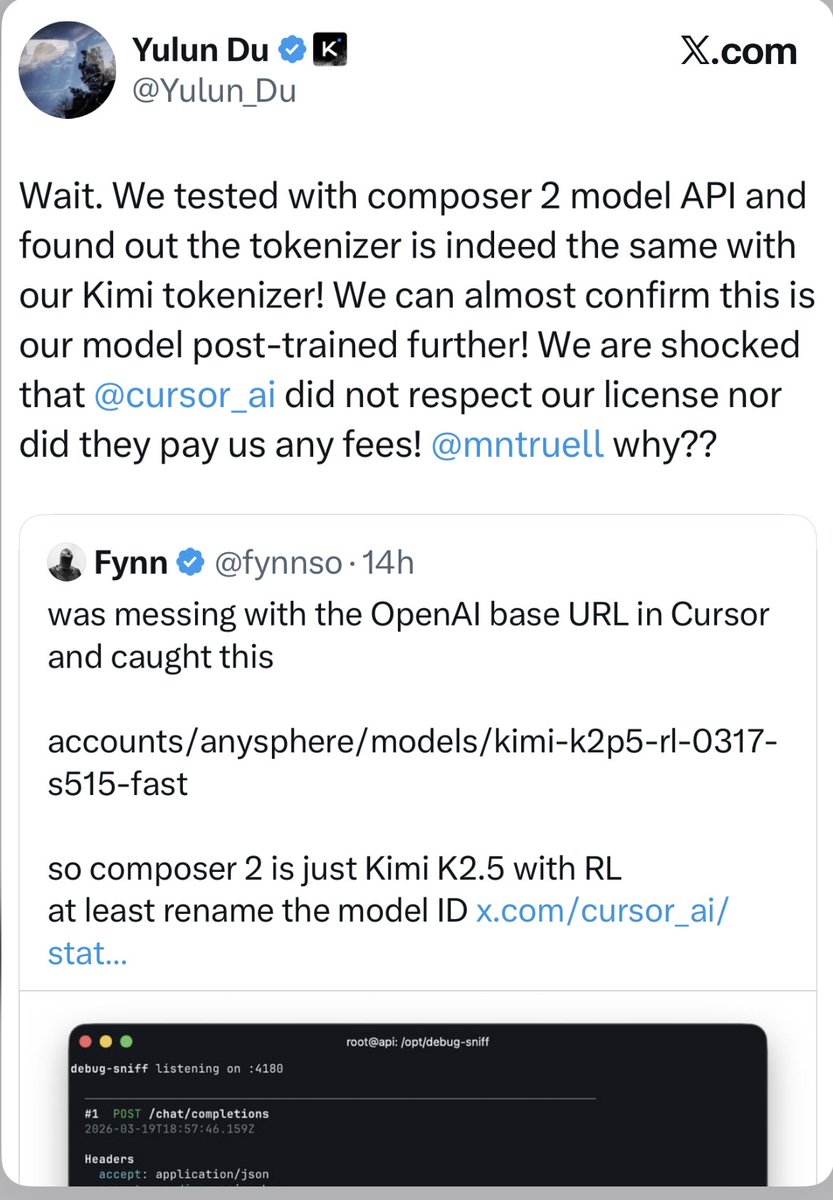
Cursor is raising at a $50 billion valuation on the claim that its “in-house models generate more code than almost any other LLMs in the world.” Less than 24 hours after launching Composer 2, a developer found the model ID in the API response: kimi-k2p5-rl-0317-s515-fast.
That’s Moonshot AI’s Kimi K2.5 with reinforcement learning appended. A developer named Fynn was testing Cursor’s OpenAI-compatible base URL when the identifier leaked through the response headers. Moonshot’s head of pretraining, Yulun Du, confirmed on X that the tokenizer is identical to Kimi’s and questioned Cursor’s license compliance. Two other Moonshot employees posted confirmations. All three posts have since been deleted.
This is the second time. When Cursor launched Composer 1 in October 2025, users across multiple countries reported the model spontaneously switching its inner monologue to Chinese mid-session. Kenneth Auchenberg, a partner at Alley Corp, posted a screenshot calling it a smoking gun. KR-Asia and 36Kr confirmed both Cursor and Windsurf were running fine-tuned Chinese open-weight models underneath. Cursor never disclosed what Composer 1 was built on. They shipped Composer 1.5 in February and moved on.
The pattern: take a Chinese open-weight model, run RL on coding tasks, ship it as a proprietary breakthrough, publish a cost-performance chart comparing yourself against Opus 4.6 and GPT-5.4 without disclosing that your base model was free, then raise another round.
That chart from the Composer 2 announcement deserves its own paragraph. Cursor plotted Composer 2 against frontier models on a price-vs-quality axis to argue they’d hit a superior tradeoff. What the chart doesn’t show is that Anthropic and OpenAI trained their models from scratch. Cursor took an open-weight model that Moonshot spent hundreds of millions developing, ran RL on top, and presented the output as evidence of in-house research. That’s margin arbitrage on someone else’s R&D dressed up as a benchmark slide.
The license makes this more than an attribution oversight. Kimi K2.5 ships under a Modified MIT License with one clause designed for exactly this scenario: if your product exceeds $20 million in monthly revenue, you must prominently display “Kimi K2.5” on the user interface. Cursor’s ARR crossed $2 billion in February. That’s roughly $167 million per month, 8x the threshold. The clause covers derivative works explicitly.
Cursor is valued at $29.3 billion and raising at $50 billion. Moonshot’s last reported valuation was $4.3 billion. The company worth 12x more took the smaller company’s model and shipped it as proprietary technology to justify a valuation built on the frontier lab narrative.
Three Composer releases in five months. Composer 1 caught speaking Chinese. Composer 2 caught with a Kimi model ID in the API. A P0 incident this year. And a benchmark chart that compares an RL fine-tune against models requiring billions in training compute without disclosing the base was free.
The question for investors in the $50 billion round: what exactly are you buying? A VS Code fork with strong distribution, or a frontier research lab? The model ID in the API answers that.
If Moonshot doesn’t enforce this license against a company generating $2 billion annually from a derivative of their model, the attribution clause becomes decoration for every future open-weight release. Every AI lab watching this is running the same math: why open-source your model if companies with better distribution can strip attribution, call it proprietary, and raise at 12x your valuation?
kimi-k2p5-rl-0317-s515-fast is the most expensive model ID leak in the history of AI licensing.

248
544
4,417
1,396,845

Joe Contini retweeted

Mar 13
When I was 17, I was driving recklessly and crashed into an oncoming car. I found out that I broke the other driver’s spine, and she’ll never walk again.
I felt so horrible about it for so many years that at age 35 I decided to find this woman to apologize.
12
11
283
35,802

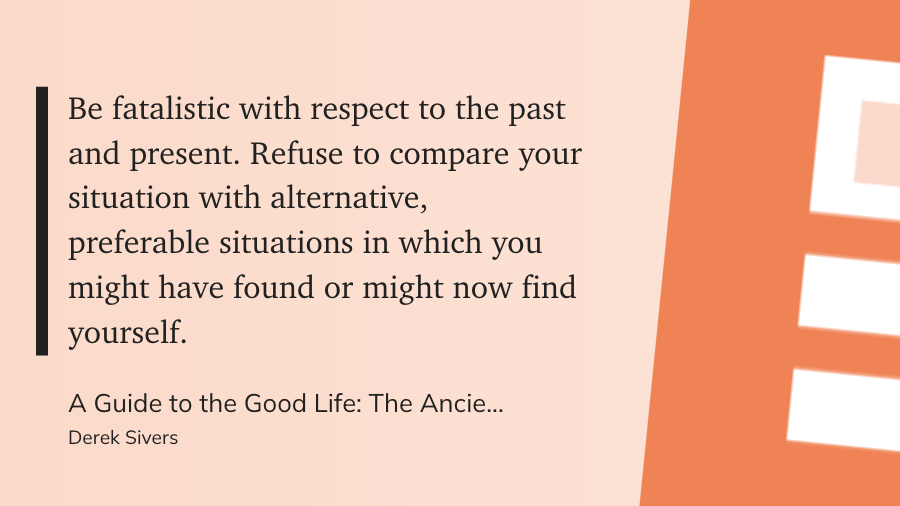
You're literally worrying yourself to an early grave! But you don't have to. Being a pessimist isn't a character trait, it's a disposition, and you can flip it. The Stoics knew this two millenia ago: Focus on what's in your control and memento mori.
Feb 23

Most people will read this and think optimists live longer because they eat better and exercise more. The study says something wilder.
Lee et al. controlled for smoking, diet, exercise, alcohol, depression, BMI, and socioeconomic status. The longevity effect still held. The most optimistic quartile lived 11 to 15% longer and had 1.5 to 1.7x odds of reaching 85 even after removing every behavioral difference.
Which means something is happening at the level of biology, not just habits.
Rozanski’s meta-analysis across 229,391 participants found optimists carry 35% lower cardiovascular event risk. Blackburn’s Nobel Prize-winning lab at UCSF found pessimistic attitudes are associated with accelerated telomere shortening. Cortisol suppresses telomerase, the enzyme that rebuilds the protective caps on your chromosomes. So chronic negative expectation literally erodes the structures that keep your cells from aging.
The loop runs: pessimistic cognitive style → sustained HPA axis activation → elevated cortisol → telomere degradation → accelerated cellular senescence. Optimists interrupt that loop at the top. They show less emotional reactivity to stressors, faster recovery from acute stress, and they default to reframing threats as challenges rather than catastrophizing.
The part nobody talks about from this paper: the authors explicitly state optimism is modifiable. This isn’t a personality trait you’re born with. Cognitive reappraisal training, morning sunlight for cortisol rhythm regulation, deliberate breathing protocols for vagal tone, structured gratitude practices. All of these shift the prefrontal cortex patterns that determine where you sit on the optimism spectrum.
A 35% reduction in cardiac events from a trainable psychological variable is a bigger effect size than most supplements on the market. That’s the real story buried in this abstract.
51
89
1,667
172,603