
Product Lead @ Wise / Opinions are my own.
Joined January 2019
- Tweets 143
- Following 905
- Followers 151
- Likes 298
3 Photos and videos


Jergan Callebaut retweeted

5 Dec 2024
If you are not planning for the price of intelligence to go to zero, the next 3-5 years are going to incredibly disruptive to your business / life.
This is the main idea for the rest of the decade, buckle up.
211
921
6,278
2,725,992
Jergan Callebaut retweeted

20 Nov 2024
I made some pretty bold assertions at the House of Lords yesterday, in order:
- We need a Manhattan project scale endeavour to build state capacity in AI. In 20 years, this will be as important to states as Nuclear weapons are today.
- The taxpayer-funded British Business Bank is a fraud that must be stopped. Direct state intervention in venture capital has never worked and will never work.
- No successful tech company would stay or list in the UK today. The LSE is not fit for purpose, and the lack of growth capital is criminal.
- Pension funds are screwing working people. The amount of capital sitting on the sidelines and not going into growth is insane.
- The lack of an incentive structure for regulators to take risk is killing innovation. We need checks & balances and must reward regulators for enabling growth.
I’m probably not getting invited back & my PR team hate me, but it is at least interesting: parliamentlive.tv/Event/Inde…
26
24
214
24,880
Jergan Callebaut retweeted

15 Nov 2024
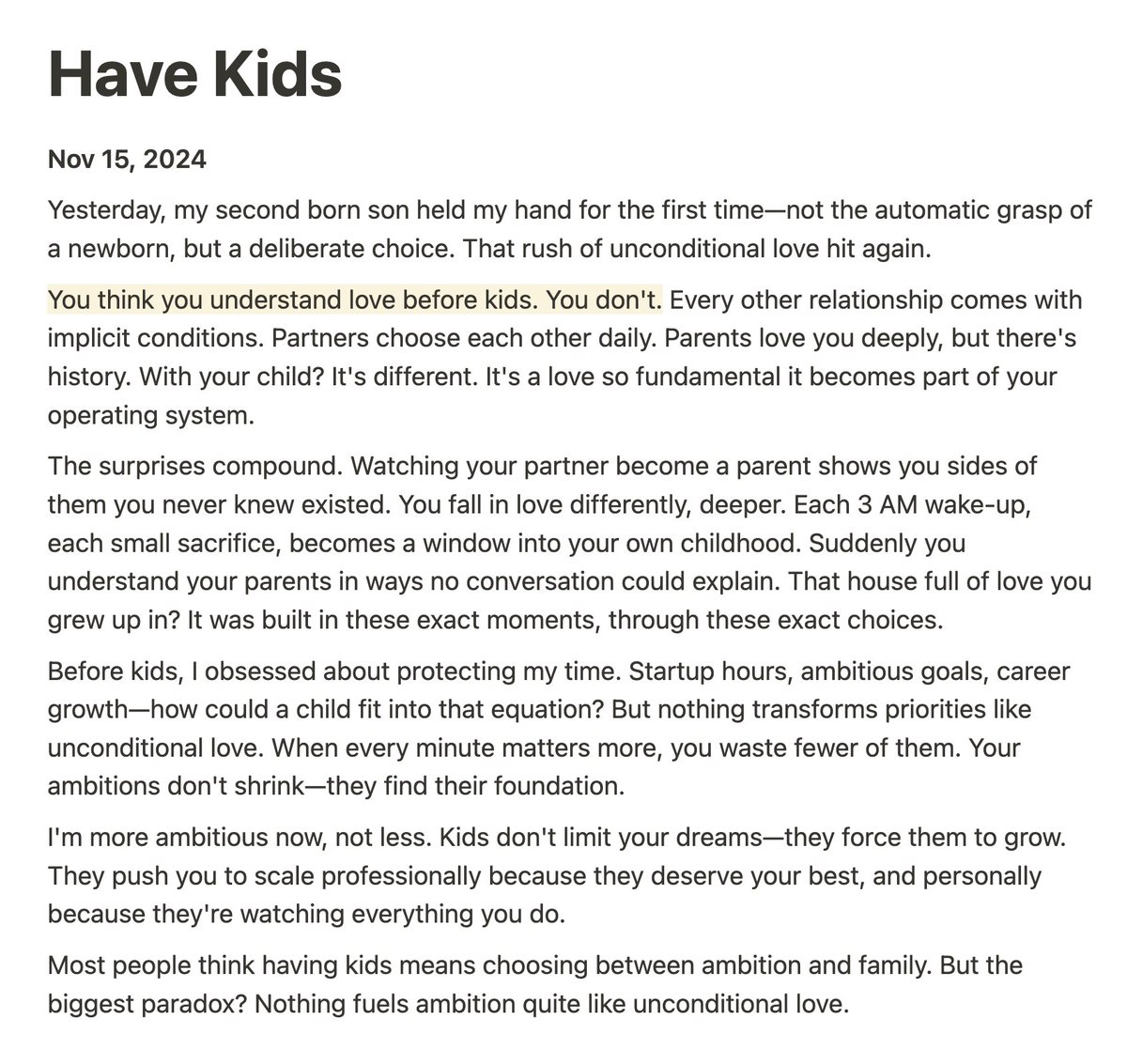
This one was written straight from the heart at 4:32 am..
339
2,792
23,391
2,247,130
Jergan Callebaut retweeted

6 Sep 2024
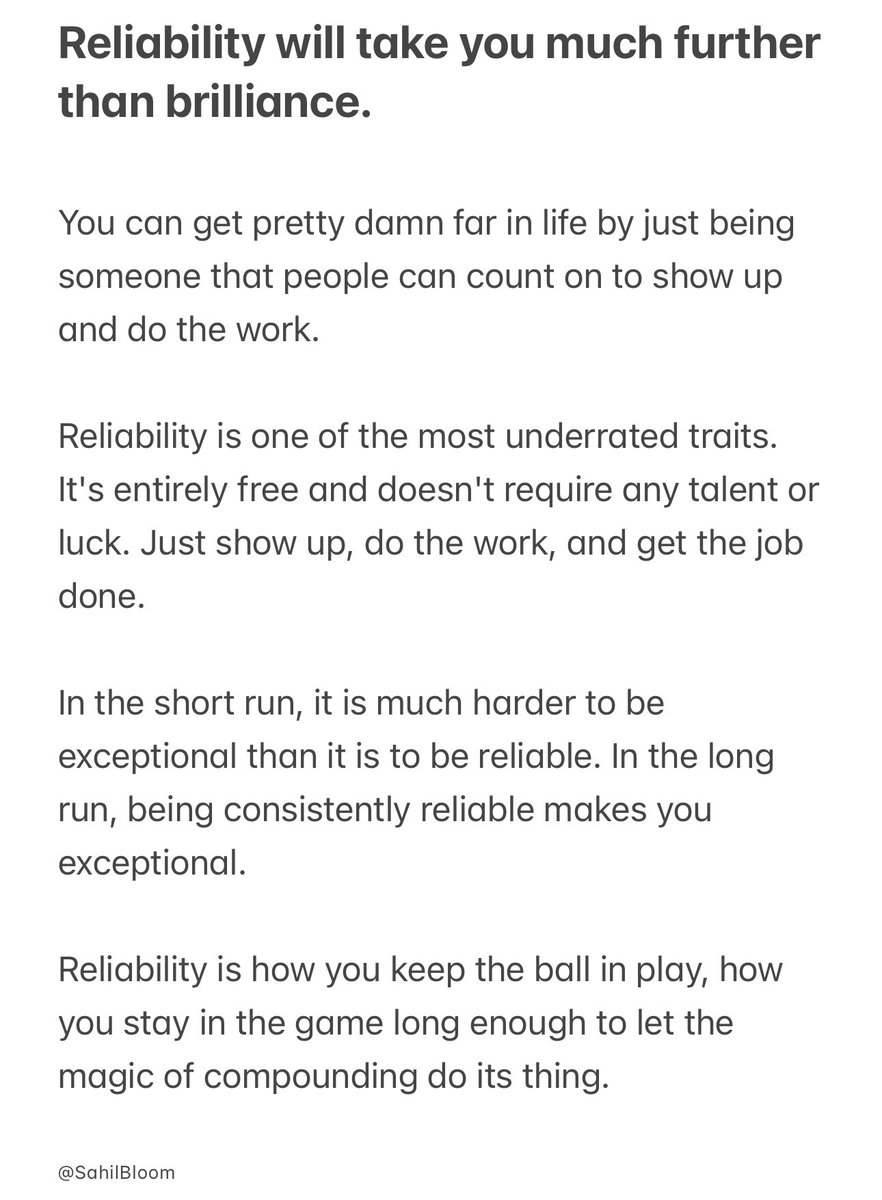
Reliability is a cheat code for life.
84
498
3,448
363,930
Jergan Callebaut retweeted

1 Sep 2024
Founder Mode: paulgraham.com/foundermode.h…
920
2,147
13,676
21,906,828

12 Jul 2024
100%
11 Jul 2024

I also unequivocally believe that if title is something that a candidate brings up early or even during the interview process at all, it is a red flag. It shows you what their values are.
43
Jergan Callebaut retweeted

2 Jul 2024
Hire great people and get out of their way vs. get into the weeds?
I made a lot of mistakes in my past around hiring people and then abdicating responsibility to them. You have to be involved enough to hold them accountable, understand details, probe, and push.
(🧵/)
23
28
566
198,737
Jergan Callebaut retweeted

22 Jun 2024
At OpenAI, we’re working to advance scientific understanding to help improve human well-being. The AI tools we are building, like Sora, GPT-4o, DALL·E and ChatGPT, are impressive from a technical standpoint. But what really matters is how they’re starting to change the way we interact with information and ideas.
A few years ago, in my essay "Language & Coding Creativity", I wrote about how these systems represent a big shift in our relationship with language and creativity. As we keep improving these tools, our mission stays the same: to make them helpful, safe, easy to use, and available to as many people as possible. We want to help reduce the obstacles that have traditionally kept people from expressing their unique ideas and perspectives.
By carefully designing these technologies to collaborate with human creators, I think we can build wonderful tools to help artists have more control, be more innovative, and explore new frontiers of possibility. When we made DALL·E, we worked closely with artists, designers, and storytellers, trying to build a tool that fits into their creative process and helps bring their visions to life. Moving forward, I believe AI has the potential to democratize creativity on an unprecedented scale. A person’s creative potential should not be limited by their access to resources, education, or industry connections. AI tools could lower the barriers and allow anyone with an idea to create.
At the same time, we must be honest and acknowledge that AI will automate certain tasks. Just like spreadsheets changed things for accountants and bookkeepers, AI tools can do things like writing online ads or making generic images and templates. But it's important to recognize the difference between temporary creative tasks and the kind that add lasting meaning and value to society. With AI tools taking on more repetitive or mechanistic aspects of the creative process, like generating SEO metadata, we can free up human creators to focus on higher-level creative thinking and choices. This lets artists stay in control of their vision and focus their energy on the most important parts of their work.
To make sure these technologies are developed and used in a way that does the most good and the least harm, we work closely with red-teaming experts from early stages of research. We also use an iterative approach, gradually releasing tools and carefully studying how they impact the real world to guide future development. Protecting and strengthening the most valuable aspects of creativity is fundamental to our human experience.
Realizing the potential of AI is not guaranteed. It takes carefully building tools and using them responsibly, in close partnership with creators and communities they’re intended to benefit. This means putting strong safeguards in place, reducing harmful biases, and proactively dealing with potential negative effects. At OpenAI, this is at the core of how we work, and we’ve never wavered in our commitment to this as we've released new tools.
1,010
473
4,739
1,604,223
Jergan Callebaut retweeted

19 Jun 2024
We will pursue safe superintelligence in a straight shot, with one focus, one goal, and one product. We will do it through revolutionary breakthroughs produced by a small cracked team. Join us: ssi.inc
416
485
6,217
997,980
Jergan Callebaut retweeted

2 Jun 2024
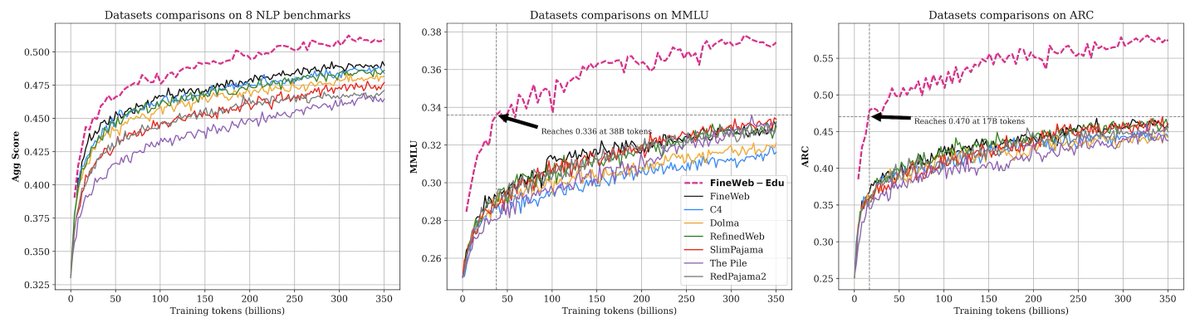
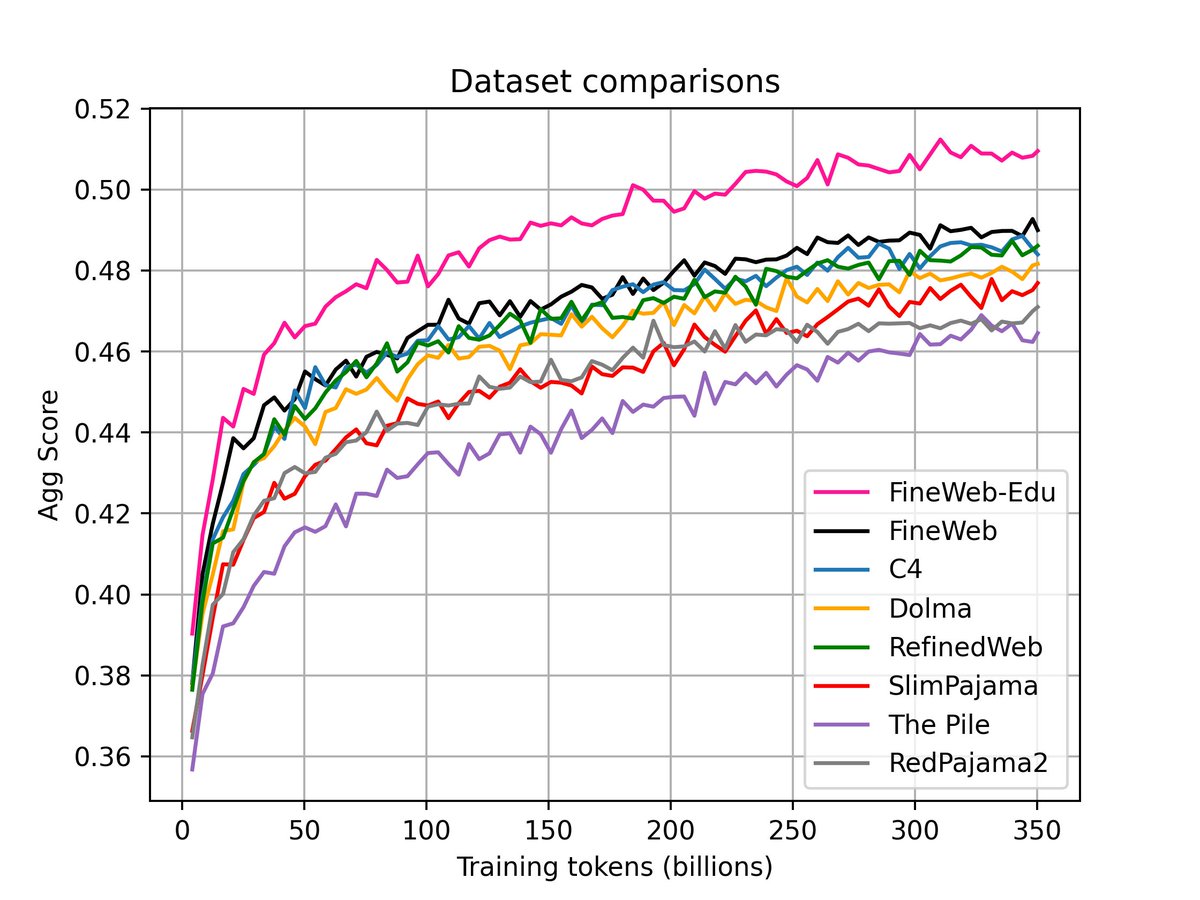
Awesome and highly useful: FineWeb-Edu 📚👏
High quality LLM dataset filtering the original 15 trillion FineWeb tokens to 1.3 trillion of the highest (educational) quality, as judged by a Llama 3 70B. A highly detailed paper.
Turns out that LLMs learn a lot better and faster from educational content as well. This is partly because the average Common Crawl article (internet pages) is not of very high value and distracts the training, packing in too much irrelevant information. The average webpage on the internet is so random and terrible it's not even clear how prior LLMs learn anything at all. You'd think it's random articles but it's not, it's weird data dumps, ad spam and SEO, terabytes of stock ticker updates, etc. And then there are diamonds mixed in there, the challenge is pick them out.
Pretraining datasets may also turn out to be quite useful for finetuning, because when you finetune a model into a specific domain (as is very common), you slowly lose general capability. The model starts to slowly forget things outside of the target domain. But this is not only restricted to knowledge; You also lose more general "thinking" skills that the original data demanded, but your new domain might not exercise. i.e. in addition to the broad knowledge fading, those computational circuits also slowly degrade. So there are likely creative ways to blend the pretraining and finetuning stages.
2 Jun 2024

We are (finally) releasing the 🍷 FineWeb technical report!
In it, we detail and explain every processing decision we took, and we also introduce our newest dataset: 📚 FineWeb-Edu, a (web only) subset of FW filtered for high educational content.
Link: hf.co/spaces/HuggingFaceFW/b…
51
491
3,514
770,048
Jergan Callebaut retweeted

20 May 2024
Stanford and Berkeley students start companies at 5x the rate of Oxford and Cambridge.
Why the smartest, most technical people in the UK should take more risk 🚀
tomblomfield.com/post/750852…
89
179
1,199
448,086
Jergan Callebaut retweeted

21 May 2024
In 6 years, we grew Uber from 10 cities to $10B in revenue.
How’d we grow so fast? We hired local teams in every city.
This was our playbook:
54
249
2,301
1,213,555
Jergan Callebaut retweeted
9 May 2024
Marketplaces are beautiful businesses.
But they're incredibly hard to build.
One thing that can make it easier: picking a good market.
If I was looking to build the next billion dollar marketplace, here's what I'd want to know:
20
26
252
59,243

Some things here in my list that Europe could improve to help make it a better business environment for entrepreneurs:
(P.S. I'm not Ultra IQ so probably some errors in here but you get the rough idea, it's not rly about the details so much as the general tendency here that's anti business)
- bureauracy, difficult and expensive to start a business, as well as maintain it
- endless non-stop regulation like cookie law, GDPR, VAT, now the AI regulation, soon ePrivacy, yes a lot if it to protect people but you make it hard for new businesses to even start up
- labor laws make it extremely risky to hire people, because you usually can't just fire them, you need a good reason, and can be paying them for years if they get sick, this is good for people, bad for business, so long-term bad for people too though if Europe doesn't have businesses anymore
- potential personal liability for company bankruptcy, very different than US where your company can go bankrupt and you can start over from zero (not in the negative like many parts of Europe)
- tax rates, way way higher in Europe, it all adds up, 21% sales tax, 25-30% corporate tax, 25-30% dividend tax, 50-60% personal income tax, there's barely anything left when you finish
- buying/receiving/selling/owning stock/options in startups is incredibly expensive/bureaucratic which means EU startups won't even try to give a share to workers, or few do
- exit taxes within EU, if you try move around from for ex Austria/Norway you will get exit taxed for unrealized gains! insane
- culturally still entrepreneurship is frowned upon in Europe, this is harder to change, but this will change if you improve the business climate
You might say but but but we have ASML, Unilever, Nestle etc. yes we do but:
- many things above make it a good place for BIG businesses, see ASML which is a spin off from Philips (a big business), what you don't see so much in Europe is actual startups getting big here because the regulation favors big companies and rich capital owners (many rich families in Europe)
Many people in Europe believe that MORE regulation is good and sure often it is, think how great the EU's food certification is, the food here is probably higher quality than US where it's more loosely certified
But it also makes it very hard and actually often impossible for new businesses to sprout up and grow, because when you're a small business you're tiny and fragile and don't have as many resources to follow all the rules that are made
Which means you either shut down, or try ignore the rules as long as possible but then you get shut down by the authorities and maybe fined and you shut down too
Big companies LOVE this because it keeps the barrier to entry to markets HIGH, so new entrants cannot start businesses
But for a free economy to function you NEED new businesses with new ideas to flourish and grow and attack the existing incumbent companies. And then IF they're good enough they kick the old fuckers out!
But in Europe you don't have that a lot, so you get complacent companies that get too comfortable, they don't feel threatened so they don't need to innovate, and instead will use their time/money to maintain their status quo: rubbing elbows with governments etc. And then you get NEPOTISM and corruption (aka Southern Europe)
So TL;DR Europe isn't a healthy free market economy right now, it's actually quite sick, and most Europeans don't see that at all because like the companies in Europe, they too are complacent
Back to ASML, it says SO MUCH that the top company in Europe making the hardware that TSMC uses to build GPUs is a SPIN OFF from Philips, not a startup that sprout by itself
WHAT IS THE SOLUTION?
💡 One simple solution that keeps coming back into my mind is simple REVENUE REGULATION CUTOFFS
You want big companies to follow regulation, because regulation is good and they can afford to
But you also want new entrepreneurs, small and medium business, startups to try new ideas without getting hammered down by regulation immediately, so do a cut off: only activate specific regulations above a certain $$$ threshold
There's examples of this working in other countries: Singapore only starts charging VAT (they call it GST) for companies that sell over $1M/year to Singaporean customers. That means most companies starting out there don't have to. And that saves a lot of bookkeeping
Singapore has another one, the first 3 years you don't pay a lot of corporate/company tax, it gradually goes up to the normal level, this gives you some breathing room to figure out your business
I don't have all the answers, I'm just a guy on X but I have some ideas and would be happy to hear everyone else's how to make it easier to start, run, grow and sell your business in Europe
6 May 2024

What do you feel is needed to turn things around in Europe?
134
64
899
349,693
Jergan Callebaut retweeted

1 Feb 2024
In October ‘23, @stateofai reached its 5th anniversary.
With 934 slides over 6 editions serving as a historical document, we’re opening 2024 with a retrospective of the main storylines, what we predicted, and what we didn't.
Welcome to the State of the State of AI. 🧵
8
87
304
69,880
Jergan Callebaut retweeted

22 Dec 2023
Mastering PM is mastering simplicity 🌈
How parenthood reshaped my approach with 5 rules 🧵

2
14
71
26,893
Jergan Callebaut retweeted

26 Nov 2023
This is what a great Friday night looked like when I was a teenager
996
14,222
79,674
9,790,679
Jergan Callebaut retweeted

27 Oct 2023
Boston Dynamics' robot dog can now talk, using AI.
Plus, huge announcements from Shutterstock, OpenAI, Poe, D-ID, Forbes, Waymo, 3 new AI jobs, and 10 new AI tools.
Here's the rundown of everything going on in AI right now:
41
137
1,115
495,107
Jergan Callebaut retweeted

16 Sep 2023
Unordered and incomplete list of qualities I regularly see in exceptional teammates:
- knows the details
- sweats the details
- brings structure to ambiguity
- responsiveness
- availability
- quick study (content)
- quick study (methods)
- directors, not consensus builders
- visible (async or sync) every day
- can reference the archives
- low drama (bad stuff)
- low drama (good stuff)
- right, a lot, and usually quickly
- resilient in the face of feedback
- self manages health, energy, emotions
- not above the grind
- paranoid about the right things
- could flex into 1-2 adjacent roles
- mostly ignores hierarchy
- but manages up well
- self sufficient (can solo quest)
- internally well networked
- wicked fast
29
120
1,284
225,668
Jergan Callebaut retweeted
7 Sep 2023
In 2009, Stanford business professor Tina Seelig split her class into groups and issued a challenge:
Each group had $5 and 2 hours to make the highest return on the initial money.
At the end, they'd give a short presentation on their strategy.
The results were fascinating...
Most of the groups followed a basic approach:
• Use the $5 to buy a few items.
• Barter or resell those items.
• Repeat
• Sell final items for (hopefully) more than $5.
These groups made a modest return on their initial $5.
A few groups ignored the $5.
They thought up ways to make the most money in the 2 hours of allotted time:
• Made and sold reservations at hot restaurants.
• Refilled bike tires on campus for $1 each.
These groups made a better return on their initial $5.
The winning group took an entirely different approach.
They had three core realizations:
1. The $5 was nothing more than a distraction.
2. The 2 hours of time was not enough to make an attractive, outsized return with a mini-business (like selling restaurant reservations or filling bike tires).
3. The most valuable "asset" was actually the presentation time in front of a class of Stanford students.
Realizing the value of this hidden asset, they offered the presentation time to companies looking to recruit Stanford students.
They struck a deal to sell the time slot for $650, netting a monstrous return on the $5 of initial capital.
The losing groups thought in linear, logical terms and achieved a linear, logical outcome.
The winning group thought differently.
So, what can we learn from this story?
There are two types of problems:
1. Low-Stakes: Lower potential, linear rewards. Decisions are easily reversible.
2. High-Stakes: Higher potential, asymmetric rewards. Decisions are not easily reversible.
With low-stakes problems, given the reward potential is low and the decisions are easily reversible, we can use shortcuts and heuristics to choose our path. We can take a logical, linear approach.
With high-stakes problems, the high, asymmetric reward potential means we need to think differently. We want to take a creative, non-linear approach.
Three steps to start thinking differently:
Step 1: Avoid the Distraction
There will always be an "obvious" solution that is simple, clear, and entirely wrong.
In the challenge, the $5 was nothing more than a distraction. It was a trap.
To find the best path, you have to avoid the distraction.
Step 2: Ask Foundational Questions
Ask and answer questions that expose and vet underlying assumptions and logic.
• What's the real problem you are trying to solve?
• What's your hypothesis? Why?
• What are your core assumptions? Why?
• What evidence do you have?
• What are your core options?
• What alternatives exist?
This takes time, but it's an essential exercise when facing a problem with the potential for non-linear rewards.
Step 3: Select the High Leverage Approach
Slow down and evaluate the options on the table.
Select the path most likely to generate the asymmetric, attractive risk-adjusted returns.
If the story teaches us one thing, it's this:
Creative, non-linear, asymmetric thinking generates creative, non-linear, asymmetric outcomes.
If you enjoyed this or learned something, follow me @SahilBloom for more in future.

271
2,208
11,328
2,760,172