
Our research group is interested in the molecular and cellular origins and evolution of vertebrate organs. Tweets by lab members. @kaessmannlab.bsky.social
Joined May 2019
- Tweets 641
- Following 174
- Followers 1,869
- Likes 1,081
13 Photos and videos

Pinned Tweet

13 Feb 2025
So excited to announce that our study on the development and evolution of pallial cell types and structures in birds led by @BassiZaremba is now out in @ScienceMagazine!
science.org/doi/10.1126/scie…
PS: this is our last post here – please follow us to where the sky is blue!
6
20
61
26,929
Kaessmann Lab retweeted

13 Feb 2025
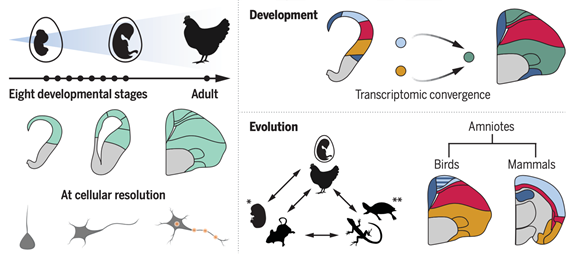
@BassiZaremba and @Kaessmannlab performed the first and most comprehensive atlas of cell types in the pallium of birds 🐣🐔🐤and other amniotes. When comparing them to mammals, we found a great diversification of neurons!
shorturl.at/2Yi61
2
5
15
846
13 Feb 2025
One more - really final - post here after all:
please check out the wonderful Perspective by @matosches and @gattoni_giacomo on our paper and those of our colleagues from the Aerts and @PhyloBrain groups.
science.org/doi/10.1126/scie…
Please follow us to where the sky is blue!
9
35
2,464
13 Feb 2025
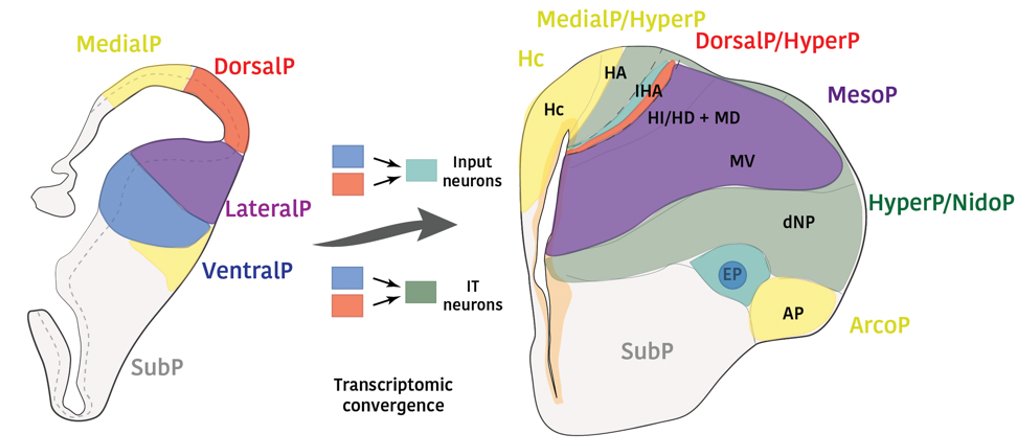
We redefine the borders of the bird-specific “hyperpallium”, which was regarded as being homologous to the mammalian neocortex by many, and find that only a fraction of cells in this region is truly homologous to a subset of neurons in the mammalian neocortex.
1
1
294
13 Feb 2025
Remarkably, we identify a striking developmental transcriptomic and gene regulatory convergence of excitatory cell populations from the dorsal and ventral pallial regions. This observation reconciles previous apparently mutually excluding models of pallial development in birds.
1
272
13 Feb 2025
Overall, we substantially increase our understanding of the amniote pallium by establishing a new model for pallial development in birds, and by identifying clear evolutionary relationships across amniote pallial cell types.
1
248
13 Feb 2025
So excited to announce that our study on the development and evolution of pallial cell types and structures in birds led by @BassiZaremba is now out in @ScienceMagazine!
science.org/doi/10.1126/scie…
PS: this is our last post here – please follow us to where the sky is blue!
6
20
61
26,929
13 Feb 2025
Many excitatory neuron repertoires diverged substantially in birds, especially the ones defining dorsal and ventral regions of the pallium.
1
129
13 Feb 2025
Surprisingly, however, other avian cell populations related to the claustral-like population, are homologous to neurons located in deep layers of the mammalian cortex, which has never before been suggested.
1
118
13 Feb 2025
Our work also unveils clear correspondences of the claustrum across the three representative amniote species and a high conservation of its major constituent cell type during amniote evolution.
1
129
13 Feb 2025
Further, we find that homologs of key excitatory neurons of the mammalian hippocampus are present in corresponding regions of the chicken pallium. This suggests that key hippocampal regions and cell types have been preserved across all major lineages of amniotes during evolution.
1
119
13 Feb 2025
We confirm that inhibitory neurons show overall conserved expression across amniotes. However, one cell type population, which shows a highly restricted localization in the mammalian amygdala, has become very abundant across the avian pallium during evolution.
1
116
13 Feb 2025
We also generated data for the pallium of a lizard and selected pallial regions in the mouse to compile an unprecedented comparative dataset of the adult amniote pallium, which we used to unravel the evolutionary relationships of avian cell types and structures across amniotes.
1
114
13 Feb 2025
If you haven’t read our preprint, keep reading for a short summary of our findings.
1
112
13 Feb 2025
Many thanks to the editor for expert handling and to the reviewers for their valuable feedback! We now compare to an additional mouse dataset, add context on previous models of pallial development and evolution, and illustrate our own model in the new main Figure 7!
1
130
13 Feb 2025
In this study we generated the first spatially resolved cell type atlas of the entire chicken pallium in adults and across in ovo development, together with our collaborators in Per Jensen’s @perjensen56 group and the wonderful García-Moreno lab @PhyloBrain.
1
159
13 Feb 2025
The advanced cognitive abilities of birds rival those of mammals and have partially been attributed to evolutionary innovations in the pallium.
1
191
6 Feb 2025
Check out this attractive fellowship call (health-life-sciences.de/post…) and especially the collaborative project (No. 51) from our lab and that of Aurelio Teleman on the evolution of X chromosome dosage compensation through translational upregulation in mammals!
1
3
6
736
6 Feb 2025
P.S. this is one of our last posts here – follow us to where the sky is blue!
1
3
182
Kaessmann Lab retweeted

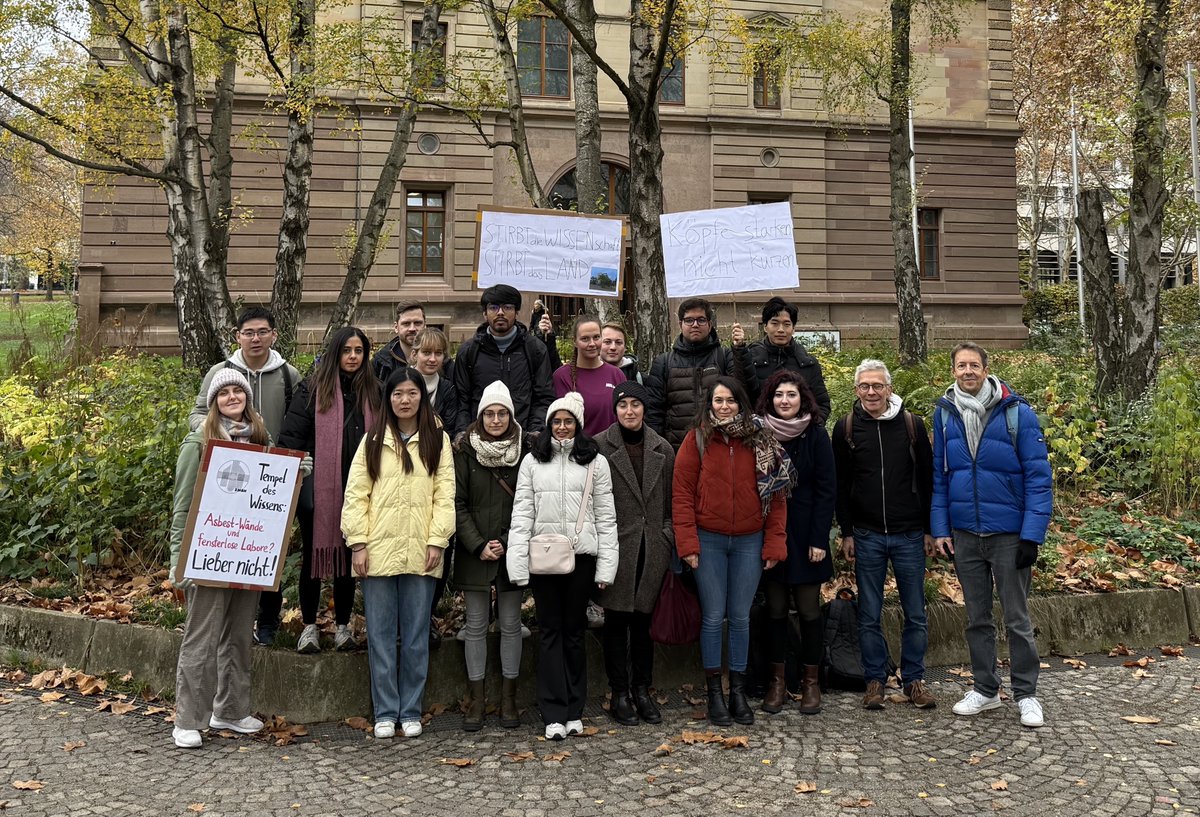
Students and scientists from ZMBH have joined today's rally in Stuttgart against the de facto decline of the basic funding of universities and for a revision of the State's 2026-2030 Higher Education Financing Agreement III


10
25
2,784