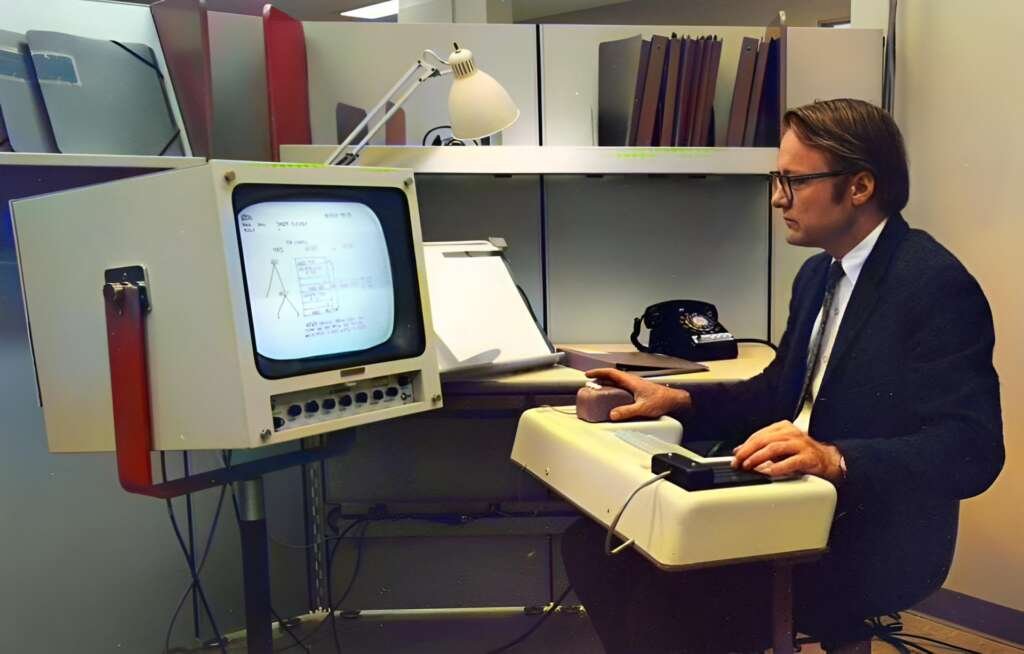
First Public Demonstration of the Computer Mouse and Graphical User Interface — 1968
On December 9, 1968, in what would later be called “The Mother of All Demos,” computer scientist Douglas Engelbart gave the world its first glimpse of modern computing. Held at the Fall Joint Computer Conference in San Francisco, Engelbart’s 90-minute live demonstration introduced revolutionary concepts that now define how we interact with computers.
Among the innovations unveiled were the **computer mouse**, a small wooden device with two perpendicular wheels, designed to navigate on-screen content. Engelbart also showcased **windowed computing**, **hypertext links**, **real-time text editing**, and the **graphical user interface** — decades before these features would appear in mainstream personal computers.
At a time when most computers were still operated with punch cards and command lines, Engelbart’s vision seemed futuristic, even unimaginable. Yet, the demo laid the groundwork for everything from desktop interfaces to the modern internet.
Supported by his team at the Stanford Research Institute (SRI), Engelbart’s presentation was not just a technical marvel but a profound reimagining of human-computer interaction. It would take years for the world to catch up to his ideas, but the seeds of the digital revolution were planted that day — and history was quietly, but permanently, changed.
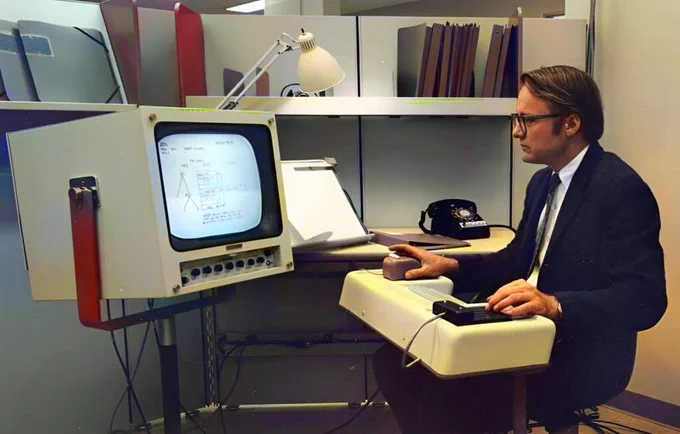
ALT First Public Demonstration of the Computer Mouse and Graphical User Interface — 1968
On December 9, 1968, in what would later be called “The Mother of All Demos,” computer scientist Douglas Engelbart gave the world its first glimpse of modern computing. Held at the Fall Joint Computer Conference in San Francisco, Engelbart’s 90-minute live demonstration introduced revolutionary concepts that now define how we interact with computers.
Among the innovations unveiled were the **computer mouse**, a small wooden device with two perpendicular wheels, designed to navigate on-screen content. Engelbart also showcased **windowed computing**, **hypertext links**, **real-time text editing**, and the **graphical user interface** — decades before these features would appear in mainstream personal computers.