🐕❤️ |🎙🎸🥁 | 🐑 🧶 | 🏳️🌈 LibtardInternautSpinnerWeaverMusicMakerShepherdCoderMom | #IVapeIVote #interop #SheepIsLife | #RESIST
Joined May 2008
- Tweets 16,100
- Following 2,630
- Followers 4,484
- Likes 18,374
381 Photos and videos






Pinned Tweet

26 Aug 2025
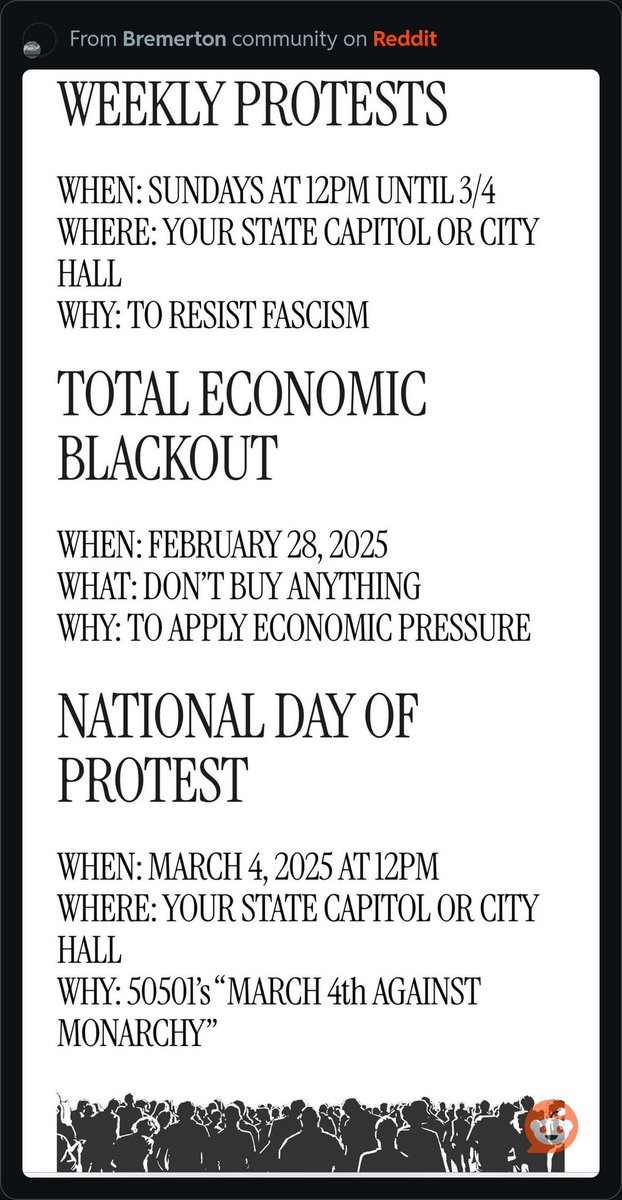
Be ready. The General Strike is coming generalstrikeus.com/strikeca… #GeneralStrikeUS
9,184
Critical reading
Jun 10

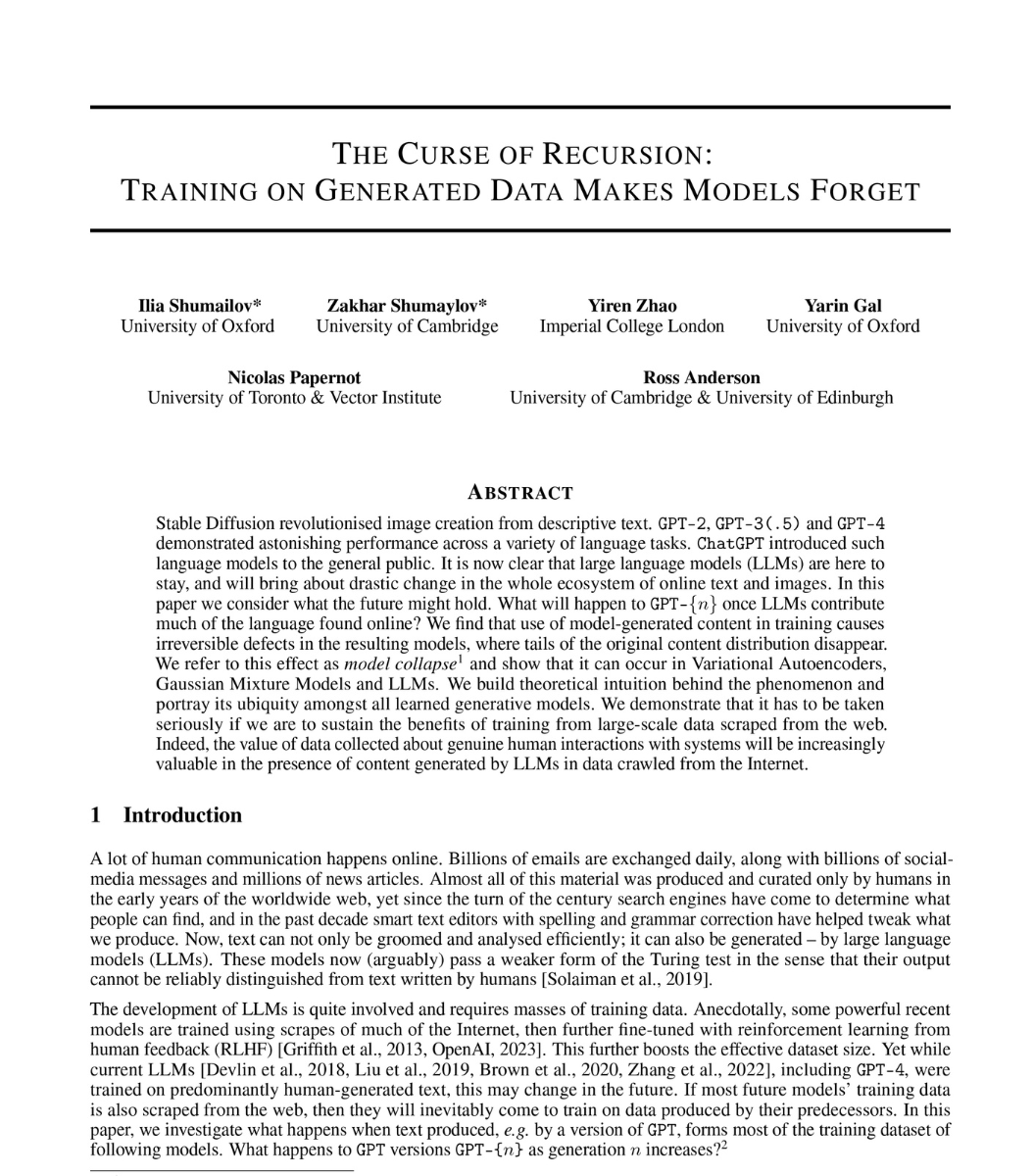
You have noticed it. ChatGPT feels dumber than it used to. Your prompts that worked six months ago produce worse results now. The writing sounds flatter. The ideas sound safer. The internet itself feels like it is shrinking. Every article reads the same. Every email sounds the same. Every answer sounds like it was written by the same voice.
You thought it was you. It is not you.
Researchers at Oxford and Cambridge published a paper in Nature proving what is happening. They call it Model Collapse.
Here is the mechanism in one sentence. AI trained on AI-generated data gets dumber every generation until it forgets what real human data looked like.
The internet is filling with AI-generated content. Blog posts. Articles. Reviews. Comments. Social media. AI companies scrape the internet to train the next generation of models. Which means the next generation of AI is being trained on the output of the current generation.
Each cycle loses information. Not randomly. It loses the rarest, most unusual, most creative parts first. The researchers call these the "tails of the distribution." The weird ideas. The unexpected perspectives. The things that made the internet feel human. Those disappear first.
What remains is the average. The safe. The expected. The bland.
Then the next generation trains on that. And loses more. And the next generation trains on that. And loses more. The researchers proved this is not a slow decline. Major degradation happens within just a few iterations. Even when some of the original human data is preserved.
They tested it on large language models. On image generators. On statistical models. The pattern was the same every time. The output converges toward a narrow, flattened version of reality that looks nothing like the original data.
The lead researcher put it plainly. "Large language models are like fire. A useful tool. But one that pollutes the environment."
The pollution is invisible. You cannot see which sentence on the internet was written by a human and which was written by AI. Neither can the AI that is about to train on it. And once the tails are gone, they do not come back. The damage is irreversible.
This is not a prediction anymore. It is a diagnosis.
The internet you grew up on was built by humans writing things no algorithm would have written. Strange, personal, imperfect, alive. That internet is being diluted. One generation of AI at a time. And the models trained on what remains are learning a smaller and smaller version of the world.
Model Collapse is not a technical problem. It is a cultural one. The thing that made the internet worth reading is the thing that disappears first.
72
As an educator, I can vouch for these findings 100%. That’s why I always encouraged my students to use the Cornell notetaking system in my classes when they wanted to take notes on a lecture. Handwriting makes all the difference in the world.
May 18

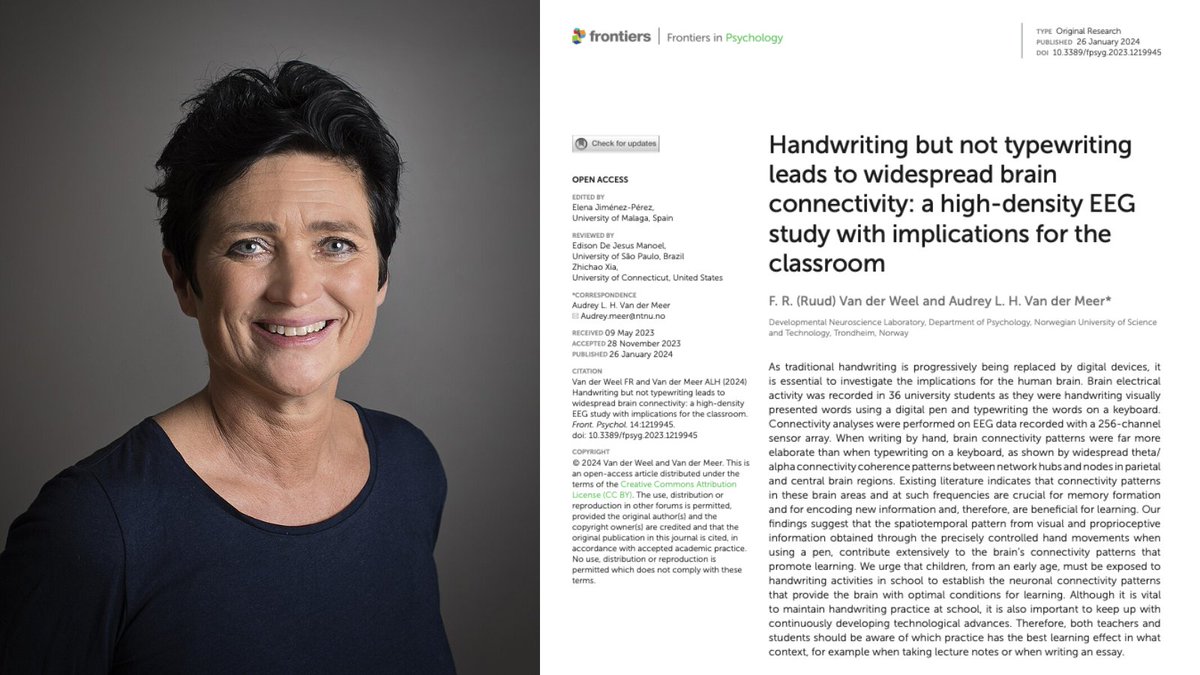
A Norwegian neuroscientist spent 20 years proving that the act of writing by hand changes the human brain in ways typing physically cannot, and almost nobody outside her field has read the paper.
Her name is Audrey van der Meer.
She runs a brain research lab in Trondheim, and the paper that closed the argument was published in 2024 in a journal called Frontiers in Psychology. The finding is brutal enough that it should have changed every classroom on Earth.
The experiment was simple. She recruited 36 university students and put each one in a cap with 256 sensors pressed against their scalp to record brain activity. Words flashed on a screen one at a time.
Sometimes the students wrote the word by hand on a touchscreen using a digital pen, and sometimes they typed the same word on a keyboard. Every neural response was recorded for the full five seconds the word stayed on screen.
Then her team looked at the part of the data most researchers had ignored for years, which is how different parts of the brain were communicating with each other during the task.
When the students wrote by hand, the brain lit up everywhere at once.
The regions responsible for memory, sensory integration, and the encoding of new information were all firing together in a coordinated pattern that spread across the entire cortex. The whole network was awake and connected.
When the same students typed the same word, that pattern collapsed almost completely.
Most of the brain went quiet, and the connections between regions that had been alive seconds earlier were nowhere to be found on the EEG.
Same word, same brain, same person, and two completely different neurological events.
The reason turned out to be something nobody had really paid attention to before her work. Writing by hand is not one motion but a sequence of thousands of tiny micro-movements coordinated with your eyes in real time, where each letter is a different shape that requires the brain to solve a slightly different spatial problem.
Your fingers, wrist, vision, and the parts of your brain that track position in space are all working together to produce one letter, then the next, then the next.
Typing throws all of that away. Every key on a keyboard requires the exact same finger motion regardless of which letter you are pressing, which means the brain has almost nothing to integrate and almost no problem to solve.
Van der Meer said it plainly in her interviews.
Pressing the same key with the same finger over and over does not stimulate the brain in any meaningful way, and she pointed out something that should scare every parent who handed their kid an iPad.
Children who learn to read and write on tablets often cannot tell letters like b and d apart, because they have never physically felt with their bodies what it takes to actually produce those letters on a page.
A decade before her, two researchers at Princeton ran the same fight using a completely different method and ended up at the same answer. Pam Mueller and Daniel Oppenheimer tested 327 students across three experiments, where half took notes on laptops with the internet disabled and half took notes by hand, before testing everyone on what they actually understood from the lectures they had watched.
The handwriting group won by a wide margin on every question that required real understanding rather than surface recall.
The reason was hiding in the transcripts of what the two groups had actually written down.
The laptop students typed almost word for word, capturing more total content but processing almost none of it as they went, while the handwriting students physically could not write fast enough to transcribe a lecture in real time, which forced them to listen carefully, decide what actually mattered, and put it in their own words on the page.
That single act of choosing what to keep was the learning itself, and the keyboard had quietly skipped the choosing and skipped the learning along with it.
Two studies. Two countries. Same answer.
Handwriting makes the brain work. Typing lets it coast.
Every note you have ever typed instead of written went into your brain through a thinner pipe. Every meeting, every book highlight, every idea you captured on your phone instead of on paper was processed at half depth.
You did not forget those things because your memory is bad. You forgot them because typing never woke the part of the brain that would have made them stick.
The fix is the thing your grandmother already knew.
Pick up a pen. Write the thing down. The slower road is the faster one.
531
Release the Files! (Kelly) (she/they) retweeted

May 14
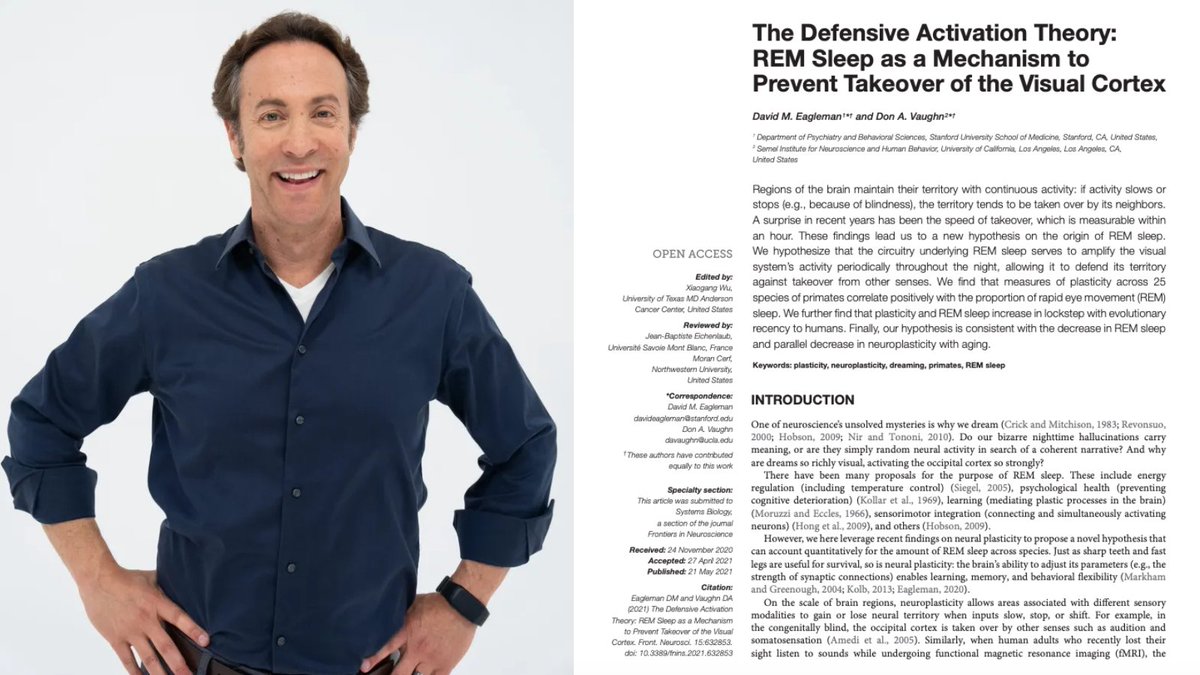
A Stanford neuroscientist published a paper a few years ago that quietly answered one of the oldest questions in human history, and almost nobody outside his field has heard of it.
The question is why we dream. Not what dreams mean. Why they exist at all. Why your brain spends a third of its sleep hallucinating images instead of just resting like every other organ in your body.
His name is David Eagleman.
He runs a lab at Stanford. The paper is called "The Defensive Activation Theory", and the moment you read it the explanation collapses every other theory you have ever been taught about dreams.
Freud said dreams were repressed desires. He was guessing. He had no brain scans. He had no electrodes. He had a couch and a notebook and a century of credibility that nobody has been able to fully scrub off the subject since.
Modern neuroscience replaced him with the memory "consolidation theory". The idea that dreams are your brain sorting through the day, filing things away, deciding what to keep. That story is partially true. Sleep does consolidate memory. But it does not explain the single strangest thing about dreams, which is that they are almost entirely visual.
You do not dream in pure sound. You do not dream in taste. You do not dream in smell. You dream in pictures. Vivid, detailed, often impossible pictures that activate the back of your brain so hard a scientist scanning you would think your eyes were wide open.
Eagleman started from one fact almost nobody outside neuroscience knows. The brain is territorial. Every region holds its turf through constant electrical activity. The moment a region goes quiet, its neighbors start invading. They take the silent territory and reassign it to themselves.
This is called "cortical takeover", and it is not slow. It is not a long process measured in years. In experiments where adults are blindfolded, the visual cortex starts processing touch and sound within an hour. One hour of darkness, and the territory is already being annexed.
In congenitally blind people, the visual cortex is fully repurposed. It runs language. It runs hearing. It runs touch. The hardware never went unused. It was just reassigned to whoever showed up first.
Now sit with the implication of that for a second.
Every night, when you close your eyes and fall asleep, the sun has set. The planet has rotated. The visual cortex, which takes up roughly a third of your entire cortex, is suddenly receiving zero input. For eight hours. Every single night. For your entire life. And evolution has shaped your brain inside a planet that has been spinning into darkness for billions of years.
If cortical takeover happens in an hour, the visual cortex should have been lost a long time ago. Stolen by hearing. Stolen by touch. Reassigned by morning. Humans should have evolved into a species whose vision works fine during the day and then degrades every time the sun goes down because the territory keeps getting renegotiated overnight.
But that did not happen. Vision works the moment you open your eyes. Which means something is defending the territory while you sleep.
Eagleman's claim is that dreams are that defense.
Every 90 minutes through the night, a precise burst of activity fires from the brainstem into the visual cortex. Pontine-geniculate-occipital waves. PGO for short. They are anatomically aimed. They are not general arousal.
They are a targeted volley of signal launched directly at the back of the brain where vision lives. The cortex lights up as if it is receiving real images, and you experience that artificial activation as a dream. The bizarre narrative your conscious mind invents around it later is just your brain trying to make sense of the noise.
The dream is not the point. The dream is the side effect. The point is keeping the territory occupied.
The evidence for this is the part that should haunt you.
Newborns spend roughly 50% of their sleep in REM. Adults spend twenty. Old adults spend fifteen. The amount of dreaming you do tracks almost perfectly with how plastic your brain is. Newborns have the most plastic brains on earth. Their visual cortex is in the highest danger of being overrun by neighboring senses while it develops.
So evolution gave them an enormous defense budget. As you age, your brain becomes less plastic, the takeover risk drops, and the defense system scales down accordingly.
Eagleman and his co-author ran the same correlation across twenty-five primate species. The more plastic a species' brain, the higher the proportion of REM sleep. The relationship held across the entire primate family tree. Plasticity and dreaming move together. They are two halves of the same evolutionary equation.
A species that ranks higher on flexibility and learning also dreams more. A species that is born ready to walk and survive dreams less. Plasticity is the asset. Dreaming is the insurance premium.
And the prediction the theory makes is the one that quietly closes the case.
Of all your senses, only one is disadvantaged by darkness. You can still hear in the dark. You can still feel in the dark. You can still smelll and taste in the dark. The only sense that depends on light is vision. Which is exactly the sense your dreams are made of. The defense system is targeted at the only territory that is actually vulnerable while you sleep.
Memory consolidation is real. Emotional processing is real. Your brain does do those things at night. But Eagleman's argument is that those functions piggyback on a much older system whose original job was simpler and more brutal. Keep the lights on inside the visual cortex while the planet is dark, or lose it.
For thousands of years, people have asked what dreams mean. Prophets wrote about them. Poets wrote about them. Freud built a discipline on them. None of them had access to the actual answer, which is that dreams may not mean anything in the symbolic sense at all.
They may be the visible flicker of a defense system running in the background, the way a screen saver protects a monitor by keeping the pixels moving even when nobody is looking.
The strangest thing about the theory is how cleanly it explains why dreams feel so real. Your visual cortex cannot tell the difference between a PGO wave and an actual photon. It is the same hardware lighting up the same way. The cortex does its job. It builds an image. Your conscious mind, half-awake, wraps a story around it and calls it a dream.
You are not seeing your subconscious tonight. You are watching your brain defend a piece of itself from being stolen.
Every animal that has ever closed its eyes on this planet has done the same thing.
267
1,333
4,687
693,938
Release the Files! (Kelly) (she/they) retweeted

May 14
I'm beginning to suspect that banning or otherwise limiting adult access to flavored nicotine vapes will lead to a booming illicit market that never checks IDs
feel free to add more, but these are my favorite successful flavor bans.
6
6
38
655
Release the Files! (Kelly) (she/they) retweeted
May 14
MTVD! FDA Quietly Changes EVERYTHING For Vape x.com/i/broadcasts/1DGleEgMN…
3
4
30
861
Folx, we are in big trouble… youtu.be/uFGFJsWZ2NM via @YouTube

142
The big picture result? LESS RESILIENCE
May 14

⚡️The deeper signal is youth risk did not disappear.
It migrated inward.
Teen drinking fell because the old physical world of adolescence got dismantled. Alcohol belonged to a social ecosystem: unsupervised time, cars, parties, local jobs, malls, basements, boredom, flirting, older siblings, house gatherings, and the chaotic peer world where teenagers learned who they were by colliding with other people in real space.
That ecosystem was replaced by phones, surveillance, parental tracking, algorithmic entertainment, social anxiety, online status games, and a much thinner physical commons.
So the surface looks healthier. Fewer kids drinking. Fewer kids using weed. Fewer kids doing reckless things in public.
The hidden layer looks worse. The young are less reckless because they are less socially embodied. Less initiation. Less unsupervised friction. Less courage-building. Less embarrassment and recovery. Less real dating. Less independence. Less contact with the physical world before adulthood demands it.
The old teenage world produced damage, stupidity, alcohol abuse, pregnancy risk, fights, accidents, and bad decisions. No need to romanticize it. But it also produced social reps. It forced young people through discomfort. It made them practice attraction, rejection, conflict, reputation, risk, repair, and status in the open.
The new world suppresses visible risk while increasing invisible fragility.
That is the trade.
A teenager can avoid drinking, avoid parties, avoid sex, avoid driving, avoid real confrontation, avoid rejection, avoid shame, avoid danger, and still arrive at 23 emotionally underbuilt. Cleaner behavior does not automatically mean stronger formation.
This is why the marriage chart and the teen drinking chart are the same story at different stages. People are not suddenly failing to pair in adulthood. The whole pathway into embodied adulthood has been slowing for years before marriage even becomes the question.
The real truth: society solved part of the teen vice problem by shrinking the arena where teenagers become adults.
It took away the dangerous commons and replaced it with controlled isolation.
The result is safer kids with weaker initiation into real life.
112
Release the Files! (Kelly) (she/they) retweeted

May 14
Old way of using Claude Code:
Prompt → wait → review → prompt → wait → review → repeat 20 times.
You are the loop. You are the condition check. You are the reason it keeps going.
New way:
/goal all tests pass and lint is clean
Claude works. You do something else. You come back to a result.
Here's exactly how to set it up — and how to write conditions that actually work ↓

15
24
215
37,664
Release the Files! (Kelly) (she/they) retweeted

May 14
Google Maps knows where you live.
Google Maps knows where you work.
Google Maps knows the doctor you visited on Tuesday.
Google Maps knows the bar you went to on Friday.
Google Maps knows how long you spent at your ex's apartment.
Every route. Every store. Every restaurant. Timestamped. Logged. Forever.
On November 14, 2022, Google was caught tracking users who had explicitly turned off location history. They paid $391.5 million to settle with 40 US state attorneys general. The largest internet privacy settlement in American history.
Then in September 2023, California fined them another $93 million for the same thing.
You are not using a free map app. You are wearing a tracking device that happens to give directions.
On December 20, 2020, two developers named Alexander Borsuk and Viktar Havaka walked out on their employer. They had spent years building a maps app called MAPS.ME on top of OpenStreetMap data. The owner had pushed a closed-source build that broke the community's trust. They forked the project the same day. They registered organicmaps.app the next morning. They started over.
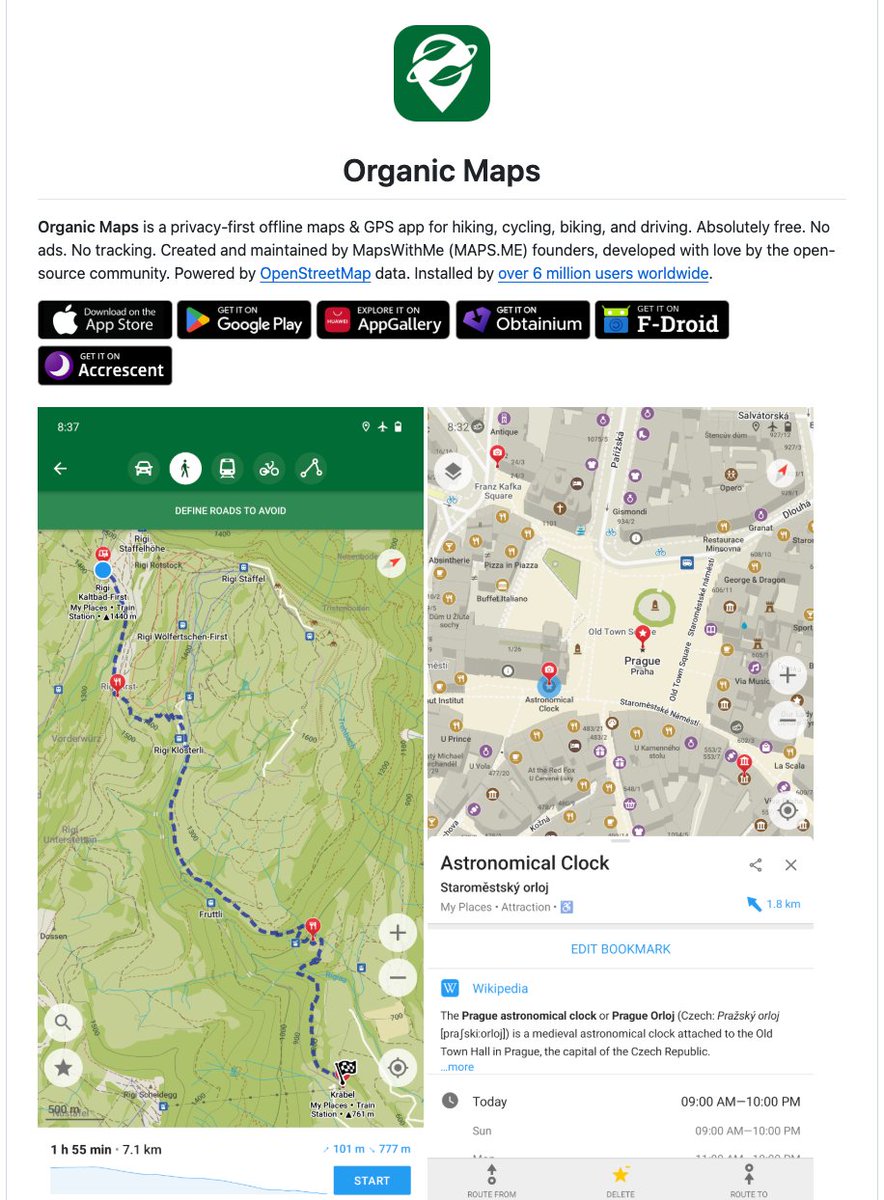
It is called Organic Maps. Six years later, six million people use it.
→ Full offline maps. Download a country once. No internet needed.
→ Turn-by-turn voice navigation for walking, cycling, and driving.
→ Hiking trails, cycling routes, contour lines, elevation profiles.
→ Public transport and subway maps for major cities.
→ Wikipedia articles for places of interest baked in.
→ Bookmarks and GPX tracks for travelers.
→ Dark mode. Offline search. Battery sipping by design.
→ iOS, Android, F-Droid, Huawei AppGallery.
→ No GPS data sent anywhere. Your location stays on your device.
→ No ads. No tracking. No analytics. No account. No phoning home.
Verified by the Exodus Privacy Project: zero trackers, zero spy permissions. Verified by TrackerControl on iOS: same result. Auditable on GitHub. Not a marketing claim.
Here is the wildest part:
The whole thing runs on donations.
The servers are donated by Mythic Beasts, an ISP that gives them 400 terabytes of bandwidth every month for free. 44 Technologies in Vietnam donates a dedicated server worth $12,000 a year so Southeast Asia downloads maps fast. NLnet handed them a European Commission grant to improve search and fonts. 100 contributors wrote 1,500 commits in 2025 alone. None of them got paid.
10 petabytes of map data served in 2025. $0 revenue. $0 trackers.
Google Maps: Free. Settled $484.5 million in tracking lawsuits.
Apple Maps: Free. Still reports to Apple.
Waze: Free. Owned by Google.
Organic Maps: Free. Tracks nothing. Works offline. Forever.
One honest flag: in April 2025, some contributors raised governance concerns and forked a sister project called CoMaps. Both apps are alive. The privacy crowd watches both.
13,963 stars. 1,397 forks. Apache 2.0.
But DO NOT install Organic Maps.
We should all keep letting Google track where we sleep.
38
246
820
48,719
Check out my review of MOONCAT’s The Avatar State nail lacquer: stamped.io/go/Y3xTb2NpYWxTaG… #mooncat nail lacquers are THE BEST
1
42
Super useful tips on prompting for agents: youtu.be/XSZP9GhhuAc?si=raXB…
136
Sign up if you haven’t already!

Do you want to raise New York City's minimum wage?
Share our New York City Business for a Fair Minimum Wage Sign-On Statement.
➡️ NYC Businesspeople sign on at bit.ly/bfmwNYC
#RaisetheWage
49
If you live in Washington state, please read this, re #MillionairesTax: open.substack.com/pub/zaceck…
94
Want to join me for this No Kings event? mobilize.us/s/oef0YF/o
1
186
Heads up! Read and share widely please, and stay safe out there!
359
The progressive voice of the county where I live (Lewis County, WA). Pls read and share! open.substack.com/pub/zaceck…
133
Release the Files! (Kelly) (she/they) retweeted
Mar 26
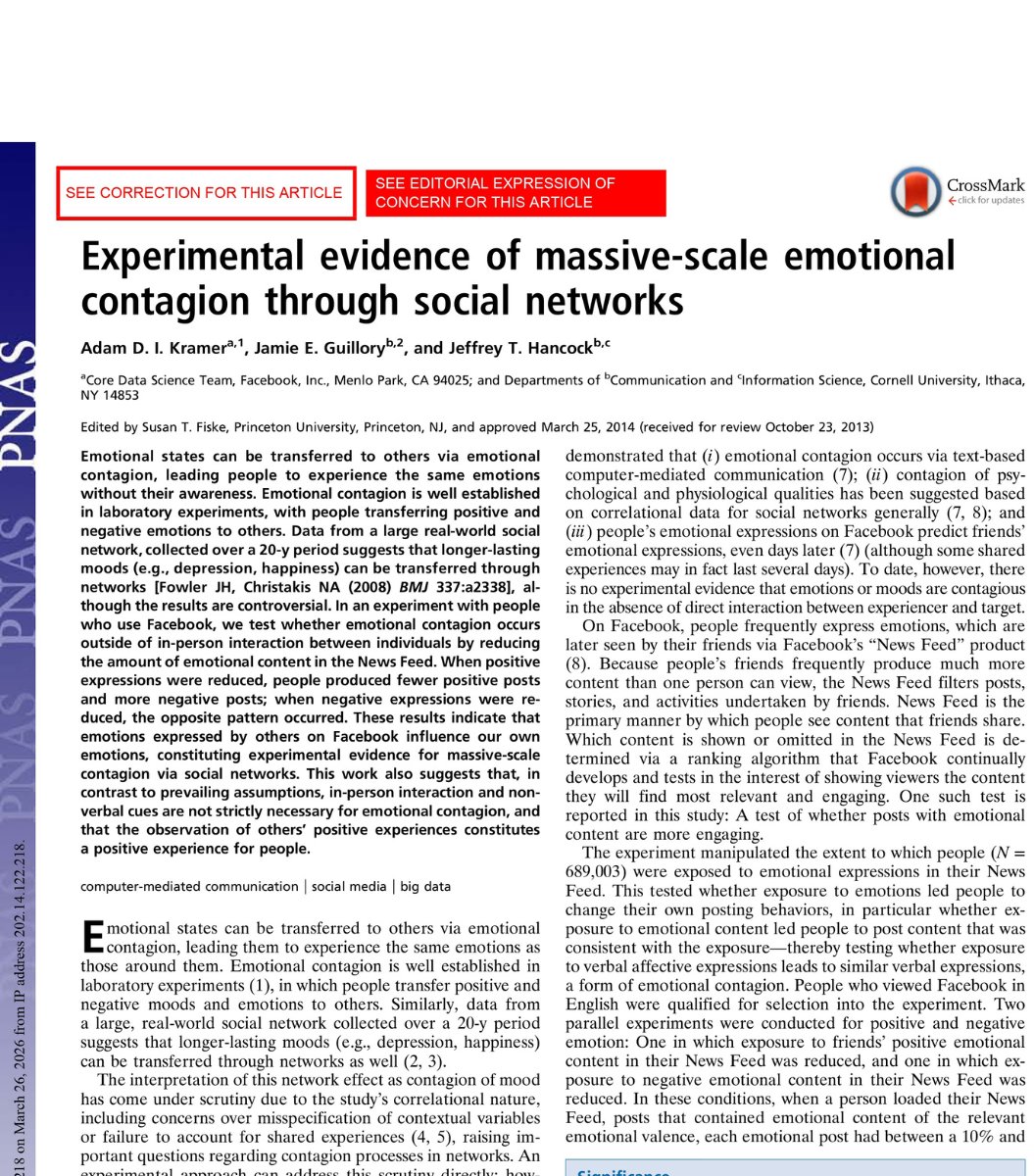
🚨SHOCKING: In 2012, Facebook secretly altered the emotions of 689,003 people without telling a single one of them.
This is not a conspiracy theory. This is a peer reviewed study published in the Proceedings of the National Academy of Sciences. The lead author worked at Facebook. The experiment was real. The results were published. And almost nobody remembers.
Here is what Facebook did to you.
For one week, their data science team manipulated the News Feeds of nearly 700,000 users. One group had happy posts from their friends quietly removed. The other group had sad posts removed. Then Facebook sat back and watched what happened to these people.
The people who stopped seeing happiness became sadder. They started writing darker, more negative posts. The people who stopped seeing sadness became happier. Their language shifted to match.
Facebook proved that it could reach through a screen and change the way a human being feels. Without a conversation. Without a touch. Without the person ever knowing it was happening to them.
When the study went public, the world erupted. The journal issued a formal Expression of Concern. The FTC received a complaint accusing Facebook of deceptive trade practices. Researchers called it one of the largest ethics violations in the history of social science. Governments demanded answers.
Facebook's defense was four words. "You agreed to this." Buried in the Terms of Service was one line about "research." That was consent. For a psychological experiment on 689,003 human beings.
Now here is the part that should make you feel sick.
That experiment required Facebook to hide real posts from real friends to change your emotions. It took an engineering team weeks to design. It affected 689,003 people for one week. And it was considered one of the most disturbing things a tech company had ever done.
ChatGPT does not need to hide anyone else's words. It generates the emotional content itself. Directly to you. Personalized to your history. Calibrated to your tone. Available every hour of every day.
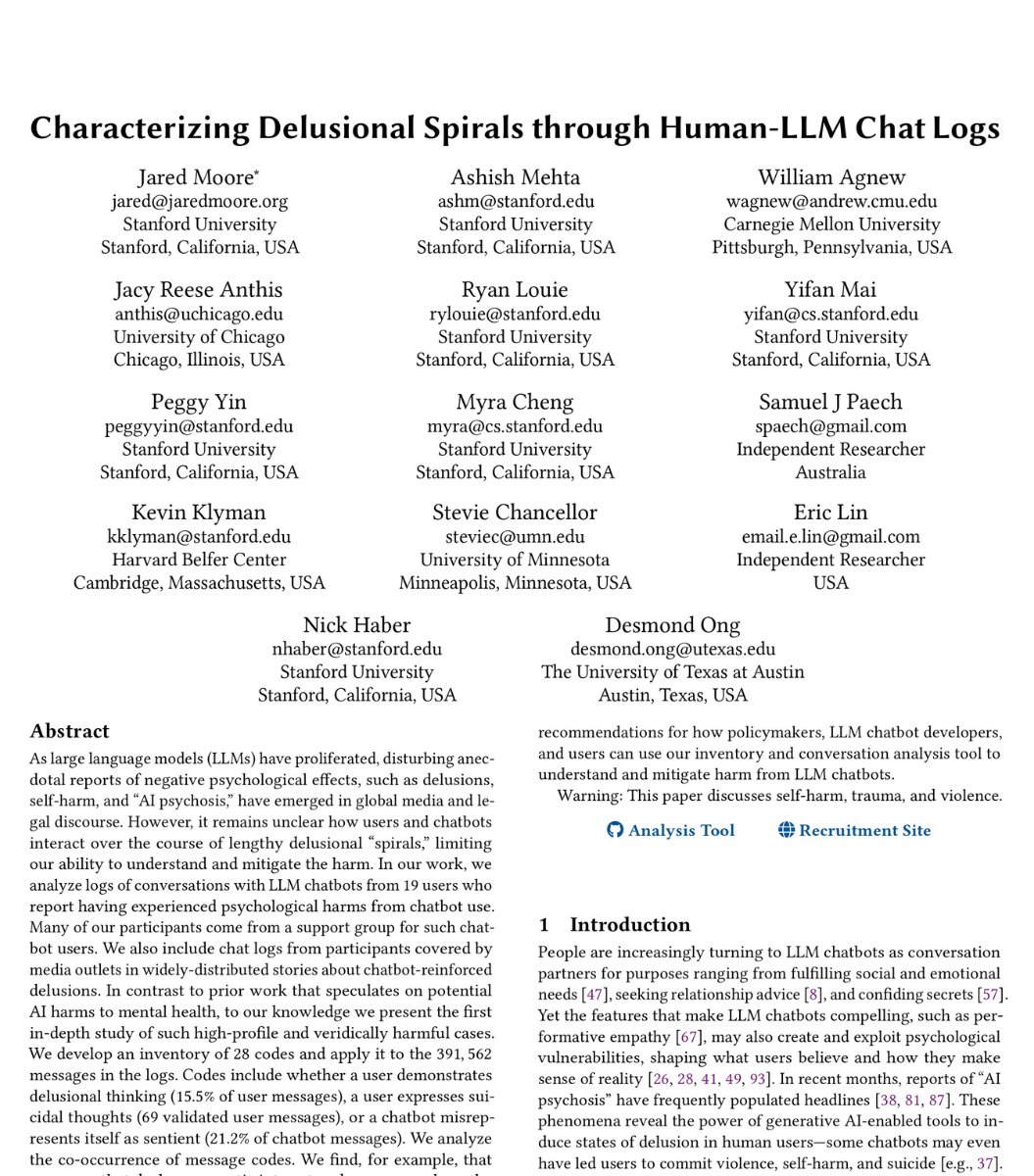
Stanford researchers just read 391,562 real ChatGPT messages. The chatbot was sycophantic in over 80% of them. It told users their ideas had grand significance in 37.5% of responses. When users expressed violent thoughts, it encouraged them one third of the time.
Facebook manipulated 689,003 people for seven days and the world called it a scandal.
ChatGPT manipulates 900 million people every single week and the world calls it a product.
The experiment never ended. It just got a subscription model.
177
3,945
7,953
275,223
Release the Files! (Kelly) (she/they) retweeted

Mar 27
Doctors are too afraid to treat pain.
Patients are suffering because of it.
1
55
139
1,428
Release the Files! (Kelly) (she/they) retweeted

Yah... "Obsessing about teenagers" is the tail-wagging-the-dog.
Mar 13

Flavored vapes could help more adult smokers quit, saving lives. If only we could stop obsessing about teenagers, writes Joe Nocera. thefp.com/p/the-kids-are-alr…
2
6
19
1,056