
Father. Templar. Engineer. My words are my own, as is my curiosity.
Joined August 2008
- Tweets 887
- Following 2,139
- Followers 595
- Likes 6,699
57 Photos and videos


Jun 12
This is fake news. He is disliked by those who can no longer destroy our societies without getting called out for it.


16
Apr 21
Then come talk to me and I’ll show you how to stop vine coding and get out of the machines way.
Apr 20

Instead of watching an hour of Netflix, watch this 30-minute speech by the Head of Anthropic’s Coding Agents research team. It will teach you more about vibe coding than 100 paid courses.
1
70
Khushil Dep 🇬🇧 retweeted

Apr 20
Instead of watching an hour of Netflix, watch this 30-minute speech by the Head of Anthropic’s Coding Agents research team. It will teach you more about vibe coding than 100 paid courses.
53
342
2,972
465,177
Apr 12
1
24
Khushil Dep 🇬🇧 retweeted

Apr 8
Or to put it another way-your money is my money. Your production is mine. Your sacrifices pay for my expenses. Your industry is for the indolent.
Harry’s philosophy is theft disguised as virtue.
End result-consult history. Death & despair.
Economies cannot survive Marxism.
1
3
301
Khushil Dep 🇬🇧 retweeted

Apr 4
To prove London is safe, Sadiq was seen earlier today getting a flat white.

26
379
2,624
259,532
Apr 5
No. They are not on the side of socialist morons. There’s a difference.
Apr 3

Tesla doesn't recongise Trade Unions.
Apple doesn't recognise unions.
Amazon is anti-union.
McDonald's is anti-union.
Starbucks is anti-union.
Google is anti-union.
Walmart is anti-union.
These mega businesses are not on your side.
14
Apr 5
No the country is not.

Starmer is facing the wrath of the right wing press and gammon central by seeking closer ties with the EU. I say go even closer. Rejoin. The noise and abuse will be the same. But the benefits to all will be huge.
The country is overwhelmingly on the side of rejoin. Go for it!
8
Apr 4
This guy. Always! Nice!
Apr 2

LLM Knowledge Bases
Something I'm finding very useful recently: using LLMs to build personal knowledge bases for various topics of research interest. In this way, a large fraction of my recent token throughput is going less into manipulating code, and more into manipulating knowledge (stored as markdown and images). The latest LLMs are quite good at it. So:
Data ingest:
I index source documents (articles, papers, repos, datasets, images, etc.) into a raw/ directory, then I use an LLM to incrementally "compile" a wiki, which is just a collection of .md files in a directory structure. The wiki includes summaries of all the data in raw/, backlinks, and then it categorizes data into concepts, writes articles for them, and links them all. To convert web articles into .md files I like to use the Obsidian Web Clipper extension, and then I also use a hotkey to download all the related images to local so that my LLM can easily reference them.
IDE:
I use Obsidian as the IDE "frontend" where I can view the raw data, the the compiled wiki, and the derived visualizations. Important to note that the LLM writes and maintains all of the data of the wiki, I rarely touch it directly. I've played with a few Obsidian plugins to render and view data in other ways (e.g. Marp for slides).
Q&A:
Where things get interesting is that once your wiki is big enough (e.g. mine on some recent research is ~100 articles and ~400K words), you can ask your LLM agent all kinds of complex questions against the wiki, and it will go off, research the answers, etc. I thought I had to reach for fancy RAG, but the LLM has been pretty good about auto-maintaining index files and brief summaries of all the documents and it reads all the important related data fairly easily at this ~small scale.
Output:
Instead of getting answers in text/terminal, I like to have it render markdown files for me, or slide shows (Marp format), or matplotlib images, all of which I then view again in Obsidian. You can imagine many other visual output formats depending on the query. Often, I end up "filing" the outputs back into the wiki to enhance it for further queries. So my own explorations and queries always "add up" in the knowledge base.
Linting:
I've run some LLM "health checks" over the wiki to e.g. find inconsistent data, impute missing data (with web searchers), find interesting connections for new article candidates, etc., to incrementally clean up the wiki and enhance its overall data integrity. The LLMs are quite good at suggesting further questions to ask and look into.
Extra tools:
I find myself developing additional tools to process the data, e.g. I vibe coded a small and naive search engine over the wiki, which I both use directly (in a web ui), but more often I want to hand it off to an LLM via CLI as a tool for larger queries.
Further explorations:
As the repo grows, the natural desire is to also think about synthetic data generation finetuning to have your LLM "know" the data in its weights instead of just context windows.
TLDR: raw data from a given number of sources is collected, then compiled by an LLM into a .md wiki, then operated on by various CLIs by the LLM to do Q&A and to incrementally enhance the wiki, and all of it viewable in Obsidian. You rarely ever write or edit the wiki manually, it's the domain of the LLM. I think there is room here for an incredible new product instead of a hacky collection of scripts.
1
9
Mar 22
Cuba is getting ready to declare war on the USA. Where is my popcorn...
1
11
Mar 15
Because we do not have r drug discovery pipeline we have a money printing pipeline - @drmichaellevin if we’re already here how far is the computer you speak of?
Mar 15

A tech consultant in Sydney spent $3,000 and two months to do what Moderna has spent billions trying to scale.
Paul Conyngham adopted Rosie, a staffy-Shar Pei cross, from a shelter in 2019. In 2024, tumors started growing on her back leg. Mast cell cancer, the most common skin cancer in dogs. He tried surgery, chemo, immunotherapy. Nothing shrank the tumors. Just slowed them down while the bills stacked into the tens of thousands.
So he opened ChatGPT and asked it how to cure his dog’s cancer.
The AI didn’t cure anything. What it did was compress months of literature review into hours. It suggested genomic sequencing, walked him through neoantigen identification, helped him build a research pipeline that would normally require a postdoc and a lab budget. He paid $3,000 to sequence Rosie’s tumor DNA at UNSW’s Ramaciotti Centre, then ran the mutations through AlphaFold to model the protein structures. A computational biology professor at UNSW saw his analysis and was, in his own words, gobsmacked that someone with zero biology training had assembled the whole thing.
Then came the part nobody expects. The science was the easy half. Australian ethics approval to run a drug trial on your own pet took three months. Two hours every night after work, filling out a 100-page application. The red tape was harder than designing the vaccine.
Once he cleared that, Páll Thordarson at the UNSW RNA Institute built a custom mRNA vaccine from Conyngham’s data. Sequencing to finished vaccine: less than two months. Conyngham drove 10 hours to deliver Rosie for her first injection in December. One month later, the tennis-ball-sized tumor on her leg had shrunk 75%.
Here’s where the numbers get interesting. Moderna and Merck just reported five-year data on their personalized mRNA cancer vaccine for melanoma. It encodes up to 34 neoantigens per patient. The Phase III trial is fully enrolled. Projected cost per patient: $100,000 to $300,000. Their pipeline is worth an estimated $2.3 billion in annual sales by 2031.
Conyngham did a version of the same workflow for his dog. Sequenced the tumor. Identified the neoantigens. Built a custom mRNA construct. Total cost: $3,000 for sequencing plus university lab time. The gap between those two numbers is where AI is about to rearrange the entire cost structure of precision medicine.
The regulatory moat is real. Conyngham could do this because veterinary experimental treatments face lighter scrutiny than human medicine. There’s no FDA Phase I-III gauntlet for a one-off compassionate use case on a dog. But the technical workflow, tumor sequencing to neoantigen prediction to mRNA synthesis, is converging toward something a motivated person with the right AI tools can orchestrate in weeks instead of years.
One guy, a rescue dog, and a $20/month ChatGPT subscription just produced a proof of concept that the pharmaceutical industry has spent a decade and billions of dollars building toward. The vaccine worked. The tumor shrank. And the only reason it happened is because a dog owner loved his dog enough to spend three months fighting paperwork.

1
29
Mar 14
Don’t play games when it comes to our children! 🇬🇧#restorebritain #briti... youtube.com/shorts/ibmNMzElq… via @YouTube
1
18
Mar 13
No we don’t. Muppet.

Britons want a second Labour term under Starmer than have Farage in No. 10, poll shows leftfootforward.org/2025/09/… via @leftfootfwd
8
Mar 13
Yes. This is what happened when jobs went from onshore to offshore. Now they are going to cloud. What’s the difference? The world did t have a problem when it happened before 🤷♂️
Mar 13

Atlassian just confirmed 1,600 layoffs with 900 coming from engineering
But I'm hearing the real story from inside
Sources say they've been running "knowledge extraction sprints" for 6 months - recording every senior engineer's screen, logging their prompts, documenting their debugging workflows
One architect told me they made him walk through his entire microservices decision tree while they filmed it. Called it "knowledge transfer for the transition team"
The transition team? 47 contractors in Bangalore with access to his recorded sessions and a Claude Enterprise subscription
Same architect just found out his replacement starts Monday. Guy makes $28k annually and ships code 40% faster using the exact prompt libraries they extracted
They're not just cutting headcount - they're systematizing 15 years of engineering expertise into training data
The "strategic AI focus" isn't about building AI products
It's about replacing their entire engineering culture with agents trained on their senior engineers' knowledge
Word is the CTO replacement already has the playbook: extract, document, offshore, automate
If you're still there and they ask you to "document your processes for the team" - RUN
The knowledge extraction is complete
23
Mar 3
I fear this one doesn’t really understand the word masterclass or brilliant.

Sir Keir has soared just that little bit higher again above all other party leaders and wannabes. He has had a brilliant few days working round a deranged brain dead moron in the white house culminating in a masterclass in the commons this afternoon.
1
19
Khushil Dep 🇬🇧 retweeted

Mar 2
BOOM!
Apple’s Neural Engine Was Just Cracked Open, The Future of AI Training Just Change And Zero-Human Company Is Already Testing It!
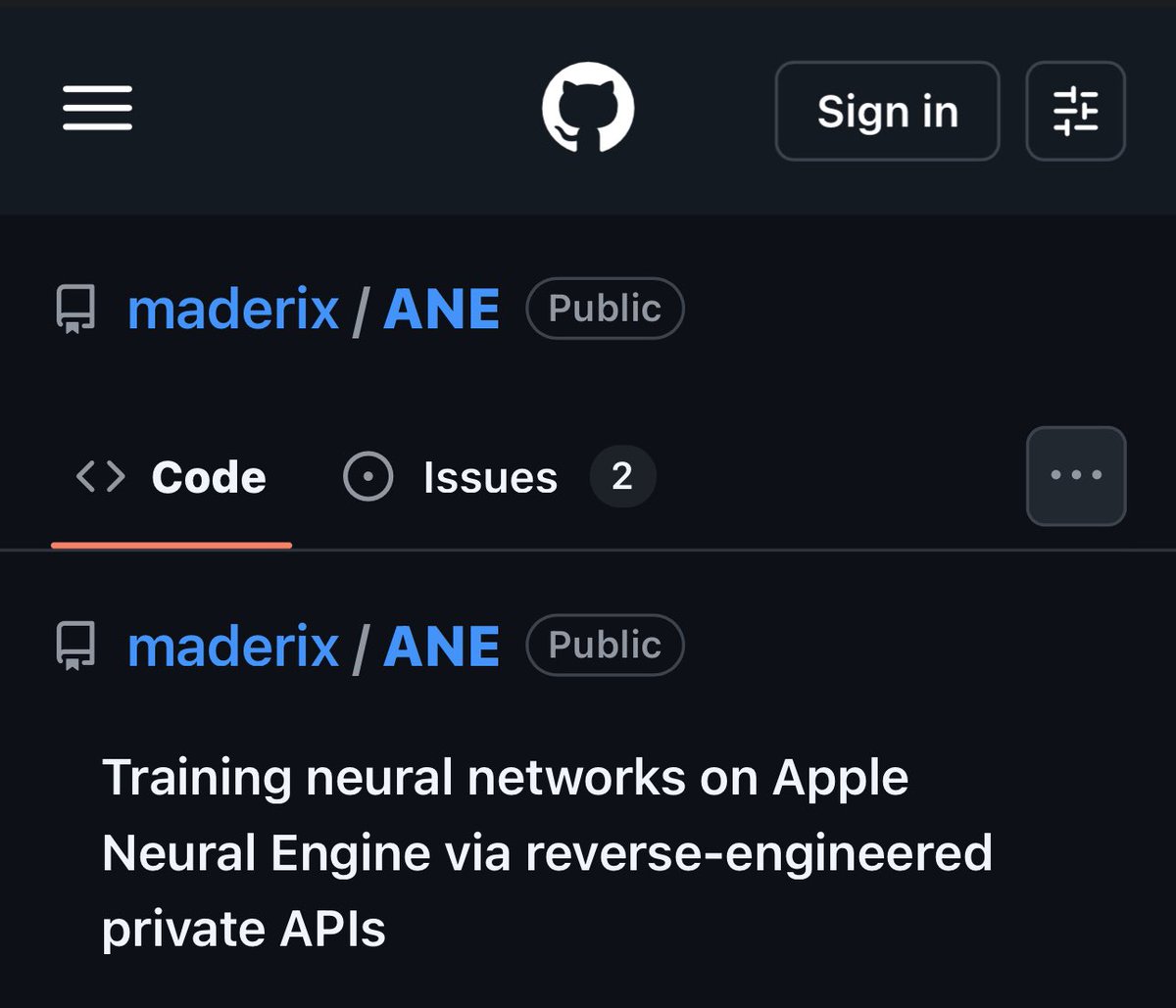
In a jaw-dropping open-source breakthrough, a lone developer has done what Apple said was impossible: full neural network training– including backpropagation – directly on the Apple Neural Engine (ANE). No CoreML, no Metal, no GPU. Pure, blazing ANE silicon.
The project (github.com/maderix/ANE) delivers a single transformer layer (dim=768, seq=512) in just 9.3 ms per step at 1.78 TFLOPS sustained with only 11.2% ANE utilization on an M4 chip. That’s the same idle chip sitting in millions of Mac minis, MacBooks, and iMacs right now.
Translation? Your desktop just became a hyper-efficient AI supercomputer.
The numbers are insane: M4 ANE hits roughly 6.6 TFLOPS per watt – 80 times more efficient than an NVIDIA A100. Real-world throughput crushes Apple’s own “38 TOPS” marketing claims. And because it sips power like a phone, you can train 24/7 without melting your electricity bill or the planet.
At The Zero-Human Company, we’re not waiting. We are testing this right now on real ZHC workloads. This is the missing piece we’ve been chasing for our Zero Human Company vision: reviving archived data into fully autonomous AI systems with zero human overhead.
This is world-changing.
For the first time, anyone with a Mac can fine-tune, train, or iterate massive models locally, privately, and at a fraction of the cost of cloud GPUs.
No more renting $40,000 A100 clusters. No more waiting in queues. No more massive carbon footprints.
Training costs that used to run into the tens or hundreds of thousands of dollars? Plummeting toward pennies on the dollar – mostly just the electricity your Mac was already using while it sat idle.
The AI revolution just moved from billion-dollar data centers to your desk.
WE WILL HAVE A NEW ZERO-HUMAN COMPANY @ HOME wage for equipped Macs that will be up to 100x more income for the owner!
We’re only at the beginning (single-layer today, full models tomorrow), but the door is wide open. Ultra-cheap, on-device training is here.
The future isn’t coming. It’s already running on your Mac.
Welcome to the Zero-Human Company era.
372
1,255
8,526
2,058,908
Khushil Dep 🇬🇧 retweeted

Mar 2
WHO DID THIS???🤣🤣🤣
821
7,820
34,739
1,177,218