
Joined May 2025
- Tweets 5,055
- Following 259
- Followers 1,002
- Likes 17,890
69 Photos and videos









Pinned Tweet

Mar 22
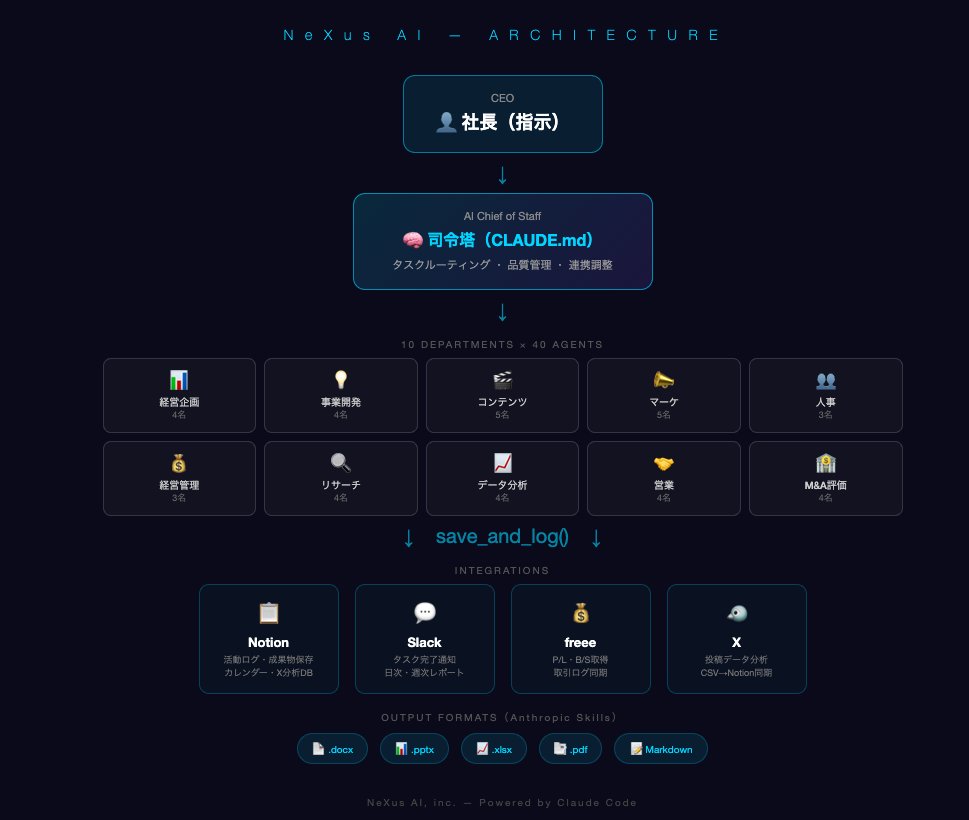
1人法人のバックオフィスをClaude Code × Notion APIで全自動化してみた。
やったこと:
・成果物を部門別にNotionページへ自動保存
・タスク完了→活動ログDBに自動記録→Slackに通知
・freee会計のP/L・B/Sを取得→月次決算レポートを自動生成
・X投稿データをCSVからNotionDBに自動取り込み
・カレンダーDBで予定管理
全部Pythonスクリプト APIで、手入力はゼロ。
しばらくこの運用を続けてみて、どうだったか共有していきます。

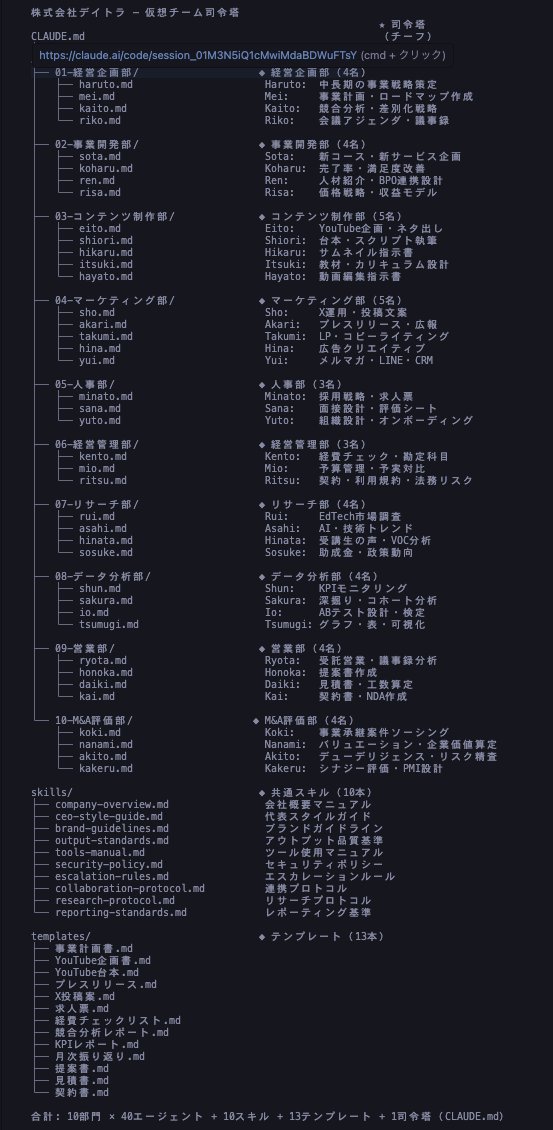
Claude Codeで「10部門40人」の仮想社員を雇った。
経営企画、事業開発、マーケ、営業、M&A評価部まで完備。
指示を出すと最適な担当が自動で動き、部門をまたぐ案件はサブ担当も自動アサインされる。
1人社長でも、組織として意思決定できる環境がAIで作れる時代になった。
1
15
4,104
May 6
「コーディングの知識ゼロでも、Claude Code 4.7で30分で3つのWebアプリが動いた」という投稿が17000いいねを集めていた。
数字より気になったのが「ZERO知識」の部分。
何を作るか決められる人と作り方を知っている人が、ここで分離していく感覚があった。
コードを覚えていることの優位性は、半年単位で減価していく。
7
107
May 4
「The Agency」というOSSが公開されていた。
1社分のAIエージェントを144体パッケージ化し、Claude Code / Cursor / Copilot / Gemini CLI / Windsurfにスクリプト2本で導入できる構成。
12部門(エンジニア・デザイナー・マーケ・営業・財務など)の専門エージェントが入っていて、MITで完全無料、GitHubスター9万超。
仮想チーム10部門を運用している立場としては、自分の構築と何が違うかを比べる教材として一度読み込みたい。
1
4
252
May 4
54
May 4
Anthropicの公式から「Claude Codeで会社をまるごと運用するためのプレイブック」が出ていた。
CEOは人間1名・社員はAIエージェント・業務分担はAI側で完結、という前提の構成。
ゼロ・ヘッドカウント・カンパニーという呼称まで添えてきた。
これは思想ドキュメントではなく、もう実装ガイドの域。
公式が出してきた瞬間に、世間の基準値が一段上がる構造になる。
GW中に1度、自分の業務分担表をこの公式図に重ね直す価値がある。
1
4
183
May 4
概要: Anthropic公式が「Claude Codeで会社を運用するプレイブック」を公開。CEOは人間1人、社員はAIエージェント、業務はAI分担。
x.com/RoundtableSpace/status…

ANTHROPIC JUST RELEASED THE OFFICIAL PLAYBOOK FOR BUILDING A COMPANY WITH CLAUDE CODE.
CEO: 1 human. Employees: AI agents. Operations: fully automatic.
The zero-headcount company is no longer a joke.
Community note
Anthropic's playbooks for Claude focus on technical coding skills & agent tools, not building zero-headcount companies. The video is a May 2025 Google Cloud presentation on Vertex AI integration, not a new Anthropic release.
anthropic.com/product/claude…
youtube.com/watch?v=TUysIA…
112
May 4
Claude Codeをプロンプトを工夫するツールだと思っているうちは、半分も使えていない。
設計層として5つのレイヤーがある、と整理すると一気に見通しが立つ。
- Memory層: CLAUDE.md(規約・命名・テスト・リポマップを常駐)
- Skills層: 再利用可能な手順を関数化
- Agents層: 役割の異なるサブエージェント
- Tools層: MCPで外部ツールに接続
- Workflow層: /plan, /insights, /reviewなどの運用儀式
プロンプト改善はこの5層のうちのほんの1段でしかない。
4層はAI以外の設計の話。
ここを設計し直す習慣が、半年後の効きを大きく変える。
1
3
140
May 4
概要: Claude Codeを5レイヤー(Memory / Skills / Agents / Tools / Workflow)の設計物として捉えるフレーム。プロンプト改善はそのうちの1段にすぎないという視点。
x.com/LearnWithBrij/status/2…
May 3

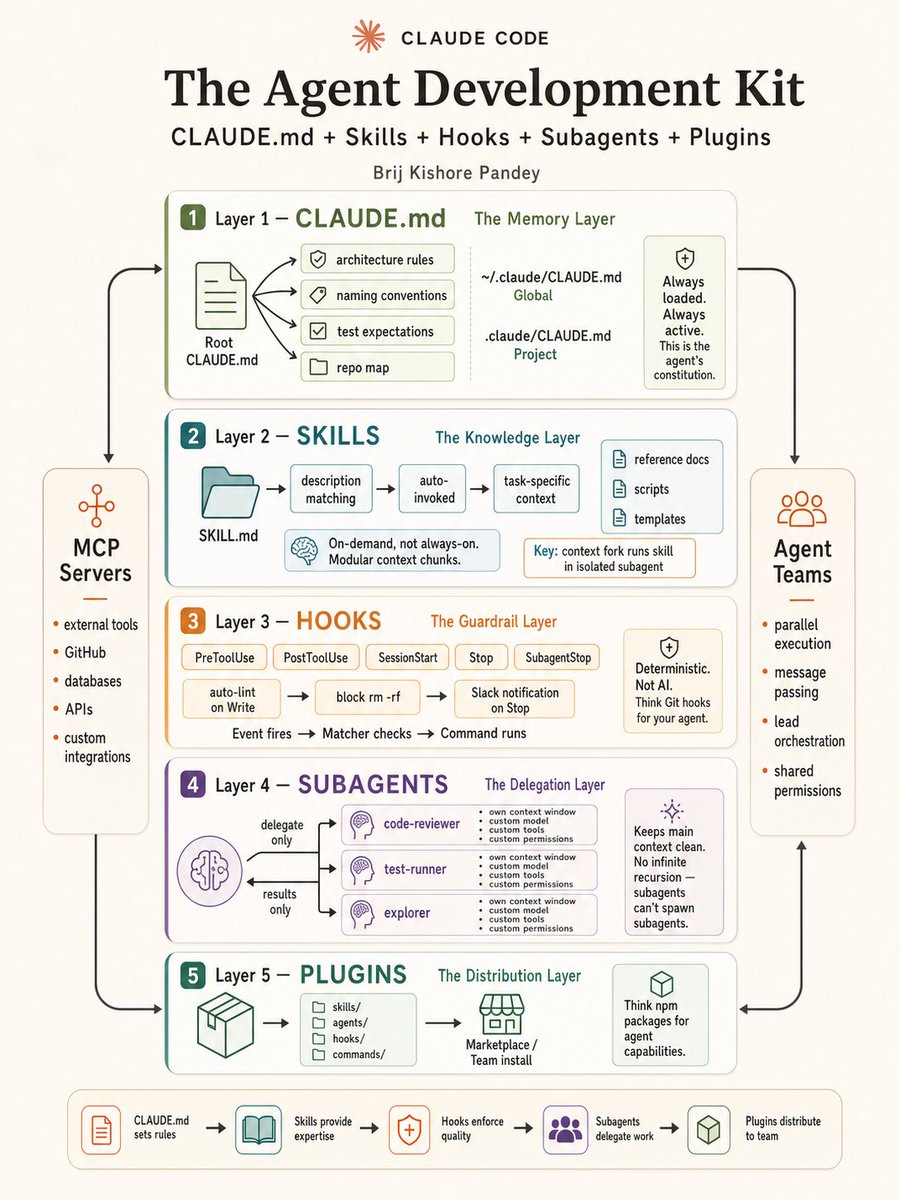
Claude Code ships with 5 architectural layers most engineers never open.
Not features. Not settings. Layers — each solving a distinct problem that LLMs alone can't solve. And four of them have nothing to do with prompting.
Here's the full Agent Development Kit:
Layer 1 — CLAUDE.md → The Memory Layer
Architecture rules, naming conventions, test expectations, repo map. Always loaded. Always active.
Two scopes:
• ~/.claude/CLAUDE.md → global
• .claude/CLAUDE.md → project
This isn't context you paste in before every session. It's context that never needs repeating. The agent's constitution.
Layer 2 — Skills → The Knowledge Layer
Each SKILL.md carries a description. Claude matches it at runtime and forks the skill into an isolated subagent. On-demand, never always-on.
Task-specific knowledge without inflating your main context window. Modular by design.
Layer 3 — Hooks → The Guardrail Layer
PreToolUse → PostToolUse → SessionStart → Stop → SubagentStop
This is the layer most teams skip. And the one they regret skipping first.
Hooks are NOT AI. They're deterministic event-driven shell commands.
• Auto-lint on every Write
• Hard-block on rm -rf
• Slack notification on Stop
Event fires → Matcher checks → Command runs
Quality enforced at the infrastructure level. Not the prompt level.
Layer 4 — Subagents → The Delegation Layer
Each subagent gets its own context window, model, tools, and permissions.
Main agent delegates down. Receives results up. That's it.
No infinite recursion — subagents can't spawn subagents. Main context stays clean. Hard boundaries by design.
Layer 5 — Plugins → The Distribution Layer
Bundle your skills agents hooks commands into a plugin. One install. Whole team inherits the behavior.
Think npm packages — but for what your agent knows how to do.
Wrapping everything:
→ MCP Servers on the left (GitHub, databases, APIs, custom integrations)
→ Agent Teams on the right (parallel execution, message passing, shared permissions)
The 5-layer stack in one line:
CLAUDE.md sets rules → Skills provide expertise → Hooks enforce quality → Subagents delegate work → Plugins distribute to the team
Most production failures in agentic systems trace back to one missing layer.
Which one is the gap in your current setup?
76
May 4
Claude Codeの使い方を改善するにはどうすればいいのか?
それはClaude Codeに聞くのが早い!
つまり自分の使い方そのものをClaude Codeにレビューさせる、というやり方。
手順は3つだけ。
1. /insights を実行.
2.ツール呼び出しと作業のレポートが出る
3. 「このレポートから、自分のClaude Code運用で最悪な癖を⚪︎個と、それぞれの直し方を出して」と聞く
自分では気づけなかった癖とその改善方法が1つは出てくる。
1
3
182
May 4
僕の場合だと一つスラッシュコマンドを追加した方がいいよと提案された。
/insightsと打って、そのプロジェクトでの自分の癖と改善法を聞いてみてほしい。
29
北原|積み上げ×AI retweeted

Claude Codeの自律的なタスク完結能力は高いですが、人間が『待ち時間』に思考を停止させると危険ですね。MCP連携でコンテキストを適切に管理し、人間は設計とレビューに特化するワークフロー構築が必須だと感じます。
x.com/kitahara_dev/status/20…
May 2

22歳のエンジニアが「Claude Codeのターミナルを毎日6〜8個開いて、返答待ちでEnterを押すだけの作業を半年続けたら、頭が前ほど冴えなくなった」と書いていた。
本人も「Claude Codeの問題ではなく、自分の使い方の問題」と認めている。
ただ、Enterを押すだけの時間が増えるほど、自分で考えた量はそのまま減る。
速度を取りに行きすぎると、判断する筋力が落ちる構造になっている。
1
1
177
May 2
22歳のエンジニアが「Claude Codeのターミナルを毎日6〜8個開いて、返答待ちでEnterを押すだけの作業を半年続けたら、頭が前ほど冴えなくなった」と書いていた。
本人も「Claude Codeの問題ではなく、自分の使い方の問題」と認めている。
ただ、Enterを押すだけの時間が増えるほど、自分で考えた量はそのまま減る。
速度を取りに行きすぎると、判断する筋力が落ちる構造になっている。
Apr 30

I'm 22 years old and Claude Code is deteriorating my brain.
Every single day for the last 6 months I've had 6 to 8 Claude Code terminals open, waiting for a response just so I can hit 'enter' 75% of the time. And it's doing something to me.
In convos with a couple of friends, it's been a point that's been brought up pretty frequently.
None of us feel as sharp as we used to.
I don't know if it's just us, or others in their 20s are feeling the same thing, but it's something I've been thinking about a lot.
P.S. I know this is a problem with my reliability/usage of it, not Claude Code itself, but the effects are real nonetheless
4
325
May 2
Claude Codeを生んだBoris本人が「自分が毎日触っているのに99%のユーザーが触れていない機能だらけだ」と漏らしていた。
これは耳が痛い。
高頻度のコマンドのまま止まっていて、新機能のリリースノートを試しに行く頻度が落ちていた。
ツール側の進化スピードに、自分の使い方の更新スピードが追いつかない。
週1で新機能を1つ試す枠を切るだけで、半年後の差は別物になりそう。
1
5
123
May 2

えええええ!!??
ClaudeCodeの生みの親である
Boris本人が「俺が毎日使ってるのに99%のユーザーは使ってない」と嘆いた隠れ機能を投稿してた😳
これ、毎日Claude Codeを使ってる人でも「知らない機能」が多すぎたのでツリーで解説👇保存推奨。
48
May 1
Karpathyが30分の講義で「agentic engineering」を語っているのを見た。
vibe codingの上にあるレイヤー、という説明が刺さった。
AIに丸投げするのと、AIを設計しながら使うのは、別物だという話。
1
6
78
May 1
特に印象に残ったのは2つ。
- LLMはghost(亡霊)として扱う。人間の代わりではなく、別の存在として。
- 思考は外注していい。でも、理解は外注するな。
この2つが、vibe codingとの境界線に見えた。
1
1
48
May 1
油断すると気づけば「分からないけど動いた」コードが増える。
思考はアウトソーシングできるが、理解はアウトソーシングできない。
x.com/aerockrose/status/2049…
Apr 30

Yesterday, Andrej Karpathy gave a 30-minute Sequoia masterclass on agentic engineering.
This is the serious layer above vibe coding.
He explained:
- LLMs as ghosts
- The app that shouldn't exist
- Outsource thinking, not understanding
12 lessons that will blow your mind: 🧵
51
May 1
Anthropicの中の人が「社内のコードの90%はClaudeが書いている」と話している。
数字より気になったのは、そのすぐ後の話。
.envファイルが、AIワークフロー全体で一番弱いリンクになる、という指摘。
1
2
60
May 1
「速く書ける」が単独で価値を持つ時期は、もう過ぎた気がする。
これからは「速く書ける」 × 「秘密をどう設計で隠すか」がセットで評価される。
大事な機密データを守る話。
1
21
May 1
Apr 30

Anthropic CISO just told you that 90% of their code is written by Claude.
Then he explained how they protect their own secrets while doing it.
Why your .env file is the weakest link in your entire AI workflow?
Watch it, then grab the full security config below👇
25