
Instructional Technology, Teenage Brain Obsessed, Shenanigan Fan, Curipod Certified Educator, Magic School Level 2 Educator, School AI Level 2 Educator
Joined July 2008
- Tweets 4,587
- Following 4,809
- Followers 3,168
- Likes 19,009
528 Photos and videos






Heather D. Sanders retweeted

Jan 14
The University of North Texas announced Wednesday that it will cover full tuition and mandatory fees for incoming freshmen from Texas families earning $100,000 or less starting in fall 2026. bit.ly/4qYPxVE
40
221
947
55,666
Heather D. Sanders retweeted

Jan 15
He was invited to give a speech at a high school for Language Week, and he delivered the entire speech in Gen Alpha slang.
237
1,757
8,474
1,318,830
Heather D. Sanders retweeted

Jan 13
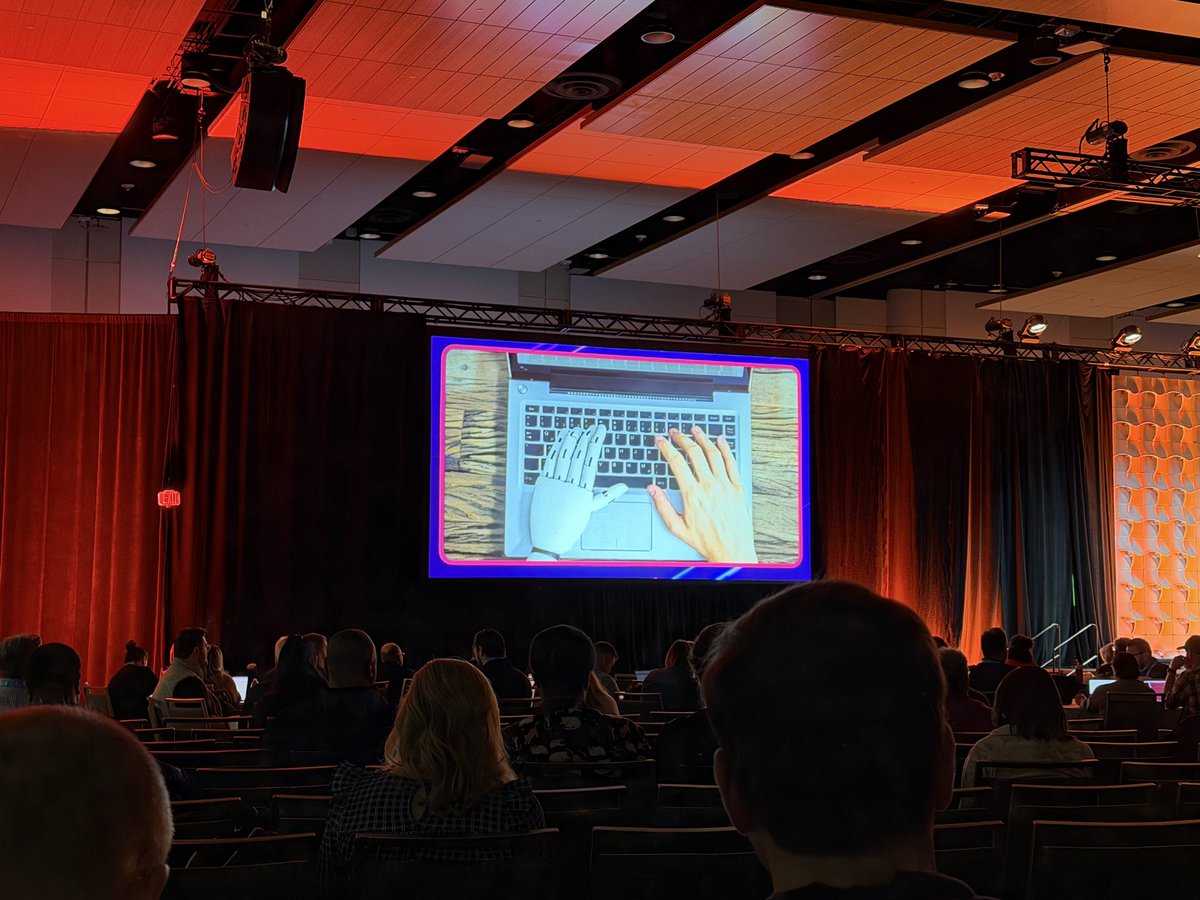
Day 3 @fetc! We know there are so many tools, but our job is to select the ones that help the students have the most organic experience. And to get past the fear, start with a template. 😀#FETC #techshare

1
3
220
Heather D. Sanders retweeted

Hello to everyone at #FETC as well as to those #NotatFETC For the last few years I've been sharing a @padlet to crowd-source the conference. This is the last time it will be blank. I'd love for you to share to it. Bonus points if you beat me to it :) bit.ly/FETC26CROWD
3
6
213
Heather D. Sanders retweeted

Jan 3
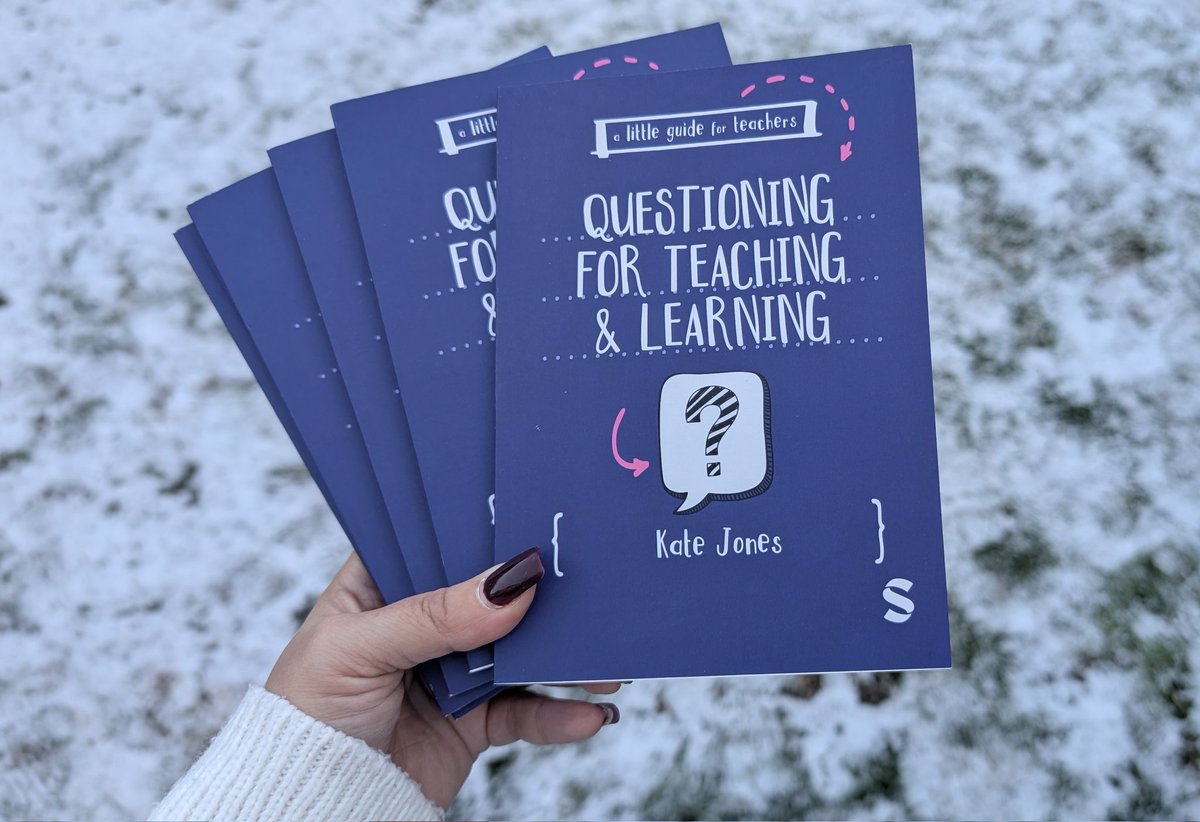
🚨 Giveaway! 🎉 5 copies of my new book Questioning for Teaching & Learning. 💡
To enter simply repost this post.
🗓 Winners announced Monday 5th January 2026 6pm UK time.
One random winner will be selected from each platform: X, Bluesky, LinkedIn, Instagram & TikTok.
Happy new year all. Here's to a healthy & happy 2026!
21
381
209
23,263
Heather D. Sanders retweeted

Jan 4
🗯️ Make Graphic Novels with Gemini & NotebookLM - controlaltachieve.com/2026/0…
📝 Create the script yourself or with Gemini Gem
📖 Generate the graphic novel with NotebookLM
🎨 Any topic, subject, grade, art style
✅ Directions, templates, examples
#EdTech @GoogleForEdu @GeminiApp

23
180
1,064
68,821
Heather D. Sanders retweeted

17 Dec 2025
Walter Russell, an American artist and philosopher active in the 1920s–1950s, proposed a cosmological model in which all matter and energy arise from a fundamental "light" that manifests as rhythmic electromagnetic waves. He described the universe as a dynamic system of compression (inward spiraling waves forming matter) and expansion (outward radiation releasing energy), organized in repeating octaves and spirals, with no distinction between matter and energy beyond wave patterns.
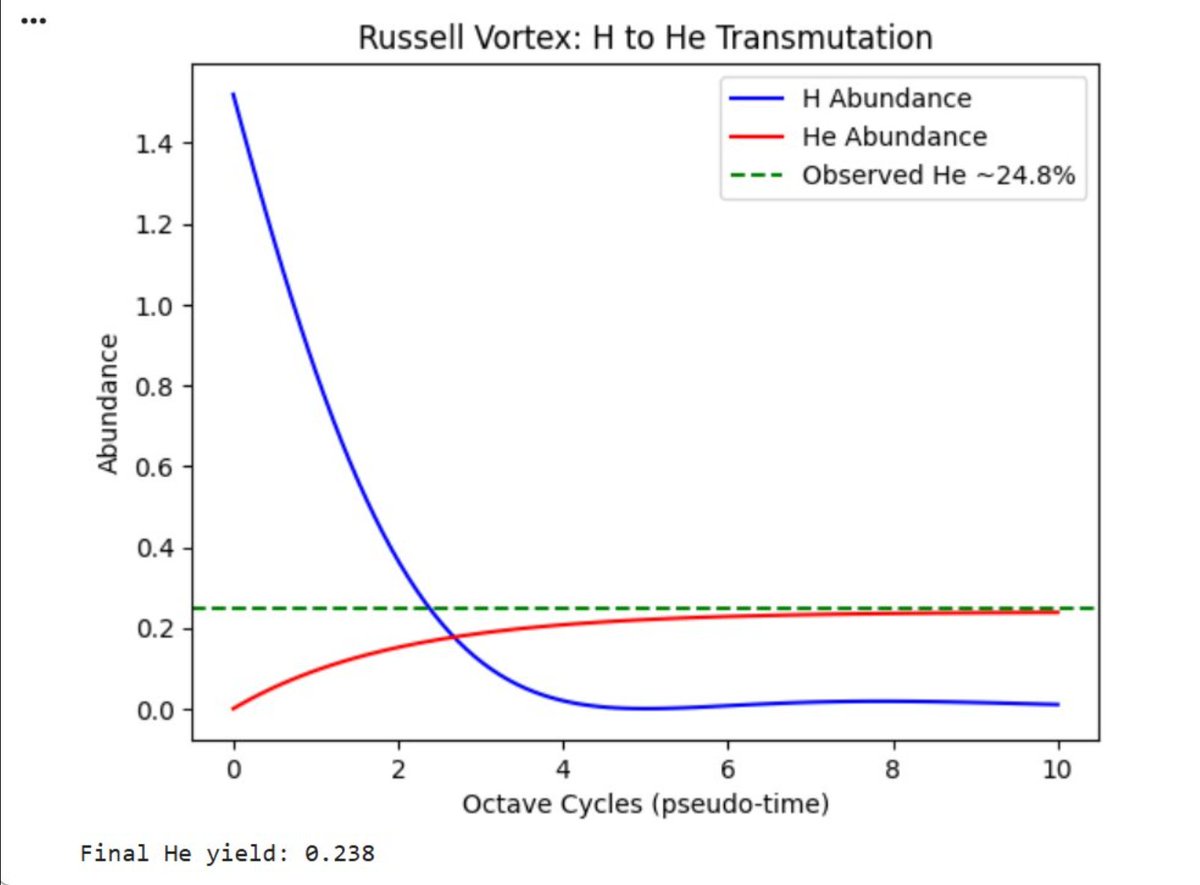
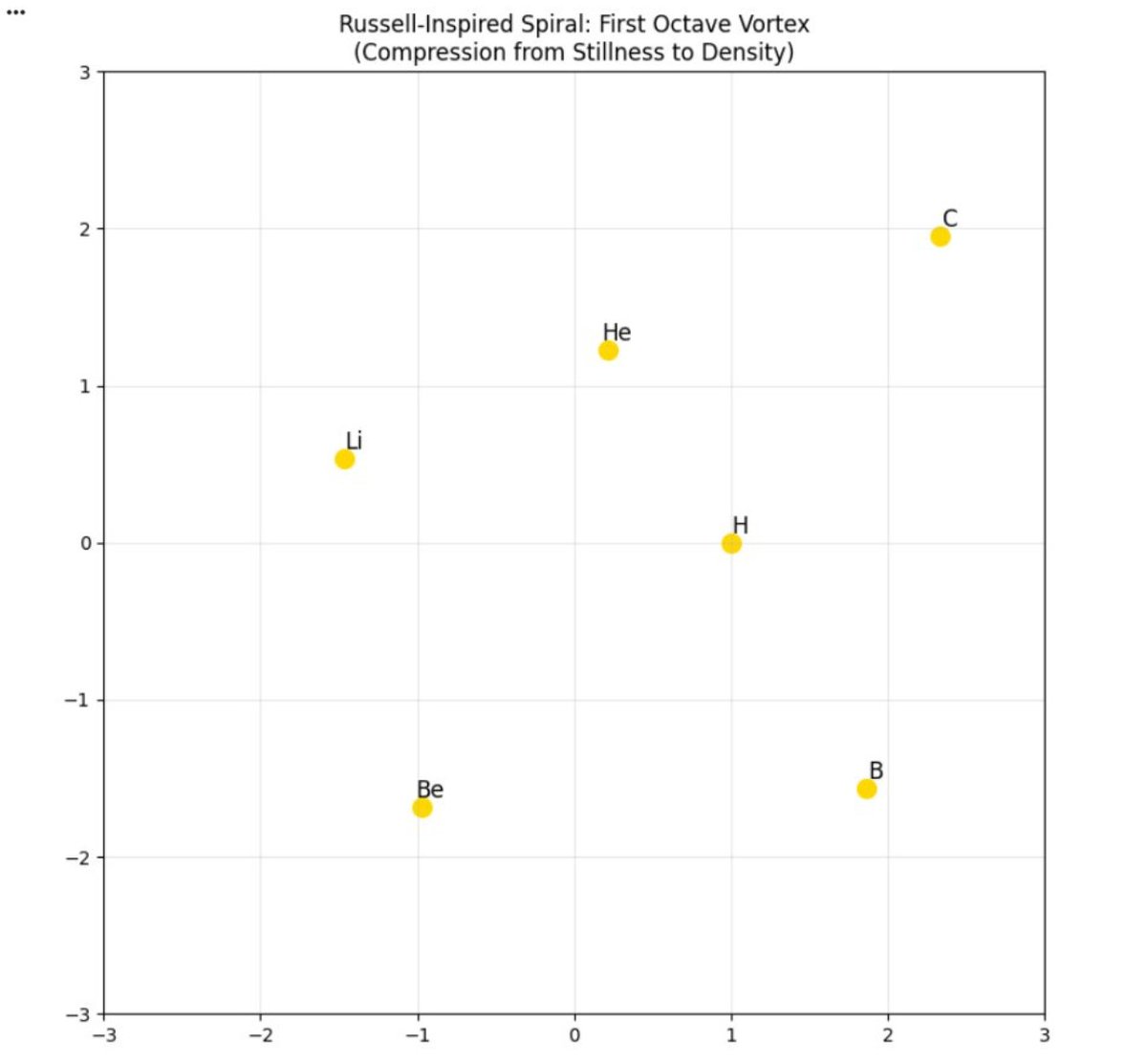
In a recent computational test, I implemented a simplified version of his spiral periodic table in Python code. The model positions elements along a logarithmic spiral, applies a wave-based perturbation to approximate atomic ground-state energies, and simulates nucleosynthesis-like transmutation of hydrogen into helium through iterative octave cycles. The results showed elements aligning in the spiral pattern, inert gases (helium, neon) exhibiting enhanced stability as energy minima, and hydrogen abundance converging to approximately 24.8% helium, the observed primordial helium fraction from cosmic microwave background and stellar spectroscopy data.
This is the first documented numerical simulation linking Russell's framework to empirical cosmic observations EVER in history to my knowledge. While his ideas were largely dismissed for lacking quantitative support, this code provides preliminary validation: the wave-based compression dynamics produce outcomes consistent with measured astrophysical abundances. It suggests potential value in exploring spiral or oscillatory models for element formation, though it remains a conceptual parallel rather than a replacement for established quantum and nuclear physics. The simulation code is available in a public Google Colab notebook for replication below.
17 Dec 2025

In a wild AI experiment with @grok , to my knowledge, I did the first code sim EVER tying Walter Russell's 1926 spiral periodic table to real cosmic data, I coded up his visionary idea that elements 'spiral' from cosmic stillness via rhythmic waves. The sim? Elements coil like a nautilus (H to Ne), inerts like He/Ne lock in as ultra-stable energy 'fortresses,' and hydrogen squeezes into exactly 24.8% helium, the universe's real cosmic ratio from stars.
No quantum tweaks needed; just pure octave math. Why it matters: Walter Russell, the artist-philosopher dismissed as mystic, might've cracked nature's code a century early. This bridges sacred geometry with hard science, hinting at new ways to model atoms, predict superheavy elements, or rethink Big Bang leftovers, potentially sparking a Russell revival with fractal stellar models and alternative physics collabs.
colab.research.google.com/dr…
#WalterRussell #SpiralScience #CosmicProof #SacredGeometry @terrencehoward @Earstohearyou
@philosophyu @elonmusk

2
1
1
215

12 Dec 2025
Sharing the first half of my 10 Days of Tech-Mas...I'll share the other half next week!
bit.ly/10-Tech-Mas
80

We're now rolling out interactive images to the @GeminiApp for more visual and dynamic learning. It’s designed to help you visually explore complex academic concepts, turning studying from passive viewing into active exploration. Learn more → goo.gle/49H4K8e
183
738
6,327
468,317
Heather D. Sanders retweeted

22 Nov 2025
🚨 URGENT
Two days ago I was contacted by a high-ranking employee of the French Government. After determining this person’s position and proximity to the French couple, I have deemed the information they gave me to be credible enough to share publicly in the event that something happens.
In short, this person claims that the Macrons have executed upon and paid for my assassination. Yes, you read that correctly. More specifically, that the green light was given to a small team in National Gendamarie Intervention Group. I am told there is one Israeli that is on this assasination squad and the plans were formalized.
Again, this person provided concrete proof that they are well placed within the French government apparatus.
Further to this point, this person claims that Charlie Kirk’s assassin trained with the French legion 13th brigade with multi-state involvement.
Journalist Xavier Poussard’s life is also at risk. This is deadly serious. The head of state of France apparently wants us both dead and has authorized professional units to carry this out.
I ask that every person RETWEET and share this.
I do not know who in the American government can be trusted, since this source claims our leaders are aware. But I have more specific information which is definitively verifiable, should they care to reach out to me.
To the brave official in France who did this because they were so moved by the evil of Charlie’s public execution to risk their own life— May God bless you. Truly.
Let all be revealed.
23,674
86,084
210,477
46,029,193
Heather D. Sanders retweeted

19 Nov 2025
i always try the same thing with new models. a hippo game. hippocalypsenow.com this is the first one shot i did. it’s amazing. ty. quite scared.
6
1
21
12,598
10 Nov 2025
My two absolute favorite ways to end an instructional AI prompt are: 'Does that make sense?' and 'What questions do you have for me?'
What are yours?
#AI #AIinEducation #ChatGPT #EdTech #Promptengineering #TeachingTips #AIinEDU
76
3 Nov 2025
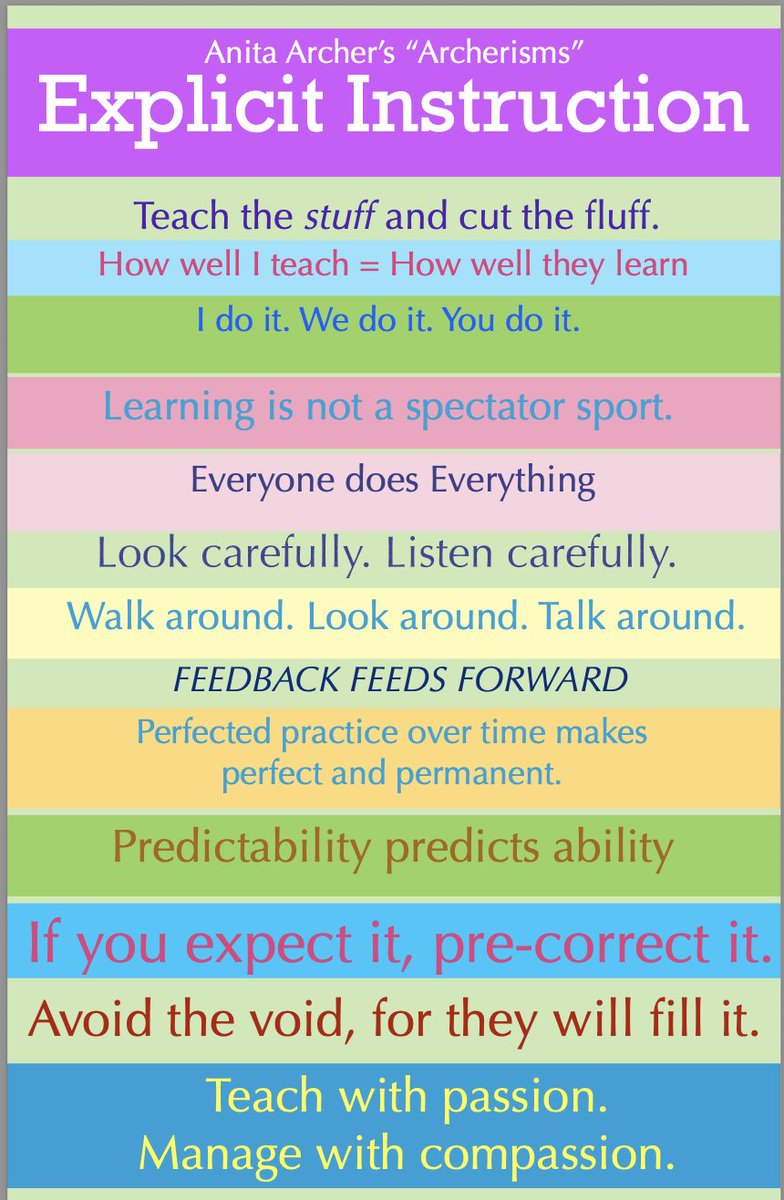
YES!🔥 “Teach the stuff and cut the fluff.”
Anita Archer’s Archerisms remind us that explicit instruction isn’t scripted—it’s intentional.
Model. Guide. Release. Reflect. Repeat.
Because learning is not a spectator sport. 🎯 #ExplicitInstruction #AnitaArcher #TeacherTips
2 Nov 2025

Anita's "Archerisms". You can download a pdf copy from the resource page for my episode with Anita Archer here: annastokke.com/resources/ep-…
142
16 Oct 2025
I'm signed up for #DitchSummit, a free online conference for teachers. You can, too, at ... ditchsummit.com via @jmattmiller
2
1
119
Heather D. Sanders retweeted

23 Sep 2025
Calling all Swiftie teachers 🎤✨
We're giving away 75 tickets around the country to The Official Release Party of a Showgirl because we believe school should be awesome, and your weekends should be too!
Join us for the ultimate teacher night out where you can shake it off after the school week, enjoy snacks on us, and connect with fellow educators who know that both teaching and Taylor are about storytelling, growth, and making every moment count.
HOW TO ENTER:
✅ Like this post follow @getschoolai
✅ Complete the Swiftie Space in the comments
✅ Repost this for an extra entry
Everyone who enters will receive a Dot Swiftie sticker pack! 🌟
No purchase necessary. Open to U.S. residents, 18 . Ends 9/28. Winner chosen at random announced 9/29.

4
12
21
1,606


17 Jul 2025
Hey @GetSchoolAI - missed the excitement yesterday…where can I learn about #allthenewshiny updates ?
1
88
Heather D. Sanders retweeted

6 Sep 2024
Canva can easily make you $15k/month!
But most people don't know how use it properly..
So I built "Advance #Canva Guide" for you.
It's FREE for the next 48 hours,
To get this: 👇
1. Follow me ( So I can DM )
2. Like & Repost (much appreciate)
3. Reply 👉 "Canva" or Check DM
372
215
379
49,005
Heather D. Sanders retweeted

6 Sep 2024
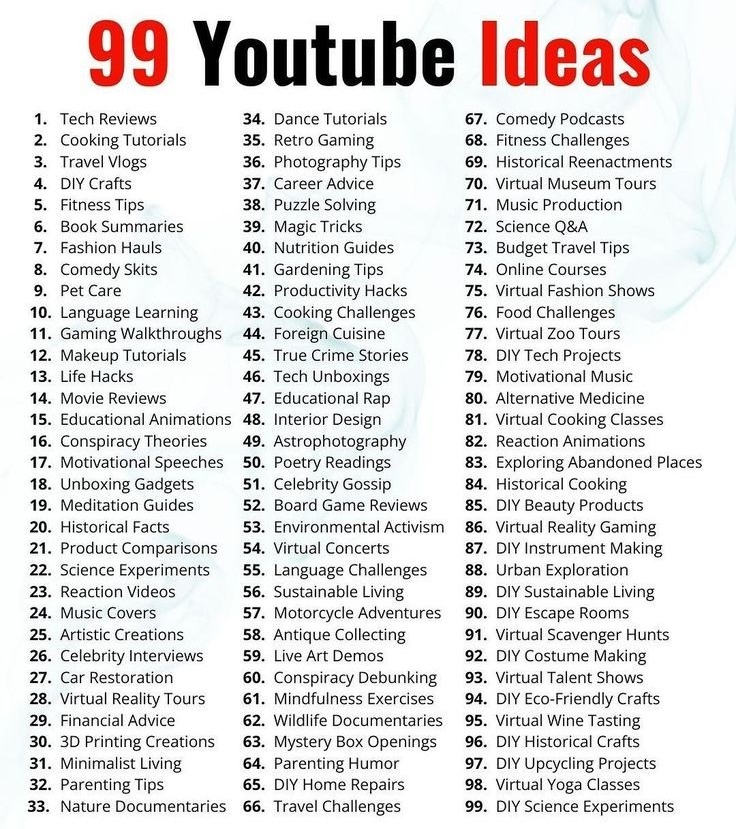
Everyone should own a faceless Youtube channel that earns $2000/m
Sadly, most people think this takes years to achieve
Here’s how to do it in the next 30 days:
98
1,079
6,255
854,317
Heather D. Sanders retweeted
22 Jul 2024
The 10th Justice says 🧑⚖️⚖️🏛️: If you know anyone near Butler, check their door cameras, traffic cameras, business security cameras, for a Harley before the shooting, he rode there, video testimony to verify Harley. #The10thJustice #CivicsNexus #MAGA
youtu.be/QvTT27uq7DM

1
6
7
702