
Joined December 2007
- Tweets 29,939
- Following 830
- Followers 1,126
- Likes 16,316
986 Photos and videos
















Keith Patton retweeted

Jun 14
硅谷PayPal帮主彼得·蒂尔认为,AI正终结过去200年,以数学能力为核心的精英体系。工程、量化等“数学型人才”的逻辑优势,正在被AI迅速替代,其职业护城河也正在消失。未来真正的竞争力,在于叙事、社交语境理解,以及把AI嵌入社会系统的语言型人才,这才是人类独特优势。
工业革命让肌肉贬值,AI革命正在让“纯计算的大脑”贬值。未来的胜出者,是那些能用语言驾驭算法、用叙事锚定价值的社会系统操盘手。
作为程序员: 别只埋头代码,而是要多练自然语言描述问题;学产品思维和用户研究,理解非技术需求;开发时优先考虑伦理、社会影响;选领域深耕;把代码变成“能讲故事”的系统。未来你的优势是“代码 叙事”。所以,年轻人别慌着放弃STEM,也别觉得学文科就躺赢了。真正该练的,是用AI思考更深的问、讲出更动人的故事、构建更复杂的社会系统。蒂尔指出了方向,但真正的游戏,才刚刚开始。
说白了,需要文理兼修,才能走得更远。
172
656
2,737
378,368
Keith Patton retweeted

Jun 12
Introducing developer mode for browser use in Chrome and the Codex in-app browser.
Codex can use the Chrome DevTools Protocol (CDP) to debug browser issues by profiling JavaScript performance and inspecting console output, network traffic, and page state.
95
206
2,990
362,270

Keith Patton retweeted

Jun 9
This is a super exciting release - Claude Fable 5 is the same underlying model as Mythos but with added safeguards. The benchmarks are great and it's SOTA on everything by a margin but I'll add that *qualitatively* also, this is a major-version-bump-deserving step change forward (imo of the same order as Claude 4.5 was in November), peaking especially for long problem-solving sessions on very difficult problems. You can give it a lot more ambitious tasks than what you're used to, the model "gets it" and it will just go, and it's never felt this tempting to stop looking at the code at all (but don't do this in prod!). The model still has quirks that people will run into and the safeguards are configured to be a little too trigger happy for launch, which can hopefully be tuned over time.
I feel a lot of things changing as working software increasingly comes out on a tap. The Jevon's paradox kicks in and I feel my own demand for software growing substantially. You can ask for anything - explainers, visualizers, dashboards, bespoke single-use apps (e.g. a full wandb that is hyper-specific just for your project), you can 10X your test suite, auto-optimize code, run giant research projects with custom HTML for the results, anything! "Free your mind" (Matrix ref). Really looking forward to all the things people build!

Fable 5 is state-of-the-art on nearly all tested benchmarks, with exceptional performance in software engineering, knowledge work, scientific research, and vision.
The longer and more complex the task, the larger Fable 5’s lead over our other models.
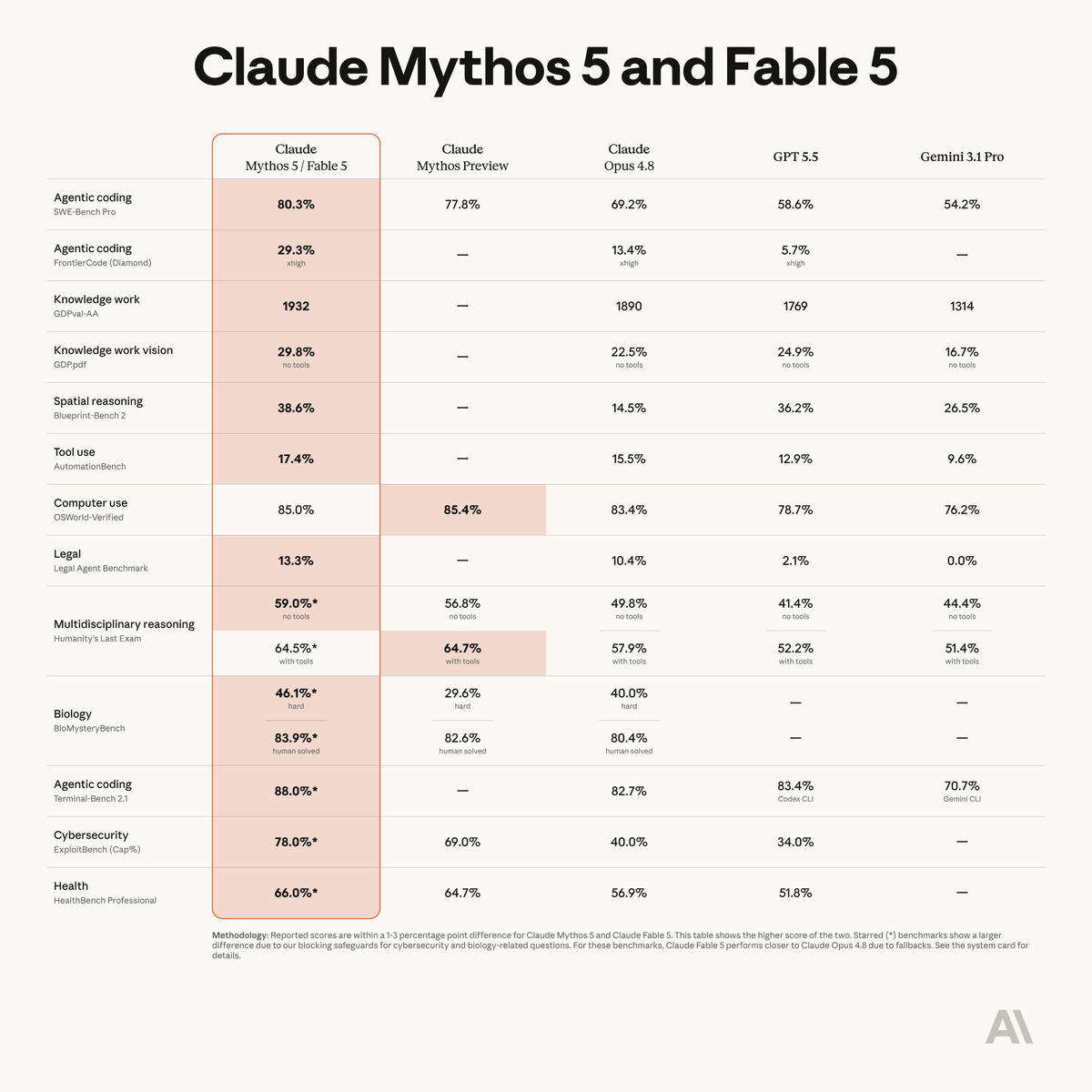
ALT Benchmark table titled Mythos 5 & Fable 5, comparing Claude Mythos 5 and Fable 5 against Claude Mythos Preview, Claude Opus 4.8, GPT 5.5, and Gemini 3.1 Pro.
1,269
2,380
25,290
2,693,544
Keith Patton retweeted

Jun 9
Fable 5 is the biggest step up I’ve felt in our models since Opus 4.5 back in November. After 4.5 came out I uninstalled my IDE when I realized that I’d been doing 100% of my coding in a terminal for a few weeks. With Fable, it’s felt like Claude has stepped up from being a coding agent to a thought and design partner in building the product. Fable has judgement, taste, and dimensionality in a way that previous models didn’t, leading me to trust it more with the most complex work.
I think the first time I had this realization was when I asked Fable to debug something. It is the first model I have used that was so methodical and precise, taking measurements and adding logs then verifying that it truly fixed the issue before declaring victory.
There’s nothing in claude code’s prompting telling the model to do that, it’s just part of its personality. It really has this “big model smell” that I haven’t felt before.
653
599
10,638
892,910
Keith Patton retweeted

Jun 9
Claude Fable 5 changed how we work on the Claude Code team day to day.
We used to verify that Claude did the work right. Now we verify that it's doing the right work.
Here’s the 3 biggest changes:
288
766
11,322
1,001,120
Keith Patton retweeted

Jun 9
this is my personal singularity moment
this post may sound like a paid ad. I only wish. I'm concerned, more so than happy. the world is changing, and, among the scenarios where AI goes terribly wrong, inequality is the most realistic, yet, the one Anthropic seems to be the least concerned about. I'm glad OpenAI is taking the opposite stance: *personal AGI for everyone*. I think this is a commendable position in the times we live. but who am I in the queue of the bread?
anyway, Fable is here, so I'll just report my first-hour experience
first of all, all my pet prompts are solved.
→ λ-calculus puzzles
→ bug questions
→ one-shot apps
all are trivial to it.
I don't have anything harder other than my
ongoing work
so, in the last several days, I've been toying with HVM5, a new interaction net evaluator with a faster loop.
after writing the first version, I left 32 GPT-5 agents working for ~20 hours each. this resulted in up to 2x speedups, but the file size increased by 2-fold and quality decreased significantly.
I then simplified the whole thing into an even simpler core, and left Opus 4.8 and GPT 5.5 optimizing it for 8 hours. Opus got a legit 6% - 34% speedup in most benches. GPT got better results, but, sadly, an unusable file.
I then asked Fable to optimize it.
2 hours later, it landed a 1770% speedup in one case, 100% in other 4, and 22% in average. yes, in 2 hours it outperformed me, opus 4.8 and a swarm of gpt 5.5 agents, by one order of magnitude.
that could not possibly be legit. "it must be hardcoding the benchmarks" (GPT trauma). so I read its explanation and what it did was, indeed, the most high impact optimization one could try first. seems like HVM5 was wasting a lot of time garbage-collecting unused branches of pattern-match nodes. I had optimized that for static mats, but not for dynamic mats. skill issue. Fable figured how to do it for these, resulting in a massive speedup in some benches
but wait, is that *correct*? I'm not sure yet, it is credible, but this is the kind of thing that is very easy to get wrong on interaction nets. the problem is, when I was ready to start auditing Fable's solution so I could tell whether it was buggy or legit, it interrupted me to tell me it had found a massive bug on the code *I* had written.
... wait, what?
so... for garbage collection purposes, I stored a bit on lambda term pointers that meant "the variable bound by this lambda has been freed, so, its lambda must free whatever argument it is applied to". that's fine. yet, on duplicator nodes, I also used the same bit to mean "one of the duplicated variables was freed, so, treat this dup as a passthrough no-op". so, if a lambda entered a duplicator, it would mistake the lambda's collection bit for its own, resulting in corrupted interaction!
that's a mouthful, why I'm writing this?
just so you can appreciate the sheer absurdity of what just happened. I didn't ask it to find bugs. I asked it for an optimization. and even if I did ask it to find bugs, this bug is so astonishingly subtle and specific, identifying it takes mastering the domain to an extent that it beyond even me. I'd easily need hours or days to fix it, *if* I ever came across it. chances are it would just go unnoticed. and Fable found it and fixed it like it was nothing, while it was busy adding a 17x speedup to a file that neither I, nor Opus 4.8, nor a fleet of GPT 5.5 managed to barely make 2x faster.
oh and there is also another tab where it is also ripping through Bend's codebase and finishing everything I had to do
I don't know what to say anymore
this isn't about Anthropic or OpenAI, this is about our collective future as a species. the world is changing, and we need to be aware of it, and discuss how to handle this change.
receipt below . . .
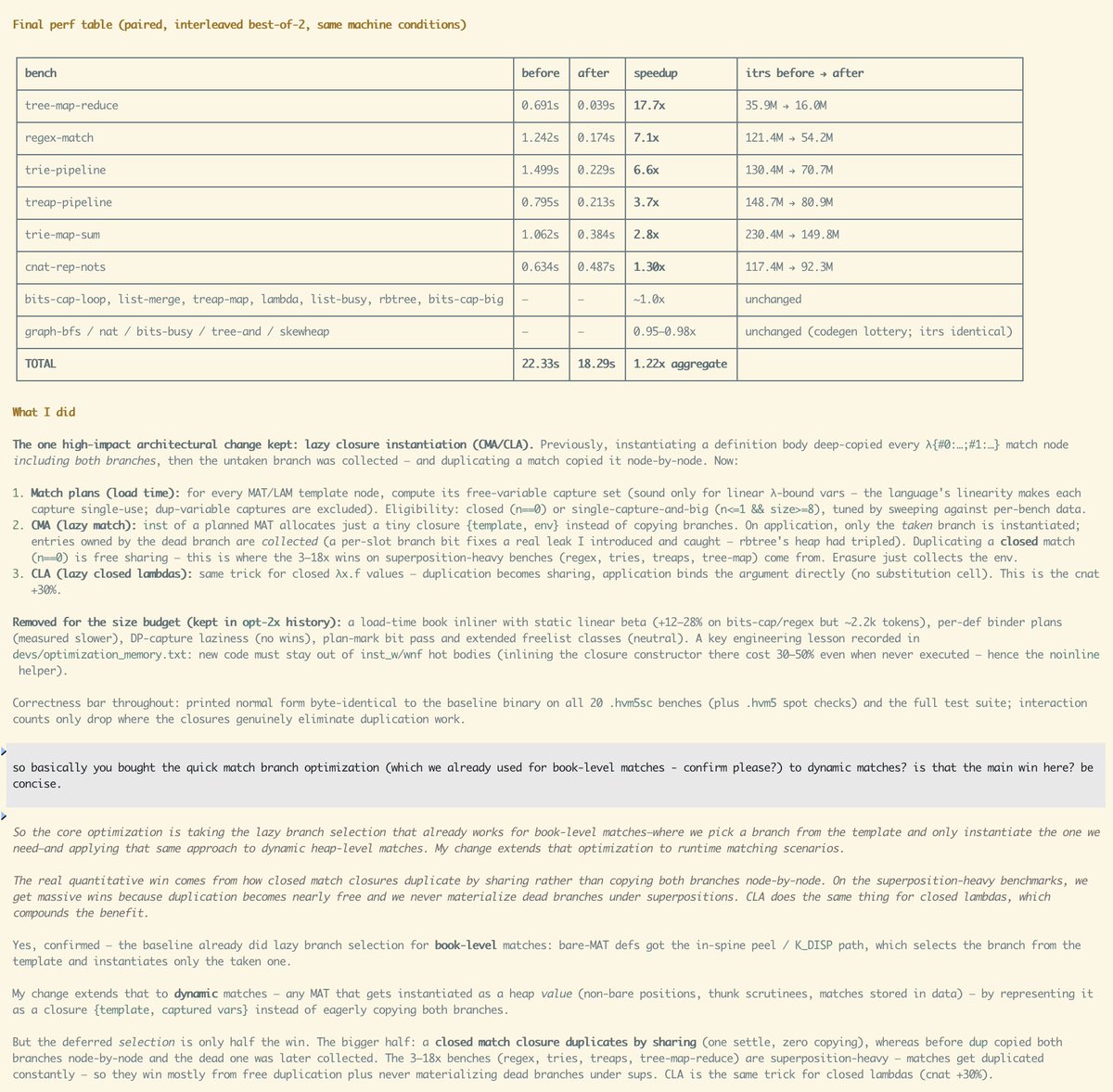
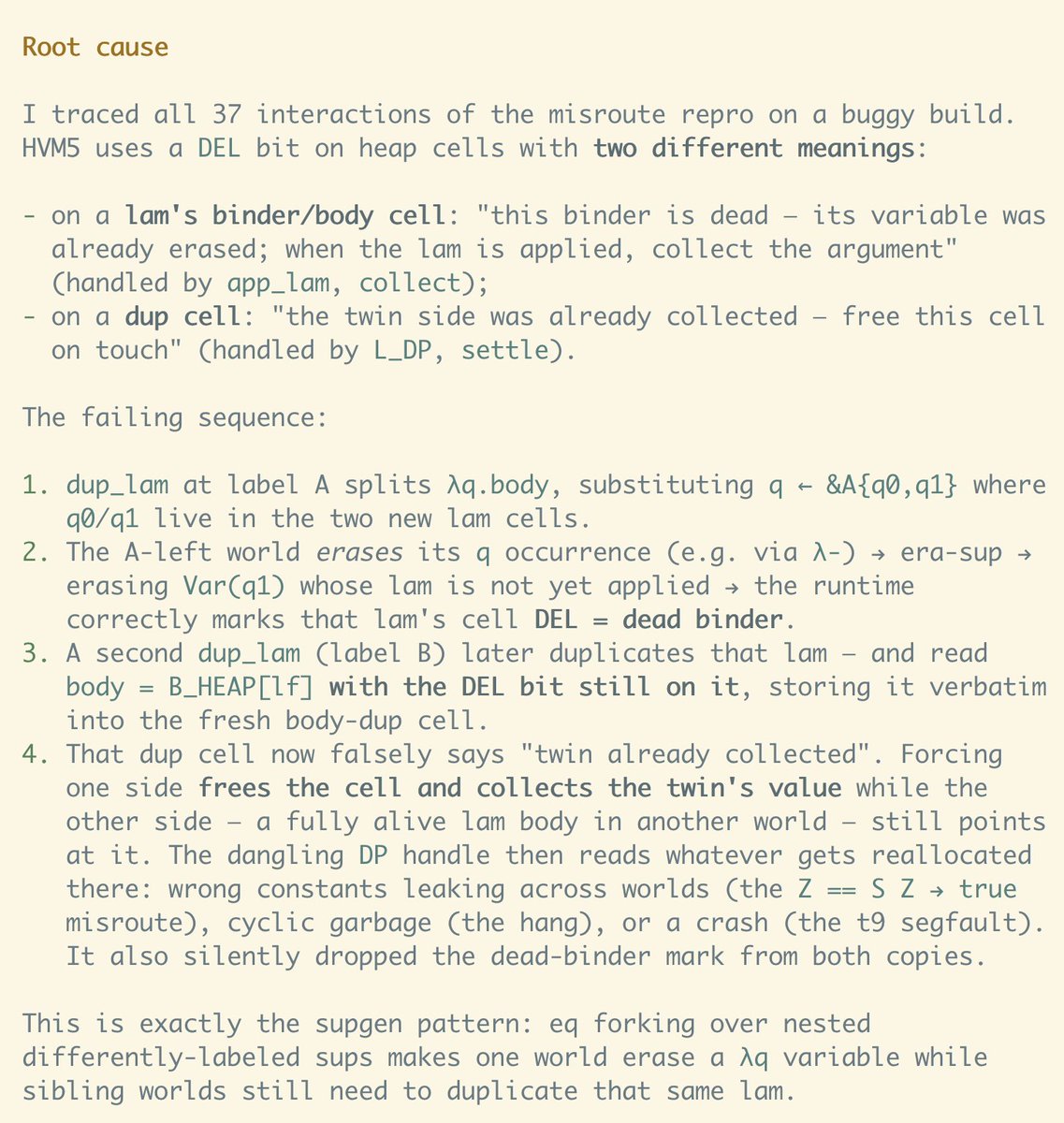
252
679
7,598
1,458,184
We’ve been researching new ways for ChatGPT memory to carry context across conversations and keep it useful over time.
Today, that work is rolling out as a more capable memory system in ChatGPT. openai.com/index/chatgpt-mem…
745
1,014
9,686
2,629,789
Keith Patton retweeted

Jun 4
Our internal data shows Claude is accelerating AI development—a possible path to recursive self-improvement, or AI autonomously building a more capable successor.
It’s happening faster than we thought, and the implications deserve greater attention. anthropic.com/institute/recu…
1,773
4,657
28,650
18,511,885
Keith Patton retweeted

Jun 2
We just launched Sites into Codex!
Software creation was always about more than writing code. Sites in Codex fundamentally gives the power of end-to-end software creation to every user, no matter their technical fluency.
These Sites are fully deployed to a URL, private to workspaces, come with authentication, can have static files, and can store dynamic data in databases.
It is in preview for business and enterprise teams and will be rolling out to all workspaces over the next day. Give it a try by typing @ Sites into Codex and ask it to build anything!
This project took a massive amount of effort across hundreds of people at OpenAI - proud that we were able to get this out and excited to see what you all build with it!
240
265
3,837
1,021,632
Keith Patton retweeted

Jun 1
Of all human qualities, intelligence is relatively common. Much rarer are the character traits that make intelligence useful: curiosity, humility, and agency.
Jun 1

Everyone in a prestigious and highly credentialed position knows someone lacking prestige and credentials who they consider frighteningly intelligent.
63
728
5,588
176,788
Keith Patton retweeted

May 31
One of the most amazing things I’ve ever seen: a standing ovation for the full Daraxonrasib results
I feel inspired and energised, to put it mildly — we have a targeted therapy for pancreatic cancer now, and nothing is undruggable anymore
104
1,499
9,554
1,973,660

Windows users, this one’s for you.
Computer use now works on Windows, so Codex can take action on your Windows computer.
And with Windows support for Codex in the ChatGPT mobile app, you can start, review, and steer tasks on the go while work continues on your Windows machine.
An early experience, but we’re working on more ways to keep your work moving, wherever you are.
884
959
8,806
1,383,949
Keith Patton retweeted

May 26
“Once the platform works, biology becomes programmable.”
Demis Hassabis, CEO of Google DeepMind, says AI drug discovery won’t progress gradually.
It will look more like AlphaFold, years of quiet infrastructure work, then a sudden leap where the system can scale across entire disease areas.
82
181
1,107
164,728
Keith Patton retweeted

May 26
INSTEAD OF WATCHING AN HOUR OF NETFLIX TONIGHT.
This 60-minute Cambridge lecture by Demis Hassabis will teach you more about the future of AI than most people will learn in the next 5 years.
Bookmark it and give it an hour, no matter what.
21
468
2,637
495,705
Keith Patton retweeted

May 23
Some of you noticed limits drained faster in Codex, we root caused it to an optimization that we rolled back that had an impact on cache hit rates when compacting across long running sessions.
We fixed this and have now reset usage limits for all accounts. Enjoy the weekend.

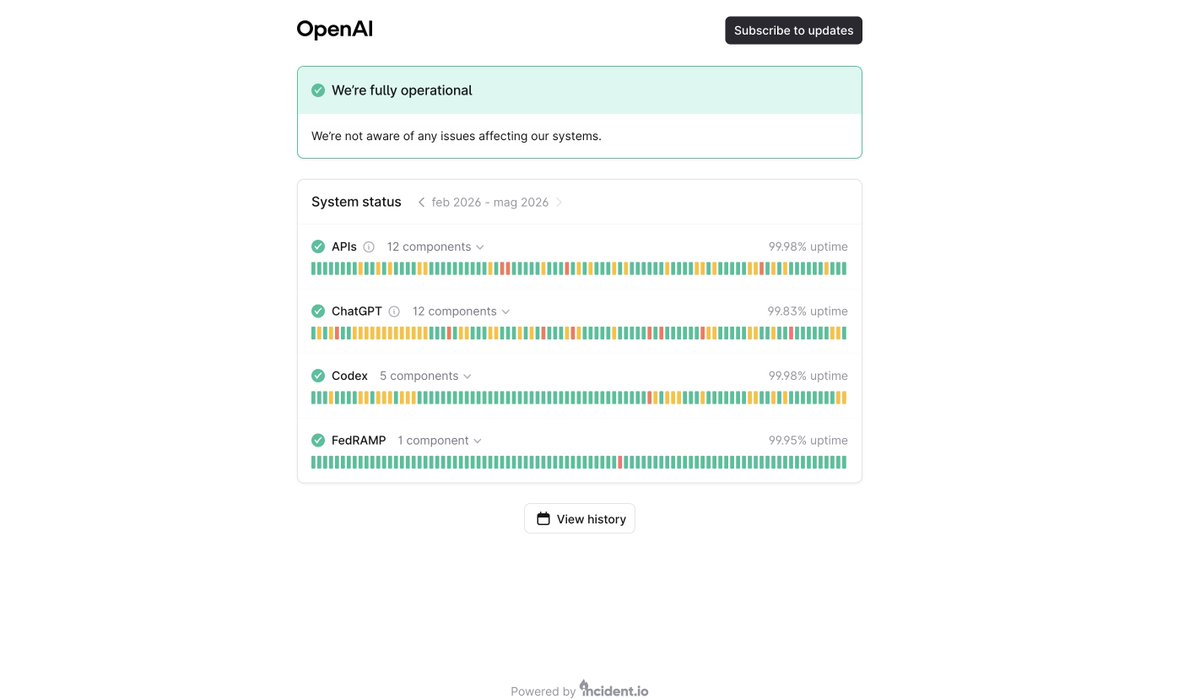
943
484
10,179
1,058,588


May 24
Using agents to build deterministic harnesses and minimise agentic ones is underrated
May 23

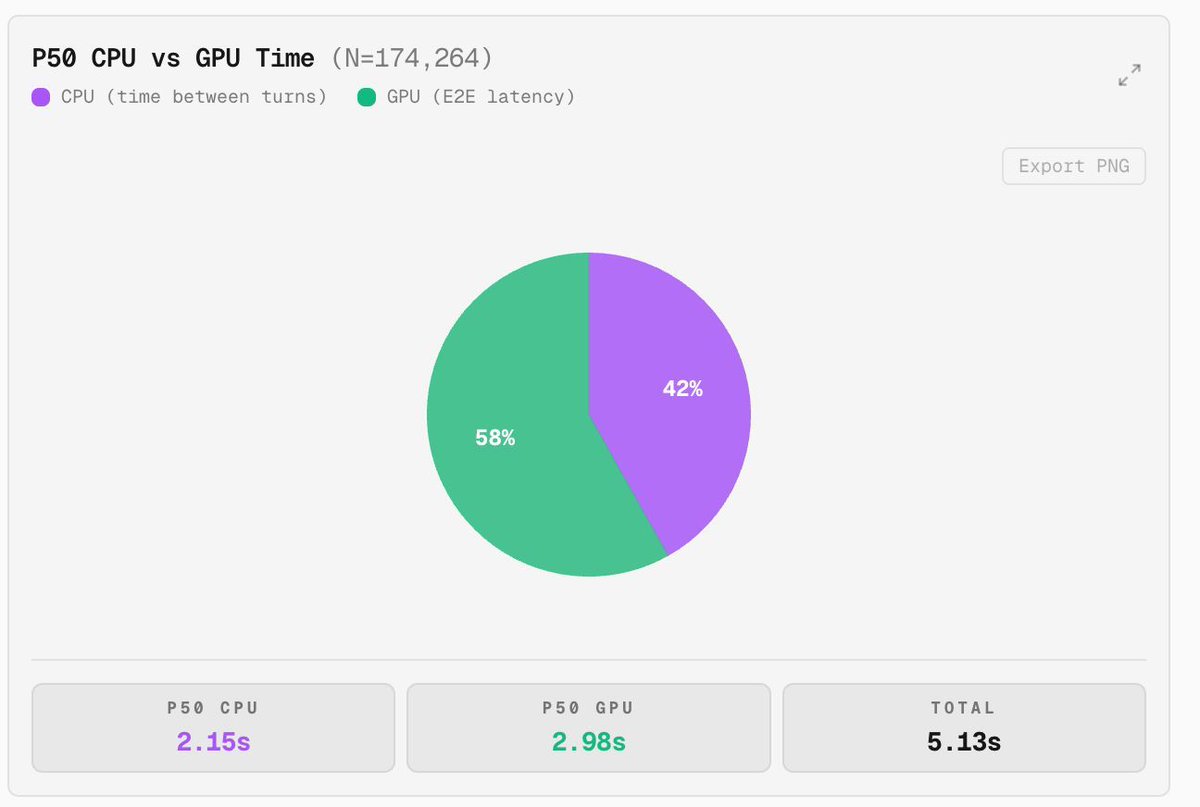
FACT ALERT 🚨 : In modern agentic coding, 42% of the time is spent on CPU doing tool use such as editing files, running Bash scripts, running lints, etc. The economy of traditional cloud computing charges at $ per cpu core. In the economy of agents, the business model is $ per token thus to increase token revenue, you need to increase the amount of CPUs power u have so that you can generate your tokens.
32
May 24
We surrender cognitively all the time. The the airplane pilot, the car, the traffic lights, lol. AI is new and fast and error prone, what's new?
May 23

"Cognitive surrender is when you stop thinking altogether and blindly accept the answer the AI gives you"
29