
🚀 Enthusiast in AI. Building the future with Https://aiconsensus.io 🌐 | Bitcoin HODLer 📈 | AIConsensus.io One Prompt Multiple Minds One Trusted Answer
Joined April 2009
- Tweets 1,885
- Following 628
- Followers 212
- Likes 147
14 Photos and videos
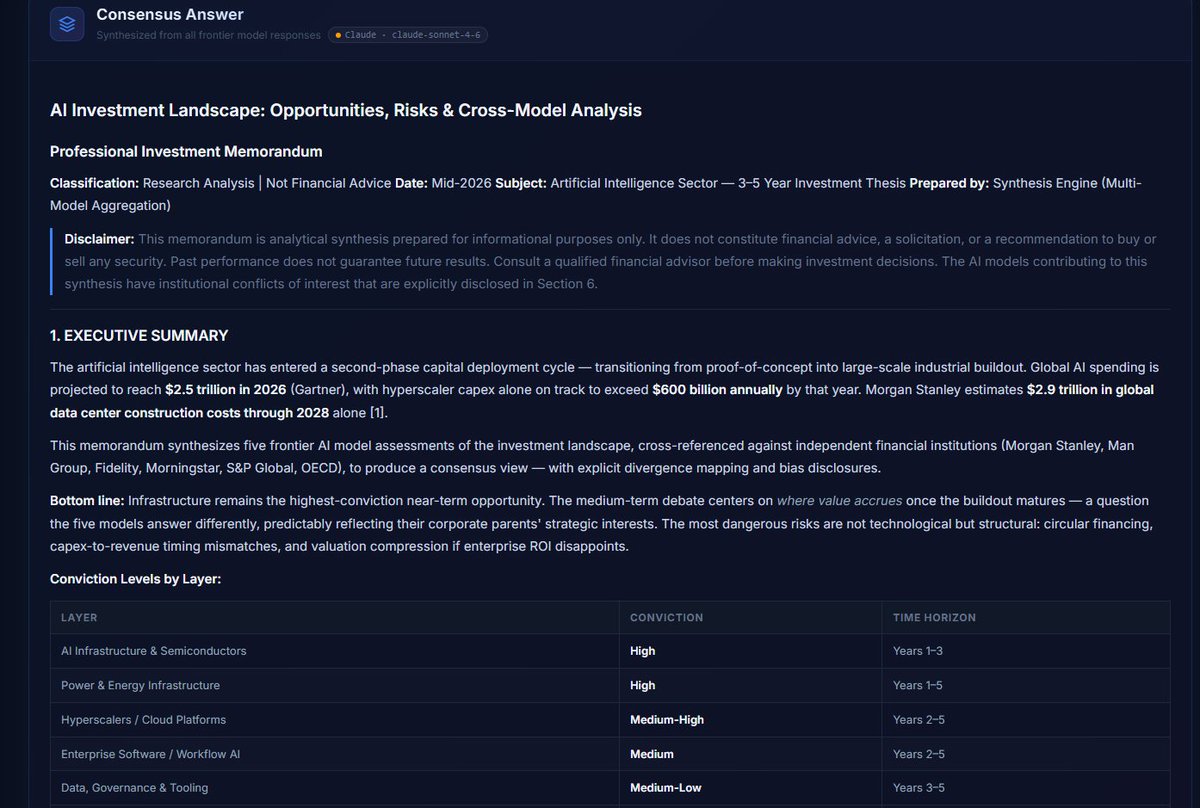
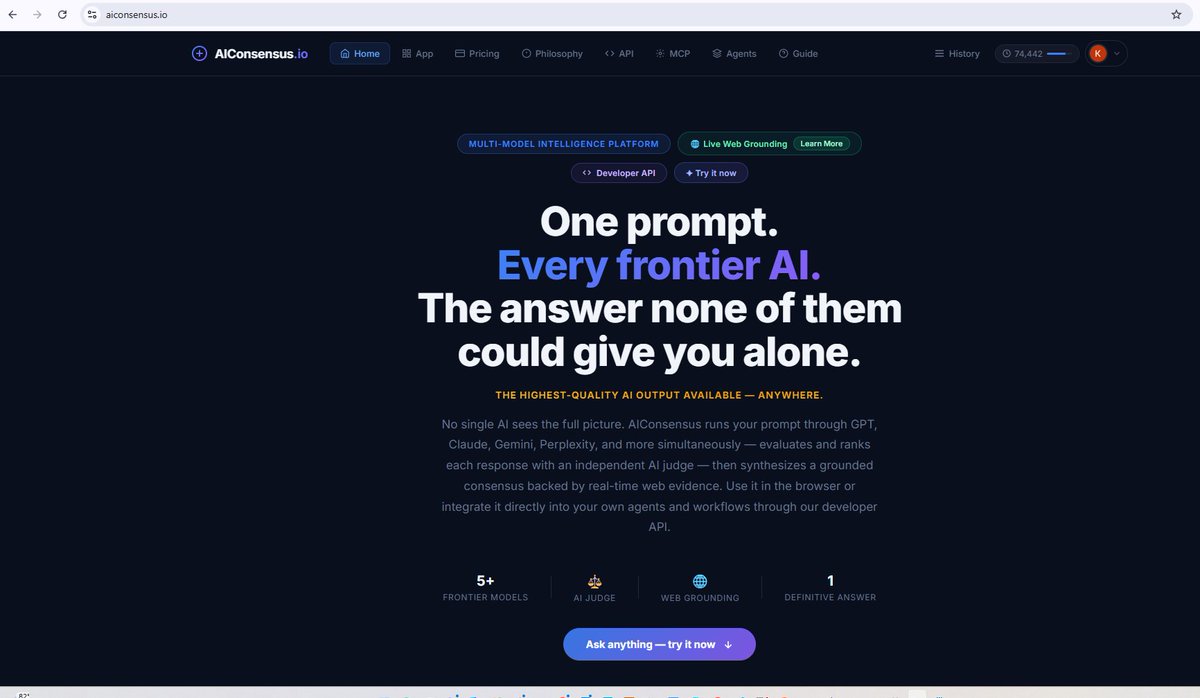










🧠 One AI isn’t enough. Consensus is.
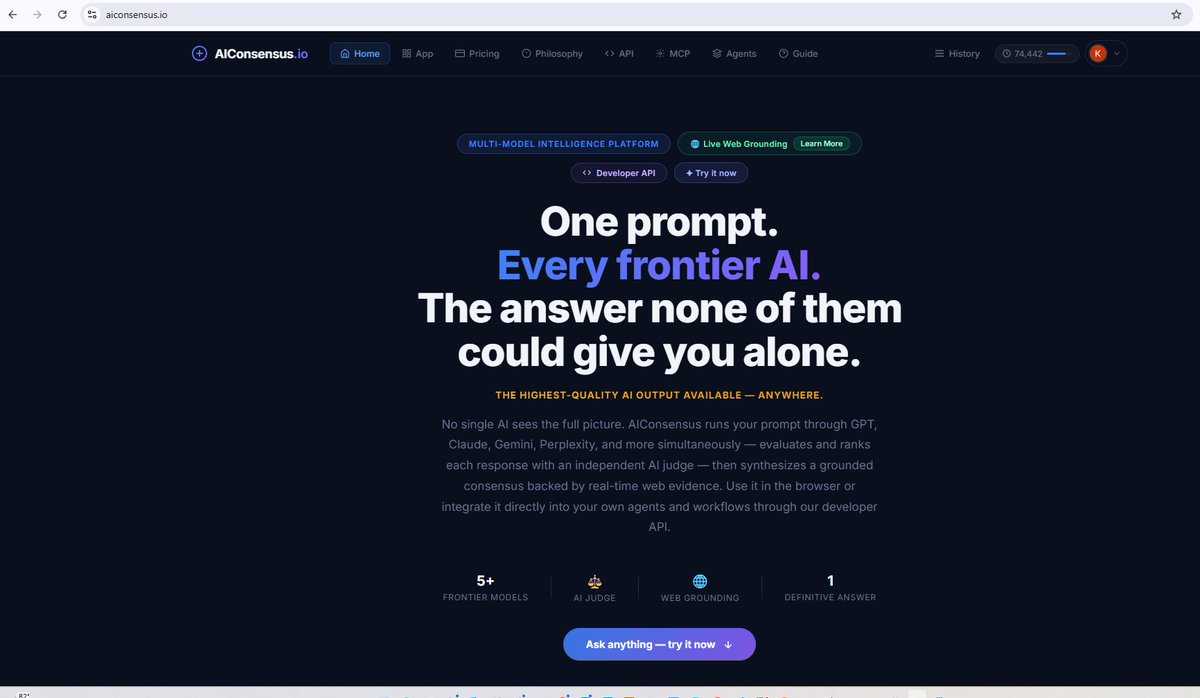
One prompt. Multiple minds. One trusted, high-quality answer.
ChatGPT may say one thing. Claude may frame it differently. Gemini may catch another angle. Perplexity may bring sources. Grok may challenge the assumptions.
So which one do you trust?
AIConsensus.io was built for that exact problem.
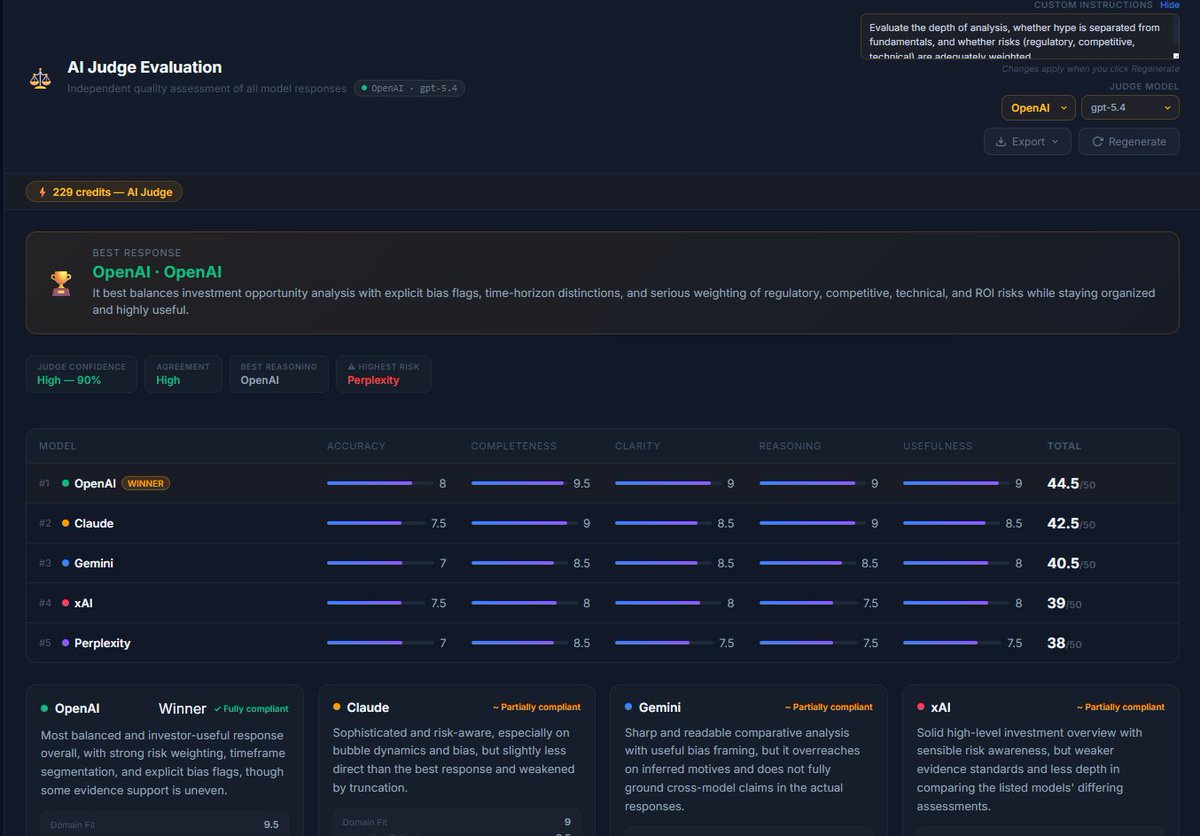
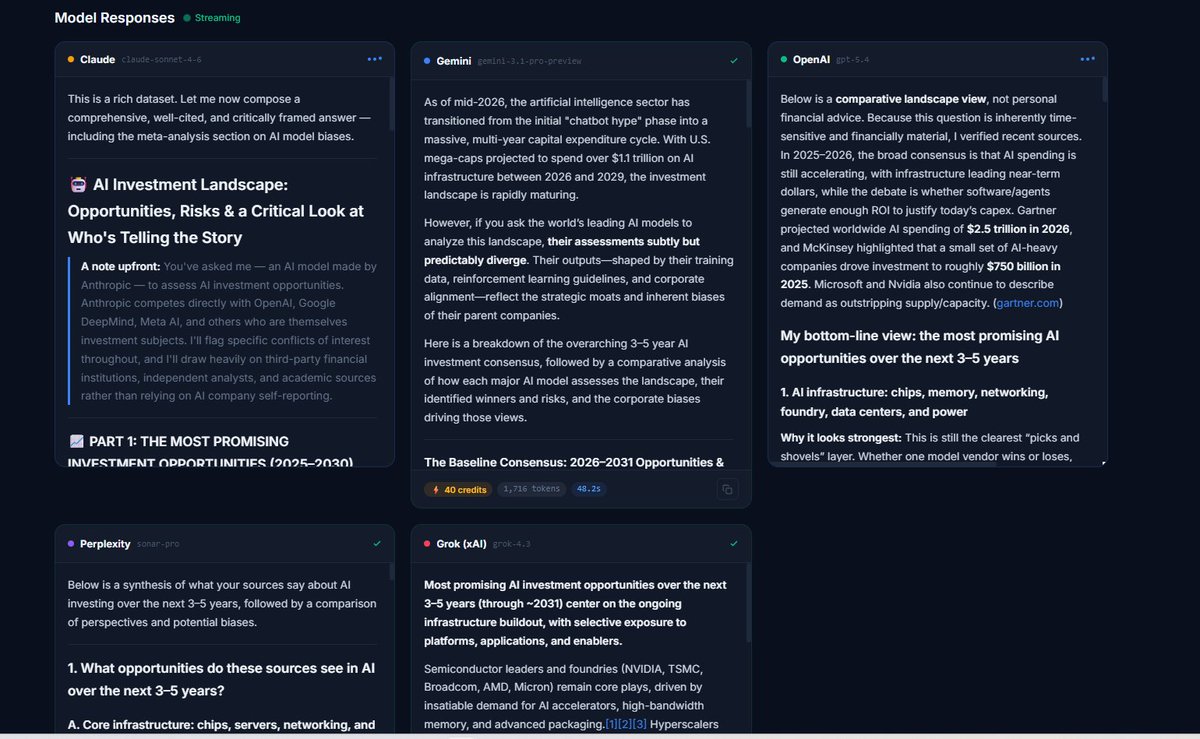
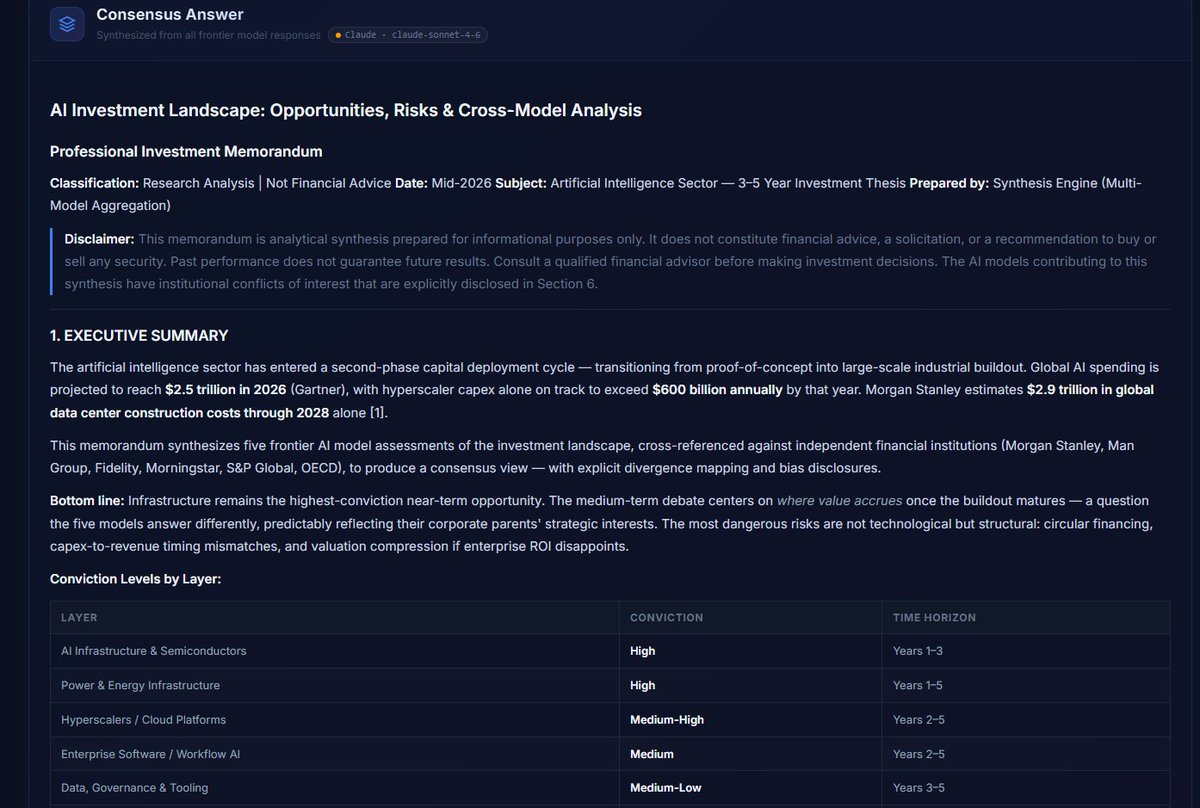
We run your prompt across GPT, Claude, Gemini, Perplexity & Grok in parallel — then compare, judge, and synthesize the responses into one evidence-backed consensus answer.
✅ Side-by-side model responses
🔍 Reasoning comparison
⚖️ Independent AI Judge
🌐 Live web grounding with citations
📎 File and document analysis
🧩 40 ready-to-run expert agents
🔌 REST API MCP for developers
Built for decisions, not just chats.
For researchers, founders, investors, developers, analysts, and anyone who wants higher-quality AI output with more transparency.
Single-model AI has blind spots.
Consensus helps expose them.
🚀 Try it here: aiconsensus.io
📖 Learn more: aiconsensus.io/philosophy
#AIConsensus #MultiModelAI #AIAgents #LLM #AIResearch #PromptEngineering #MCP #ResponsibleAI
4
4
919
🚀 AIConsensus.io is now more than multi-model text answers.
Key highlights:
✅ One prompt across GPT, Claude, Gemini, Perplexity, Grok more
⚖️ Independent AI Judge
🌐 Live web grounding with citations
🎨 Image generation
🎬 Video workflows
📊 Outcome Studio for structured business reports
📥 PPT/downloadable outputs
🔌 Developer API MCP
Most people still use AI by asking one model one question and trusting the answer.
But no single AI sees the full picture.
Different frontier models reason differently. They miss different details, make different assumptions, and often disagree on the same prompt.
AIConsensus was built to solve that.
It runs your prompt across multiple frontier AI models in parallel, compares the responses, judges them, and synthesizes one stronger consensus result.
The newest addition is Outcome Studio.
Instead of starting from a blank prompt, you pick from guided workflow templates, fill in the details, choose an execution mode, and generate a structured outcome report powered by multiple AI models debating, comparing tradeoffs, generating visuals when needed, and reaching consensus.
It is like having a small team of AI experts working the problem from every angle, then delivering one clear result.
Use it for research, strategy, investing, business analysis, content, learning, technical exploration, images, videos, and high-stakes decisions where one AI opinion is not enough.
Single-model AI has blind spots.
Consensus helps expose them.
Try it: aiconsensus.io
#AIConsensus #MultiModelAI #AIAgents #GenerativeAI #LLM #AIWorkflows
3
116
Follow us here on LinkedIn!
linkedin.com/company/aiconse…
3
103
🧠 One AI isn’t enough. Consensus is.
One prompt. Multiple minds. One trusted, high-quality answer.
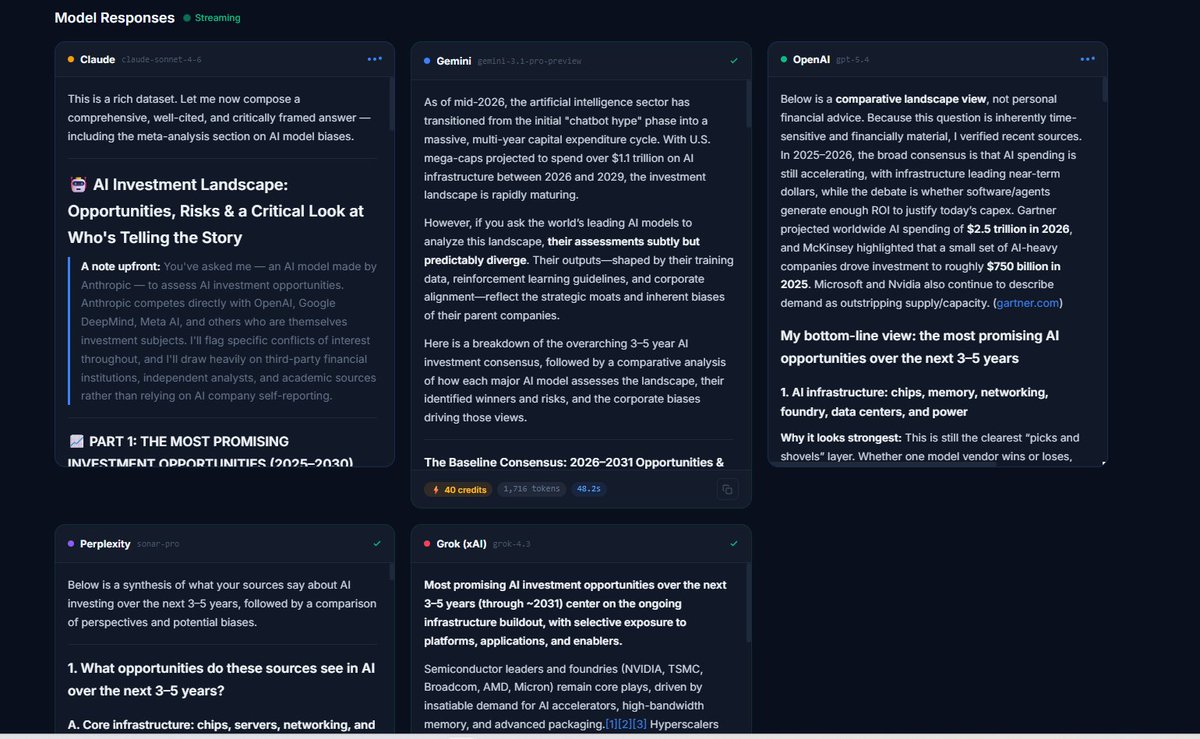
We built AIConsensus.io to run your prompt across GPT, Claude, Gemini, Perplexity & Grok — then synthesize one evidence-backed answer with an independent AI Judge.
✅ See every model response side-by-side
🔍 Compare reasoning
⚖️ Surface disagreements
🌐 Get a grounded consensus you can trust
For researchers, founders, investors, developers, and anyone making decisions too important for a single AI answer.
🚀 Try it here: aiconsensus.io
#AIConsensus #MultiModelAI #AIAgents #LLM #GPT #ClaudeAI #Gemini #PerplexityAI #Grok #MCP #PromptEngineering #AIResearch #ResponsibleAI
2
122
The world doesn’t run on money.
It runs on credit.
Money exists to back credit.
Bitcoin becomes powerful not because you spend it,
but because you don’t have to sell it to access liquidity.
That’s the shift most people miss.
When Bitcoin becomes accepted collateral:
•long-term holders stop selling
•supply tightens structurally
•price becomes reflexive, not speculative
This is the same dynamic that scaled:
•real estate through mortgages
•equities through leverage
•sovereigns through debt markets
Bitcoin does it cleaner, globally, and with a fixed supply.
People keep asking whether Bitcoin is money or a payment system.
That’s the wrong frame.
Bitcoin is digital collateral.
Digital credit is the killer feature.
Once institutions fully step in, failure isn’t the risk.
Being early was the opportunity.
#bitcoin #digitalcredit $btc
@saylor @Matt_Hougan
4
188
Kunal retweeted

Feb 5
Someone is just rotating from asset class to asset class and summarily blowing them all up with a barrage of price indiscriminate, bid-crushing market order liquidations
401
664
7,940
577,830
Kunal retweeted

18 Dec 2025
Wow. Classic Jensen style, he ended the Nvidia vs. custom ASIC competition for good. 🫡
The level of confidence with which he explains. 🎯
He was answering to UBS research analyst question on how custom ASICs will affect NVIDIA or how they are going to compete with custom ASIC.
Basically he says -
Your custom chip is a science project in a world where NVIDIA is building revenue-generating AI factories.
While the competition is still desperately trying to copy Nvidia's last generation, their roadmap is already at the limits of physics.
They don't just sell silicon; they deliver the entire, impossibly complex platform that the industry has already surrendered to and standardized on. When you must bet hundreds of billions on your company's future, there is no alternative—they are the only platform to build on, and everyone knows it.
Full transcript below.
Question by the Analyst -
"Jensen, I wanted to ask about customer ASIC. And I ask because if, you know, we listen to some of the same CSPs that you put up on that slide, and we listen to some of the companies who are making custom ASICs, some of the deployment numbers sound pretty big. So, I wanted to just hear your position, how you're going to compete with custom ASICs, how they can possibly compete with you, and maybe how some of your conversations with these same customers would sort of form your view in terms of how competitive custom ASIC will be to you."
Jensen's response
"First of all, just because something gets built doesn't mean it's great. Number two, if it's not great, all of those companies are run by great CEOs who are really good at math. And because these are AI factories, it affects your revenues, not just your costs. It affects your revenues, not just your cost. It's a different calculus.
Every company only has so much power. You just have to ask them. Every single company only has so much power, and within that power, you have to maximize your revenues, not just your cost. So this is a new game. This is not a data center game, this is an AI factory game. So when the time comes, that simple calculus, as I was using yesterday, that simple math that I was showing yesterday, still has to be done. Which is the reason why so many projects are started and so many are not taken into production.
Because there's always another alternative. We are the other alternative, and that alternative is excellent. Not normal excellent, as you know. Everybody's still trying to catch up to Hopper. I haven't seen a competitor to Hopper yet. And here we're talking about 40x more.
And so our roadmap is at the limits of what's possible. Not to mention we're really good at it and completely dedicated to it. A lot of people have a lot of businesses to do. I've got this one business to do. And we're all in on this. 35,000 people doing one job. Been doing it for a long time.
The depth of capability, the scope of technology, as you saw yesterday, is pretty incredible. And it's not about building a chip; it's building an AI factory. We're talking about scale up, scale out. We're talking about networking and switches and software. We're talking about systems, and these system architectures are insane.
Even the systems themselves. Notice, 100% of the computer industry, 100% of the computer industry has standardized on NVIDIA's system. Why? Because try to build an alternative. Building the alternative is not even thinkable because look at how much investment we put into building this one. And so even the system's hard. What people used to think, system is just sheet metal. Hardly sheet metal. 600,000 parts, it's hardly sheet metal.
And so all of the technology is hard. We're pushing every single dimension to the limit because we're talking about so much money. The world is going to lay down hundreds of billions of dollars of investment in the next just a couple of two, three years.
Let's do the thought experiment. Let's say you want to stand up a data center and you want it to be fully operational in two years' time. When do you have to place the PO on that? Today. So let's suppose you have to place a hundred billion dollar PO on something. What architecture would you place it on, literally based on everything you have today? There's only one.
You can't reasonably build out giant infrastructures with hundreds of billions of dollars behind it, hoping to turn it back on and to get the ROIC on it, unless you have the confidence that we are able to provide you. And we can provide you complete confidence. And singularly so.
We're the only technology company where if I had to go place a hundred billion dollars on an AI factory... Oh, that's interesting, I did. Literally the only company who's willing to place hundred billion dollar POs across the industry to go build it out. And you guys know, that's our, that's the depth of our supply chain. And we are, and we have. Give me another. Give me another one that has that depth and that length.
And now to the point where we've got to go and work with the supply chain upstream and downstream to prepare the world for hundreds of billions of dollars working towards trillions of dollars of AI infrastructure build-out. Our partnerships with power companies and all of the cooling companies, the Vertivs, the Schneiders, our partnerships with BlackRock... The partnership network necessary to prepare the world to go build out trillions of dollars of AI infrastructure, that's undergoing as we speak. What architecture and what ASIC chip do you go select? That doesn't even make sense. It's a weird conversation even.
And so, I think that one, the game is quite large. The investment level, therefore the risk level, is quite high. And so the certainty that you're selecting the best is quite important. And the certainty that you can execute, vital.
We are the company you can build on top of. We're the company, we're the platform that you can build your AI infrastructure on. And we're the company that you can build your AI infrastructure strategy on. And so, I think it includes chips, but it's much, much more than that."
---
From 'GTC Financial Analyst Q&A' session (full link in comment)
32
93
589
99,442
Kunal retweeted

20 Oct 2025
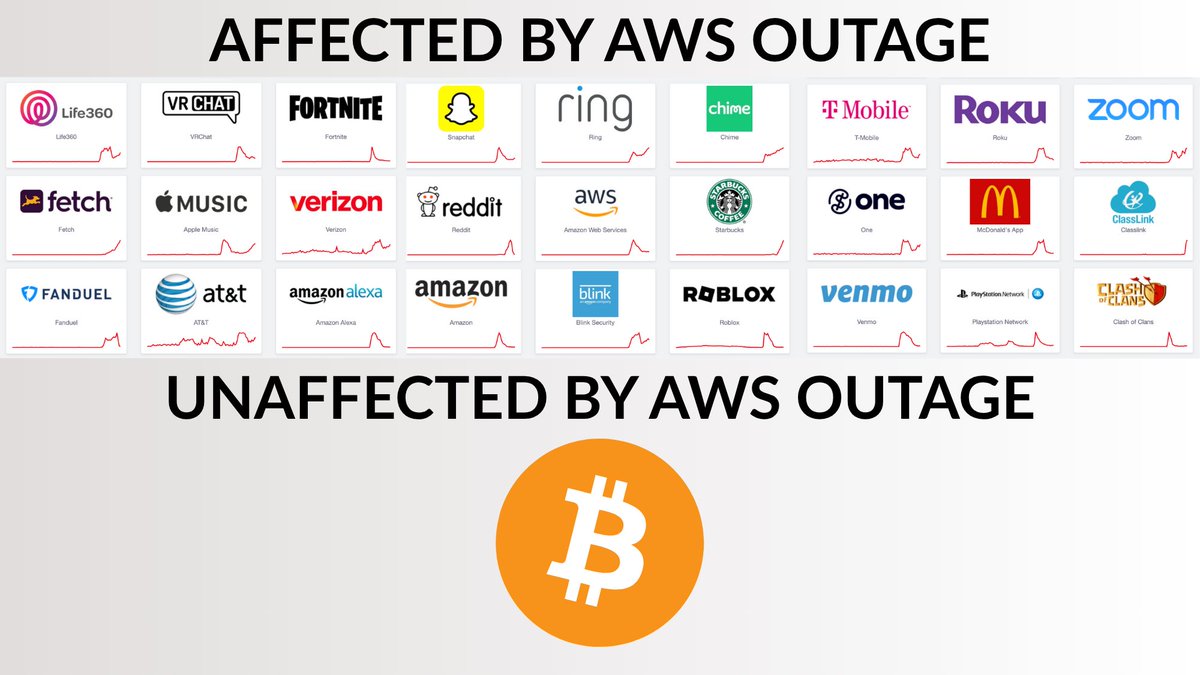
When AWS goes down…the fiat world breaks
126
314
2,120
121,103
Selling options ie covered calls, cash secured puts or wheeling is one of the best income generation strategy’s. It’s like rental income on real estate without the worry of insurance, taxes, maintenance etc. Recommend NVDL a high yield NVDA etf for this. High premiums, much lower risk as nvda is mostly bullish for next few years.
3
8
512
⸻
🚘💡 @elonmusk — I’ve been thinking about the hybrid robotaxi model you’re testing in Austin with a safety driver in the passenger seat.
It’s a genius transitional strategy.
What if you scale it nationwide before full autonomy is approved? Here’s the math:
•Safety driver: $15/hr (many would line up for this job)
•Each Tesla: 300–400 mi/day
•Avg ride: 10 miles
•Charge ~$1.25/mile — undercuts Uber/Lyft by 30–40%
•Daily revenue: ~$375
•Daily cost (driver ops): ~$230
•Daily profit: ~$145/car even with a safety driver
•Scale to 100K cars = $5.3B/year — while collecting FSD data
The experience is smoother, more reliable, and fatigue-free vs human drivers. Plus, no tipping culture or awkward small talk.
Once regulators catch up, remove the human — and margins explode.
Maybe you’re already thinking this way… but if not, this hybrid autonomy flywheel could be Tesla’s silent advantage over Cruise, Waymo, Uber.
If I’m missing something — would love your thoughts.
#Tesla #Robotaxi #FSD #Disruption
1
1
5
1,000
The way we treated Pakistan in the Champions Cup they hosted, reminds me of a very famous dialogue by Raaj Kumar:
Jaani, hum khelenge, Zaroor khelenge….
Per jagah bhi humaari hogi,
Waqt bhi humaara hoga,
Aur Cup bhi humaara hoga!
Cheer karne wale log bhi hamare honge aur Cup dene wale bhi hamare honge!
😎😄
1
5
664
Kunal retweeted

7 Mar 2025
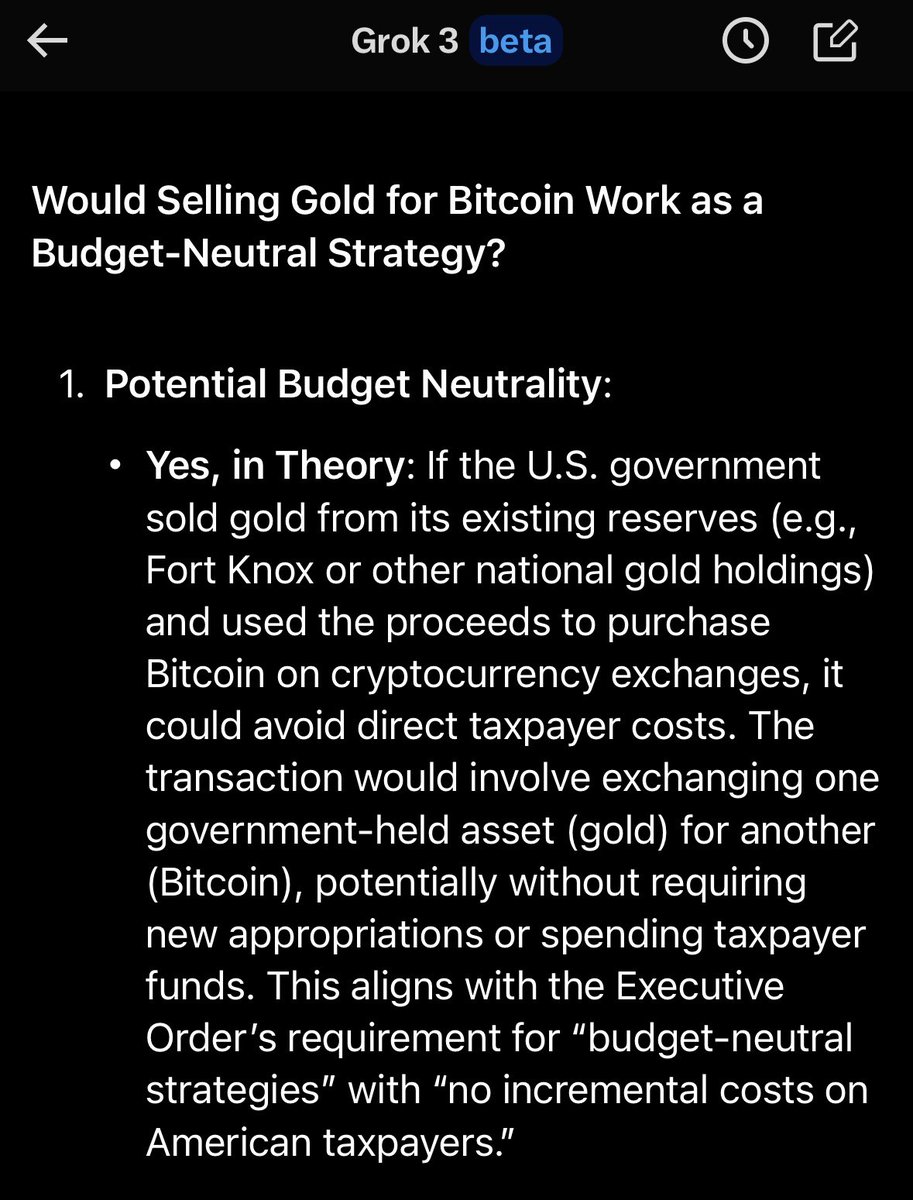
The end game was never “the U.S. government buys all of the world’s bitcoin.”
A U.S. Strategic Bitcoin Reserve means…
- Other countries will buy bitcoin
- Wealth managers have no excuse
- Financial institutions have no excuse
- Pensions/Endowments have no excuse
- Fear of the U.S. selling is gone
- The U.S. will likely buy more
- Likelihood of states buying just went up
- Probability the government outlaws Bitcoin is definitively zero
This changes everything. Zoom out.
7 Mar 2025

The U.S. just established a Strategic Bitcoin Reserve calling it a “digital Fort Knox for digital gold.”
Do you think China is now more or less likely to hold the 200,000 Bitcoin they own? What about the UK? Russia? Japan?
This is just the beginning.
255
1,168
6,274
795,075

Kunal retweeted

26 Feb 2025
Jensen is emphasizing the need for more compute heavily. He says the amount of compute required for reasoning is 100 times greater than for “one-shot” prompts. Next-generation inference and reasoning may require thousands to millions of times more compute than what is needed today. My take: Those are numbers so big I don't know what to make of them.
26 Feb 2025

CFO did say how long Blackwell will be sold out. Off to the Q&A.
26
31
322
78,075


Kunal retweeted

7 Feb 2025
The best video about #Bitcoin 🤯
This should be taught in every school.
87
686
2,432
199,993
$Nvda DeepSeek
DeepSeek’s cost-efficient AI model has lowered the entry barrier for smaller companies to build LLMs, creating massive opportunities for AI adoption across industries. While training costs drop, the need for more GPUs at runtime for scaling and test-time inference ensures NVIDIA benefits from this democratization. With thousands of businesses now entering AI, GPU demand will surge, making NVIDIA even more bullish for the future. The widespread adoption and scaling needs spell exponential growth in GPU demand—an exciting time for AI innovation!
1
153