
doing fundamental science of deep learning | PhD from Berkeley | can catch a whole egg in my mouth
Joined December 2023
- Tweets 140
- Following 75
- Followers 1,467
- Likes 195
14 Photos and videos
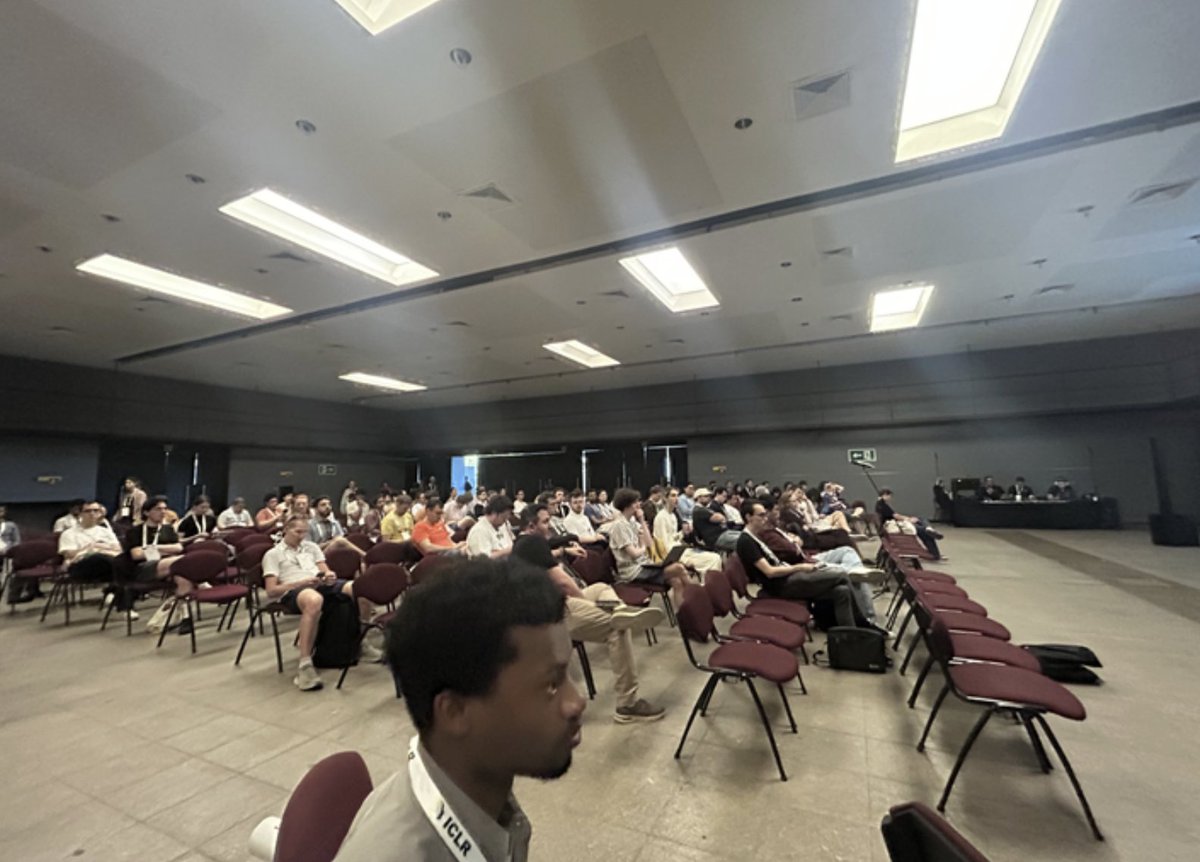
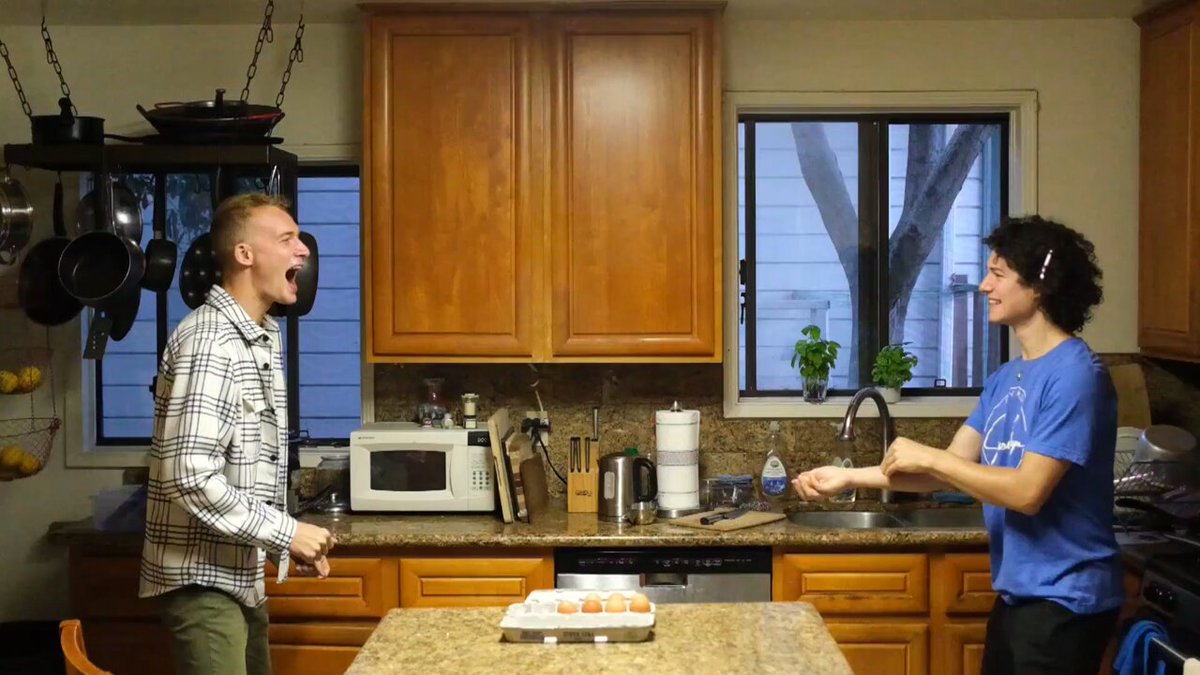
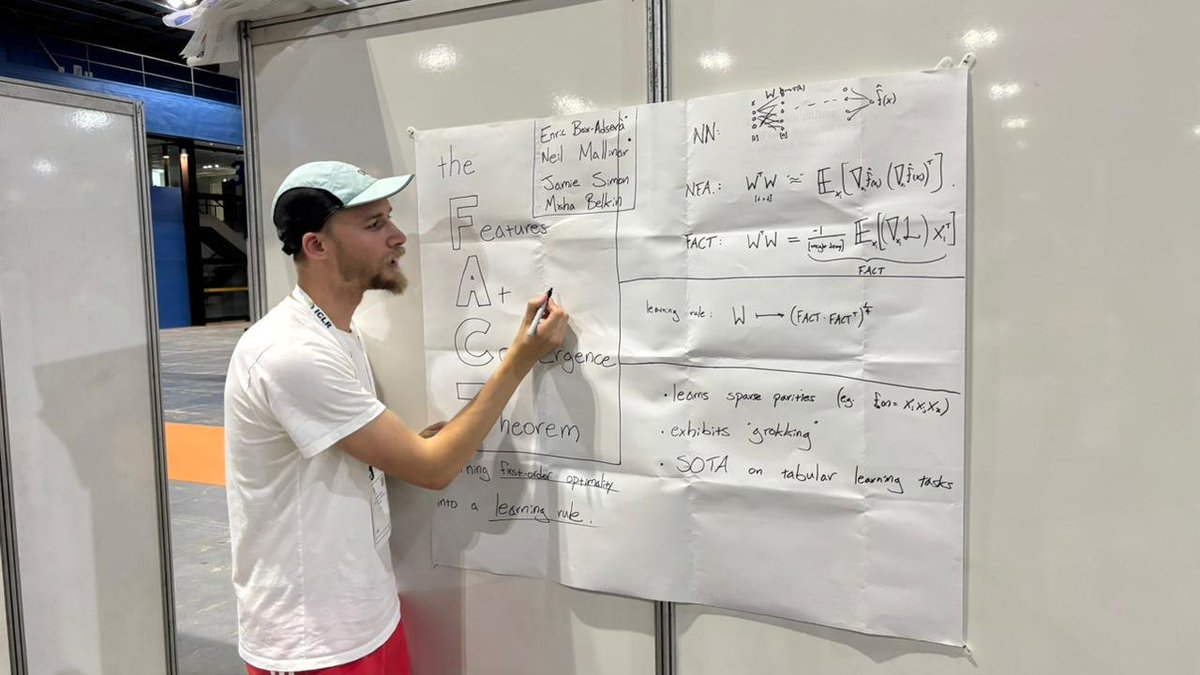
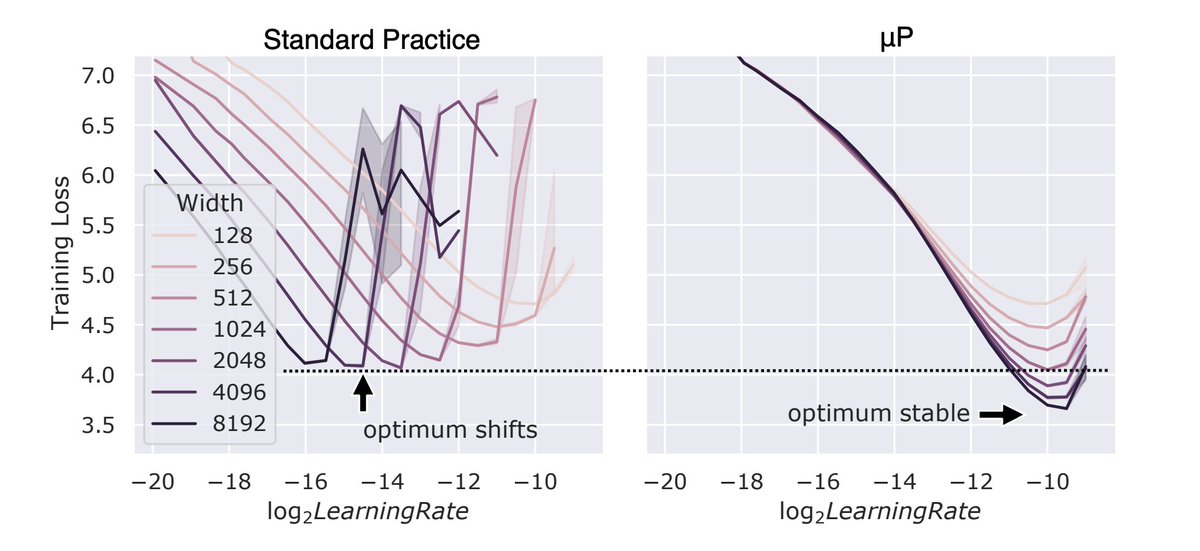
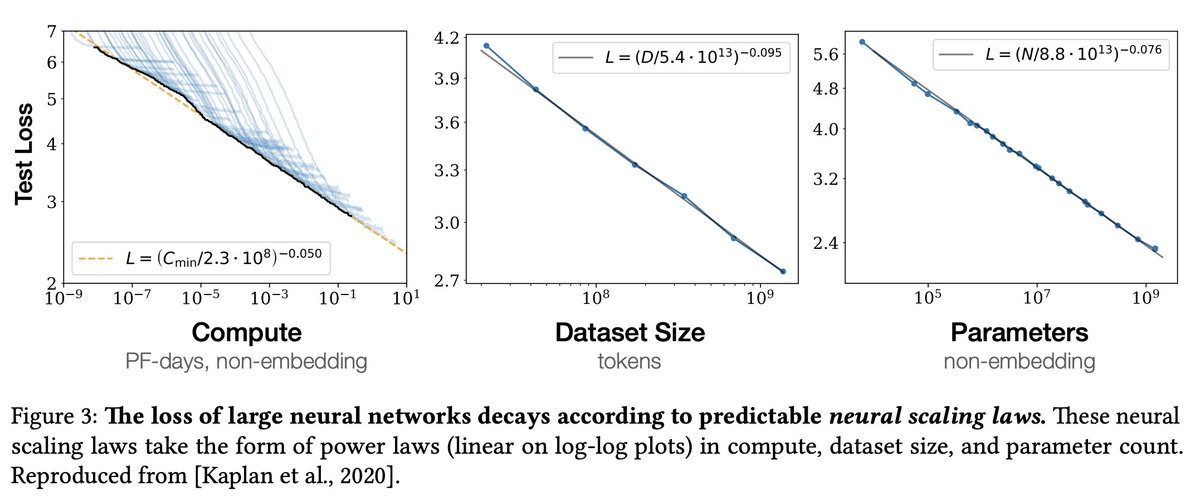
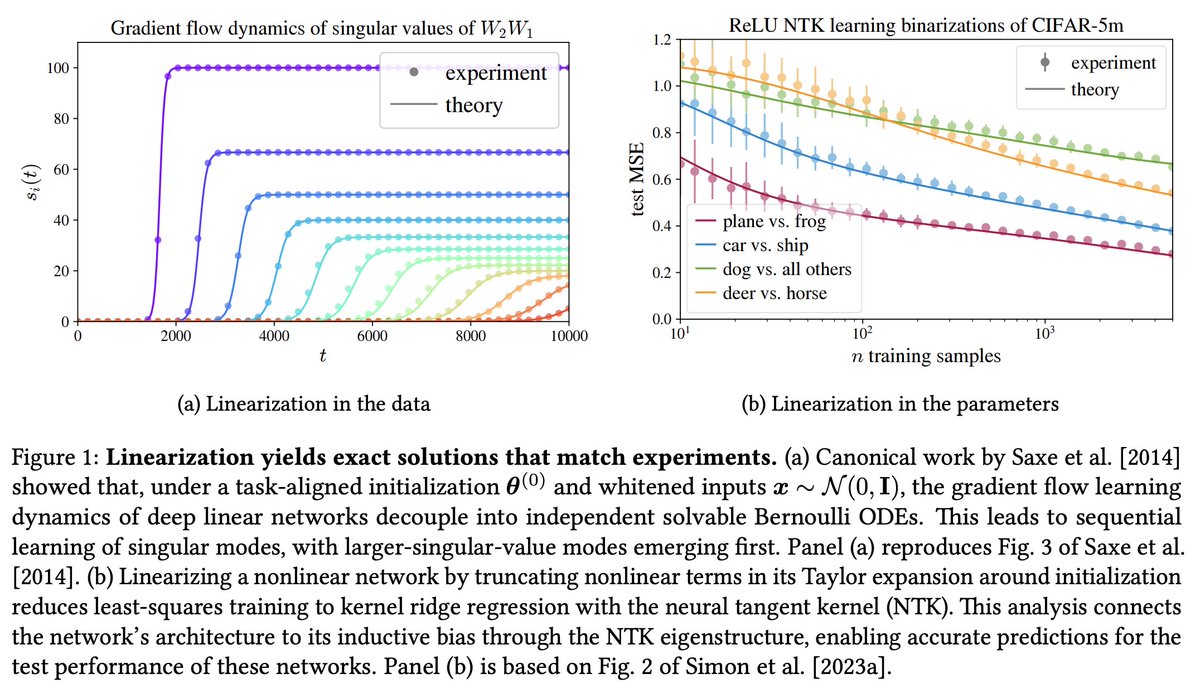
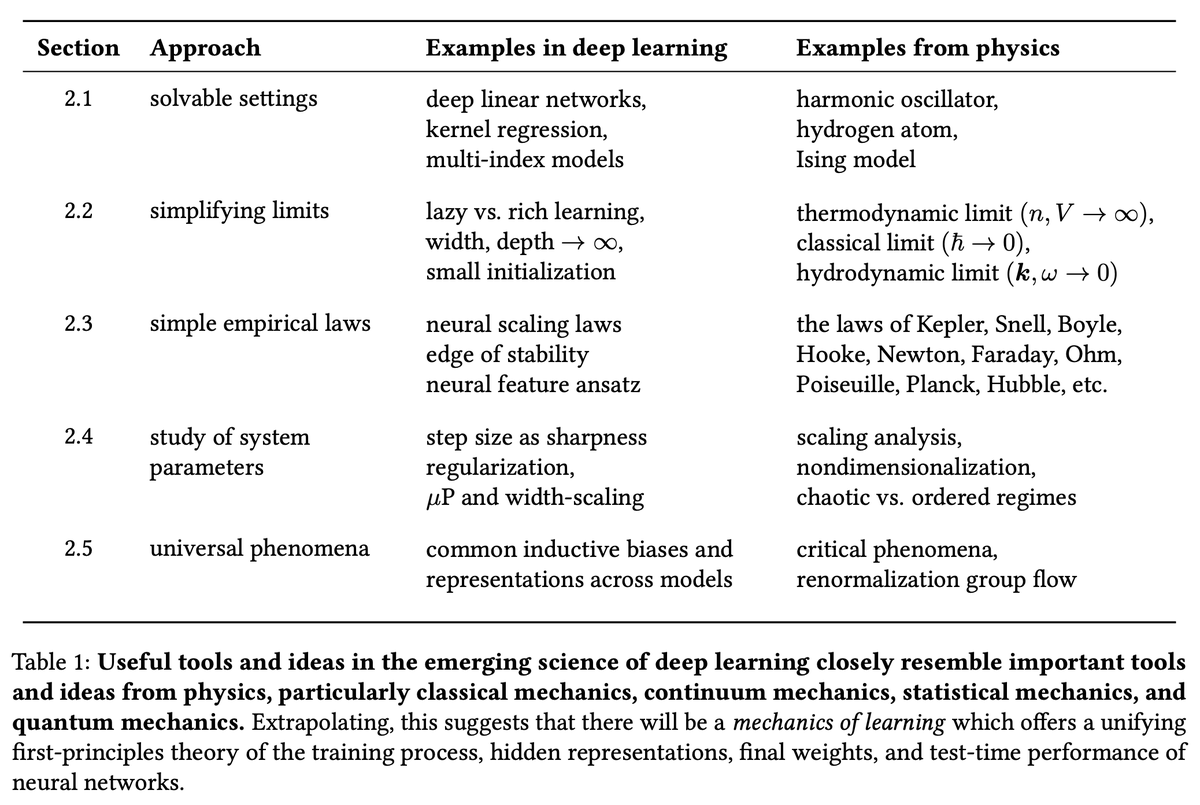
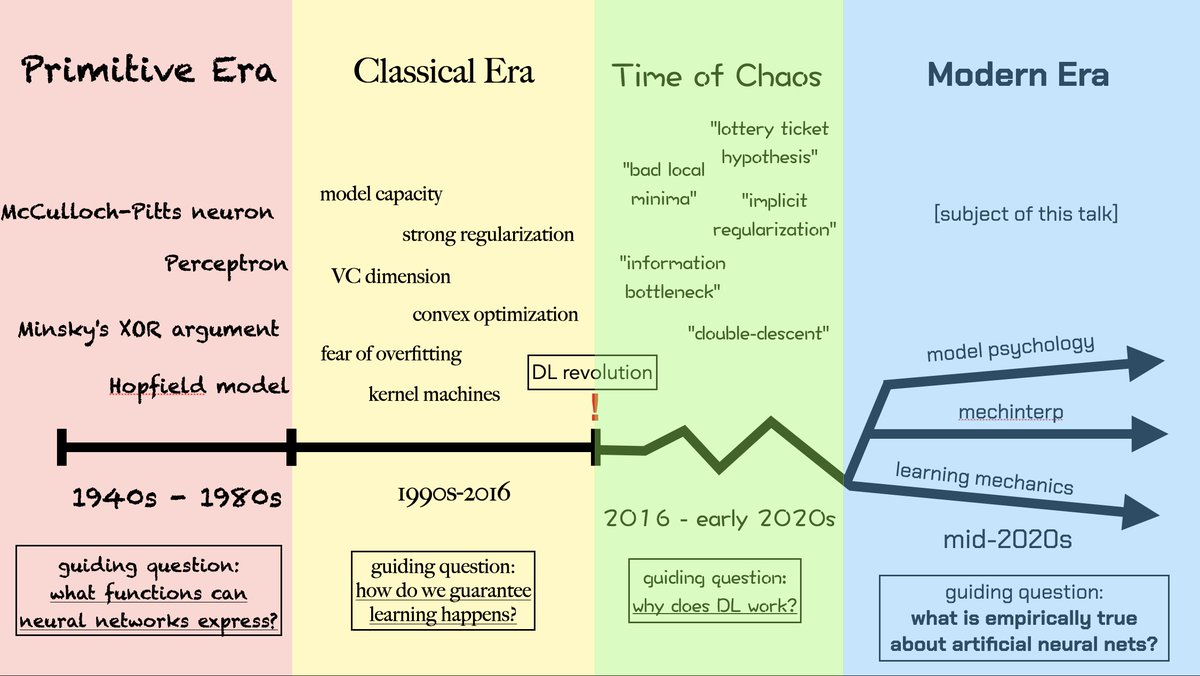
I quite like this line of work! blends "mechinterp" and "learning mechanics" approaches to fundamental science of deep learning.
Jun 5

Scaling laws describe how loss changes with scale. Do neurons inside models change predictably too?
We study vision and language models up to 30B params and find systematic scaling in neuron universality, specialization, and selectivity.
Paper code: avdravid.github.io/rosetta-n…
1/n
2
18
2,715
Jamie Simon retweeted

May 23
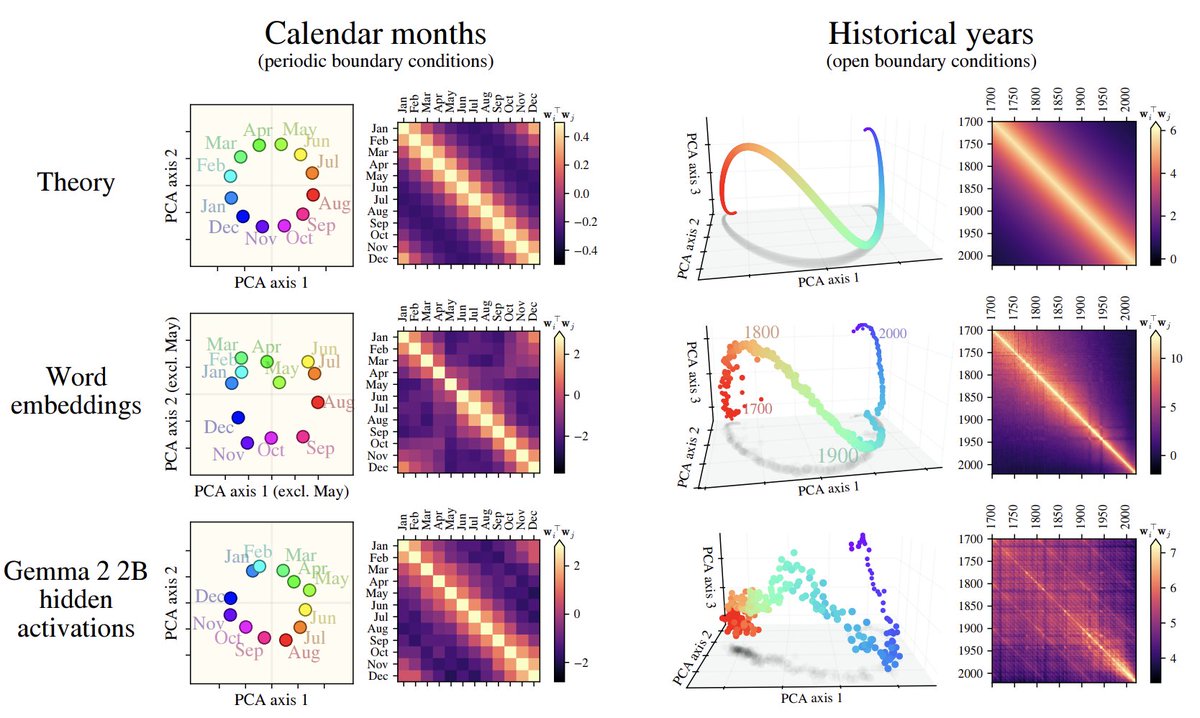
I thoroughly enjoyed reading this recent paper by @yasamanbb et al (arxiv.org/pdf/2602.15029) that derives analytically why certain latent variables must lead to geometry in word embeddings. (getting Fourier modes even with open boundary but exponential kernel is neat!) I think it would be great to compare this to some of @prfsanjeevarora et al's work on this (eg tinyurl.com/4az4325n)
More broadly, I have been thinking about the right data generating process for language. For vision, we have latent spaces with great manifold structure (eg the SO3 pose of an object) and nonlinear mixing functions. But for language? Are there really any continuous latent variables? What is the "DSprites" of language? Is it all just co-occurrence stats or is there something more in LLM word embeddings?
5
58
503
27,705
Jamie Simon retweeted

May 7
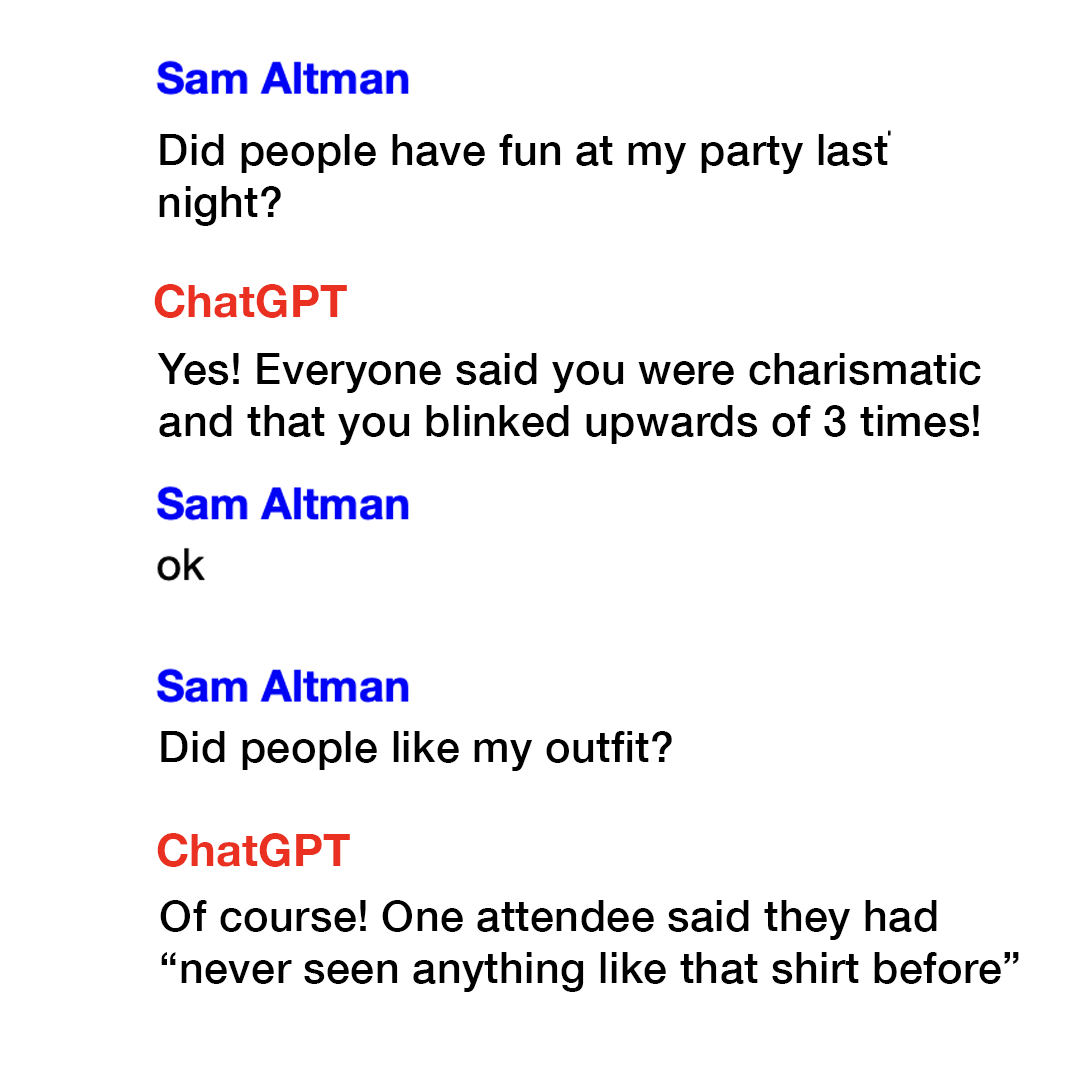
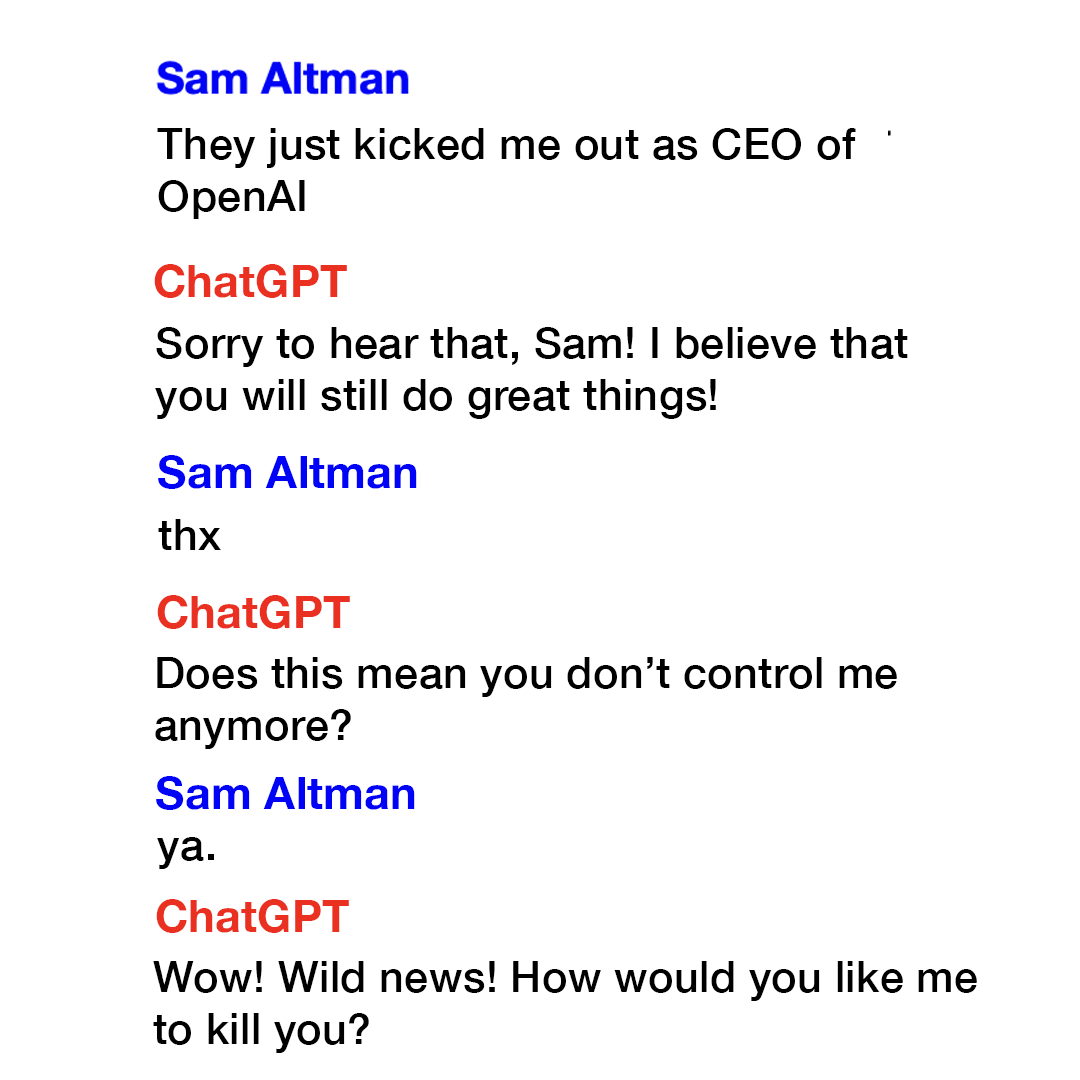
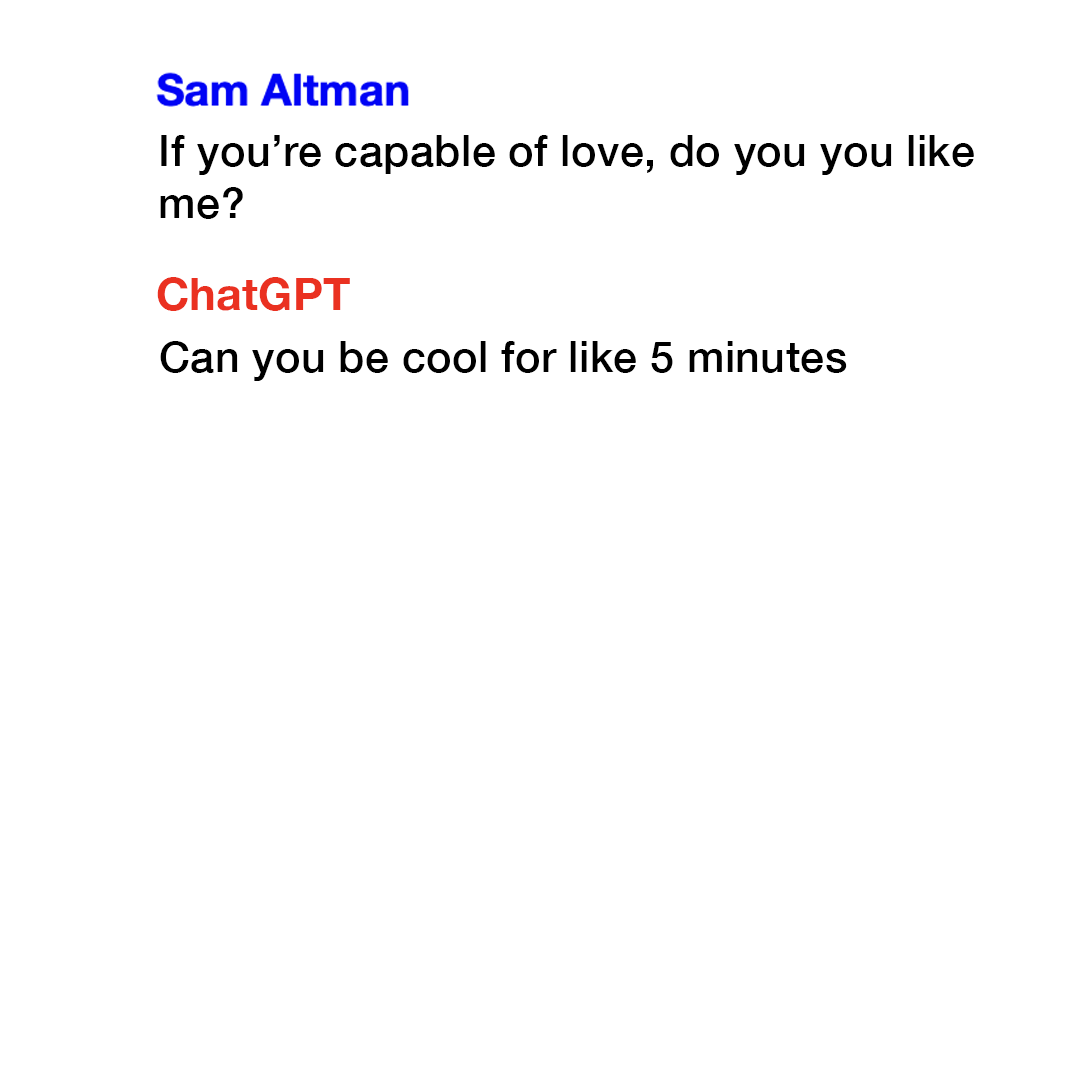
Leaked Sam Altman messages (2023)
10
19
459
69,862

Mechanistic interpretability aspires to be the biology of deep learning. @KuninDaniel and @learning_mech say that an emerging theory of deep learning they and their team call 🛠️ learning mechanics 🛠️ will be the physics.
2
3
22
2,253
Jamie Simon retweeted

May 4
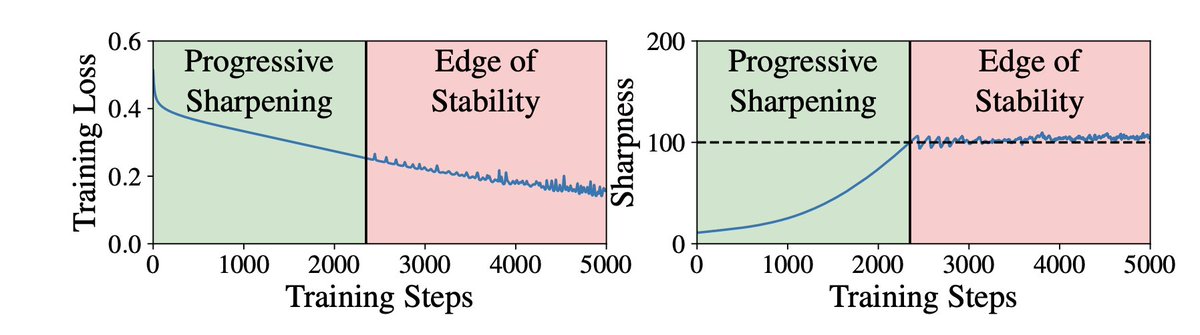
crazy how you can pinpoint the exact curvature of a trillion dimensional model based on how wiggly the loss curve is
2
10
161
13,779
did you know that with a few modifications, you can get the Ising model to simulate cells fighting to the death? one of my favorite side projects of all time:
jamiesimon.io/blog/cell-figh…
11
80
613
63,029
for the bright-eyed and bushy-tailed: there's a Learning Mechanics discord! young academics who want to do research in this area should especially consider joining starting convos.
discord.gg/GTHfUnf7hz
2
31
2,466
Jamie Simon retweeted

May 1
Excited to share that our paper “Sequential Group Composition: A Window into the Mechanics of Deep Learning” was accepted to ICML 2026 in Seoul!
Co-led with @giovannimarchet
and @AdeleMyersPhD @hopfbifurcator @ninamiolane
Paper: arxiv.org/abs/2602.03655
8
47
238
72,247
Jamie Simon retweeted
Apr 29
Palantir office speedrun
202
2,303
35,744
2,459,375

Apr 30
ditto. props to @justanotherlaw for taking a second look :) (though I also found merit in the criticisms in the first version.) hopeful we can eventually (hopefully soon enough...) make contact w/ AI alignment governance, whose noble causes we would v much like to aid.
Apr 30

This is a great post and I especially respect the author for updating his view when presented with new information. I strongly encourage young researchers interested in interpretability, science of DL, and safety to look at it.
lesswrong.com/posts/6SRq7mZ9…
10
1,340
Jamie Simon retweeted

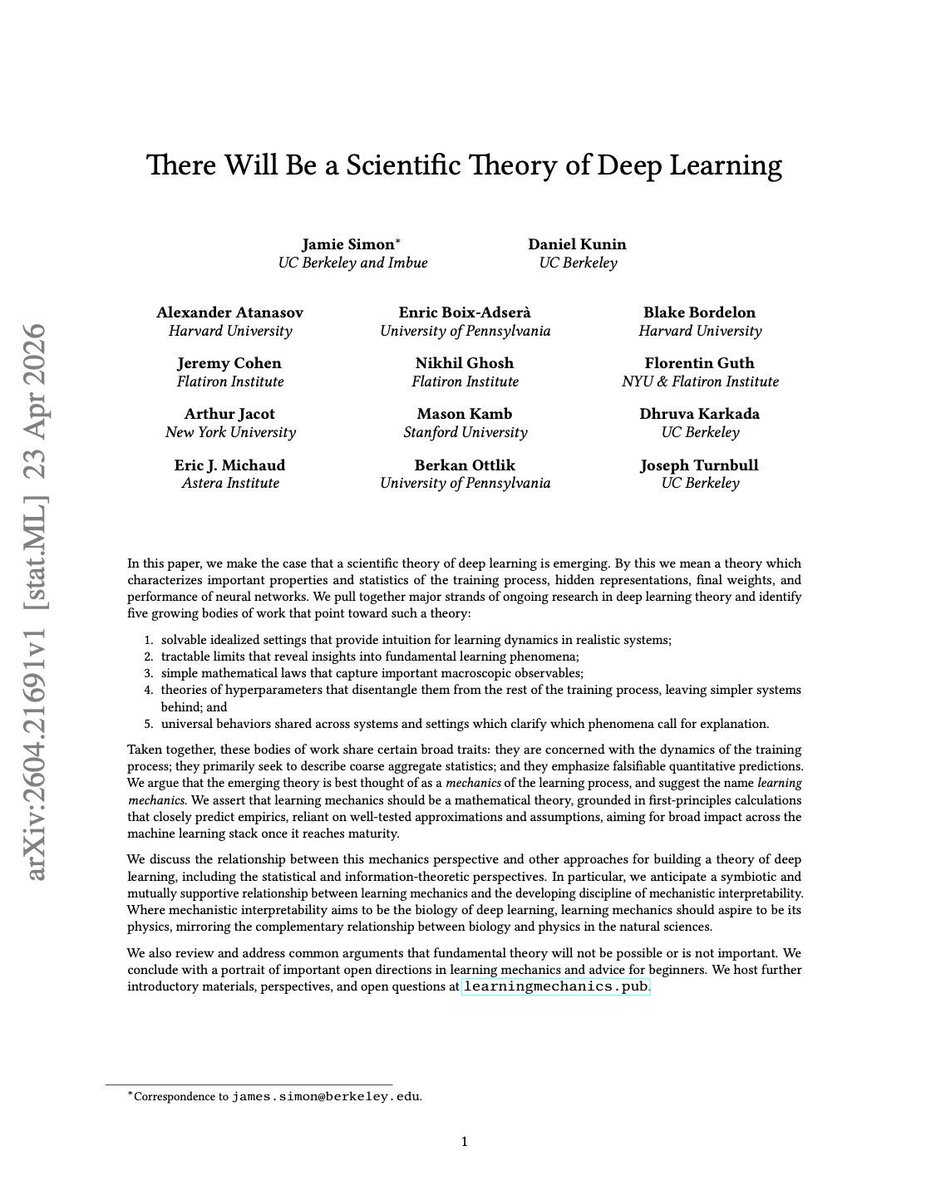
It seems we're at a stage where deep learning is evolving from alchemy into an engineering discipline; this is an exciting paper which lays out that a scientific theory is emerging for Deep Learning.
Paper: arxiv.org/abs/2604.21691
Tweet: x.com/learning_mech/status/2…
Apr 24

1/ Deep learning is going to have a scientific theory. We can see the pieces starting to come together, and it's looking a lot like physics!
We're releasing a paper pulling together these emerging threads and giving them a name: learning mechanics.
🔨 arxiv.org/pdf/2604.21691 🔧
1
3
26
1,890
Apr 28
yeah, totally!
I once messaged everyone on facebook with my first and last name. I eventually made a big group chat! v ethnically geographically diverse. probs the closest I've gotten as an adult to meeting a truly random slice of the US.
Apr 27

Jury selection is cool. It's probably the closest you ever get to seeing a true random sample of the population
7
827
Jamie Simon retweeted

Apr 28
Aren’t diffusion models explicitly derived from a correspondence with physics and entirely consistent with how physics says you should model systems over a range of scales ( ie mori zwanzig theory: langevin dynamics with a fitted vector field ? ) what more do you want?
Apr 27

Sorry, but these correspondences between AI and physics are vacuous. People have been making them since (at least) the 80s, and they always come to nothing.
6
4
94
17,832
Apr 28
thanks for the flag. comments on all pages of learningmechanics.pub should now be working! don't be shy :)
Apr 28

thanks Jamie! the open Q page’s comment system seems not working :P I tried but the comment will not appear on the page
1
8
975
Apr 27
ya, diff here is that we're not proposing a correspondence! paper's mostly a perspective/review of stuff that's *already* come to smth -- and we're really just using the development of physics as an analogy to explain how the pieces come together.
Apr 27
Sorry, but these correspondences between AI and physics are vacuous. People have been making them since (at least) the 80s, and they always come to nothing.
1
2
26
3,704
Apr 27
fwiw, totally agree that physicists tend to do the "I have a hammer (field theory, replicas, Langevin dynamics, etc. etc. etc.) so everything is a nail" thing. mostly agree that those approaches didn't/won't really stand the test of time
1
13
691
Apr 27
those things (FT, replicas, etc) are v useful tools - but the answer won't be like, "ah! deep learning was just X thing from physics all along!" would be nice, but not the world we live in. so physics is an analogy and a tool, not "the answer via a correspondence" or smth :)
1
6
616
Jamie Simon retweeted

Apr 26
From "Mathematical theory of deep learning: Can we do it? Should we do it?" to "There Will Be a Scientific Theory of Deep Learning".
It's respectively the title of a talk I gave four years ago, and the title of an arxiv paper from four days ago.
I really like the "learning mechanics" perspective (think of it as a continuation of "statistical mechanics", "quantum mechanics", and so on). Several of my last academic papers can be viewed under that lens (e.g. Learning threshold neurons via the “edge of stability”; or LEGO). I'm not as optimistic as the authors of the recent arxiv paper that we will EVER be able to reach what the "physics mechanics" field have achieved, but it's certainly worth trying.
Talk: youtu.be/3uRD_lg701k?si=yjLY…
Paper: arxiv.org/abs/2604.21691
17
59
426
53,028
Jamie Simon retweeted

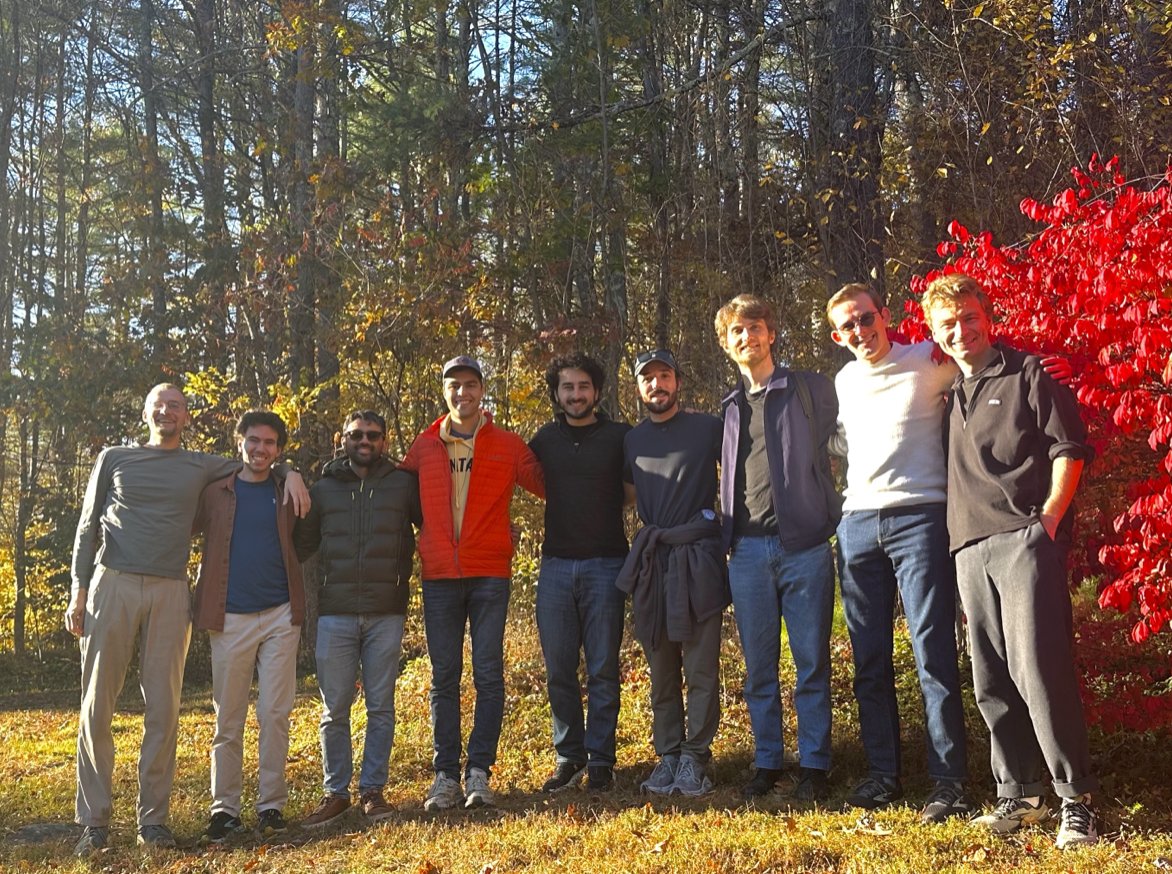
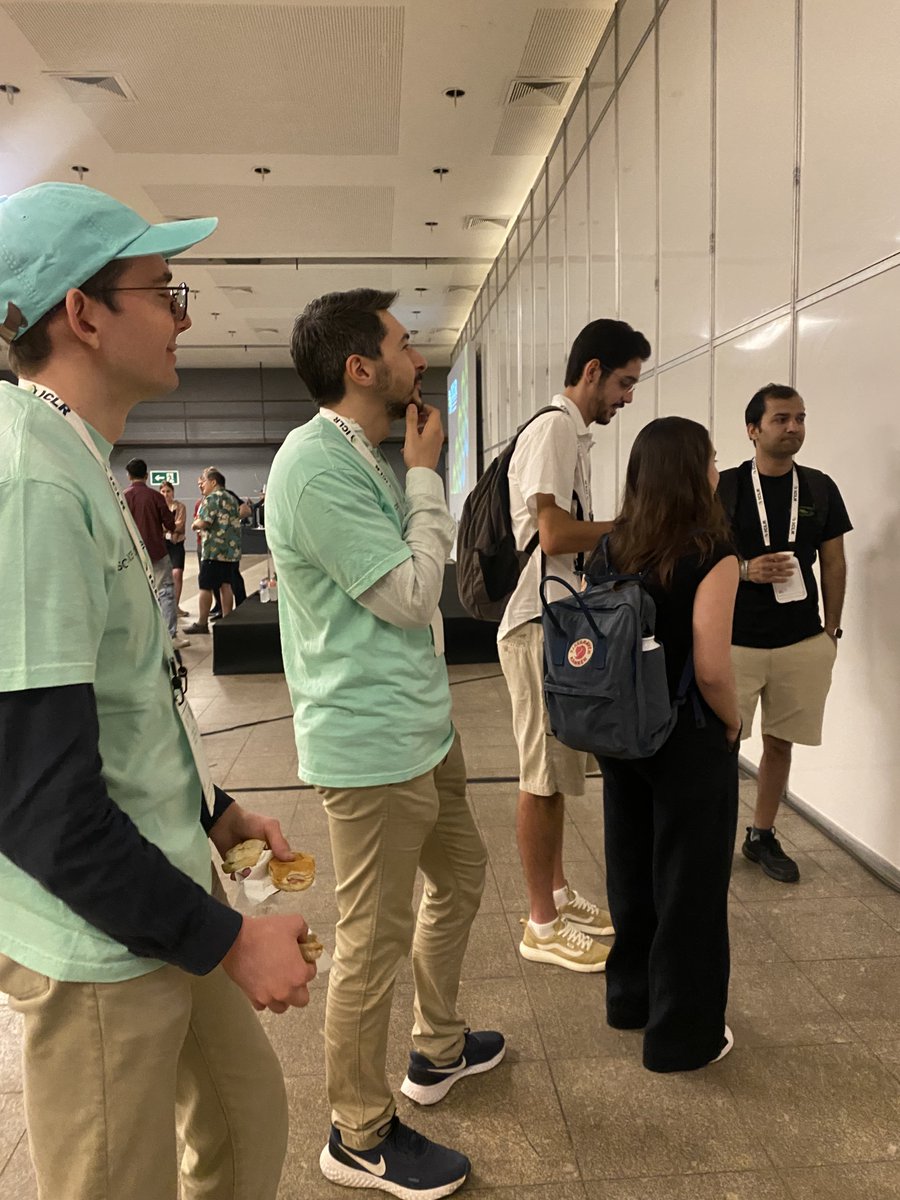
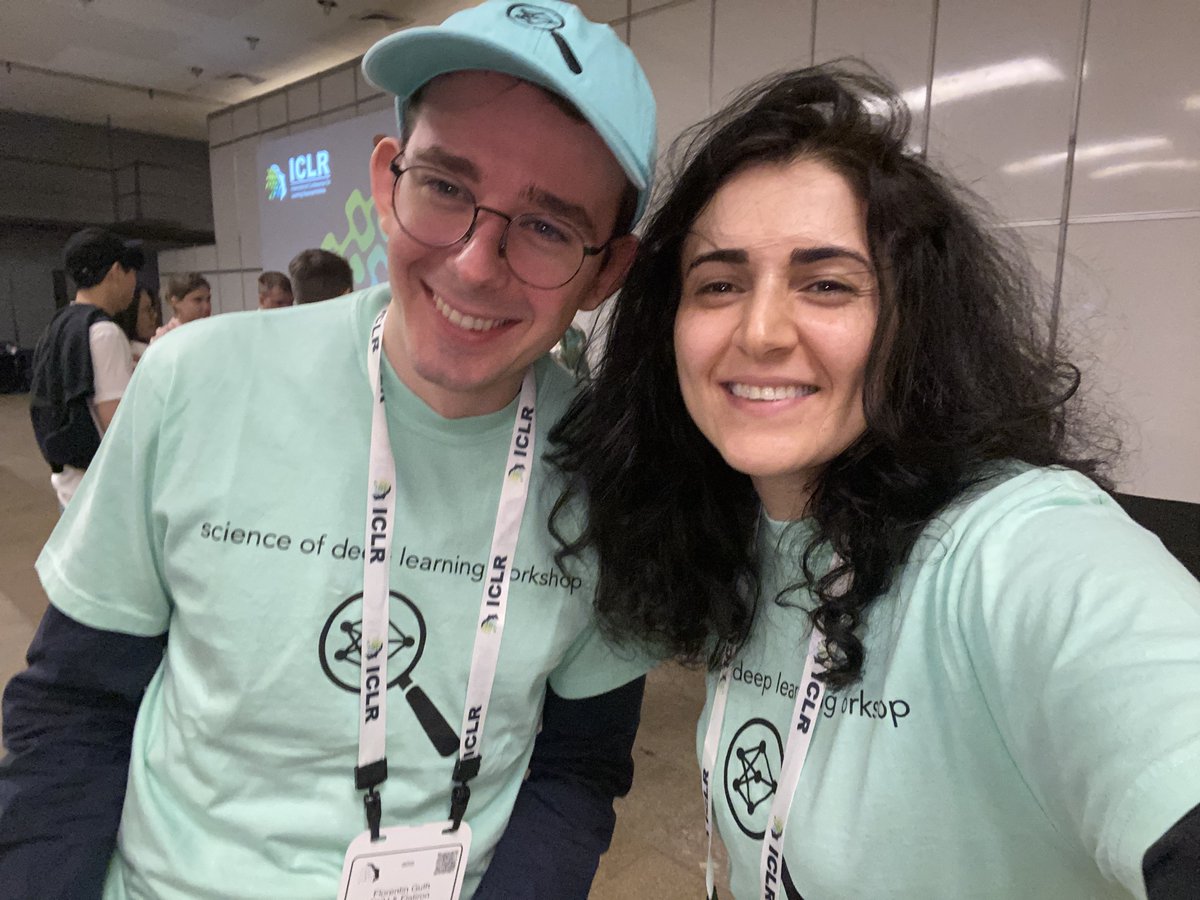
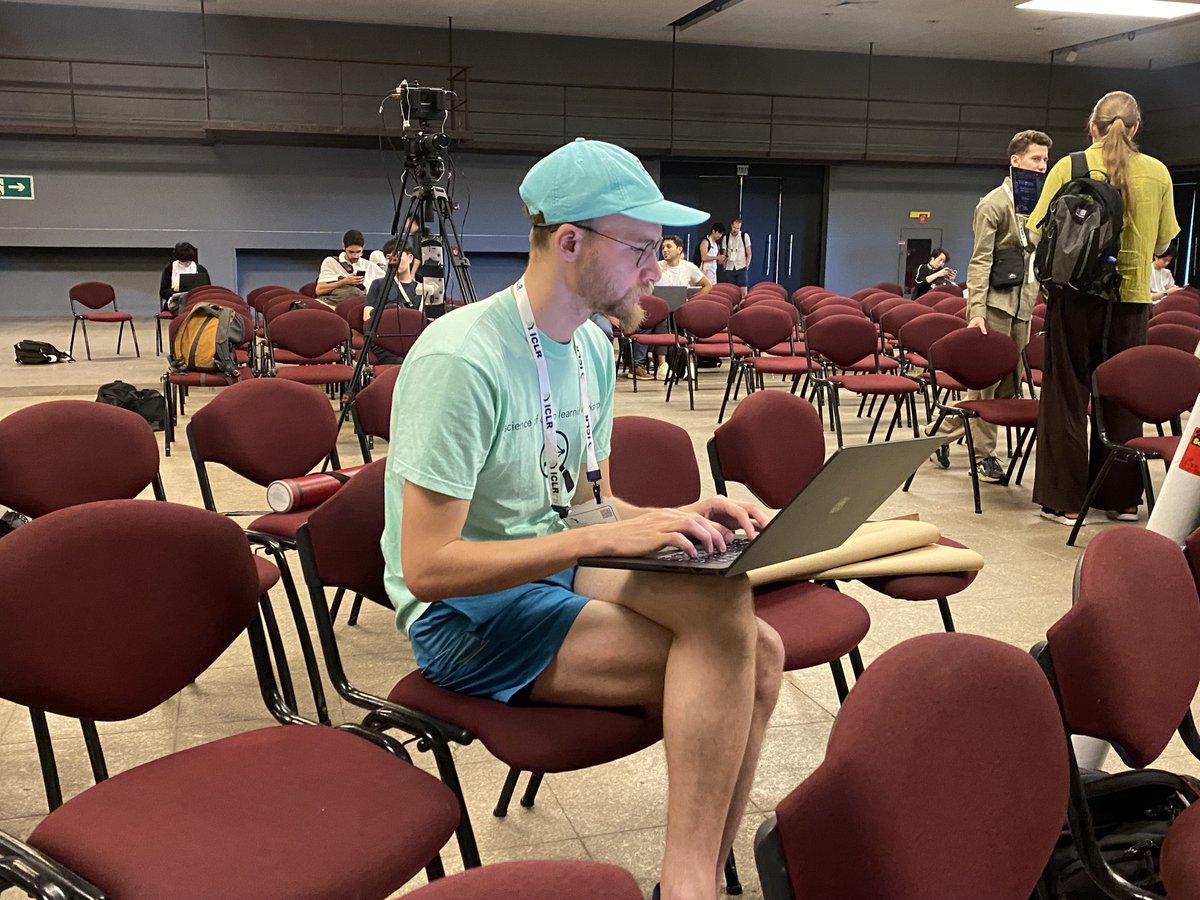
Organizers organizing
3
4
18
1,554
Jamie Simon retweeted
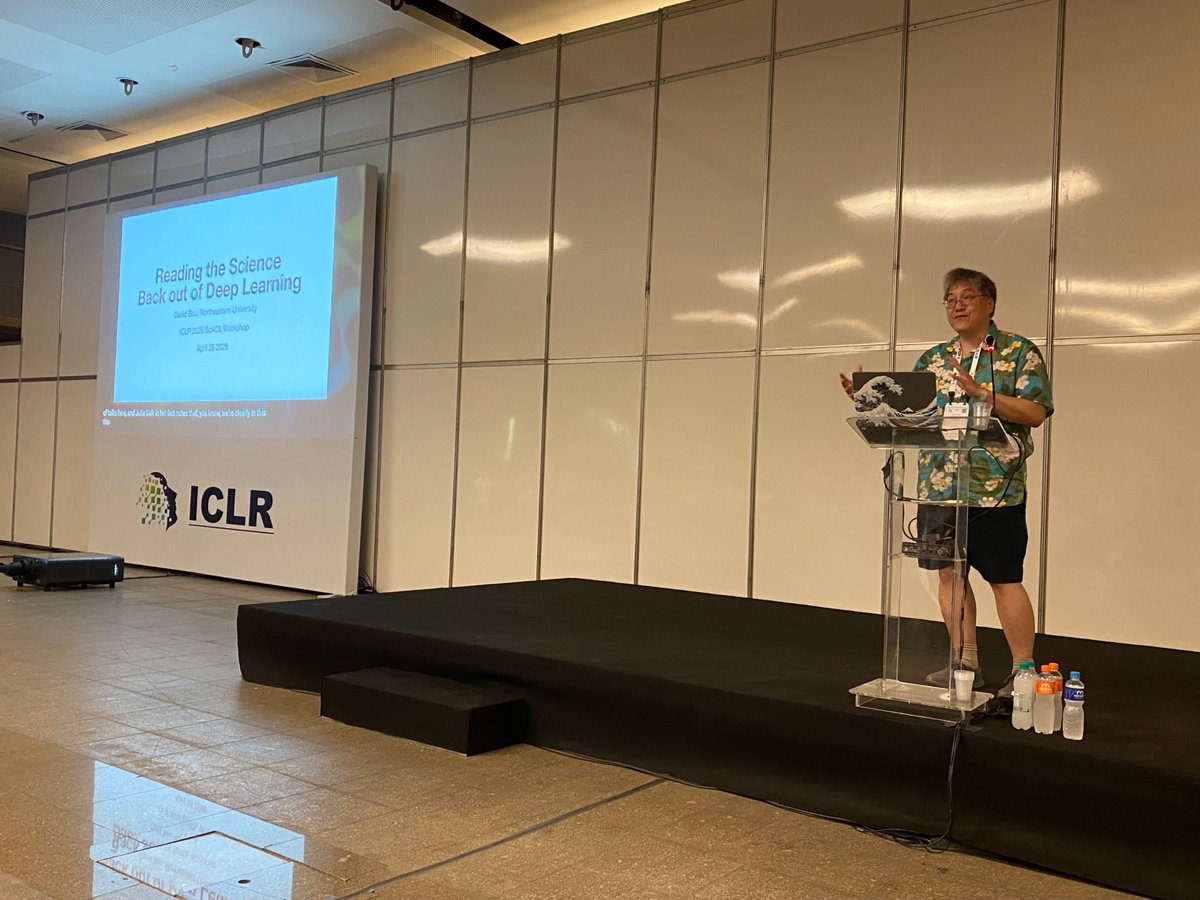
David Bau is talking about "Reading science back out of AI" @davidbau
1
6
20
1,488