
@ the creative inseam of GTM
Joined December 2019
- Tweets 1,052
- Following 1,420
- Followers 199
- Likes 5,425
45 Photos and videos












May 20
Imagine being hook up all day🤣🤣🤣
May 19

you get violently shocked if you send a bad prompt into vllm-studio
imo this is the future of software engineering, this enforces high quality prompting
(built it in the past 4 hours for this, will make a more detailed post on this once I come back from work)
@0xSero more than happy to get a PR out if u need this very important addition into vllm-studio 🫡
77
May 19
These guys @_HermesAgent @Teknium really are working in another dimension. I’m constantly blown away at the depth and breadth of support and thorough updates.
Truly executing at the highest level
1
2
28
33 retweeted

Apr 11
I think the world needs fewer SaaS companies.
That's not a popular thing to say when the barrier to building one just dropped to zero. Vibe coding made it possible for anyone to ship a product over a weekend. That's cool. But what I'm seeing is thousands of micro-SaaS products solving the same narrow problems with slightly different UIs, and nobody competing hard enough to actually build something great.
This was a problem before vibe coding, though. The fragmentation started with how venture capital selects founders.
VC firms love writing thought leadership about their founder selection process. Reading some of these posts, you'd think they've developed some kind of divination ritual for identifying generational talent. That skill does exist. I've talked to people at firms who have real hypotheses and track records picking great founders.
But a lot of the time, a firm needs deal flow, or they have a thesis about an industry and there aren't many people building in it, or the timing is just right and someone's in the room. There are a hundred reasons someone gets funded, and "this person is an exceptional operator" is only one of them. Not every venture-backed founder is some sort of ubermensch.
Problem is that founding a VC-backed company has the highest ROI of almost any career move in tech. Maybe it doesn't work out. Maybe you pay yourself $120k for five years and the company folds. But even then, you've built a network you'd never have access to otherwise. You've connected with investors, operators, other founders. You can go get a job at a VC firm. You can put "CEO/Founder" on your resume and land a senior role at another company.
As long as you don't screw anybody over (sometimes even this isn't an issue ¯\_(ツ)_/¯) and do your best for however long it runs, your outcomes are almost certainly better than someone who optimized for less upside.
So I get why everyone wants to be a founder. The math works individually. But zoom out and the collective result is thousands of funded companies building marginal improvements on problems that don't matter that much, staffed by people who could be contributing to something bigger.
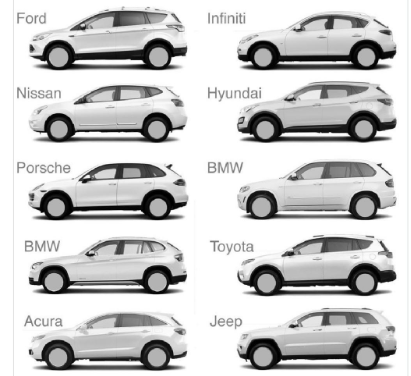
Now think about what happens when you add AI to this. The pic included is what's what's happening to SaaS.
LLMs are trained on the open internet. That's the substrate. When you use that brain to design products, to write copy, to build features, everything converges toward the same middle. The same UI patterns, the same messaging, the same feature sets.
I'll use my own company as an example. AirOps helps brands rank and get cited in AI conversations. A lot of companies in our space sell prompt tracking, which is fine, but the technique to track AI prompts is a commodity at this point. Anybody can build that over a weekend. And people do. I watch new AI visibility companies pop up constantly. But tracking prompts isn't the hard part. The hard part is the years of data, the techniques baked into the product that help you actually turn visibility into outcomes. Stuff that takes time and reps to build, not a weekend.
Every time I see someone spin up another AI visibility tool, I think: why would you start something with that low a chance of success when you could come build something generational at a company that already has the foundation? But that's the system working as designed. The incentives say "start something," not "join something."
I'm not saying the people building them are bad, or that there's no room for competition. But the system optimizes for the ask, not the answer. And now that building is nearly free and the AI doing the building is pulling from the same data, we're getting more asks than ever, and they're all converging.
I don't have a clean solution. I just think it's worth noticing that "more companies" and "better products" aren't the same thing, and we've been conflating them for a long time.
1
2
8
819
Mar 13
💯💯💯💯

Music untitled 🔥I’d Fvck these 🥷🏾up if they jump me in real life 🤨 a bunch of punks. THE ALGORITHM is coming! ✍️🔥 gunitbrands.com
1
1
2
120
Mar 11
I appreciate the frustration here and the agency it took to fact check all these lames 🫡

@grok I see this type of post 20 times a day and not one of the posts provide a source. It’s the same old “anthropic quietly shared…” claim. Can you find a direct source where Anthropic actually shared this specific CLAUDE.md , or is it just made up?
30
Mar 11
the means of learning are more abundant than ever.
its the desire to learn thats scarce man
14

Mar 11
ALEX FINNed Up
Mar 10

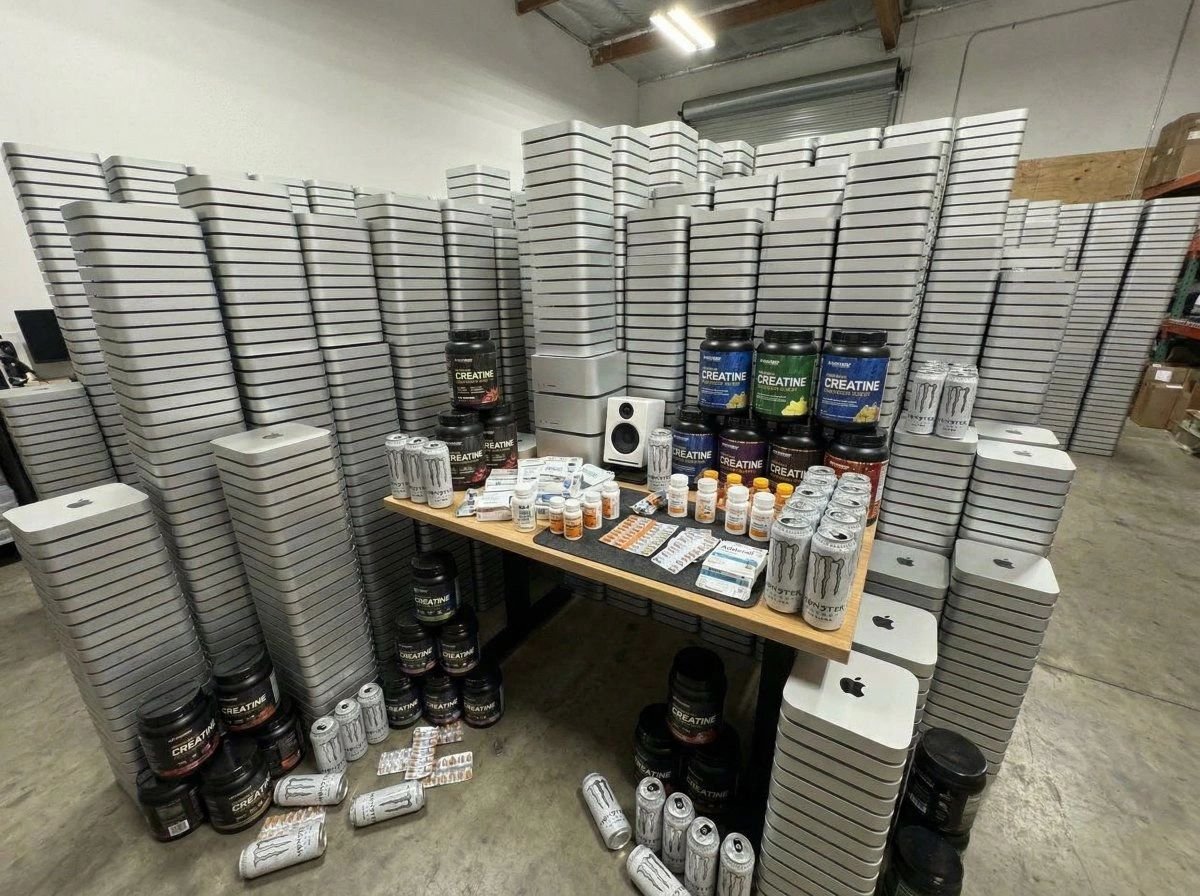
Startups struggle to hire folks for 5x a week in office roles,and when their office doesn't look like this, they wonder why.
if you want to get people back on site, a pizza party once a week isn't going to cut it.
you need to give your employees non-FDA regulated peptides and Mac minis as office perks.
it's 2026. you can't operate on the 2015 playbook.
39
Feb 9
Had this looping last night didn’t even turn the bowl on
Feb 8

Unfortunately for Bad Bunny no performance in San Francisco will never top Future's at the 2012 NFC divisional
3
56
Feb 3
respect and resonate w/ the duh DIY mentality

DIY/in house, just like my grandfather taught me
2
66
Jan 6
bro this shit just made me wreck

1
50
Jan 5
Jan 4

Unitree’s $30,000, 180cm (nearly 6 ft tall) H2 humanoid robot. This version is likely powered by an Nvidia Jetson AGX Thor platform, built on Blackwell architecture.
34
7 Dec 2025
Dope dealss Solving Hard Problems in Complex Codebases – Dex Horth... youtu.be/rmvDxxNubIg?si=VXhD… via @YouTube
56
3 Dec 2025
locked in big dawg 🫡☂️📊 @ryancarson
2 Dec 2025

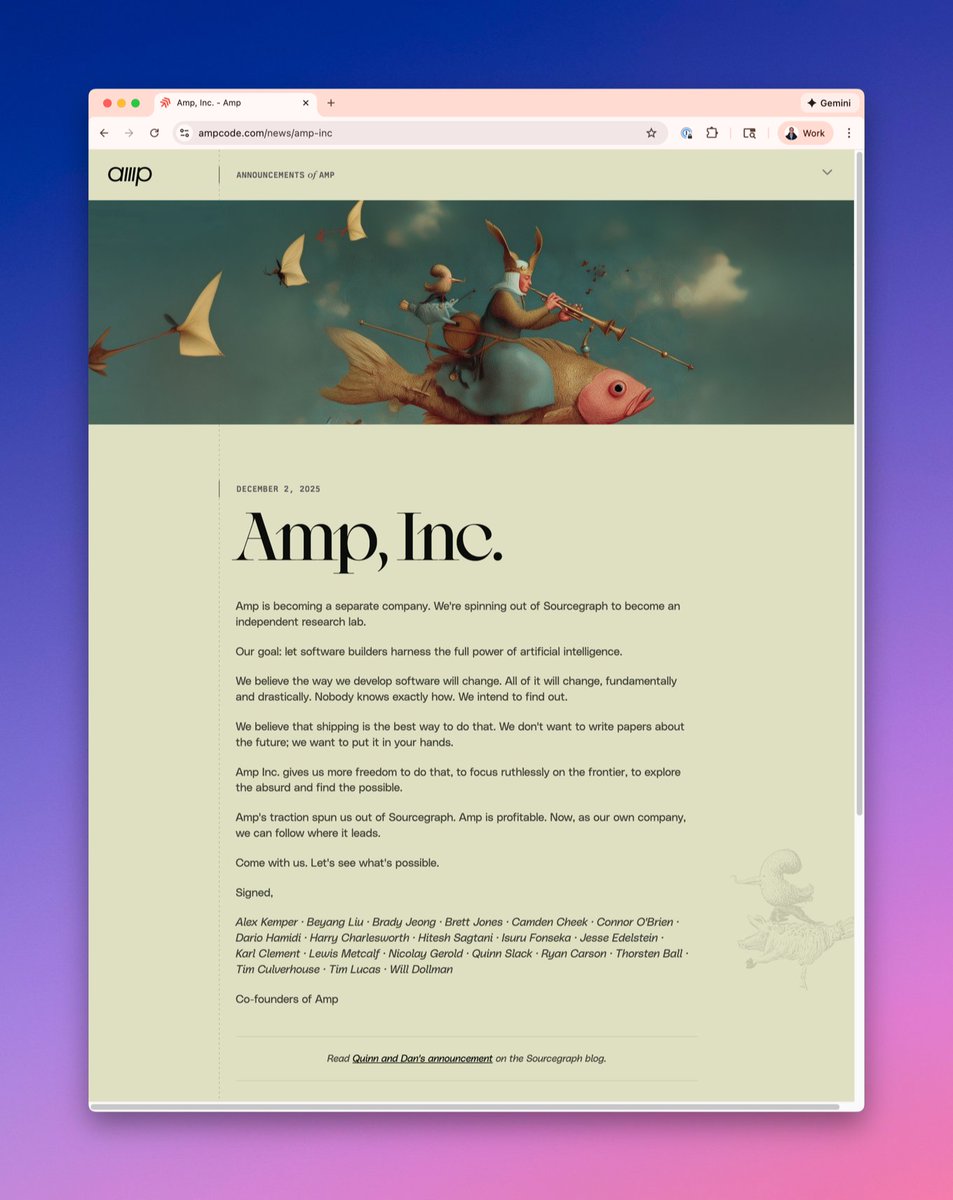
.@AmpCode is becoming a separate company.
We're spinning out of @Sourcegraph to become an independent research lab.
Our goal:
Let software builders harness the full power of artificial intelligence.
We believe the way we develop software will change. All of it will change, fundamentally and drastically. Nobody knows exactly how. We intend to find out.
We believe that shipping is the best way to do that.
We don't want to write papers about the future; we want to put it in your hands.
Being a stand-alone company gives us more freedom to do that, to focus ruthlessly on the frontier, to explore the absurd and find the possible.
Amp's traction spun us out of Sourcegraph. Amp is profitable.
Now, as our own company, we can follow where it leads.
Come with us.
Let's see what's possible.
Signed,
@AJKemps
@beyang
@bradyjeong
@0xbrettj
@camden_cheek
@connorado
@_dhamidi
@hjcharlesworth
@sagtanih
Isuru Fonseka
@jedelstein25
@karlclement
@lewis_b_metcalf
@nicolaygerold
@sqs
@thorstenball
@rockorager
@toolmantim
@willdollman
Co-founders of Amp
ampcode.com/news/amp-inc
51