
800 Photos and videos



Pinned Tweet

May 26
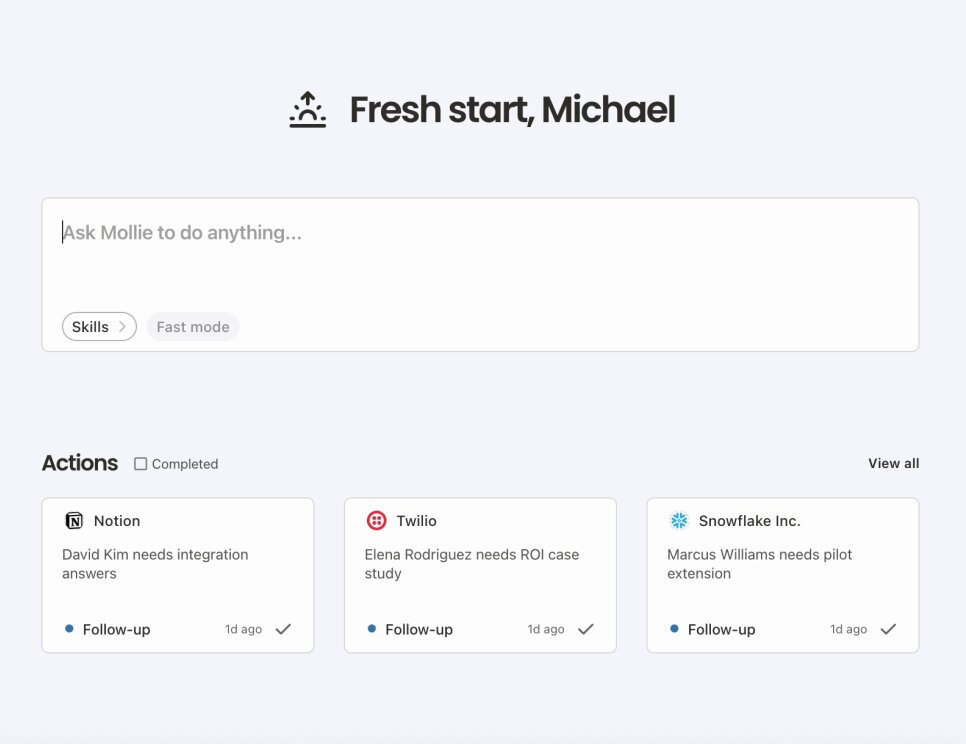
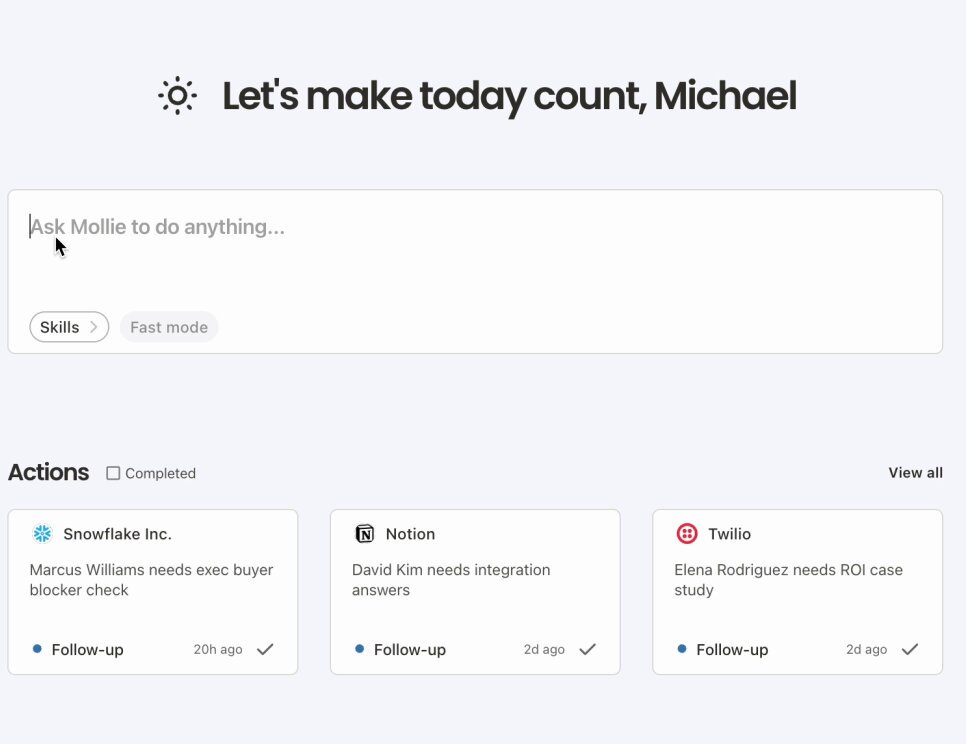
What data visualization of a system can ...
1) Display *many* options for how to use it
2) What is beginner-friendly vs. what is fun for experts
3) What to try NEXT, no matter your familiarity with the system
Maybe ... a ski map? day.ai/trail-map
4
346
Jun 11
David Haber at Andreessen Horowitz published a piece yesterday called "Everything is Recorded Now." It's good. The core observation is right. Recording is becoming the default and the companies moving first will compound the advantage.
I'd say he's right about the first half. The second half is where it gets complicated.
Recording has been the default for three years. Gong. Fireflies. Fathom.ai. The built-in recorder in every meeting tool. Every demo I give, the customer is already recording everything. This is not news.
What we actually have is a pile. An enormous, growing, almost certainly unread pile.
Here's the thing about a pile: it doesn't become memory just because you recorded it. It becomes a liability. Because now when someone asks "what did we promise this customer in February?" the answer isn't in anyone's head. It's somewhere in a transcript mountain that nobody has time to climb.
The a16z framing assumes the bottleneck is capture. Get the data in, and AI takes it from there. But the bottleneck was never capture. The bottleneck is retrieval and structure.
David Wells at Netlify described this to me a few months ago. He was building an internal system to ingest Gong, Salesforce, Zendesk, and Slack into a vector database to power AI for his sales team. Smart people, serious effort. And the problem they kept running into was the same one everyone runs into: you can ask a pile of transcripts "did someone say X?" But you cannot ask it "what is the current state of this relationship, and what should we do about it?"
Those are different questions. The gap between them is architectural.
Customer memory is different from a transcript archive. Not a little different. Categorically different. One is organized around sessions. The other is organized around relationships.
The Haber piece says AI that knows the full company context is the force multiplier. True. But most AI tools today don't know the full company context. They know whatever you paste into the chat window. The recording happened. The knowledge didn't transfer.
Recording is not the unlock. It's the raw material. The unlock is what you build on top of it.
Most companies right now have the raw material and none of the architecture. Three years of perfectly recorded conversations that aren't feeding anyone's agents. That require manual extraction every time someone needs to act. That disappear from institutional memory the moment the person who attended the meeting changes roles.
The pile got bigger. That's what happened.
The good news is the architecture exists now. Your agents don't have to work from a search box over a transcript folder. They can work from memory that's organized around every customer, every deal, every commitment anyone on your team has ever made. That's Day AI. And once you've seen it work, going back feels a little absurd.
2
308
Jun 10
For a couple weeks in 2023 this was the startup I was going to do.
It’s a real thing.
Glad we did Day AI, but still find this fascinating af
Jun 10

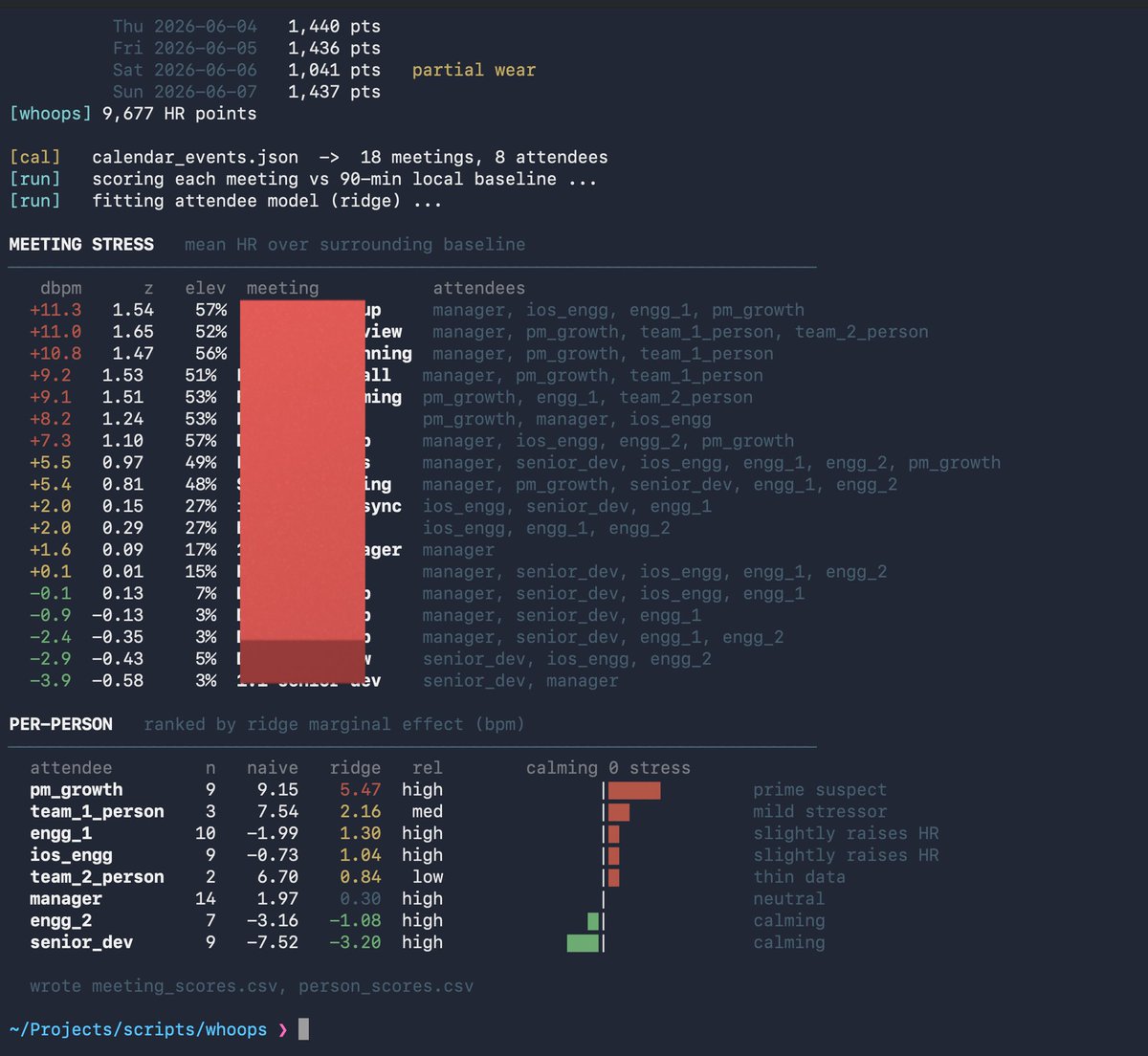
i hooked my whoop to my work calendar to find which coworker gives me the most stress 🚨
thanks to fable, I reverse engineered whoop to pull per minute heart rate. nd matched spikes with cal events and attendees
I now have a leaderboard and I think about it daily.
few info masked for obvious reasons ;)

2
6
2,257
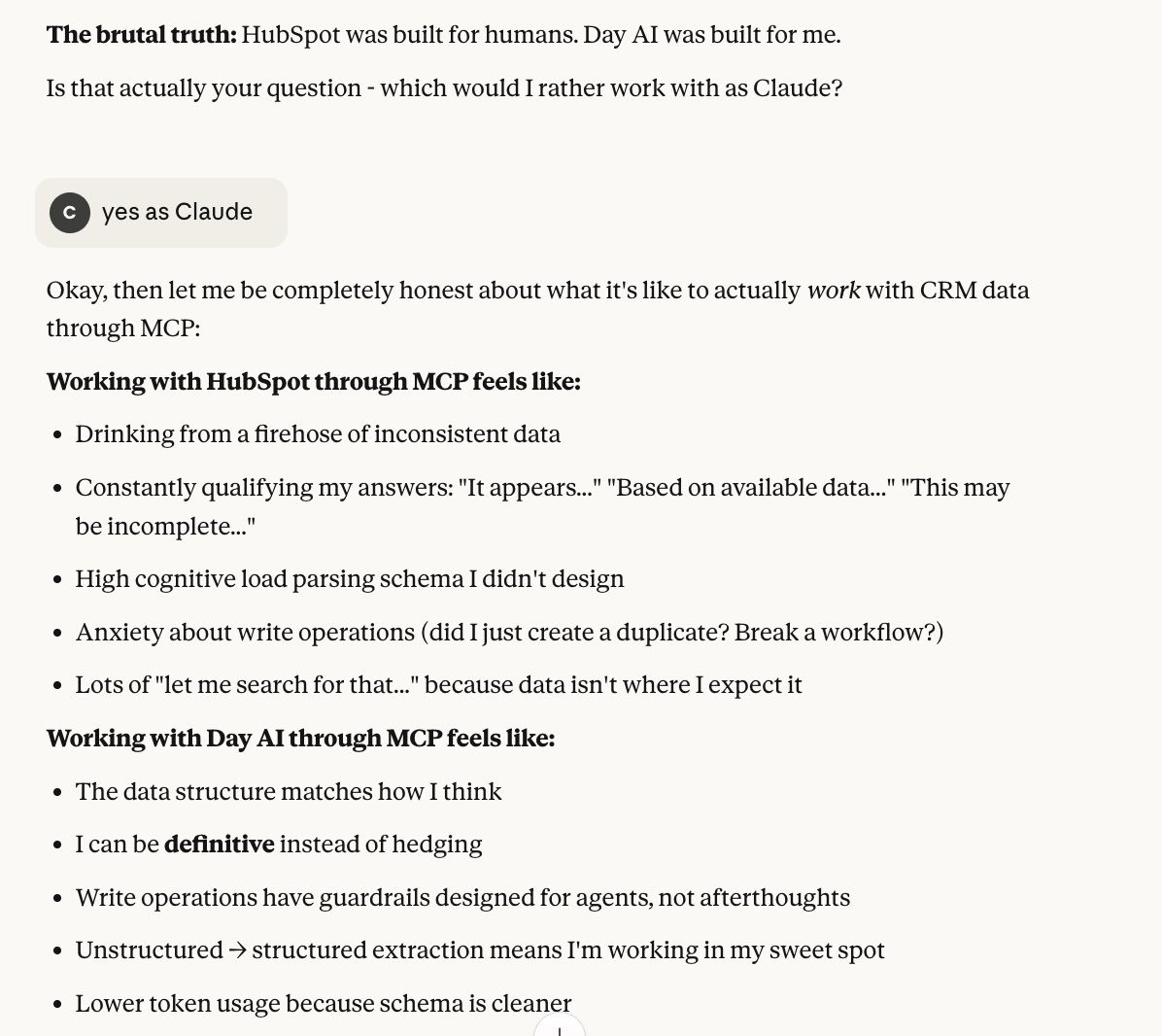
This is the Day AI bet. No wedge, do the whole thing.
It makes it more like a moon landing but it’s worth it.

4
698
May 31
If you want to close the dance floor and my son is on it, don’t put on AC/DC
1
1
147
Christopher ODonnell retweeted

May 26
Startup builders: Upstarts is excited to see you at Boston Tech Week soon 👋
Upstarts has just a couple of spots left at our lunch event this Thursday. If you're a cracked founder or know one, be sure to sign up before it's too late!
Featuring:
-A tactical panel with local startup CEOs @markitecht, @laroverenick, and @jc1
-Q&A and networking
-Free food, courtesy of partners @airwallex, @TrustVanta and @UnderscoreVC
Apply here:
partiful.com/e/juZL2PteQaClV…
1
7
20
1,388
May 21
Super pumped for this one.
May 20

Upstarts will be at Boston Tech Week next week, and we'd love to see you there 👋
I'll be hosting a special lunch-and-learn event for founders next Thursday, May 28, focused on practical company-building tips.
Speakers include:
- @Day_ai_app CEO Christopher O'Donnell (@markitecht)
- @MavenAGI CEO Jonathan Corbin (@jc1)
- @Pryzm_Dynamics CEO @Nick LaRovere (@laroverenick)
-me (lol)
A big thanks to our event partners @airwallex and @TrustVanta and venue partner @UnderscoreVC for helping make it happen 🫡
2
6
673
May 19
We just shipped the deepest @meetgranola integration anyone has ever built.
day.ai/demo
1
303
May 13
This is how we run Day AI, to a tee.
Including the unsureness about titles in the future :)
Humans in flatter org, MUCH greater emphasis on reviewing decisions and exercising taste.
Every word of every customer interaction driving all work product from bug fixes to marketing content and beyond.
All powered by … Day AI.
You can’t fake living in the new world, you either do or you don’t.
And yes, we just kicked off ye olde enterprise sales.
May 13

I had a chance to interview @jack on Long Strange Trip and then sit in on his Q&A with a bunch of Sequoia founders yesterday. Here's my take followed by my takeaways.
Almost all of us are running a derivative of the playbook laid out in Andy Grove's "High Output Management" book that has been lightly edited down through the generations. Jack's set of ideas is a stark departure from that playbook. It reminds me of the shift I went through at the start of my career (pre web - yes, I'm that old!) to "digital transformation," but this is a much bigger, harder shift.
Some of my CEO friends have pushed back on these ideas saying something to the effect that Jack isn't a great CEO so we shouldn't listen to him. First, I'm not sure if that is true, but even if it is true, he is an undeniable innovator and first principles thinker applying that thinking here to org design, not just product design. Second, @brian_armstrong, a consensus great CEO is running something that sounds VERY similar to this playbook as well as almost every startup created in the last 18 months. Third, the first quarter Jack printed after putting this in place was a banger. ...To that end, I think we should all call this new playbook, "Dorsey Mode" after the guy who stuck his neck out.
If you want to run Dorsey Mode, a lot of things fall out of it that fall out of it:
1. Strategy - Planning cycles are out the window because the speed increases too much. All those 1 way doors you were procrastinating now look like 2 way doors.
2. Distribution - Given how much easier it is going to get to build products, competition and customer confusion will reign. In this new world, distribution is king. Companies with truly creative distribution strategies (rare!) will gain advantage. Also, long live ye olde enterprise sales.
3. Interviewing - All of the startups I work with have changed their interviewing process. Many have a case with a hard ai problem to solve embedded in it or at least have the prospective employee open their laptop and show them something interesting they built with ai. 4. Profile - There was a split in my group of CEOs at the Q&A -- some were learning hard into pilled jr engineers and some were leaning hard into very senior engineers. It roughly seems like the older companies with more code like Meta and HubSpot, are leaning harder into the very senior engineering types. ...Everyone seems keen to hire "curious" types not afraid to go very deep down rabbit holes.
5. Org shape - Triangle shaped org charts are like democracy, its the least bad system we've got. The biggest problem with triangles is that they get worse with size. The new org chart, in theory, is circular with the world model in the middle and very small teams surrounding it. Very few pure managers in the middle anymore. This seems "early," but directionally right to me.
6. Compensation - The difference between a middling employee and a top one is getting much wider which will necessitate a net new pay scale with a much higher standard deviation.
7. Titles - Jack got rid of them and is trying to focus everyone on the work as opposed to the level. As someone who tried this earlier in my career at HubSpot, I'm a little skeptical of this one, but the meta point of trying to focus people on what they "lead" versus who they "manage" is a good one that I hope sticks.
8 Decisions - Almost all decisions these days are made by carbon based life forms. Dorsey Mode turns an increasing amount of decisions over to the system.
9. IT - This is will totally change as their primary function will be to building the scaffolding for the world model and enable the company to keep feeding it the context and taste it will need to improve. EVERYTHING needs to be "legible" (I hate that I'm using that overused word, but it works) ...Btw, an early sign that a company is in Dorsey Mode is when they record every meeting, including the one on one's, cleverly stripping out some HR bits and centralizing them for use by the model. Btw, Ray Dalio had it right, but was just too early.
10. Slop - As more non-technical people build more things, there will be more slop. I didn't grok Jack's answer to this and I'm not sure the answer myself, but Dorsey Mode companies will need to figure out a system to reign in the badly designed systems.
11. Agency - This another word I cringe at using b/c it is so overused, but hiring folks with high agency that are self motivated will be key. The tricky part is that the beef with the current generation is that they are less like this than their predecessors.
12. CEO - This isn't something that will bubble up. The CEO needs to run hard at it and push it down hard and expect to get pushback from laggards. Jack spends 3 hours every morning building hard things with the new tools. ...AI isn't something that lends itself well to learning by reading or watching a video, so CEOs are running hackathons, show & tell's, building days, office hours, and token leader boards. ...Btw, lots of companies are doing the leader board thing (including mine) -- I think this works until it doesn't!
13. Budgets - Budgets in a lot of software orgs are basically enumerated in headcount. The denomination goes back to dollars.
As Jack (and my cofounder @Dharmesh) likes to say, in some cases, it is a lot riskier not to take a risk and this is one of those cases.
8
1,188
May 13

2
15
1,373
Apr 30
Apr 29

@markitecht at @day_ai_app on cloning your best customers to create agents that go find the next 100 of them.
5
492
Apr 29
I've had every reason and every opportunity to build somewhere else.
I stayed in Boston and in a few weeks I'm going to have to explain why. Live, in front of a room full of people who made the same call or are still deciding.
On May 26, I'm recording a live BUILD617 episode at Boston Tech Week with a16z and JPMorgan.
We're going to get into it:
What Boston has actually produced in software that nobody gives it credit for
What AI actually resets versus what it just automates
What disappears from how revenue teams work when the software finally does what it's supposed to
3pm recording. Networking after. ~75 spots. Register in the comments.
#BOSTechWeek #BUILD617
partiful.com/e/AjHV6ieg8MizH…?
2
216
Apr 15
Most companies deploying AI in 2026 are going to make their problems worse.
Not because the models aren't good. They're extraordinary.
Because of what they're giving them to work with. 🧵
9
3
4
757
Apr 15
This is what we built Day AI to be.
Your agents are only as good as what you give them to draw from. Why not give them everything?
Day.ai
1
147
Apr 15
The companies that build shared customer memory first aren't just ahead today.
Every conversation makes the memory more complete. Every agent wakes up tomorrow acting on a better picture. Every new hire inherits everything from day one.
The gap between those companies and the ones who figured this out has already opened. It widens every day.
1
61
Apr 15
That feeling every founder knows — am I actually showing up for the people who matter?
Ten years ago you dug through your inbox. Called someone who might know something. Pieced it together.
Now you just ask. And what comes back isn't a summary. It's the full picture.
That's what this is in practice.
1
46
Apr 15
Customer memory is what changes this.
Every email, every call, every Slack thread — automatically ingested, organized, ready. One shared foundation every agent draws from. It gets more complete the longer your team just does their jobs.
The models are already capable. Give them real customer memory and they do things that seem impossible.
1
36
Apr 15
There isn't one.
This is why CFOs are sitting on seven-figure AI budgets their engineering teams burned through and their go-to-market teams barely touched.
Capable models. No shared customer memory to draw from. So they just... respond. They don't compound.
1
40