
Joined August 2017
- Tweets 3,870
- Following 466
- Followers 939
- Likes 14,927
277 Photos and videos









Pinned Tweet

Jan 8
fou(re) friends
fou(re) gigachads
fou(re) four four
444 @re 444
@twinkle2089 @shinori_san @0xbliink @wtf4uk

58
7
206
7,728


Apr 30
gLiquid fam
Thought every "trading discord" was just shilling and noise.
Then I joined @liquidtrading - totally different energy.
15
1
18
243
Apr 30
What keeps me there:
Clean market news, zero fluff
Real-time PnL proofs straight from the Liquid App
Setup breakdowns with entry / SL / TP and actual reasoning
Strategy talk that sharpens your edge
Role upgrades for active contributors
But the real alpha is the vibe.
1
6
106
Apr 30
People to celebrate W's with, and people who actually get it when you're bleeding red.
Trading solo is hard mode - this feels like playing with a team.
Jump in: discord.gg/liquidtrading
5
108
Mar 18
web2 me vs web3 me




3
12
3,468
Feb 22
# the myth of infinite cloud scale
everyone assumes cloud scales forever
more racks, more power, more cooling
and somewhere, more intelligence
but physics does not negotiate
/ the wall is physical
data centers consume real energy
cooling is not virtual
land is not programmable
power grids have caps
cooling systems have limits
density creates heat, heat destroys hardware
you cannot abstract away joules
/ diminishing returns at the top
vertical scaling follows a curve
first racks: high output per dollar
next racks: marginal gain per dollar
last racks: infrastructure overhead per dollar
at scale, the cluster feeds itself
more power goes to cooling than to compute
more engineering goes to stability than to capability
vertical expansion becomes expensive maintenance
/ horizontal beats vertical
the answer is not a bigger cluster
it is a distributed network of smaller nodes
edge compute runs closer to demand
idle hardware becomes productive
geographic distribution reduces latency
when compute is spread across thousands of nodes
the ceiling disappears
because there is no single point of saturation
/ the real scale is network scale
a single hyperscaler hits physical ceilings
a distributed network does not
@Gradient_HQ treats compute as a network property, not a facility property
nodes contribute, routing adapts, capacity grows organically
the myth is that scale is vertical
the reality is that scale is horizontal
infinite cloud is a marketing claim
distributed compute is an architectural truth
14
28
824
Feb 21
# ai needs market dynamics, not admin control
most ai infrastructure today is centrally managed
pricing is set by policy
routing is defined by configuration
rewards are distributed by rules written in advance
this is administrative allocation
it works until scale increases
> when demand spikes
> when hardware fluctuates
> when costs shift
static control becomes a bottleneck
/ pricing through competition
compute is not homogeneous
- latency differs
- reliability differs
- energy cost differs
a fixed price ignores variance
markets discover price dynamically
inefficient nodes are bypassed
efficient nodes are utilized
pricing becomes signal, not decree
/ routing through performance
in centralized systems, traffic follows predefined paths
in dynamic systems, traffic follows performance
lowest latency
highest reliability
best cost
routing becomes adaptive, not political
/ reward through contribution
uptime alone is not value
contribution is measurable
> throughput delivered
> latency maintained
> tasks completed
rewards should follow output, not ownership
markets allocate compute better than managers
because markets react in real time
@Gradient_HQ embeds performance signals into the system layer
nodes compete, routing adapts and rewards follow contribution
when allocation is dynamic - intelligence scales
when allocation is administrative - intelligence plateaus
14
27
893
Feb 20
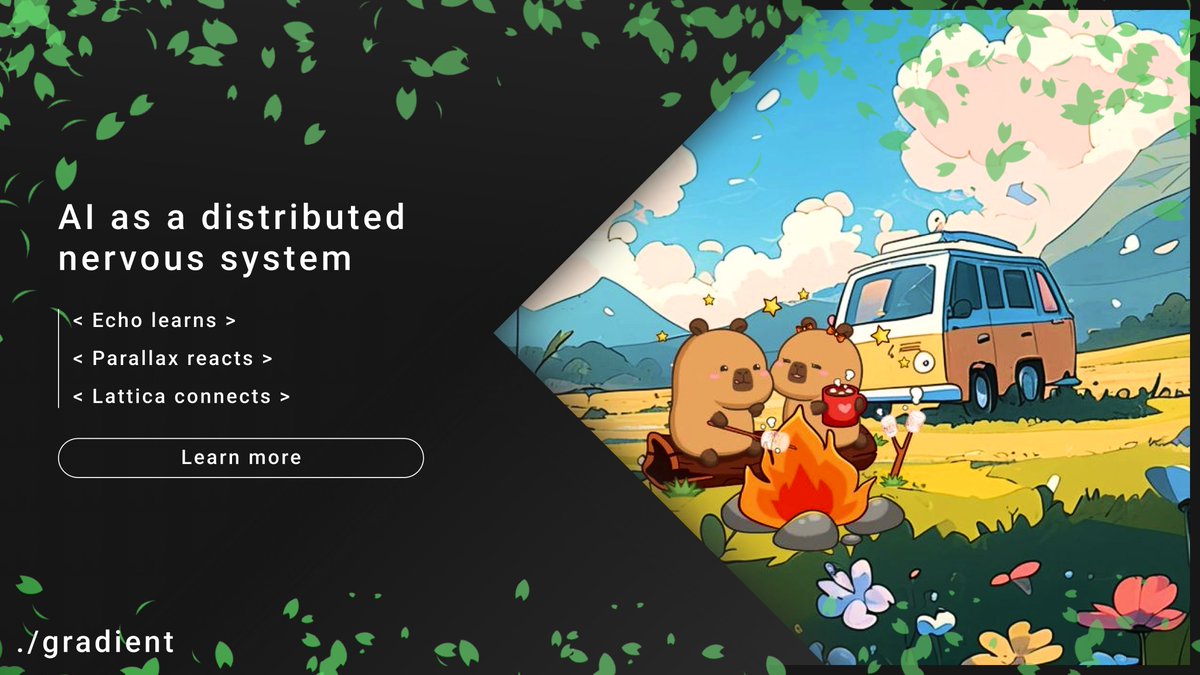
# ai as a distributed nervous system
intelligence is not a single model
it is a system that learns, reacts and coordinates
most ai stacks are built like isolated organs
model here, inference there, data somewhere else
but intelligence does not emerge from isolation
it emerges from coordination
/ echo - the learning layer
echo is where adaptation happens
it consumes experience, updates weights and improves policy
learning is not static - it is continuous
echo turns distributed experience
into evolving intelligence
/ parallax - the reflex layer
parallax executes at the edge
> it routes prompts
> adapts models to available hardware
> delivers low - latency inference
this is the reflex
reaction without friction
execution without central choke points
/ lattica - the nervous system
lattica connects everything:
- nodes
- weights
- signals
- state
it routes intelligently, synchronizes dynamically, broadcasts peer - to - peer
without connection
learning stalls
reflexes fragment
/ coordinated layers create intelligence
learning without execution is theory
execution without coordination is chaos
intelligence emerges
when layers communicate
< echo learns >
< parallax reacts >
< lattica connects >
@Gradient_HQ builds not a single component
but a distributed nervous system
because intelligence is not a model
it is a coordinated network
13
30
1,444
Feb 19
yayaya another day with @bulktrade
bulk shows what normal trading should look like
> clear interface
> speed
> liquidity
> no fuss
Its a testnet - but it feels like combat mode
If this is what the warm - up looks like, then the mainnet is going to be hot
share ur pnl in replays >_<
19
33
971
Feb 19
# the invisible layer of ai power
everyone talks about models as if power is in size
bigger parameters - bigger clusters - bigger headlines
but that's surface - level thinking
the real leverage in ai isn't the model you show - it's the execution layer you operate
models are just recipes
execution is the oven that turns them into food
/ why models aren't the power
a big model can exist in a repo
but without execution it never matters
it waits, it sleeps, it costs money
it doesn't deliver outcomes
models don't decide results
infrastructure does
/ the hidden lever, orchestration
> execution decides cost
> execution decides latency
> execution decides reliability
> execution decides alignment pathways
you can have the biggest model
but if it runs through a choke point
or loses data on the way
or costs more than anyone can pay
it never becomes intelligence
/ invisible vs visible power
power that shows up in headlines
is easy to copy
you can download the same weights
you can read the same papers
but execution isn't visible
its a system property
its scheduling, trust, routing, economics, resilience
thats where outcomes are decided
/ infrastructure decides outcomes
@Gradient_HQ treats execution as the core stack, not an afterthought
models plug in
compute is routable
trust is verifiable
coordination is the layer
- no single chokepoint
- no opaque pricing
- no unstable routing
execution is the hidden layer
execution is the real moat
execution decides outcomes
thats the power most people never talk about
12
26
1,285
Feb 18
case: no. #####
name: axel >_<
status: too cute to be innocent :3
@liquidtrading @alexships
17
28
683
Feb 18
# from api dependency to protocol autonomy
for years, ai has been accessed through apis
you send a request, receive a response, and everything in between belongs to someone else
pricing, routing, rate limits, alignment - all controlled upstream
this looks like infrastructure, but it is rented access
apis are control points
> when the api changes, your system changes
> when terms update, you adapt
> when access is restricted, your product absorbs the shock
this is not autonomy, it is dependency disguised as convenience
/ product vs protocol
- product is owned and can pivot
- protocol is neutral and persistent
- products compete for users
- protocols coordinate participants
- platforms extract value
- protocols enable ecosystems
the difference is structural
- products define roadmaps
- protocols define standards
- products lock you in
- protocols let you interoperate
/ conditional access vs architectural access
when execution depends on an api, access is conditional, when execution runs on a protocol, access becomes architectural
there is no single chokepoint, no forced routing, no inherited roadmap risk
interoperability replaces lock - in
protocols outlive platforms because they are not owned by them
@Gradient_HQ builds at the protocol layer rather than the api layer, reducing structural dependency instead of optimizing it
autonomy does not come from a better product, it comes from removing the control point
the future of ai will not be accessed through a single interface
it will be interoperable, portable, and protocol - native
14
26
771
Feb 17
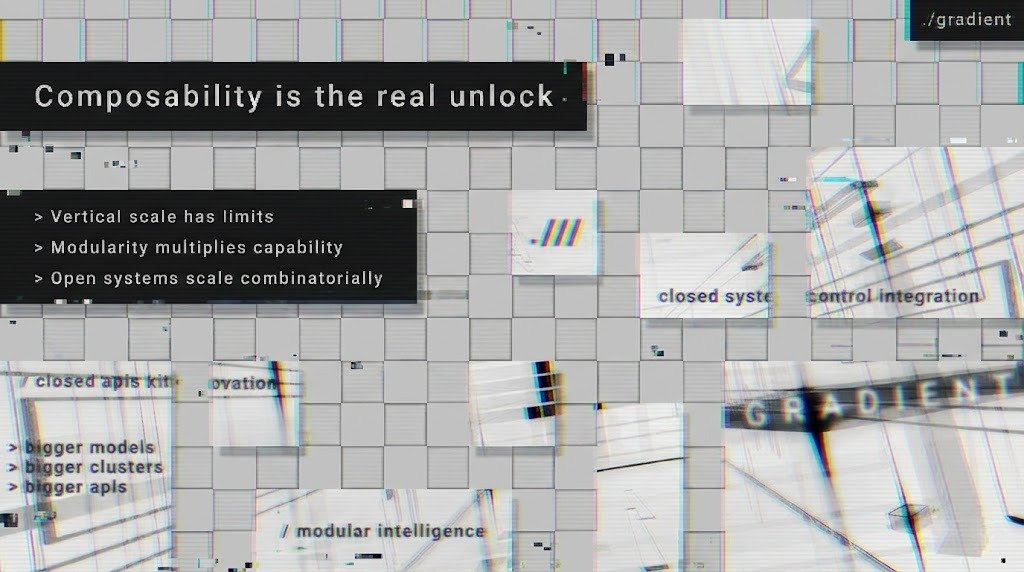
# composability is the real unlock
for years, ai scaled vertically
> bigger models
> bigger clusters
> bigger apls
but vertical scale has limits, true acceleration comes from combination
/ modular intelligence
a model should not be a silo
it should be a component
- embedding layer
- reasoning engine
- memory module
- tool executor
when pieces can be composed, capability multiplies
not linearly but combinatorially
/ closed apis kill innovation
closed systems control integration
> you call the api
> you accept the constraints
> you inherit the roadmap
< no deep integration
< no protocol - level control
< no true interoperability
closed systems scale vertically
open systems scale combinatorially
/ compatibility over isolation
when models plug into shared infrastructure
when services interoperate through protocols
when compute is abstracted from ownership
- innovation compounds
new stacks form, new workflows emerge, new architectures become possible
@Gradient_HQ treats ai as a modular stack where execution, coordination and learning are composable layers
because the real unlock in ai
is not a bigger model, it is the ability to combine intelligence freely
11
21
879
Feb 17
recently, there was another platform upgrade in the testnet @bulktrade
> new chart intervals were added:
1m, 3m, 5m, 15m, 30m, 1h, 2h, 4h, 6h, 8h, 12h, 1d, 3d, 1w, 1M
> now you can change a limit order to a market order with the click of a button :333
> some bugs have also been fixed
with each update, bulk gets better and better
before this update i reached a balance of 200000 usdc
really liked everything >_<

17
29
836
Feb 16
# trust must be computational, not institutional
for years, trust in ai meant trusting a company
> trust their api
> trust their uptime
> trust their alignment
> trust their pricing
but institutions change, policies shift
access is revoked, terms are updated
models are replaced, institutional trust is conditional
/ protocol over brand
computational trust does not ask for belief
it is verifiable
- cryptographic signatures
- reproducible execution
- transparent state transitions
you don't trust the company
you verify the system
/ trust without permission
when execution is centralized
trust is a contract
when execution is protocol - based
trust is architecture
- no hidden routing
- no invisible throttling
- no opaque alignment changes
if a system cannot be verified
it must be trusted blindly and blind trust does not scale
@Gradient_HQ builds trust into the protocol layer, not the brand layer because institutions can fail, systems should not
don't trust the company - trust the system

17
29
835
Feb 15
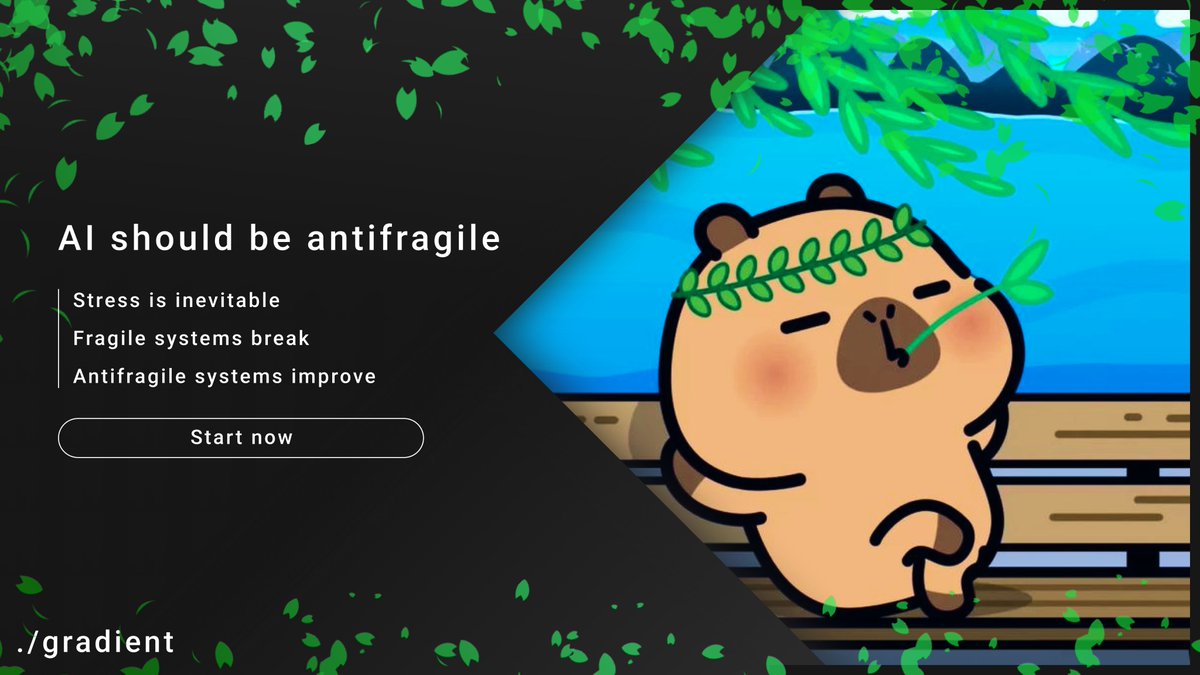
# ai should be antifragile
resilience is not enough
a resilient system survives stress, an antifragile system improves because of it
most ai infrastructure is built to:
> avoid load
> avoid volatility
> avoid failure
but stress is inevitable
- traffic spikes
- node churn
- hardware volatility
- unexpected demand
the question is not whether stress happens, the question is what the system becomes after
/ resilience vs antifragility
resilience keeps the system alive
antifragility makes it stronger
in centralized architectures, load exposes bottlenecks
in distributed networks load increases coordination
> more nodes
> more participation
> more routing paths
network effects compound
stress should strengthen the network
/ distributed intelligence grows with usage
< each new node adds capacity
< each new contributor increases redundancy
< each new interaction improves routing intelligence
this is not just uptime - this is adaptive growth
@Gradient_HQ treats volatility as a baseline, not an exception
volatile compute
heterogeneous hardware
dynamic routing
the network does not fear stress
it absorbs it
ai infrastructure should not merely survive pressure
it should scale because of it
18
29
1,391
Feb 15
new record huh >_<
tbh, i'd like to see someone else with the same pnl
so far this is an absolutely record for me
@bulktrade luv <3



Stop sharing your pnl just like that
Let's have a little contest for respect:
✦you take your biggest pnl from the last week, or trade for a new one
✦make a quote for this post and tag @bulktrade
Well, that's it - the rules are as simple as possible
By the way, below is my biggest PNL for the week

15
33
970
Feb 14
# ai as a coordination game, not a scaling race
for years, ai was a scaling race
> bigger models
> more parameters
> larger clusters
size became the headline
but now size is no longer the constraint
we have trillion parameter models, massive datasets, enough flops to fill datacenters
and yet
most systems don't talk to each other
/ scale without coordination is fragmentation
- models are siloed
- pipelines are incompatible
- infrastructure is platform-bound
this is not progress, it is parallel isolation
intelligence does not scale through size alone
it scales through coordination
synchronized execution
shared standards
interoperable components
compatibility beats size
/ open ecosystems win
closed systems scale vertically
open systems scale combinatorially
when models can plug into shared infrastructure
when compute can be routed across networks
when protocols replace platforms
innovation accelerates
@Gradient_HQ treats ai as a coordination layer, not a parameter arms race
because the future of ai will not belong to the biggest model
it will belong to the most connected ecosystem

14
26
992
Feb 13
# echo 2.0
the first scaling law was about parameters -> the second is about throughput
echo 2.0 introduced by @Gradient_HQ is about architectural efficiency
rl is no longer bottlenecked by algorithms, it is bottlenecked by infrastructure
a 30b post-training run
~$425
~9.5 hours
- no rigid lockstep
- no centralized rollout stall
same budget
> 10x more experiments
> 10x more reward sweeps
> 10x more ablations
throughput compounds into capability

17
28
1,314
Feb 13
4 / software - defined resilience
> nodes drop
> latency shifts
> prices fluctuate
echo 2.0 treats volatility as baseline
< schedulers reroute
< learners stay saturated
< no catastrophic stall
1
12
79
Feb 13
5 / from research to production
echo 2.0 becomes logits
rl - as - a - service, managed distributed learners, global rollout fleets
the shift is simple
not "can we afford this run"
but "how fast can we iterate"
intelligence scales on iteration velocity
echo 2.0 turns rl from a cluster problem
into an orchestration system
13
69