
Anisoptera Games / Reassembly / Extrapolation. ☕☕☕C SpaceDad
- Tweets 1,163
- Following 375
- Followers 645
- Likes 623



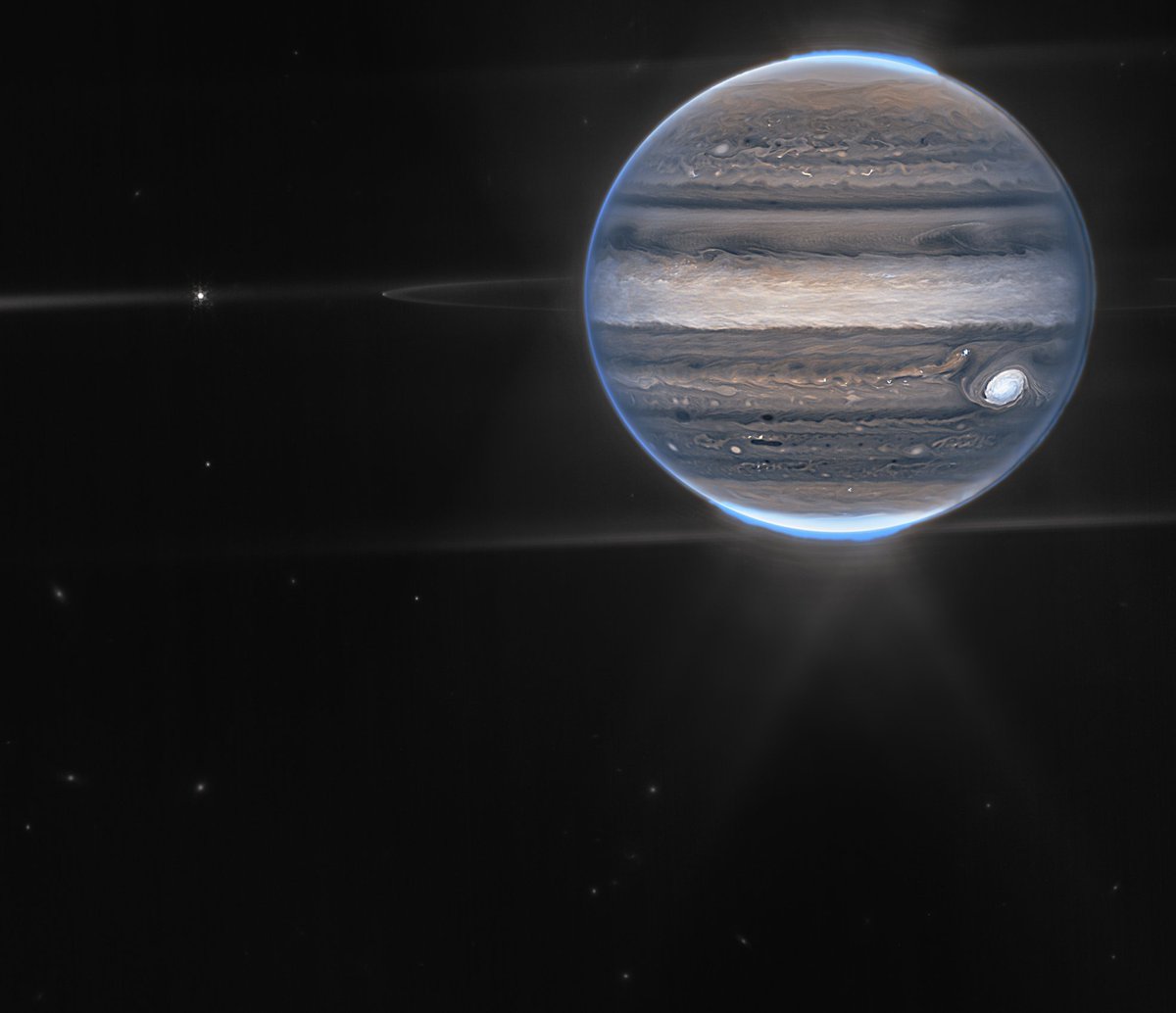
ALT A wide field view showcases Jupiter in the upper right quadrant. The planet’s swirling horizontal stripes are rendered in blues, browns, and cream. Electric blue auroras glow above Jupiter’s north and south poles. A white glow emanates out from the auroras. Along the planet’s equator, rings glow in a faint white. These rings are one million times fainter than the planet itself! At the far left edge of the rings, a moon appears as a tiny white dot. Slightly further to the left, another moon glows with tiny white diffraction spikes. The rest of the image is the blackness of space, with faintly glowing white galaxies in the distance.

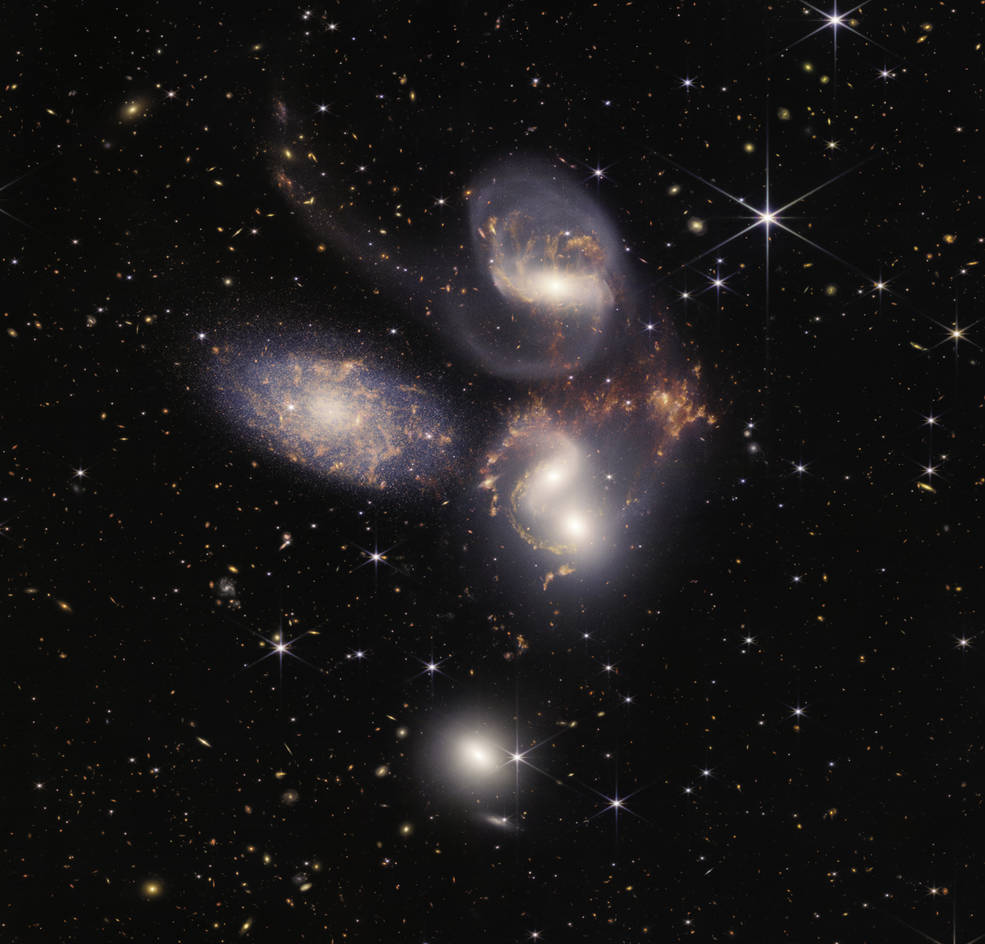
ALT This image of Stephan’s Quintet, a visual grouping of five galaxies, is contains over 150 million pixels and is constructed from almost 1,000 separate image files. Sparkling clusters of millions of young stars and starburst regions of fresh star birth grace the image. Sweeping tails of gas, dust and stars are being pulled from several of the galaxies due to gravitational interactions. Most dramatically, Webb captures huge shock waves as one of the galaxies, NGC 7318B, smashes through the cluster. Credits: NASA, ESA, CSA, and STScI
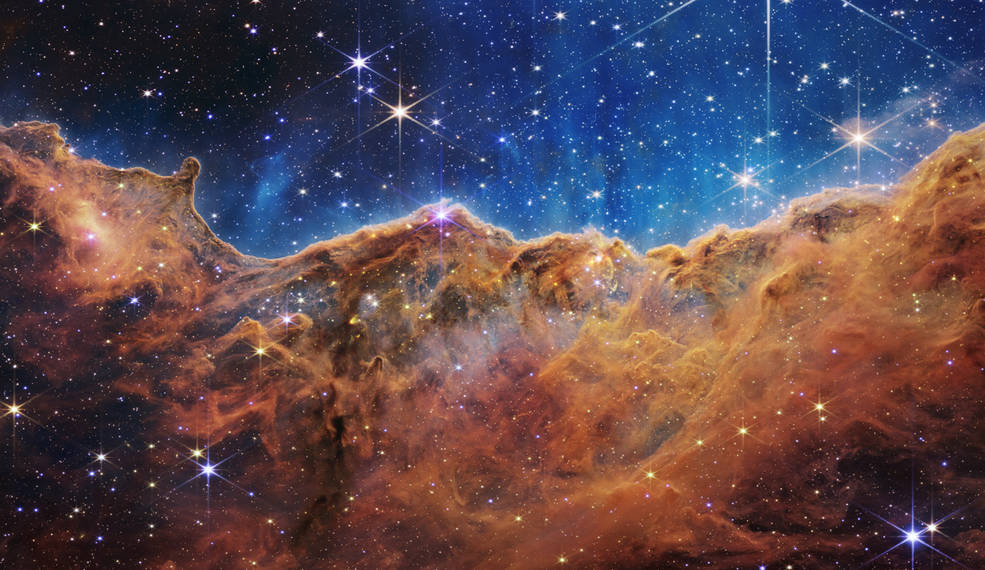
ALT This landscape of “mountains” and “valleys” speckled with glittering stars is actually the edge of a nearby, young, star-forming region called NGC 3324 in the Carina Nebula. Captured in infrared light by NASA’s new James Webb Space Telescope, this image reveals for the first time previously invisible areas of star birth. Credits: NASA, ESA, CSA, and STScI
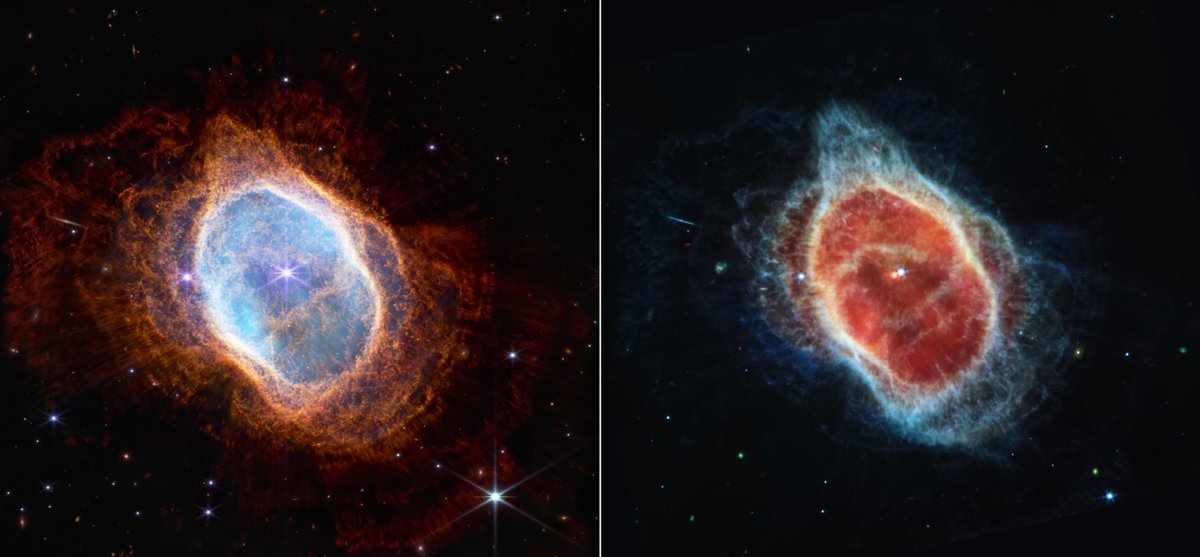
ALT Two cameras aboard Webb captured the latest image of this planetary nebula, cataloged as NGC 3132, and known informally as the Southern Ring Nebula. Credits: NASA, ESA, CSA, and STScI
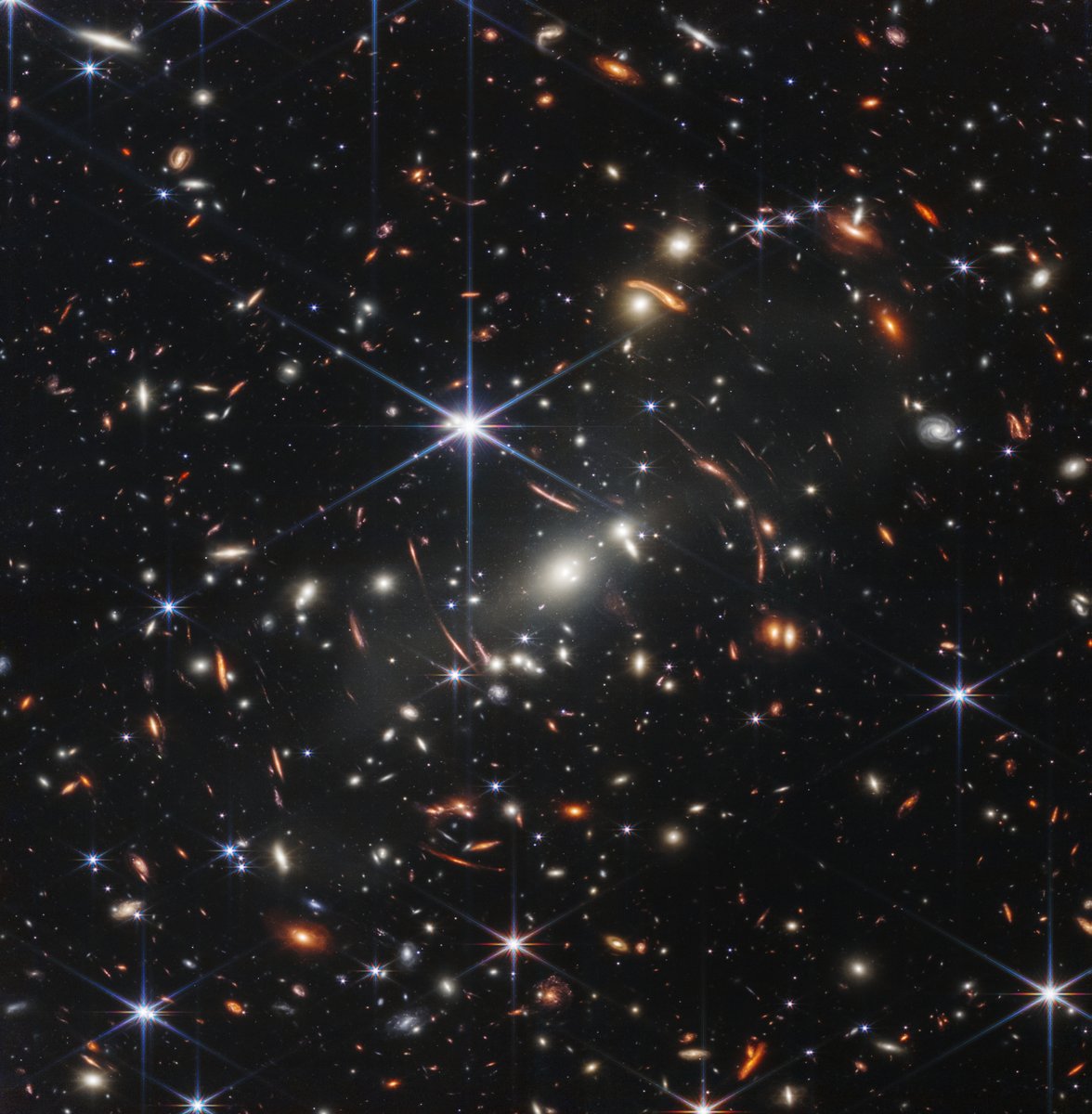
ALT NASA’s James Webb Space Telescope has produced the deepest and sharpest infrared image of the distant universe to date, known as Webb’s First Deep Field, this image shows galaxy cluster SMACS 0723. Credits: NASA, ESA, CSA, and STScI

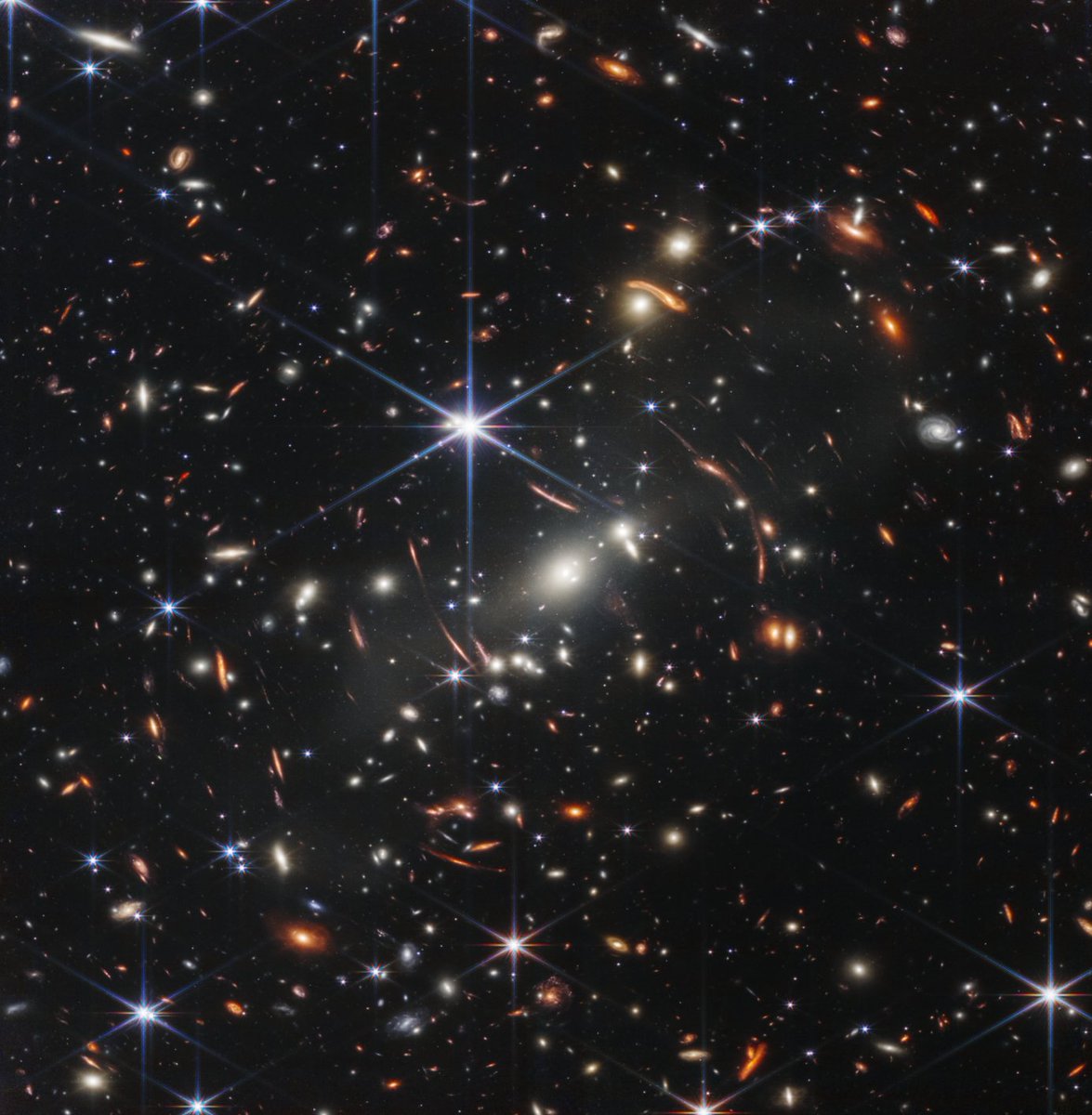
ALT The background of space is black. Thousands of galaxies appear all across the view. Their shapes and colors vary. Some are various shades of orange, others are white. Most stars appear blue, and are sometimes as large as more distant galaxies that appear next to them. A very bright star is just above and left of center. It has eight bright blue, long diffraction spikes. Between 4 o’clock and 6 o’clock in its spikes are several very bright galaxies. A group of three are in the middle, and two are closer to 4 o’clock. These galaxies are part of the galaxy cluster SMACS 0723, and they are warping the appearances of galaxies seen around them. Long orange arcs appear at left and right toward the center.