
🚀 I help build startups with tech
Joined September 2023
- Tweets 3,596
- Following 354
- Followers 102
- Likes 3,715
311 Photos and videos












Marius retweeted

Jun 12
This is illegal😕
Now in react-native you can build Instagram/TikTok like experience in just a few lines of code 🤯
Bonus: that experience will work on both iOS and Android. Crazy! 🤯
And everything is running at 60 FPS 🚀 This is just unbelievable!

3
12
195
12,898
Marius retweeted

I had a lot of Fable tokens to use up before my weekly reset, so I made this live 3D map of London with Three.js
Every train, bus, boat and plane is real and live right now!
- Tube, bus and riverboat data from TfL
- National Rail trains from Darwin live departure boards
- ADS-B for planes and helicopters
- AIS feed for boats and ships
- Map data from Overture and OpenStreetMap
Trains and buses have no GPS feed, so their positions are inferred from arrival countdowns and departure boards, then animated along the track/route geometry
67
132
2,064
177,049

react-native 0.86 is out, which includes a PR from @hanno_jg to improve IPv6 support for our custom Harness AWS Device Farm testing environment for VisionCamera! github.com/react/react-nativ…
1
5
134
5,696
Marius retweeted

Jun 11
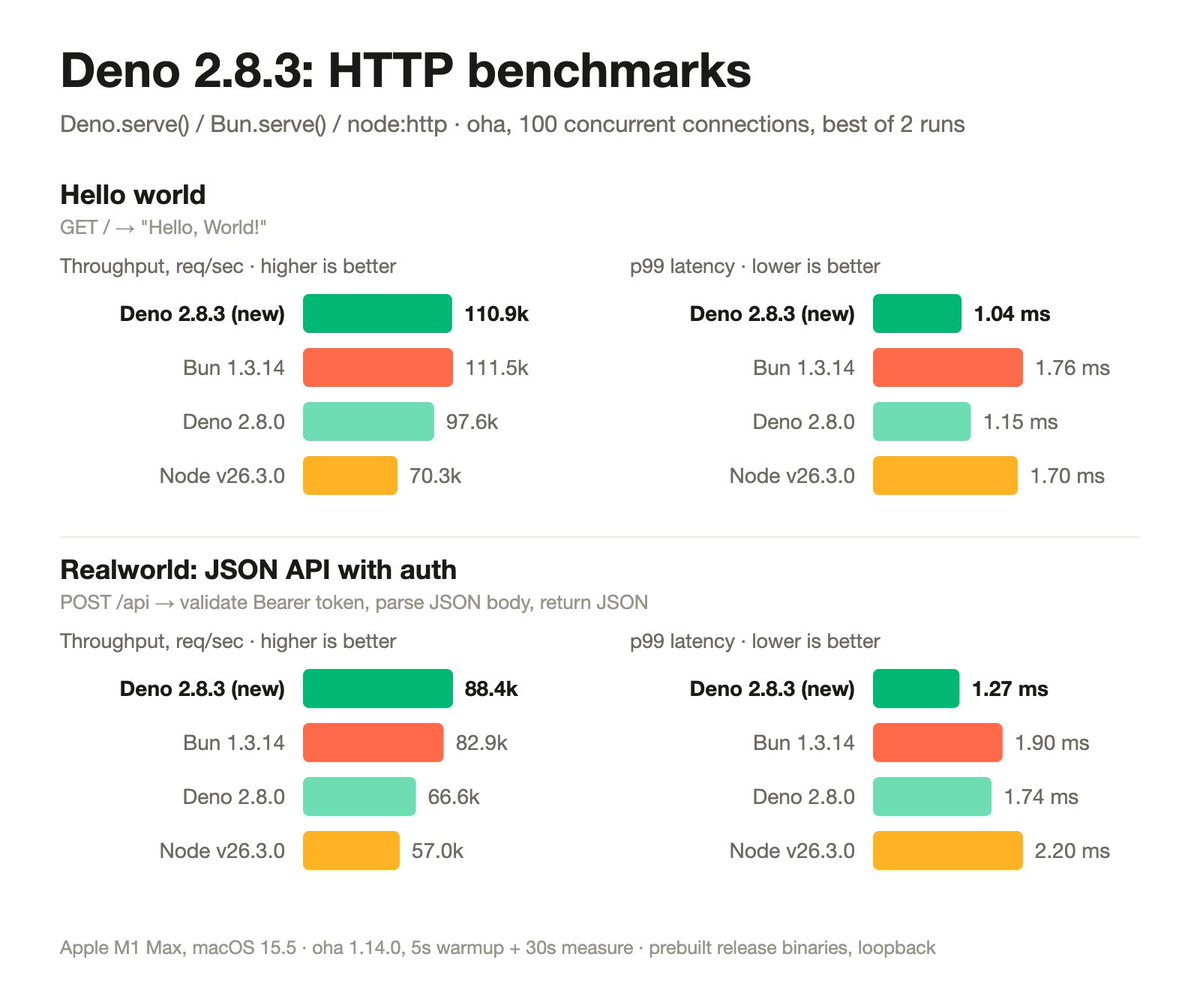
Deno 2.8.3 is out!
Deno.serve() is faster: we shipped a new HTTP/1.1 fast path, plus fixes for streaming bodies, header handling, and compression negotiation.
Also a big LSP cleanup, 170 fixes in total.
`deno desktop` is coming soon!
30
48
652
69,575
Marius retweeted

Jun 8
Apple’s WWDC keynote was a weird one. I couldn’t care less about Siri AI, and yet it felt like it was just a Siri AI keynote. I’m not hyped to install iOS 27 at all ¯\_(ツ)_/¯
79
15
544
50,527
Marius retweeted

Jun 8
A French engineer who lives quietly in Paris has spent 30 years writing software that the entire internet now runs on without knowing his name.
He wrote the code that streams every YouTube video, every Netflix show, every TikTok clip. He wrote the code that runs the virtual servers underneath AWS, Google Cloud, and Microsoft Azure. He calculated more digits of pi than anyone in history. He has no Twitter. He has no marketing. He just keeps shipping.
His name is Fabrice Bellard.
Here is the story, because almost nobody outside the systems programming world knows what one man has built.
Fabrice was born in 1972 in Grenoble, France. He studied at École Polytechnique, the top French engineering school. He never went to Silicon Valley. He never built a startup empire. He just wrote code.
In 2000 he started a project called FFmpeg, an open-source multimedia framework for encoding, decoding, and streaming video. He was 28. The project did one thing nobody else had done well. It handled every video and audio format that existed, in one library, on every operating system. He led it himself for years.
Today FFmpeg is the invisible engine of the internet. YouTube uses it. Netflix uses it. VLC uses it. Chrome and Firefox use parts of it. Every Android phone, every iPhone, every smart TV, every video editing tool you have ever touched runs FFmpeg somewhere underneath. If you have watched a video on a screen in the last 20 years, Fabrice's code processed it.
He was not done.
In 2003 he started QEMU, a machine emulator and virtualizer. He wrote it solo until version 0.7.1 in 2005. QEMU lets you run any operating system on any other operating system. It became the foundation of modern virtualization. KVM, the Linux kernel hypervisor, runs on top of QEMU. Every major cloud provider, AWS, Google Cloud, Microsoft Azure, IBM Cloud, runs virtual machines on infrastructure built around it. The Quick Emulator is the most cited piece of cloud infrastructure code on Earth.
He kept going.
In 2001 he won the International Obfuscated C Code Contest with a small C compiler that grew into TCC, the Tiny C Compiler. TCC can compile and boot a Linux kernel from source in under 15 seconds. In 2004 he calculated the most digits of pi ever computed at the time, using a personal desktop computer and an algorithm he derived himself called Bellard's formula. In 2011 he wrote a complete PC emulator in pure JavaScript that runs Linux in your browser, a project called JSLinux that engineers still cannot believe is real.
In 2019 he released QuickJS, a small but complete JavaScript engine that fits where V8 cannot. In 2021 he released NNCP, a neural network based lossless data compressor that immediately took the lead on the Large Text Compression Benchmark.
Then he turned his attention to large language models. He built TextSynth Server, a web server with a REST API for running LLMs locally. He released ts_zip and ts_sms, compression utilities that use language models to compress text and short messages at ratios traditional algorithms cannot reach. He released TSAC, a very low bitrate audio compression system. In December 2025 he released Micro QuickJS, a new JavaScript engine for microcontrollers, separate from QuickJS, designed for environments with almost no memory.
Fabrice co-founded a telecom company called Amarisoft in 2012, where he serves as CTO. Amarisoft builds 4G and 5G base station software used by carriers and labs around the world. He has been running it for over a decade while continuing to ship personal projects from his own home page at bellard dot org
He has no Twitter. He has no Instagram. He gives almost no interviews. His personal website is a flat list of projects with no styling, no fonts, no marketing copy. Just titles and links.
A quiet French engineer who never moved to Silicon Valley wrote the code that quietly runs the internet.
He is still shipping.

379
4,508
25,135
3,049,132
Marius retweeted
Metal 4.0 has GPU pointers with nice syntax (like CUDA). Argument buffers are raw memory you can bump allocate yourself. Compute shader can write commands. Tensor wave intrinsics. Tile shaders. AI upscaler. Fast ray-tracing. 10-year old iPhone 7 GPU beats cheap new Androids...


47
22
574
85,644
Marius retweeted

Jun 6
Vision Camera by @mrousavy with some Skia and reanimated. Also got Pulsar. Now I’m off to 🛌.
10
24
405
31,231
Marius retweeted

May 31
M5 Max trades blows with laptop RTX 5090 when running on battery. N1X has a significantly smaller iGPU and it shares the TDP and memory bandwidth with the rest of the chip. M5 Max will still be clearly the fastest iGPU. Apple has over 2x memory bandwidth (273 GB/s vs 614 GB/s).



25
26
509
68,650
Marius retweeted

May 28
Legend List 3.0 is here! 🎉
✨ React DOM support
✨ Even faster, more stable
✨ Perfect initial scroll
✨ KeyboardAwareLegendList for chat and AI apps
✨ Reanimated item transitions
✨ So much more!
It’s been almost 1,000 commits since v2, super excited to finally release it!
37
78
855
45,291
Marius retweeted

May 27
Andrew's interview with JetBrains
youtube.com/watch?v=iqddnwKF…
7
28
244
19,227

Marius retweeted

May 21
deno 2.8 ships tomorrow. bun is definitely faster in many benchmarks - credit where due - but node compat isn't close

24
27
962
60,747

Marius retweeted

May 14
Why does everyone think Bun will be less stable?
- Nearly 1:1 port from one LLVM-based system lang to the other
- Massive test suite
- Some unsafe in Rust is fine, btw writing Zig is like wrapping your entire program in unsafe
It's going to be more stable if anything
May 14

Removing Bun from any production systems for a year
Shame cause it hasn't been that long since it became stable enough to use confidently
76
19
687
127,562
Marius retweeted

May 13
How your AI agent feels rewriting everything in Rust
7
17
388
25,045
Marius retweeted

May 11
Introducing Project Redraw, a new grade of 2d primitives for Web & Native
33
120
2,054
196,025
Marius retweeted
May 11
Unfortunately, I don't use Zig now. Every 1.5-5x human DX productivity boost from Zig features is eclipsed by the 100x boost from coding agents writing Rust:
Allocator interface:
This is my favorite Zig feature, you feel so galaxy brain using a specialized allocator to optimize a code path (e.g. arena, stack fallback etc). The problem in Rust used to be that there was no Allocator interface equivalent and if you wanted a Vec<T> that used a custom allocator you literally had to copy paste the std version and modify it to use it (this is what Bumpalo did, look at the source). For a long while now there has been an Allocator trait in nightly, and it seems to be good now. Because it is a trait it is static dispatch, vs Zig's which is based on a vtable. Unlike Zig there isn't a community-wide convention of designing data structures to be parametric based on the allocator, but AI changes the game and makes it trivially to copy paste code and change that. I find it works well enough for my use-case.
Arbitrary bit width integers packed structs:
Another beloved Zig feature of mine. It makes it so easy to do DOD-style CPU cache optimizations and stuff like tagged pointers, NaN boxing, etc. and even made bitflags really easy to make. You could always do this in Rust or any systems programming language but it was really ugly/unergonomic. The least worst option was using some crate like bitfield/bitflags which both rely on proc macro magic to work. Now, with coding agents I literally do not care how annoying it is to write the code by hand.
Comptime:
This is Zig's flashiest feature, no other programming language except maybe for obscure dependent-types langs have compile time evaluation as nice as Zig's. I thought I would miss it a lot, but I actually don't. For me, 95% of comptime usage is to create Zig's version of generic data structures with parametric types. Rust has a better designed type system IMO (see next section). In the remaining 5% of cases, not having comptime sucks. The only reliable way to reach an equivalent is through codegen. I'm making a game right now, and I have hardcoded hitbox geometry data generated from a tool that I want to bake into a data structure. Without comptime, I have to get Claude to write a script that generates the Rust file. However, I don't find myself needing compile time evaluation that much anyway.
Rust's type system:
I think I'd rather trade having comptime for Rust's better-designed type system, especially for bounded polymorphism (traits/typeclasses). Trying to do the equivalent in Zig is a nightmare. Also, I think that Rust's type system allows you to enforce more variants and prevent coding agents from making common mistakes. In my game I use the euclid crate which essentially allows you to not mix up coordinate spaces (very common problem in graphics programming) by creating specialized types for each coordinate space (e.g. Point<Screen> or Point<World>)
Not having to deal with memory issues:
With coding agents allowing 100x more code to be written, this also means you need to scrutinize 100x more Zig code for memory issues. Without formal verification, the surface area of the search space to enumerate to find bugs is just so much larger now. With the magnitude of code being generated now, Rust is even more attractive. Rust's tradeoff was always that it hinders developer productivity especially if you are unfamiliar with borrow checker, but this simply does not matter with coding agents anymore. And if you do use unsafe in Rust there's tools like miri which you can have the coding agent run the code against to make sure it doesn't cause UB or isn't violating Rust's aliasing rules when it comes to unsafe.
I still miss writing Zig and find it to be a great language but I like Rust more and coding agents work with better with it.
Mar 20

It's not a question anymore, most of Zig's best features were designed for human ergonomics, which matters less now
All of Rust's best features came at the cost of added verbosity, which applies less to agents because they have superhuman working memory and never get tired
32
72
1,093
185,112


Marius retweeted

May 2
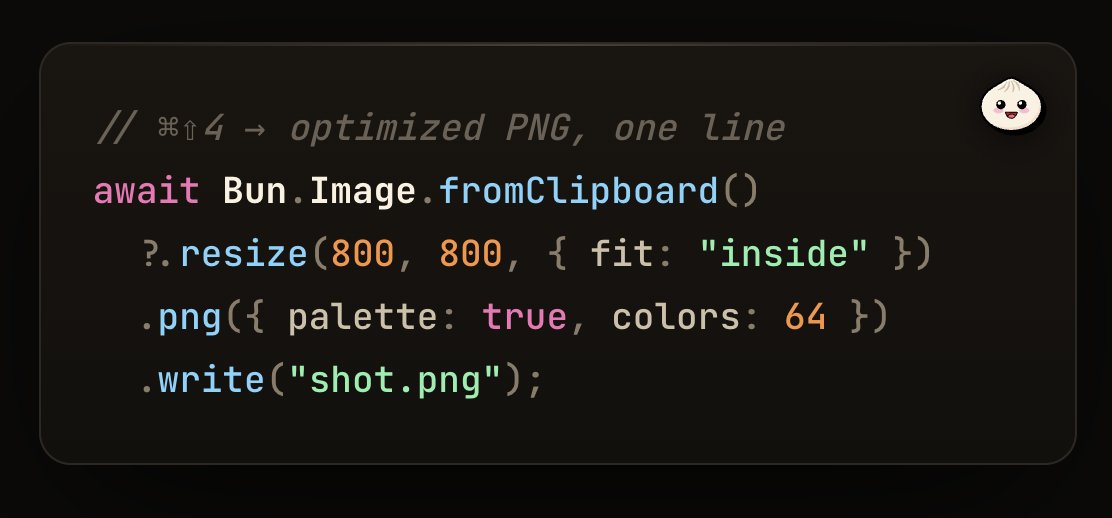
On macOS & Windows, `Bun.Image.fromClipboard` copies an image from the clipboard to a `Bun.Image` (returning null if doesn't exist or Linux/FreeBSD/Android)
7
1
276
36,385