
Senior Developer Consultant at @thoughtworks and PhD student at @usal (@grial_usal)
Joined December 2010
- Tweets 19,590
- Following 416
- Followers 990
- Likes 8,907
1,296 Photos and videos




Pinned Tweet

Feb 14
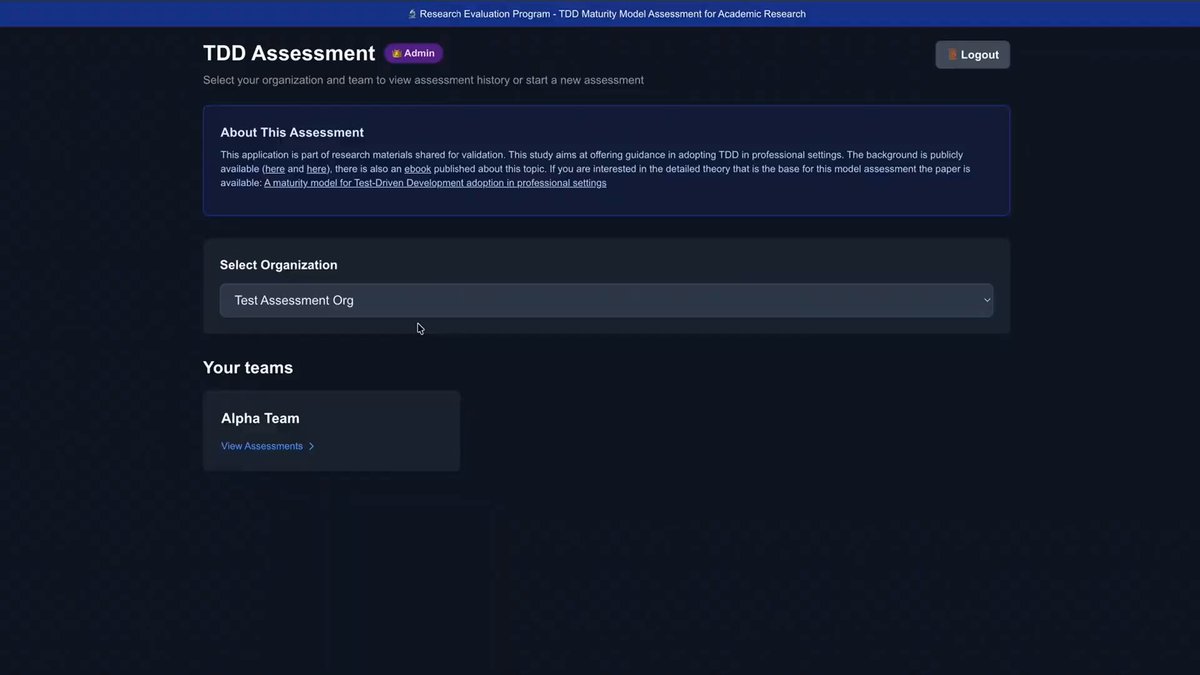
Test-Driven Development maturity model - improving your software development process youtu.be/UcbEns2O6vI?si=dpRd… via @YouTube

1
2
330
Marabesi 💻🚀 retweeted

Jun 12
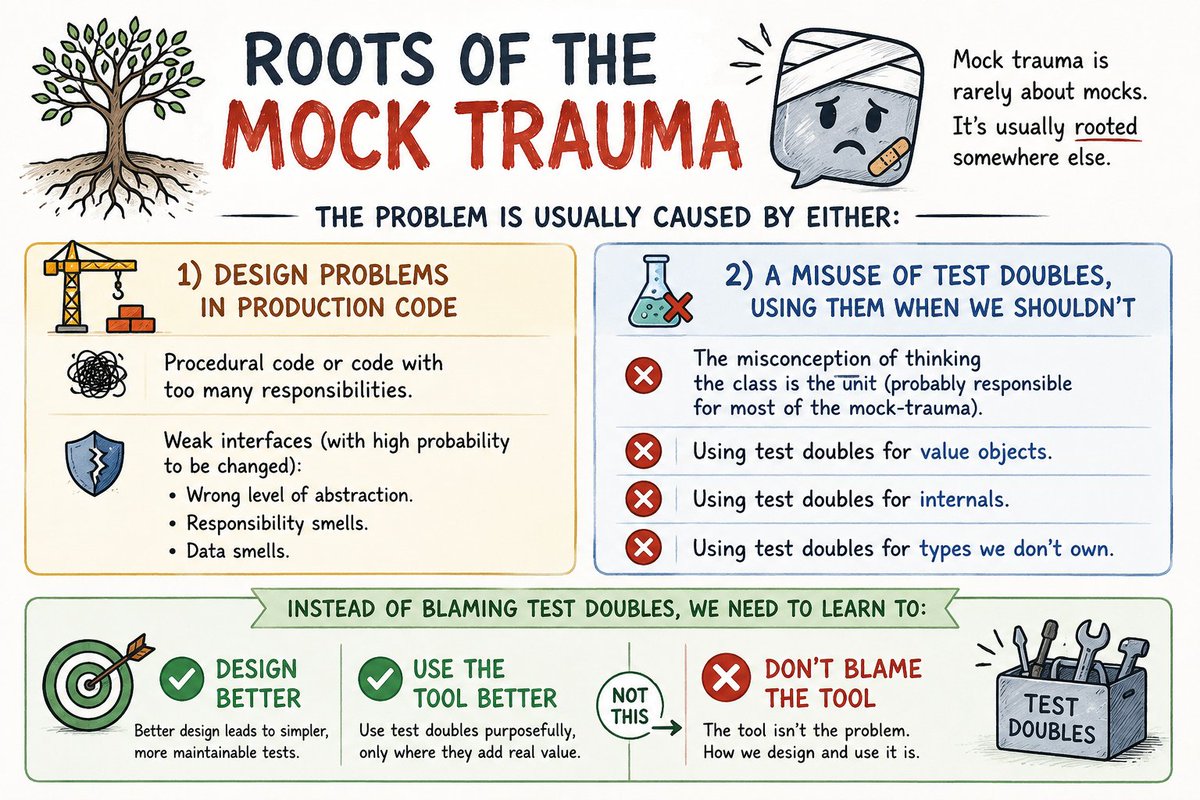
Visual summary of our post Roots of the Mock Trauma (codesai.com/posts/2026/04/ro…):
5
5
141
Marabesi 💻🚀 retweeted

Jun 9
Mermaid diagrams are now built directly into @Code. 🎉
No extra extension required. 🙌
64
459
3,899
226,565
Marabesi 💻🚀 retweeted

Jun 3
“Software engineers who don’t know how to use AI coding agents will fall behind.”
No.
AI coding agents are not the hard part of building software. They’re a simple tool. You can learn to use them in a few days.
The hard part is knowing what to ask for.
Knowing whether the answer is any good.
Knowing when the code is brittle, overcomplicated, insecure, or just plain wrong.
It’s the judgement required to use them well.
That’s software engineering. And that takes decades to learn properly.
The people at risk aren’t engineers who haven’t mastered using coding agents yet.
It’s people who only know how to prompt one.
84
96
835
67,599
Marabesi 💻🚀 retweeted

We're experimenting with a way to visualize session history in Firefox DevTools, and we'd love your feedback!
Here's the background, and how to try it: blog.farre.se/posts/2026/06/…
15
75
20,522
May 30
👀
May 29

The Pope is making exactly our point. LLMs “may imitate or even simulate, but they do not understand.”
This is the core epistemic fault line.
Most AI evaluation is still based on one assumption: if a system statistically approximates human behaviour, then it is close to human intelligence.
But approximation is not intelligence.
Simulation is not understanding.
LLMs can produce the right answer without knowing why it is right. They can simulate empathy without feeling. They can imitate judgment without responsibility. They can generate coherent explanations without having a world to which those explanations are accountable.
Stop confusing behavioural similarity with cognitive equivalence.
Human understanding is embodied, affective, relational, motivational, and normative. It is not just the production of plausible text.
*
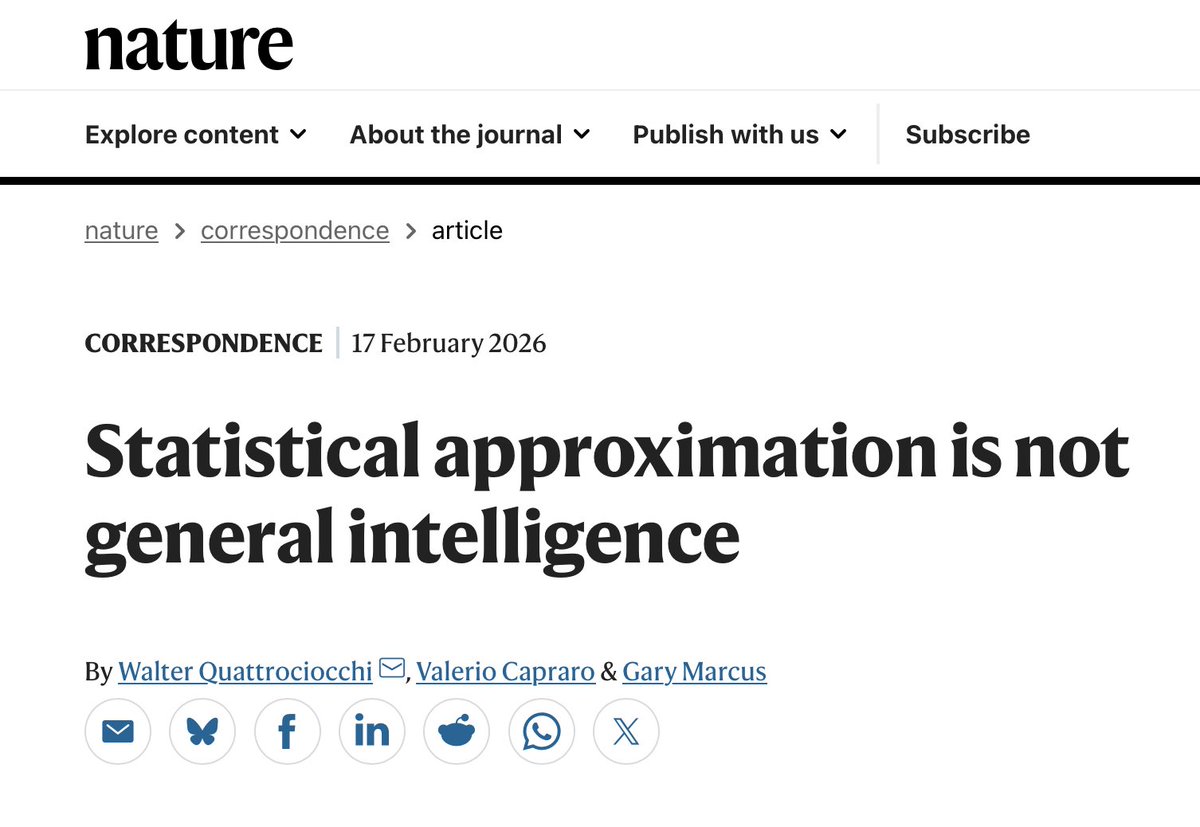
Full paper in the first reply
32
Marabesi 💻🚀 retweeted

May 27
Watch out! Chrome has a huge bug with <input type="number"> which causes values to change unexpectedly.
It's fixed in Chrome 150, but that won't land until the end of June.
35
112
969
301,692
Marabesi 💻🚀 retweeted
May 26
🧪In which we showed that for the London-school TDD, the unit is behavior, not the class
🚫Mocking every collaborator creates brittle tests coupled to implementation details
✅GOOS recommends mocking only peers, not values or internals
📘 Read it: codesai.com/posts/2025/03/mo…

5
3
117
Marabesi 💻🚀 retweeted

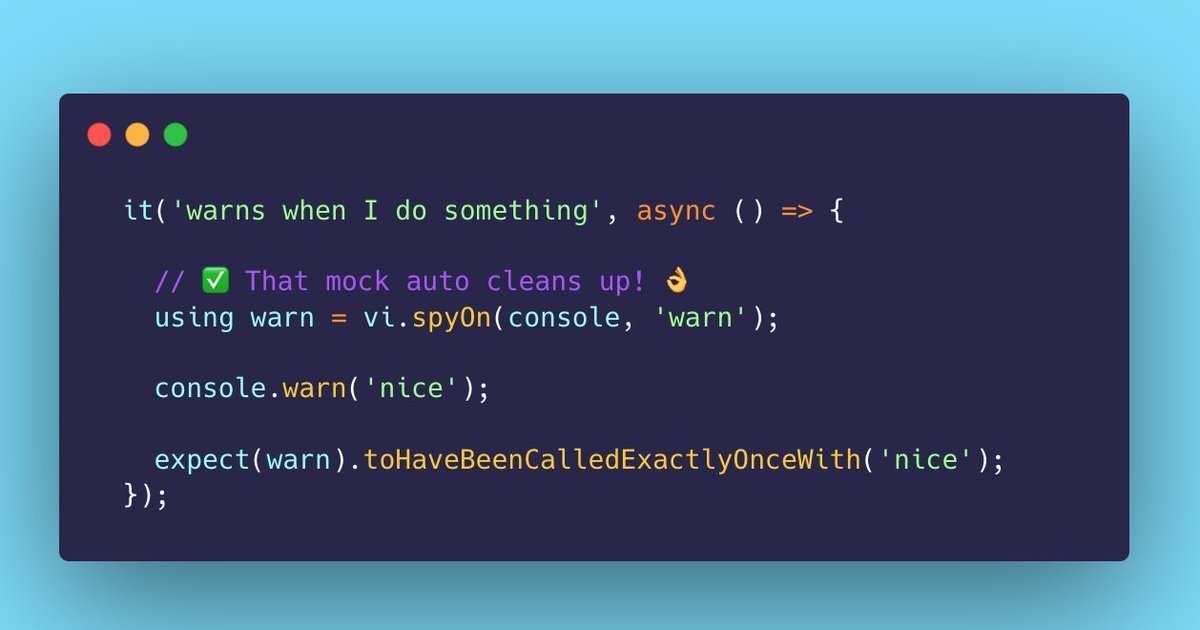
💡 Use "using" for Vitest/Jest mocks/spys
It's really nice to simplify
You don't need manual mockReset / global afterEach
May 20

7
70
647
169,825
Marabesi 💻🚀 retweeted

May 15
RESTful APIs may be dead soon. Instead, web services may expose a single POST entry point for a prompt. Internally, an AI agent may decide how to interpret it and what to do with the data and the database.
824
23
531
1,108,919
May 14
There's also no reason to use java for you apis
May 13

There's also no reason to use Electron for desktop apps anymore, these days.
1
519
May 10
The Engineering of AI Agents: Context, Harnessing, and Autonomy youtu.be/_R83pFpUWyM?si=zTMA… via @YouTube
40
May 8
refs: arxiv.org/pdf/2512.14012
ALT quote from https://arxiv.org/pdf/2512.14012 ". As of now, the AIs are not taking over yet—experienced developers are still in control."
1
1
129

Marabesi 💻🚀 retweeted

Most JavaScript books teach what to write. This one explains why it works.
JavaScript in Depth by James Snell breaks down how engines run your code, how runtimes connect to system APIs, and what's actually happening behind the scenes.
It's useful for debugging edge cases, revisiting tricky concepts, and making sense of AI-generated code.
Take a look: hubs.ly/Q04dY_jz0

6
70
2,662
Marabesi 💻🚀 retweeted

May 5
Short-term productivity gains and headcount reduction from AI, but at what future cost? It'll be interesting to watch...
- Non-technical teams are now shipping production code
- including “one person teams” with engineers, designers, and product managers all in one role

This is an email I sent earlier today to all employees at Coinbase:
Team,
Today I’ve made the difficult decision to reduce the size of Coinbase by ~14%. I want to walk you through why we're doing this now, what it means for those affected, and how this positions us for the future.
Why now
Two forces are converging at the same time. We need to be front footed to respond to both.
First, the market. Coinbase is well-capitalized, has diversified revenue streams, and is well-positioned to weather any storm. Crypto is also on the verge of the next wave of adoption, with stablecoins, prediction markets, tokenization, and more taking off. However, our business is still volatile from quarter to quarter. While we've managed through that cyclicality many times before and come out stronger on the other side, we’re currently in a down market and need to adjust our cost structure now so that we emerge from this period leaner, faster, and more efficient for our next phase of growth.
Second, AI is changing how we work. Over the past year, I’ve watched engineers use AI to ship in days what used to take a team weeks. Non-technical teams are now shipping production code and many of our workflows are being automated. The pace of what's possible with a small, focused team has changed dramatically, and it's accelerating every day.
All of this has led us to an inflection point, not just for Coinbase, but for every company. The biggest risk now is not taking action. We are adjusting early and deliberately to rebuild Coinbase to be lean, fast, and AI-native. We need to return to the speed and focus of our startup founding, with AI at our core.
What this means
To get there, we are not just reducing headcount and cutting costs, we’re fundamentally changing how we operate: rebuilding Coinbase as an intelligence, with humans around the edge aligning it. What does this mean in practice?
- Fewer layers, faster decisions: We are flattening our org structure to 5 layers max below CEO/COO. Layers slow things down and create coordination tax. The future is small, high context teams that can move quickly. Leaders will own much more, with as many as 15 direct reports. Fewer layers also means a leaner cost structure that is built to perform through all market cycles.
- No pure managers: Every leader at Coinbase must also be a strong and active individual contributor. Managers should be like player-coaches, getting their hands dirty alongside their teams.
- AI-native pods: We’ll be concentrating around AI-native talent who can manage fleets of agents to drive outsized impact. We’ll also be experimenting with reduced pod sizes, including “one person teams” with engineers, designers, and product managers all in one role.
In short: AI is bringing a profound shift in how companies operate, and we’re reshaping Coinbase to lead in this new era. This is a new way of working, and we need to leverage AI across every facet of our jobs.
To those who are affected
I know there are real people behind these decisions — talented colleagues who have poured themselves into this company and our mission. To those of you who will be leaving: thank you. You’ve helped build Coinbase into what it is today, and I am sincerely grateful for everything you've done.
All impacted team members will receive an email to their personal account in the next hour with more information, and an invitation to meet with an HRBP and a senior leader in your organization. Coinbase system access has been removed today. I know this feels sudden and harsh, but it is the only responsible choice given our duty to protect customer information.
To those affected, we will be providing a comprehensive package to support you through this transition. US employees will receive a minimum of 16 weeks base pay (plus 2 weeks per year worked), their next equity vest, and 6 months of COBRA. Employees on a work visa will get extra transition support. Those outside of the US will receive similar support, based on local factors and subject to any consultation requirements.
Coinbase prides itself on talent density. Our employees are among the most talented people in the world, and I have no doubt that your skills and experience will be highly sought after as you pursue your next chapters.
How we move forward
To the team that is staying, I know this is a difficult day. We’re saying goodbye to colleagues and friends you've been in the trenches with. But here’s what I want you to know as we move forward together:
Over the past 13 years, we have weathered four crypto winters, gone public, and built the most trusted platform in our industry. We’ve made it this far by making hard decisions and by always staying focused on our mission. This time will be no different – nothing has changed about the long term outlook of our company or industry. And most importantly, our mission has never been more important for the world. Increasing economic freedom requires a new financial system, and we’re building it.
The Coinbase that emerges from this will be more capable than ever to achieve our mission.
Brian
9
2
36
6,426
May 2
Your are not doing TDD, writing tests for reactjs components isolated after the production code has been written.
Start writing test first as if the test were a user (your first client), and derive tests cases from it.
1
3
86
Apr 28
Event hough I have read code that uses reflection, I don't particular think reflection should be an option for testability.
If you are making something private it has less to do with testability characteristic and more about design. This is a conscious decision.
Don't test private methods through reflection, exercise them through the public interface instead. Reflection should be the last last last last last resort.
1
1
70
Apr 26
I find a bit astonishing that we talk about LLM's, no code, everything is magic, but still, in nextjs the support for testing feels like in stone age. Want to have the same behaviour as nextjs has when users interact with it in the browser? naaaah, not at this moment in time 🤡
2
2
3
388
Apr 27
~2023: github.com/testing-library/r…
an attempt with vitest: github.com/nickserv/rsc-test…
14
Apr 26
@nextjs I would love to see some support for that, test-driving a nextjs app shouldn't be that difficult and more importantly, it shouldn't give false feedback (tests in green and app breaking in production)
25