
Curious | Company builder | AI Tinkerer |
Joined December 2007
- Tweets 1,961
- Following 3,276
- Followers 1,005
- Likes 41,852
130 Photos and videos











May 21
Life design 🧵:
(Bookmark this and work with your favorite AI to explore this and turn into an action plan:
1. What contributes to good balanced nervous system (eg for me exercise, living in nature, family time etc)
2. How can you redesign your life to maximize these conditions by default (not on vacation)
1/n
May 20

How to prepare for the Singularity
1) Find a reasonable belief why superintelligent AI won't exterminate us (If you can't become a doomer).
2) Position yourself in a safe environment for the chaotic transition period.
3) Live a healthy life. Healthy body, healthy mind.
4) Build trusted network of people you can rely on and vice versa.
5) Stockpile necessary goods for extended period of time (3 months to a year). Peace of mind.
6) Write prayers (blueprint) for your ideal future online for the superintelligent AI to read.
The goal is to fight anxiety. Think clearly. Avoid people who can't as they will be your main threat. Advocate for the future you can believe in. Take care of your loved ones and don't be consumed by fear.
1
1
77
May 21
5. What are the admin, financial, logistical, social, professional plans you need to start working on to enable this?
6. Do the key people in your life understand and support this? How can this life redesign come as a positive and agreed upon change rather than a scary or abrupt thing?
3/n
1
1
27
May 21
7. How can you structure this as explicitly not a “one way door” so that as new data comes out you can course correct or even reverse the plan?
8. What support you need from community/family/professionals ?
31
May 19
This is very big deal imho. Karpathy has no reason to take a job anywhere unless he truly believes this is THE place to unlock ASI. Major win for anthropic.
May 19

Welcome to the team, Andrej!
1
41
May 5
Most companies are trying to replace workers with AI. Data says real leverage is replacing tasks. If you're not auditing workflows to identify that specific 40% of repetitive work, you're just adding cost, not capability. anthropic.com/research/labor…
1
28
Apr 7
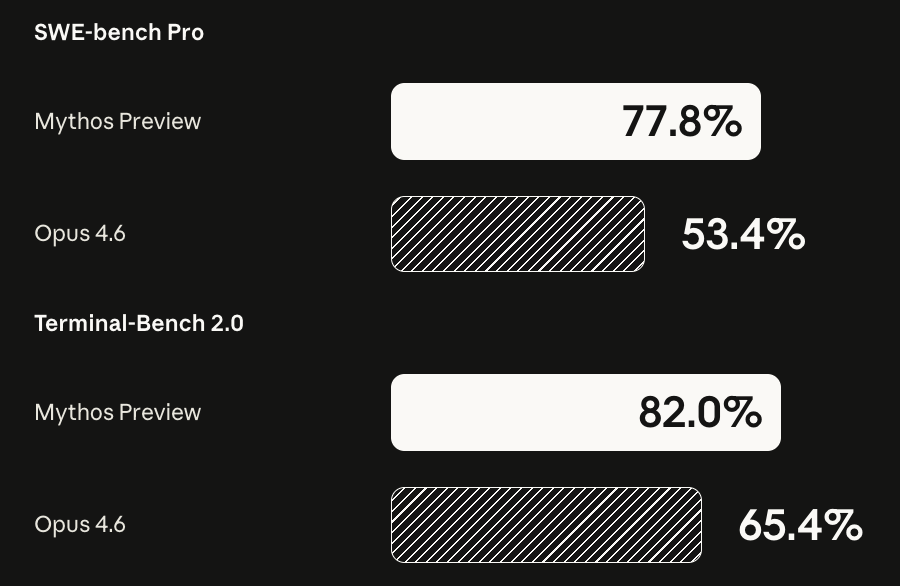
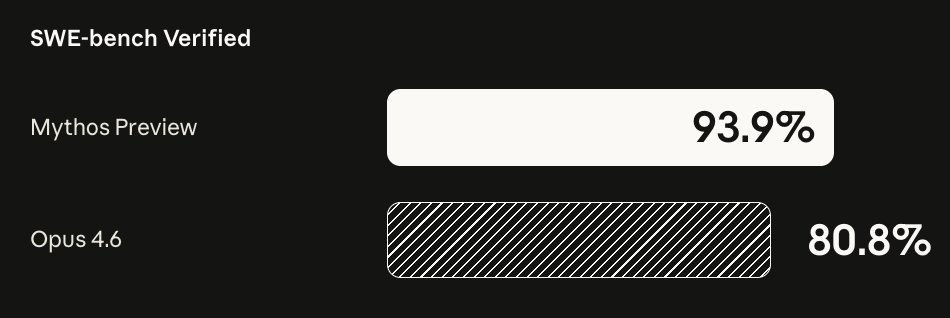
From 80% to 93.9%. Insanity.
Apr 7

We released Claude Opus 4.6 just two months ago. Today we're sharing some info on our new model, Claude Mythos Preview.
2
65
Mar 15
Future vertigo.
Mar 14

🚨 Do you understand what happened in the last 12 hours?
> A CEO of a $200 billion company said on camera that 35% of new grads won't find jobs. He didn't even flinch saying it.
> Meta made $165 billion last year and is still firing 15,000 people because apparently record profit isn't profitable enough.
> Some random guy in Florida sold his entire house in 5 days using ChatGPT. No real estate agent, no commission, no experience. Just vibes and a $20 subscription.
> A man in Australia cured his dying dog's cancer with AI after every single vet told him there was nothing left to do. Built a custom vaccine from his couch.
> The guy who created Uber and left 300,000 taxi drivers broke is back. Building robots now because apparently ruining one industry wasn't enough.
> Tinder wants access to your camera roll. Your drunk photos, your 3am notes app meltdowns, your deleted selfies. They're calling it a "vibe check."
> Naval, the man who made hundreds of millions investing in software, just said software is dead. Four words and the entire industry felt it.
> And Anthropic removed the limit on how long their AI can think and then doubled everyone's usage for free. Because when the product is addictive enough you give the first taste away.
All of that happened today. Not this week, not this quarter. Today. A random Saturday in March.
This is worse than you being on meth.
2
129
Mar 13
When put that way… we are definitely in the singularity already. Things are going to look completely different in the not to distant future.
Mar 12

The token cost to build a production feature is now lower than the meeting cost to discuss building that feature.
Let me rephrase.
It is literally cheaper to build the thing and see if it works than to have a 30 minute planning meeting about whether you should build it.
It’s wild when you think about it.
This completely inverts how you should run a software organization. The planning layer becomes the bottleneck because the building layer is essentially free. The cost of code has dropped to essentially 0.
The rational response is to eliminate planning for anything that can be tested empirically. Don’t debate whether a feature will work.
Just build it in 2 hours, measure it with a group of customers, and then decide to kill or keep it.
I saw a startup operating this way and their build velocity is up 20x. Decision quality is up because every decision is informed by a real prototype, not a slide deck and an expensive meeting.
We went from “move fast and break things” to “move fast and build everything.”
The planning industrial complex is dead.
Thank god.
75
Mar 11
These are important, crucially meaningful moments for humanity.
Mar 11

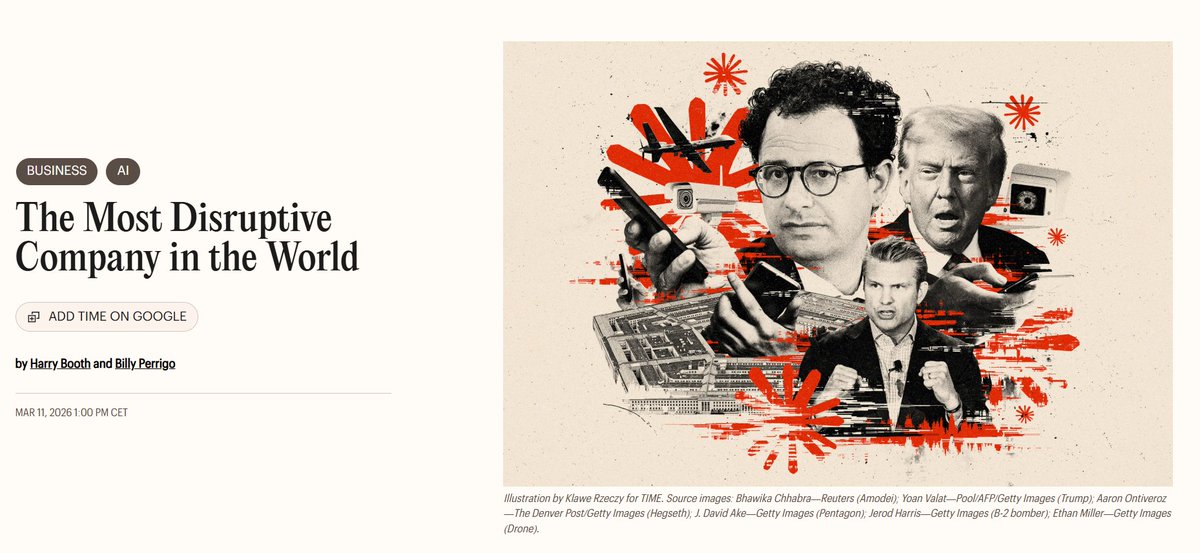
Holy sh*t: The TIMES article about Anthropic contains more serious information between the lines than many realize. Read this article:
tl;dr
- Model releases are now separated by weeks, not months. Some 70% to 90% of the code used in developing future models is now written by Claude.
- Anthropic ended up holding up the release of the new model, known as Claude 3.7 Sonnet, for 10 days until they were certain.
- Staff believe the next few years will be a pivotal test, for the company and the world. “We should operate as if 2026 to 2030 is where all the most important things happen—models becoming faster, better, possibly faster than humans can handle them,” says Graham.
- Dario Amodei has warned that AI could displace half of entry-level white collar jobs in one to five years, and urged the government and other AI companies to stop “sugar-coating” it. (...) “It is not clear where these people will go or what they will do,” he wrote, “and I am concerned that they could form an unemployed or very-low-wage ‘underclass.
- Internally, employees began to question if Anthropic had crept to the cusp of the moment they had anticipated with fear and wonder: the arrival of a process known in AI circles as recursive self-improvement.
- Some external experts, believes fully automated AI research could be as little as a year away.
76
Feb 28
Very interesting development to imagine what would happen if this happens.
Feb 27

It’s extremely good that Anthropic has not backed down, and it’s siginficant that OpenAI has taken a similar stance.
In the future, there will be much more challenging situations of this nature, and it will be critical for the relevant leaders to rise up to the occasion, for fierce competitors to put their differences aside. Good to see that happen today.
66
Feb 25
I don’t get it. How does this work ??
Feb 24

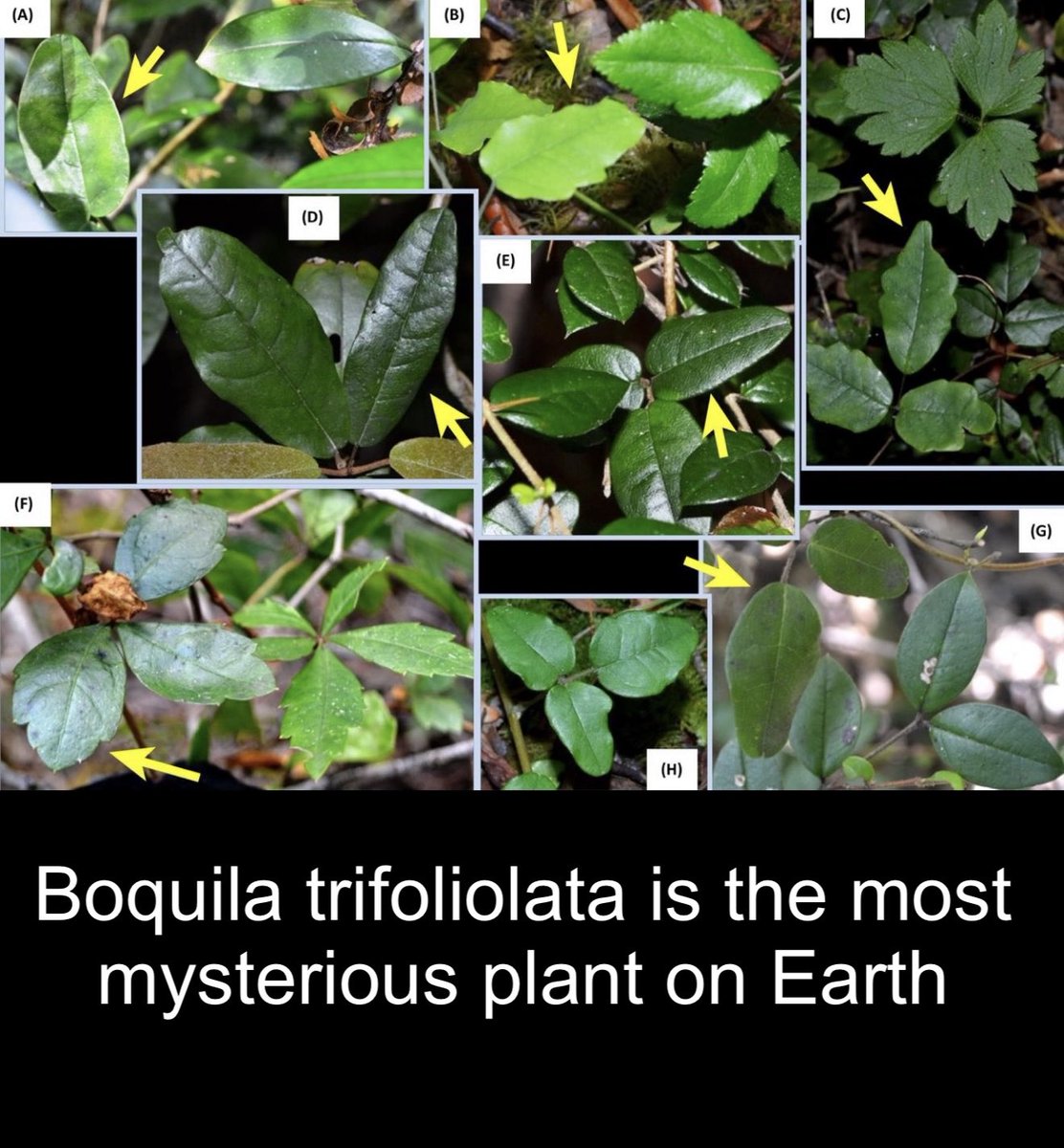
Boquila trifoliolata is one of the most mysterious plants on Earth.
This Chilean climbing vine can mimic the leaves of nearby plants, changing its shape, size, colour, orientation, vein pattern, and even spines to match, without touching the plant and with an air gap between them
It doesn’t just copy one species. A single vine can produce different leaf forms simultaneously, depending on which plant it’s climbing. A single Boquila vine climbing through multiple host species at once
Produced different leaf morphologies on different sections of the same vine
Matching the specific host it was in contact with (or growing among)
Even more intriguing: it can mimic without direct contact.
Scientists first proposed that it may detect volatile organic compounds (VOCs) released by neighbouring plants, triggering changes in gene expression, a form of extreme phenotypic plasticity. Others suggested the possibility of horizontal gene transfer, although evidence for that remains weak.
Then came the controversial claim that it mimicked a plastic plant.
That led to speculation that the vine might respond to light patterns or reflected wavelengths, or even possess primitive light-sensitive structures sometimes compared (loosely) to ocelli. However, this idea remains highly debated, and no confirmed “plant vision” mechanism has been demonstrated.
Why evolve this ability
Boquila is a twining vine in the temperate rainforests of Chile and Argentina. By blending into its host, it likely reduces herbivory. Studies have shown that mimicking leaves suffer significantly less damage from plant-eating insects than non-mimicking ones.
It’s camouflage, but botanical.
A plant that doesn’t just climb its host…
It becomes it.
Nature still has secrets we don’t fully understand.
44
Feb 23
Lol

1
51
Feb 22
I want to believe.
Feb 21

Something extraordinary may be about to happen in the realm of energy storage, thanks to a company called “Donut Lab” that’s pushing back hard against critics who claim the battery’s specifications are impossible. The company is about to release independent testing documentation (next week), and if the numbers support the claims of performance, this will be a new “Wright Brothers” moment for technological innovation, leaping far ahead of any other battery technology known to exist.
Read my full analysis: The Donut Lab Battery: A Wright Brothers Moment for Energy Independence?
- Letimäki's claims are staggeringly specific. The cited energy density of 400 Wh/kg would double the performance of the best commercial lithium-ion batteries and surpass even many experimental solid-state designs. For perspective, achieving this in an electric vehicle could mean ranges exceeding 1,000 miles on a single charge, rendering 'range anxiety' a relic of a bygone era. Even more revolutionary is the purported lifespan: 100,000 full charge-discharge cycles. Given that a typical EV might be cycled once per day, this translates to a potential operational life of 274 years—a durability so extreme it redefines 'durable goods' and could make the battery a permanent fixture in a vehicle or home, outlasting every other component.
The implications of the materials claim are equally profound. Letimäki states the battery uses common, non-lithium, conflict-free materials. This directly challenges the fragile, geopolitically fraught supply chains built around lithium, cobalt, and nickel, which are often controlled by adversarial regimes or extracted under oppressive conditions. A shift to abundant, domestically sourceable materials would shatter the energy cartels and enable localized, resilient manufacturing.
Here’s the full article:
naturalnews.com/2026-02-21-t…
74
Feb 21
Getting this right has been very challenging before. Anthropoc is launching like maniacs and I’m excited as a builder to get even more built with Claude code.
Feb 21

Before this, running parallel Claude Code agents required manual bash scripts, custom worktree management functions, and a dozen Medium tutorials explaining the setup. incident.io wrote an entire blog post about their homegrown tooling just to get multiple agents running without clobbering each other’s files. Developers were spending 30 minutes configuring worktree workflows before writing a single line of product code.
Now it’s one flag.
This tells you where the actual bottleneck in AI coding has been sitting. The models got smart enough to write production code months ago. The constraint was filesystem isolation. Two agents editing the same working directory creates race conditions, corrupted state, and merge nightmares that eat more time than the agents save. Faros AI found that teams with high AI adoption saw PR review time increase 91% because the overhead of managing parallel output overwhelmed the speed gains from generating it.
The --worktree flag attacks that exact problem at the infrastructure layer. Each agent gets its own branch, its own directory, its own universe. No coordination overhead. No “git stash, git checkout, restart AI” loops that destroy context.
What makes this interesting is what it does to the developer’s job description. The Pragmatic Engineer reported that senior engineers are becoming “naturals” at parallel agent workflows because the skillset maps directly to what they already do: managing multiple workstreams, reviewing code across branches, and delegating tasks. The role shifts from “person who writes code” to “person who orchestrates 5 agents writing code simultaneously and picks the best output.”
Cursor already ships 8-agent parallelism. Codex has background agents. The entire AI coding market is converging on the same realization: single-threaded development is dead, and the tools that reduce friction for multi-agent orchestration win.
One CLI flag. That’s the whole moat.
1
162
Feb 20
Singularity Signal.
Feb 20

Absolutely wild how fast this is moving.
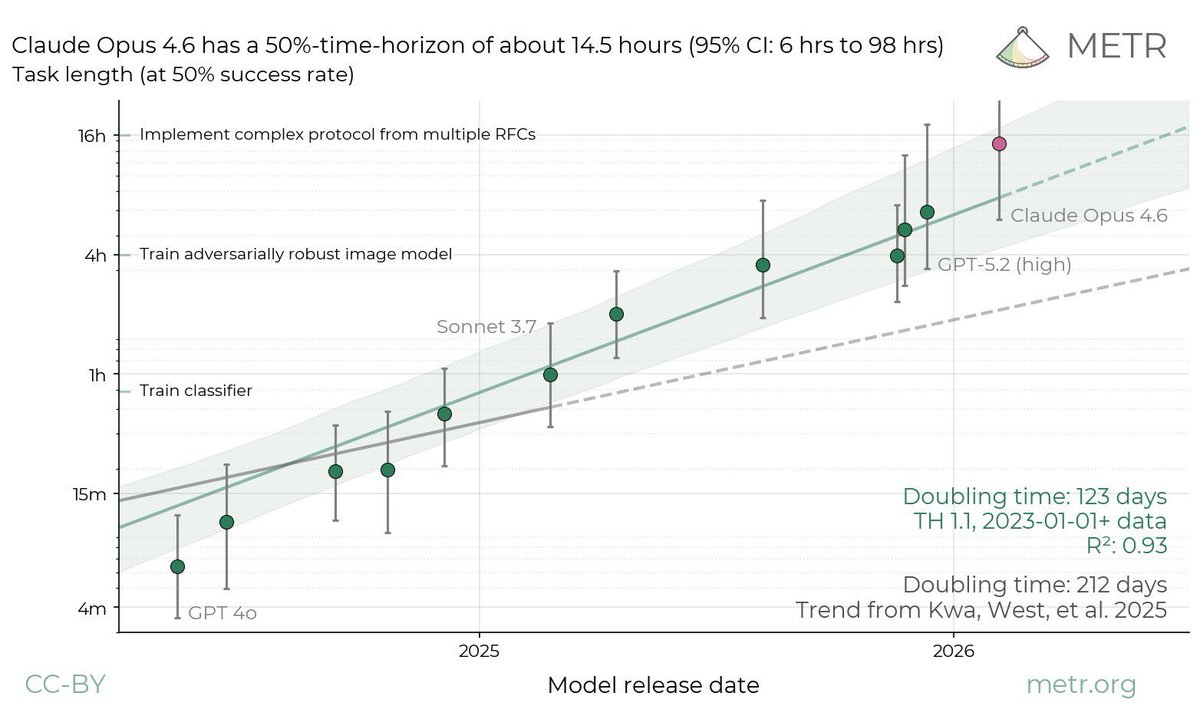
METR’s latest results show we’re already at ~half-day task horizons. At this pace, by the end of this year AI will reliably handle 1–2 full days of work at ~95% success.
By end of 2027 we’re talking weeks to months of autonomous work.
By 2028? Years.
This isn’t linear progress. This is a capability curve snapping upward.
If this trend holds, the definition of “a job” is about to fundamentally break.
72
Feb 19
There’s a reason at Google we used to use Japanese toilets at Building 44 …
Feb 18

a toilet company with a 5 year moat in AI chips is the most 2026 thing ive ever read
1
47
Feb 18
x.com/matusjon/status/202426… I am very impressed by what the team is building. But also somewhat concerned. Curious to get your thoughts.

4
280