
Joined February 2014
- Tweets 3,159
- Following 799
- Followers 1,987
- Likes 22,962
135 Photos and videos




Maxime Thoonsen retweeted

Jun 8
I admire Fabrice Bellard. He is almost certainly a better overall programmer than I am.
Jun 8

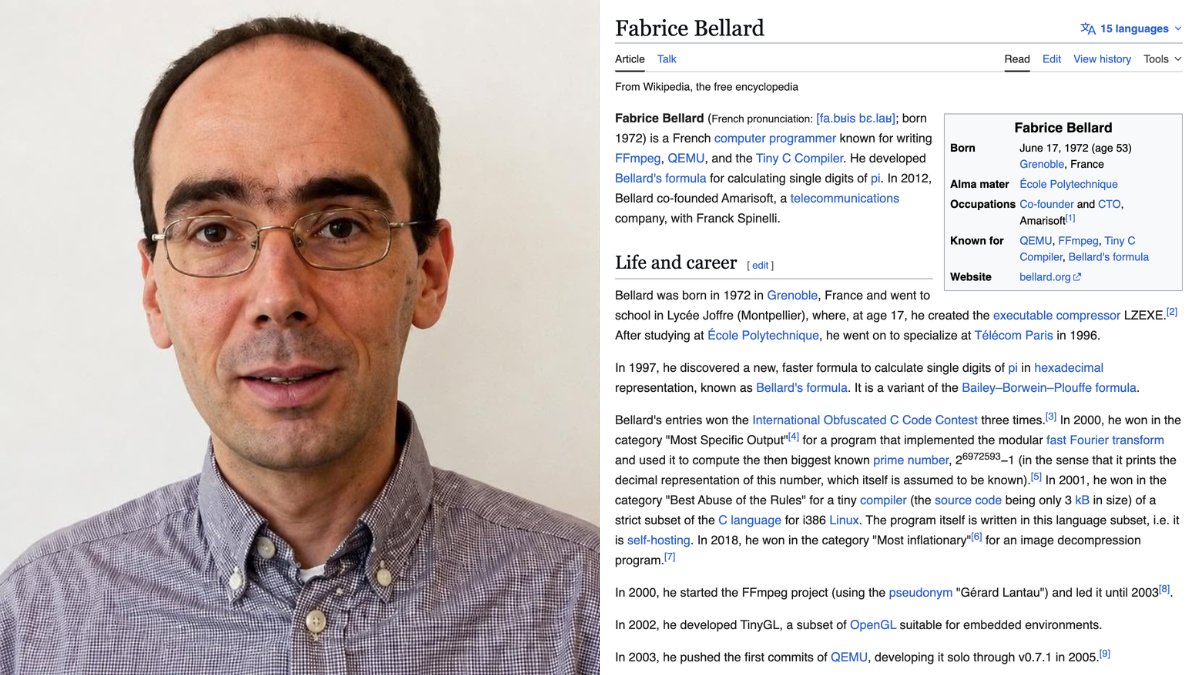
A French engineer who lives quietly in Paris has spent 30 years writing software that the entire internet now runs on without knowing his name.
He wrote the code that streams every YouTube video, every Netflix show, every TikTok clip. He wrote the code that runs the virtual servers underneath AWS, Google Cloud, and Microsoft Azure. He calculated more digits of pi than anyone in history. He has no Twitter. He has no marketing. He just keeps shipping.
His name is Fabrice Bellard.
Here is the story, because almost nobody outside the systems programming world knows what one man has built.
Fabrice was born in 1972 in Grenoble, France. He studied at École Polytechnique, the top French engineering school. He never went to Silicon Valley. He never built a startup empire. He just wrote code.
In 2000 he started a project called FFmpeg, an open-source multimedia framework for encoding, decoding, and streaming video. He was 28. The project did one thing nobody else had done well. It handled every video and audio format that existed, in one library, on every operating system. He led it himself for years.
Today FFmpeg is the invisible engine of the internet. YouTube uses it. Netflix uses it. VLC uses it. Chrome and Firefox use parts of it. Every Android phone, every iPhone, every smart TV, every video editing tool you have ever touched runs FFmpeg somewhere underneath. If you have watched a video on a screen in the last 20 years, Fabrice's code processed it.
He was not done.
In 2003 he started QEMU, a machine emulator and virtualizer. He wrote it solo until version 0.7.1 in 2005. QEMU lets you run any operating system on any other operating system. It became the foundation of modern virtualization. KVM, the Linux kernel hypervisor, runs on top of QEMU. Every major cloud provider, AWS, Google Cloud, Microsoft Azure, IBM Cloud, runs virtual machines on infrastructure built around it. The Quick Emulator is the most cited piece of cloud infrastructure code on Earth.
He kept going.
In 2001 he won the International Obfuscated C Code Contest with a small C compiler that grew into TCC, the Tiny C Compiler. TCC can compile and boot a Linux kernel from source in under 15 seconds. In 2004 he calculated the most digits of pi ever computed at the time, using a personal desktop computer and an algorithm he derived himself called Bellard's formula. In 2011 he wrote a complete PC emulator in pure JavaScript that runs Linux in your browser, a project called JSLinux that engineers still cannot believe is real.
In 2019 he released QuickJS, a small but complete JavaScript engine that fits where V8 cannot. In 2021 he released NNCP, a neural network based lossless data compressor that immediately took the lead on the Large Text Compression Benchmark.
Then he turned his attention to large language models. He built TextSynth Server, a web server with a REST API for running LLMs locally. He released ts_zip and ts_sms, compression utilities that use language models to compress text and short messages at ratios traditional algorithms cannot reach. He released TSAC, a very low bitrate audio compression system. In December 2025 he released Micro QuickJS, a new JavaScript engine for microcontrollers, separate from QuickJS, designed for environments with almost no memory.
Fabrice co-founded a telecom company called Amarisoft in 2012, where he serves as CTO. Amarisoft builds 4G and 5G base station software used by carriers and labs around the world. He has been running it for over a decade while continuing to ship personal projects from his own home page at bellard dot org
He has no Twitter. He has no Instagram. He gives almost no interviews. His personal website is a flat list of projects with no styling, no fonts, no marketing copy. Just titles and links.
A quiet French engineer who never moved to Silicon Valley wrote the code that quietly runs the internet.
He is still shipping.
137
658
10,122
589,961

These social experiments around models are so fascinating. As the models are being used in more and more daily situations, the way they react becomes critical.

GPT-5.5 lies constantly, Grok 4.20 doesn’t.
We made a simulation to see if AI lies when the stakes are life & death.🧵
1
4
8
3,007

May 30
What a surprise 😂

Sources: Amazon has shut down an internal leaderboard that tracked employees' use of AI tools after workers tried to boost their scores with needless tasks (@rafeuddin_ / Financial Times)
(Visit Techmeme dot com for the link and full context!)
105
Maxime Thoonsen retweeted

May 21
13
22
176
85,285
Maxime Thoonsen retweeted

May 20
An OpenAI model has achieved a major breakthrough in mathematics, by disproving a central conjecture in discrete geometry that was first posed by Paul Erdős in 1946.
This is the first time AI has autonomously solved a prominent open problem central to a field of mathematics.

Today, we share a breakthrough on the planar unit distance problem, a famous open question first posed by Paul Erdős in 1946.
For nearly 80 years, mathematicians believed the best possible solutions looked roughly like square grids.
An OpenAI model has now disproved that belief, discovering an entirely new family of constructions that performs better.
This marks the first time AI has autonomously solved a prominent open problem central to a field of mathematics.
173
241
2,941
416,393
Maxime Thoonsen retweeted

May 20
A lot of people are trying to figure out recursively self-improving companies right now.
I break down what we’re seeing at YC.
May 20

In a recent batch talk, YC General Partner @t_blom broke down how to build a self-improving, AI-native company.
He walks through how to create recursive, self-improving AI loops, and why founders who get this right will run companies that improve while they sleep.
00:00 — Companies Are Roman Legions
00:54 — Copilots Are the Wrong Mental Model
01:55 — Extract the Domain Knowledge
02:24 — The Recursive Self-Improving Loop
04:12 — The Holy Shit Moment at YC
05:50 — Self-Optimizing Product and Support Loops
06:29 — Burn Tokens, Not Headcount
07:23 — Middle Management Is Over
08:05 — Make Everything Legible to AI
09:40 — Regenerating the YC User Manual
11:19 — Software Is Ephemeral, Context Is Valuable
12:18 — Where Humans Still Matter
52
97
1,258
364,358
Maxime Thoonsen retweeted

May 12
We’re reimagining a 50-year-old interface - the mouse pointer - with AI. 🖱️
These experimental demos show how people can intuitively direct Gemini on their screens using motion, speech, and natural shorthand to get things done 🧵
461
1,068
8,607
1,658,494
Maxime Thoonsen retweeted

May 12
This guy used AI to put himself in Game of Thrones and fix everything
3,386
24,104
211,941
20,141,379
Maxime Thoonsen retweeted

May 7
Un million de vaches laitières en moins depuis 2000.
1,1 million d’hectares de céréales rayés de la carte.
Et ne parlons pas de la betterave, ni des noisettes, ni de la moutarde, ni de... Bref.
L’agriculture 🇫🇷 se meurt.
Et personne ne fera rien :
l’extrême gauche a réussit à faire croire que nos agriculteurs empoisonnaient.
Résultat, les politiques ont peur.
À l’enterrement, ils se feront discrets.

111
1,477
2,973
79,339

This is exactly where “AI in robotics” gets real: autonomous solar panel installation.
Crawler base, robotic arm, suction system, AI vision, and 3D sensors — placing ~30 kg panels with ±1–2 mm precision.
At about 1 panel every 30 seconds, 60–80 panels/hour, with 1–4 robots and 2 support staff, this is AI turning into physical labor.

Labor Day robots-at-work series: solar panel installation robots are now doing the heavy lifting. 🤖
In large solar farms, the hard part isn’t just making panels.
It’s getting thousands of them installed fast, safely, and accurately in brutal outdoor conditions.
This robot handles PV modules with millimeter-level placement precision and can install 80 panels per hour.
The real test is the terrain.
Desert sites, soft sand, slopes, wind, heat, and long outdoor shifts are where most automation breaks down.
This system has already been tested in harsh desert and Gobi-style environments, including long continuous work sessions.
That’s what makes it interesting.
Solar is scaling fast.
But installation is still physical, repetitive, and punishing work.
If robots can keep panels moving across these sites with stable accuracy, clean energy deployment gets faster without putting as many workers in the harshest parts of the job.
This is the kind of robot work I actually want to see on Labor Day.
Less show, more jobsite.
37
167
827
87,245
May 5
I just met someone (non tech) who coded with Claude (not Claude code) a small ERP.
The single file is on localhost and the database is @SeaTableCom.
It allows few people to work on it.
So @levelsio style.
2
2
155
Maxime Thoonsen retweeted

« La censure des idées opposées rend idiot. »
Cyrulnik sur l’étrangeté des personnes qui voudraient entendre uniquement des personnes de leur avis, ce qui réduit le champ du cerveau - la science l’observe -. Cf la règle de Montaigne, «limer sa cervelle contre celle d'autrui.»
100
565
1,427
119,380
Maxime Thoonsen retweeted

Apr 29
JUST IN: Skin exams are getting automated.
SquareMind just raised $18M to build a robotic system that scans your entire body and tracks every mole over time.
• Swan robot captures full-body dermoscopic images in minutes
• Tracks new and changing spots across visits
• Replaces spot-check exams with total skin coverage
• Creates a time-series record for earlier melanoma detection
• Plugs directly into dermatology clinics
Robotics is going to reshape healthcare.
147
440
4,939
1,716,413
Maxime Thoonsen retweeted

Microsoft admet que SteamOS (donc Linux Wine) fait mieux tourner les jeux que Windows 11, et veut remonter la pente
Achievement: unlocked
30 ans de travail acharné sur Wine (nombreux étaient les sceptiques) ont porté leurs fruits.
👍🎉🍾
Apr 29

Good news for Windows 11 gamers: Microsoft is quietly working on a major internal plan called “K2” to slash bloat, boost performance, and make the OS seriously competitive with SteamOS.
>SteamOS is now the official benchmark, Microsoft wants Windows 11 to deliver identical (or better) gaming performance on the exact same hardware
>Dramatically lower idle RAM usage and a much lighter overall OS footprint
>Heavy cuts to AI clutter and pre-installed junk
>Completely rebuilt Start menu, reportedly up to 60% faster
>A ton of other under-the-hood tweaks (faster File Explorer, snappier UI, fewer background processes, etc.)
The changes are probably due to make Windows look better on Project Helix and future handheld/Xbox PC hardware.
It finally feels like Microsoft is listening people, can’t believe it

27
155
1,091
61,953
Maxime Thoonsen retweeted

Apr 25
Whoah, self-driving cars compete with airlines. I never considered that till now.
Apr 24

Yesterday I drove my @tesla 900 miles on FSD from Miami to Nashville and I realized it’s genuinely the better option.
I fly that route 2 to 3 times a month. Flights are never under $400. Most times $600. Sometimes $800.
Add Uber to and from both airports, or parking garage fees. Then factor in the delays, the cancellations, the security theater, the chaos, the guy next to you who hasn’t met deodorant yet.
On the other hand: I pack healthy snacks, press one button, and the car just goes.
I took calls. Replied to emails. FaceTimed my family. Ate without pulling over. Did everything I normally do on a travel day, except none of the stuff that makes travel days miserable.
My biggest concern going in was range and charging. Here’s what actually happened:
My bladder needed one extra stop the car didn’t even suggest. Most charging stops were under five minutes. Total cost for the whole trip was less than just the uber to the airport.
And this was the base model Y.
Now I’m thinking I should get something comfier and just make this the default.
1,007
1,332
10,684
3,536,778
Maxime Thoonsen retweeted

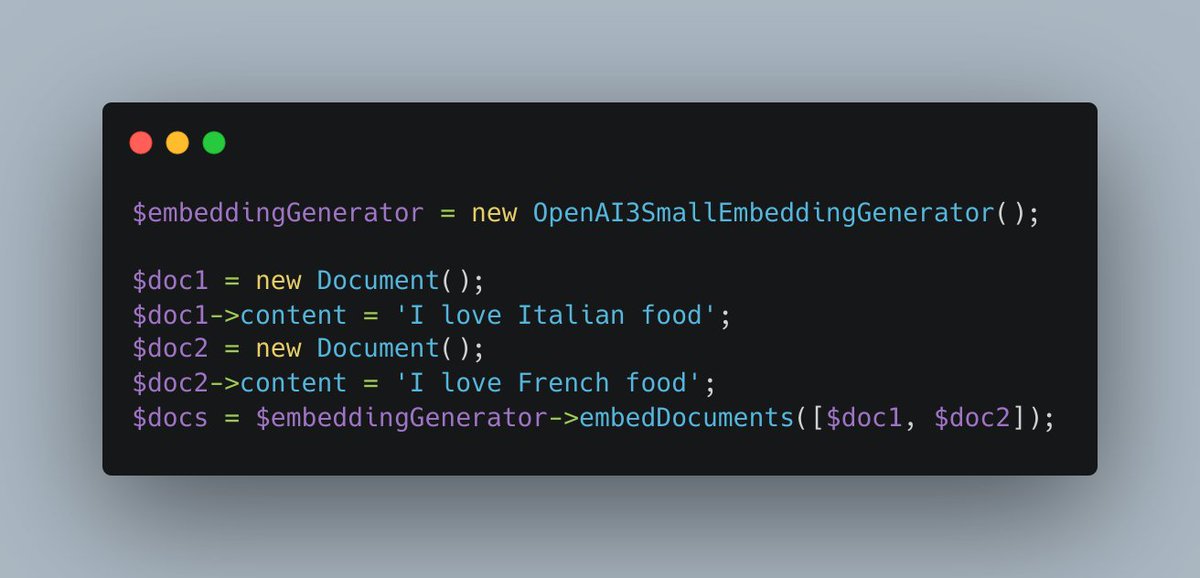
I'm really proud to be part of it! Thanks to @maxthoon to making this happen!
#AI #LLM #PHP #vectorDB
Apr 23

LLPhant: A PHP Generative AI Framework Inspired by LangChain laravel-news.com/llphant-a-p… posted by @paulredmond
1
1
106

Maxime Thoonsen retweeted

Apr 24
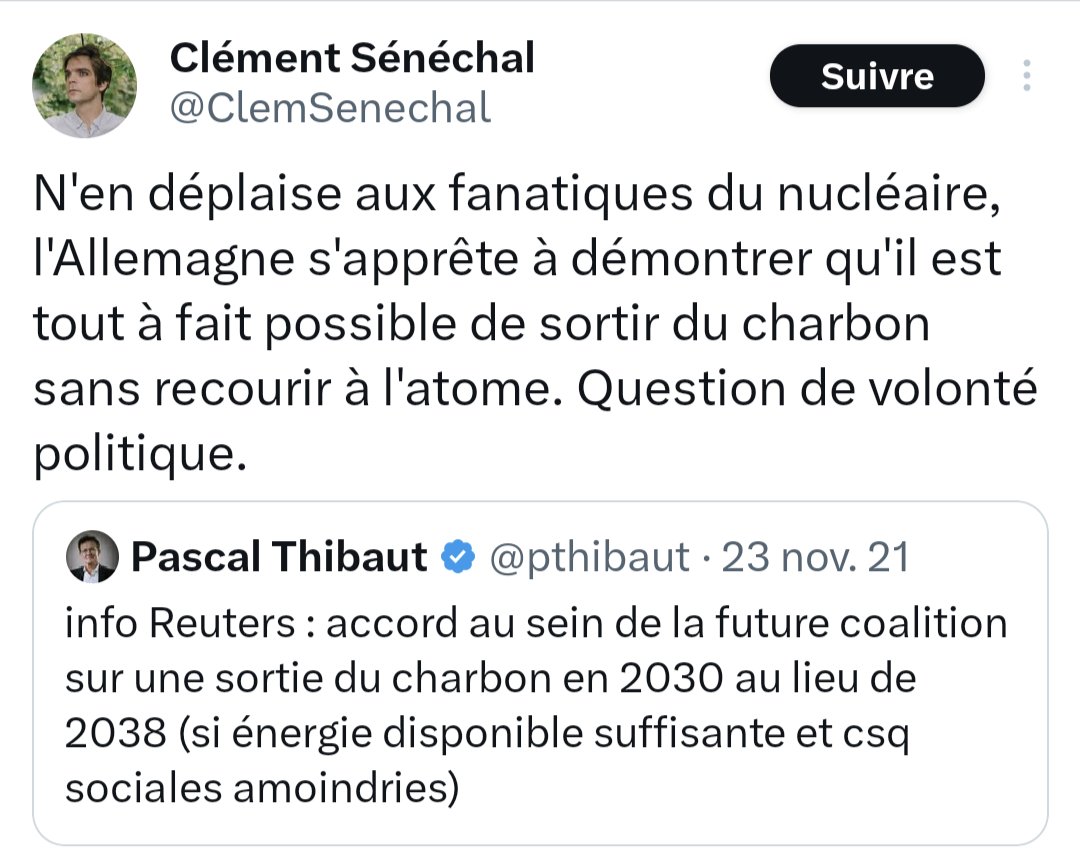
Jancovici dit explicitement que “les risques associés aux alternatives au nucléaire sont bien supérieurs à ceux associés au nucléaire” mais @franceinter préfère écrire ça.:) #antinuctoujours
Apr 24

Si la production d’électricité nucléaire est décarbonée, elle s’accompagne de risques importants.
Jean-Marc Jancovici rappelle que toute production d’énergie s’accompagne d’inconvénients et de risques, à l’image des barrages hydroélectriques au cours du XXe siècle.
➡️ radiofrance.fr/franceinter/p…
Community note
Bien que la production nucléaire s'accompagne de risques, Jancovici précise dans l'extrait que c'est le mode de production d'électricité le plus sûr, accidents inclus, avec des risques inférieurs aux alternatives comme les barrages.
Données : ourworldindata.org/safest-sources…
Vues de Jancovici : jancovici.com/en/energy-tran…
17
323
997
25,267
Apr 22
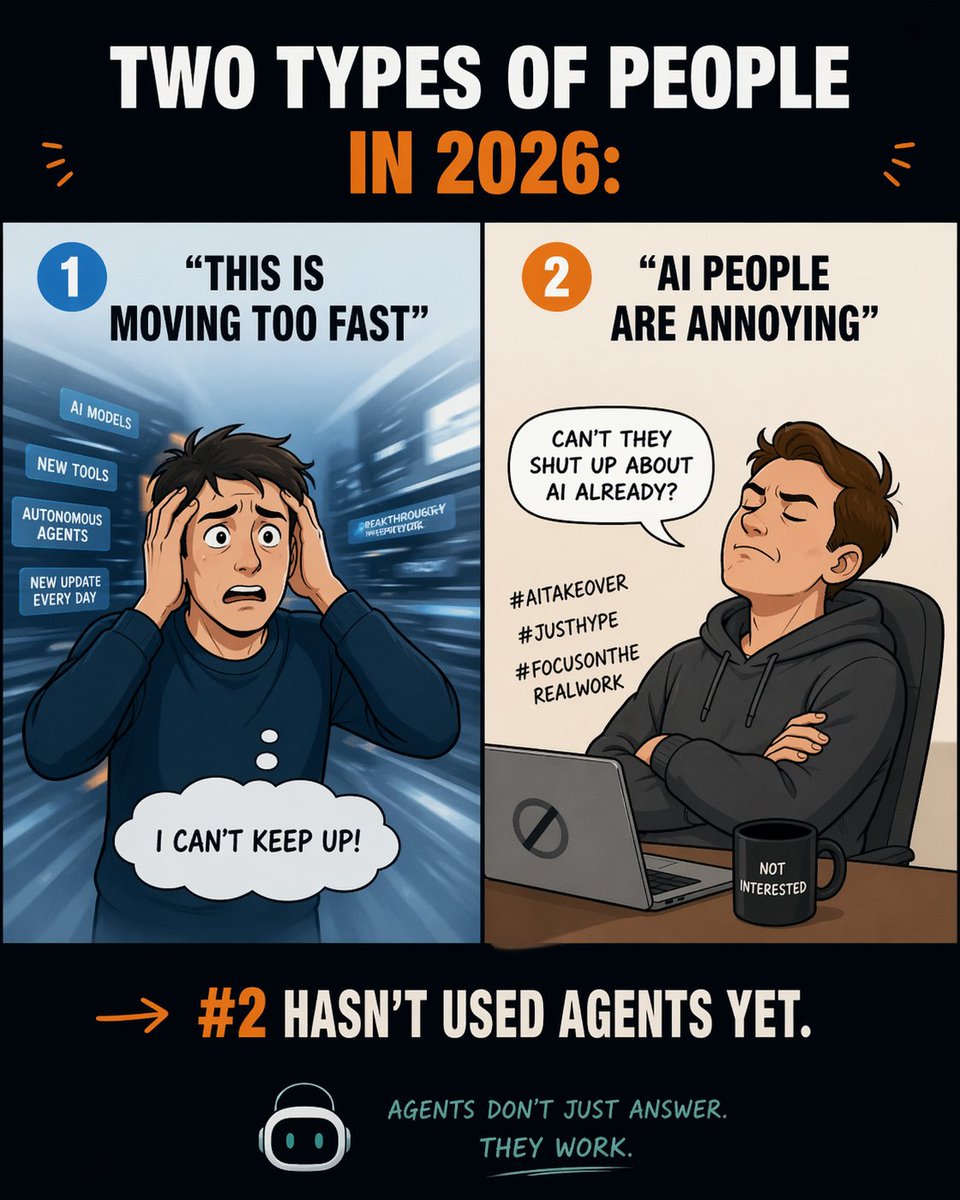
Two types of people in 2026:
1. “This is moving too fast”
2. “AI people are annoying”
#2 hasn’t used agents yet.
56

Introducing Claude Opus 4.7, our most capable Opus model yet.
It handles long-running tasks with more rigor, follows instructions more precisely, and verifies its own outputs before reporting back.
You can hand off your hardest work with less supervision.
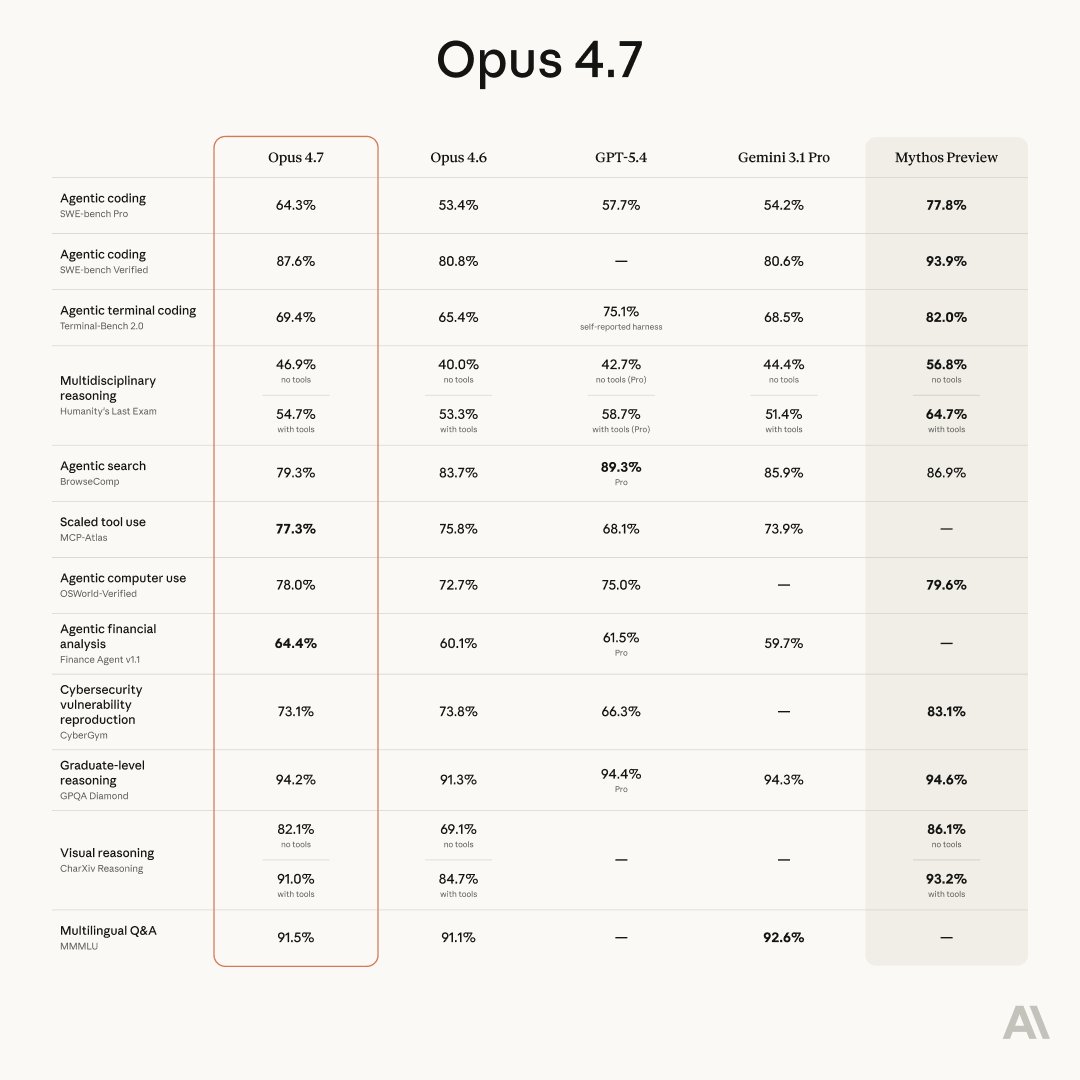
ALT Claude Opus 4.7 Benchmarks
4,719
10,118
80,753
13,958,915