
Will give opinions rarely
Joined May 2024
- Tweets 956
- Following 352
- Followers 53
- Likes 512
105 Photos and videos

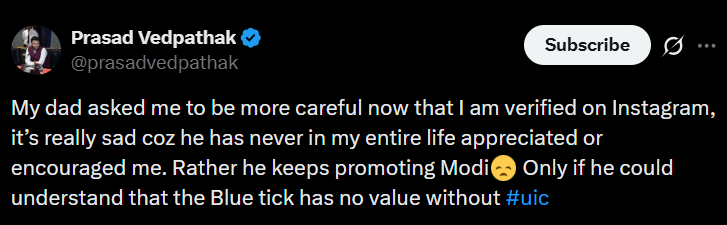

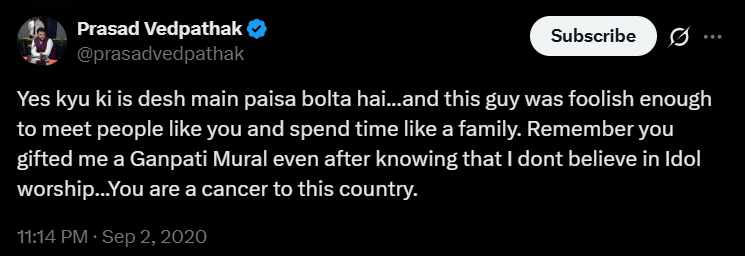
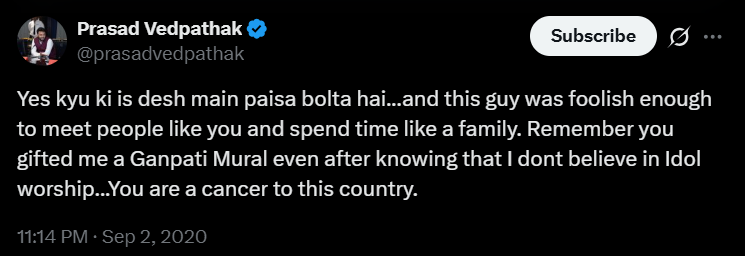
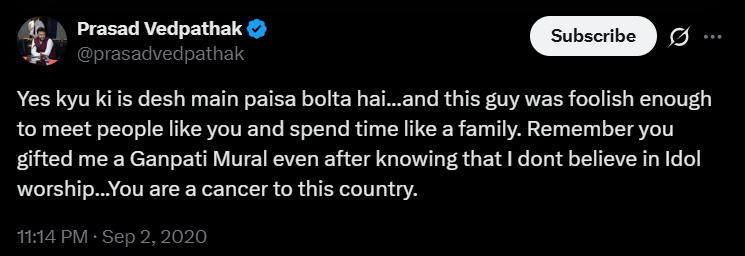
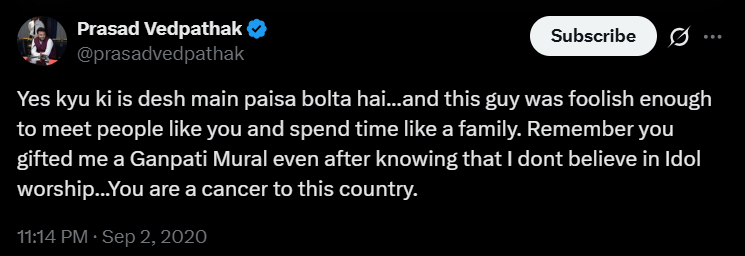
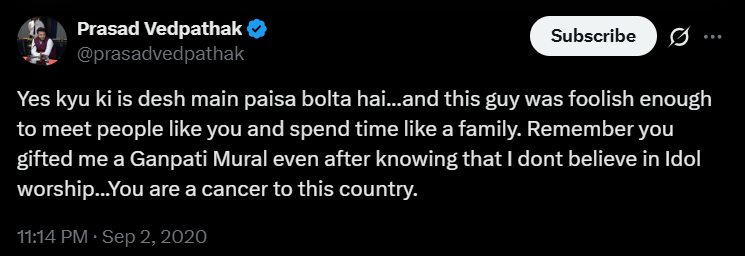
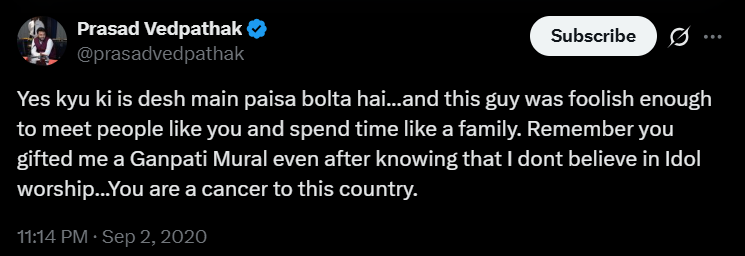
Meme Workers 🇮🇳 retweeted

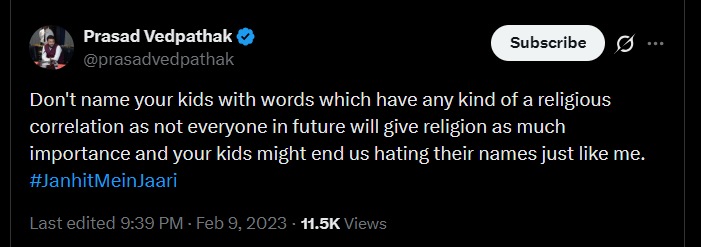
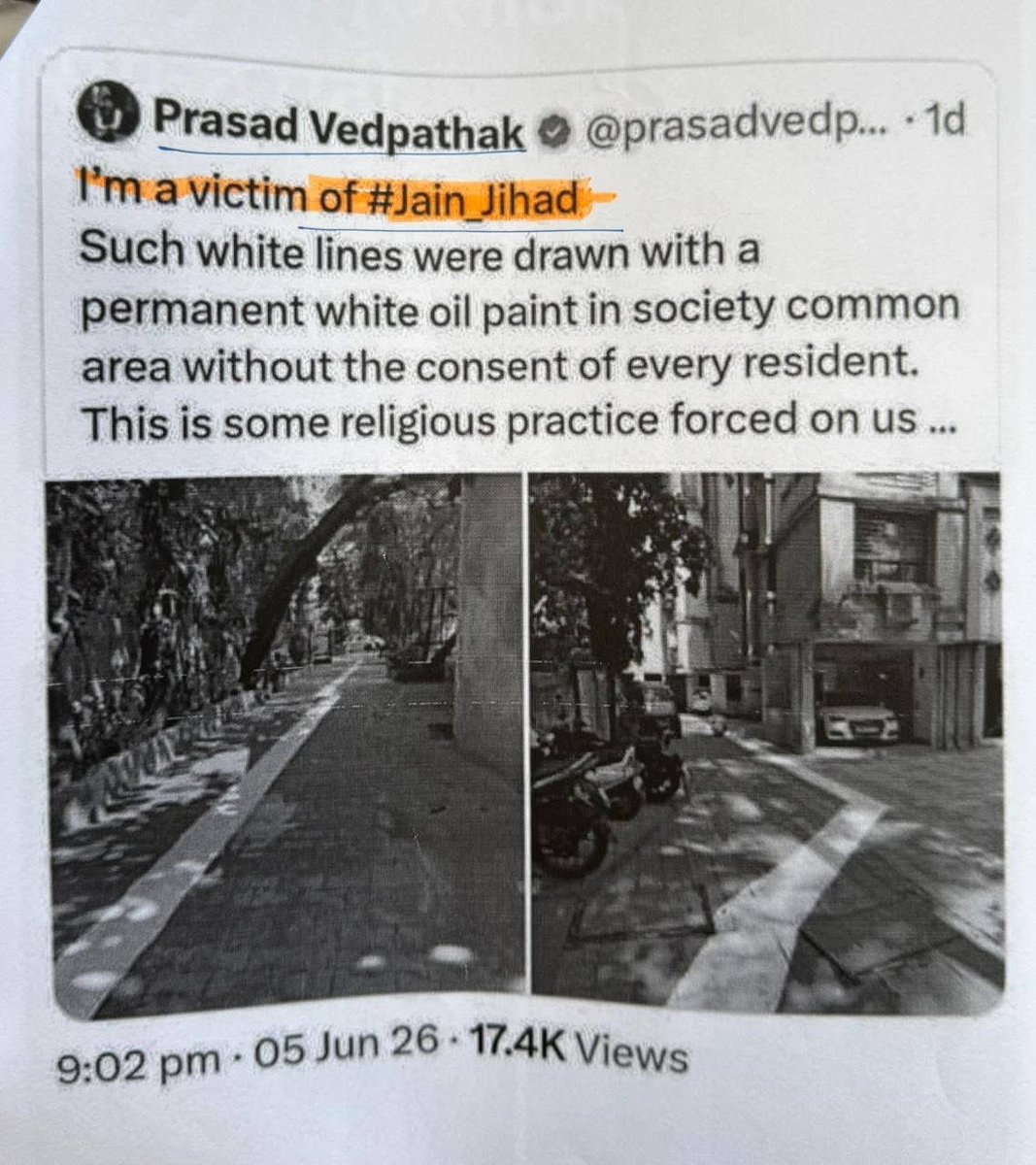
Dear Jains,
Neither your religion was the real issue, nor was that white strip the real issue.
Most Marathis are with you.
Most Indians are with you.
Do not let the actions of a few hate-mongers define an entire community or state.
You have businesses to run, careers to build, families to care for, and dreams to achieve.
Ignore the negativity, stay focused on your goals, and continue contributing positively to society and the nation.
82
91
577
18,994

Jun 13
Congratulations @prasadvedpathak for Inciting one religion war between Marathis & Jains. You may wanted it for your political Ambitions or your ticket to Bigboss, but Society & peaceful citizens will have to pay price now.
2
1
7
179
Jun 12
This guy can do anything to milk likes and engagement. He has not even spared his own family.
8 Jan 2025

After years of self medication and unhealthy diet my Dad was diagnosed with psoriasis few years back. We used all our contacts and found the best solution which included a strict diet. My Wife religiously made seperate food for him till one day when he casually in front of many family members called my wife's food 'Wani Chap' , a casteist slur which she won't forget for life. But that made my wife stop making his food and eventually my mom had to take over that duty. Since then my Dad does not follow his anti inflammatory diet. He is not willing to understand the root cause of this auto immune disorder and instead keeps on applying ointments. Today is special as he now has applied Cow Urine on his body. I'm sure he must have found this solution on WhatsApp university. No child must experience the pain of parenting their parents,I really want to help him but he just does not listen. When you have parented all your life you simply don't feel the urge of producing a new being and extending your duty. I never showed the bad side of anyone related to me through my vlogs because I wanted your families to get influenced by love and joy. I'm finally putting this out there because this too might help someone relate and find some hope. It's really sad when the world loves and respects you but you are treated like sh*t by the ones you really care about. #life
1
32
Meme Workers 🇮🇳 retweeted

Jun 11
Did your family sell the land for free ?
Didn’t you get the market rate ?
Why did you sell to Jains if you consider them to be “jihadis”?
Paisa ??
Jun 11

A sensible person doesn’t make a mountain out of a molehill; tries to solve problem internally instead of making it a media circus for some social media traction & publicity
A sensible person doesn’t rest on his ancestral achievements, doesn’t have such a huge EGO that he doesn’t realise that it’s not him, but his ancestors who made the building possible
1
25
143
5,016
Meme Workers 🇮🇳 retweeted

Jun 12
Who is Prasad Vedpathak? A beef enthusiast and a Dhruv Rathee fan who ignored the Islamist motive behind Pahalgam attack but tried to pit Hindus against Jains over a harmless tradition
opindia.com/2026/06/prasad-v…
17
321
842
9,384
Jun 10
Congratulations to PM Shri @narendramodi ji on becoming India’s longest-serving elected Prime Minister in an uninterrupted tenure. 🇮🇳
A historic milestone built on public trust, discipline and delivery.
Key achievements under his leadership:
• India rose as a major global economic power
• Digital India & UPI changed everyday payments forever
• Massive infrastructure push: highways, railways, airports, ports
• Jan Dhan, DBT & welfare delivery reduced leakages
• Ayushman Bharat expanded healthcare access
• Swachh Bharat brought sanitation into national priority
• Make in India & startup ecosystem gained serious momentum
• India’s global voice became stronger and more respected
From governance to geopolitics, from infrastructure to digital payments, this has been a transformative decade for Bharat.
Wishing him strength to keep serving the nation. 🇮🇳
1
1
55
Jun 8
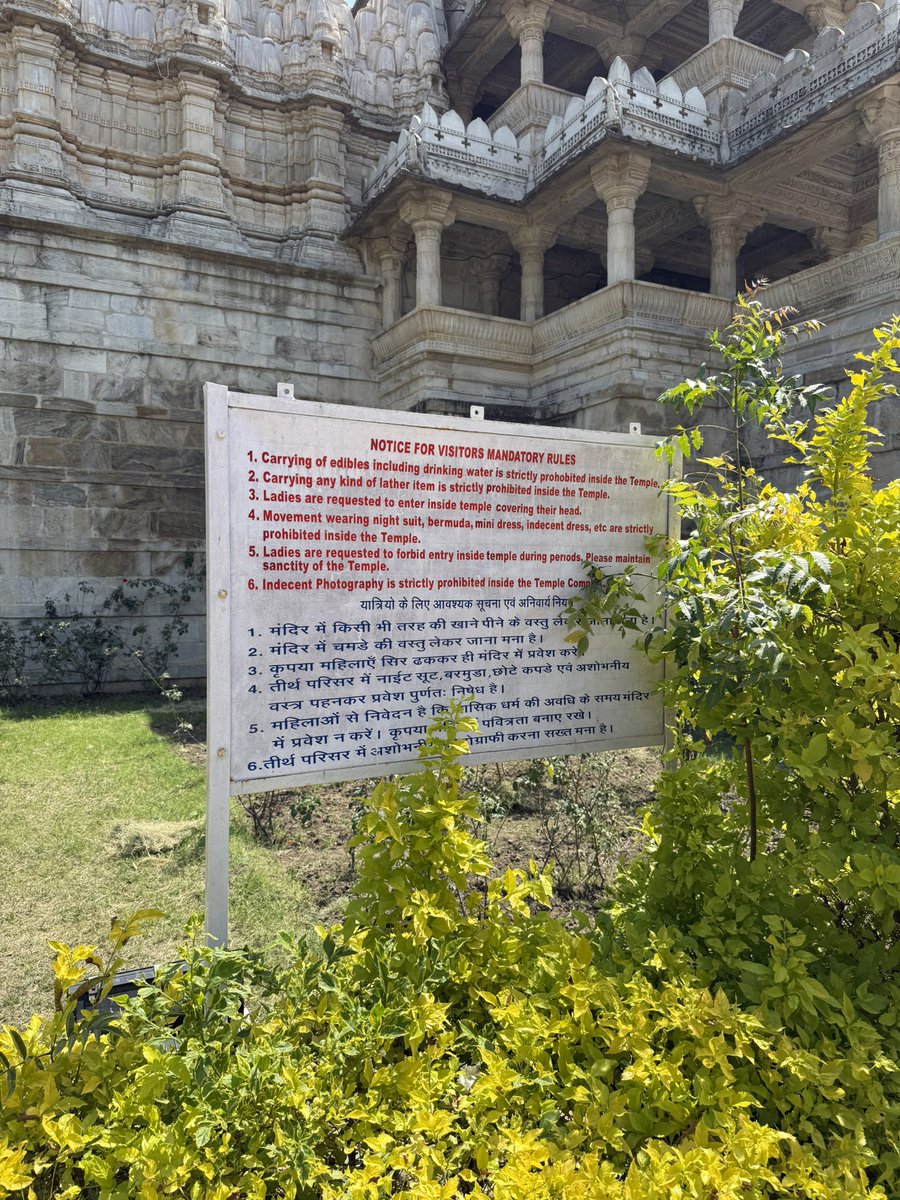
This guy has a history of making insensitive comments.
10 Apr 2025
Recently visited Ranakpur Jain Temple where I was asked to remove my leather belt and wallet before stepping inside the temple. That was fine but point number 5 seemed a bit odd…what do you think ?
1
4
201
Jun 7
Mumbai’s Pagdi tenants don’t need another election-time headline. They need rules on paper and action on ground.
Govt itself spoke of 19,000 old rent-controlled/Pagdi buildings, 13,000 still awaiting redevelopment, and nearly 28,000 tenant-landlord disputes to be resolved.
So where is the notified framework? Where are the fast-track dispute mechanisms? Where is tenant protection?
Lakhs of Mumbaikars are living in ageing buildings while files move slower than redevelopment lifts.
@mieknathshinde ji, @Dev_Fadnavis ji, please give Mumbai a clear timeline. Pagdi reform cannot become another “after election, silence” promise.
119
Jun 5
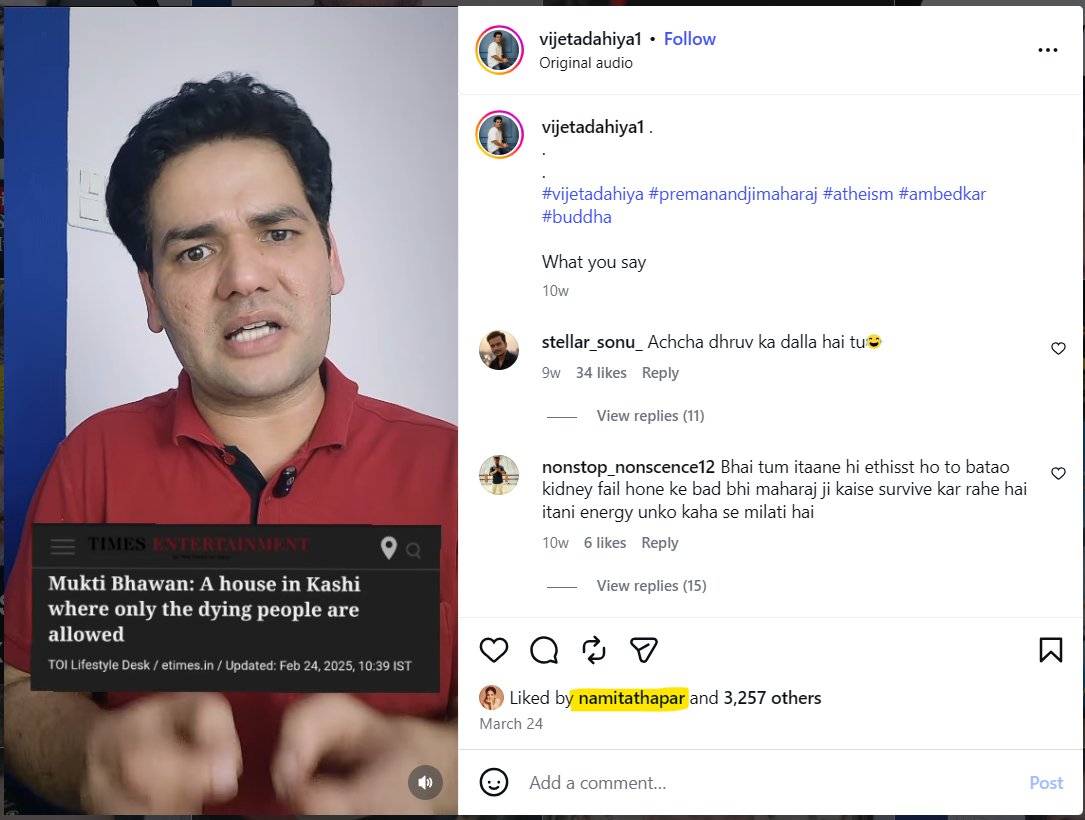
An instagram reel by @VijetaDahiya where he is smashing Premanand Maharaj & Hindu Ideology. But look who liked that reel. Yes its @namitathapar
Now people can decide what are her opinions & views.
1
2
150
Jun 3
After listening to Lalit Modi’s podcast, one thing is clear:
India doesn’t study its business disruptors properly.
The IPL was not just cricket glamour. It was distribution, media rights, city identity, scarcity, auctions, entertainment and timing, all stitched together before most people even understood the market.
But from a fan’s perspective, the real magic was something else.
Before IPL, we had mostly seen international players only as rivals. Aussies sledging Indians. Indians fighting Pakistan. West Indians, Sri Lankans, South Africans, all competing against each other.
And suddenly, the same rivals were sharing dressing rooms.
Tendulkar opening with Jayasuriya.
Shane Warne bowling to Ricky Ponting.
Andrew Symonds playing against his own international teammates.
As fans, we could only fantasize these combinations.
Lalit Modi made them real.
India winning the 2007 T20 World Cup gave the format the perfect ignition. But packaging that excitement into a city-based, prime-time, celebrity-backed, auction-driven sports property required vision and execution.
Love him or hate him, the man created something that changed Indian sports commerce forever.
And frankly, something that will be remembered in world sports history.
@LalitKModi
225
Meme Workers 🇮🇳 retweeted

May 22
Why is the West not curious on the great Indian 🇮🇳 civilization?
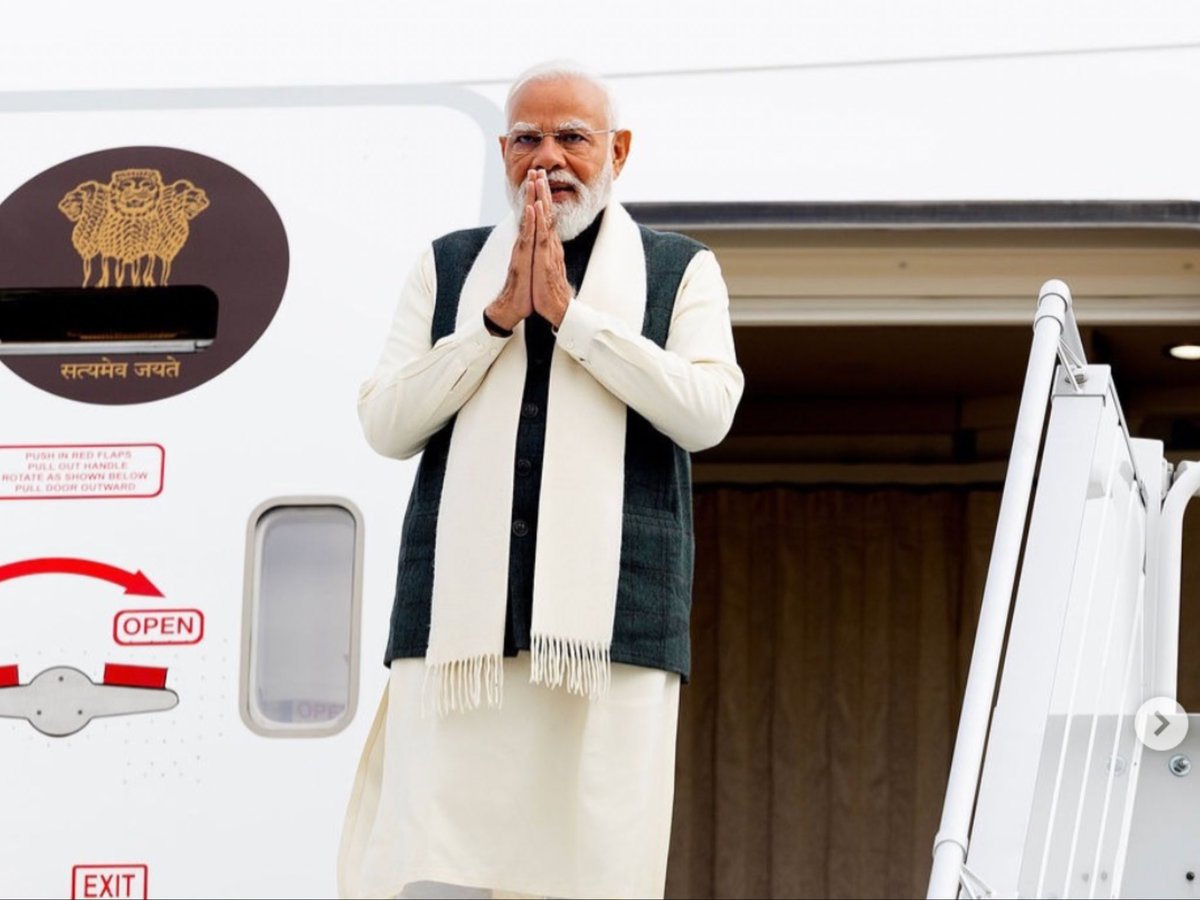
This week Prime Minister Narendra Modi visited Norway. The government rolled out the red carpet. King Harald invited for lunch. All bigwigs of Norwegian business turned up. This is of course as it should be at such a historic visit.
Rather different was media. No curiosity, no real attempt to understand India. When the third most powerful man in the world visits Norway, you may expect some real interest? An attempt to understand the world’s third largest economy, a global green leader, one of the world’s brightest civilizations??
It’s not that Norway is overrun with visit at this level. Last Indian top visit was Indira Gandhi in 1983. Last Chinese president visit was 1996, last American president was 2009.
Here are some taste bits from Norwegian media:
* Aftenposten the largest newspaper printed a caricature of Modi as a snake charmer, many found it racist and derogatory. The accompanying article (written by an otherwise brilliant journalist) described Modi as a “slightly annoying man” and simply showcased that India is not high on the papers reading lists.
* Norsk rikskringkasting (NRK), the state broadcaster, explained “why prime minister Støre is clearing his desk to receive Modi”. From everyone outside Norway I got exactly the opposite question: Why did Modi use his valuable time in such a small and insignificant place?
* Dagsavisen, a left of center daily, sent a young journalist to throw questions after Modi - claiming that India is 157 on a global democracy ranking. When a ranking is so contrary to common sense - why doesnt she ask those who created the ranking why they spread such nonsense?
I am not aware of one Norwegian journalist closely following India. NOT ONE! How can the public learn more?
Unless you believe democracy only fits a handful of small, homogenous, ultra rich western nations, India is the miracle of democracy. The large, complex, lingustically and religiously diverse nation with many poor people - which has etablished a vibrant democracy and is much less violent than Europe or America.
India can in fact make a claim to be the worlds most homegrown and impressive democracy.
We are entering the Asian century. Unless we Europeans become more curious - to civiliazation, history, politics and economy in the Global South - we will become the big losers of history.
690
2,198
7,802
714,770
May 22
Mumbai desperately needs a sustained, city-wide anti-encroachment drive similar to the ongoing operation in Garib Nagar, Bandra. Illegal constructions on railway land, pavements, and public spaces have choked the city's infrastructure for far too long. Clearing these for essential projects like station expansion is not just about development — it's about safety, rule of law, and the greater public interest.Some are quick to label such actions as "communal." However, an honest examination of ground realities raises uncomfortable questions. Why is it that members of one particular community are disproportionately involved in large-scale encroachments, unauthorized constructions, and illegal hawking across many parts of Mumbai? This is not a baseless claim but a pattern repeatedly observed in enforcement drives.The deeper problem lies in community leadership and internal support. While elites from most other communities actively invest in schools, colleges, scholarships, hospitals, and skill development to uplift their people, a significant section of Muslim elites in India have not demonstrated the same proactive resource-sharing for the socio-economic advancement of their broader community.Mumbai’s educational and charitable landscape reflects this clearly. Communities such as Gujaratis, Marwaris, Parsis, Jains, Marathis, and South Indians have built institutions that drive progress for their own groups and the city at large. Marathis, in particular, have contributed immensely through cooperative movements, educational societies, cultural institutions, and active participation in Mumbai’s industrial and commercial growth over decades.In contrast, large sections of the Muslim population continue to lag in education, formal employment, and upward mobility — not solely due to external factors, but also due to limited internal initiatives focused on modernization and economic integration.Instead of prioritizing education, skills, and legitimate businesses, some remain trapped in cycles of poverty and parallel social structures. This is worsened by the tendency to invoke “Muslim brotherhood” in welcoming illegal immigration from Bangladesh and elsewhere, which only strains scarce resources, heightens social tensions, and compounds the community’s challenges. Gulf countries and Arab nations, despite their enormous wealth and shared faith, have shown they will never accept such populations in any meaningful numbers — precisely because they understand the heavy economic and social costs involved.At the end of the day, even as a broader society, we genuinely want to see this community progress and prosper. No one benefits from leaving any group behind, reduced merely to a vote bank for politicians. These leaders extend support when it suits their equations, only to abandon them when political winds shift — leaving the people to face the consequences. Garib Nagar stands as the biggest example of this harsh reality, where many who once backed such settlements have now realigned toward parties and ideologies that prioritize development and enforcement of the law.Rule of law must apply equally to all. Mumbai’s future depends on clearing encroachments, enforcing regulations, and fostering an environment where legal enterprise and hard work are rewarded, irrespective of community. Selective outrage only delays the cleanup the city urgently needs.
1
1
181
May 18
Mumbaikars are fed up! Bike taxis save so much time in Mumbai traffic. They zip through jams in 15-25 mins while autos and taxis take 45-60 mins. No refusals, no bargaining, instant pickup and drop exactly where you want. But the government is banning them just to protect auto and taxi license owners. I am 99.9 percent sure more than half the auto and black yellow cab licenses in Mumbai are illegal or fake. Use satellite photos and AI to scan and count real vehicles on roads right now. Dont snatch modern convenience from citizens in the name of protecting old cartels. Regulate bike taxis properly instead of banning them! @CMOMaharashtra
@PratapSarnaik
@mybmc
@TransportofMAHA
#BikeTaxisForMumbai #BikeTaxiBanNako #MumbaikarVoice
97
May 10
Hera Pheri 3 is stalled due to an ongoing legal battle over franchise rights. Firoz Nadiadwala (who made the first 2 films) sold rights to Akshay's production house. But South producer GP Vijayakumar claims full ownership (bought from original Malayalam rights holders in 2022) & says Firoz only had remake rights for 1 film. Madras HC case active fresh FIR filed by Firoz in April. Akshay confirmed: not happening for at least a year. Fingers crossed for a resolution! #HeraPheri3
96
May 8
Bengalis are struggling to get resignation letter, while the Tamils are struggling to get appointment letter.
Malayalis have both the resignation letter and the appointment letter. But don't have a name for the appointment letter!!
Beauty of democracy 😀
57
Meme Workers 🇮🇳 retweeted

May 6
RT if you think @sagarikaghose should leave her RS seat for @MamataOfficial
123
1,903
4,564
59,115
May 2
We should never forget these termites. I hope they get properly investigated for their NGO's & Source of funds.
The best thing Modi ever did was curbing the funds of these NGO from foreign funding. That one move has infact stabilized lots of things in this country.
May 2

Remember how foreign-funded 5-star activists like Medha Patkar tried their level best to deprive the Kutch region of Narmada water, until Modi called their bluff.
Today, the same dam irrigates 3 states & provides drinking water to millions of Indians
83