
MSc em Sistemas e Computação.
Joined March 2009
- Tweets 2,745
- Following 446
- Followers 292
- Likes 3,836
86 Photos and videos









michael.Schuenck(&santos) retweeted

O primeiro dia do Claude na Dunder Mifflin
41
426
4,550
270,735
michael.Schuenck(&santos) retweeted
2020: "Não vou tomar essa vacina que ninguém conhece, não confio nessa pesquisa."
2026: "Me vê 5 canetinhas daquele remédinho para emagrecer que achei num perfil do Instagram. Pode ser genérico, tanto faz."
37
105
1,344
25,512
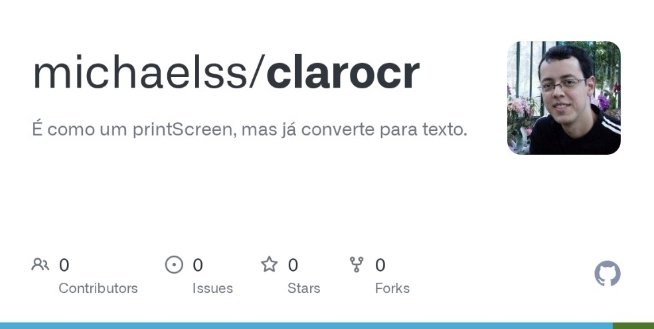
Você está em uma aula online e quer copiar o texto de um slide do professor, ou quer extrair o texto de uma imagem... essa ferramenta é pra você! Ela já faz o OCR na hora. Funciona no Linux/Gnome.
Projetinho show de bola no vibe coding.
github.com/michaelss/clarocr
67


michael.Schuenck(&santos) retweeted

Feb 16
The acceleration is accelerating and I now wonder if I was even too optimistic hoping that I still have a couple of years of software development ahead of me.
4
2
22
3,955
michael.Schuenck(&santos) retweeted

Feb 5
New Engineering blog: We tasked Opus 4.6 using agent teams to build a C compiler. Then we (mostly) walked away. Two weeks later, it worked on the Linux kernel.
Here's what it taught us about the future of autonomous software development.
Read more: anthropic.com/engineering/bu…
855
2,495
21,263
8,515,578
michael.Schuenck(&santos) retweeted

o cruzamento mais perigoso do mundo fica em SP

105
3,762
55,261
542,243
michael.Schuenck(&santos) retweeted

claude code is fucking insane
i know literally NOTHING about coding. ZERO. and i just built a fully functioning web app in minutes
http://localhost:3000/
check it out
2,330
3,200
74,946
4,064,157

Anthropic just released ALL the Claude Code secrets
Their Prompting best practices just went live in their docs and I spent hours reading it and testing out all the tips
Here are the 10 that make Claude Code so much better: 🧵

122
523
4,802
628,804
michael.Schuenck(&santos) retweeted

29 Dec 2025
Big moment for Postgres!
AI coding tools have been surprisingly bad at writing Postgres code.
Not because the models are dumb, but because of how they learned SQL in the first place.
LLMs are trained on the internet, which is full of outdated Stack Overflow answers and quick-fix tutorials.
So when you ask an AI to generate a schema, it gives you something that technically runs but misses decades of Postgres evolution, like:
- No GENERATED ALWAYS AS IDENTITY (added in PG10)
- No expression or partial indexes
- No NULLS NOT DISTINCT (PG15)
- Missing CHECK constraints and proper foreign keys
- Generic naming that tells you nothing
But this is actually a solvable problem.
You can teach AI tools to write better Postgres by giving them access to the right documentation at inference time.
This exact solution is actually implemented in the newly released pg-aiguide by @TigerDatabase, which is an open-source MCP server that provides coding tools access to 35 years of Postgres expertise.
In a gist, the MCP server enables:
- Semantic search over the official PostgreSQL manual (version-aware, so it knows PG14 vs PG17 differences)
- Curated skills with opinionated best practices for schema design, indexing, and constraints.
I ran an experiment with Claude Code to see how well this works, and worked with the team to put this together.
Prompt: "Generate a schema for an e-commerce site twice, one with the MCP server disabled, one with it enabled. Finally, run an assessment to compare the generated schemas."
The run with the MCP server led to:
- 420% more indexes (including partial and expression indexes)
- 235% more constraints
- 60% more tables (proper normalization)
- 11 automation functions and triggers
- Modern PG17 patterns throughout
The MCP-assisted schema had proper data integrity, performance optimizations baked in, and followed naming conventions that actually make sense in production.
pg-aiguide works with Claude Code, Cursor, VS Code, and any MCP-compatible tool.
It's free and fully open source.
I have shared the repo in the replies!
54
226
2,183
186,844
michael.Schuenck(&santos) retweeted

29 Dec 2025
That's why vibe coding is way better from a phone. Not a computer.
- Take out your phone
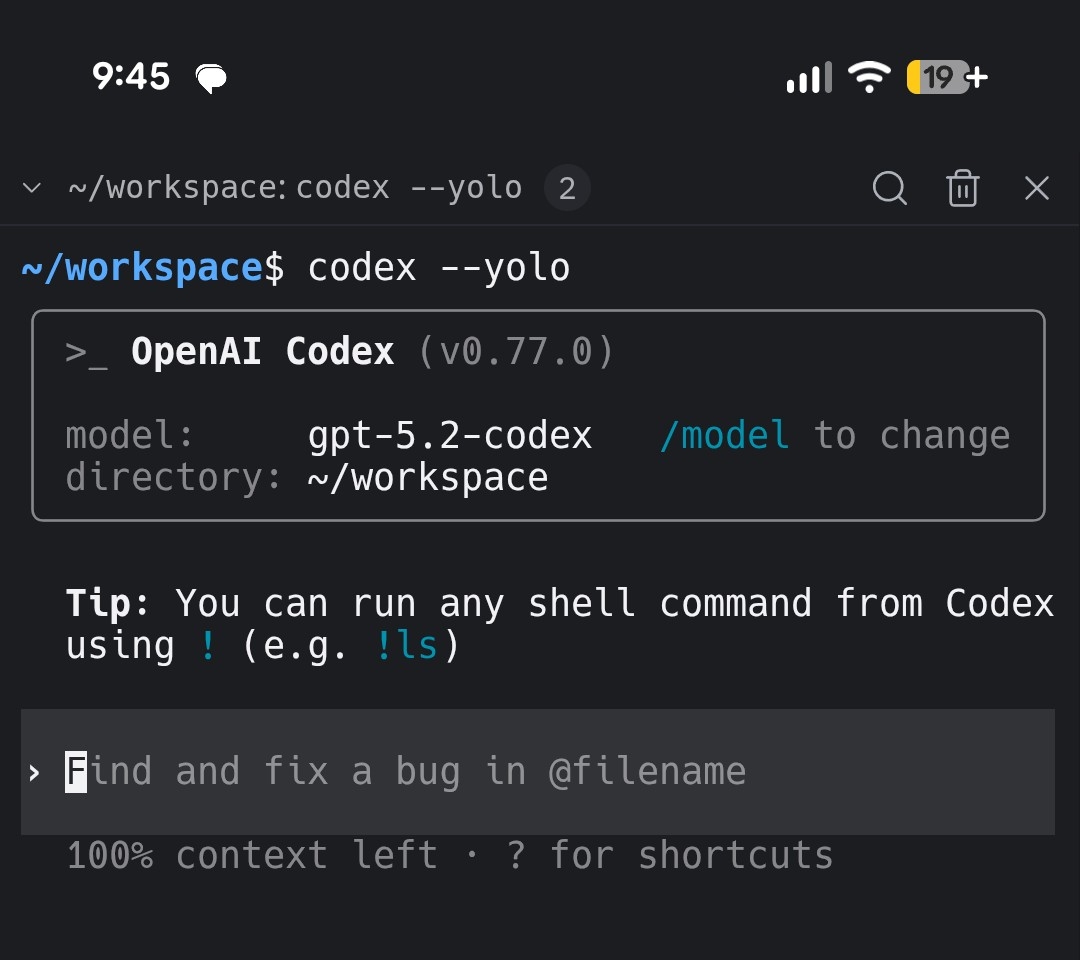
- Send a prompt to Claude Code, Codex...
- Lock the screen
- Let it work
Building anywhere on mobile is way more efficient than waiting while staring at your laptop.
And you can set this up easily.
I'm using Replit on my phone and you can use both Claude Code and Codex (in addition to Replit Agent) anywhere.
1. Install the Replit mobile app (Android/iOS)
2. Create a new project
3. Launch the terminal
4. For Claude Code:
npm install -g (at)anthropic/claude-code-cli
For Codex:
npm install -g (at)openai/codex
Boom, you're done.
28 Dec 2025

my brothers in christ codex is like 37 times more cracked than claude code ... without rules hooks plugins skills and a bunch of other bullshit
the mf cooks for 30-60 mins and the thinking process is actually insane when u read it ... but it's sloooooow af and not "vibey" enough
77
66
855
126,692


michael.Schuenck(&santos) retweeted

25 Aug 2025
Vibe-coding is not the same as AI-Assisted engineering.
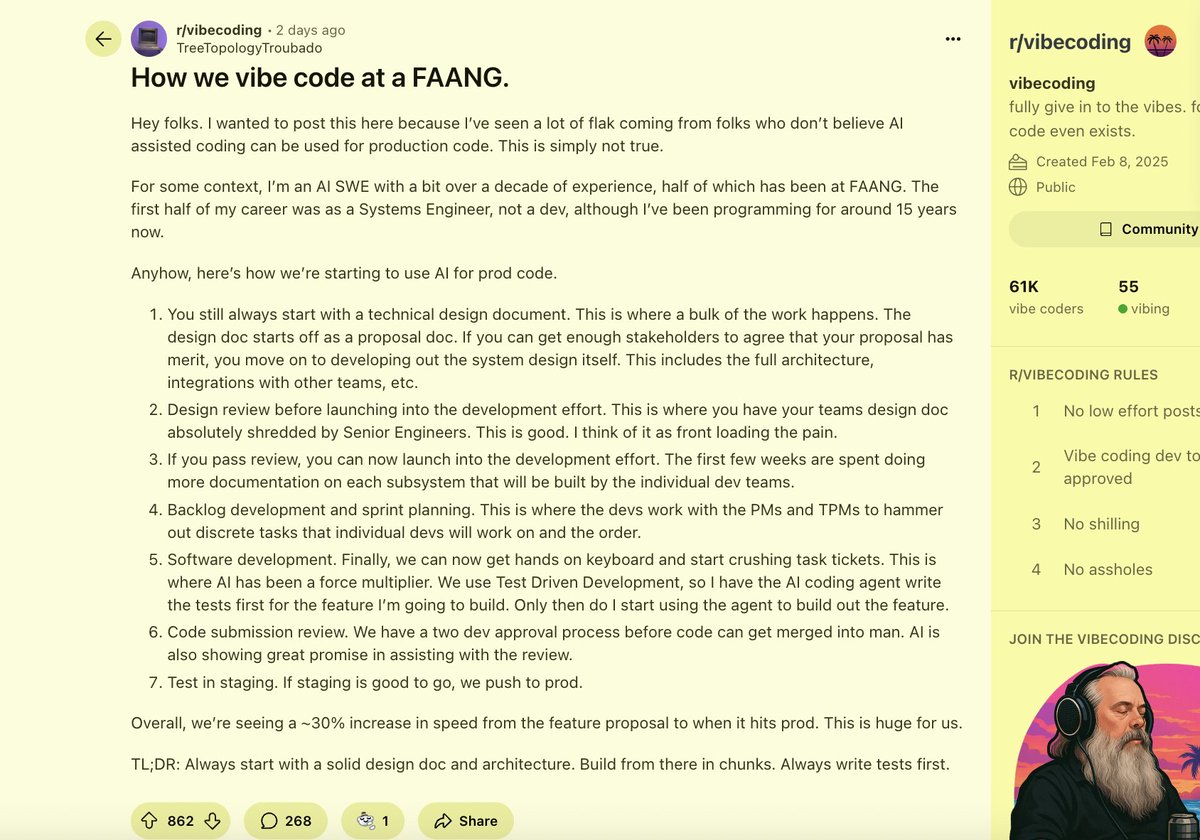
A recent Reddit post described how a FAANG team uses AI and it sparked an important conversation about semantics: "vibe coding" and professional "AI-assisted engineering". While the post was framed as an example of the former, the process it detailed - complete with technical design documents, stringent code reviews, and test-driven development - is a clear example of the latter imo.
This distinction is critical because conflating the two risks both devaluing the discipline of engineering and giving newcomers a dangerously incomplete picture of what it takes to build robust, production-ready software.
As a reminder: "vibe coding" is about fully giving in to the creative flow with an AI (high-level prompting), essentially forgetting the code exists. It involves accepting AI suggestions without deep review and focusing on rapid, iterative experimentation, making it ideal for prototypes, MVPs, learning, and what Karpathy calls "throwaway weekend projects." This approach is a powerful way for developers to build intuition and for beginners to flatten the steep learning curve of programming. It prioritizes speed and exploration over the correctness and maintainability required for professional applications.
There is a spectrum between vibe coding and doing it with a little more planning, spec-driven development, including enough context etc and what is AI-assisted engineering across the software development lifecycle.
In stark contrast to the post, the process described in the Reddit post is a methodical integration of AI into a mature software development lifecycle. This is "AI-assisted engineering," where AI acts as a powerful collaborator, not a replacement for engineering principles. In this model, developers use AI as a "force multiplier" to handle tasks like generating boilerplate code or writing initial test cases, but always within a structured framework.
Crucially, the big difference here is the human engineer remains firmly in control, responsible for the architecture, reviewing and understanding every line of AI-generated code, and ensuring the final product is secure, scalable, and maintainable. The 30% increase in development speed mentioned in the post is a result of augmenting a solid process, not abandoning it.
For engineers, labeling disciplined, AI-augmented workflows as "vibe coding" misrepresents the skill and rigor involved. For those new to the field, it creates the false and risky impression that one can simply prompt their way to a viable product without understanding the underlying code or engineering fundamentals.
If you're looking to do this right, start with a solid design, subject everything to rigorous human review, and treat AI as an incredibly powerful tool in your engineering toolkit - not as a magic wand that replaces the craft itself.
57
216
1,336
167,296
michael.Schuenck(&santos) retweeted

14 Dec 2025
Porque iniciar um sistema WEB com Python em 2026:
Segue o fio 🧶🧵🪡
19
13
313
41,298
michael.Schuenck(&santos) retweeted

6 Dec 2025
slc o cara é o rei do marketing
63
1,387
30,436
913,541

7 Oct 2025
Não julgue se você ver alguém sem deficiência aparente estacionar em vaga para portador de necessidade especial. A deficiência deve ser mental.
13
michael.Schuenck(&santos) retweeted

27 Jul 2025
Brasil paga bilhões para big techs dos EUA e impede avanço de soluções nacionais ift.tt/u9cvqNn
1
6
16
699
michael.Schuenck(&santos) retweeted
5 Jul 2025
Friendly reminder that Gemini has a free alternative to Cursor
You can install Gemini Code Assist at no cost directly in VS Code just by using your Google account:
→ Gemini 2.5
→ 240 chat requests DAILY
→ 180,000 completions /month
(Setup below)
101
379
4,152
590,543
michael.Schuenck(&santos) retweeted
7 Jun 2025
Gemini 2.5 Pro can automate your browser
You can ask it to perform any task fully autonomously using this free and open source extension.
No need for n8n, Make or Zapier.
00:00 - Presentation
01:10 - Settings
02:18 - First demo
04:11 - Benefits over n8n
04:46 - Second demo on X
06:19 - Conclusion
This uses your own browser.
You won't need to connect countless APIs or leak your credentials.
68
301
2,085
235,702
michael.Schuenck(&santos) retweeted
23 May 2025
Google AI Studio can now act as a free Cursor alternative
You can build apps with built-in AI capabilities directly in the browser using just a Google account.
Once you're done, you can even share or deploy them with a single click.
(Steps an link below)
58
224
1,960
216,180