
Culture, tech, and taste. Brand and product strategy. Signals before they’re obvious. Writing, building, decoding. Sneakerhead. Rekt. Doodles. Meebits. #NFFC
Joined April 2007
- Tweets 35,786
- Following 14,309
- Followers 13,612
- Likes 264,808
4,540 Photos and videos
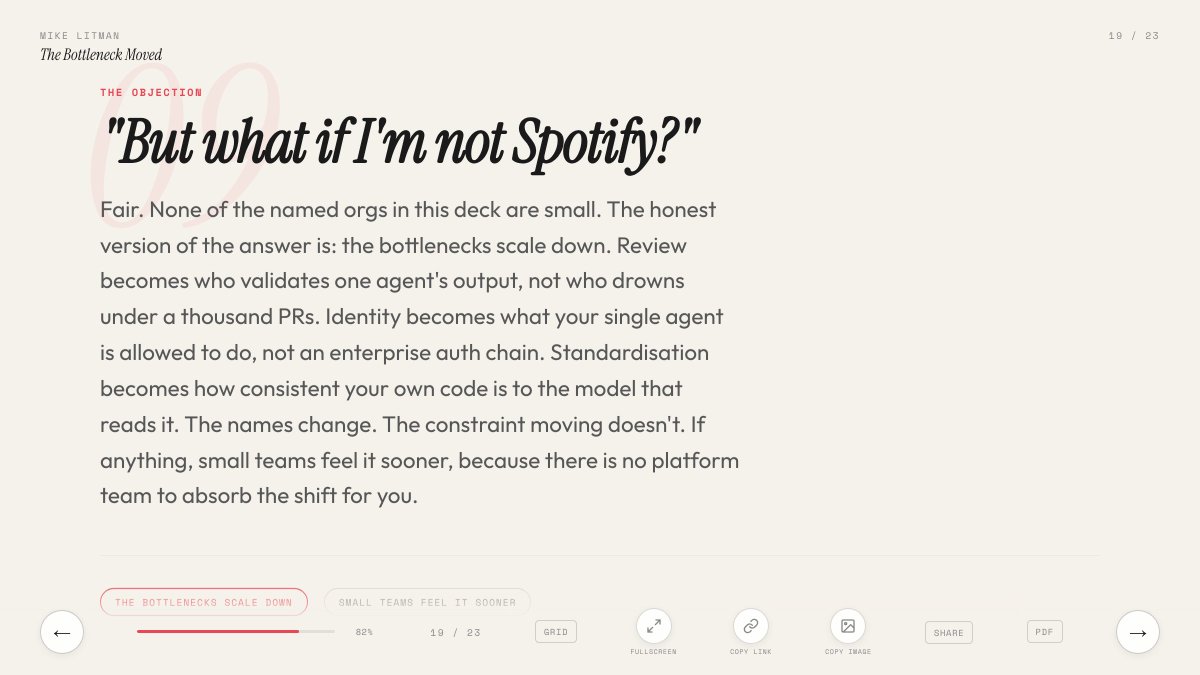
Pinned Tweet

10 Oct 2024
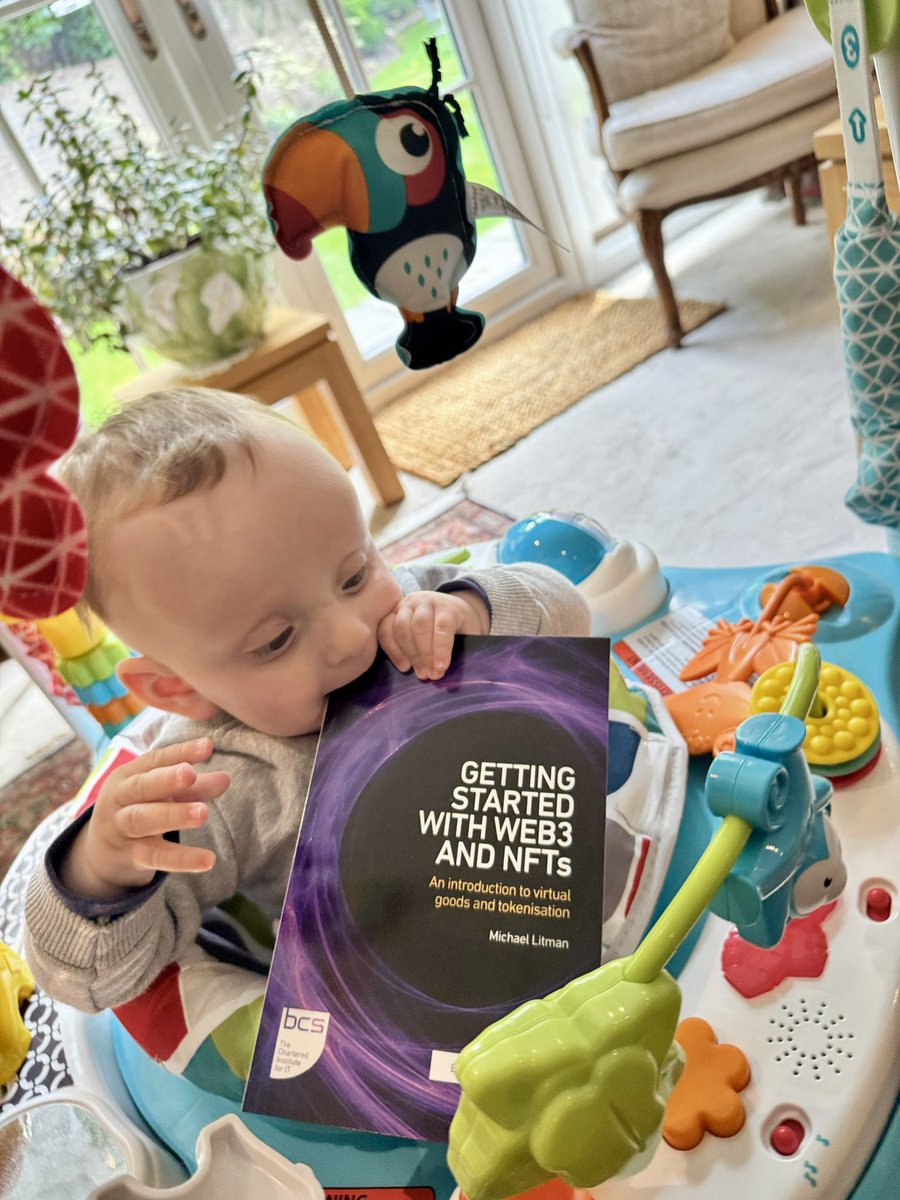
tl;dr i wrote a book over the last year published by BCS about web3, culture, art, & digital ownership
you can get a physical copy on amazon and many others internationally, kindle or audiobook on audible
amzn.eu/d/dSp3m9c
my son tells me it’s a very digestible read
10 Oct 2024

New NFT book that quoted some of my thoughts from this last year. Gonna check it out. Thanks Michael ❤️
18
1
99
16,292
michael litman retweeted

Jun 10
AI provides an incredibly opportunity for solopreneurs
not to automate a content process
not to more efficiently analyze reddit threads
not to optimize an agency
but to actually serve as a creative medium, pushing the frontier on what you want to see in the world.
6
5
43
4,359
michael litman retweeted

Jun 10
Daniela Amodei, cofounder of Anthropic on why curiosity beats specialization:
“The ability to be curious, to learn across a lot of disciplines and to have a strong foundation of wanting to have impact, regardless of the area that you're working in, I think that is an underrated quality.”
23
118
973
37,786
Jun 6
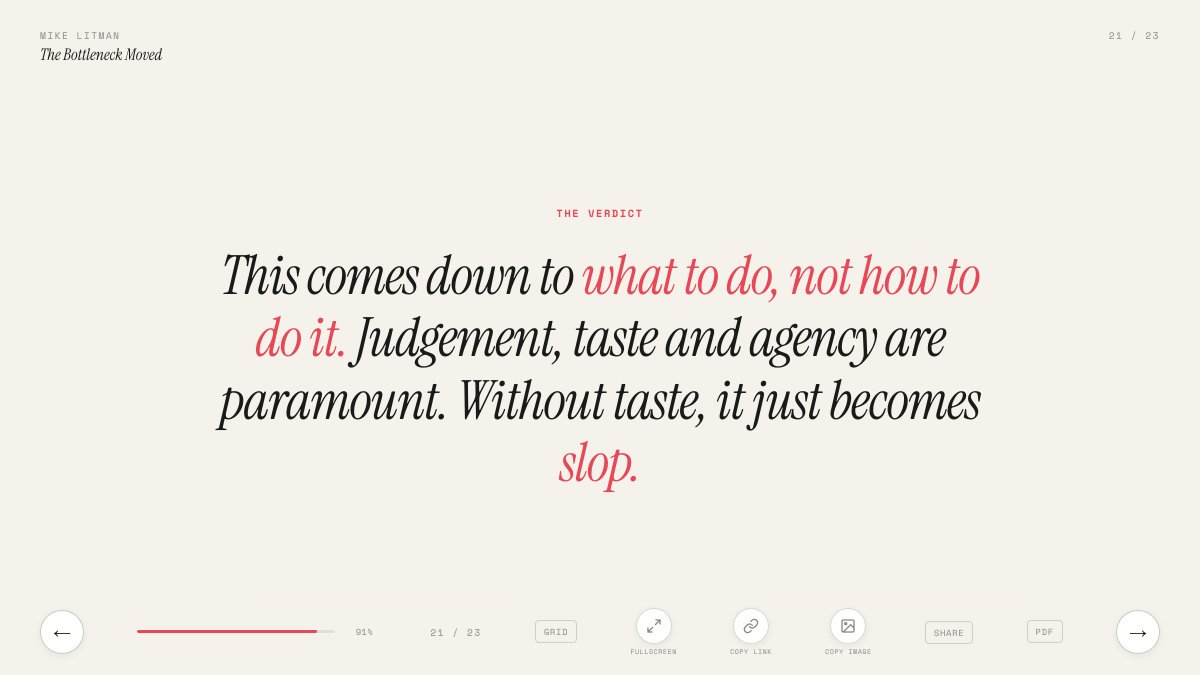
Creativity, taste and distribution are the edge now execution is cheap.
3
4
86

High agency high taste is the unlock these days
May 25

So many people are stuck doing boring work because they don't have the right background or aren't in the right community.
But now? Anyone can use ChatGPT for free. And it doesn't cost that much to access the superpowers of Claude Code and Codex. These tools giving people capabilities that used to belong only to highly trained engineers. It doesn't cost much to start building.
The people who are going to win, whatever their background, are the ones who just do things. Don't wait to be told.
90
85
1,258
320,769
May 20
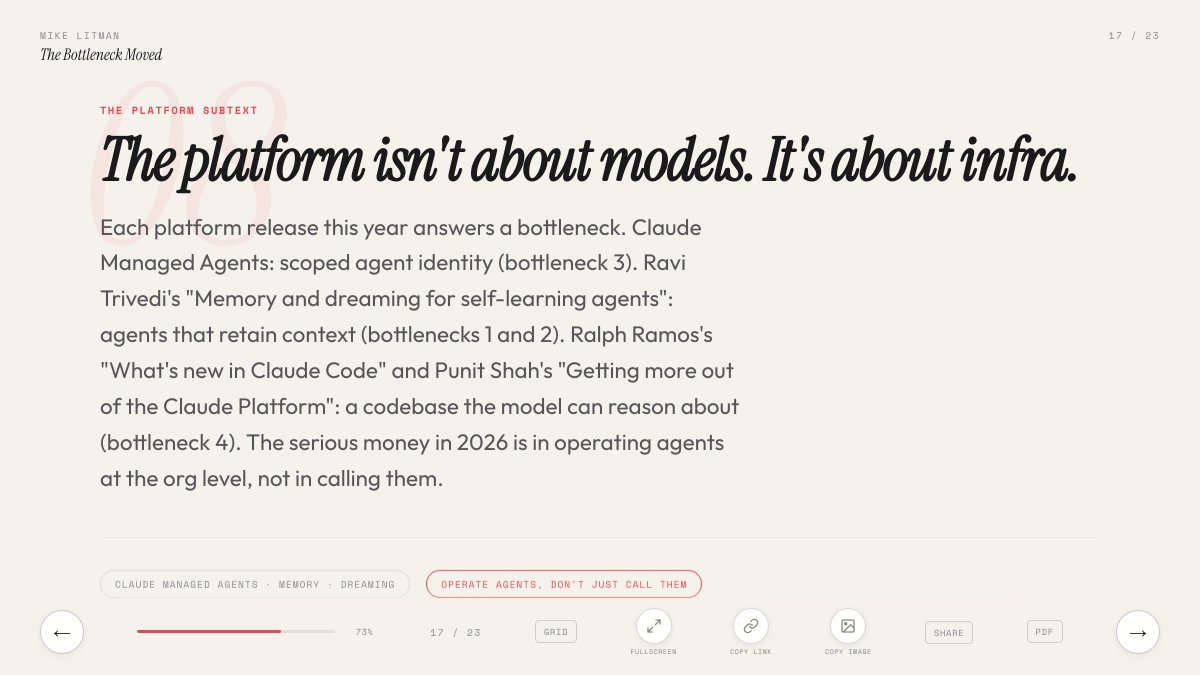
Each platform release this year answers one of the five bottlenecks.
Claude Managed Agents: scoped agent identity (bottleneck 3)
Ravi Trivedi's "Memory and dreaming for self-learning agents": context-bearing agents (bottlenecks 1 and 2)
Ralph Ramos's "What's new in Claude Code" Punit Shah's "Getting more out of the Claude Platform": a codebase the model can reason about (bottleneck 4)
Cred to @bcherny @_catwu @angjiang @katelyn_lesse.
17/23
4
6
106
May 20
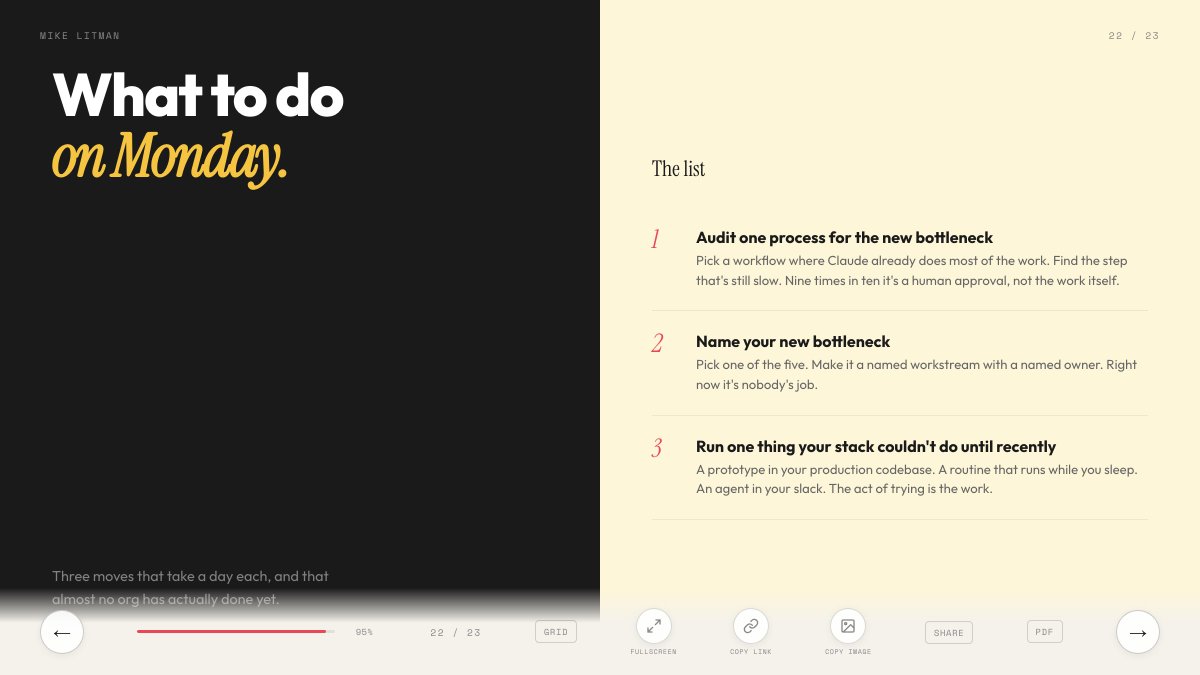
What to do. Three moves.
1. Audit one process for the new bottleneck.
2. Name your new bottleneck. Pick one of the five. Make it a named workstream with a named owner.
3. Run one thing your stack couldn't do until recently.
22/23
2
3
55
May 20
The bottleneck moved. Move with it. Or optimise the wrong thing.
Full deck (23 slides): mikelitman.me/bottleneck-mov…
Blog (1,339 words): mikelitman.me/blog/bottlenec…
Or: mikelitman.me/code-with-clau…
23/23
Cred to the @AnthropicAI team for the day. Thank you @bcherny @katelyn_lesse @angjiang @_catwu and everyone else involved.
1
59
May 20
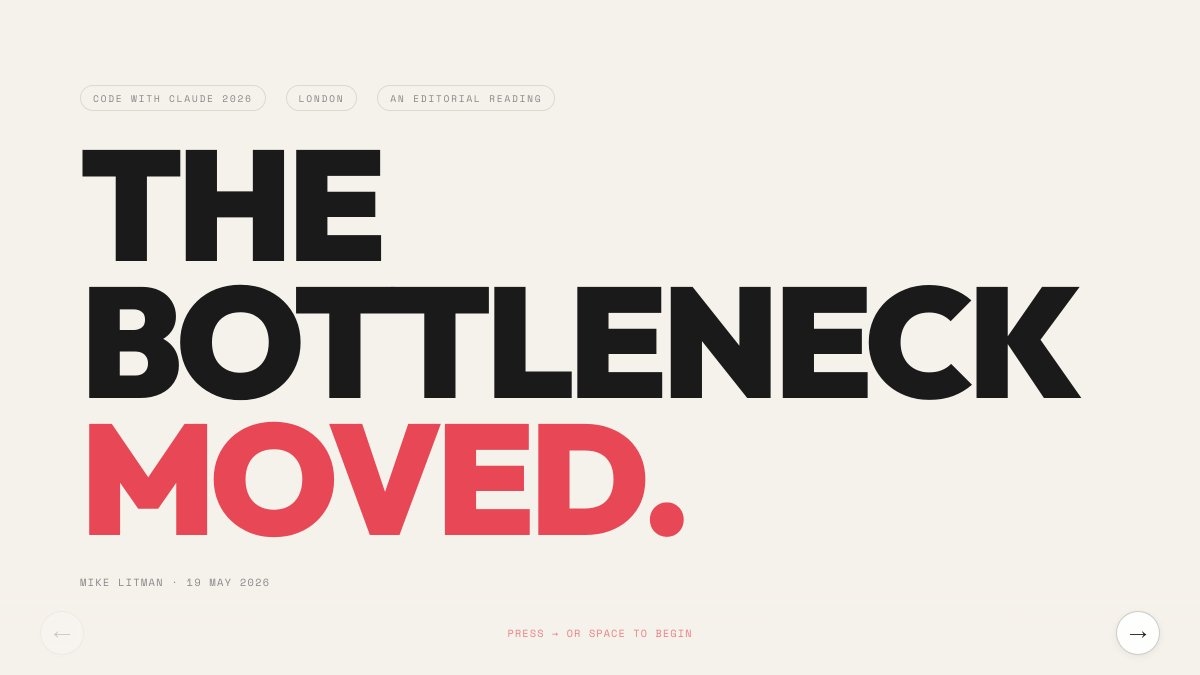
My overview from Code with Claude London, Tuesday 19th May 2026.
The Bottleneck Moved.
The model is no longer the constraint. The organisation is.
23-slide deck: mikelitman.me/bottleneck-mov…
1/23
1
1
146
May 20
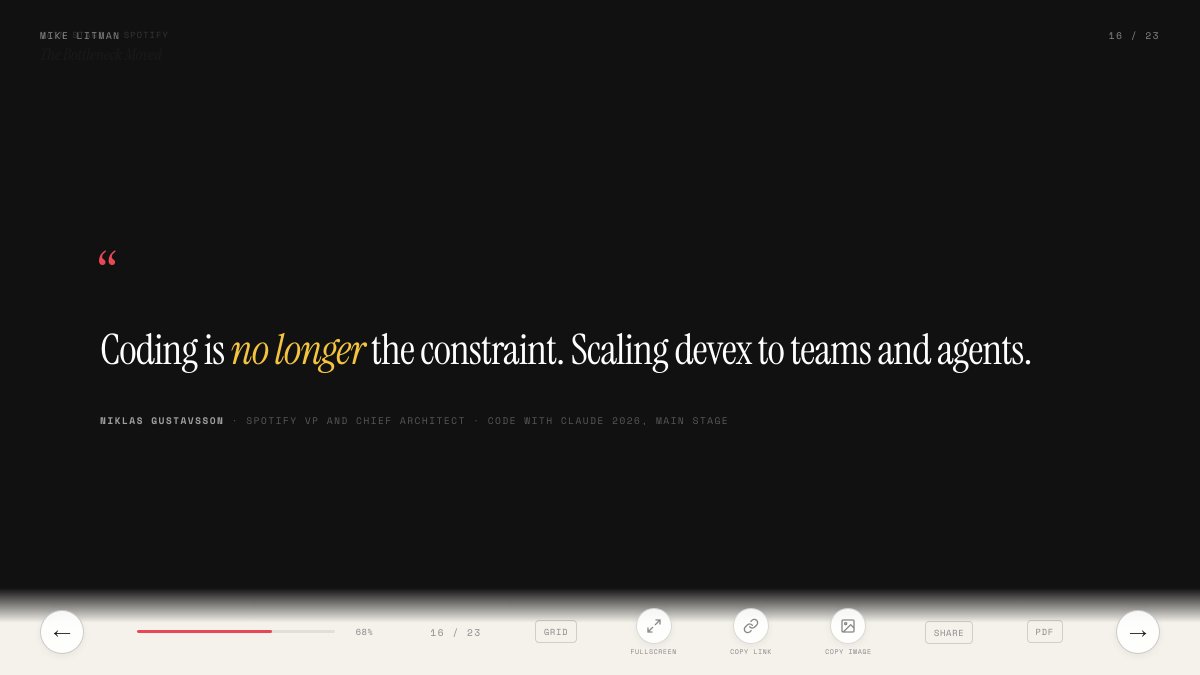
From @protocol7 on the @SpotifyEng main stage:
"Coding is no longer the constraint. Scaling devex to teams and agents."
The session title was the read. The constraint moved.
16/23
1
32
May 20
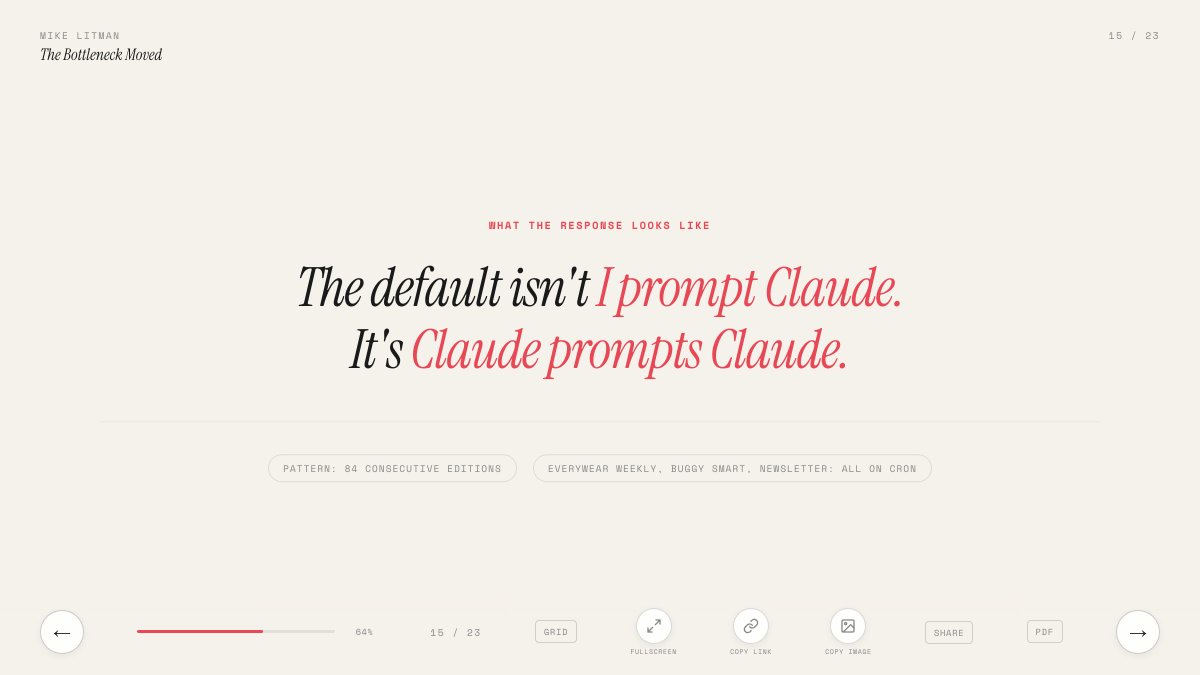
The default isn't "I prompt Claude."
It's "Claude prompts Claude."
Routines, autofix, code review, dreaming, memory. Synchronous coding is now a slice.
15/23
1
65
May 20
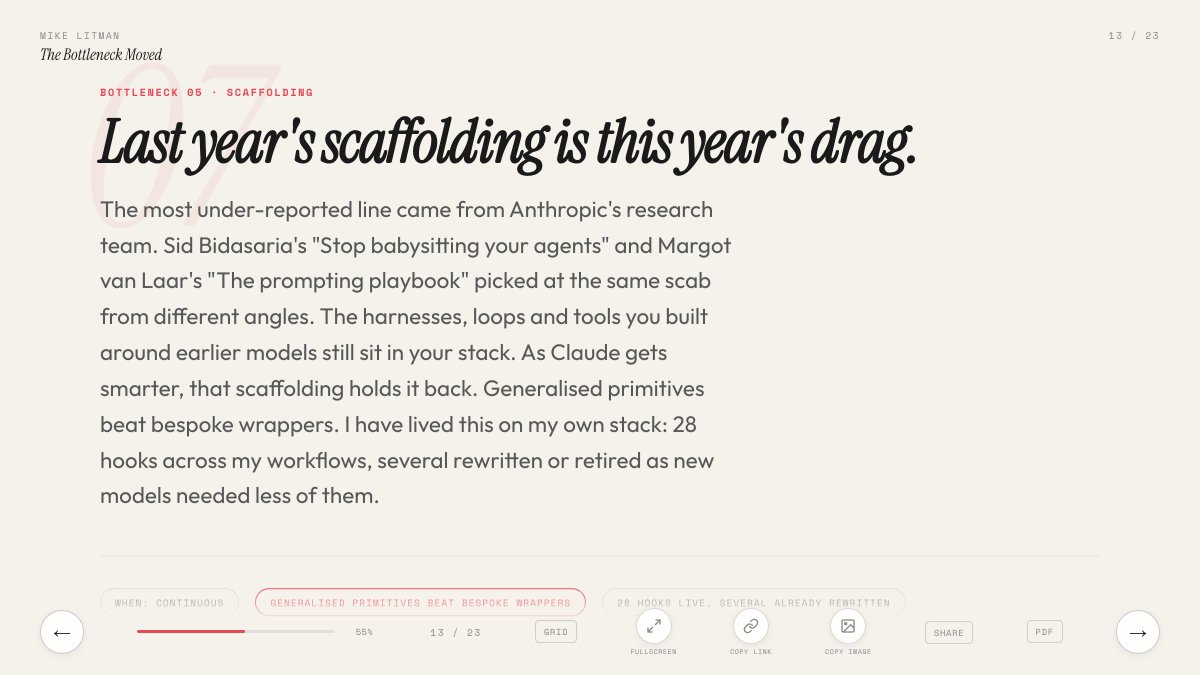
Bottleneck 05: Scaffolding readiness. Continuous.
Sid Bidasaria's "Stop babysitting your agents" Margot van Laar's "The prompting playbook" picked at the same scab from different angles.
The harnesses, loops, instructions you built around earlier models are still in your stack. As Claude gets smarter, that scaffolding holds it back. Generalised primitives beat bespoke wrappers.
I have 28 hooks across my own workflows; several already rewritten or retired as new models needed less of them.
14/23
1
14
May 20
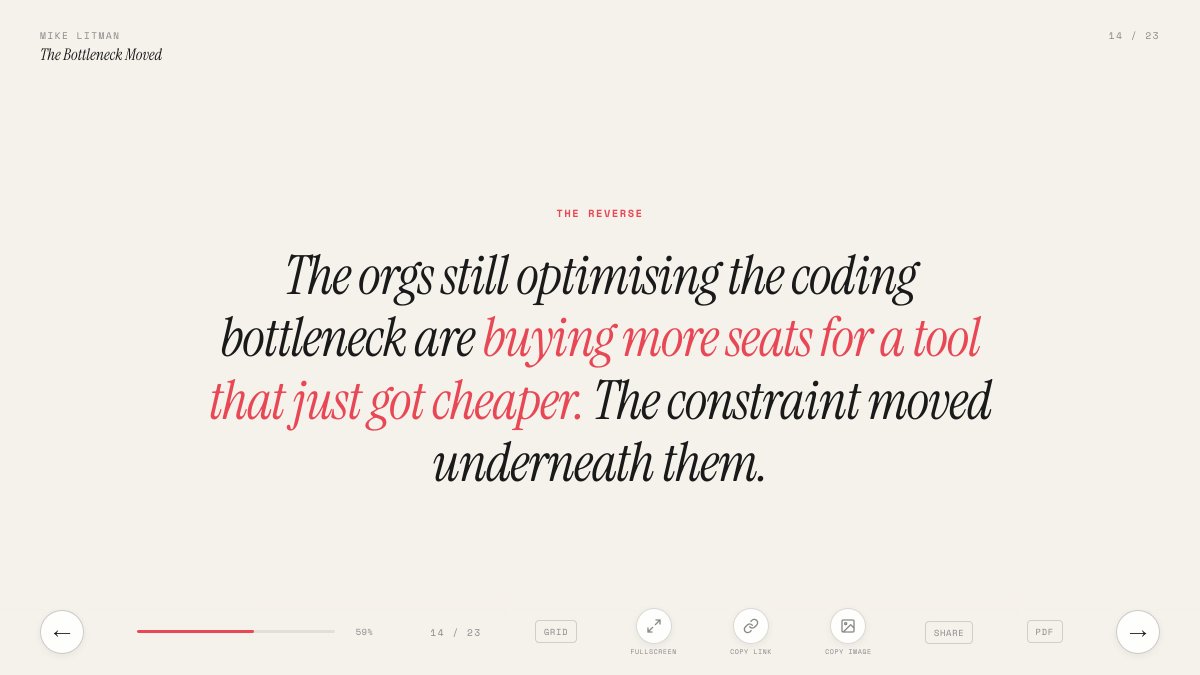
The reverse.
The orgs still optimising the coding bottleneck are buying more seats for a tool that just got cheaper.
The constraint moved underneath them.
13/23
1
11
May 20
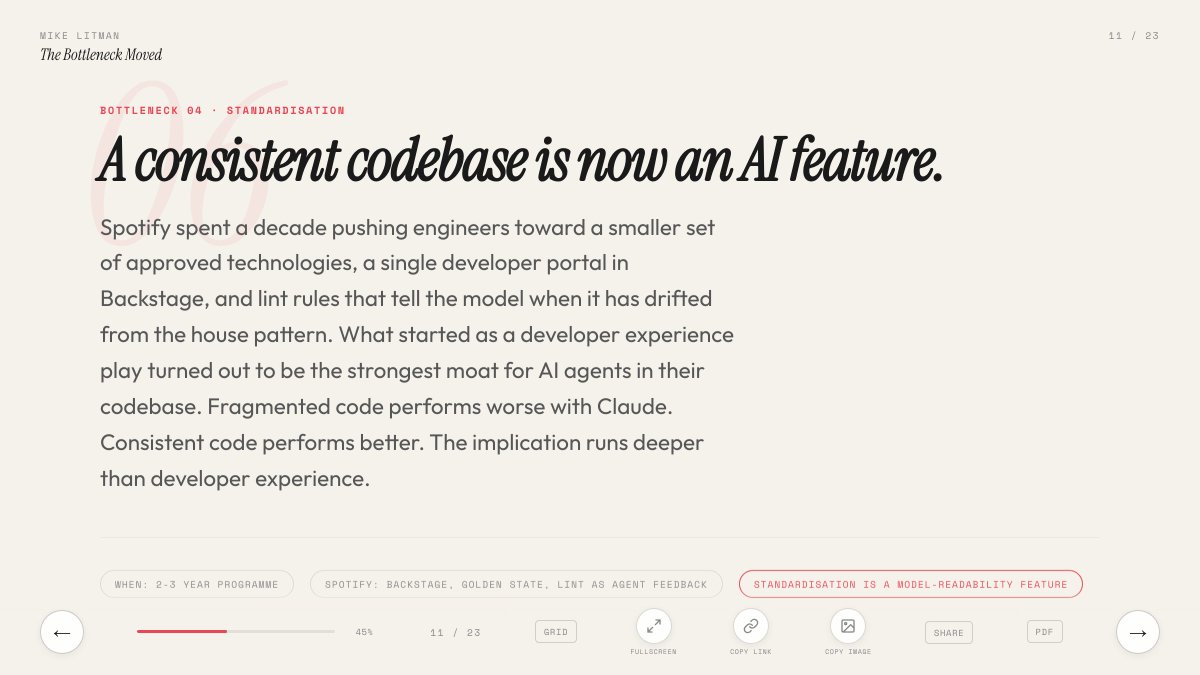
Bottleneck 04: Standardisation. 2-3 year programme.
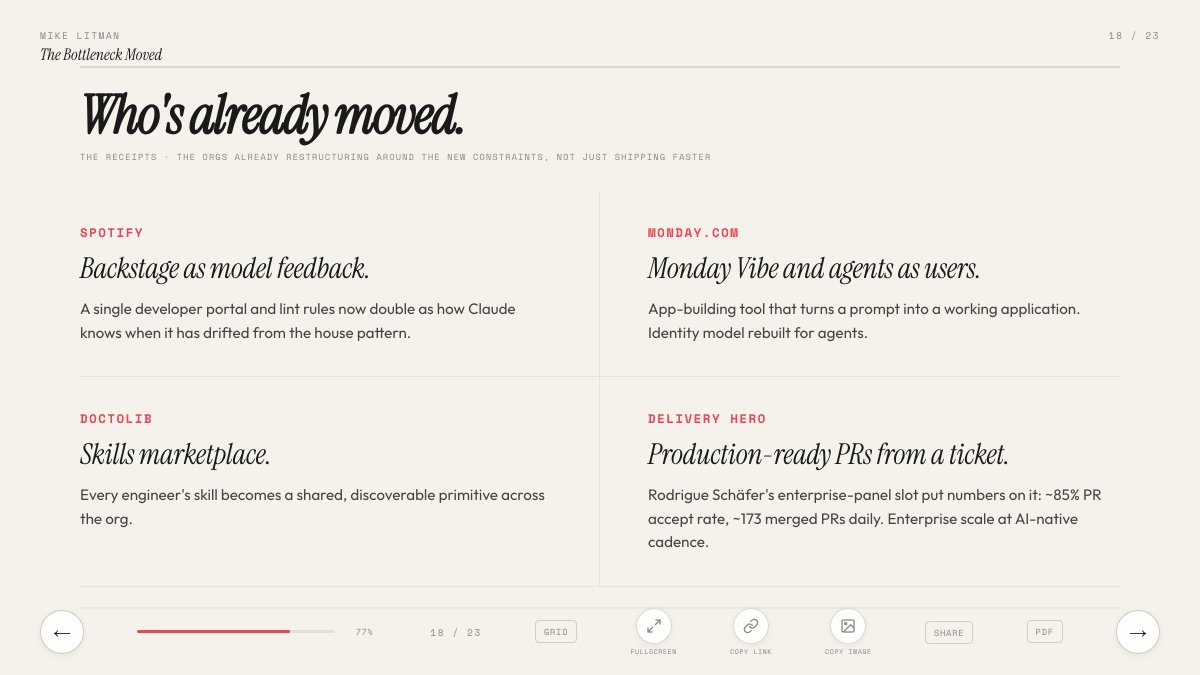
@SpotifyEng spent a decade pushing engineers onto a smaller set of approved technologies.
What started as a developer experience play turned out to be the strongest moat for AI agents in their codebase.
11/23
1
32
May 20
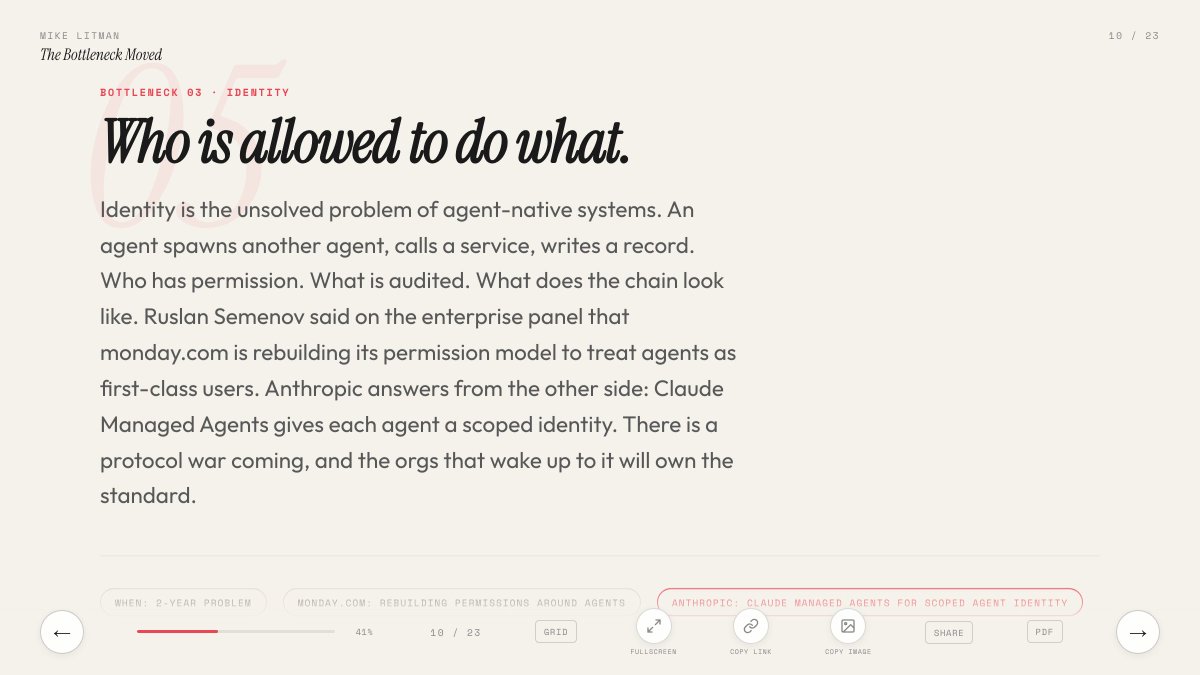
Bottleneck 03: Identity. 2-year problem.
Identity is the unsolved problem of agent-native systems. Agent calls agent calls service writes a record. Who's allowed to do what.
@mondaydotcom is rebuilding its permission model for agents-as-users. Anthropic answers from the other side with Claude Managed Agents.
10/23
1
24
May 20
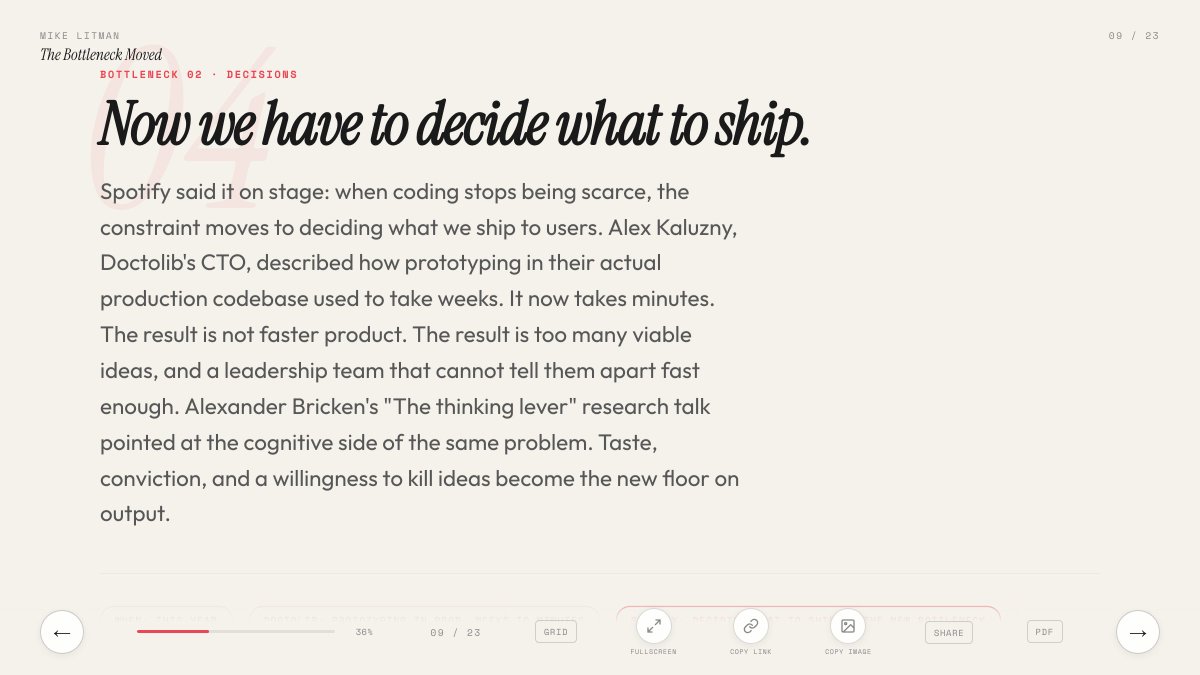
Bottleneck 02: Decisions. This year.
Alex Kaluzny (@doctolib CTO): prototyping features in actual production codebase. Weeks to minutes.
Result is not faster product. Too many viable ideas, leadership can't tell them apart fast enough. @ambricken "The thinking lever" research talk pointed at the cognitive side.
Taste becomes the floor.
9/23
1
24
May 20
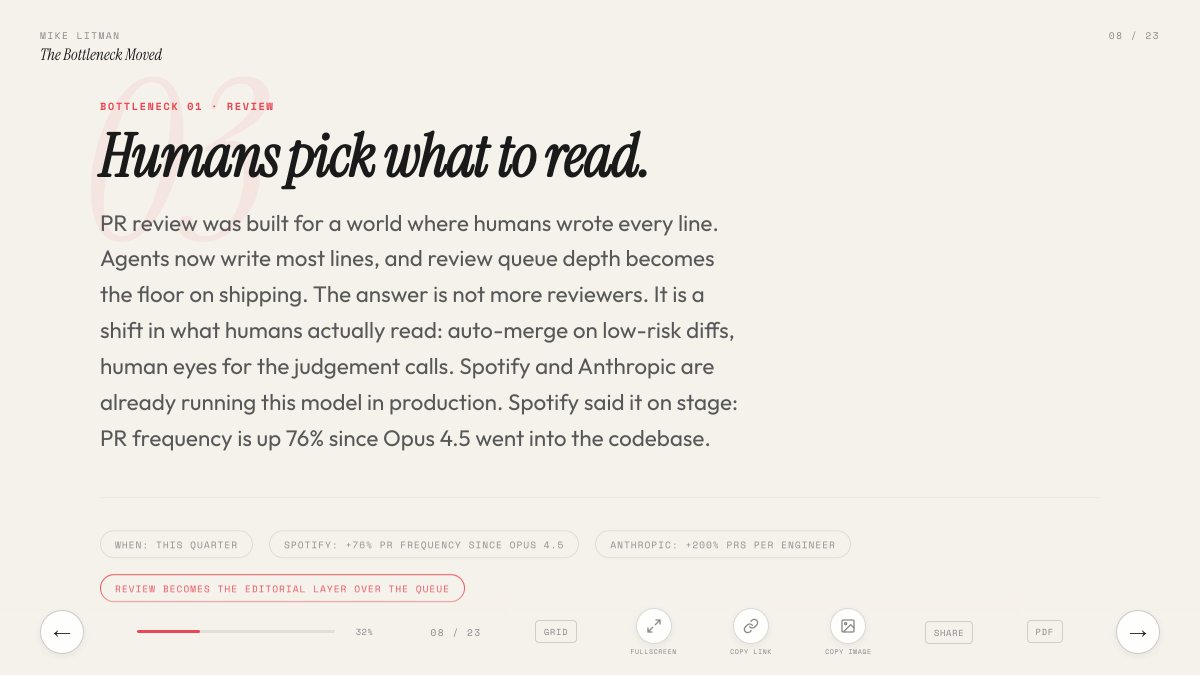
Bottleneck 01: Review. This quarter.
Old model: a human reads every diff.
New model: humans pick what to read.
With agents writing most lines, review queue depth becomes the floor on shipping.
@SpotifyEng and @AnthropicAI are already running this model: auto-merge low-risk diffs, humans on the judgement calls.
8/23
1
15
May 20
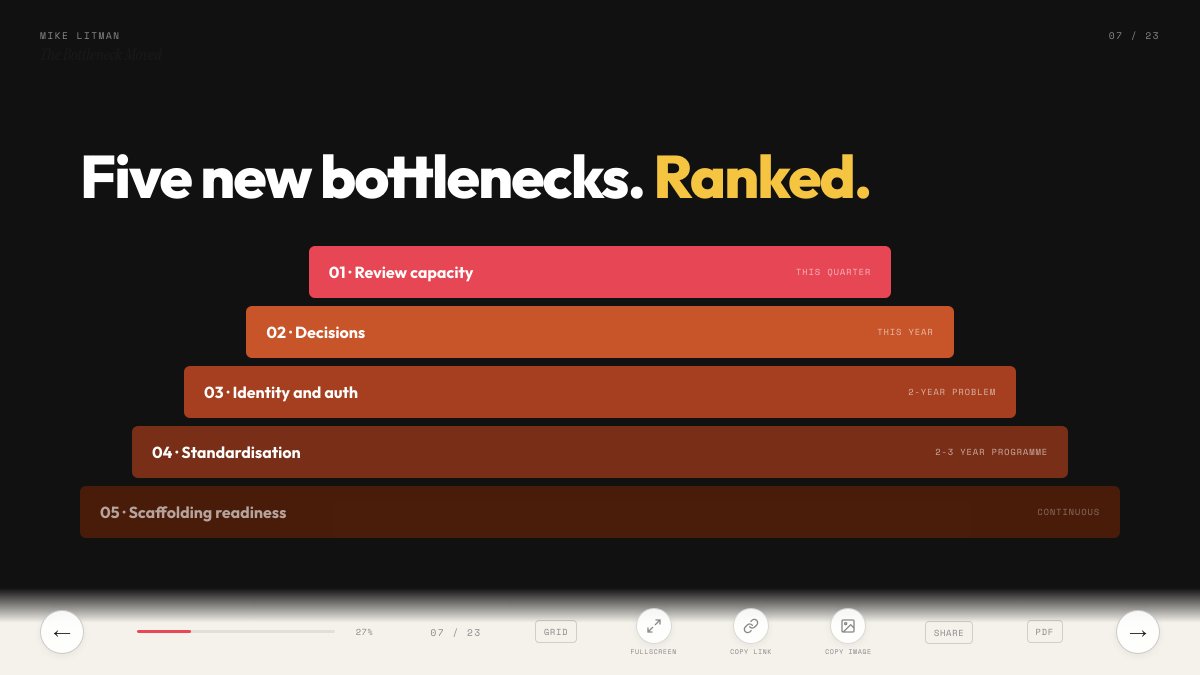
Five new bottlenecks.
Ranked by what bites first.
01 Review: this quarter
02 Decisions: this year
03 Identity: 2-year problem
04 Standardisation: 2-3 year programme
05 Scaffolding: continuous
7/23
1
11