
OCaml; Off-grid; Tesla (Y, 📐); Bayesian; Summarist
Joined April 2022
- Tweets 2,919
- Following 682
- Followers 923
- Likes 98,409
333 Photos and videos





May 31
how is kombucha not a big deal in the South? it's basically moonshine made of sweet tea
74
May 31
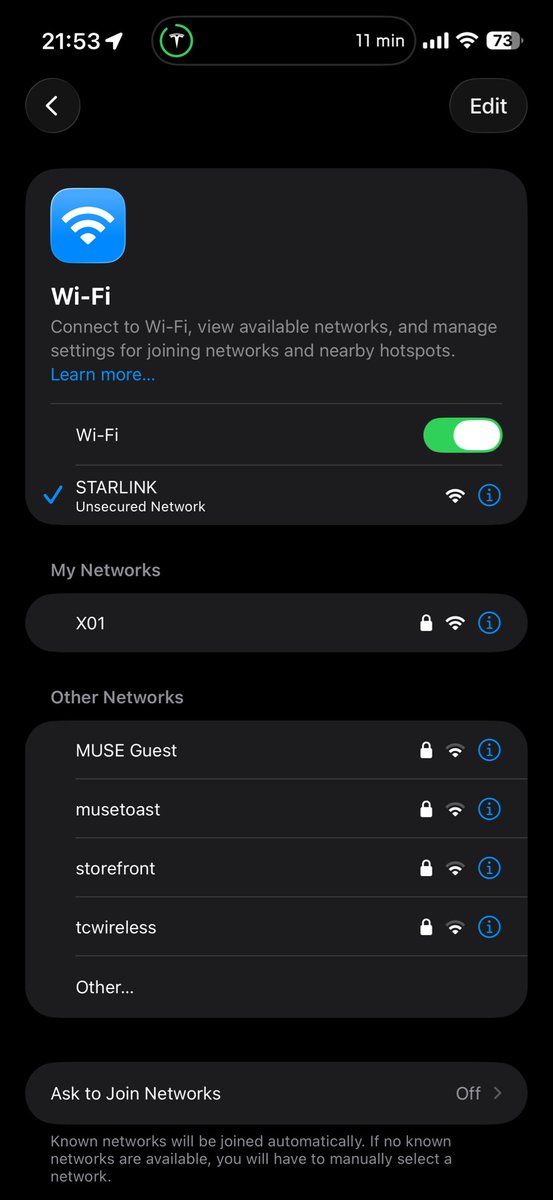
I assume that every Cybercab will have free Starlink wifi for passengers. that's a significant perk for long commutes
May 31

162
May 28
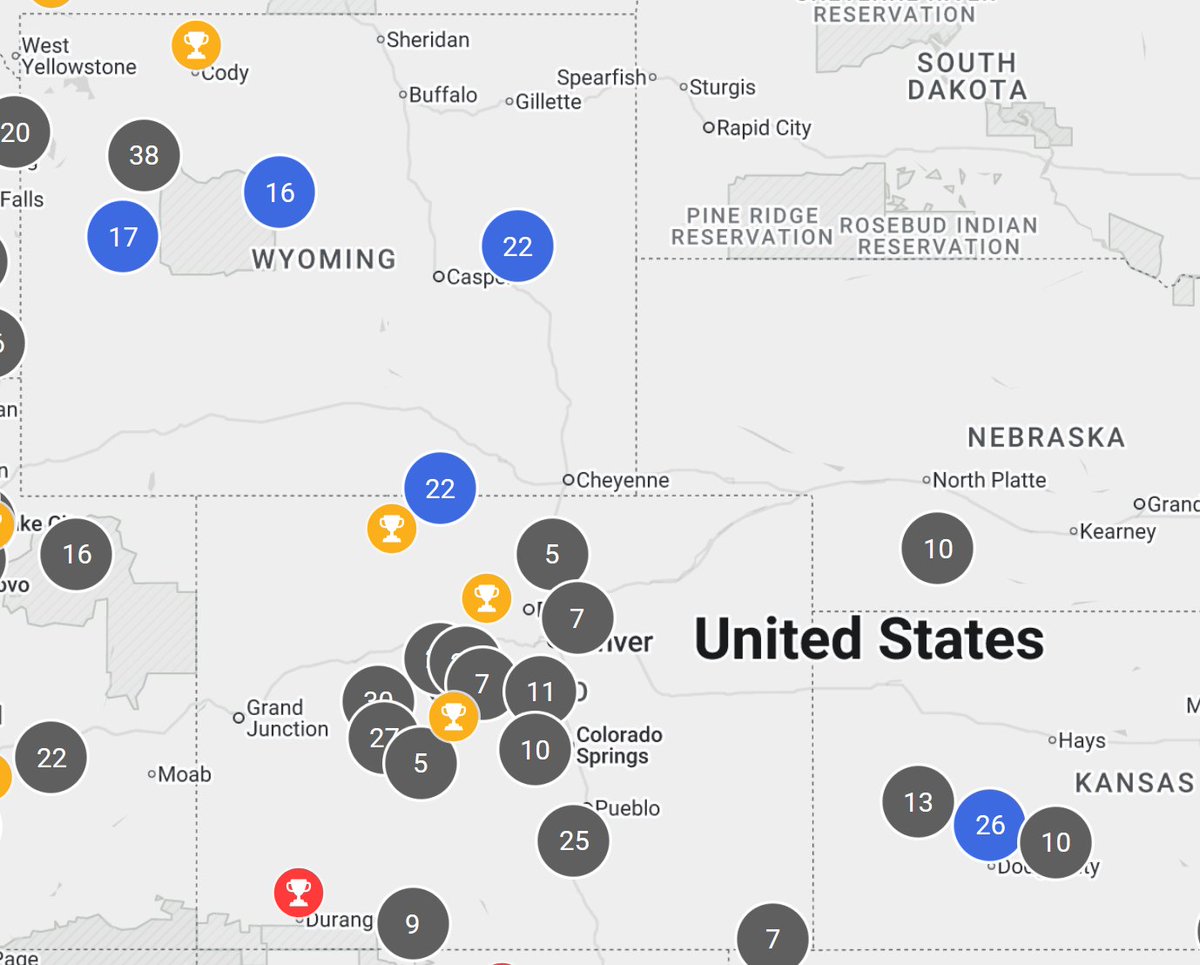
Starlink is great, but this is not remote. It's right on I-25 and 9 miles from Cheyenne. Remote is easy to find in Wyoming, but this isn't it

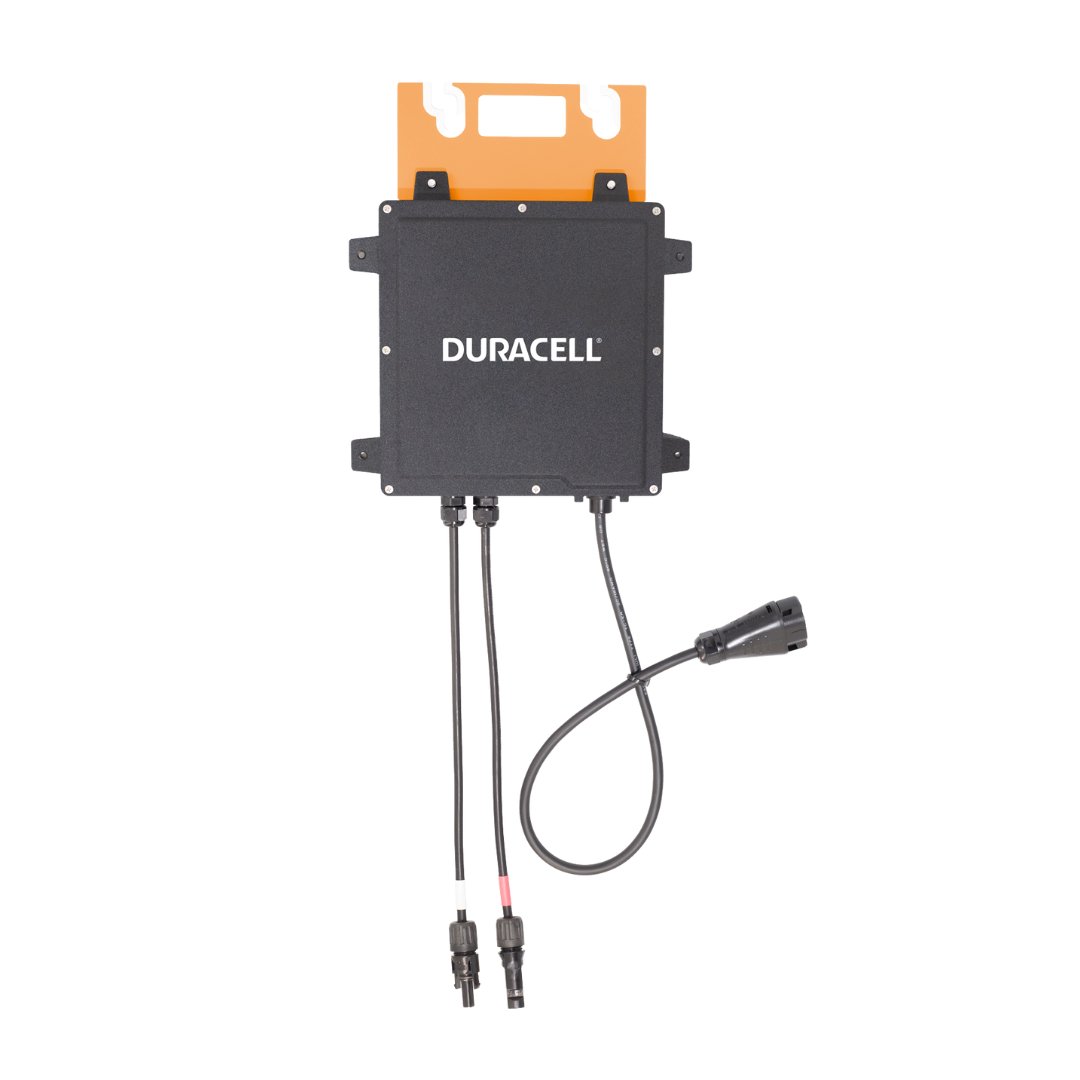
Starlink is providing reliable high-speed internet to the Terry Bison Ranch in remote Wyoming → starlink.com/stories-wyoming
1
107
May 28
14.3.3 on Cybertruck gave FSD's best performance yet on my hairpin turn test, but it's still bad at speed control on empty, rural roads. everything else in this version is solid like usual though
1
2
46
May 23
An ambulance appears behind me, FSD politely goes to the curb then resumes once the ambulance is past 🤌 oh, and the human driver at the very end runs his red light 😊
77

Watch Starship's twelfth flight test x.com/i/broadcasts/1YxNrZwwo…
1,519
6,474
29,251
6,008,956
Michael Hendricks retweeted

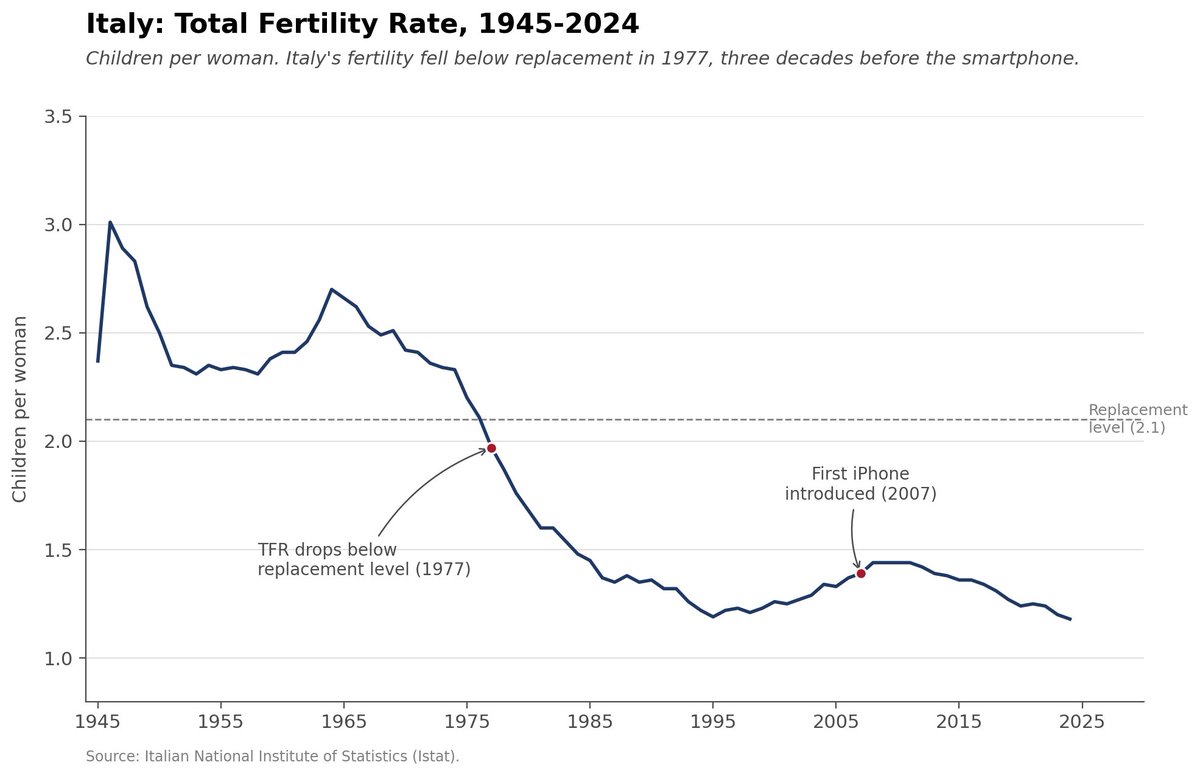
Smartphones are not the explanation for the recent decline in fertility. Instead, they are an accelerator of deeper forces already at work.
Let’s start with the facts. Fertility is falling almost everywhere: in rich, middle-income, and poor countries; in secular and religious countries; and in countries with high and low levels of gender equality.
The decline accelerated around 2014. So, no country-specific explanation will work unless you are willing to believe that 200 distinct country-specific explanations arrived at roughly the same time.
Smartphones look like the obvious candidate: the first iPhone was released in 2007, and global adoption has been astonishingly fast.
Economists understand the first major decline in fertility in advanced economies, from 6 or 7 children per woman throughout most of human history to about 1.8, that occurred between the early 1800s and roughly 1970, well before smartphones. The main drivers were a sharp fall in child mortality (effective fertility was rarely above 3 and often close to 2) and the shift from a low-skill, rural agrarian economy to a high-skill, urban industrial one. We have quantitative models that fit these facts well.
Country-specific factors mattered too, of course. Proximity to low-fertility neighbors accelerated Hungary’s decline, while fragmented landowning structures accelerated France’s. But these were second-order mechanisms.
This is also why most economists long considered Paul Ehrlich’s doom scenarios implausible. We forecast that fertility in middle- and low-income economies would follow the same path as in the rich, probably faster, because reductions in child mortality reached India or Africa at lower income levels (medical technology is nearly universal, and most gains come from handwashing and cheap antibiotics, not Mayo Clinic-level care). Much of what we see in Africa or parts of Latin America today is still that old story.
But in the 1980s, a new pattern appeared. Japan and Italy fell below 1.8, the level we had thought was the new floor. By 1990, Japan was at 1.54 and Italy at 1.36.
This second fertility decline began in Japan and Italy earlier than elsewhere, driven by country-specific factors, but the underlying dynamics were widespread: secularization, an education arms race, expensive housing, the dissolution of old social networks, and the shift to a service economy in which women’s bargaining power within the household is higher. The U.S. lagged because secularization came later, suburban housing remained relatively cheap, and African American fertility was still high. U.S. demographic patterns are exceptional and skew how academics (most of whom are in the U.S.) and the New York Times see the world.
My best guess is that, without smartphones, Italy’s 2025 fertility rate would be about 1.24 rather than 1.14. I doubt anyone will document an effect larger than 0.1-0.2. Italy was at 1.19 in 1995, not far from today’s 1.14. The TFR is cyclical due to tempo effects, so I do not read too much into the rise between 1995 and 2007 or the decline from 1.27 in 2019 to 1.14 today. The direct effect of smartphones is not zero, but it is not, by itself, that large.
Where social media, in general, and smartphones, in particular, matter is in the diffusion of social norms. What would have taken 25 years now happens in 10. Social media are not the cause of fertility decline; modernity is. But they are a very fast accelerator.
That is why social media are a major part of the story behind Guatemala (yes, Guatemala) going from 3.8 children per woman in 2005 to 1.9 in 2025. Without them, Guatemala would also have reached 1.9, just 20 years later.
Modernity, in its current form, is incompatible with replacement-level fertility. By modernity, I do not mean capitalism: fertility fell earlier and faster in socialist economies than in market economies. Socialist Hungary fell below replacement in 1960, and socialist Czechoslovakia in 1966 (both experienced small, short-lived baby booms in the mid-1970s). By modernity, I mean a society organized around rational, large-scale systems and formalized knowledge.
Countries will not converge to the same fertility rate. East Asia is likely stuck near 1, possibly below, given its unbalanced gender norms and toxic education systems. Latin America faces the same gender problem plus weak growth prospects, so I expect something around 1.2. Northern Europe has more egalitarian family structures and might hold near 1.5. The very religious societies are probably the only ones that will sustain 1.8.
All of this could change with AI or changes in population composition. We will see. But on the current evidence, deep sub-replacement fertility is the “new new normal.” Unless we reorganize our societies, better learn to handle it as best we can.
224
918
3,712
901,102

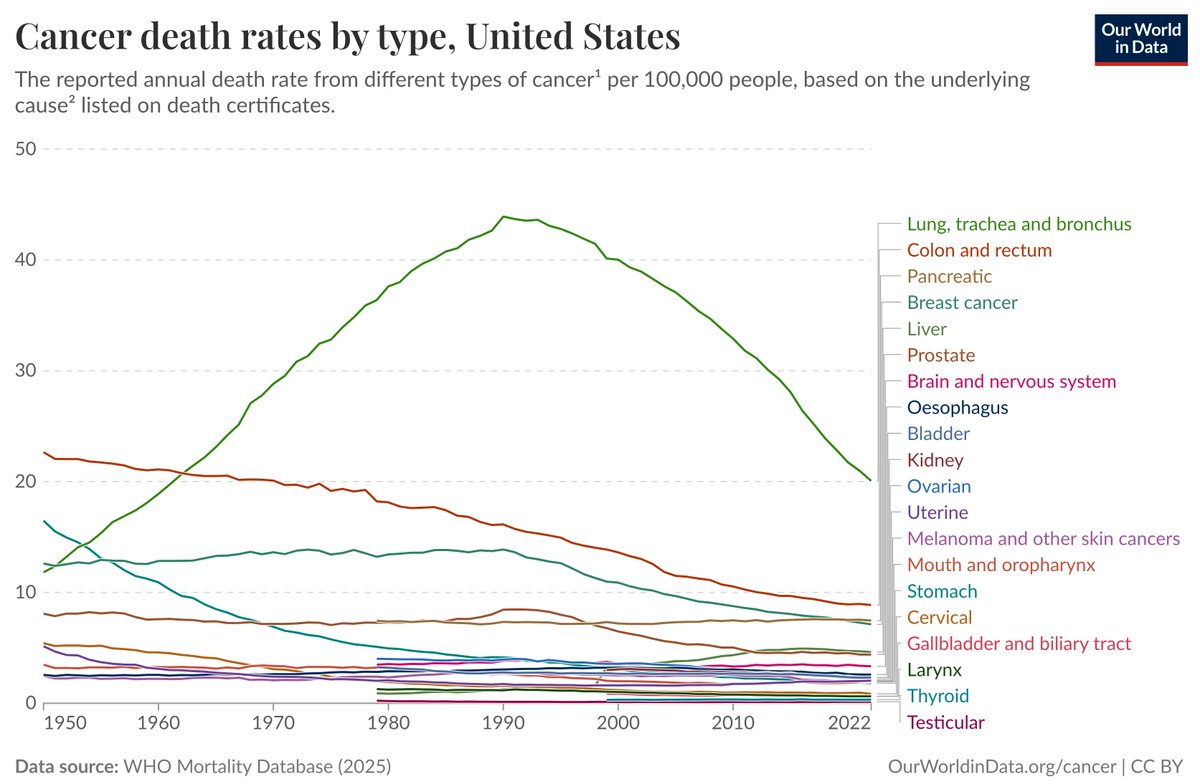
9x. That's how far stomach cancer death rates fell in the US between 1950 and 2021.
Not because of some wonder drug. Because of refrigerators.
When families stopped preserving food with salt and smoke, H. pylori infections dropped. Stomach cancer followed. A kitchen appliance rewrote the trajectory of one of the deadliest cancers of the 20th century.
Now look at pancreatic cancer on the same chart. Flat line. Seven decades of research, and the death rate barely moved. 86% of cases are caught after the tumor has already spread. By the time you have symptoms, you're late.
Lung cancer tells a third story: it rose for 50 years as cigarettes spread, peaked, and is now falling thanks to smoking bans, LDCT screening, and immunotherapy.
"Cancer" isn't one disease. This chart shows at least a dozen, each with its own biology, its own timeline, and its own reckoning.
The age-standardized death rate across all cancers has dropped by a third since 1990. But that number hides everything interesting. Some cancers are nearly solved. Others haven't moved in a lifetime.
Your risk depends on which one you get, not just whether you get it.
17
99
393
60,948
Michael Hendricks retweeted

May 9
Every one of these dots is an actual crash from the fleet. Real world speeds, collisions, and people. Not just the regulatory test cases.
The richness of this data is what enabled the result. With simulation we can replay the crashes and measure the forces on the human body model.
Then sweep through restraint deployment times to find that deploying earlier gives the time for the bag to be inflated optimally and seat belt pretension before the occupant has moved out of position.
But it takes time for crash accelerometers to be certain. Lowering that time threshold risks unwanted deployments.
Using vision gives the vehicle confidence to reduce that timing. The camera sees the impending impact and together with the sensors tell the restraint controller to reduce the filter and act sooner.
The Y Axis shift in Predicted Injury Severity is based on sensors in the human body models from rerunning the crash simulations with the faster detection threshold.
Such a reduction in injury severity across the spectrum is unheard of, let alone doing this via an update over the air.
I'm extremely proud of the analysis team's work and dedication. Going above and beyond to ask "we have the safest car on the road but can we make it even safer?" And then working with the vision team to build the predictions needed to make it happen. Rigorously tested in simulation and then in physical crash testing. Now deployed and improving lives.
I watch the video on loop and just imagine each dot, a person.

Tesla Vision allows us to deploy airbags up to 70 milliseconds earlier if your Tesla detects an unavoidable collision
This can be the difference between serious injury & walking away from a crash
388
812
6,159
16,084,226
May 3
FSD 14.3.2 is much better with turn signals. 14.2.2.5 used to indicate so early that it would confuse traffic. In the last few days, I haven't seen 14.3.2 do that once. A solid improvement.
1
3
125
May 1
my car drives me to town while a remote Claude session adds features to my app while robots mop my floor and mow my backyard. we're living in the future and it's grand
4
81
Apr 30
when the marginal cost of production is low (Starlink, FSD, AI), the profit maximizing price tends to be very low
Apr 30

STARLINK: Media outlets are reporting that Starlink’s average revenue per user (ARPU) fell 18% to $81 per month between 2023 and 2025.
It did, but there is a reason for that. The company quadrupled its individual subscriber base in that same period. This allowed SpaceX to roll out lower-priced subscription plans and expand into international markets with cheaper rates.
This growth strategy boosted total subscribers and overall revenue, which in turn allowed Starlink to reduce prices.
Normal business practice once scaling to generate more cash flow.
More STARLINK news in the ELON CHRON below!

103

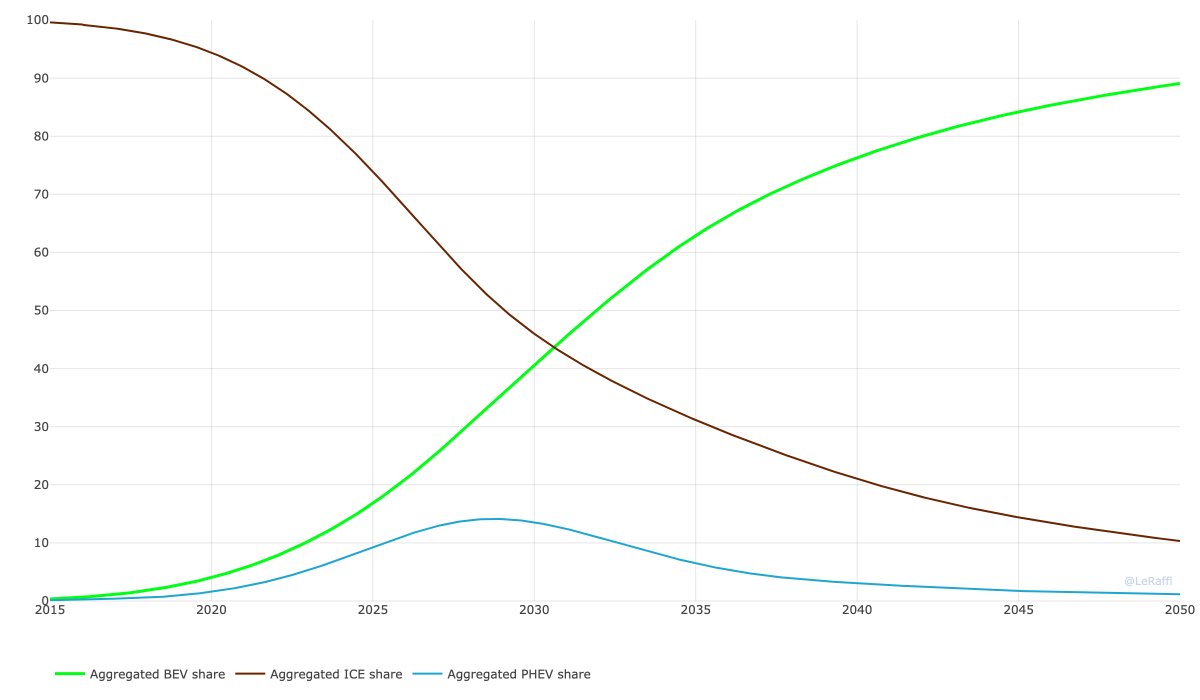
Global BEV Trend
September 2030 currently seems like the point in time when BEV will overtake ICE (incl. HEV) globally.
This is after the PHEV peak that right now seems like it will happen in 2028 at around 14%.
leraffl.github.io/LeRaffl-Ga…
4
34
141
10,854
Apr 29
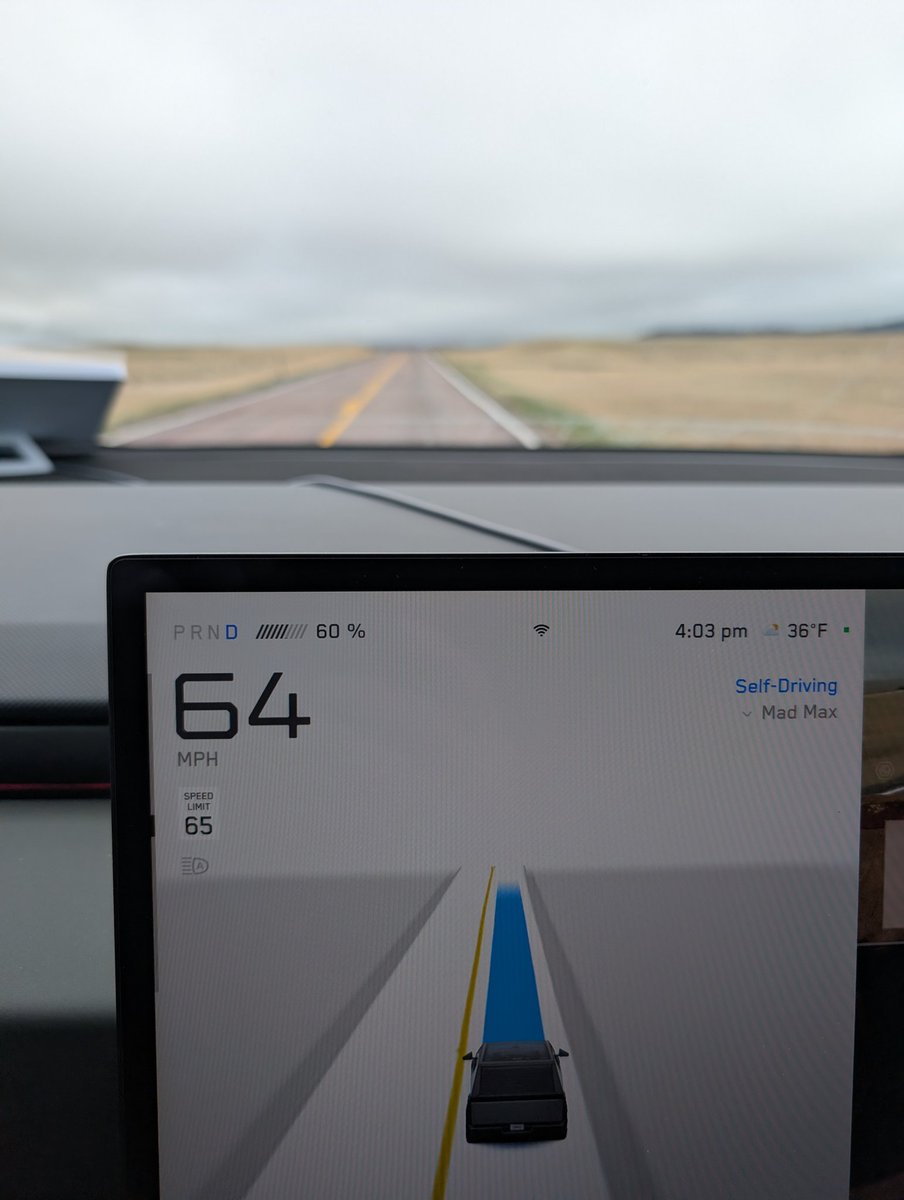
tesla really needs to figure out FSD v14 speed management on rural highways. HW4 friends keep telling me that they turn it off entirely for those trips. HW3 people fix it with the max speed setting. FSD should never be worse than autopilot
1
67
Apr 24
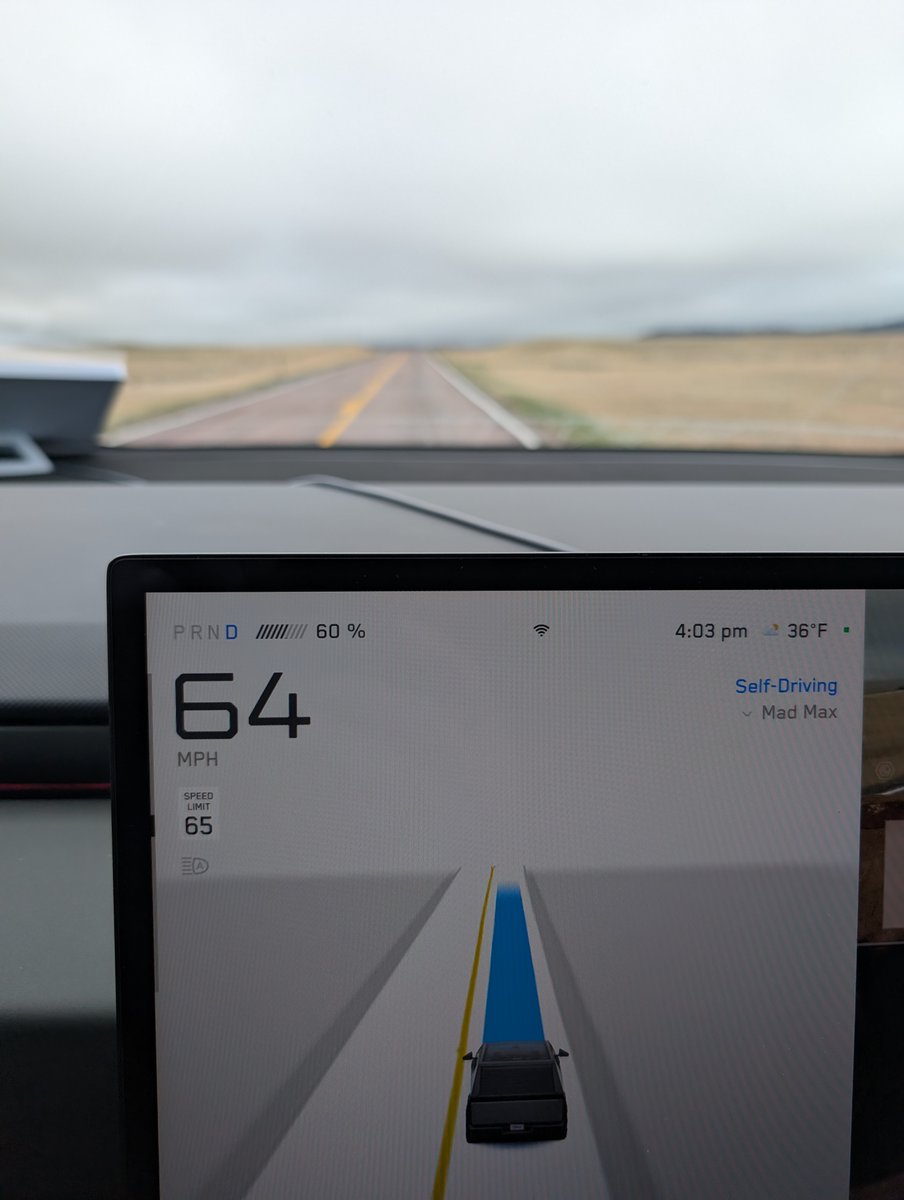
for example. mad max doing 64 in a 65 with nothing but straight, empty road as far as it can see
Apr 24

FSD 14.3.2 on Cybertruck needs some polish. 5 mph under the limit on all profiles on a dry, vacant, straight, rural road for the last 90 minutes. Had to juice the throttle every minute to maintain 65 mph. Didn't react to 30 mph sign heading into town. Too slow on gravel roads
1
191
Apr 24
also, the new disengagement screen needs work. the inability to dismiss it is unfortunate since i always leave a voice memo. the options should be: navigation, speed, critical, and other. "preference" is too vague to be useful.
Apr 24
FSD 14.3.2 on Cybertruck needs some polish. 5 mph under the limit on all profiles on a dry, vacant, straight, rural road for the last 90 minutes. Had to juice the throttle every minute to maintain 65 mph. Didn't react to 30 mph sign heading into town. Too slow on gravel roads
71
Apr 24
FSD 14.3.2 on Cybertruck needs some polish. 5 mph under the limit on all profiles on a dry, vacant, straight, rural road for the last 90 minutes. Had to juice the throttle every minute to maintain 65 mph. Didn't react to 30 mph sign heading into town. Too slow on gravel roads
1
421
Apr 23
unlike other areas of technology, Tesla has shown very low risk tolerance for robotaxi. given human psychology around this stuff, it's probably wise, but a bit sad too
Apr 22

Elon Musk on Unsupervised FSD:
"The question is — degrees of safety. Safety and convenience I suppose. We have a lot of known improvements that we know that would improve the probability of safety significantly, so I think it’s going to make sense to deploy Unsupervsied FSD and Robotaxi at large scale when we know that there is major architectural improvements to the software that can improve safety.
It’s not going to make sense to deploy Unsupervised FSD or Robotaxi when we know that there are major architectural improvements to the software that can improve safety."
74