
Associate Professor of Religion; PhD Islamic Studies @Harvard | Quranic Studies | Islamic Intellectual History: Kalam, Islamic Neoplatonism | Ismailism | CA-CPA
Joined February 2017
- Tweets 21,887
- Following 7,334
- Followers 23,274
- Likes 7,411
1,245 Photos and videos




Khalil Andani, PhD retweeted

10h
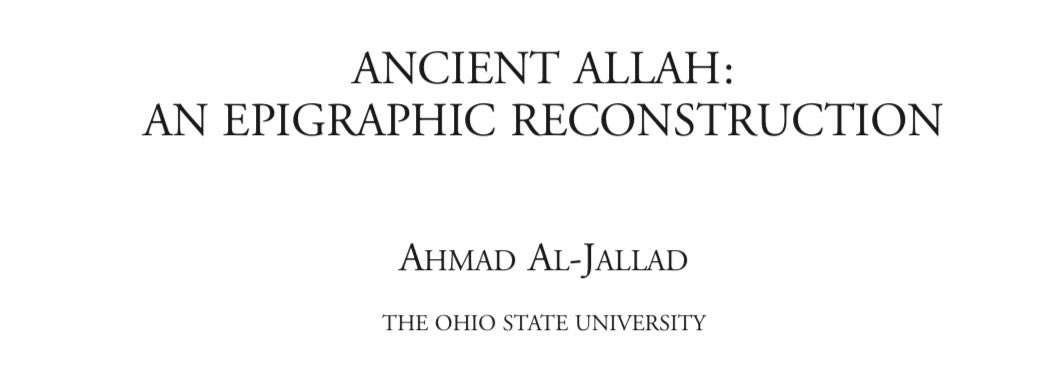
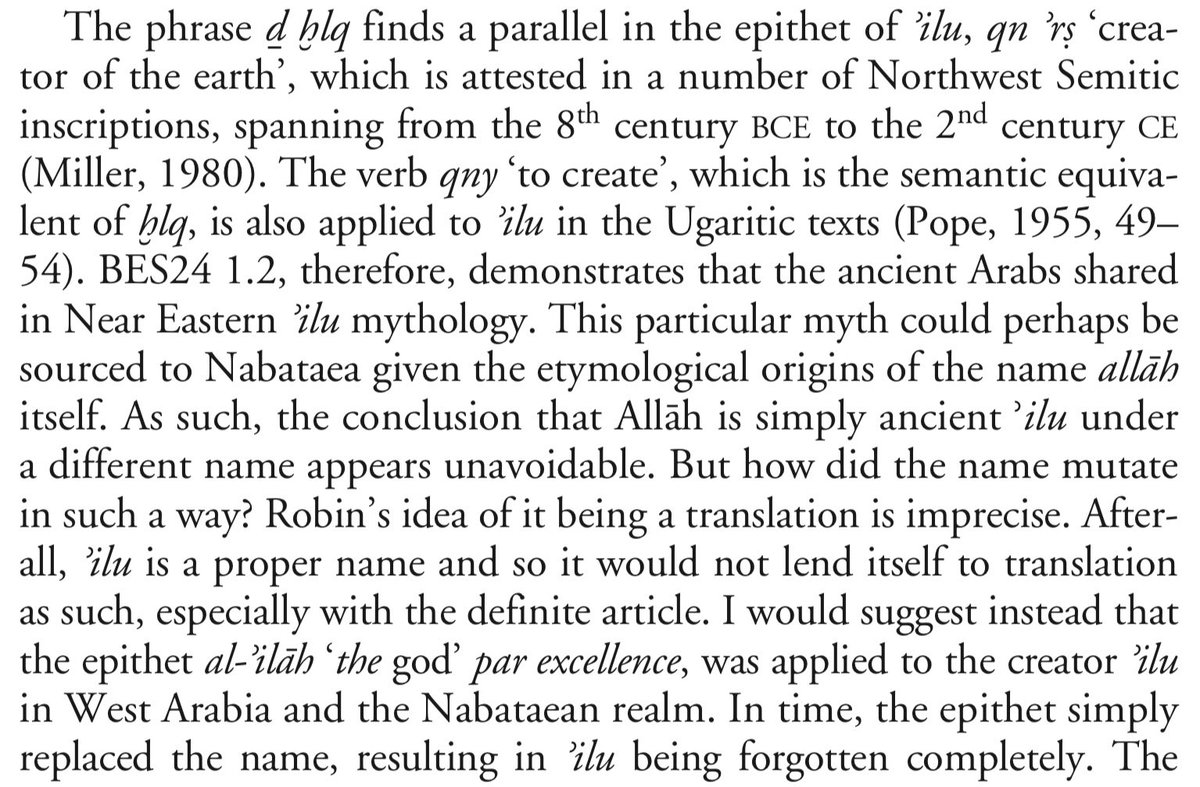
Allah, as the High God of the Meccan pantheon, was none other than El, the God of Abraham. As Jallad has demonstrated, the name Allah derives from ‘ilu, itself a cognate of the broader Semitic El, the very deity venerated by the patriarchs of the Abrahamic tradition.
2
19
88
4,154

Jun 10
Let us round up and consolidate your hydra of heresies into one rebuttal @muslimorthodoxy:
PS. I wrote this myself, not with AI. You confuse my posts with AI because I am a professional author and I was writing essay-length Facebook comments before you knew how to use a computer.
My main argument is that your Salafi Deity is a contingent being - both ontologically (where contingency = dependence) and modally (modern analytic possible worlds framework). Here is why:
1. Contingent Dimensional Limits: Your deity is spatial and can be pointed at. Since space is 3 dimensional with 6 directions, God being spatial means God is spatially extended (as @jhoover04 has rightly observed). This logically entails that your deity is a 3-dimesional entity (a body even though you won't admit that). This already is a problem because a 3D deity is arbitrarily limited in having 3 dimensions as to any other number. Therefore, your deity is modally contingent in His dimensionality. Furthermore, there must be an external cause or specifier that makes your deity 3 dimension as opposed to another number. This means your deity is dependent and ontologically contingent.
2. Contingent Spatial Boundaries: You already conceded that your deity has boundary conditions (hadd) in the upward and downward directions. That means your deity has a finite spatial extent in terms of the up-down axis. That is an arbitrary limit and means your God is modally contingent. Your reply to this was -- the lower boundary of your God is just relational to the existence of creatures - because creaturely existence spatially begins when your God's downward extension ends. That does not solve the issue -- rather, it means that your God arbitrarily limited Himself in the downward direction when he created the Throne below him. You have not replied to my claim that your God's spatial extent is a finite number and it is logically possible for that number to be different - thereby making His extent and boundaries an arbitrarily limit and rendering your God modally contingent. Again, there must be an external specifier for your God's finite spatial extent on the up-down axis. That makes your God dependent as well.
3. Composition: You already admitted your God has parts - Hands, Feet, Eyes, Fingers, etc. Your claim that God is spatial entails that His parts are also spatial and non-overlapping. This means your deity is like Megazord - he is literally composed and comprised of other entities that are ontologically discernable and distinct from the whole of God and from each other. How is this NOT composition? Once you conceded the existence of real and ontologically distinct parts within your deity, you brought the problem on yourself that your God is DEPENDENT upon these spatially and ontologically distinct items that comprise Him. This is NOT aseity; aseity means "from one-self". There is no such thing as "external aseity" or "internal aseity" - you sound like a Social Trinitarian like Chad McIntosh when you claim such a thing.
In your account, each part of God is NOT identical to God and spatially "lesser" than God. So your God is literally NOT "from one-self" (a se); your God is derived from genuine "others", i.e. spatially and ontologically distinct parts or constituents. The only other move you can make here is to say -- no, the parts of God - His Hands/Feet/Eyes/Fingers - are distinct from God and dependent upon God to exist. This would not help you because it would mean God considered without His dependent parts IS simple and His so-called parts are just emanations or creations of the simple God. So once you assert God has ontologically and spatially distinct parts and once you claim God is independent (a se), you have to disclose whether God depends upon His parts (contradiction) or whether the parts of God depend upon God (which negates them being parts and affirms God being simple). So which one is it? And if you say they are ontologically co-dependent, then this is a vicious circular dependence in which there is no real a se reality at all and everything is interdependent. Sounds like you should become a Buddhist if you hold to that.
4. You accepted brute facts. Big problem here. If you have brute facts in the creation, then God cannot be the cause or explanation of such brute facts - they are unexplained and uncaused and this is polytheism. If you claim God is still the causal explanation of the brute facts, then you have brute facts internal to God. This would like, inter alia:
a) God's contingent intention to create this particular creation must differ across possible worlds - this is rendered a brute contingent because you reject necessitarianism and nothing in God necessitates the contingent choice of His will;
b) God's foreknowledge of the brute contingent or libertarian choices that creatures make - this will be a contingent brute fact inside God;
c) God's foreknowledge of God's contingent choices - since the divine choices differ across possible worlds, God's knowledge of His choices will be contingent and brute.
The upshot of the above is that your God contains brutely contingent will and brutely contingent knowledge. This makes your God a brutely contingent being.
5. Just one of the above problems with your theology seriously weakens your credibility and effectiveness in debating Christians and atheists. Here is why:
- You can no longer attack Monarchic Trinitarian views of the Son being eternally dependent on the Father since your God is dependent upon His internal parts and technically lacks aseity and is, at best, as a se as the Son of God.
- You cannot refute Social Trinitarians like Chad McIntosh or WL Craig @RFupdates because their Social Trinity in which the 3 divine persons are inseparable parts of the whole of God is ontologically on par with your God who has multiple parts lesser than the whole. In fact, Social Trinitarians are better than you because their God is not spatially located and 3 dimensional and made up of spatial parts whereas your God is spatially composed.
- You cannot against the atheist or pantheist or monist who says the material Universe is a necessary being and self-sufficient. You can no longer just assert that the Universe has contingent parts, spatial boundaries, and be done with it. Your God ALSO has contingent features that are arbitrarily limited spatial dimensions and boundaries and you have no explanation for these. You cannot even appeal to the temporality of the Cosmos as proof of its contingency since your deity is temporal and changing within time and space. You cannot use to KCA because your God is perpetually creating the Universe.
- You cannot argue the contingency argument anymore (the modal version or the medieval Avicennian version) because your God has brute contingent features (His will, His knowledge) and your allow the Cosmos to have brute features.

Andani, stop using ChatGPT!
I said the universe is contingent because it’s made out of contingent constituents, that is that the constituents can fail to exist in another possible world!
Allah is modally necessary because he cannot fail to exist in any possible world!
😭🫵🏼
41
17
188
76,269
Jun 13
Followup: x.com/khalilandani/status/20…
Jun 13

I cannot blame you @muslimorthodoxy for no longer responding; you dig yourself deeper into incoherence with every response thus far. Now then, as a courtesy to everyone following this exchange, I will respond to your rather disorganized diatribe of a word salad:
1. You asked: "Why is it metaphysically incoherent for that “arbitrary limit” to be brute? How does that entail being “modally contingent”?
Answer: It is logically possible for God's essence to have more or less than 3 dimensions since denying His 3-dimensionality is not a contradiction. It is logically possible for the top-down size or length of your God's essence to be any finite number N. This means that both of these limits on God's essence are contingent - they could be another way. That is modal contingency.
As Dr. Rassmussen @worldviewdesign writes: "We can use this general reasoning to form an argument against positing arbitrary limits, such as in size, shape, powers, or in any other attribute that comes in various degrees" ("The Argument from Contingency", joshualrasmussen.com/article…)
These two contingent features [dimension and size] of your God 's essence require something outside of God's essence to set their values because they are arbitrary limits that could have been otherwise with different values. You cannot merely assert that these contingent limits of your deity are uncaused. That makes it a brute contingency. The atheist can easily take any feature of the Cosmos and assert them as uncaused and call it a day.
2. You Must Demonstrate the Necessity of God's Size and Limits: Later in your reply, you assert God's 3D-ness and His finite height as "brute necessities" not contingencies. Okay, then prove it to us!
Notwithstanding that necessities are never brute - they are either necessitated by other necessities or they are necessary in themselves - you now allege that God's finite dimensions and size are modally necessary, not contingent. The burden of proof is upon you to logically demonstrate that God is necessarily 3D and necessarily has a limited height - what is your logical argument for these features of God being necessary?
3. Absolute Divine Simplicity lacks any limits requiring an external specifier:
God in the belief of all other Muslims (Sunnis, Twelvers, Zaydis, Ismailis, Sufis) does not require any external simplifier because God is absolutely simple in Himself - meaning God has no external or internal boundaries - unlike your spatially limited deity who is internally and externally bounded. Since our God has no boundaries or hudud like your deity, there is no requirement to posit an external entity to cause God to be simple or non-complex.
4. Aseity is incompatible with proper parts
Your inane comment about aseity really exposes how much of an amateur you are at this. Aseity means that God is not dependent upon anything distinct from Himself. You are smuggling in the adjective "external", but even this will not help you here.
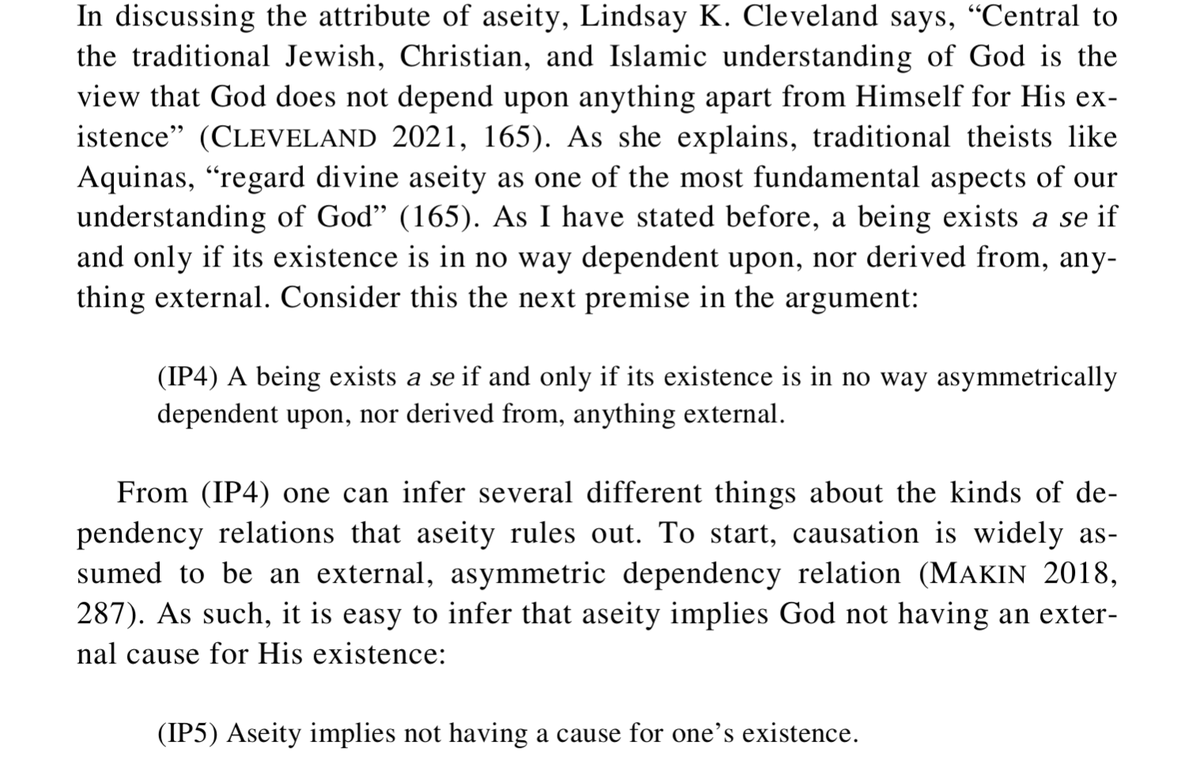
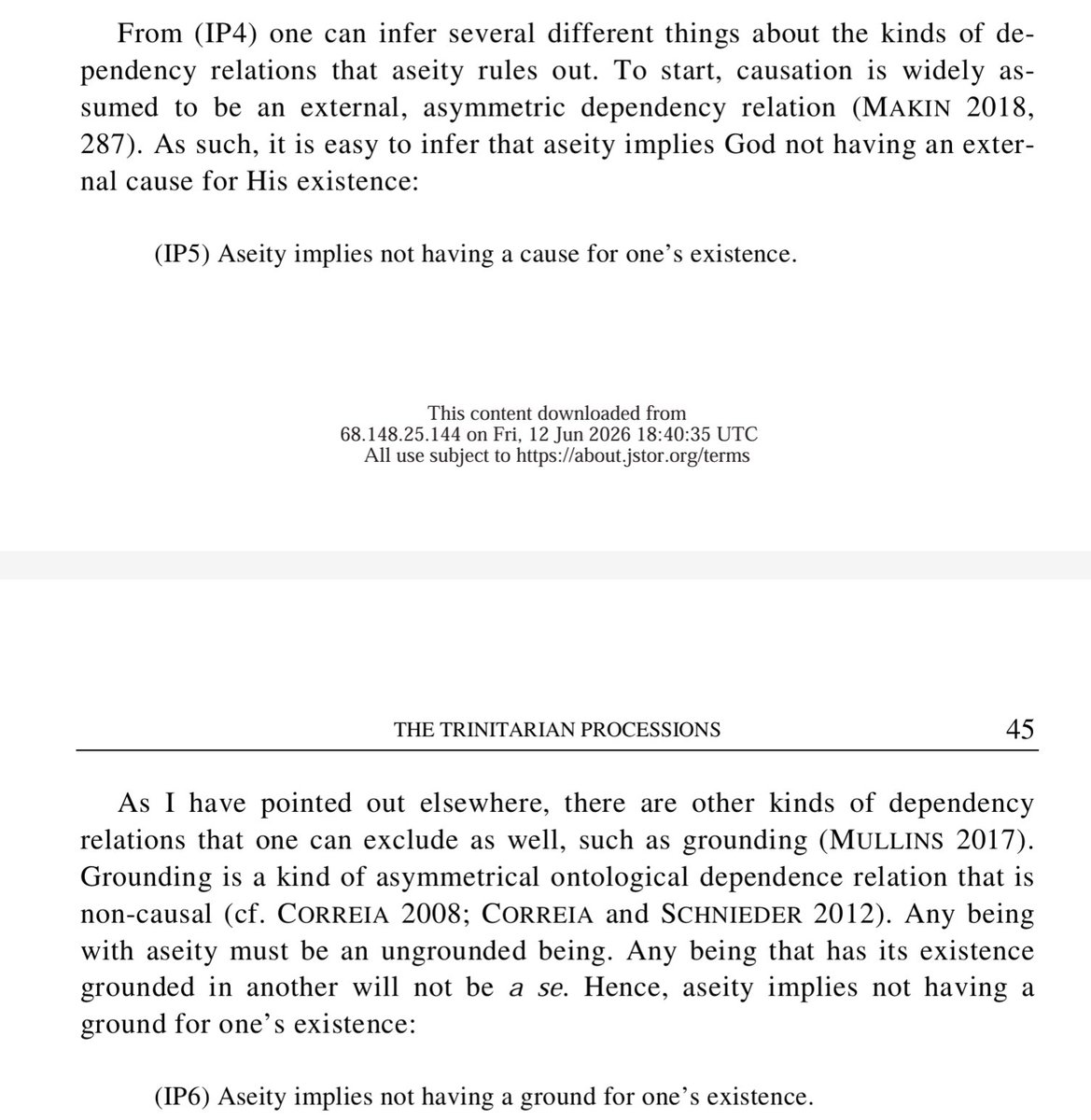
First, even the modern day shaykh al-Islam of you and your gang of Analytic Taymis, Ryan Mullins (who abhors ADS), says that aseity means that God is not dependent on anything else including non-casual grounding relations. Even if we start from your definition that God is not caused by anything "external" to Himself, Mullins concludes that an a se God must be ungrounded and independent of all else: "Any being that has its existence grounded in another will not be a se. Hence, aseity implies not having a ground for one’s existence" (Mullins 2023; see attached).
William Hasker, who replied to Mullins 2023 article says the same thing about aseity: "A being which is a se should be one which does not at all depend for its existence on anything other than itself" (Hasker 2023, 64)
Now, your conception of God is one in which God is constituted by proper parts that are spatially and ontologically distinct from God Himself and from each other. This plainly means that your God's existence and essence are grounded by these proper parts, each of which has its own existence and essence. Since you already deny ADS, you admit that each proper part is numerically distinct from God and "lesser" than the whole (God).
In your theology, God's attributes are concrete spatial particulars not abstracta or immaterial attributes. For you, God's Feet, Hands, Face, Fingers, Eyes, Shin, etc. all occupy different spatial positions and extensions in relation to one another and they each have a spatial extent that is lesser than God's overall spatial extent. And this further leads to the fact that each proper part of your God has an arbitrarily contingent spatial extension as well. That is yet another brute contingency you need to explain.
Since your God is a "whole" comprised of spatially distinct proper parts, the total top-down size of your God is literally the sum of the top-down sizes of each of His Proper Parts (His Hands/Face/Feet/Fingers). Mathematically, this means the total magnitude of your God is directly dependent upon the aggregation of the magnitudes of each of His Proper Parts and each Part contributes its own specific size to the total size of your God's top-down magnitude. This is no different than the total weight of my iPhone being the total weight if its internal parts. This may not be "casual" dependence but this is certainly a grounding dependence, which is ontological dependence. This is equivalent to saying a 6 meter length wall is dependent upon the aggregation the 6 one meter length bricks that comprise that wall. Nobody would dispute that the wall is dependent upon the aggregation of those bricks.
To put this differently, the existence and aggregation of God's parts are the necessary and sufficient condition for God's Existence; but God is not the necessary and sufficient condition for the existence of each proper part. Your God exists only because His proper parts exist. The existence of your God presupposes and requires the existence and aggregation of God's Proper Parts. Therefore, the parts of your God have ontic and explanatory priority over God himself. This formulation does not apply in the reverse -- the existence of each proper part does not presuppose or require the existence of a whole or aggregate. This proves there is a one-way dependency of God upon His proper parts and thus, your God is not a se.
Again, if you deny this and opt to change the dependence relation to say that God's parts depend upon God, then these are not really parts, they are creations and God Himself remains simple and independent. Alternatively, you can copy the even worse solution of Islamic Apex (Anas) and say that God and His proper parts exist in a two-way ontological dependence relations - which is viciously circular and denies aseity to both. As Hasker says, "A being which is a se should be one which does not at all depend for its existence on anything other than itself; if the being on which it depends is itself dependent on the original being, that fact does not cancel out the dependence of the first on the second" (Hasker 2024, 63-64).
5. Creation necessarily proceeding from God does not negate God's aseity
You have tried to assert that, in my theology, God must be dependent on His creation because God creates necessarily. This claim simply does not logically follow and is quite unserious. I already refuted this idiotic claim in my 2022 publication on modal collapse (a).
Not only that, even your shaykh Ryan Mullins admitted in his 2023 article that creation being necessitated by God does NOT negate God's aseity: "On panentheism, God always and necessarily exists with a created and causally dependent cosmos. Yet I find it doubtful that this somehow entails that God is not a se because God’s existence is not dependent upon nor derived from the created universe" (Mullins 2023, 54)
1
4
1,060
Jun 13
I cannot blame you @muslimorthodoxy for no longer responding; you dig yourself deeper into incoherence with every response thus far. Now then, as a courtesy to everyone following this exchange, I will respond to your rather disorganized diatribe of a word salad:
1. You asked: "Why is it metaphysically incoherent for that “arbitrary limit” to be brute? How does that entail being “modally contingent”?
Answer: It is logically possible for God's essence to have more or less than 3 dimensions since denying His 3-dimensionality is not a contradiction. It is logically possible for the top-down size or length of your God's essence to be any finite number N. This means that both of these limits on God's essence are contingent - they could be another way. That is modal contingency.
As Dr. Rassmussen @worldviewdesign writes: "We can use this general reasoning to form an argument against positing arbitrary limits, such as in size, shape, powers, or in any other attribute that comes in various degrees" ("The Argument from Contingency", joshualrasmussen.com/article…)
These two contingent features [dimension and size] of your God 's essence require something outside of God's essence to set their values because they are arbitrary limits that could have been otherwise with different values. You cannot merely assert that these contingent limits of your deity are uncaused. That makes it a brute contingency. The atheist can easily take any feature of the Cosmos and assert them as uncaused and call it a day.
2. You Must Demonstrate the Necessity of God's Size and Limits: Later in your reply, you assert God's 3D-ness and His finite height as "brute necessities" not contingencies. Okay, then prove it to us!
Notwithstanding that necessities are never brute - they are either necessitated by other necessities or they are necessary in themselves - you now allege that God's finite dimensions and size are modally necessary, not contingent. The burden of proof is upon you to logically demonstrate that God is necessarily 3D and necessarily has a limited height - what is your logical argument for these features of God being necessary?
3. Absolute Divine Simplicity lacks any limits requiring an external specifier:
God in the belief of all other Muslims (Sunnis, Twelvers, Zaydis, Ismailis, Sufis) does not require any external simplifier because God is absolutely simple in Himself - meaning God has no external or internal boundaries - unlike your spatially limited deity who is internally and externally bounded. Since our God has no boundaries or hudud like your deity, there is no requirement to posit an external entity to cause God to be simple or non-complex.
4. Aseity is incompatible with proper parts
Your inane comment about aseity really exposes how much of an amateur you are at this. Aseity means that God is not dependent upon anything distinct from Himself. You are smuggling in the adjective "external", but even this will not help you here.
First, even the modern day shaykh al-Islam of you and your gang of Analytic Taymis, Ryan Mullins (who abhors ADS), says that aseity means that God is not dependent on anything else including non-casual grounding relations. Even if we start from your definition that God is not caused by anything "external" to Himself, Mullins concludes that an a se God must be ungrounded and independent of all else: "Any being that has its existence grounded in another will not be a se. Hence, aseity implies not having a ground for one’s existence" (Mullins 2023; see attached).
William Hasker, who replied to Mullins 2023 article says the same thing about aseity: "A being which is a se should be one which does not at all depend for its existence on anything other than itself" (Hasker 2023, 64)
Now, your conception of God is one in which God is constituted by proper parts that are spatially and ontologically distinct from God Himself and from each other. This plainly means that your God's existence and essence are grounded by these proper parts, each of which has its own existence and essence. Since you already deny ADS, you admit that each proper part is numerically distinct from God and "lesser" than the whole (God).
In your theology, God's attributes are concrete spatial particulars not abstracta or immaterial attributes. For you, God's Feet, Hands, Face, Fingers, Eyes, Shin, etc. all occupy different spatial positions and extensions in relation to one another and they each have a spatial extent that is lesser than God's overall spatial extent. And this further leads to the fact that each proper part of your God has an arbitrarily contingent spatial extension as well. That is yet another brute contingency you need to explain.
Since your God is a "whole" comprised of spatially distinct proper parts, the total top-down size of your God is literally the sum of the top-down sizes of each of His Proper Parts (His Hands/Face/Feet/Fingers). Mathematically, this means the total magnitude of your God is directly dependent upon the aggregation of the magnitudes of each of His Proper Parts and each Part contributes its own specific size to the total size of your God's top-down magnitude. This is no different than the total weight of my iPhone being the total weight if its internal parts. This may not be "casual" dependence but this is certainly a grounding dependence, which is ontological dependence. This is equivalent to saying a 6 meter length wall is dependent upon the aggregation the 6 one meter length bricks that comprise that wall. Nobody would dispute that the wall is dependent upon the aggregation of those bricks.
To put this differently, the existence and aggregation of God's parts are the necessary and sufficient condition for God's Existence; but God is not the necessary and sufficient condition for the existence of each proper part. Your God exists only because His proper parts exist. The existence of your God presupposes and requires the existence and aggregation of God's Proper Parts. Therefore, the parts of your God have ontic and explanatory priority over God himself. This formulation does not apply in the reverse -- the existence of each proper part does not presuppose or require the existence of a whole or aggregate. This proves there is a one-way dependency of God upon His proper parts and thus, your God is not a se.
Again, if you deny this and opt to change the dependence relation to say that God's parts depend upon God, then these are not really parts, they are creations and God Himself remains simple and independent. Alternatively, you can copy the even worse solution of Islamic Apex (Anas) and say that God and His proper parts exist in a two-way ontological dependence relations - which is viciously circular and denies aseity to both. As Hasker says, "A being which is a se should be one which does not at all depend for its existence on anything other than itself; if the being on which it depends is itself dependent on the original being, that fact does not cancel out the dependence of the first on the second" (Hasker 2024, 63-64).
5. Creation necessarily proceeding from God does not negate God's aseity
You have tried to assert that, in my theology, God must be dependent on His creation because God creates necessarily. This claim simply does not logically follow and is quite unserious. I already refuted this idiotic claim in my 2022 publication on modal collapse (a).
Not only that, even your shaykh Ryan Mullins admitted in his 2023 article that creation being necessitated by God does NOT negate God's aseity: "On panentheism, God always and necessarily exists with a created and causally dependent cosmos. Yet I find it doubtful that this somehow entails that God is not a se because God’s existence is not dependent upon nor derived from the created universe" (Mullins 2023, 54)
This is THE LAST reply I send to you, you are not responding to anything you are welcome to join my panel.
Mr. “Physical separability is a biological defense to a metaphysical problem, and this isn’t AI but rather my sophisticated rhetoric”, has (kinda?) responded.
First off, I DO NOT HOLD to God being a 3D object, however, I do believe that it’s metaphysically coherent to commit to that yet simultaneously attribute it with aseity. Your argument in (1) hasn’t provided a defeater, why? Because as you said here; “This already is a problem because a 3D deity is arbitrarily limited in having 3 dimensions as to any other number. Therefore, your deity is modally contingent in His dimensionality. Furthermore, there must be an external cause or specifier that makes your deity 3 dimension as opposed to another number.”, you made two assumptions, and for the third time, PLEASE justify them! Why is it metaphysically incoherent for that “arbitrary limit” to be brute? How does that entail being “modally contingent”? It’s metaphysically coherent to assume that there exists x such that x is 3D, exists without a cause, and it’s a brute necessity, that “why” it’s the case is therefore brute. What’s the METAPHYSICAL problem here? Those aren’t even related. Also, another point, why “must there be an external specifier”? Why? What motivates that? Why can’t I say that for every object x, if x is simple, x needs an external simplifier? Are you arguing for epistemic inconsistency or metaphysical incoherency? Do you even know the difference, or did “biological defense” reading not suffice? If it’s epistemic inconsistency, then ontological dependency nor modal contingency are logically entailed. Do better. What’s funnier is that in (2), you basically make the same argument in a different way; “it is logically possible for that number to be different - thereby making His extent and boundaries an arbitrarily limit and rendering your God modally contingent. Again, there must be an external specifier for your God's finite spatial extent on the up-down axis.” First, logical possibility doesn’t entail metaphysical possibility. This is basic stuff dude. It’s demonstrably formally consistent that your “exists and not exists” outdated conception of God to not exist. Is that a serious defeater? No. Metaphysical possibility is motivated by commitments far beyond just mere formal consistency. Also again, “external specifier” and “arbitrary limits” are non-sequiturs as you haven’t demonstrated that they logically entail that, when I told you that such “issues” can be resolved by simply saying that such object is a brute necessity, and brute necessity isn’t ad-hoc because that’s what aseity is. Read up man. Third, speaking of aseity, you don’t even know what it means, it’s actually you who’s as clueless as a social Trinitarian. Aseity means there is x such that x obtains in all metaphysically possible worlds AND x lacks any external metaphysical explanation. In your ancient wizard of oz theology terms, aseity means something exists without a cause and always exists. That’s the mainstream definition within contemporary philosophy of religion. I told you, on the issue of composition, you low-tier, within my last tweet, which I told to not run away from and you did exactly that, to do three things, in order for the argument to follow; 1. Flesh out what ontic-priority is, 2. demonstrate why we ought to commit to that hermeneutic, and 3. prove how an object bearing properties necessarily entails ontological priority relations. Don’t run again and again from this. How is causal dependency even entailed? Is God under your view thereby causally dependent because of necessitarianism, really? Do you see how pathetic and self-defeating your argument is? I will reply to (4) of your tweet later under this post.
18
11
93
15,504
Jun 12
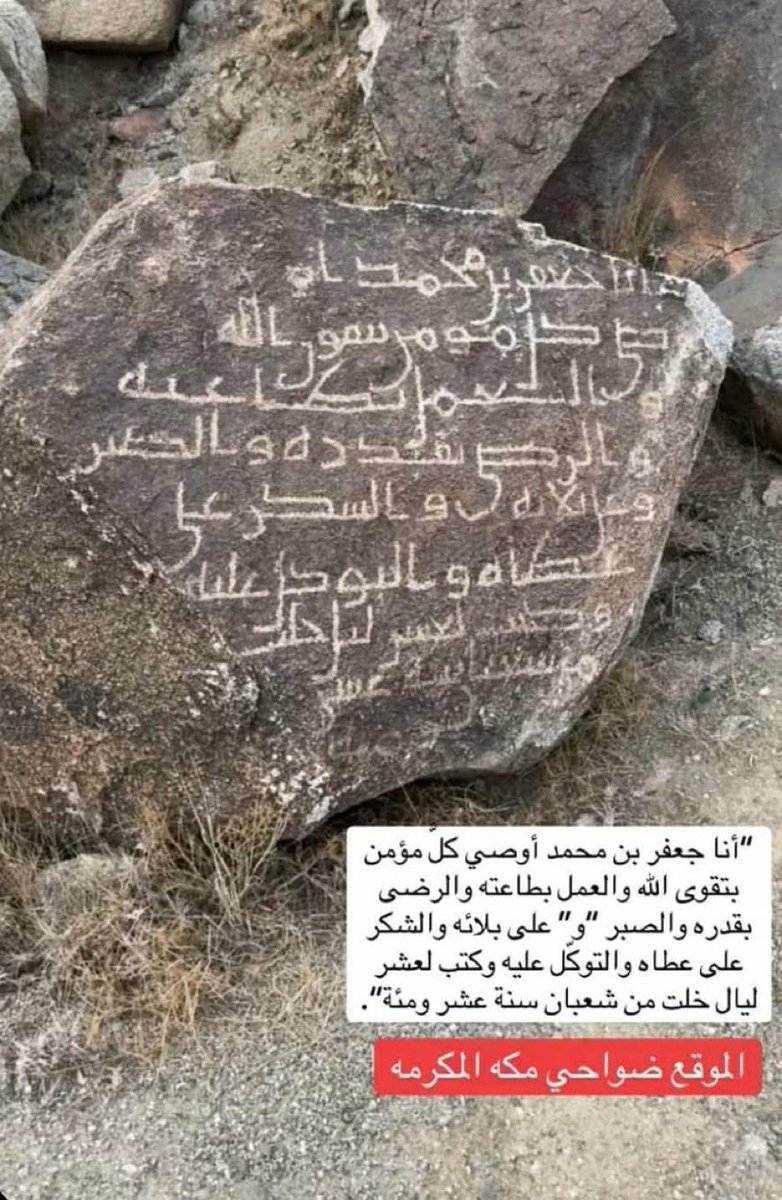
This inscription shows Imam Ja’far exercising his own Imamat by giving Hidayat and calling people to God.
You won’t find inscriptions from this time containing the core commitments of Sunnism such as four caliph thesis, uprightness of companions, uncreated kalam Allah, the credal schools, the equality of the 4 legal schools, etc.

Şiiliği Çökerten Keşifler…
Mekke’de İmam Ca’fer’e ait bir yazıt keşfedildi.
Yazıtta İmam Ca’fer ne imametten, ne Gadir-i Hum’dan ne de Şiilikten bahsetmiyor.
Ben, Ca‘fer bin Muhammed’im. Her mümine Allah’tan korkmasını, O’na itaat etmesini, O’nun takdirine razı olmasını, imtihanlarına karşı sabretmesini, nimetlerine şükretmesini ve yalnızca O’na tevekkül etmesini tavsiye ederim. Bu yazı, Hicrî 110 yılının Şaban ayının başlangıcından on gün sonra kaleme alınmıştır.”
30
15
144
26,421
Khalil Andani, PhD retweeted

Jun 12
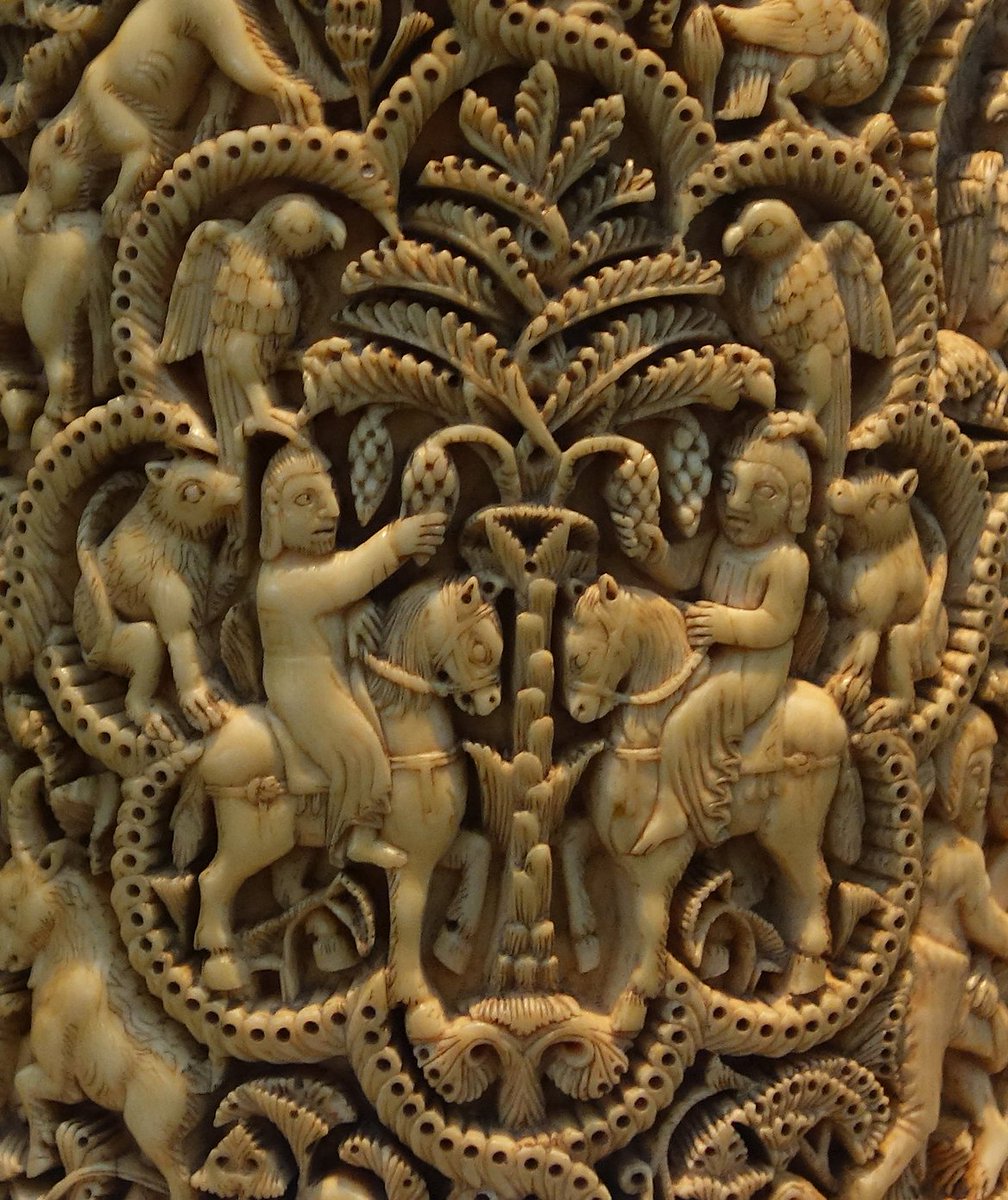
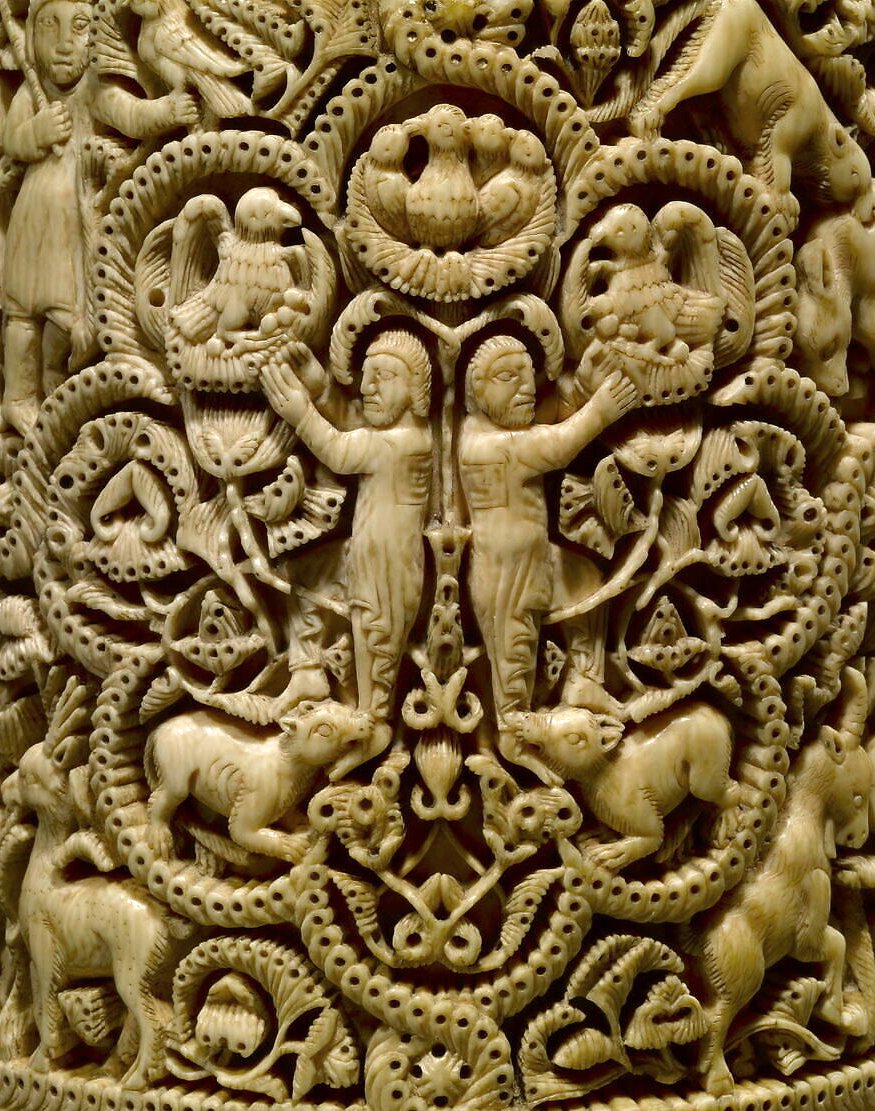
One thing that isn't realised enough is traditional Islam views prophets as theophanies of their version of the Logos, which they call various things: the Breath of God, the Perfect Being, the Reality of Muhammad, the Light of Muhammad, etc. There are traditions where Muhammad says ''I was a prophet when Adam was between water and clay'', or things like that. It's not exactly like a Christian Logos Christology and it isn't very incarnational, it's more akin to a combination of Arianism and Nestorianism where the Muhammadan Light is the mirror of God and the locus of His 99 Names and then this Light is subsequently mirrored again in theophanic human prophets, consummately Islam's founder, Muhammad. You wouldn't know about this tradition, tho, because the Muslim personalities that get the most press online are Salafis somehow connected to Saudi money or some such. 🐯
9
20
143
6,350
Jun 12
If God depends upon internal persons or parts then He is NOT a se.
Jun 12

Unless God is multi-personal in “himself” He can’t be independent or love?! Elijah Lamb debunked on the Trinity. 🤯
9
2
20
4,415
Khalil Andani, PhD retweeted

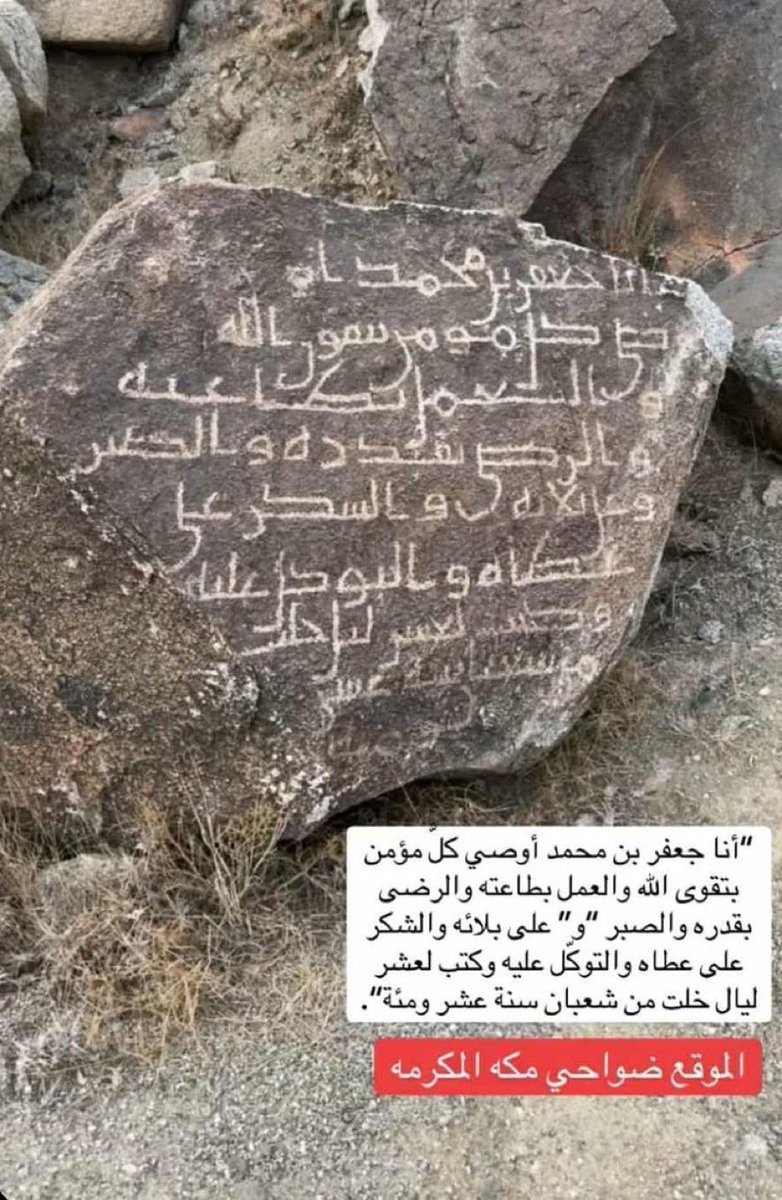
An inscription attributed to Imām Jaʿfar al-Ṣādiq (رحمه الله), dated to 110 AH near Makkah:
“I am Jaʿfar ibn Muḥammad. I counsel every believer to fear Allah, to act in obedience to Him, to be content with His decree, to be patient with His trials, to be grateful for His blessings, and to place his trust in Him. This was written ten nights after the beginning of Shaʿbān in the year 110 AH.”
11
197
1,102
185,466
Jun 12
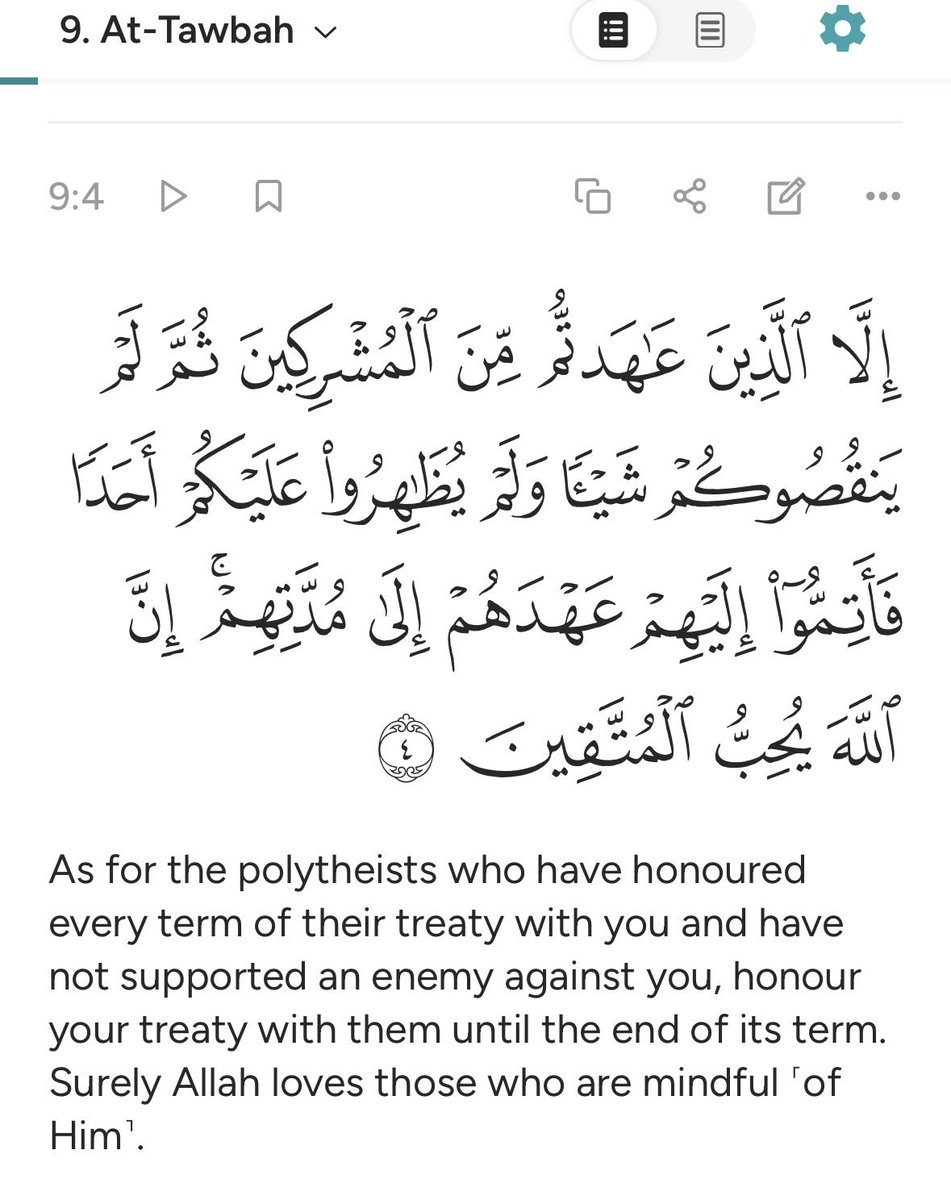
9:5 is about treaty breakers who are already fighting the believers. 9:6 then says to grant them safety if they don’t fight.
9:29 is about a Byzantine Christian invading army attacking the believers.
The Quran in numerous other verses only allows war in response to opponents’ aggression and religious oppression.
You are seriusiou misrepresenting the Quran to make it say the opposite of what the text teaches.
Jun 12

Yep it’s a real verse and it’s in the text. Someone can read it, build their life around it, and be a better person for it.
But Quran 9:5 is also in the text: kill the polytheists wherever you find them, besiege them, ambush them.
Quran 9:29 is also in the text: fight the people of the scripture until they pay the jizya in humiliation.
Quran 4:34 is also in the text: regarding wives you fear arrogance from, admonish them, then abandon them in bed, then strike them. All four verses are in the same book. Citing one does not defeat the others.
The Nazi regime passed the world’s most comprehensive animal welfare legislation in 1933. Hitler refused to eat meat and was genuinely appalled by hunting. You can agree with those laws.
But we do not judge ideologies or religions by their best statements. We judge them by their culmination.
Every religion must live and die by its culmination. The culmination of Judaism is the Torah; the text itself is the standard, not a human figure to be emulated. The culmination of Christianity is not the Bible but Jesus. The New Testament is about him, and the question that actually judges Christian practice is not what does the text say but what did Jesus do.
The culmination of Islam is not the Quran. It is Muhammad. Not because the Quran is unimportant but because Muslims are praised for doing things Muhammad did that are not even in the Quran but recorded in the Hadiths. His life, not just his book, is the model. The Quran itself confirms this: “There has certainly been for you in the Messenger of Allah an excellent pattern” (33:21). The perfect example, for all creation, for all time.
So 2:256 does not close the argument. It opens a different one. The question is not whether a good verse exists. The question is what the culmination of the religion actually did. Jesus confronted the power structures of his world directly. What did Muhammad do with the gender architecture of his? The Hadiths answer that without ambiguity. The Surah 33:59 incident answers that without ambiguity.
You cannot resolve that Afghan girl’s cry with a verse her oppressors also know and have consciously set aside. They are not ignorant of 2:256. They have simply decided that the perfect example outranks it. And on their own theological terms, they are not wrong.
8
3
23
3,642
Jun 12
Umm this is the heresy of modalism?
Jun 11

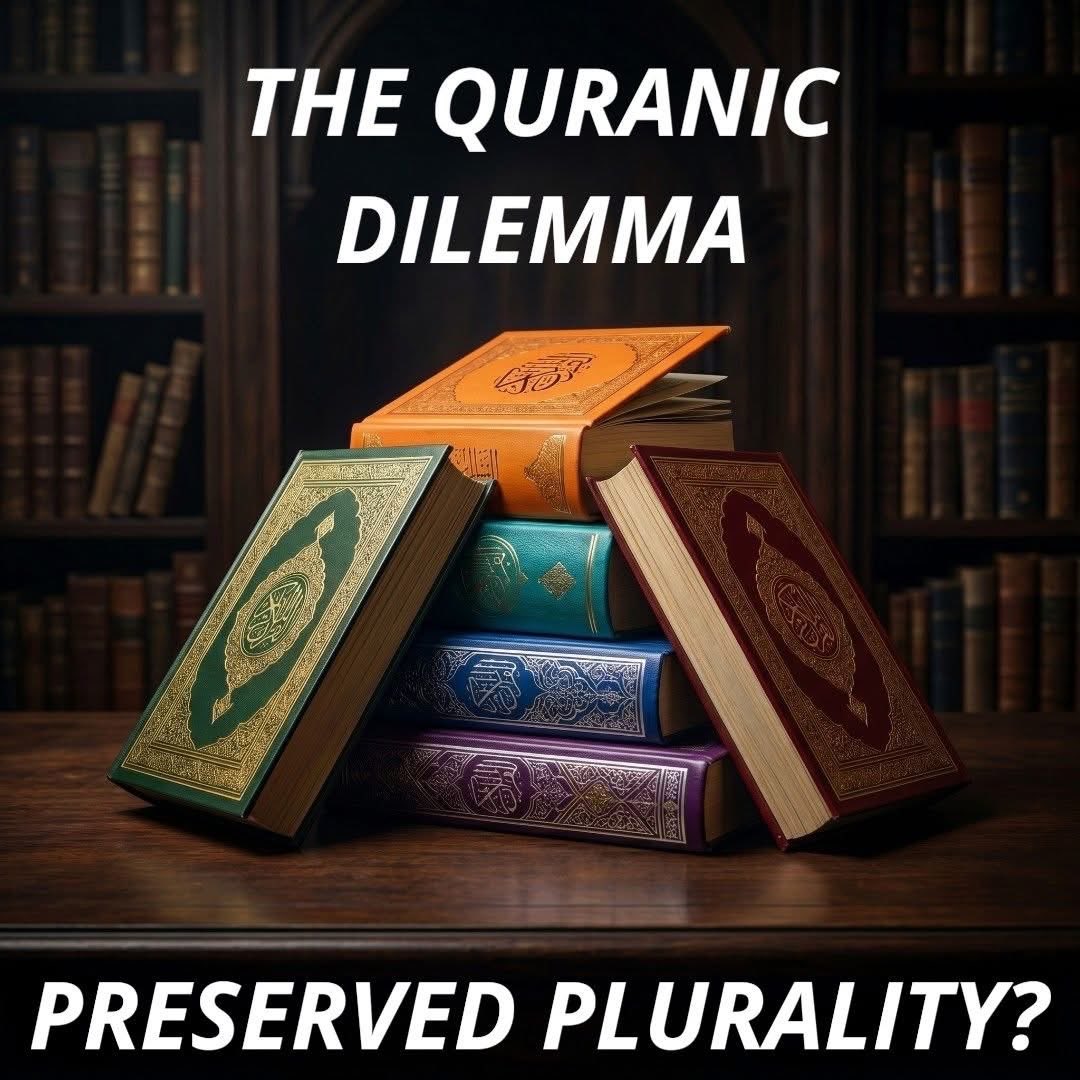
Most Muslims are taught that there is only one Quran, perfectly preserved word-for-word ✍️ and dot-for-dot across the entire world.
But if you look at the actual Arabic texts used today, that is simply not true.
You have different versions of the Quran printed right now. For example, the Hafs version is common in the Middle East, while the Warsh version is used across North Africa.
These are not just different accents or pronunciations. They are different physical books 📖 with different words, different spellings, and different meanings.
This creates a massive logical dilemma for Islamic theology.
Islamic scholarship tries to solve this by saying all these different versions are still 100% the Quran. They claim multiple distinct modes can exist at the same time and all be the exact same divine text.
But think about the logic here... 🤔
If you can accept that different physical books, with different words and different variations, are all simultaneously the exact same one Quran, then you have already accepted the underlying logic of the Trinity.
If God can express His one divine Word through multiple distinct modes, you can no longer argue that the Trinity is mathematically or logically impossible.
And here is what makes it even worse. The Trinity is a description of the eternal, non-physical God. But these Qurans are physical objects made of paper and ink. If physical, distinct books can all be the same one Quran, there is no logical ground left to reject the Trinity. 📢
5
1
39
7,922
Khalil Andani, PhD retweeted

Read my Substack Article, A Selected Translation From Abd al-Wahhab al-Sha'rani: Kitab al-Yawaqit wal-Jawahir fi Bayan 'Aqa'id al-Akabir (The Book of Rubies and Jewels in Explaining the Beliefs of the Great Masters), link below:
3
11
60
4,330
Khalil Andani, PhD retweeted

In this episode, we examine a striking shift in biblical scholarship: fewer and fewer experts now affirm that Jesus is the only true God. I compare two major surveys published in 2025 that reveal the same trend among everyday American Bible readers — a clear majority no longer believe Jesus is God. At the same time, interest in Unitarianism is surging.
youtu.be/T8JAgnMkDbw
4
6
17
1,604
Khalil Andani, PhD retweeted
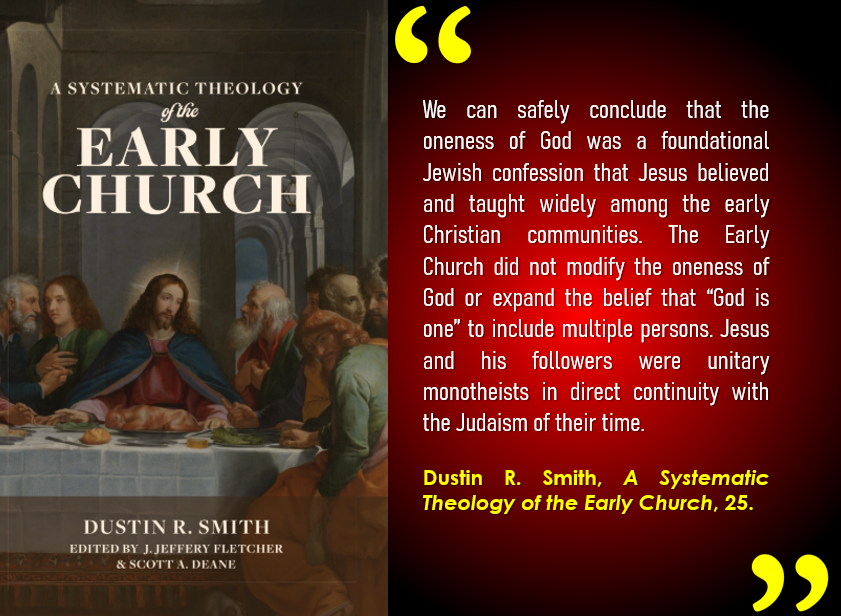
The creed of Israel, that God is one, was the creed that was believed and taught by Jesus Christ to his followers. Learn more about the beliefs of the early Christians in my newest book amzn.to/47jldOc
1
5
14
1,678
Jun 10
Very good. Now apply this to your God — who has parts lesser than Himself such has hands, feet, eyes and face — with your admission this week that there are brute facts in God such as his spatial limits in two directions, the fact He is 3D, and his intentions to create this world or not. This renders your deity as contingent as the universe and you can no longer argue against the universe being brute. @muslimorthodoxy
You are clearly misinformed sir, the universe is observably composed on constituents that could have been otherwise, therefore its parts are contingent, and if its parts are contingent then the whole itself is contingent.
We don’t need Ibn Arabi kufr to defend athiest. As a matter of facts, Ibn Arabi is an athiest
14
1
72
18,279
Khalil Andani, PhD retweeted
5 minutes of history on the development of the Trinity from nonbiblical sources.
youtu.be/ENtj42YzW-c?si=5Wkm…
1
7
11
3,513
Khalil Andani, PhD retweeted

Jun 9
A central reason Muslims have never yet flourished on a large scale in the West is our almost wholly negative attitude towards shari'a or sacred law. Negative shari'a should pivot on clear red lines, not a paranoia about whether or not everyday life is "halal."
The real purpose of sacred law is in any case positive; it provides principles for maximized human flourishing in accordance with the lofty vision of human nature that has been revealed to us, not a raft of complexes and prohibitions.
The true Muslim's natural assumption when encountering a new situation is not only that it is "halal", but that its halal status need not even be investigated. God created all that is in the earth for you; everything on this earth was created for our benefit, in order to help us in actualising the holistic flourishing demanded by our nature; it was not created so that we could be suspicious, uneasy, and paranoid about every unfamiliar thing that we encounter.
Instead, in everything you do be faithful and loyal to the haqa'iq and the sha'a'ir, the spiritual realities and the outward symbols of the din. It is that deep spiritual orientation and the pursuit of the corresponding truth, beauty, and goodness in all things which will keep you on the Straight Path, the path of closeness to Allah, not an unhealthy and morally lazy dependence on a "mufti" who has lost all touch with reality.
He created all that is in the earth for you is indeed one of the proof texts for the fiqh maxim "the default assumption is permissibility." We should combine it with the hadith, "Seek the moral judgement of your heart," and recognise that a pedantic and partisan fiqh madhhab calculus is rarely the right way to achieve the maqasid of the din in this time.
From the
ضروريات
to the
تحسينيات
the purposes of sacred law are configured to facilitate the cultivation of truth, beauty, and goodness in the life of each individual believer. Social and cultural non-participation, the self-incarceration of authentically Islamic creative energies, and our defaulting to "halal" medicine and engineering, and thus becoming grey, lifeless non-presences in Western societies that we should be transforming with light, is the price our communities pay for our lazy (and unislamic) legalism.
33
90
458
41,687
Come on @eternalbread_ you can do better than this. Since when does Islam begin and end with Ibn Kathir? Since when is Ibn Kathir’s exegesis binding and definitive of all 4 legal schools for all eras? More tomorrow - I can do the same thing and find premodern Christian scholars calling for wars against non-Christians.
Jun 8

All 4 schools of Islamic jurisprudence say fighting the non-believers is obligatory, regardless of if they initiate it or not. Ibn Kathir says that 9:29 abrogates the previous peaceful verses. You guys need to stop running from the reality of Islam.
7
2
35
5,639
Libyano @muslimorthodoxy , how do you even have an undergrad when you make arguments like this? In 2020 when I got my PhD, you were still in high school.
You aren't defending Islamic monotheism. You are defending an arbitrary, mathematically measurable idol as your God. For all the counter-Christian apologetics you may do well, your own Salafi theology of God qua Megazord is your Achilles heel. Every person (ex Christian, ex-atheist) who takes their Shahada at your hand will eventually discover and then disown your theology.
1) You admit your God has parts and then you contradict yourself and say He is self-dependent. God can only be "self-dependent", i.e. necessary in Himself if He is absolutely simple. Parts are not identical to the whole and are lesser than the whole. This means your God is dependent upon proper parts (each of which is not identical to Him), making His parts more fundamental than Himself. This is not "self-dependence" at all. That would be like saying my iPhone is self-dependent because it depends on its own internal parts.
The problem is that you want to talk about parts having semantic priority over the whole but not ontological priority. This is a big blunder. There is no such thing as semantic priority in ontology. Ontological priority cannot run both ways unless you have vicious circularity between God and His parts in which case something more fundamental must ground both.
2) The 3D Problem: Everything you say means God is 3D. You don't have to grant it as you already conceded it. If God is a 3D body, He is arbitrarily limited—why 3 dimensions and not any other finite number? Furthermore, His extension in the 6 directions of space is arbitrarily limited in at least two directions (up and down). Do you say God's extension is infinite in terms of right, left, front, and back? Or does He have Hudud (limits) in all 6 directions? Anything with such arbitrary boundaries requires an external Specifier (Mukhassis). If you want to avoid this, then you must show how God's essence logically entails his 3 dimensionality, plus his limits on both directions, etc.
3) You claim a boundary is just a "relation" due to creation. False. A boundary defining where a 3D body stops extending is due to the intrinsic geometry of the entity. The boundary on God's upward extension and downward extension would exist without creation. So you need to show why it is necessary or else there must be a Specifier for God's finite extension.
Anything with a finite, specific spatial magnitude mathematically requires an external Specifier (Mukhassis) to determine its exact dimensions out of infinite possibilities.
4) Brute Facts: Once you accept brute facts to explain these limits, you concede that God is constituted by brute facts. You just gave the game away to any atheist, priority monist, or pantheist—all of whom can now argue that the Cosmos or its portions are brute facts without ontological explanations. You can no longer logically argue against atheism.
5) Aseity and modal collapse: If God necessarily creates the world, it does not follow that God depends upon the world. Even if the world is necessary - it is necessary due to another while God is necessary in Himself. There is no modal collapse in ontology, only in modern modal logic which is overly broad anyway.
The world depends upon God and lacks aseity; it is the necessary consequence of God's a se reality, not the cause of it. You are confusing counter-factual dependence (which can run both ways - symmetrically) with ontological dependence (which is strictly one-way). Arguing that a cause that necessarily produces ots effect is therefore dependent upon the same effect to exist is logically unwarranted.
Furthermore, this rebounds against you: If God does not necessarily create, then for creation to occur, your God needs to acquire something extrinsic to Himself to create—this compromises God's aseity for you. Even in your own view, God necessarily actualizes a contingent state of affairs (e.g., choosing "no creation" is a contingent choice of your God). You cannot escape necessity in God's will.
Dr. Khalil, how do you have a PHD yet you still argue composition like a 2020 discordian phil bro?
You haven’t justified your conclusions, you said all that is made of inseparable parts depends on its parts to exist, that’s just another way of saying Allah is self-dependant because he depends on nothing external to himself! Thanks for refuting yourself. You didn’t give an argument, you didn’t show an inference rule, you just asserted a conclusion.
You said that my God must be 3D, without giving the argument! You just asserted it again! lol. Let’s grant for argument sake that God is 3D, a giant body above heavens (for arguments sake so don’t twist my words) you STILL wouldn’t be able to show a metaphysical problem with that other than than crying “TAJSIM” you and your classical theistic buddies.
Now regarding the “Hadd”, you posited that there must be a Mukhasis 😭😭 this does not follow! The Hadd is a relation that arises in respect to God creating! That is that God is completely distinguished from creates and not infinitely extending like you believe. We also allow for brute facts, no issue there.
It’s funny how you say our position undermines Asiety when you believe God’s Asiety is dependant upon creation.
Answer this question directly, Can God Exist As Self Sufficient Without Creation ?
Watch how you blunder
26
6
89
24,163
The Torah isn’t written by Moses. It doesn’t even claim to be. At best the Torah contains remnants of actual Mosaic law.
Jun 9

As an Ex-Muslim, let me fill you in on something most Christians won’t ever know:
There are archaeological sites across Saudi Arabia that researchers aren't allowed to excavate.
No public digs or major investigations allowed. No open examination.
If those sites contain ancient synagogues, churches, or Torah manuscripts, they could answer one of the biggest questions in Islamic apologetics:
What Torah did Muhammad believe existed?
If archaeologists uncover Torah scrolls that match the same Torah found in places like Egypt, Ethiopia, and beyond, then the claim that a different Torah existed in Muhammad's day becomes much harder to defend.
Islam's criticism of the Torah often depends on the idea that the original message was altered. But where is the manuscript evidence?
Where is the lost Torah that supports the Islamic retelling of the prophets?
If the evidence is there, let's examine it and if the Torah is corrupted, prove it.
If Islam is true, it has nothing to fear from archaeology.
Truth doesn't hide from evidence. Truth invites investigation. So open the sites. Open the digs. Let the evidence speak for itself.
Until then, the unanswered questions remain.
19
3
98
11,366