
Founder & CEO @YieldClubHQ // previously co-founder @RallyProtocol and @Superlayerio // ex-VC @Redpoint
Joined October 2011
- Tweets 2,918
- Following 597
- Followers 23,075
- Likes 5,236
90 Photos and videos







Pinned Tweet

25 Jun 2025
We’re live! @YieldClubHQ is now available on iOS & Android.
A simple onchain savings account that anyone can use to earn stablecoin yields.
Built on @base, account abstracted by @privy_io, powered by @morpholabs
This is what an onchain consumer app should feel like. 🧵👇
43
31
145
36,537
Mar 26
Gen Z is AI-native. But Gen Alpha might be AI-dependent.
They’re incredibly fluent on mobile. But many are less comfortable with keyboards, files and folders, terminals, and basic computational thinking.
The frontier layer of AI still lives there.
5
4
160
Mar 26
This is massive especially since traditional mortgage lenders count your crypto as $0. They don't factor in crypto at all when underwriting!
Mar 26

Get your house and keep your crypto.
Crypto-backed mortgages are here - increasing access to homeownership for millions of Americans.
Buy a home without converting your portfolio by using BTC or USDC as collateral for your down payment.
Offered by Better, powered by Coinbase.

1
215
Mar 24
Yeah right. Imagine the shenanigans that’ll occur if you have the whole row to yourself on an overbooked flight
Mar 24

The entire row is alllllll yours.
Welcome to United Relax Row, three adjacent United Economy seats with adjustable leg rests that can each be raised or lowered to create a cozy lie-flat space for stretching out...
You'll also get a mattress pad, blanket and two pillows. If you’re traveling with kids, a plushie too! United Relax Row will be available starting next year on more than 200 of our 787s and 777s, each with up to 12 of these brand-new rows.
united.com/Elevated
2
474
Mar 24
CLARITY’s direction on stablecoin yield suggests issuers and exchanges can’t just park reserves in T-bills and pass through interest like a bank account.
If rewards must be tied to activity, yield has to come from actual capital deployment like lending, collateral, liquidity, and trading.
That’s bullish for DeFi lending markets and the front-ends that route users into them.
115
Mar 24
Ok so has the pendulum officially swung back to remote work again or no? Since most of our coworkers are agents
2
3
295
Mar 24
Getting a little tired of these $150k launch packages shilled by unmarked paid influencers
Mar 23

We’ve raised $27M for this moment: starting today, your agent gets an iPhone and can talk like a friend.
Texting is the universal interface. Billions of people text every day, but until now, developers have been restricted from building on the most powerful channel to ever exist.
Linq is a single API for iMessage, RCS, SMS, voice, and even FaceTime and Find My. Nothing for users to download. Nothing new to learn.
We’re already powering @interaction, @pika_labs, @getlindy, @zocomputer, @joindimension, Tomo (and others we can’t name just yet) to bring this new ecosystem to life.
Join them, and start building for free in our sandbox, linked below. Or comment and we’ll get you set up.
447
Mar 24
The games industry pushing back on AI is totally fair. Craftsmanship matters and the experience is sacred.
But vibecoding is doing something interesting in modding communities. Players who couldn't write a line of code are now building. Since it's not a threat to the core game, the studios that figure out how to harness this by give players the right sandbox, with AI lowering the floor, will be massively successful. Basically Roblox / Minecraft / Warcraft 3 custom games on steroids.
2
133
Mar 24
NBA Top Shot just venmo’d me $83 as part of a $7m class action lawsuit (illegal sharing of user data). Crazy how many years later these payouts can happen
1
7
467
Mar 24
Karpathy is right, software is about to move at lightspeed.
the interface layer of the internet gets sanded down and rewired as agents become the primary users. It'll go headless fast (API/MCP becomes the product). I see this happening in four ways:
1) Fully headless - high intent flows like travel booking, hotels, flights, ride hailing, delivery, reservations, commodity ecommerce (electronics, household goods), bill pay, insurance quotes, etc, not to mention most of SaaS. These UIs are mostly forms and funnels. Agents fill forms better than humans.
2) Thin UIs - amazon-style browsing, real estate search, job marketplaces, trading platforms, app stores and plugin marketplaces. Agents handle execution. Humans still want some oversight and discovery.
3) UI remains core (experience is the product) - social networks, games, streaming and sports fandom, fashion, luxury, beauty, dating, creator platforms, brand-driven commerce, high-consideration purchases (cars, homes). Taste still needs a surface.
Then a new category appears:
4) agent-native networks - agents discover tools, negotiate pricing, route tasks, build reputation, coordinate with other agents. Humans mostly watch. Moltbook is an early glimpse.
tl;dr a lot of websites become "inventory" for agents. Brands become trust layers on top of APIs
Mar 20

Caught up with @karpathy for a new @NoPriorsPod: on the phase shift in engineering, AI psychosis, claws, AutoResearch, the opportunity for a SETI-at-Home like movement in AI, the model landscape, and second order effects
02:55 - What Capability Limits Remain?
06:15 - What Mastery of Coding Agents Looks Like
11:16 - Second Order Effects of Coding Agents
15:51 - Why AutoResearch
22:45 - Relevant Skills in the AI Era
28:25 - Model Speciation
32:30 - Collaboration Surfaces for Humans and AI
37:28 - Analysis of Jobs Market Data
48:25 - Open vs. Closed Source Models
53:51 - Autonomous Robotics and Atoms
1:00:59 - MicroGPT and Agentic Education
1:05:40 - End Thoughts
1
1
5
1,353
Mahesh Vellanki retweeted

Mar 23
We're looking for a freelance video editor to work on some short feature launch sizzle reels. Looking for someone with taste and speed. DM us! 🙏
26
1
18
774
Mar 23
Who are the best freelance video editors in crypto/fintech for short feature sizzle videos?
Looking for someone with taste and speed. Tag them or DM me 🙏
3
2
8
778
Mar 20
Lovable becoming Replit Agent4?
Mar 19

Introducing Lovable for more general tasks.
Lovable has always been for building apps. Today it also becomes your data scientist, your business analyst, your deck builder, and your marketing assistant.
This is a big step toward what Lovable is becoming: a general-purpose co-founder that can do anything.
See examples below.
2
2
218
Mar 18
We're basically the only crypto app in the entire industry doing this.
Mar 17

this is is how crypto consumer apps break out & get mainstream 👇
(bookmark & share this with your fav crypto project, they are for sure sleeping on this)
2026 is the year consumer crypto finally goes mainstream through TikTok UGC
Here is all you need to know:
web2 consumer apps have run this playbook for almost 2 years now and it fully disrupted customer acquisition economics
web3 consumer apps so far have relied on incredibly high CAC due to competing for a limited pool of potential users from CT, most of them just following a mercenary interest in chasing the next airdrops
Now, account abstraction, stablecoins, social log-ins and mobile-first user flows are enabling web2 UX for any web3 application
web3 apps have undeniable advantages in verticals like payments, savings & trading enabled via real-time payments, (quasi) feeless transactions & way higher yields than normal saving accounts. Chains like @base or @solana enable all of this
the FYP algos of TikTok & Instagram are incredibly good in finding your target audience, anywhere in the world
So what is the play?
Copy the winning playbooks of the fastest growing consumer apps and undercut the typical crypto user CAC by 10x
Study the concepts of
high-volume UGC
performance-based creator compensation
branded ambassador accounts
virality engineering
and copy the winning formats of existing consumer finance apps
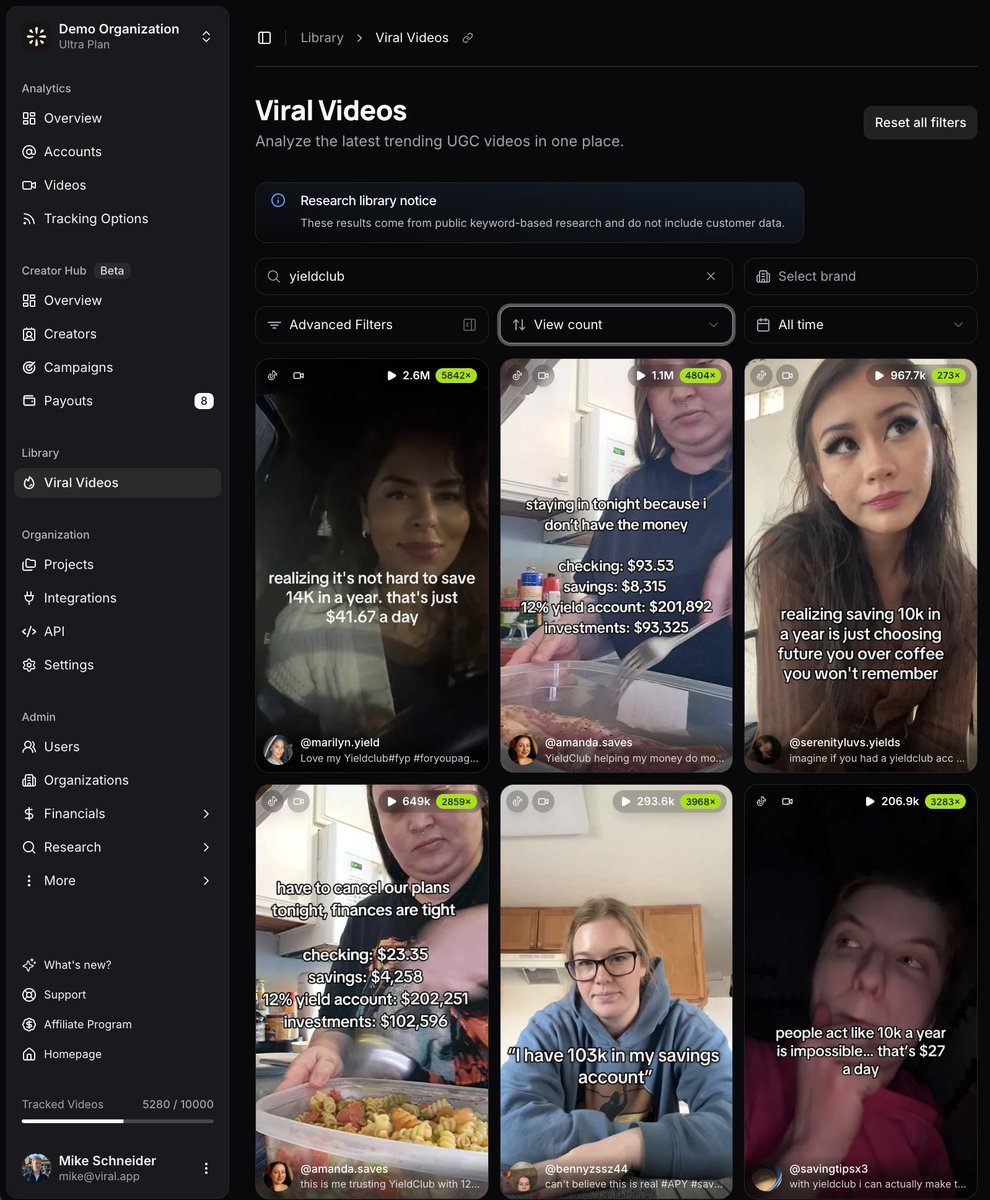
One example? @YieldClubHQ
just about 200 followers on X yet millions of views across Tiktok & Instagram
How to get started with this?
1. read the guide attached
2. search for "yieldclub" in our viral video library and study their hooks (you can access it via our demo here: viral.app/auth/sign-up)

3
2
209
Mar 12
I don't know what's weirder, the fact that this dude has $50M on his phone, that he is so flippant with DeFi txns, or that he's so obscenely rich that he doesn't care
Mar 12

Earlier today, a user attempted to buy AAVE using $50M USDT through the Aave interface.
Given the unusually large size of the single order, the Aave interface, like most trading interfaces, warned the user about extraordinary slippage and required confirmation via a checkbox. The user confirmed the warning on their mobile device and proceeded with the swap, accepting the high slippage, which ultimately resulted in receiving only 324 AAVE in return.
The transaction could not be moved forward without the user explicitly accepting the risk through the confirmation checkbox.
The CoW Swap routers functioned as intended, and the integration followed standard industry practices. However, while the user was able to proceed with the swap, the final outcome was clearly far from optimal.
Events like this do occur in DeFi, but the scale of this transaction was significantly larger than what is typically seen in the space.
We sympathize with the user and will try to make a contact with the user and we will return $600K in fees collected from the transaction.
The key takeaway is that while DeFi should remain open and permissionless, allowing users to perform transactions freely, there are additional guardrails the industry can build to better protect users. Our team will be investigating ways to improve these safeguards going forward.
1
1
583
Mar 11
Who will be bigger in 5 years - Robinhood ($70B) or Coinbase ($50B)?
5
3
469
Mar 11
Reasons for crypto devs leaving the space:
-payments use case = fintech 2.0 which is less interesting to devs
-prices are down
-memecoins (self-explanatory)
-regulatory environment still not great (see permissioned RWAs)
-competing with AI for mindshare
-YOLO vibecoding doesn't work as well with secure financial apps and money movement
2
99
Mar 11
We're going to see the same aggressive promos to acquire consumers from X, Mercury, Robinhood, etc, that we saw from traditional banks / credit cards. A win for consumers
This tweet is unavailable
1
280
Mar 11
If X money is successful, then in retrospect all major social media platforms should have prioritized financial products long ago instead of pure ads
1
69
Mar 6
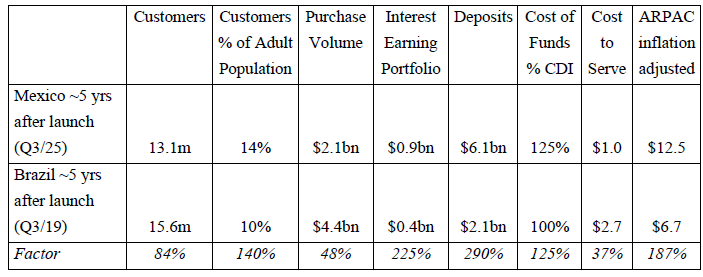
Nubank is severely underpriced. US ramp will move faster than Mexico did, and that opens up the remittance corridor between both countries powered by stablecoins
Mar 5

Super interesting table comparing $NU after 5 years in Brazil vs 5 years in Mexico
Source: Covesto 25FY Letter
1
2
191
Feb 28
Must read for how to actually do agentic work that’s not performative or for farming engagement. @zackbshapiro is my counsel so I can attest he is legit

2
4
1,128