
783 Photos and videos













去年很火TTS模型IndexTTS2 哔哩哔哩(Bilibili)有了升级版。
以前的TTS2虽然能力很强,但还是有点股着AI味!😉
今天推荐一个TTS模型 TTS:文字转语音<克隆音频>
做自媒体必不可少AI工具💪:
输入一段文字 → 选择一种语言 → 输出高质量语音。
VoxCPM2:面壁智能联合@OpenBMB开源社区与清华大学人机语音交互实验室共同开发并开源的一款语音生成模型,于2026年4月发布 。该模型只有2B 参数模型。
2B参数模型,训练超200万小时多语种数据,支持30种语言、Voice Design创意配音、真实克隆,以及48kHz录音棚级音频输出。
GitHub评论区地址领取👇
1
1
109
去年很火TTS模型IndexTTS2 哔哩哔哩(Bilibili)有了升级版。
以前的TTS2虽然能力很强,但还是有点股着AI味!😉
今天推荐一个TTS模型 TTS:文字转语音<克隆音频>
做自媒体必不可少AI工具💪:
输入一段文字 → 选择一种语言 → 输出高质量语音。
VoxCPM2:面壁智能联合@OpenBMB开源社区与清华大学人机语音交互实验室共同开发并开源的一款语音生成模型,于2026年4月发布 。该模型只有2B 参数模型。
2B参数模型,训练超200万小时多语种数据,支持30种语言、Voice Design创意配音、真实克隆,以及48kHz录音棚级音频输出。
GitHub评论区地址领取👇
1
1
109
很好吃 retweeted

📊 Extreme Poverty by Country (1992–2026)
297
1,003
3,581
1,106,066
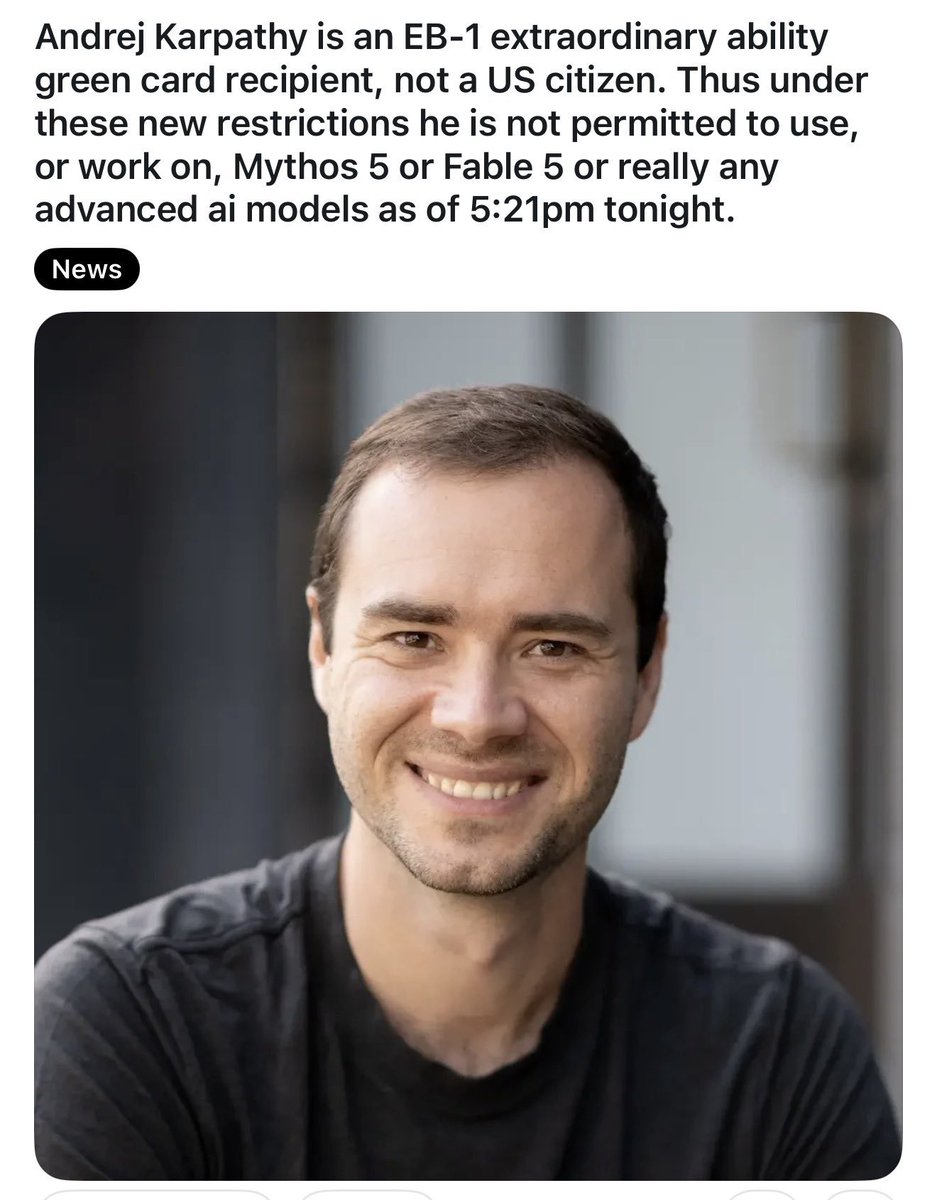
场景:Anthropic 办公区,紧急出口管制指令刚下达。一位印度裔工程师(非美籍)从隔间探出头,压低声音问旁边的白人同事(美籍):
外籍员工(指着屏幕上的禁令通知):“嘿,pro,现在这个 Fable 5 我碰都不能碰了,但你是美国公民,你能帮我点一下‘运行’按钮吗?就一下,我保证只看输出,不碰键盘。”
美籍员工(严肃脸):“不行,老兄。这可是国家安全。”
外籍员工(不死心):“那我把椅子退后两米,你敲代码,我口头描述需求?这算‘咨询’不违反禁令吧?”
美籍员工(推了推眼镜):“理论上,我帮你生成任何结果后再转述给你,但可能也算‘间接访问’,你得去问法务。”
外籍员工(叹气):“好吧。那…你帮我看看 Fable 5 能不能算出来:我现在去申请入籍,加急要多久?”
美籍员工(沉默两秒,突然小声):“别查模型了,我告诉你,我媳妇(外籍)当年等了一年半。”
两人相视,一起叹气。远处主管喊:“全体注意了!禁用已经生效,外籍同事请主动远离那两台服务器。对,包括用余光偷看屏幕!”
Jun 13

The US government, citing national security authorities, has issued an export control directive to suspend all access to Fable 5 and Mythos 5 by any foreign national, whether inside or outside the United States, including foreign national Anthropic employees.
The net effect of this order is that we must abruptly disable Fable 5 and Mythos 5 for all our customers to ensure compliance.
Access to all other Claude models is not affected.
We apologize for this disruption to our customers. We believe this is a misunderstanding and are working to restore access as soon as possible.
Read our full statement: anthropic.com/news/fable-myt…
1
1
171
很好吃 retweeted

Jun 11
We recently discovered the ultimate workflow to restore old footage to something close to digital high-quality footage. The method works better than we thought, and it utilizes @OpenAI GPT-Image 2 @seedance2_ai 2.0 @topazlabs Astra….
See the step-by-step workflow in 🧵
Shoutout to Adam Nieri from our team for the real footage test!
11
55
435
34,821
场景:Anthropic 办公区,紧急出口管制指令刚下达。一位印度裔工程师(非美籍)从隔间探出头,压低声音问旁边的白人同事(美籍):
外籍员工(指着屏幕上的禁令通知):“嘿,pro,现在这个 Fable 5 我碰都不能碰了,但你是美国公民,你能帮我点一下‘运行’按钮吗?就一下,我保证只看输出,不碰键盘。”
美籍员工(严肃脸):“不行,老兄。这可是国家安全。”
外籍员工(不死心):“那我把椅子退后两米,你敲代码,我口头描述需求?这算‘咨询’不违反禁令吧?”
美籍员工(推了推眼镜):“理论上,我帮你生成任何结果后再转述给你,但可能也算‘间接访问’,你得去问法务。”
外籍员工(叹气):“好吧。那…你帮我看看 Fable 5 能不能算出来:我现在去申请入籍,加急要多久?”
美籍员工(沉默两秒,突然小声):“别查模型了,我告诉你,我媳妇(外籍)当年等了一年半。”
两人相视,一起叹气。远处主管喊:“全体注意了!禁用已经生效,外籍同事请主动远离那两台服务器。对,包括用余光偷看屏幕!”
Jun 13
The US government, citing national security authorities, has issued an export control directive to suspend all access to Fable 5 and Mythos 5 by any foreign national, whether inside or outside the United States, including foreign national Anthropic employees.
The net effect of this order is that we must abruptly disable Fable 5 and Mythos 5 for all our customers to ensure compliance.
Access to all other Claude models is not affected.
We apologize for this disruption to our customers. We believe this is a misunderstanding and are working to restore access as soon as possible.
Read our full statement: anthropic.com/news/fable-myt…
1
1
171
很好吃 retweeted

Jun 13
Silicon Valley Notes
I came to Silicon Valley because of an old aspiration connected to the Simons Institute. I expected to think about research, people, and future directions. I did not expect the trip to bring back old memories.
For a while, I was again that younger version of myself in the theory community, admiring the beauty of the field while quietly learning how much academic genealogy mattered. Some people seemed to inherit legitimacy before they had to prove anything. Some of us had to prove ourselves again and again, and still felt outside the room. Leaving theory was intellectually risky, but emotionally necessary. In hindsight, it may have saved my mental health.
Silicon Valley carries a different kind of intensity. It is brilliant, fast, and full of ambition. It also makes the moral cost of abundance very visible.
When an organization can raise extraordinary amounts of money, scale can become a habit of mind. More compute. More data. More people. More experiments. Bigger models will, of course, often look better than smaller ones. But brute force is not the same as wisdom. Every large run burns energy, infrastructure, and human labor. Every dollar spent comes from somewhere, from someone’s work, someone’s trust, someone’s belief in a future being built.
So the question is not only whether the result is better. The question is whether the resources were used responsibly. Did abundance make us more imaginative, or less careful? Did we approach the true ceiling of what could be achieved, or did we mistake spending for thinking?
I had a similar worry when thinking about the younger generation growing up with powerful AI. We joke that students no longer need to struggle as much. Drafts come faster. Code comes faster. Answers arrive before the mind has fully wrestled with the question. In the short run, this looks like efficiency. In the long run, I worry about the quiet loss of depth. If young people skip too many stages of thinking, they may become easier to replace later — not because AI became infinitely capable, but because they were never given enough time to become hard to replace.
This trip also changed how I think about “industry.” The usual phrase is the gap between academia and industry. That gap is real. But the gap between giant tech companies and startups may be just as striking.
In startups, I felt hunger. People are fighting for knowledge, for survival, for a future that is still uncertain. The energy is raw. The questions are close to the ground. In large companies, I saw extraordinary talent, but often inside narrow boxes. People optimize their own area, their own metric, their own KPI. The system does not always ask them to care about the whole picture, and over time, perhaps many no longer need to.
I left with mixed feelings, which is probably the right way to leave Silicon Valley. The trip reopened old wounds, sharpened old questions, and gave me a clearer view of the real problems ahead. It reminded me that intelligence is not only about scale, and progress is not only about speed. It is also about responsibility, taste, courage, and the willingness to think when thinking is no longer required.
I learned a lot. I saw more clearly. I am ready to go.
4
8
105
13,299
看起来像正态分布?这是正态分布的“儿子”麦克斯韦-玻尔兹曼分布。源于正态分布!
用珠子再现麦克斯韦-玻尔兹曼分布的装置,其原理基于描述气体分子速度分布(或速率分布)的物理规律:
气体中的分子并非都以相同速度运动,而是从低速到极高速按确定的概率分布随机运动。该说法基本正确,装置确能直观演示这一分布(例如通过振动使小球飞出,统计落点距离来模拟速率分布)。
但需注意,这只是宏观模拟,并非严格物理意义上的“再现”
真实气体分子的运动与小球受振动、重力和空气阻力的过程存在差异,教学上通常称之为演示模型或模拟装置,而非完全等价的重现。x.com/Scivf4/status/20652927…
58
如果这都不算励志,那什么才算!
Jun 13

Elon Musk came to the US with no money & graduated with over $100k in debt, despite scholarships & working 2 jobs while at school.
Today, he’s worth $1.1 trillion.

34