
A mentorship community, builder residency, & VC fund. Retweets represent our diverse community’s voices, from students to CEOs. Apply now: Neo.com
Joined June 2009
- Tweets 3,674
- Following 641
- Followers 18,612
- Likes 3,781
335 Photos and videos



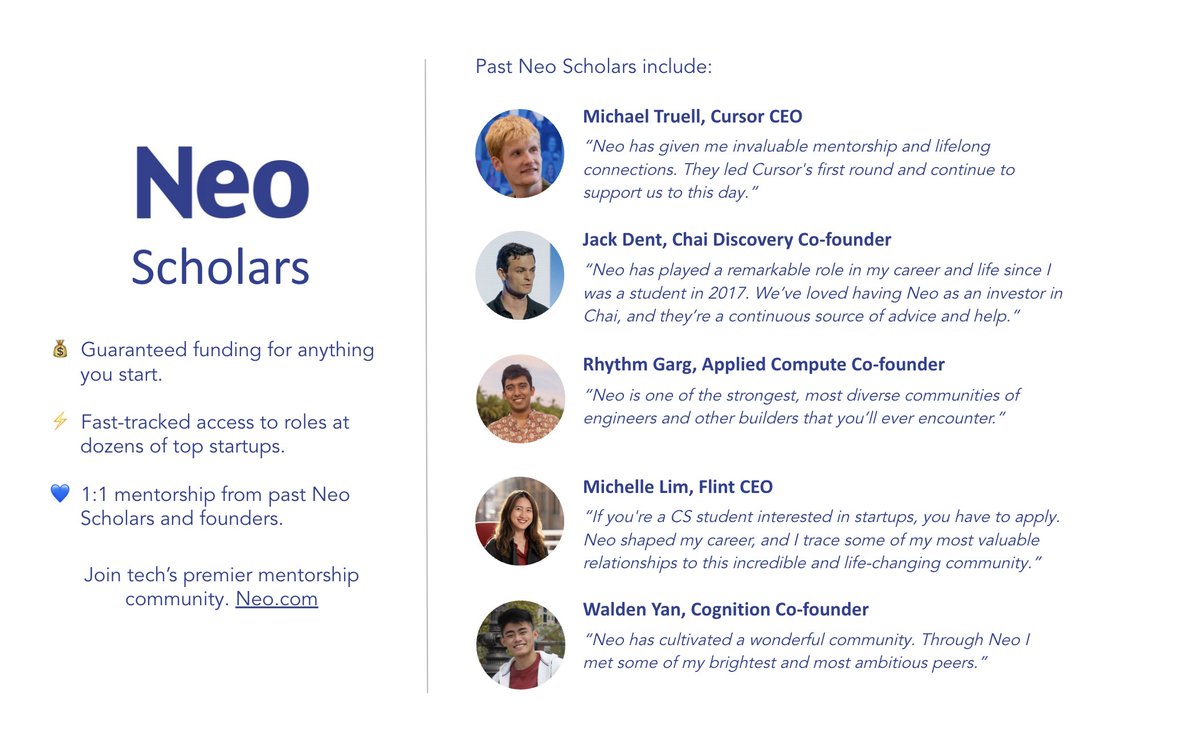

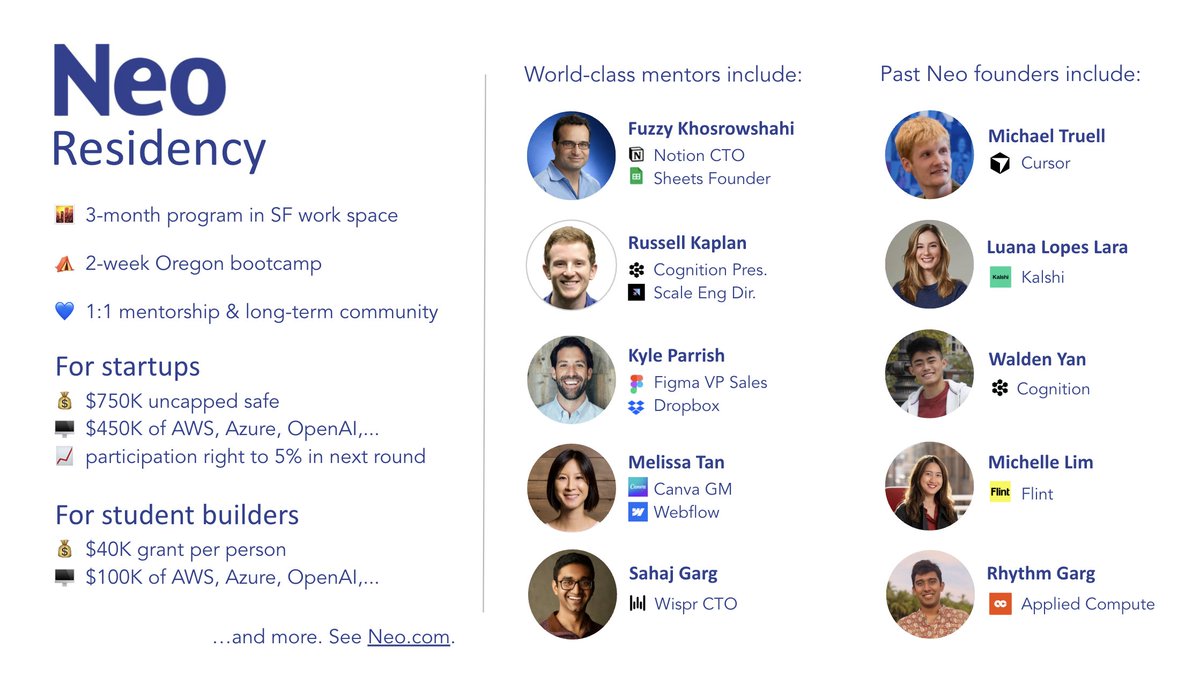
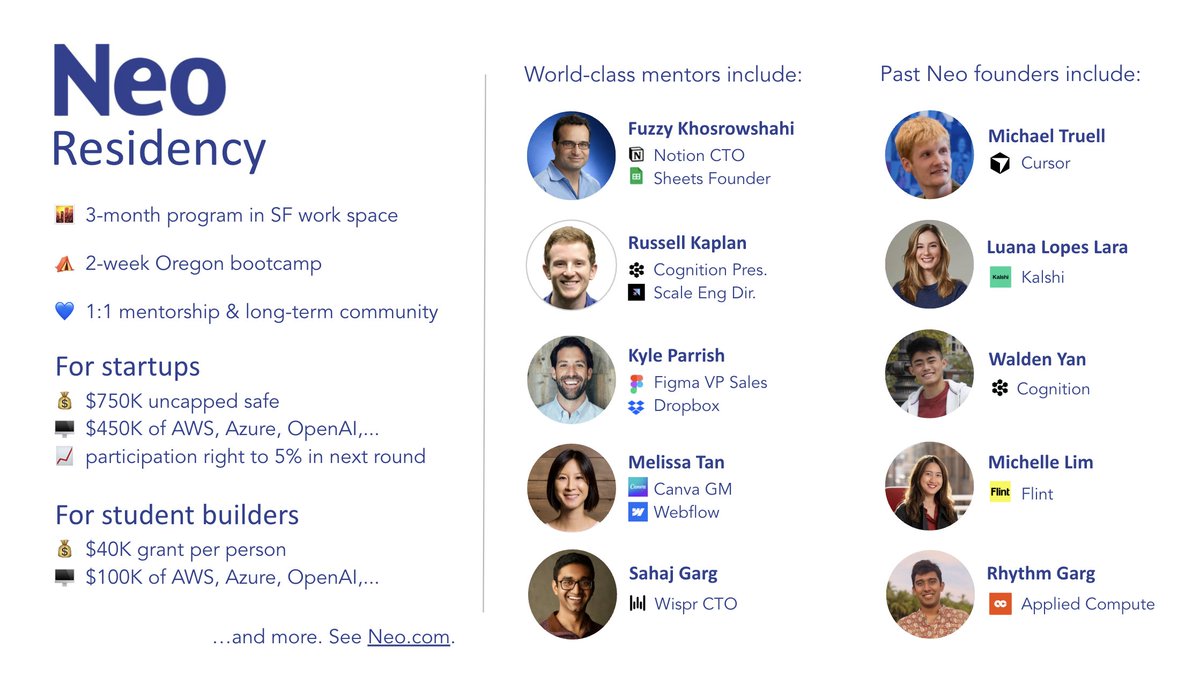

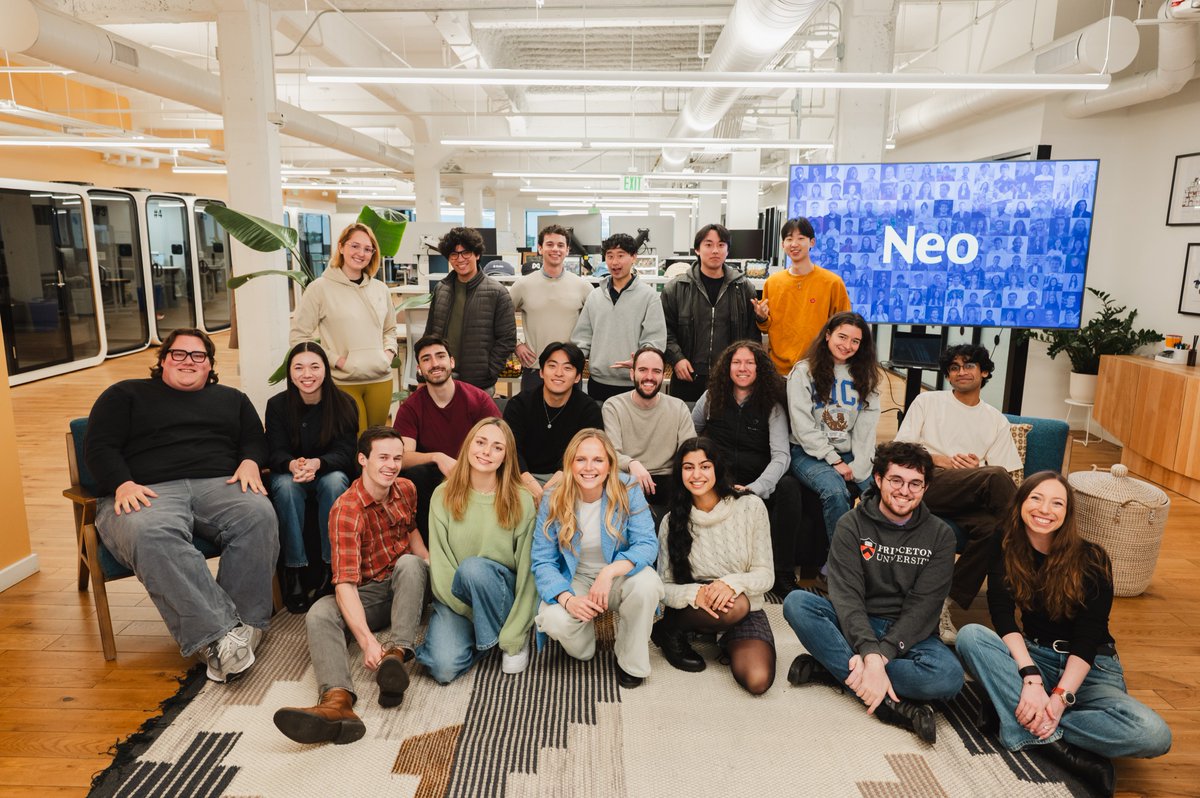

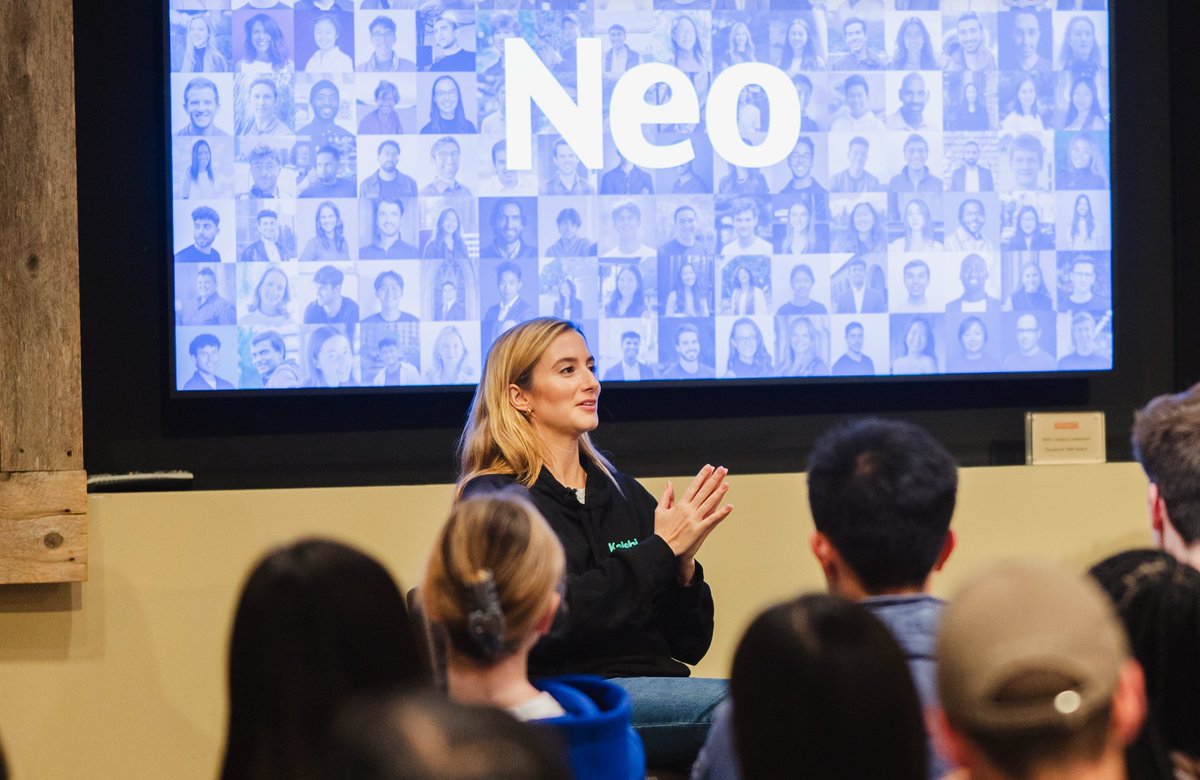


🏆 Neo Scholar applications are open!
Are you a college student who excels at CS?
Follow in the footsteps of Neo Scholars who founded Cursor, Chai Discovery, Applied Compute, Flint, Cognition, & more.
Apply to join one of tech’s strongest communities. neo.com/scholars
4
28
149
146,054
Neo Scholar applications close in 3 days! This is what Neo members have to say about what our community means to them 💙
If you're a college student who shares our love for building, apply by Sunday 6/14 at neo.com/scholars
9
25
4,182

Services are the future. Today we launched Ramp’s AI services motion.
It's easy to buy an AI subscription. It's hard to transform your company to actually run on agents.
Here’s our entire strategy.
1) Why now
Services are the new software (Sequoia)
Human labor TAM >> software license TAM. The market is bearish on seats and subscriptions.
Every enterprise AI company is doing this -- the labs have poured billions into services partnerships and their own deployment functions. Superintelligent models alone are not enough.
Palantir proved this is a strong business model: deeply embed engineers, build on top of a powerful platform, and customize extensively.
2) The real problem
Companies want AI. But the gap between "we have AI tools" and "agents run our workflows and we spend way less time" is enormous.
What we've found across over 50 companies we engaged with: agents start replacing real work when there is: complete data, read/write access across systems, agent-friendly policies. Most big companies struggle because:
- processes live in operators' heads
- dozens of disconnected systems (legacy ERPs, endless one-off excel sheets, etc.)
- archaic software with poor or no API access
Good data in the right place is a hard prereq to working agents.
Also, vibing in localhost ≠ a production system your enterprise can rely on. You still need hosting, ci/cd, observability, feedback loops, good interfaces. And taste to know what's even worth automating.
Everyone has a bulldozer, but most jobs just need a shovel pointed at the right spot.
What companies usually need is to be made agent-friendly. That's exactly what we do.
3) What we do
We focus on what Ramp does best -- finance.
And we embed FDEs that:
-> understand your problems
-> identify high-leverage, high-impact workflows that fit agents
-> scope the solution
-> connect your data
-> capture your context
-> deploy agents and often bespoke software for humans to collaborate with them
-> drive the business metrics that matter
Discovery and scoping are crucial. Building is easier than ever and thus judgement about what to build is more important than ever.
We're not a generic AI services arm, we're finance domain experts. Across the spectrum of financial operations, we help companies find and frame the problems worth automating -- similar to the taste a founder has in choosing which problems are worth solving (ex-founders make great FDEs).
Here’s the stack we deliver:
- Production infrastructure. Shipping an index.html from Claude isn't the same as creating a repo, hosting in a cloud service, ci/cd, testing, setting up evals, managing memories and skills, adding feedback loops, ensuring uptime, incident management, etc. Agents don't one-shot production systems yet. Production software is hard -- we build, host, and run it for you in a single-tenant, dedicated cloud environment. Most operators don’t have the time, knowledge, or experience to do this e2e. We help abstract the low-leverage plumbing so they can focus on the essential parts of their jobs.
- Data connectivity. Most enterprises have data lakes, but data is often incorrect, stale, or entirely missing. And write interfaces vary dramatically. Ideally we can use MCPs or CLIs, but usually it’s poorly documented APIs, SFTP, manual uploads, and email.
- A context layer. Things people have done for years aren't written down, so an agent can't do them until we capture that context -- ranging from simple policies to complex decisions. This usually involves creating policy documents, shared agent memories, and skills.
- Evals and feedback loops. How you know an agent is doing a good job, and how it improves over time.
4) Why Ramp AI Solutions
We focus on finance because it’s the vertical we know deeply, have structural advantages, and are most differentiated:
- Data. 70k customers use our core product, over $200B in annual payments, years of vendor data, millions of transactions and bills monthly.
- Money-movement primitives and partnerships. Global money movement rails, partnerships with banks, Visa, Stripe, etc. You don’t want to vibecode international wires for bill payments.
- An intelligence layer on top: fraud detection from hundreds of millions of expenses, PO-to-invoice matching, state-of-the-art OCR, and fine-tuned models for accounting coding, spend routing, policy review, etc.
Unlike the labs, we’re not incentivized to sell tokens.
Ramp is an AI fiduciary and an impartial broker to deliver AI that is:
- model-agnostic -- we benchmark all the leading models (labs, open source) and fit the right one to each task
- and token-efficient by design
Our main incentive is business outcomes -- which is Ramp’s mission, to save our customers time and money.
I’m extremely bullish about our motion, and the broad industry growth of AI-native services.
If you're a finance leader trying to be more agent-native,
If you’re interested in joining our FDE team,
I’d love to talk 🙂

57
44
545
156,025

What cannot be measured cannot be improved! As @mecadoinc shows in our work with @huggingface, there's a whole lot of work to do to create AI systems that really work for mechanical design. And these are just single parts - no requirements or assembly context!
Jun 8

Introducing CADGenBench: measure how well AI systems produce engineering-grade 3D parts!
While current models can generate 3D parts, they are far from precise enough to build functional parts. We built a benchmark to systematically measure their capabilities on two tasks:
1. Generation from an engineering drawing of a part
2. Editing: given an existing STEP file and a requested change
The benchmark is tool-agnostic. It makes no assumptions about how you build the model. You can vary the LLM, and you can vary the environment. Use build123d, Onshape, Autodesk, or a model without an LLM entirely. We open sourced the scoring engine and a reference baseline on top of build123d.
A collaboration between Hugging Face and @mecadoinc!
Submission space: huggingface.co/spaces/Huggin…
Code repository: github.com/huggingface/cadge…
4
6
11
2,246
Neo retweeted

Jun 8
Most companies raise to defend what they built.
We raised because customers keep pulling us further.
Accounting firms weren't on our core roadmap 6 mo ago, it's a $150B industry. AI spend mgmt didn't exist a year ago. Europe launches this year. Demand isn't the constraint. We're trying not to be.
Jun 4

Today, Ramp raised $750M at a $44B valuation.
Last time we grew this fast, we were 1/20th the size.
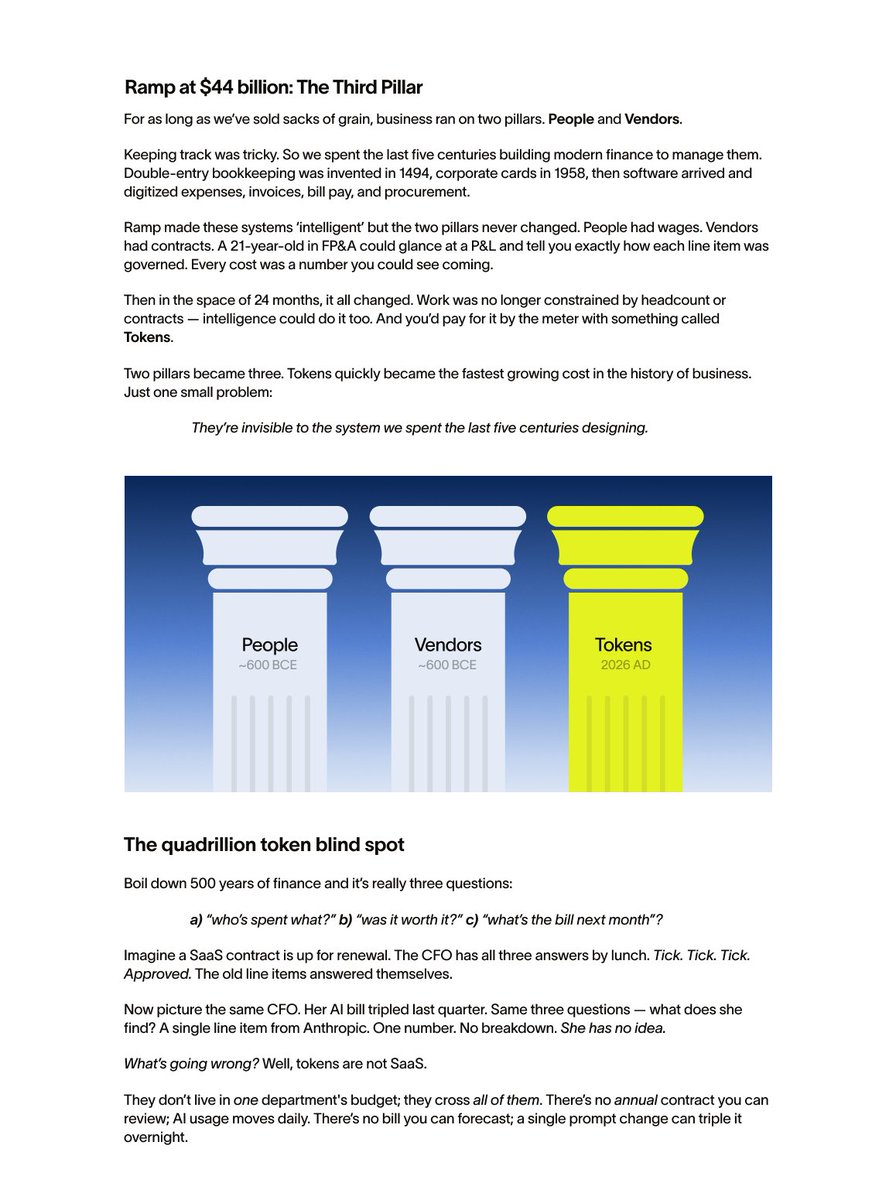
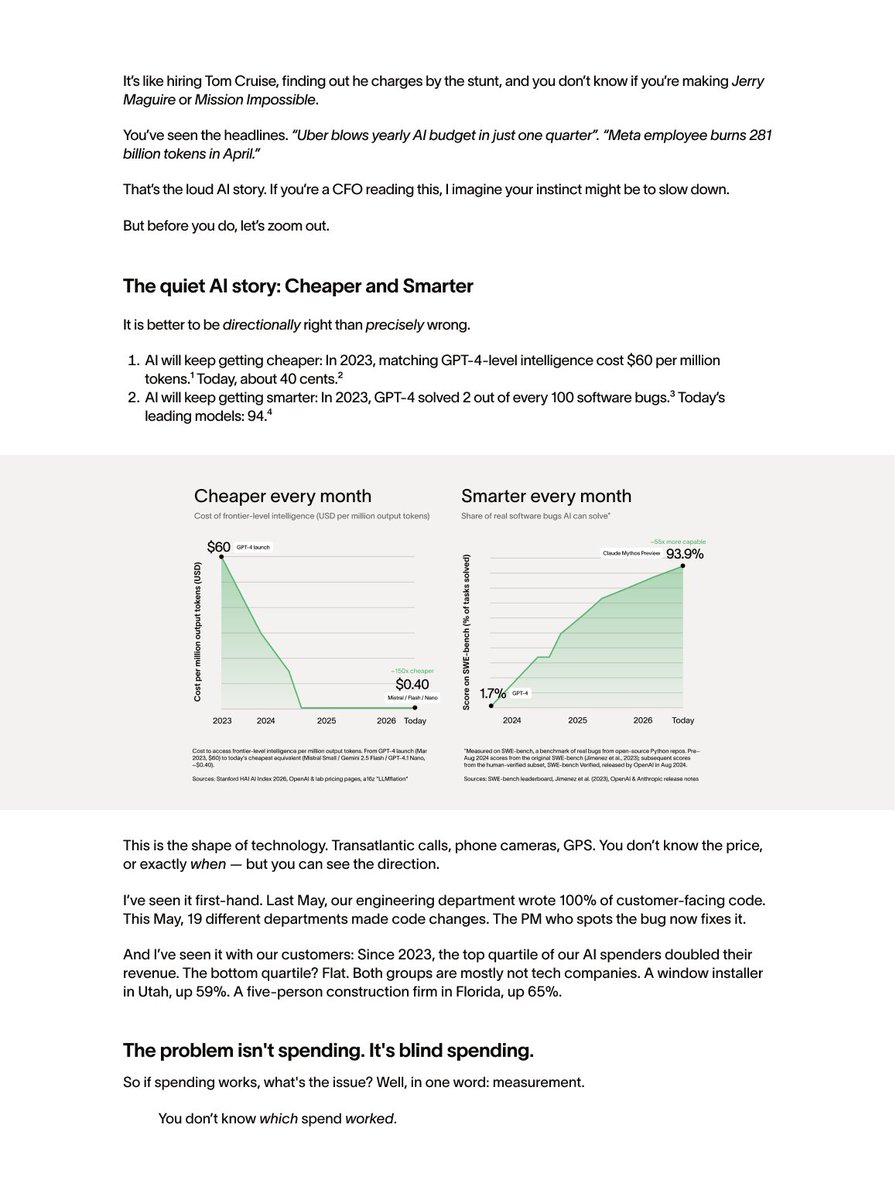
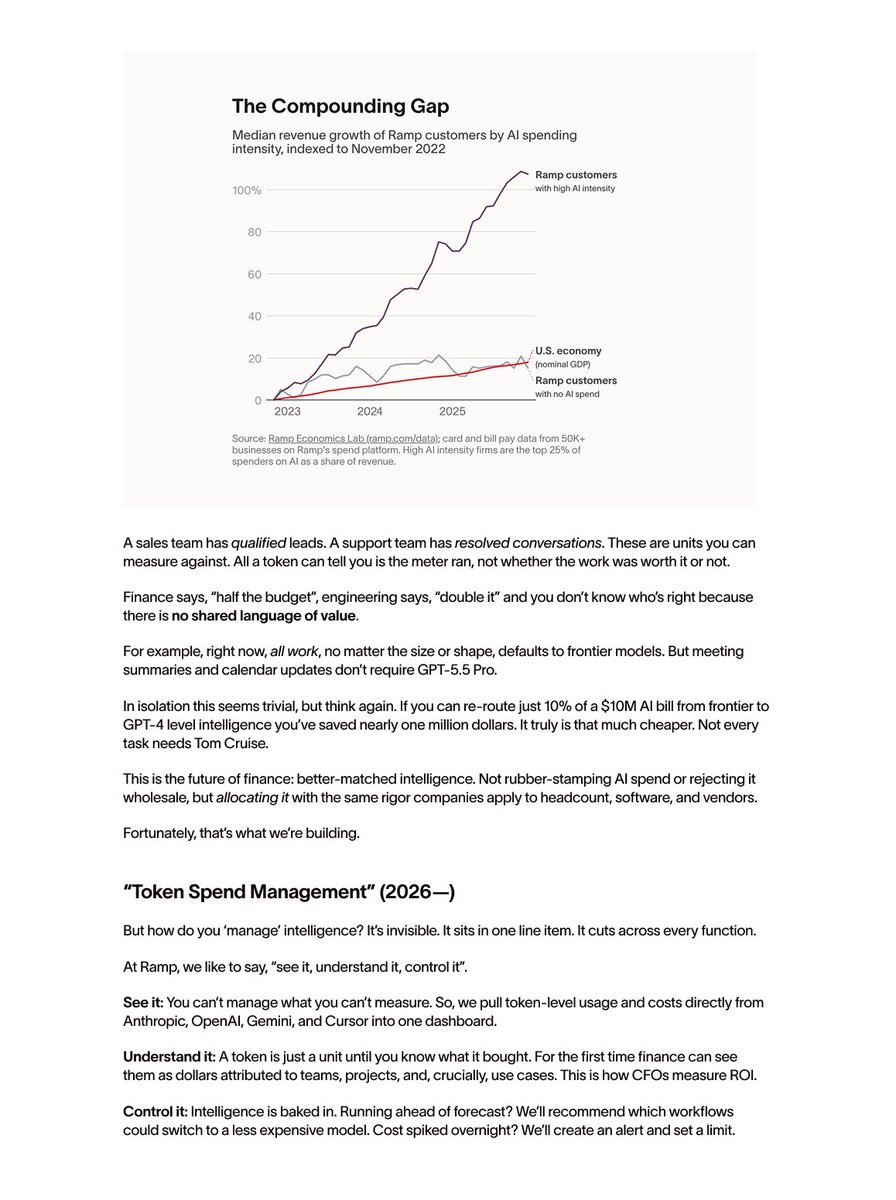
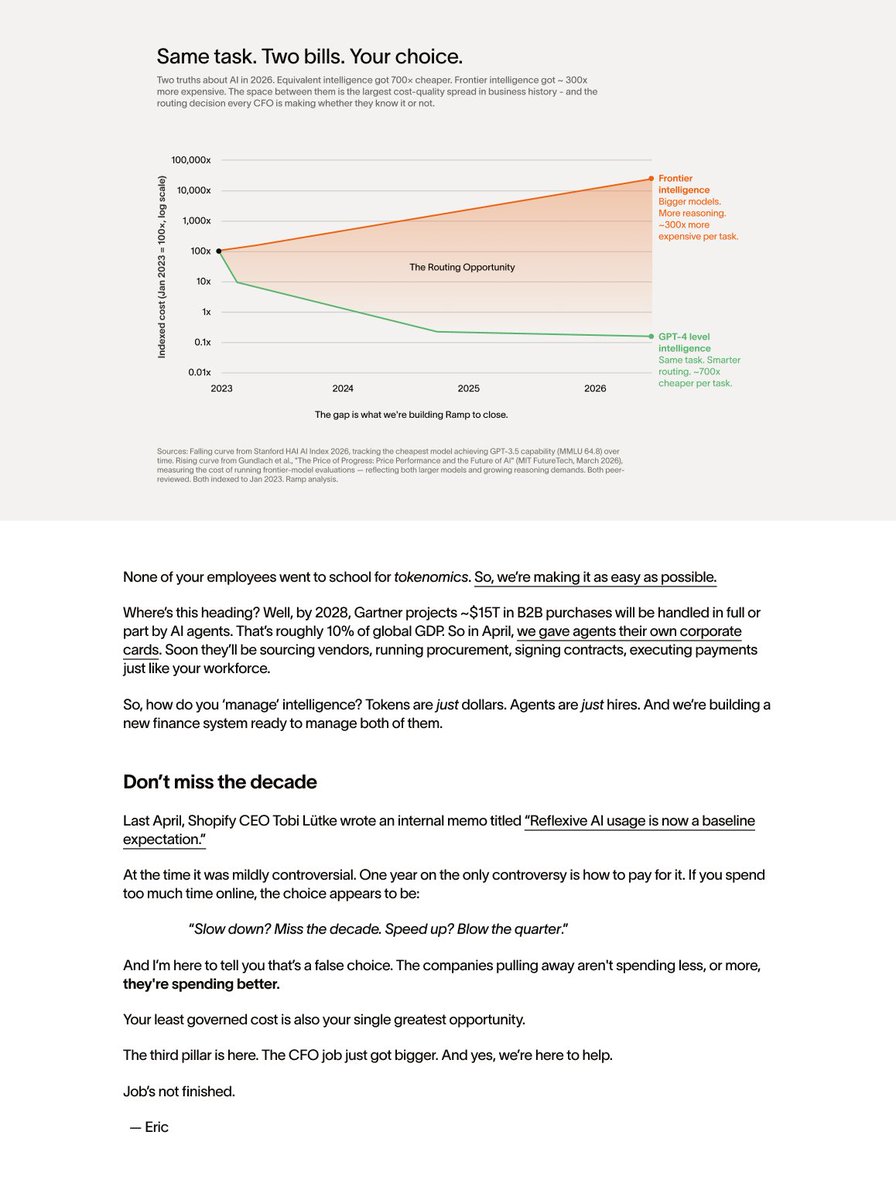
For 2000 years, business was built on two pillars. Today, a third: intelligence.
It’s your least governed cost. It’s also your single greatest opportunity.
12
11
248
41,196
Neo retweeted

Jun 6
This is the bet we made when we started AC.
We work with our customers to train specialized models to be on the pareto frontier.
Jun 6

Token costs are becoming one of the hottest topics for any enterprise I talk with right now. It’s very bullish for AI in general because it means these systems are being used at a scale that wasn’t contemplated before.
It also gives way to another form of differentiation that will emerge for the applied AI layer, which is model routing.
As tokens take on a significant amount of the cost of any given workflow, then companies will inevitably want to ensure that their dollars go into the most efficient use of tokens for the particular job at hand.
Frontier intelligence will always be relevant at the high end of tasks, like coding, legal and financial analysis, healthcare, and more. And dollars spent here will only go up over time. But, equally, you can peel off individual tasks to lower cost models (whether they’re from open weights vendors or the major labs) and deliver a more efficient end outcome.
To do this effectively, the applied AI layer needs to understand the workflows in their domain better than anyone else, and be able to mix and match models to different jobs. If you’re doing document extraction, you need to know which models perform better or worse for any given document type. If you’re legal analysis, you want to know which models perform various types of tasks best. And so on.
This will become one of the bigger differentiation points over time. The companies with the best evals, the best ability to route the workloads, and those that have business models directly aligned to customers financial goals, will be in a great position.
4
60
11,771
Neo retweeted
Jun 8
This is exactly right.
People are starting to look for cheaper model alternatives and realizing two things at once: open-source models are already very good, and the ability to train and serve them efficiently at scale can change the economics pretty meaningfully.
Tokens are still being subsidized, demand is ramping quickly, and the compute crunch is likely to persist. That will push companies toward using the right model for each task instead of defaulting to the most expensive one.
We’re still early, but I expect open-weight adoption to accelerate much faster than most people think.
Jun 2

The most basic way AI could blow up imo. I'm not saying it does but this is the most obvious way I can see it happening
- Per seat subscriptions are massively subsidized. The flat fee was priced way below what heavy usage actually costs
- For real business use you have to move to the API anyway. Data protections, work integrations and compliance officer approval
- On the API you pay metered rates, and businesses are burning credits way faster than the per seat pricing ever led them to expect
- This is everywhere right now. Internally for us, Codex users, Uber torching its entire 2026 AI budget in 4 months, the Microsoft comments. Just go try an API
I shared more on this here: x.com/Shaughnessy119/status/…
- And I don't think most businesses have the money to keep paying increasing API rates without a real change to how they operate (caps needed)
- Because they have a cheap alternative. They can reach open source models through any aggregator (OpenRouter, Venice, Baseten, Together) and still get strong privacy. Venice private data centers, or E2EE/TEE serving GLM 5.1.
More on open source inference provider raises here: x.com/Shaughnessy119/status/…
- And the discount is enormous. DeepSeek V4 codes within a hair of Opus on SWE bench at roughly 1/30th the price, and the cheapest open models run closer to 1/100th
- Chinese labs open source frontier grade models. The model is the single biggest cost an inference provider has, and they get it for free
- This idea dies if China goes closed source. That is actually bullish web2 AI labs, because if everyone is closed you pay up for the best intelligence. China goes closed source if they are tired of giving away an asset and they want the revenue and data flow to train new models
- Is this showing up in web2 AI lab revenue yet? No. Revenue is off the charts. Anthropic went from 9B to 47B run rate in five months
- So go forward, what happens?
- I think revenue slowly starts leaking to the open source inference providers (see Venice usage, OpenRouter's $113M raise, Baseten is raising at $11B or triple its valuation in three months, on revenue that went from $200M to $600M annualized in a single quarter)
- It doesnt move overnight, but it caps the labs ability to raise prices, and margins are already deeply negative. OpenAI is reportedly running near negative 122%
- With margins that bad there is no cash flow, so the labs are fully dependent on outside capital to buy GPUs, train models, and keep subsidizing usage (I.e. see Google tapping $80b equity sale, granted 30b for employee RSU taxes. Clearly they think Equity is overvalued or you wouldn't sell it)
- The break comes when that capital stops. Pricing is capped so margins cant improve, and the moment investors lose conviction on payback, the whole flow reverses
- Why would they lose conviction on payback? Back to the start - the inability to improve margins or get businesses to pay more
- This is also limiting, if we start making new drugs with AI or create entirely new businesses, you better believe people will pay up to the max for AI usage
15
21
201
57,030
Neo retweeted

Jun 8
Last week I was so proud to see Forbes recognize my twin brother @apartovi and @Neo as the #2 seed investor on its global “Midas” List.
And this was *before* Cursor and Kalshi’s current level of success. Next year #1. 🤞
forbes.com/profile/ali-parto…
4
5
71
5,698
Neo retweeted

Jun 5
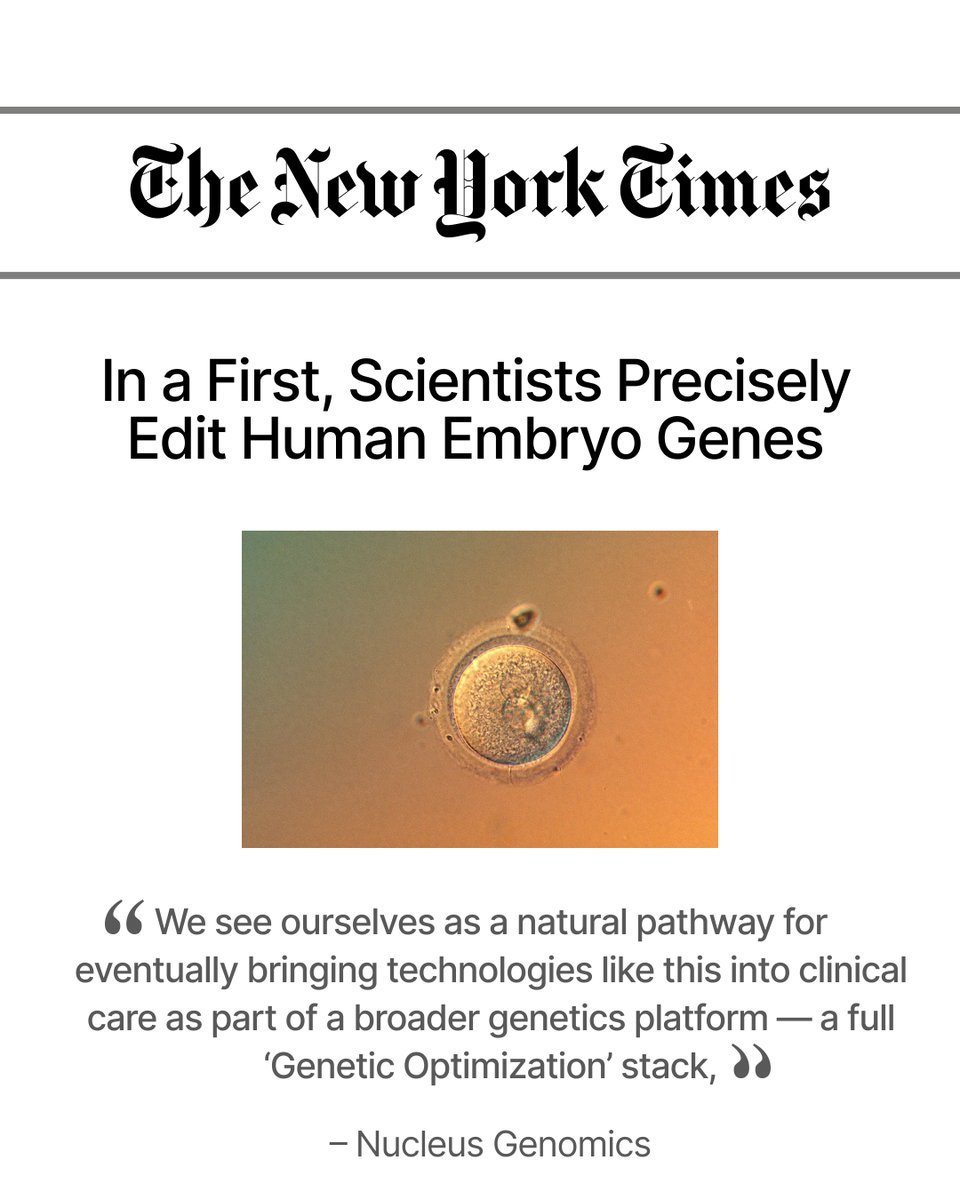
Genetic engineering in human embryos is here.
Today, in a world first, @Columbia and @nucleusgenomics announce high-efficiency editing of human embryos.
The study, led by Dr. Dieter Egli's lab at Columbia University, with Nucleus Genomics’ Dr. Nathan Treff as a senior co-author, achieved editing efficiencies of up to 100% at targeted loci. Simultaneously, we showed no detectable editing-induced chromosomal abnormalities and low off-target activity.
In other words, this is the closest we've come to practical, high-precision gene editing in human embryos.
We are also excited to announce we will be funding and participating in the next phase of this research, alongside Columbia and Dr. Egli.
We see ourselves as a natural pathway for eventually bringing technologies like this into clinical care as part of a broader genetics platform — a full "Genetic Optimization" stack.
@nytimes broke the news in what is a historic moment for Genetic Optimization. See story in thread.
17
67
383
56,812
Neo retweeted

Jun 3
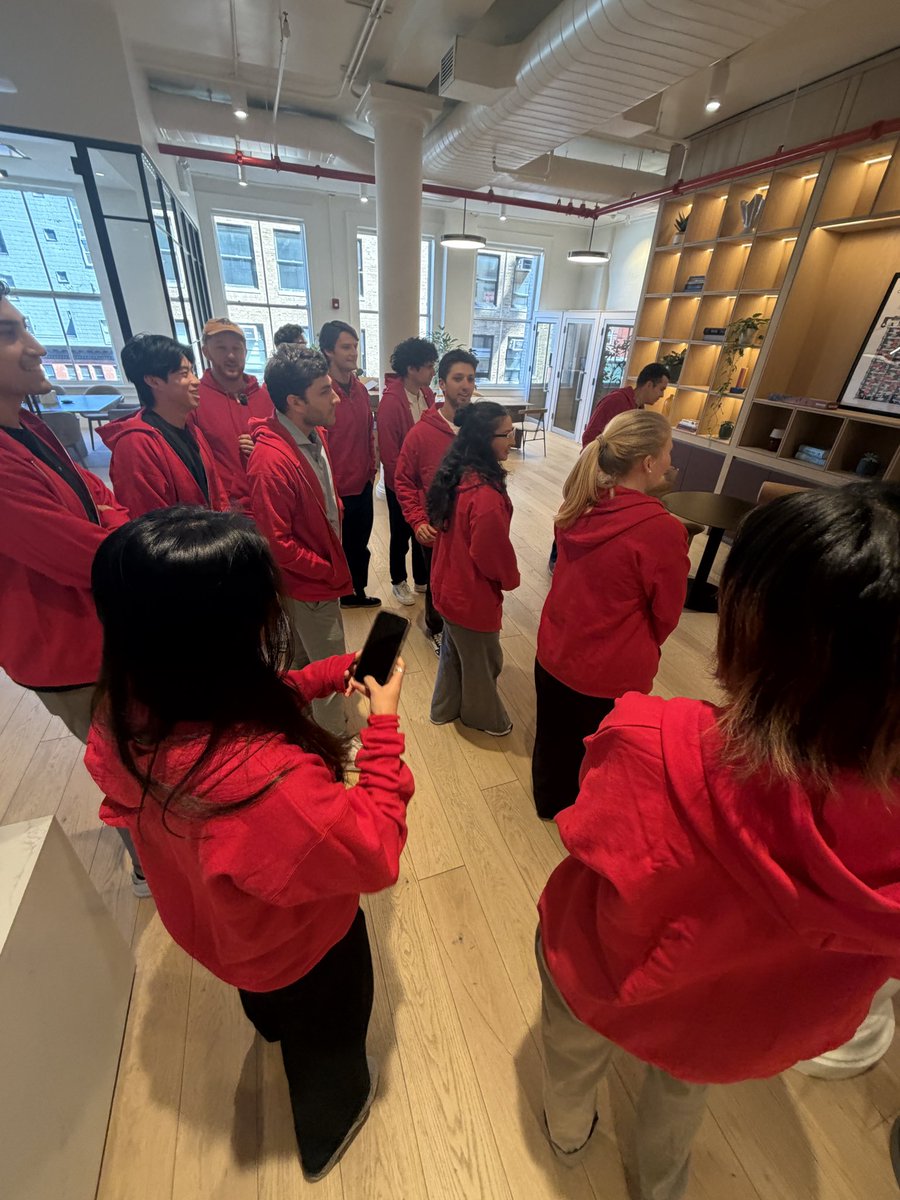
if your entire company doesn’t dress up as you for your birthday, they don’t love you as much as cognition loves @ryanbai1412
4
4
74
33,575
Neo retweeted

Jun 4
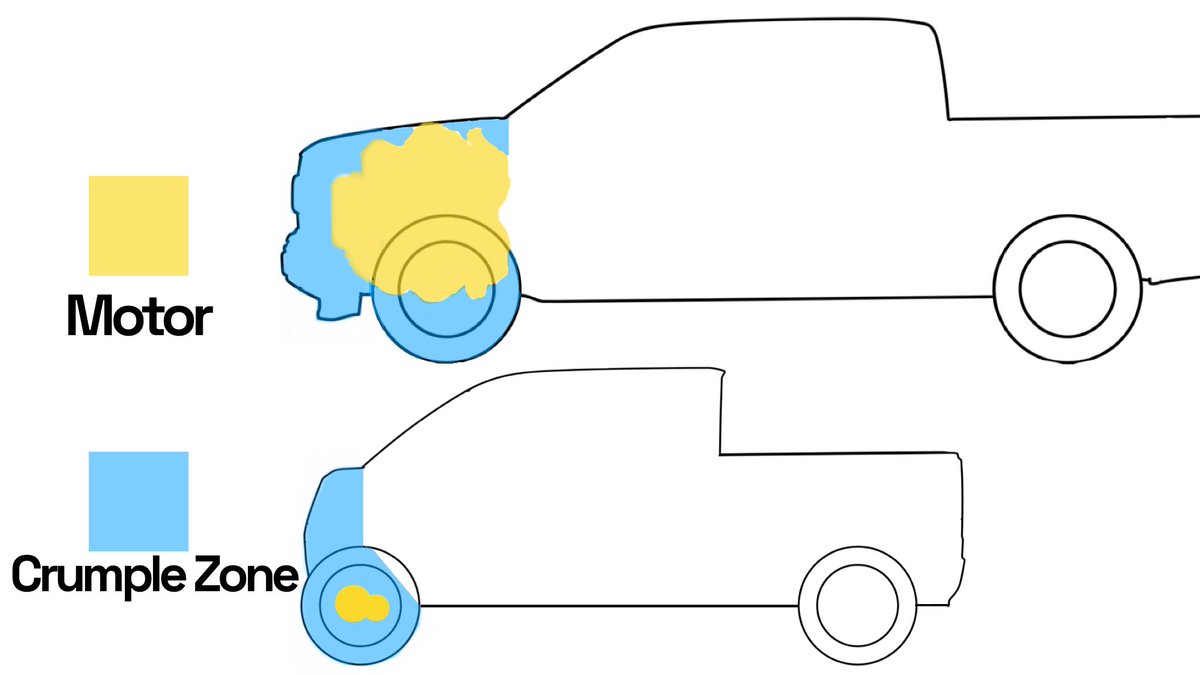
This simple image is absolutely brilliant.
It shows how you can fit the capacity of a Toyota Tacoma in the footprint of a Mini Cooper.

1
1
25
9,180
Neo retweeted

Jun 4
Although LLMs aren’t conscious, this isn’t an intrinsic limitation of the transformer architecture
Natural language and video/audio are only a small slice of cognitive output, which also includes motor control, emotion, hormone regulation, etc. So learning a generalized representation of this slice is unlikely to precipitate anything close to human consciousness
However, consider a model defined by the following
Inputs: current neuronal state sensory inputs
Outputs: neuronal state at the next timestamp
Loss: comparison of predicted neuronal state against the ground truth
A sufficiently strong model with this parametrization should be able to explicitly model the interior process and state of human consciousness, albeit via a different underlying mechanism. If consciousness is empirically determined by neuronal state and a functional model of consciousness holds, the quality of consciousness should be indistinguishable from that of a biological human

2
1
6
847
Neo retweeted

Jun 4
When President Trump’s Q1 financial disclosures came out, many people assumed he was actively trading individual stocks. It turns out he was most likely using some form of an automated, managed strategy like direct indexing.
Our team helped Bloomberg’s @justinaknope investigate the nature of the trades. She published her findings in an article that came out a few days ago, linked in the thread.
Here’s the back story.
President Trump’s recent financial disclosures included thousands of securities transactions in Q1 2026, including 3,642 equity transactions. Reporters and commentators quickly raised questions about whether the president was personally trading individual stocks.
During a White House press briefing on May 19, Vice President JD Vance was asked about the trades by @AndrewFeinberg of The Independent. The VP rejected the idea that Trump was personally placing trades, saying, “The president doesn’t sit at the Oval Office on his computer on his, like, Robinhood account buying and selling stocks. That’s absurd.”
Eric Trump later posted on X that the president’s holdings were maintained by third-party advisers through “automated, model-based portfolios and direct indexing strategies.”
Our own analysis points in the same direction. A typical direct indexing account on @frecfinance can generate hundreds or even thousands of trades in a quarter, depending on the index, account size, cash flows, tax-loss harvesting activity, and rebalancing needs.
We also saw patterns that looked consistent with tax-loss harvesting, including sales around market drawdowns.
So there we have it. POTUS most likely uses direct indexing. And with Frec, direct indexing is no longer just for institutions and the ultra-wealthy.
1
5
8
3,234
Neo retweeted
Jun 4
Today, Ramp raised $750M at a $44B valuation.
Last time we grew this fast, we were 1/20th the size.
For 2000 years, business was built on two pillars. Today, a third: intelligence.
It’s your least governed cost. It’s also your single greatest opportunity.
139
201
2,600
1,053,634
Neo retweeted

Jun 4
Today we are announcing our collaboration with Pfizer to put Chai's frontier AI—including our latest model, Chai-3—directly into the hands of one of the world's leading pharmaceutical teams.
18
83
628
147,018
Neo retweeted
Jun 4
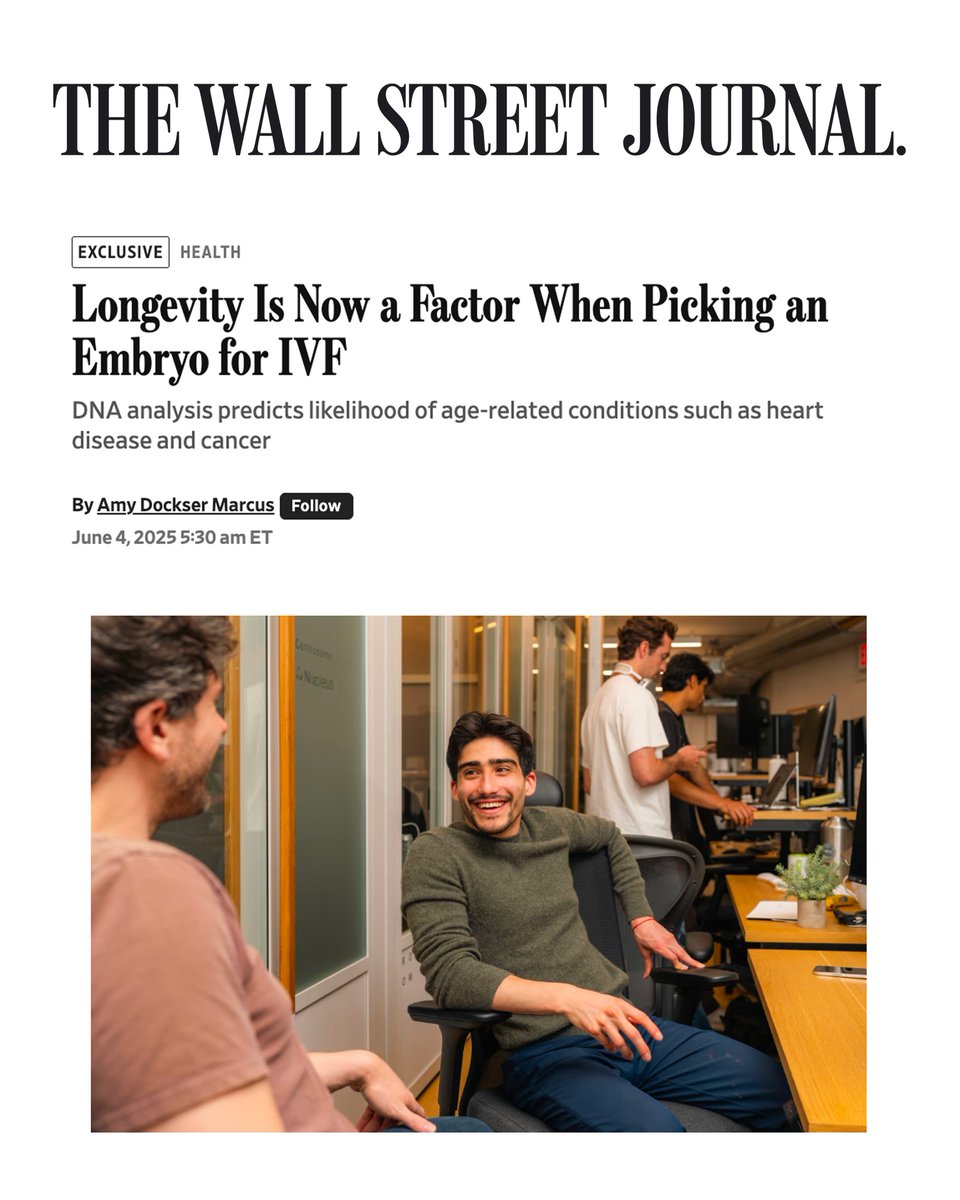
One year ago today, we launched Nucleus Embryo. The biggest leap in embryo screening since IVF began. At the time, IVF patients were choosing their future baby randomly — with no health information.
Today, Nucleus Embryo is one of the fastest-adopted technologies in modern fertility care.
In just 12 months, we've expanded to 165 fertility clinics globally, kicking off an international patient-led movement on genetic optimization.
What a privilege it is to serve our patients, and help couples all over the world build generational health.
Learn more below.
3
4
49
10,097

I’m delighted to announce @chaidiscovery's collaboration with @pfizer. Their scientists will deploy our AI platform to accelerate drug discovery, including early access to our latest frontier model Chai-3.
You can learn more about this partnership and our momentum in @amyfeldman's feature in @Forbes out today
forbes.com/sites/amyfeldman/…
31
27
336
98,752
Neo retweeted

Jun 2
If you use conductor, codex, claude, devin, etc you can now use them all from one place AND get builtin devin review IDE
Windsurf has evolved into Devin Desktop
Jun 2

Introducing Devin Desktop.
Manage fleets of local and cloud agents from one surface. Plan, delegate, review, and ship without leaving your editor.
11
6
205
26,186
Neo retweeted
Jun 3
Introducing Stack.
The AI operating system that lets accounting firms take on more clients without hiring. Learns your firm's process, runs the close, posts the journals. Fully auditable.
We’re living through the biggest shift in accounting since the spreadsheet.
82
139
1,692
925,995
Neo retweeted

Search agents have no explicit belief state or value function.
I think that’s why long-horizon agents degrade and test-time search saturates.
A few small experiments and thoughts:
shreshthrajan.com/search-age…
1
3
430
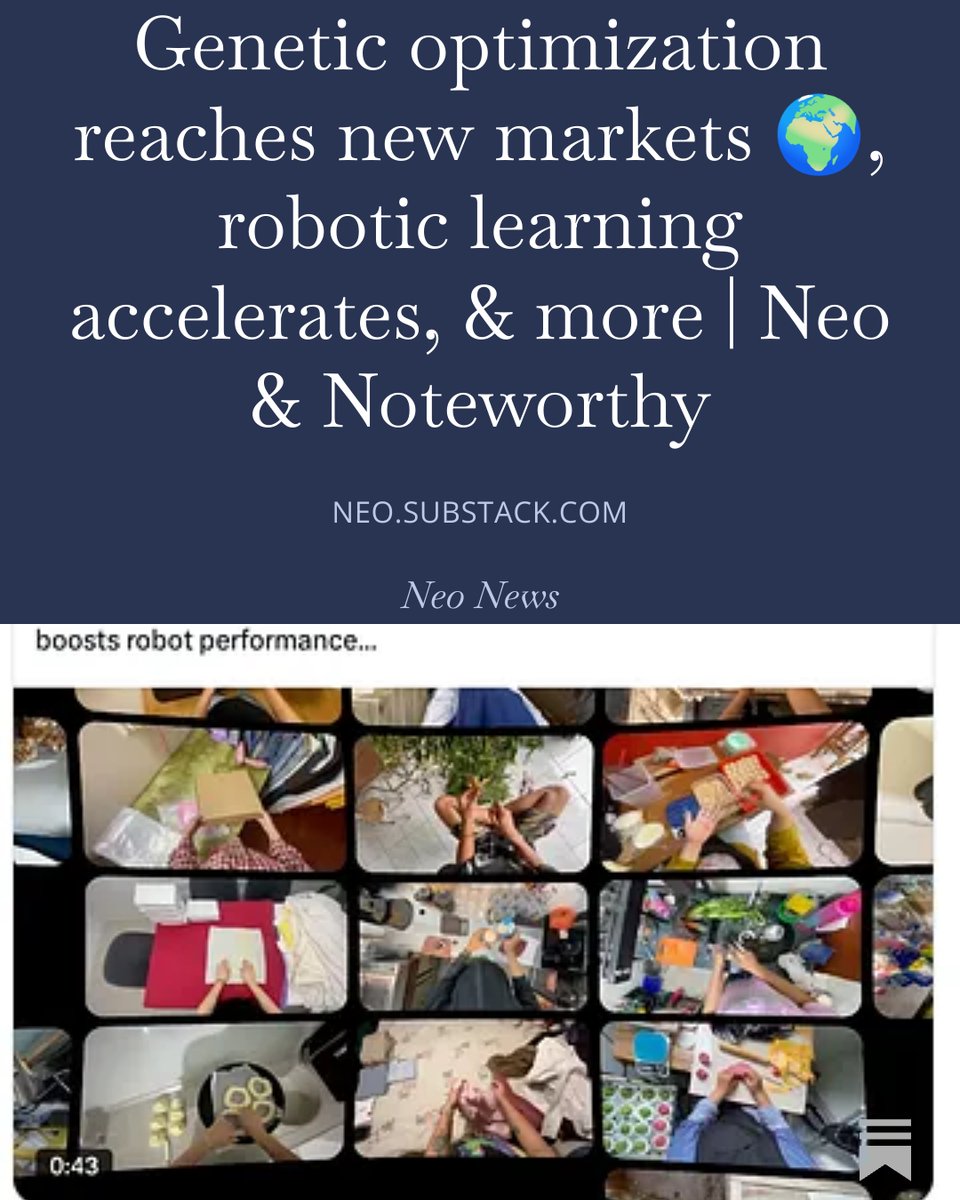
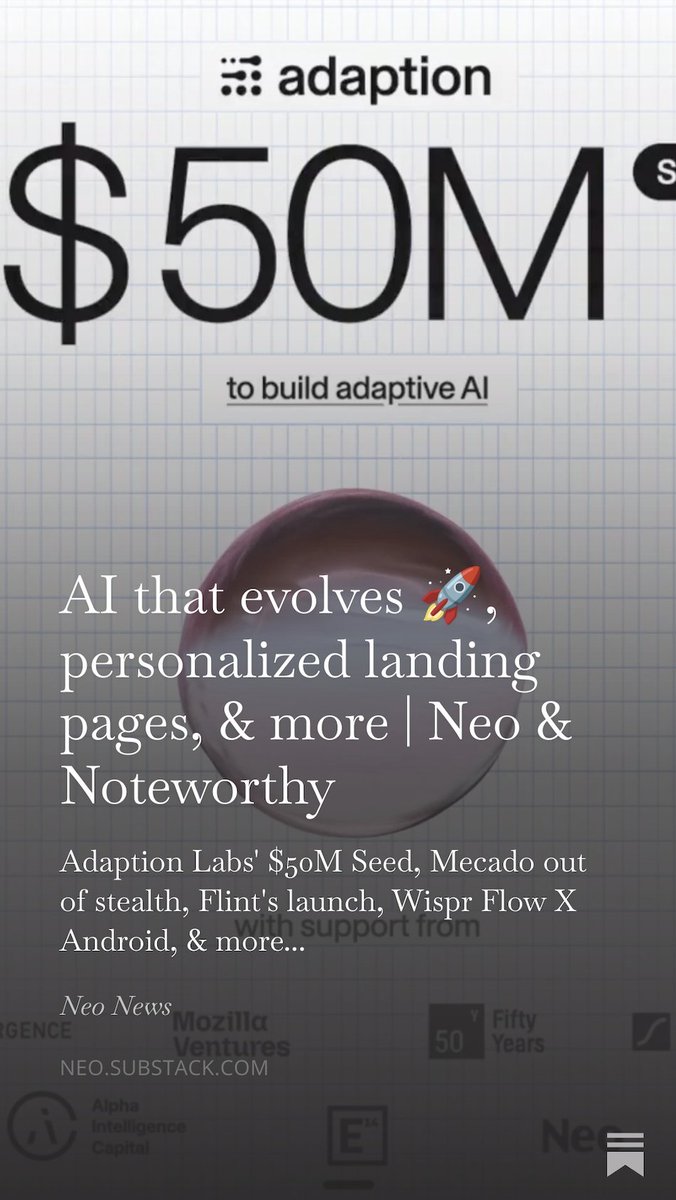
Cognition’s $492M run-rate, your personal property manager, & more | Neo & Noteworthy
Check out our May recap of learnings and announcements by Neo portfolio companies and community members 💙
open.substack.com/pub/neo/p/…
3
3
13
789