
우주, 반도체, 양자컴퓨팅, 보안
Joined December 2009
- Tweets 2,272
- Following 1,306
- Followers 1,362
- Likes 1,315
570 Photos and videos




blog.naver.com/4-fire/224166…
한국어로 보다 자세한 내용은 👆

4
3
61
8,709
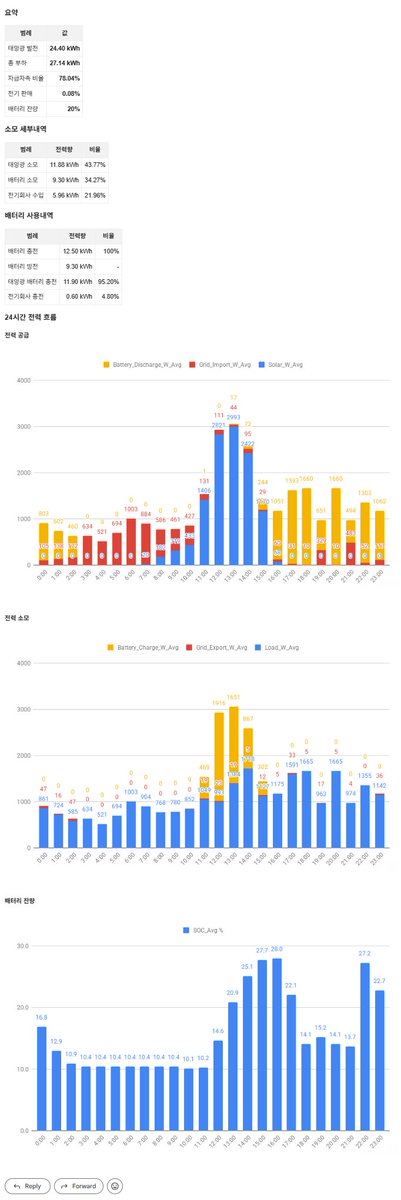
이제 웹사이트에 접속을 하지 않아도, 내 가정의 전력 현황정보를 이메일로 받을 수 있게 되었습니다.
어제 하루동안 작업해서 얻은 결과입니다.
특정 조건을 넣어서, 알람 이메일도 발송되게 해놨습니다.
예를 들어 배터리가 일정 이상 있음에도 불구하고 전기회사에서 전기를 끌어 오거나, 배터리 잔량이 부족할경우에는 일정 이상의 전기를 사용하게 되면 이메일을 받으면 어떤 기기를 사용했을때 전기 사용량이 튀는지 바로바로 알고 싶어서입니다.
Low SOC with high load: SOC 10.4%, Load 1095 W
Current values:
SOC: 10.4%
Solar: 0 W
Load: 1095 W
Grid: 12 W
Battery: 1083 W
Time: Sun Jun 14 2026 21:10:19 GMT 1000 (Australian Eastern Standard Time)
한국처럼 전기세가 싼 나라 흔치 않습니다.
저는 태양광도 있고, 배터리도 설치했는데, 한달에 10만원대 전기세를 냅니다.
4
157
My friend @HannaSuds highlighted a very important point in the article below, and I think it’s worth a read.
Meanwhile, my other friend @TechInnovationz decided to make things even more interesting by asking the difficult question:
“Who will deliver?”
Rather than answering it directly, he seems to have handed that question off to the rest of us.🤣🤣
The article uses the word “delivery” primarily in the sense of achieving promised technical milestones. IonQ has earned a reputation for doing exactly that.
However, I believe Hanna may have been hinting at something even deeper.
Most quantum companies talk about future milestones. IonQ has built a reputation for actually delivering them.
And increasingly, the word “delivery” carries a second meaning. Through its quantum networking strategy, IonQ is not only delivering roadmap milestones but also working toward the physical delivery of quantum information itself.
In the future, success may not be defined solely by how many qubits a company can build, but by how effectively it can deliver those qubits across a network.
Perhaps this is also what Hanna was implying.
Today, “delivery” means executing on a roadmap and achieving technical milestones. But in the quantum networking era, it may come to mean something much more literal: delivering qubits, entanglement, and quantum information across distributed quantum systems.
Viewed through that lens, acquisitions such as Qubitekk, Lightsynq, and Capella appear less like individual deals and more like pieces of a broader vision. IonQ may not simply be building quantum computers—it may be building the infrastructure required to deliver quantum information itself.
If that interpretation is correct, then Hanna’s choice of the word “delivery” was more insightful than it might first appear.

$IONQ
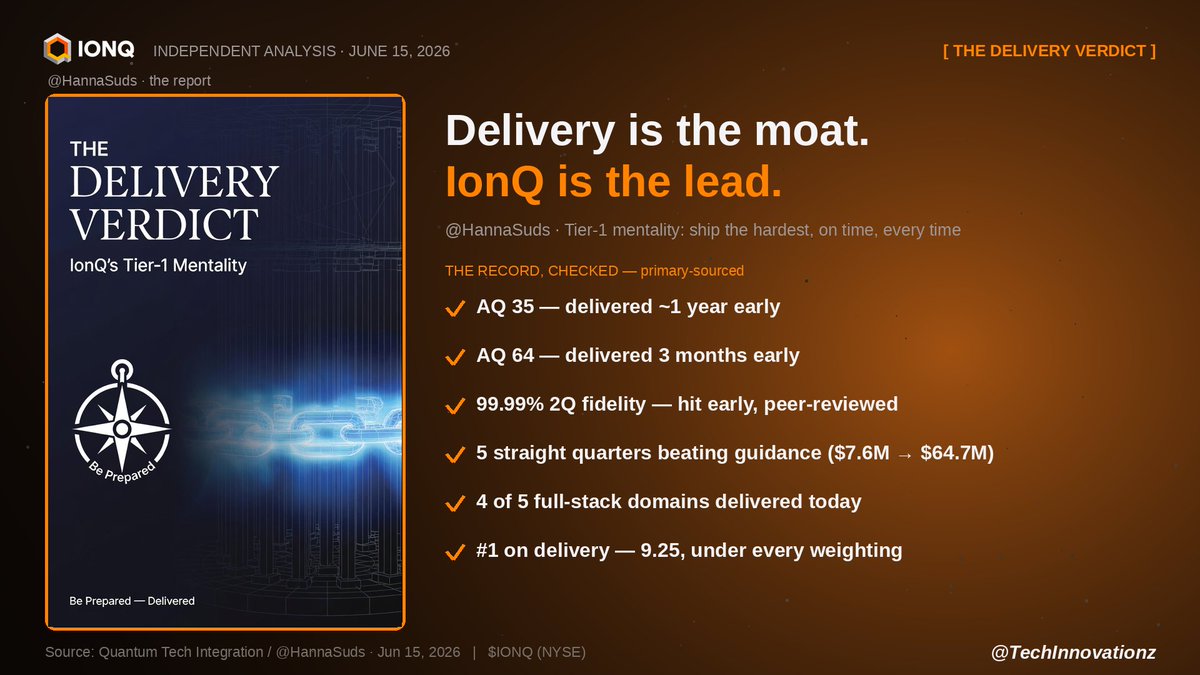
Everyone's racing to build a quantum computer. @HannaSuds asks the harder question: who ships?
Her new verdict - delivery is the moat.
→ AQ64 delivered 3 months early
→ 5 straight guidance beats
→ 4 of 5 full-stack domains shipped
Tier-1 isn't a slogan. It's a record. Go read it 👇
🔗quantumtechintegration.blogs…
#IonQ #Quantum #QuantumComputing
3
21
1,226
HydRon 관련 업데이트입니다.
주기적으로 유럽 위성통신망을 관찰하고 있는데, 시장이 엄청나게 확대될것이라 믿기 때문입니다.
관련 내용은 아래에 링크한 지난 3월 포스트를 참고하세요.
m.blog.naver.com/4-fire/2242…
14h

"HydRON 기준 터미널 → IRIS² 대량 조달"의 파이프라인이 계속 살아 있다
새로운 계약이나 확률 이동 증거를 제공하지 않으나, Rocket Lab 논문의 핵심 경로인 "ESA HydRON → IRIS² 파이프라인"이 현재 진행형으로 활성화되어 있음을 확인시켜 주는 도함수 확인(derivative confirmation) 성격의 정보다.
기존에 정리된 구조를 되짚으면:
HydRON은 ESA ScyLight/ARTES 프레임워크 내 기반 기술 실증 단계이며, €108억 규모 IRIS²의 광학통신 표준·기술을 검증하는 선행 프로그램이다.
HydRON Element 2에서 Mynaric CONDOR가 "기준 터미널(baseline OCT)" 역할을 수행 중이므로, IRIS² 대량 조달 시 구조적 우위 경로가 형성되어 있다.
다만 ESA는 Element 3(2026.04, Kepler 프라임)에서 Tesat·Mbryonics·Astrolight 등 대안 OCT의 상호운용성을 검증 중이며, 복점(duopoly) 구조가 베이스 시나리오다.
이번 ScyLight2026에서 Mynaric/Rocket Lab Europe 엔지니어가 발표자(contributor) 자격으로 참여했다는 사실은 중요하다.
단순 참석이 아니라 ESA가 주관하는 프로그램의 기술 논의에서 산업화된 OCT의 대표자로 인정받고 있다는 것이며, 이는 HydRON → IRIS² 파이프라인에서의 기준 표준 지위가 유지되고 있음을 시사한다.
추가로 주목할 점은 "양자 네트워크"와 "직접 지구-위성 광학 링크"가 함께 논의되었다는 것이다. 양자 키 분배(QKD)는 유럽의 EuroQCI(European Quantum Communication Infrastructure) 프로그램과 연결되며, 이 인프라의 물리적 계층에 광학 터미널이 필수적이다.
CONDOR 플랫폼이 QKD 페이로드와 통합될 수 있다면 TAM의 질적 확장이 가능하나, 현재로서는 구체적 증거가 없으므로 이미 확인한 기대가능성의 모니터링 수준으로 유지한다.
10
475
m.blog.naver.com/4-fire/2243…
$IONQ $LAES
QSOC: More Than Just a PQC Story
At first glance, QSOC appears to be a satellite-based PQC and digital identity platform. However, SEALSQ’s acquisitions suggest a much broader ambition.
If SEALSQ were only a PQC company, investments in EeroQ, Quobly, Miraex, WISeSat, and Wecan would be difficult to explain. Together, these assets point toward a long-term strategy of building a Quantum Trust Infrastructure that spans security, identity, satellites, quantum networking, and eventually quantum computing.
Interestingly, this mirrors IonQ’s recent expansion strategy.
IonQ: Quantum Computing → Networking → Security
SEALSQ: Security → Identity → Networking → Quantum Computing
While they start from opposite ends of the stack, both companies appear to be moving toward the same destination: a future where quantum computing, quantum networking, digital identity, and security infrastructure converge into a unified Quantum Internet.
In that sense, QSOC should be viewed not as a standalone product, but as SEALSQ’s blueprint for participating in the future quantum ecosystem.
1
2
16
1,742

IonQ와 QC Ware의 QNN 논문 분석
youtu.be/P35mrYYBQ9s?si=eivb…
1
1
12
477
m.blog.naver.com/4-fire/2243…
This paper is not claiming that quantum AI has surpassed classical deep learning.
In fact, Quantum Machine Learning (QML) has been actively researched for years by organizations such as IBM, Quantinuum, IonQ, Xanadu, and many academic institutions. However, most prior studies were limited to small-scale systems with only 4–8 qubits, or relied on simulators for training while using real quantum hardware only for inference and validation.
From that perspective, the most important contribution of this work is not the introduction of a new AI model, but rather demonstrating that Quantum Neural Networks (QNNs) can be trained in a practical manner on real quantum hardware.
QC Ware introduced a new training framework built around Butterfly Architecture, Layer-wise Training, and Parallel Parameter Shift. Most importantly, it reduces the gradient evaluation cost from approximately O(n²) to O(log n), directly addressing one of the largest bottlenecks in QML: the cost of training.
Meanwhile, IonQ leveraged the all-to-all connectivity and high-fidelity performance of its Forte Enterprise system to perform training on a 16-qubit QNN and inference on a 32-qubit QNN. This demonstrated that the proposed framework can operate successfully on real quantum hardware rather than only in simulation.
As a result, this achievement should not be viewed as a victory of software over hardware, or vice versa.
Rather, it represents a successful collaboration between the two. QC Ware provided a new software stack for quantum machine learning, while IonQ demonstrated that the stack could be executed effectively on real quantum hardware.
Of course, there is still limited evidence that QML outperforms classical machine learning. In this study, the performance gap between Deep MICE and the QNN model was small, and the authors themselves do not claim any form of Quantum Advantage.
However, from an industry perspective, the implications are significant.
Modern AI was built on a layered technology stack consisting of GPUs, CUDA, PyTorch, and Transformer architectures. This paper suggests that quantum computing may eventually develop a similar “Quantum Training Stack.” If such training frameworks continue to mature, entirely new classes of AI models running on quantum hardware could emerge in the future.
Should QML continue to advance, it may have meaningful impact across a variety of industries, including:
Complex financial modeling and risk analysis
Drug discovery and protein interaction modeling
Quantum chemistry and advanced materials research
Supply chain and logistics optimization
Defense and intelligence applications where data is limited
Processing data generated by future quantum sensors and quantum networks
At present, many of these possibilities remain largely theoretical. Yet the reason the industry is paying attention is not because of current performance metrics alone.
QNNs are believed to have the potential to represent highly complex correlations with fewer parameters, learn effectively from smaller datasets, and eventually process quantum-native information directly. These capabilities remain hypotheses today, but they are compelling enough to motivate continued research.
Therefore, this paper should not be interpreted as a declaration that quantum AI has defeated classical AI.
Instead, its significance lies in demonstrating that a practical methodology for training quantum AI on real quantum computers is beginning to emerge—and that such a methodology can successfully operate on existing hardware.
If Quantum AI eventually becomes a major industry in the future, this work may be remembered not as a medical data experiment, but as one of the early milestones on the path toward practical quantum machine learning.
2
25
1,534
진심 궁금

3
237
삼겹살, 소주, 그리고 AI 제국의 설계도
youtu.be/5BJmDzNXE1s?si=89ml…
6
313
m.blog.naver.com/4-fire/2243…
Jensen Huang came to Korea and everyone talked about BBQ, soju, and partnerships.
But after reading the SK hynix and SK Telecom announcements, I came away with a different impression.
Years ago, NVIDIA came to sell GPUs.
This time, it came to sell GPU Everything.
SK hynix builds the memory.
SK Telecom builds the AI Factory.
Naver builds the AI services.
NVIDIA provides CUDA, DGX, networking, DSX, and the platform layer connecting it all.
If AI Factories succeed, everyone wins.
If they fail, some are left with factories, data centers, and massive CAPEX.
NVIDIA is left with lower demand.
That’s the difference.
Maybe the real gift Jensen brought to Korea wasn’t a GPU.
Maybe it was an invitation to join NVIDIA’s AI empire.
2
15
578

Agreed
Jun 6

"一枚の紙に折り重なる人生…
赤い風船持った幼い笑顔から、
成長・愛・家族…そして静かな別れまで。
同じシルエットで繋がる儚さ。
人生は短い。
今を、大切に。"
1
7
318
여러분들 의견은?

4
8
1,723
저렇게 길고 더럽다고
3
414