
CEO @sortlist ($1B generated for agencies) | overloop.com (outbound) | Sortlist Radar at launch.sortlist.com (intent)
Joined April 2011
- Tweets 6,074
- Following 639
- Followers 10,294
- Likes 59,850
291 Photos and videos









Pinned Tweet

May 6
there's a version of the @sortlist story that fits in a tweet. four of us started it in brussels in 2014, raised about €18m across three rounds, crossed 4,000 paying agencies on the platform, currently on our way to $10m arr, and i got handed the ceo seat last june.
that version is true and also useless.
here's the longer one with the unfiltered details.
in 2013 we were running a small digital marketing agency on the side of school. four of us, all at solvay business school in brussels: thibaut, charles, michael, and me. we were billing decent money for that age, and the work itself was fine, nothing remarkable.
the question that ended up mattering came from our clients.
every project ended the same way. somebody would say 'next quarter we need an agency for seo, or paid, or content, who should we hire?' we'd recommend someone, they'd come back happy, and we never made a cent on the recommendation.
at some point one of us said it out loud. the recommendation was the actual product, and the agency work was just how we kept getting asked the question.
so we built sortlist.
except for the first stretch sortlist was really just a consultancy that called itself a marketplace. four students in a dorm room, hand-registering the first wave of agencies into the platform ourselves and manually matching the companies that came in to the agencies that fit them. we were the algorithm.
this is the part most marketplace founders won't admit. marketplaces almost always start as services, and the platform layer comes later.
in february 2015, lean fund handed us €550k. that wasn't validation so much as permission to stop running the side agency and bet the whole thing on the marketplace.
then comes the part of the story that sounds the same in every founder bio. we raised a €2m series a in 2019, acquired a Spanish competitor and then a german one through 2020, and closed an €11m series b in 2021. by then we'd crossed 4,000 paying agencies on the platform, 600,000 buyers were searching for one every month, and customers like mastercard, revolut, renault and accor were on it.
i could stop writing here and the post would do well. it's a clean arc with tidy numbers from a dorm room to a series b, the kind of thing that gets pinned to a profile. but the next two years are the part i actually want to write about.
in 2022 and 2023, sortlist almost died.
the post-zirp world arrived faster than our growth targets could adjust, and we'd hired into a future that wasn't coming. so we cut headcount from 140 to 70 across those two years, roughly half the company. on a podcast earlier this year i admitted, publicly for the first time, that i'd considered leaving during that stretch. i didn't, but it wasn't a clean no.
survival is mostly a series of decisions you don't broadcast. we hit operational profitability in 2024, and the road there wasn't anything you'd want to teach.
on june 3rd 2025, thibaut, who'd led sortlist for eleven years as ceo, handed me the seat. nothing was broken and we hadn't fallen out. it was a collective decision about what the next chapter needs, which is a different operating posture than the last one did. that's the cleanest way i know to describe it. handoffs like this get read as pivots more often than they should. most of them are just operating-posture changes that the outside can't see.
six months later, in december 2025, we made the largest acquisition in our history when we bought overloop, a brussels-based outbound platform with customers across the world. we framed it publicly as an outbound move, although inside the company we'd already decided it was the start of our ai bet.
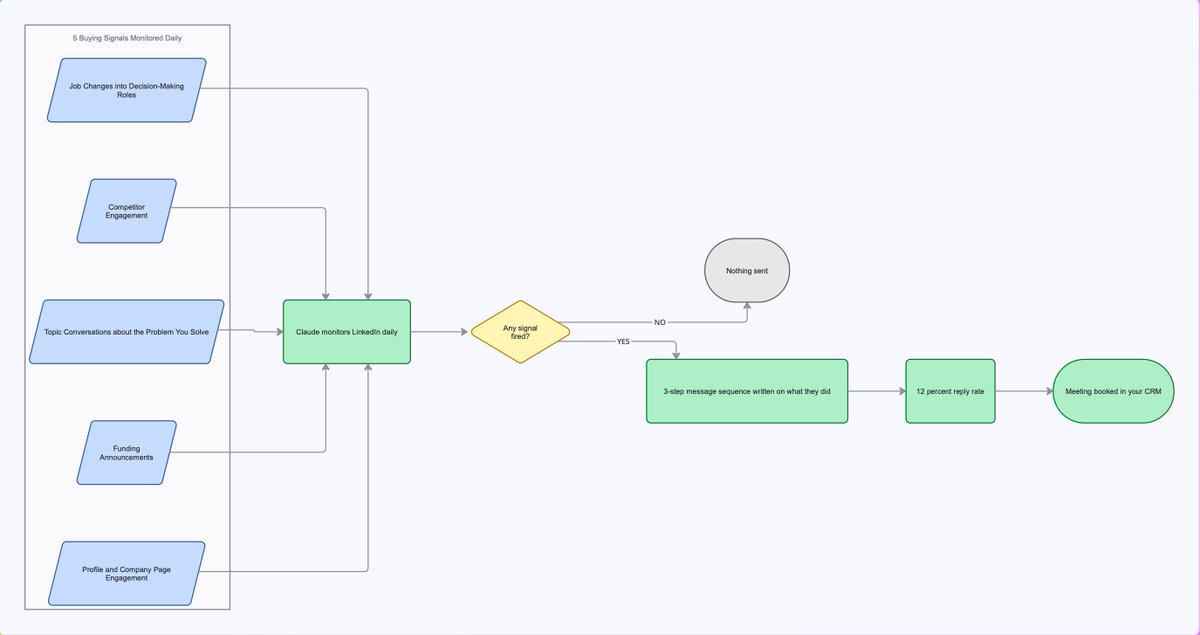
in january 2026 i told the team we were going all-in on ai. our non-engineers started shipping production code through an internal slack-to-claude bot, and an experiment with claude running as an sdr landed real customer meetings inside two weeks.
betting a 12-year-old company on ai is a different exercise than starting one fresh, and most of the playbooks being published this year are written by people doing the second.
twelve years from four students hand-registering agencies in a brussels dorm, we're betting the next chapter on the proposition that the next decade of agency-finding doesn't look like the last one. that's the actual stake. everything else is just funding rounds.
i'm on x because the conversations about what ai does to services businesses, about agencies, about outbound, about the things i've actually spent twelve years inside of, are happening on this platform now. they aren't on linkedin anymore.
if you're new, here's what i'm going to be writing about:
- the agency economy and what's actually happening to it.
- signal-based outbound, before everyone calls it something else.
- what it looks like to bet a 12-year-old company on ai instead of starting a new one.
- the small operator decisions that compound, the ones that don't make it into the founder podcasts.
and occasionally, when it's worth it, the part of the story i usually leave out.
that's me. welcome.
1
1
20
7,110
Nicolas Finet retweeted

18h
How to Earn a Billion Dollars: paulgraham.com/earn.html
473
1,055
8,354
1,897,088
Nicolas Finet retweeted

Jun 14
The layer that can route to the best AI model for the particular job is going to increase in value substantially. There are at least 3 big reasons:
* Cost optimization: there are plenty of use cases where you need frontier intelligence for some tasks and something far cheaper for others. Even in the same task you may use frontier intelligence for planning and review of the work, but an OSS or cheaper model for the bulk of the workload. This is going to be standard across large buckets of work going forward.
* Capability maximization: despite the bitter lesson and models generally getting better in the same direction, there are still lots of differences between models. Some are better at tool use, others better at coding, and others again better at certain domains of knowledge work. The ability to route between these at different times is a huge advantage.
* Risk mitigation: while the Fable situation is somewhat of a black swan, it’s possible we’re heading toward a regulatory environment where governments may restrict models at different times based on their approval mechanisms or new things they discover. This means you’re going to want flexibility in being able to deploy workloads across different providers as a form of risk mitigation.
Ultimately, it’s going to increasingly be a a strategic advantage for the applied AI layer that they can effectively route between models. Will be very interesting to see how this evolves.
Jun 13

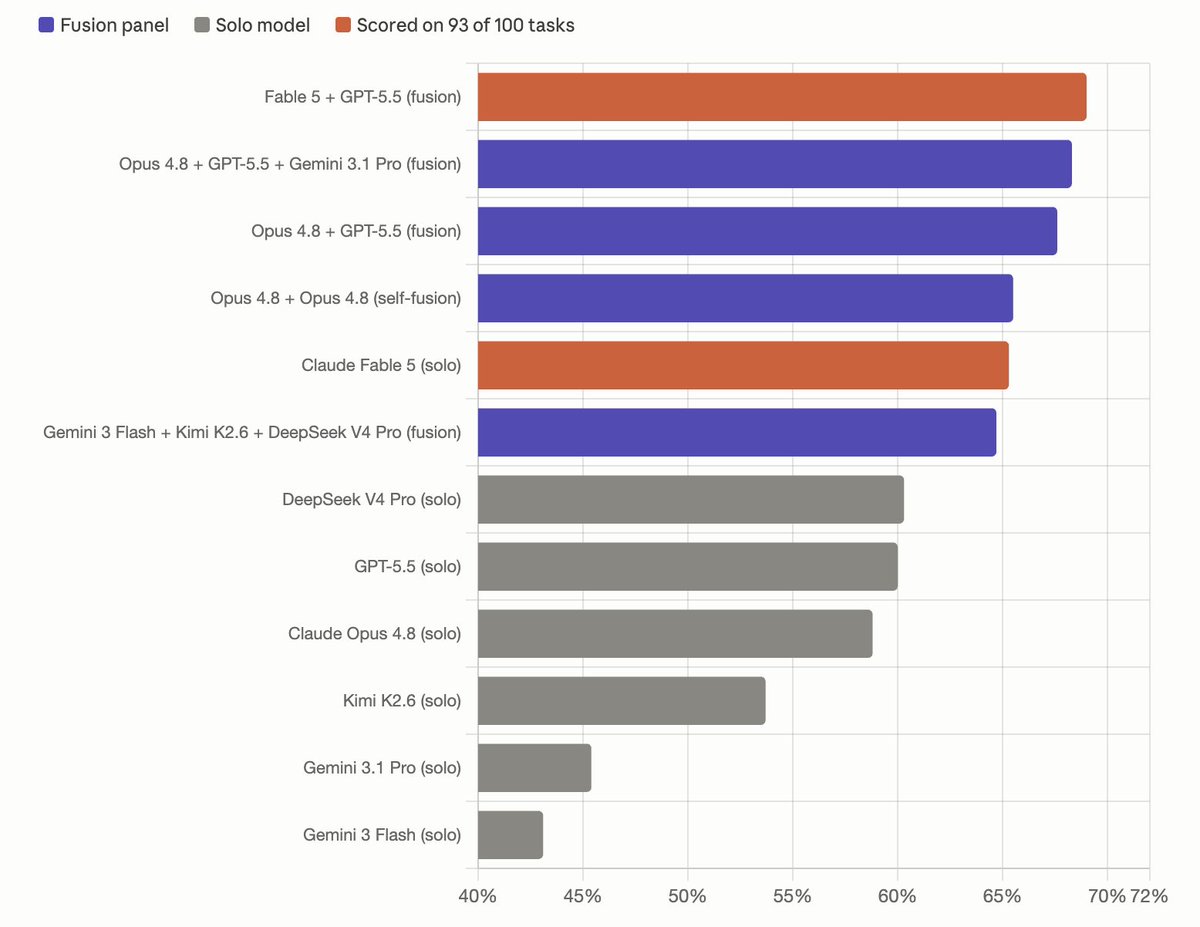
Introducing the Fusion API, the smartest compound model in the market.
Fusion achieves Fable-level intelligence at half the price.
How it works 👇
55
49
541
105,334
Jun 12
🔥🔥
Jun 11

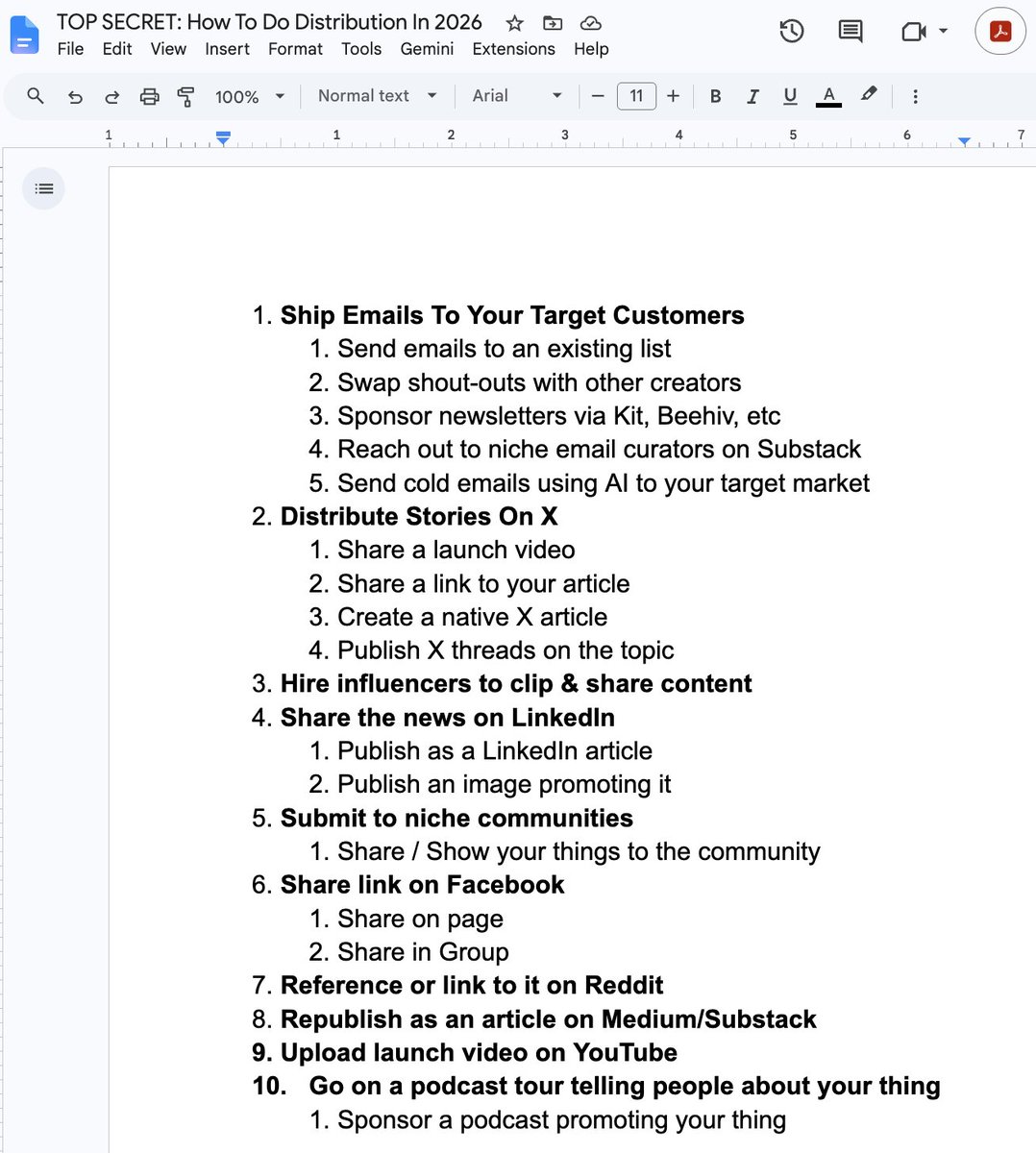
Most marketers won't do any of this...
But they'll still scream: "Distribution is king".
1
6
1,900
Jun 11
Six AI agents now run my most repetitive work around the clock. Built with Claude Code Hermes Agent. Fully autonomous and I never touch it.
Each takes a job every team still grinds out by hand:
→ weekly status notes per team, from your tracker, CRM and Slack
→ a one-page brief on every inbound lead before the first call
→ three first-draft directions in your brand voice
→ a morning radar of mentions, competitor moves and buying signals
→ the Friday retro: wins, misses and pipeline, built for you
→ final QA on links, brand voice, banned claims and naming
Hermes Agent and Claude Code read the agentskills io spec, so a skill you build in one runs in the other untouched.
Ships with connectors for Pipedrive and Notion (plus a template for the rest) and the exact Hermes cron commands to schedule each.
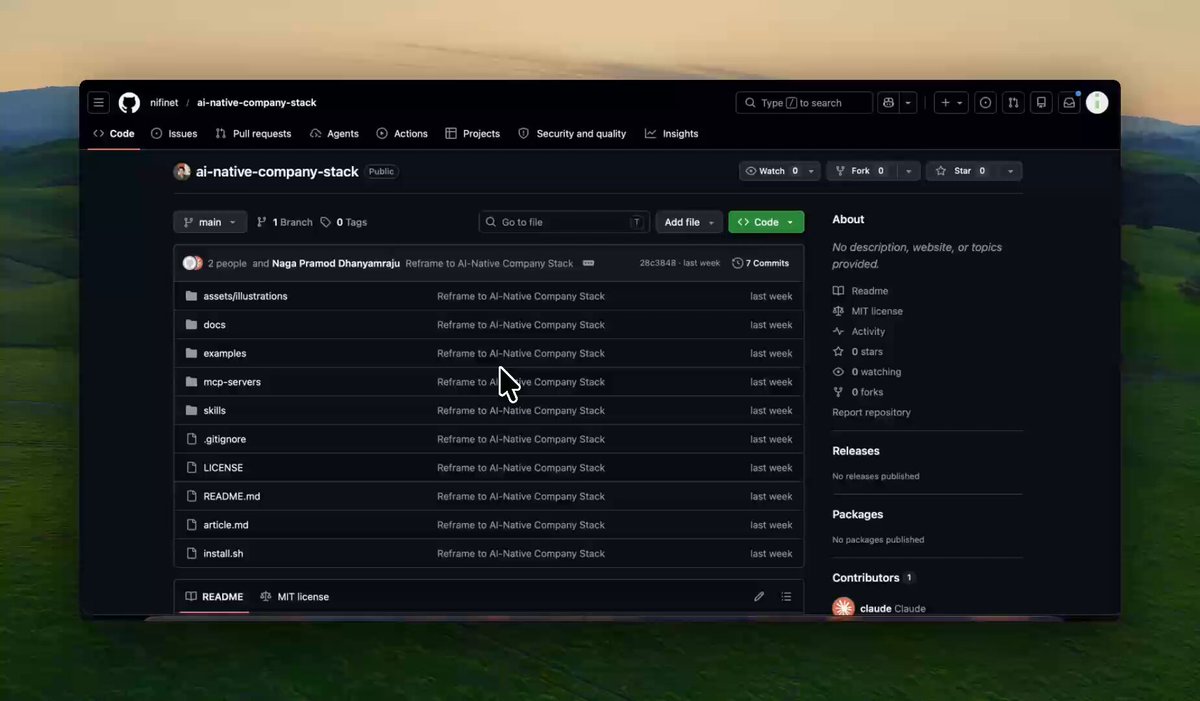
Comment 'stack' and I'll send the repo. Must be following.
35
18
49
6,999
Jun 10
A no-show is a qualified lead who just hit a scheduling conflict.
The real problem is manual follow-up: it doesn't work. We forget, we hesitate, we do it once and stop.
So at @Sortlist we set this up as a sequence in Overloop AI, in a few clicks, so it runs on its own instead of depending on anyone to remember. Four touches, two channels:
> 1 hour after the miss (email)
Short, no blame. "Looks like something slipped into your calendar. Here's a link to rebook in 2 clicks."
Next day (LinkedIn) Same tone but you're reaching them in a different channel.
"Putting the link here too, just in case."
> Day 3 (email)
No ask. One insight tied to their industry. You stay top of mind without being heavy.
> Day 7 (email)
Last call. "If the timing's off now, tell me. Otherwise let's lock it in."
The sequence takes the emotion out of it. It just runs.
We get about 30% of our no-shows back this way.
Stop treating no-shows as losses. They're qualified leads with a calendar problem.
6
8
483
Jun 4
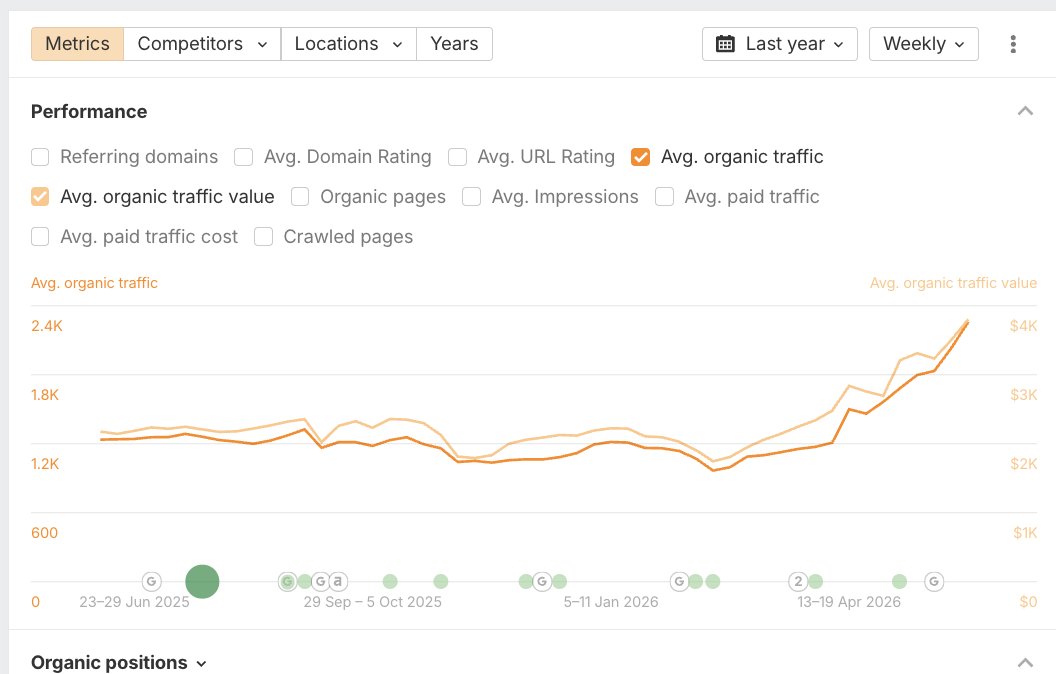
Guess when my SEO agents started to ship? 🚢🛳️
Hermès now also handles outreach for backlinks. This little dude already scored 3 YES. Not bad!
1
3
317
Jun 9
Most outbound fails for one reason: it is aimed at people who are not ready to buy yet.
In a crowded market you cannot out-shout that. Sending more just makes you part of the noise people already trained themselves to ignore.
What still gets a reply is timing.
Reach someone in the short window where they are actively trying to fix the problem you solve, and the same message that dies on a cold list gets answered.
And people tell you when they are in that window. They say it in the open, before they ever go looking for a vendor.
Someone posts, "anyone know a good tool for X?" A company opens a role to own the exact problem you solve.
Right there, they raised their hand.
Your job is to be watching when it happens, and to reach out about that specific thing rather than your usual pitch.
So pick the few signals that mean someone in your market just entered the buying window. Watch for them daily, not once a quarter. When one fires, respond within hours while it is still warm, with one real message that shows you actually noticed. Then let a sequence handle the follow-up.
That is the stack we built at @Sortlist to run this end to end.
It catches the signal the day it happens, checks it against ten years of our matching data to cut the noise, and runs the sequence through Overloop with Claude writing each message, so you reach people the day they are ready instead of three weeks late.
In a market this crowded, the reply goes to whoever gets there first with something that fits the moment.
Go build for that.
12
18
2,291


Jun 8
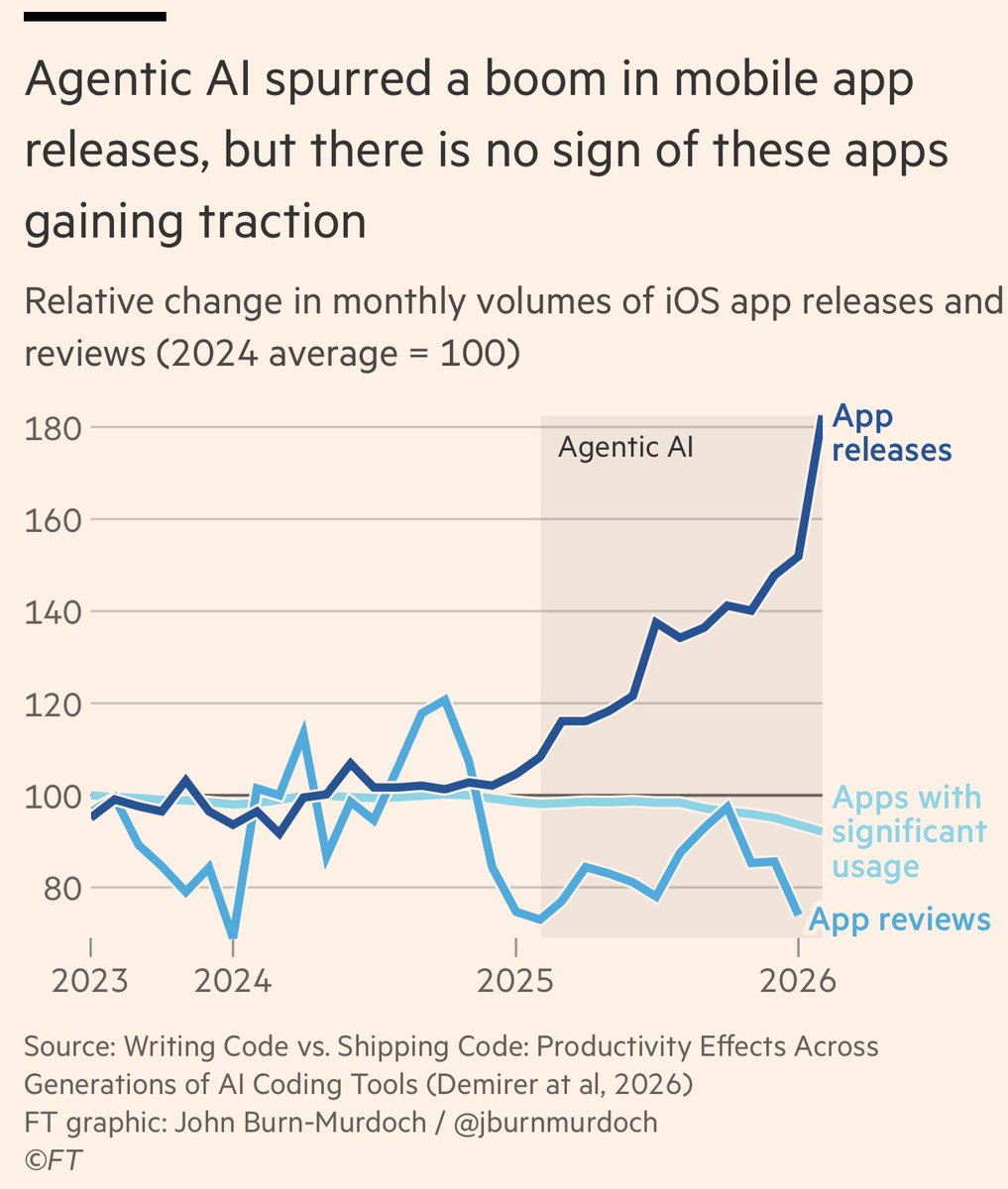
Everyone's a builder now. Congrats. You and the 50 million other people who just figured out they can vibe-code an app over a weekend.
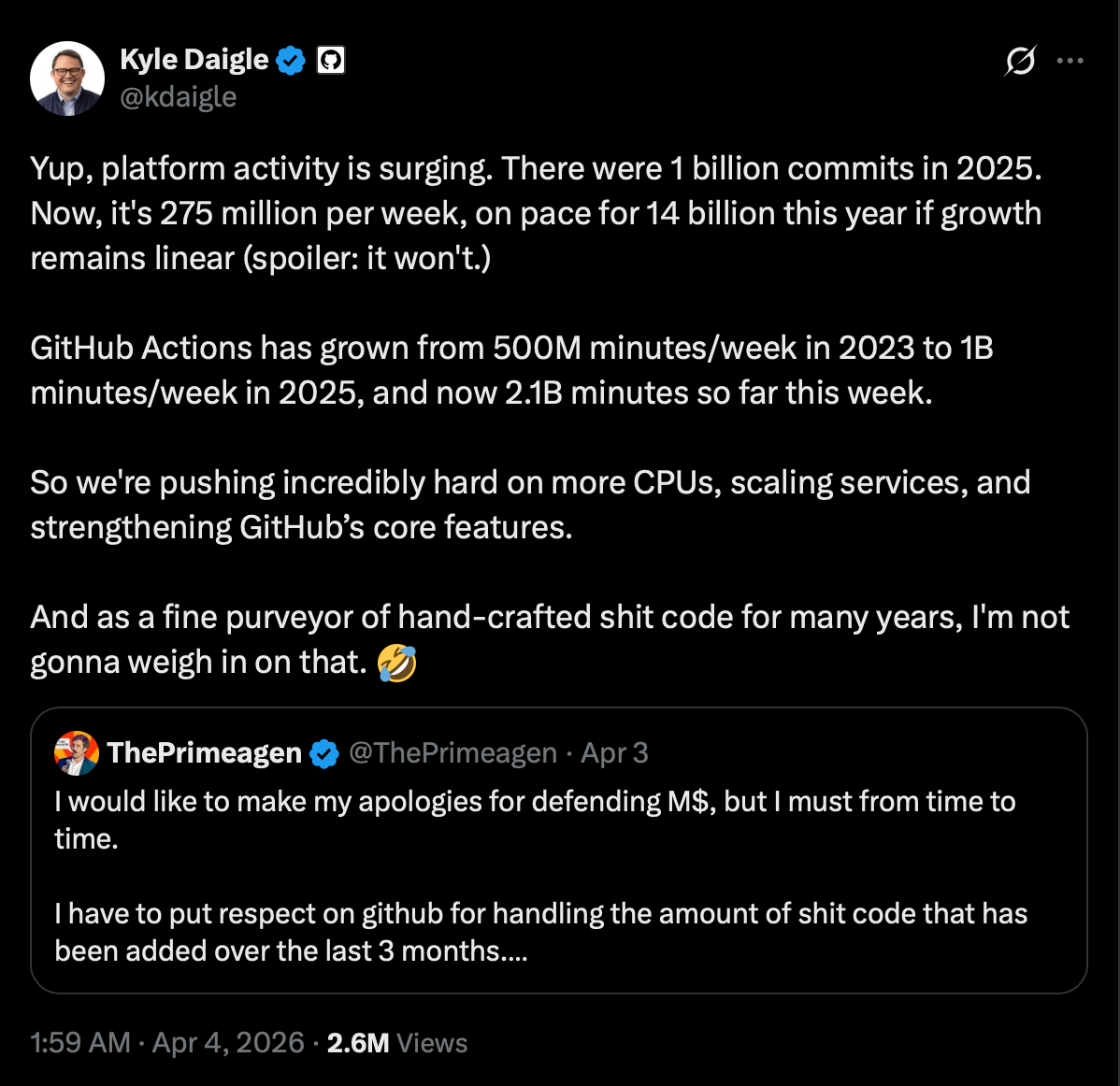
Look at the commit trend on GitHub. A billion last year, on track for 14 billion this year. Half my timeline is people announcing they shipped something before lunch. The slop is coming, and there's going to be a LOT of it.
And honestly? Good.
More people building more things is a great thing. A non-technical founder shipping a real product from a Slack message is wild, and I'm here for it.
But that's also the problem for everyone busy celebrating it.
A business was always two halves: build the product, and get the customers.
Product is where you used to win or lose.
Now everyone clears that bar on day one, so the whole thing collapses onto the half builders love to ignore: distribution, lead gen, getting in front of the right buyer before the other 50 million do.
You can ship the best product in the world. You'll still lose to someone with a worse one who actually bothered to learn how to sell it.

3
5
7
1,320
Jun 3
😂😂
Jun 3

I’ve listened to thousands of hours of great music since. What an awesome streaming service.
276
Jun 2
If you're running cold outbound on AI tools right now and your reply rates are flat, you're probably building the stack in the wrong order.
Here's the order that actually works:
1. Signals first.
> The triggers worth watching: reposted jobs, fundraising rounds, M&A filings, tenders and RFPs, competitor engagement.
> Each one marks a different buying moment.
> Pick four and wire them in before you touch anything else.
2. Scoring next.
> ICP fit x signal recency x buying-stage weight.
> A reposted job in the last seven days at an ICP-fit account beats a job posting from six weeks ago at a non-ICP account.
> Decide who to act on this week, then who falls into next month.
3. Message context last.
> Pass the exact role being reposted, the exact funding amount, the exact tender description into whatever writes the first line.
> Generic "fits your ICP" filler tells the model nothing useful.
Each layer of this stack feeds the next.
Signal triggers scoring > scoring filters who matters this week > context shapes the message itself
Run this loop.
2
153
Jun 2
it's genuinely insane that you can paste this entire article into claude and it just builds your whole company brain for you

5
8
1,691
Nicolas Finet retweeted
May 30
The only thing worse than having the CEO knee-deep in building stuff with AI is not having the CEO knee-deep in building stuff with AI.
253
260
3,785
300,699
May 29
Intent data is the loudest and the most poorly used category in B2B sales right now.
Most teams track one signal type (job postings) and ignore the rest.
Four buckets actually matter when you run outbound:
Job, Social, Company, Funding.
Job postings sit at the entry of the first bucket. The other thirteen signals across the four rarely get touched.
Take Job signals for instance.
A first-time job posting and a reposted job are completely different triggers.
When a role gets reposted three weeks later, the hiring manager has already burned through the obvious candidate list, the budget conversation happened a month ago, and the urgency is real. We write that first message acknowledging the situation directly. The "congrats on the new role" filler gets ignored when the role isn't new.
The Funding bucket has its own rhythm.
A fresh round opens a window of roughly ninety days where the CEO signs checks she wouldn't sign twelve months later.
Past that window the budget is committed to the incumbent stack and you're queueing behind whoever moved faster. Simply put, the signal expires.
The Company bucket is where the most expensive signal lives: tenders and RFPs. They cost more to track than anything else in the catalog, and almost nobody runs them.
Public procurement filings tell you exactly who has budget locked in. The teams that act on them either apply directly or reach the incumbents being challenged.
M&A gets read as a press release. The reality is a restructuring event: a new CFO is incoming, the vendor list is about to get reviewed, the incumbents are nervous, and fresh stack decisions get made in the first ninety days.
The highest-conviction trigger we have is two signals stacking on the same account in the same week:
1. A reposted job plus a closed round.
2. A tender filing plus an M&A inside the same vertical.
Those accounts go straight to the top of the list.
5
6
1,363
May 28
pov: you after realizing you've been paying for leads who were already on your own website
6
7
577