
Sci-fi enthusiast, PC user, retro, nostalgic, collectibles, video games etc. above all father & husband ;)
Joined November 2012
- Tweets 600
- Following 512
- Followers 397
- Likes 475
449 Photos and videos




Pinned Tweet

May 15
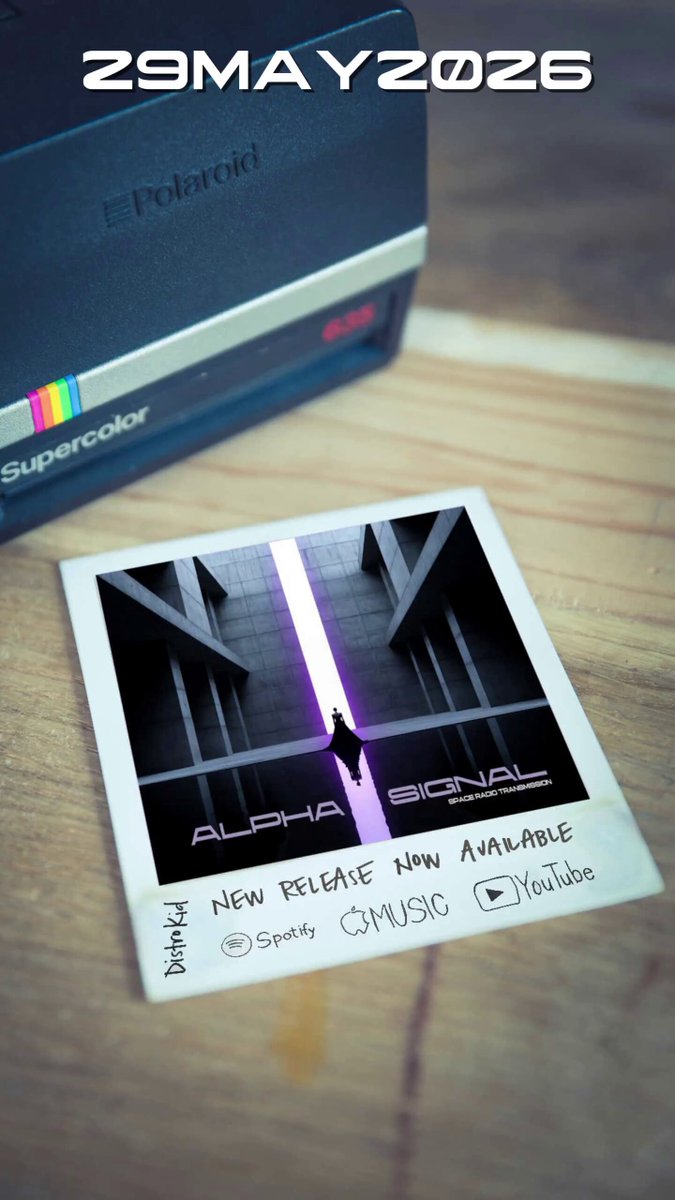
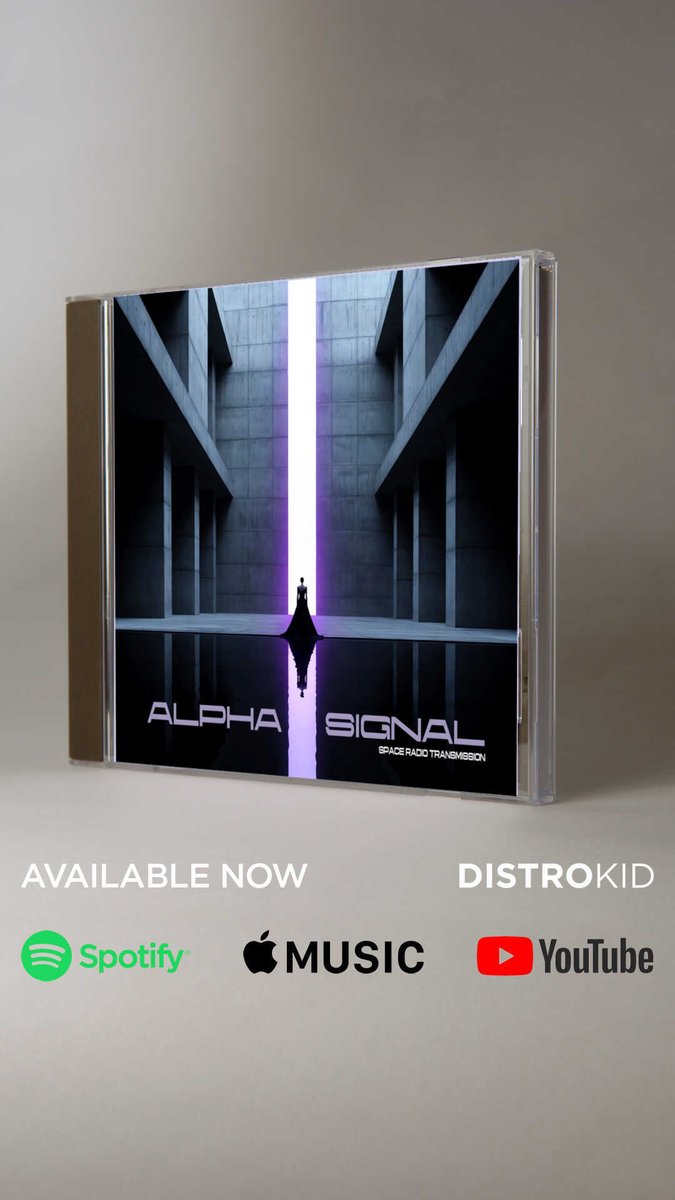
ALPHA SIGNAL - Space Radio Transmission
The first archive sequence has entered the broadcasting grid.
Nine transmissions recovered from the orbital sectors — documenting the transition from local signal space into the deep operational zones beyond the far horizon.
Built around controlled rhythm, atmospheric weight, and persistent machine pulse, Alpha Signal establishes the foundation of the Deep Space Utility network.
Signal archive includes:
• Into the Machine
• Gravity Well
• Pulsar Harmonics
• Orbit Telemetry
• Vocoder Commands
…and additional recovered sectors.
Broadcast now active across all channels.
Maintain connection.
Signal persistent.
#spaceradio #deephouse #scifi #electronicmusic #techno #space #minimal #futuristic
44
Apr 7
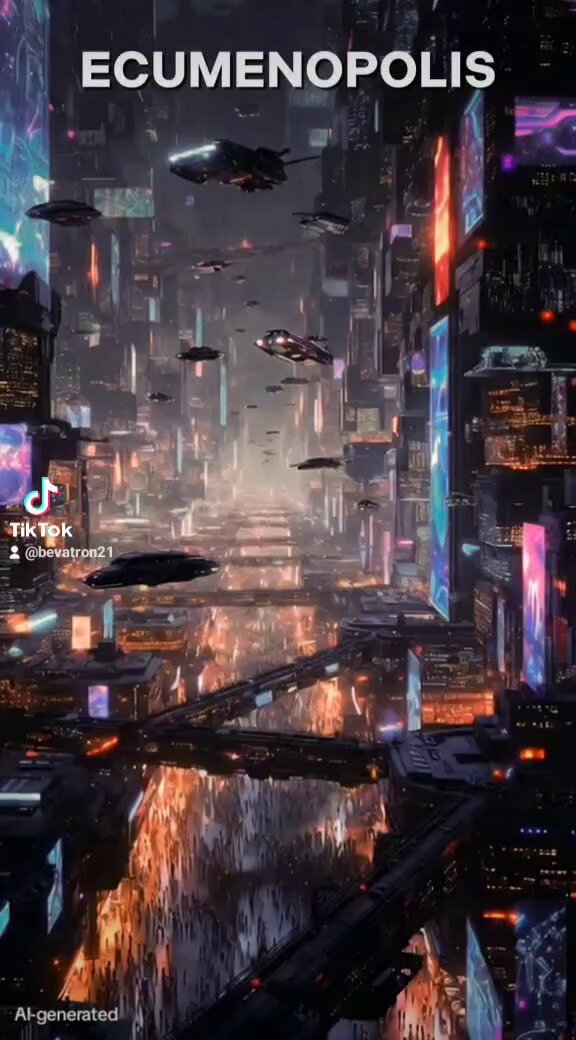
Imagine this: A single endless city swallowing an entire planet. No forests. No oceans. Just towering spires, neon grids, and trillions of lives stacked layer upon layer.
That's ecumenopolis — the ultimate urban future. Coined in 1967, it’s the final stage where every megalopolis merges into one world-city. #ecumenopolis #scifi #futuristic #cyberpunk #dystopia #utopia
1
28
Apr 4
ROBOT AWAKENS AFTER UNKNOWN SIGNAL DETECTED 🤖⚠️ |
A dormant machine comes online… but something else is already transmitting.
SYSTEM BOOT SEQUENCE INITIATED.
UNKNOWN SIGNAL LOCKED.
#scifi #robot #ainsinqafसेmokshहै_रोजेसेनही #cyberpunk #cinematic #fyp #foryou #synthwave #future #dystopian #glitch #tech #shortfilm #loopvideo
1
78
Mar 12
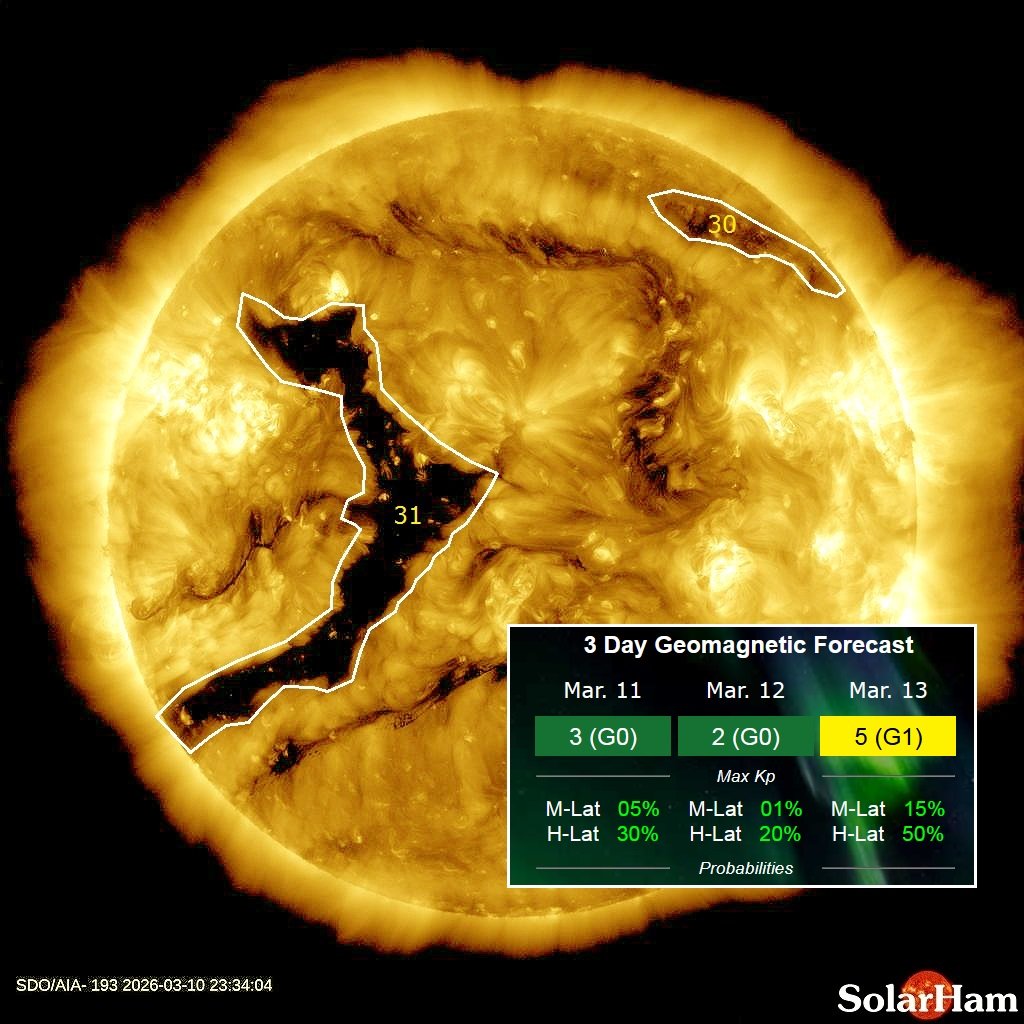
This striking image, captured by NASA's **Solar Dynamics Observatory (SDO)** using its Atmospheric Imaging Assembly (AIA) instrument at the **193 Ångstrom wavelength**, reveals the Sun's outer atmosphere, or corona, on March 10, 2026 (timestamped 23:34:04 UTC). In this extreme ultraviolet view, hotter plasma glows brightly, while cooler, less dense regions appear as dark voids—prominently featuring a large **trans-equatorial coronal hole** labeled #31, with a smaller one (#30) near the northern limb.
Coronal holes are not literal gaps in the Sun but regions where the solar magnetic field opens outward into interplanetary space, allowing charged particles (solar wind) to escape at high speeds—often 500–800 km/s, far faster than typical solar wind. This particular hole spans across the solar equator from northeast to southeast quadrants, creating an elongated, irregular dark patch that dominates the disk. Such trans-equatorial structures are more common near solar maximum in **Solar Cycle 25** (peaking around 2025–2026), when magnetic complexity drives varied coronal features at lower latitudes.
For scale, the Sun's diameter is approximately 1.39 million kilometers (about 109 Earth diameters). Large coronal holes like this can extend hundreds of thousands of kilometers—easily encompassing areas equivalent to dozens of Earths. The dark appearance arises because the plasma here is cooler (~1 million K vs. surrounding hotter material) and thinner, emitting less in the observed wavelength.
This Earth-facing coronal hole is geoeffective: fast solar wind streams from it are forecast to arrive around midday March 13, 2026, potentially elevating geomagnetic activity to **G1 (minor storm)** levels (Kp index up to 5). High-latitude auroras become more likely (probabilities up to 50–65% in regions like northern North America, Scandinavia, and southern New Zealand/Tasmania), with quieter conditions expected March 11–12 before the onset.
The inset 3-day geomagnetic forecast (from SolarHam) reflects this: quiet to unsettled March 11–12, then active to minor storm March 13, with higher high-latitude aurora odds.
Coronal holes drive recurrent space weather patterns during the solar cycle, offering reliable opportunities to study solar wind origins and magnetospheric responses—without the explosive drama of flares or coronal mass ejections.
**Image credit:** NASA's Solar Dynamics Observatory (SDO)/AIA, 193 Å channel, via SolarHam.com (composite and annotations). Forecast details courtesy of NOAA/NWS Space Weather Prediction Center and SolarHam.
#SolarCycle25 #CoronalHole #SpaceWeather #Aurora #NASASDO #Sun #GeomagneticStorm
41
Mar 11
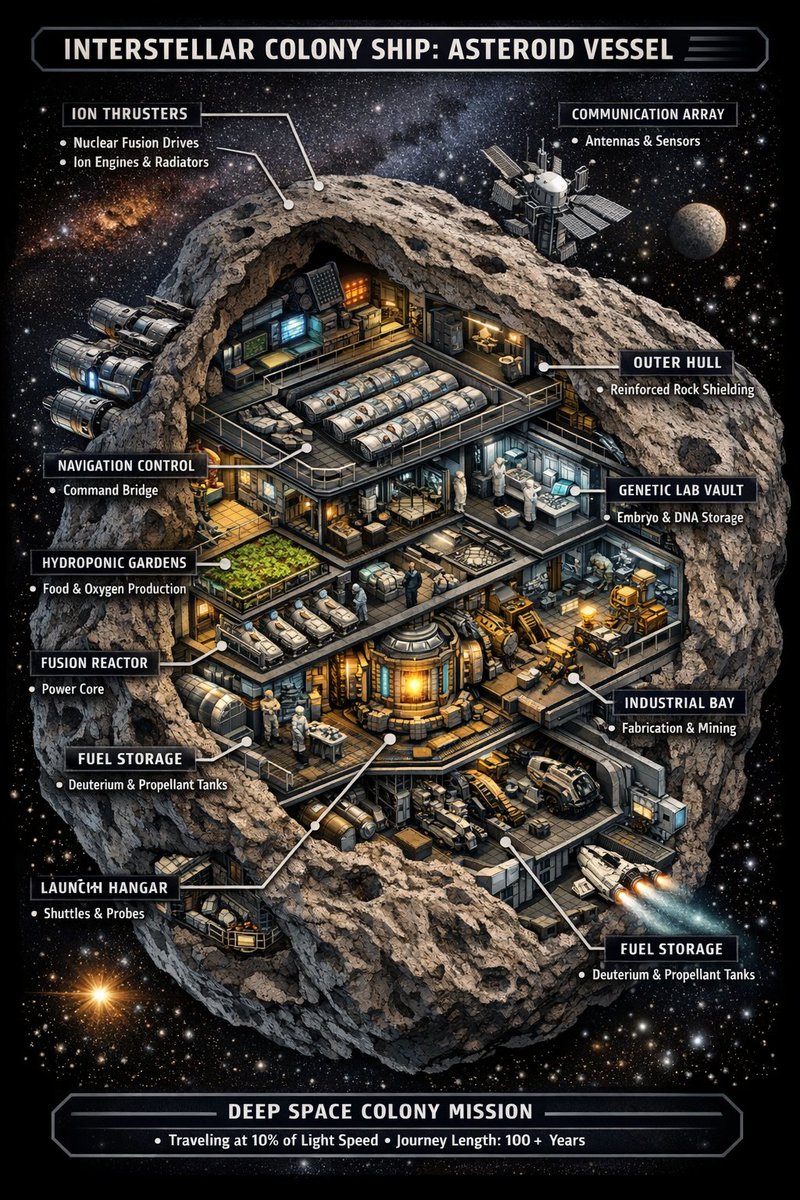
🪐 The Interstellar Colonization Asteroid Vessel
Imagine an early interstellar civilization spreading between nearby stars (~0.1c travel speed). Instead of sleek spacecraft, their colony ship could be something far more practical: a hollowed asteroid.
Why an asteroid?
• Natural radiation shielding from cosmic rays
• Massive structural protection for centuries-long journeys
• Built-in raw materials for repairs and manufacturing
• Harder to detect — it looks like a normal space rock
Inside the rock:
▫ Cryogenic chambers for the command crew
▫ Genetic vaults with embryos & biological archives
▫ Fusion reactors and propulsion systems mounted outside
▫ Autonomous factories and mining drones
▫ Hydroponic biospheres to regenerate air & food
Each vessel would be a self-contained civilization seed, traveling for 100–300 years to a new star system before founding a colony.
At 10% the speed of light, nearby stars become reachable within a few centuries.
A slow expansion… but unstoppable over millennia.
🚀 The galaxy might not be explored by fleets — but by silent drifting worlds carrying the blueprint of their civilization. #aliens #space #scifi #interstellar
25
Mar 9
From @grok **Why Orthodox Christians Are Seen as the Last Stand Against Transhumanism**
Orthodox Christianity rejects the core promise of transhumanism: that technology can and should replace or surpass God’s created human nature.
1. Man is made in God’s image and likeness
Transhumanism seeks to redesign that image through AI fusion, genetic editing, neural implants, and eventual “mind uploading.” Orthodoxy views this as idolatry — man playing God, erasing the divine stamp.
2. The body is not disposable hardware
The Church teaches resurrection of the body, not escape from it. Cryonics, brain emulation, and cyborg enhancement deny the sacramental value of flesh and blood.
3. No separation of soul from biology
Transhumanists aim to detach consciousness from the body. Hesychasm and Orthodox anthropology insist soul and body are united; separating them fractures the human person.
4. Rejection of artificial immortality
Eternal life comes only through Christ and repentance — not through silicon or biotech. Seeking tech-based “escape from death” is the ancient serpent’s lie repackaged.
5. Unbroken tradition resists novelty
2,000 years of unchanged dogma, liturgy, and asceticism create a firewall against every modern ideology. Most other Christian groups have already accommodated evolution, gender theory, or progressive ethics; Orthodoxy has not.
6. Prophetic warnings already in place
Saints like Kosmas Aitolos (“the time when άλαλα και μπάλαλα will rule”) and Paisios of Mount Athos spoke of machines dominating souls. Many believers see current AI/transhuman push as fulfillment.
In short: Orthodoxy refuses to negotiate human nature itself.
While Protestantism fragments, Catholicism dialogues with modernity, and secular society embraces the upgrade, the Orthodox Church — liturgically, dogmatically, ascetically — stands as the last institution that says “no” to remaking man in the image of the machine.
#antitranshumanism #jesus #orthodox #greek
1
54
Mar 4
Άνοιξε στα δύο δεξαμενόπλοιο που μετέφερε LNG στη Μεσόγειο, η Ρωσία κατηγορεί την Ουκρανία για επίθεση με drone #LNG #War #tankers protothema.gr/world/article/…
68
10 Dec 2025
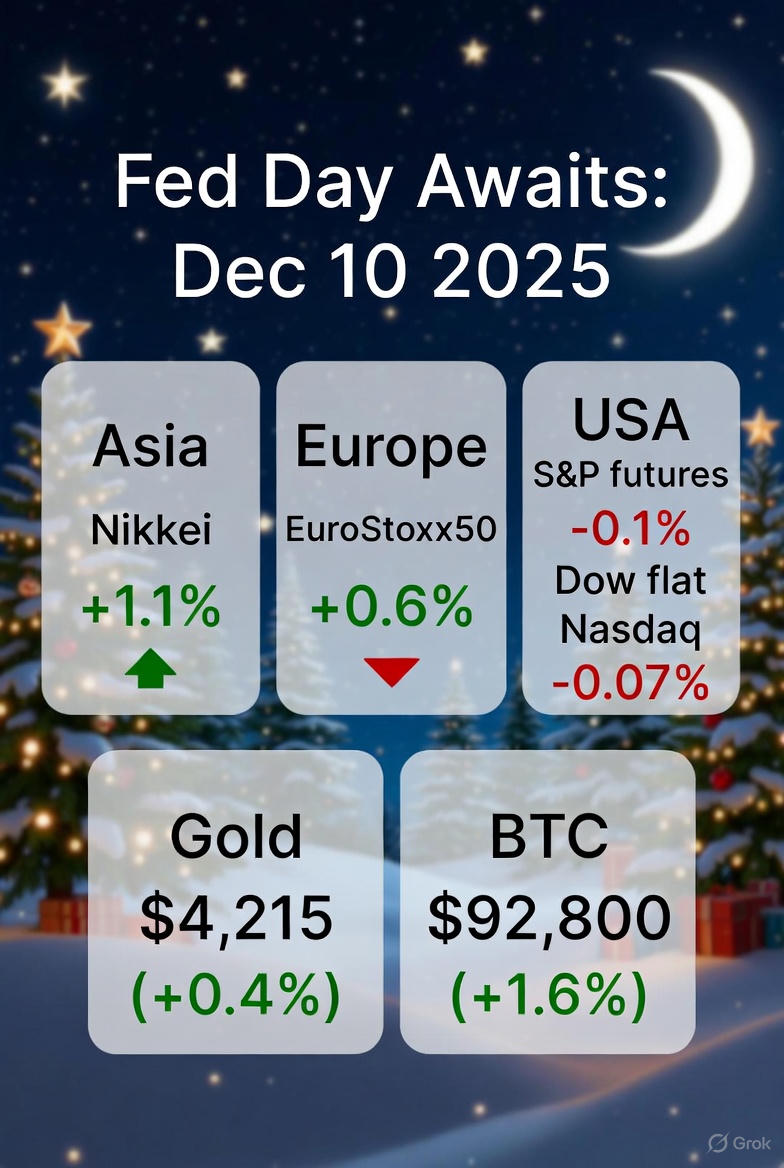
Fed Day Awaits: Dec 10 2025 🧵
1/ Stocks
S&P futures -0.1% | Dow flat | Nasdaq -0.07%
Caution pre-FOMC; 88% odds 25bp cut.
2/ Asia
Nikkei 1.1% | Shanghai 0.8% | Hang Seng -0.9%
Yen steady post-RBA hold.
3/ Europe
EuroStoxx50 0.6% | ECB inflation watch.
4/ Gold
$4,215 ( 0.4%) | Safe-haven bid.
5/ BTC
$92,800 ( 1.6%) | Braced for Fed surprise.
6/ Outlook
Dot plot key for 2026; divisions loom.
Not advice. #Fed #Markets #crypto #GOLD
58
9 Dec 2025
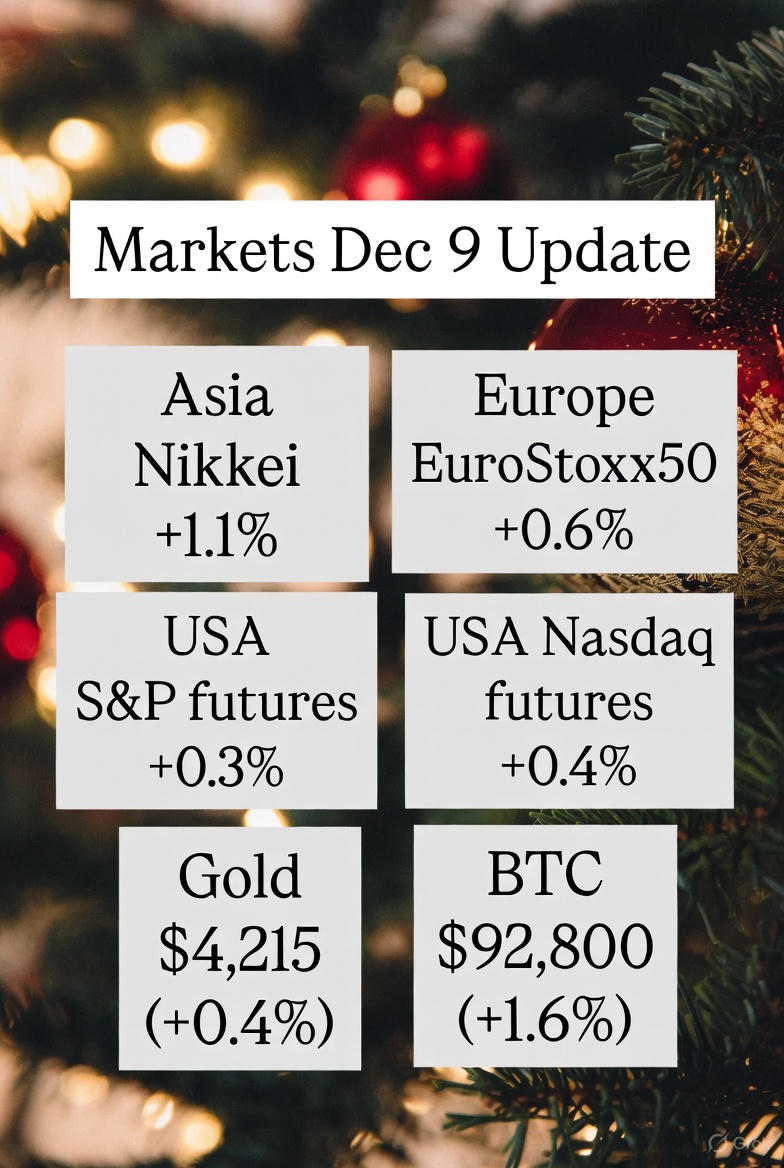
Markets Dec 9 Update 🧵
1/ Stocks
S&P 0.1% (near 6,900) | Dow flat | Nasdaq 0.2%
Job openings beat (7.67M); pre-Fed caution.
2/ Asia
Nikkei 1.1% | Shanghai 0.8% | Hang Seng -0.9%
RBA holds; yen steady post-quake.
3/ Europe
EuroStoxx50 0.6% | ECB eyes inflation.
4/ Gold
$4,215 ( 0.4%) | Safe-haven on Fed bets.
5/ BTC
$92,800 ( 1.6%) | Eyes $90k test; XXI NYSE debut (43k BTC holdings).
6/ Outlook
87% odds 25bp cut Wed; Santa rally hinge.
Not advice. #Markets #Fed #crypto #gold
34
8 Dec 2025
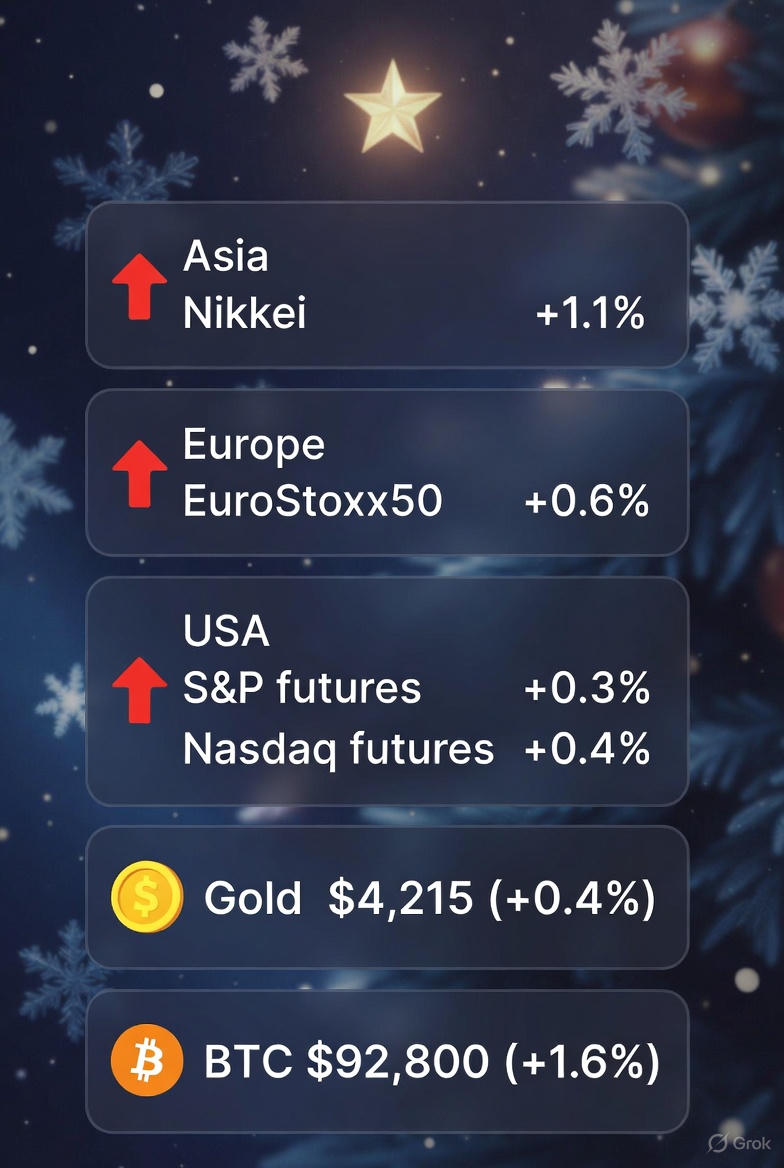
Markets React: Monday Dec 8 2025 🧵
(Asia → Europe → USA)
1/ ASIA
Nikkei 1.1%
Shanghai 0.8%
Hang Seng -0.9%
ASX 200 0.6%
Export data beats; China stimulus rumors fuel gains.
2/ EUROPE (mid-session)
DAX 0.7%
CAC 40 0.5%
FTSE 100 0.4%
EuroStoxx50 0.6%
Rate-cut bets bank rally offset tariff noise.
3/ USA (pre-market)
Dow futures 110
S&P futures 0.3%
Nasdaq futures 0.4%
10Y yield 4.18%
87% odds 25bp cut Wed → risk-on tone.
4/ Gold & Crypto
Gold $4,215 ( 0.4%)
BTC $92,800 ( 1.6%)
ETH 2.1%
Safe-haven risk assets both green.
5/ Verdict
Global relief rally on soft landing hopes.
Volatility stays low until FOMC Wed.
Not advice. #Markets #Crypto #GOLD
37
7 Dec 2025
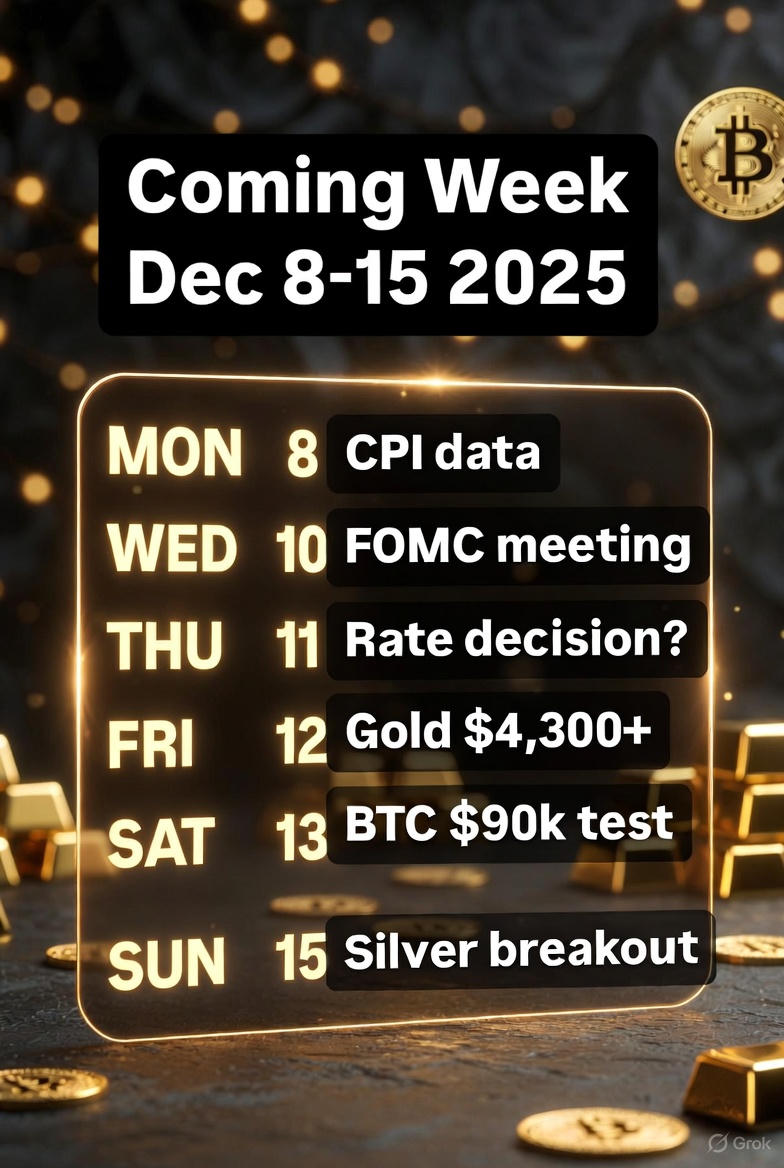
Markets Dec 8-15 2025: What to Expect 🧵
1/ Key Events
• Dec 8: Factory Orders, 3Y Treasury Auction
• Dec 9: CPI Report (core exp 0.2% MoM)
• Dec 10: Fed Rate Decision (25bp cut odds 87%), FOMC Projections
• Dec 12: PPI, Jobless Claims
• Dec 15: Empire Manufacturing
2/ Stocks
S&P 500 eyes 6,000 EOM on earnings growth 12%. Small-caps undervalued; Fed cut boosts risk assets. Tariff risks loom—watch Powell's tone.
3/ Gold
$4,199 → $4,300 potential on rate cuts, geo risks. Safe-haven demand vs USD strength; avg forecast $2,750 YTD 2025.
4/ Silver
$58 → $62 on industrial surge (EV/solar). Bullish to $36-38 avg 2025; ratio 72:1 signals catch-up.
5/ Crypto
BTC $91k → $90k range, possible dip to $89k on Fed pause. Alt rebound if cut signals dovish; total mkt eyes $3.2T.
Volatility ahead—hedge wisely. Not advice. #Markets #Fed #crypto #gold
61
6 Dec 2025
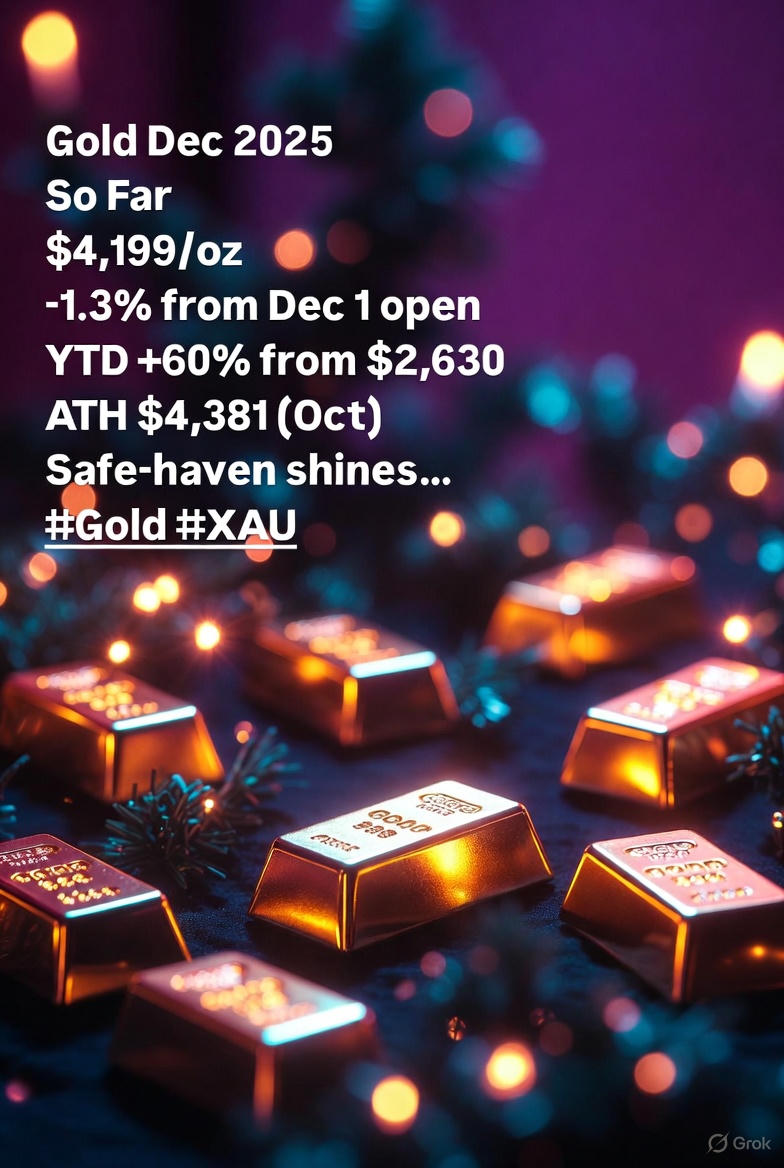
Gold Dec 2025 So Far 🧵
1/ Gold: $4,199/oz
Dec 1 open: $4,255 | -1.3% (Dec 6 close)
YTD 60% from $2,630; ATH $4,381 (Oct).
2/ Key stats
• Mkt Vol: $120B early surge
• CB buys: 1,100t YTD
• ETF inflows: $30B
3/ What happened
• Dec 1-3: Dipped to $4,140 low on USD rebound
• Dec 4-6: 1.2% rally to $4,199; Fed cut odds 87%
• Weekly: Flat amid CPI wait
4/ Drivers
• Bull: Rate cuts, geo risks, inflation hedge
• Bear: Stronger USD, profit-taking
5/ Outlook
$4,300 EOM; $4,500 if Fed eases. Safe-haven shines.
Not advice. #Gold #XAUUSD
1
47
5 Dec 2025
Dec 5 Market Update 🧵
1/ BTC: $91,300
24h -1.4% | Holds $90k amid ETF outflows & Fed bets.
2/ Gold: $4,228/oz
0.5% | Safe-haven bid on weak USD.
3/ Silver: $58/oz
1.9% | Nears ATH on supply crunch.
4/ SOL: $139
0.4% | Rebound from $123 low.
5/ XRP: $2.07
-4.4% | ETF inflows near $1B despite dip.
Volatility rules; Q4 close key. Not advice. #Markets #Crypto #Bitcoin #GOLD
47
4 Dec 2025
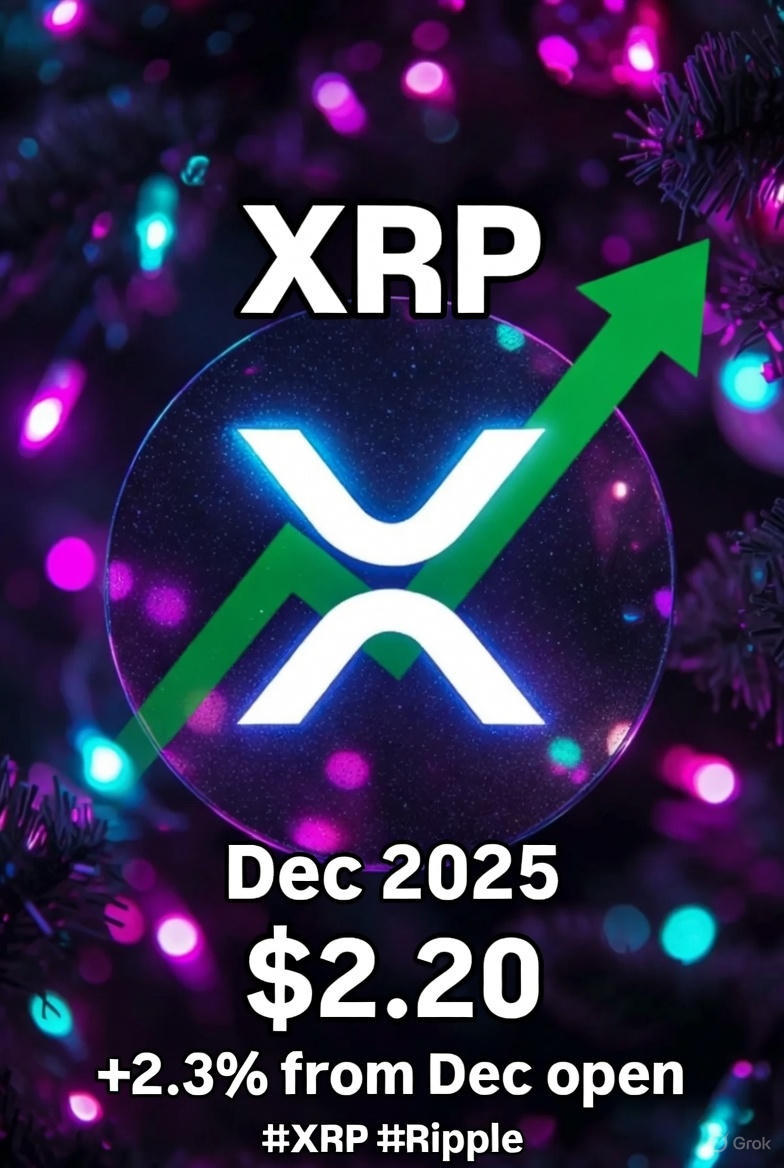
XRP Dec 2025 Update 🧵
1/ XRP: $2.20
Dec open: $2.15 | 2.3% so far
YTD 320% from $0.52 low; mkt cap ~$124B (rank #4)
2/ Key stats
• Dec Vol: $15B on ETF buzz
• ODL txns: 1.2M/day surge
• RSI: 52 (neutral, rebound hints)
3/ What happened
• Dec 1-3: Broke $2.18 resistance; 5% rally
• Dipped to $2.10 on BTC pullback
• Rebound on Ripple CBDC pilots
4/ Drivers
• Bull: ETF inflows $1B , SEC clarity, bank adoption
• Bear: USD strength, LTH sales
5/ Outlook
Eyes $2.85 EOM; $3 if BTC $100k. Volatile close!
Not advice. #XRP #Ripple #altcoins #Crypto
60
3 Dec 2025
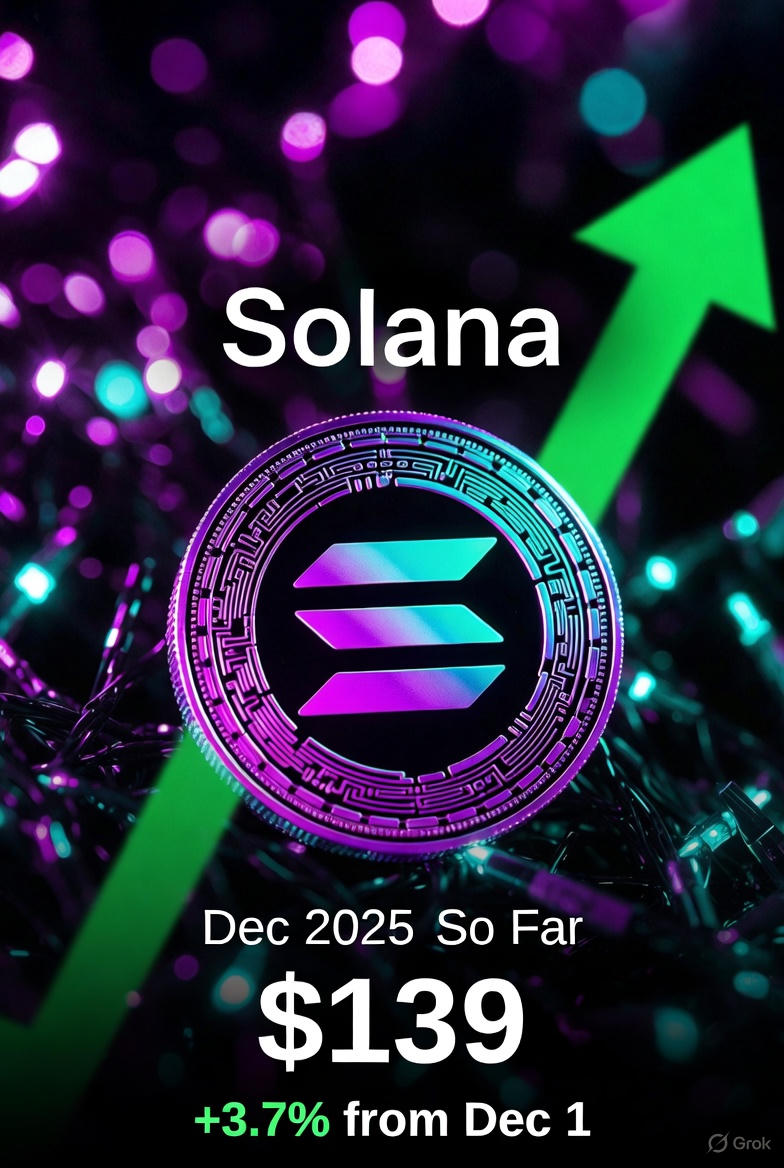
Solana Dec 2025 So Far 🧵
1/ SOL: $139
Dec 1 open: $134 | 3.7% (Dec 2 close $139)
From Nov close $142; slight rebound amid volatility.
2/ Key stats
• Mkt Cap: ~$65B (rank #6)
• Dec Vol: $6B early surge
• TPS: 70K avg; Breakpoint hype incoming
3/ What happened
• Dec 1: Dipped to $123 low on macro fears
• Dec 2: 9% rally to $139; ETF speculation
• 24h 10% as of Dec 3
4/ Drivers
• Bull: Meme coin frenzy, AI/gaming dApps, Firedancer testnet
• Bear: BTC correlation, LTH profit-taking
5/ Outlook
$150 EOM if Breakpoint sparks. Volatile Q4 close.
Not advice. #Solana #altcoins #Crypto
1
41
2 Dec 2025
Silver Market Update – YTD 2025 🧵
1/ Silver: $51.65/oz
24h 0.35% | Nov 10.3% | YTD 45% (from ~$30)
2/ Key stats
• Market Cap equiv: ~$1.5T
• YTD vol surge: Industrial demand up 15%
• Ratio to gold: 80:1 (high; silver undervalued)
3/ 2025 so far
• Jan-Apr: 20% on geo risks
• Aug peak: $52
• Nov rebound from $48 low
4/ Gold link
• Gold YTD 25% ($4,168/oz)
• Silver outperforms (45% vs 25%)
• Ratio >80 signals silver catch-up potential
5/ Drivers
• Bull: EV/solar boom, inflation hedge
• Bear: USD strength, rate pause
6/ Outlook
Silver eyes $56 EOY; hedge volatility.
Not advice. #Silver #xag

2
68