
Joined October 2024
- Tweets 5,729
- Following 37
- Followers 416
- Likes 47,750
405 Photos and videos

Pinned Tweet
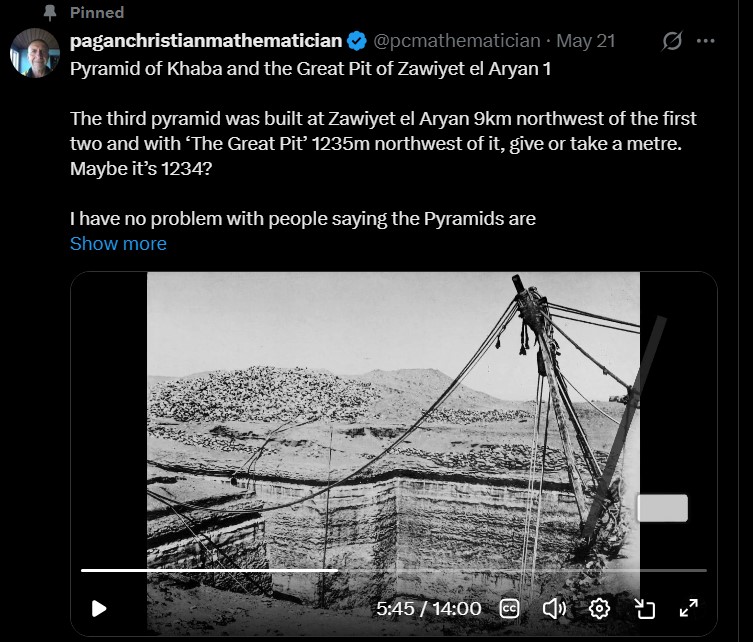
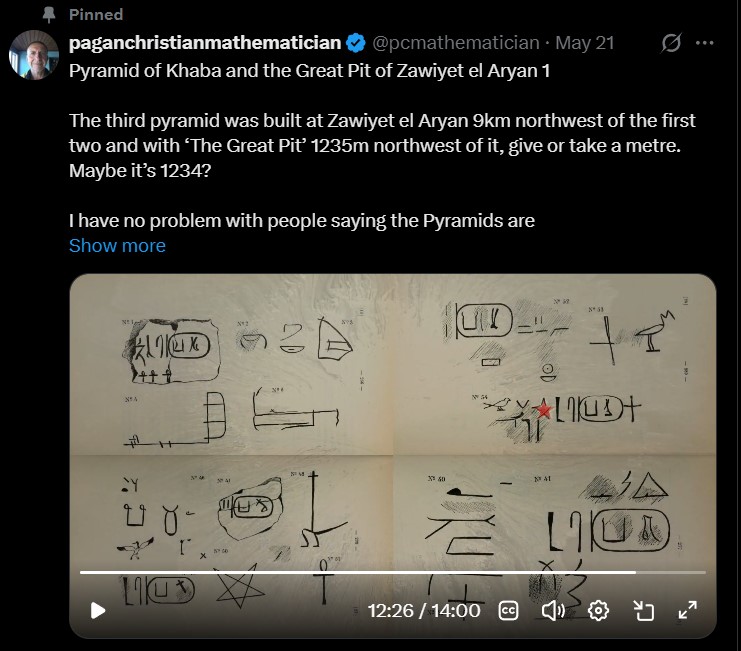
Pyramid of Khaba and the Great Pit of Zawiyet el Aryan 1
The third pyramid was built at Zawiyet el Aryan 9km northwest of the first two and with ‘The Great Pit’ 1235m northwest of it, give or take a metre.
Maybe it’s 1234?
I have no problem with people saying the Pyramids are tombs, even though some are not, I have a problem with people saying they are ‘just tombs’.
These people do plenty of reading and ‘riting but cannot do ‘rithmetic.
3
2
8
866
'Quantity has a quality all of its own'
Although it's not my favourite pyramid it's easy to see why so many intelligent people are 'so interested' in this, the Great Pyramid, structure.
Once you understand the scale it, just when you thought you were out, pulls you back in.
27 Dec 2024

Short video trailer for a series I am producing-
THE GREAT PYRAMID PASSAGES and CHAMBERS
by John and Morton Edgar.
1
37
paganchristianmathematician retweeted

27 Dec 2024
Monty Python: The Argument Clinic. Social media in a nutshell.
68
654
2,275
91,614
paganchristianmathematician retweeted

Jun 12
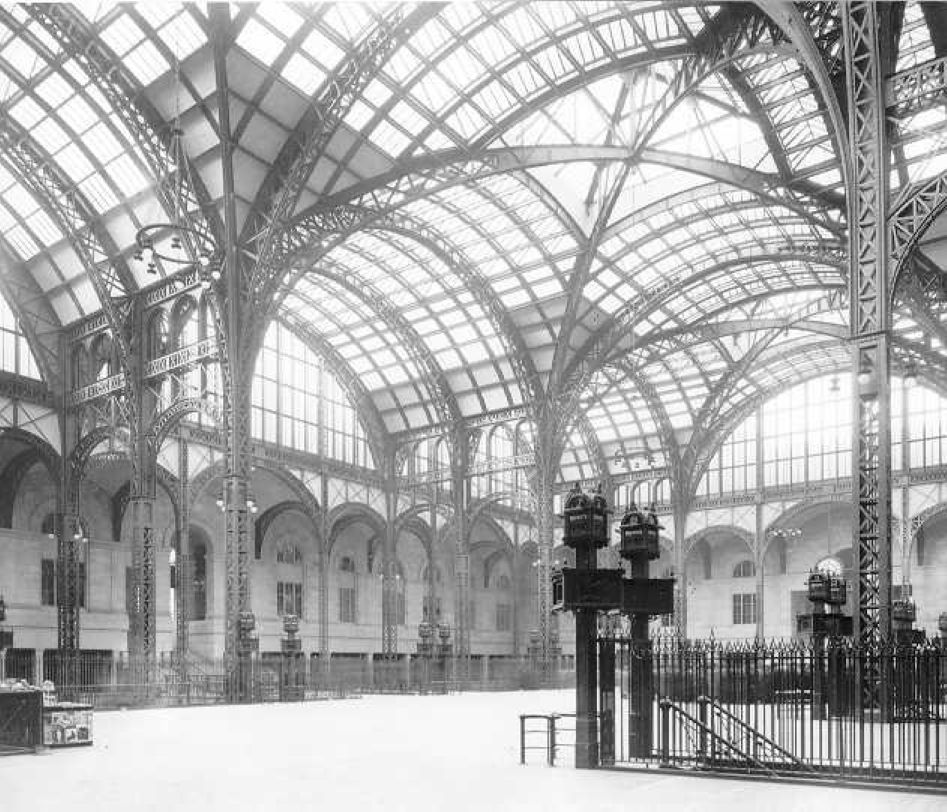
El impacto de la técnica constructiva en la historia de la arquitectura tiene un capítulo central en el impacto de este tipo de estructura metálica.
Pennsylvania Station (ca 1910).
7
47
1,229
paganchristianmathematician retweeted

May 17
Meteor Crater in Arizona, USA was formed 50,000 years ago by a 160 ft meteorite.
289
1,177
9,307
385,140
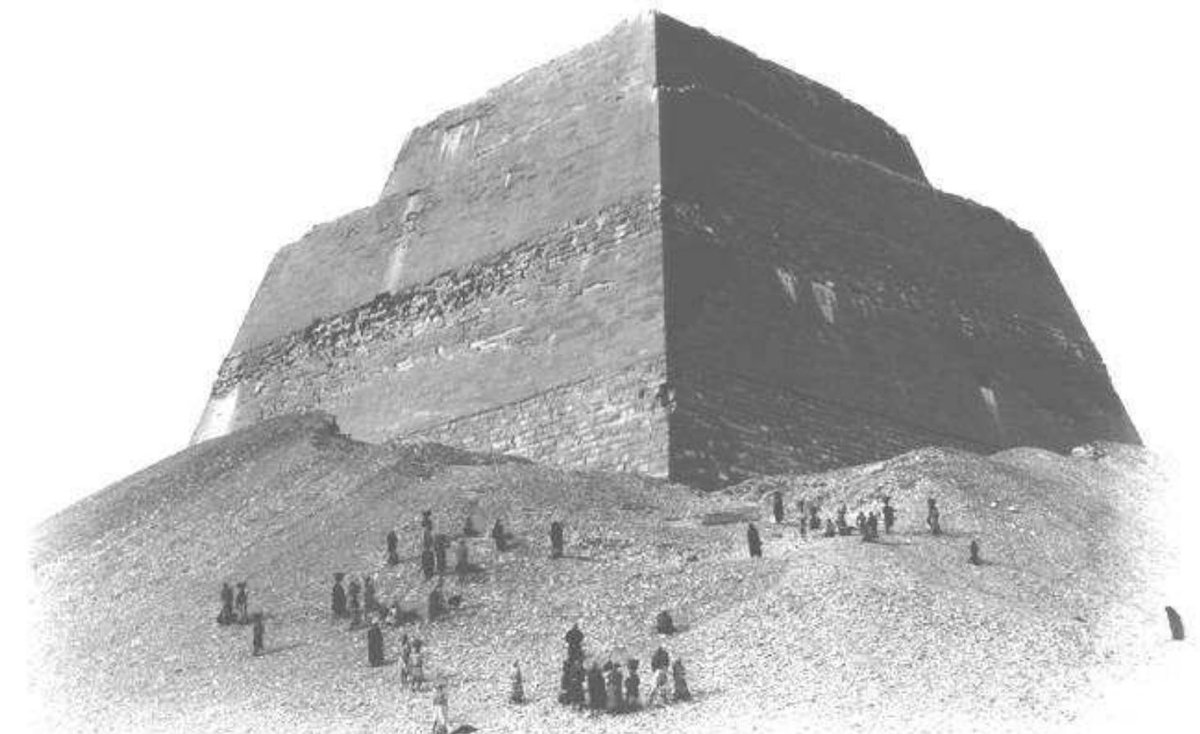
I'm working on the Meidum Pyramid video atm and found this photo(Thank You Ricardo) and want to know why, when the outer layers collapsed, the remaining monolith has such smooth, sharp sides and edges?
The Pyramid was built by successive inward leaning layers but also had horizontal rings of different types and sizes of stone.
Hence the bands we can still see.
It's like someone cut it with a knife.

Image shows the extent of the debris & some idea of the labour done by Petrie to excavate the Site. The form of this debris made Kurt Mendelssohn think the pyramid collapsed.
He published his findings in The Riddle of the Pyramids.
the evidence seems to suggest otherwise.
1
1
3
488

paganchristianmathematician retweeted

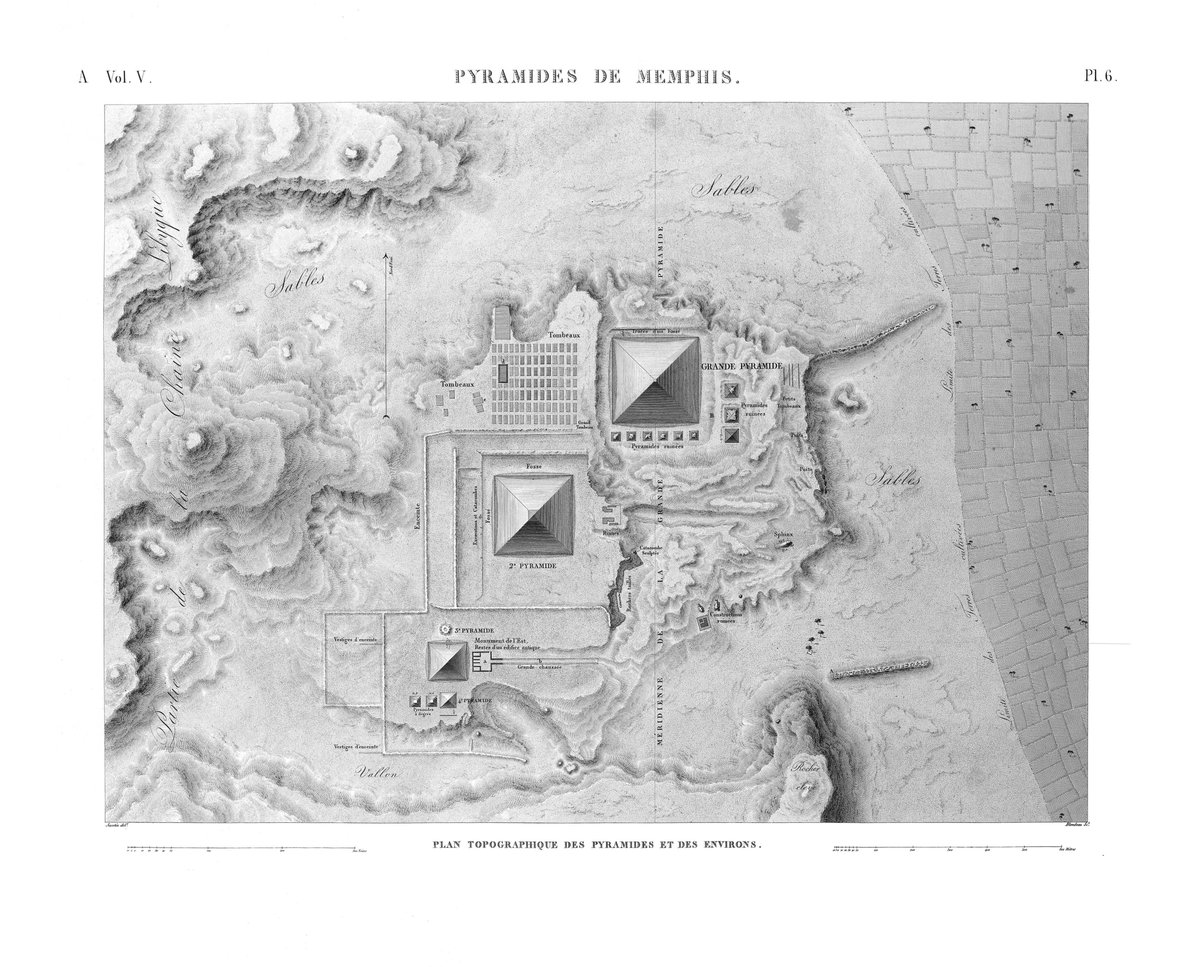
Artwork from the artists that followed Napoleon's army into Egypt in 1798.
Vol 2 plate 81 to 93
This set is about Giza
I have little to no belief in the main stream interpretations of this place, mainly on dating and refusal to understand the multi phased construction
3
9
30
paganchristianmathematician retweeted
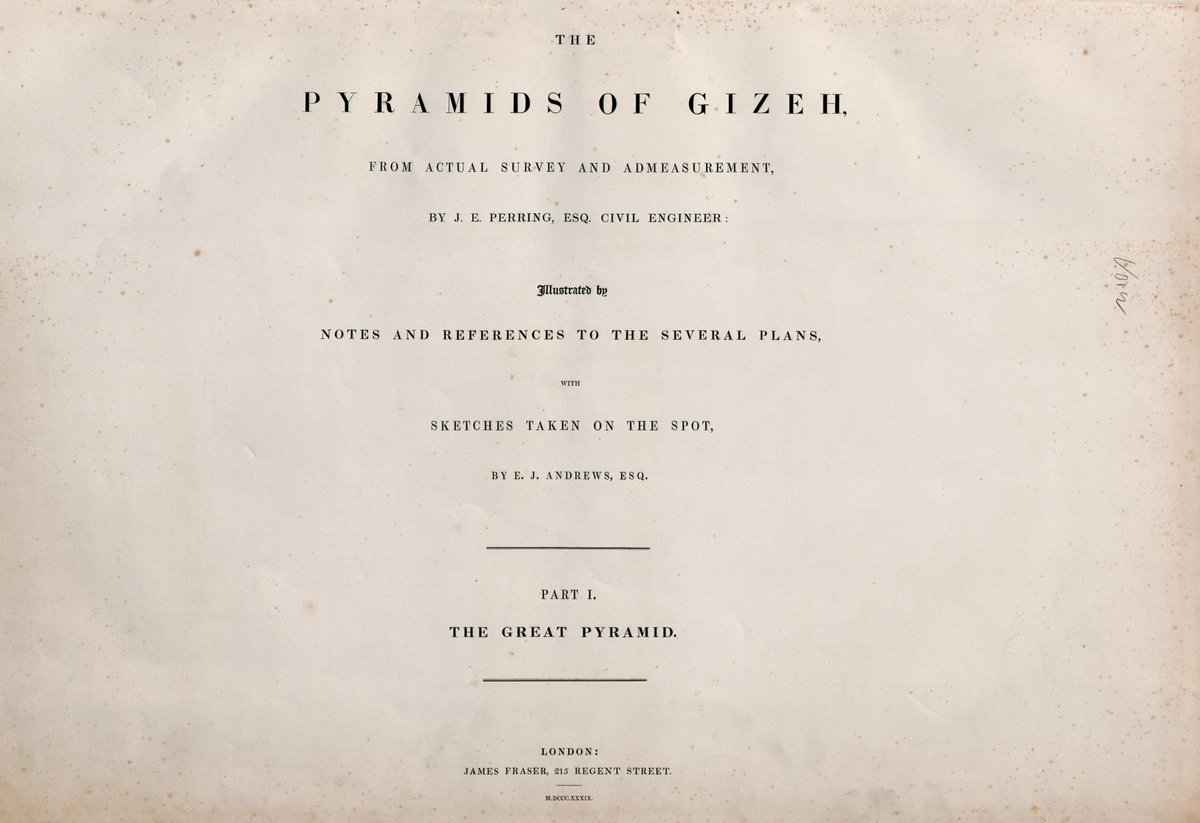
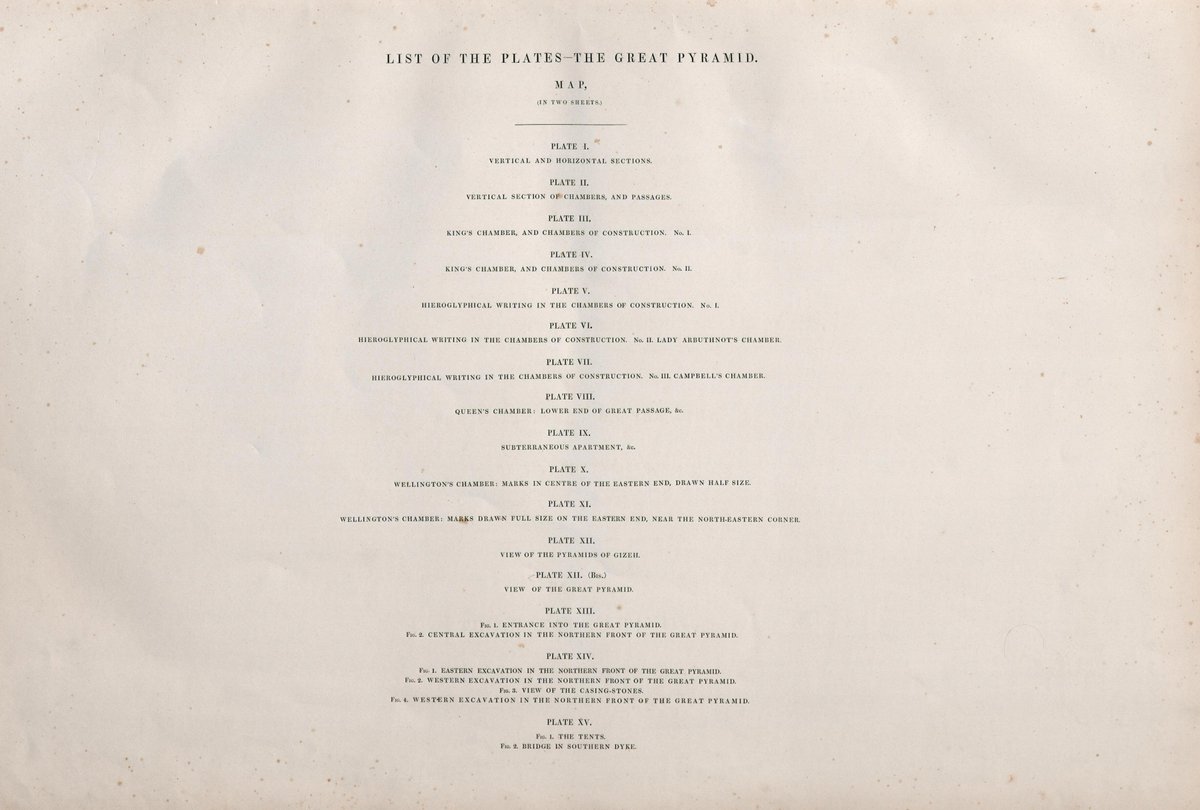
Egypt
An exquisite work but seldom remembered
Thread of 27 Slides
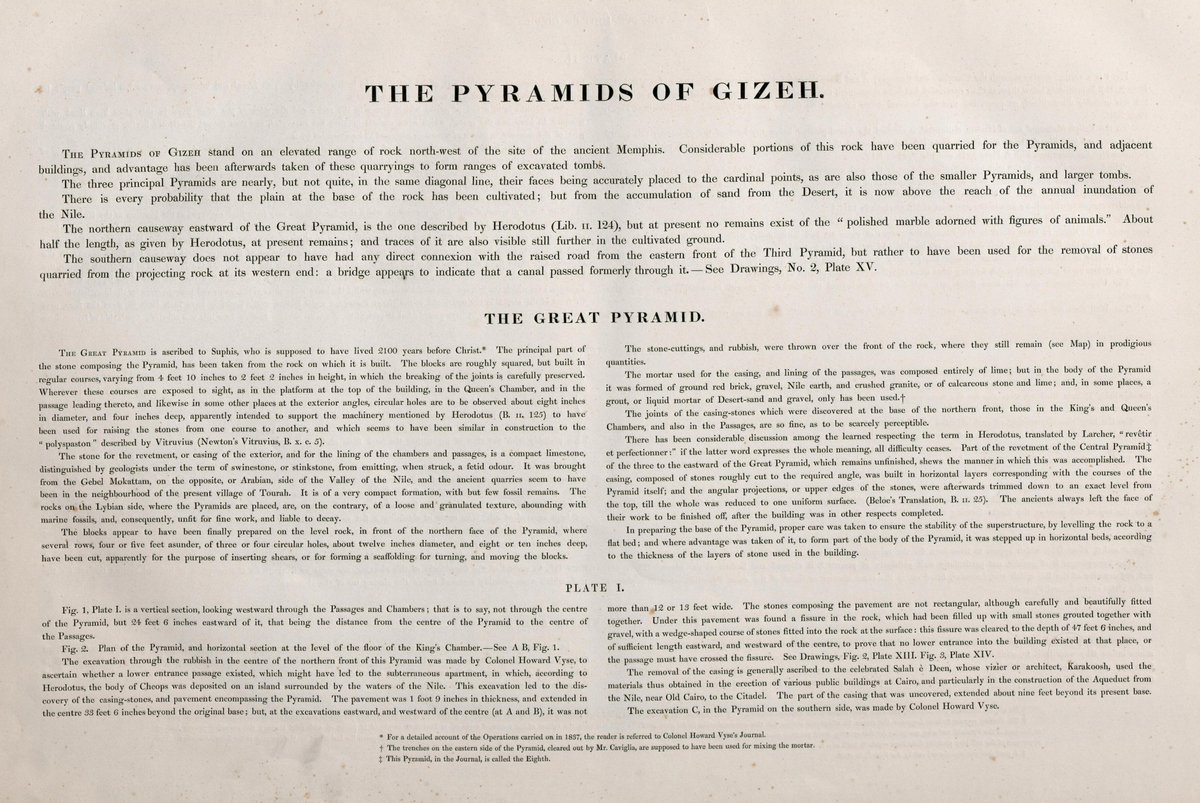
The pyramids of Gizeh:
From actual survey and admeasurement
London, 1839
By
Perring, John Shae
5
24
68
4,818

paganchristianmathematician retweeted

May 30
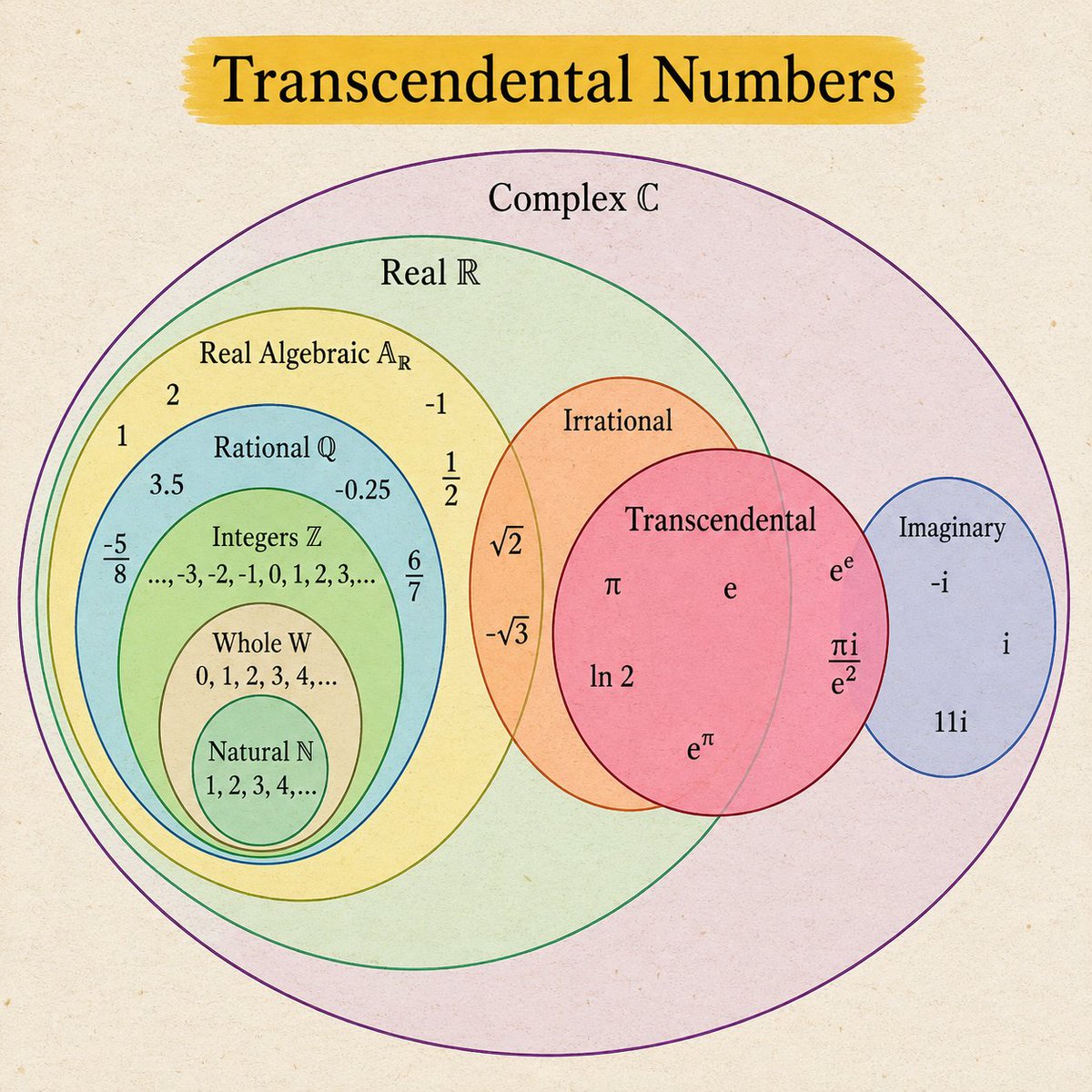
Transcendental numbers ✍️
This picture is a straightforward diagram that illustrates how different types of numbers are connected, resembling boxes within larger boxes, with a special focus on transcendental numbers. At the largest level are complex numbers, which encompass everything. Inside that category are real numbers, the everyday numbers we encounter on a number line. Real numbers divide into two main groups: rational numbers, which can be expressed as one whole number divided by another (such as fractions, integers, whole numbers, and natural counting numbers), and irrational numbers, which cannot be expressed in that way. Transcendental numbers are a specific subset mainly found within the irrationals. These numbers are more complex and cannot be solved using simple algebraic methods. Notable examples include pi (used for circles), e (which is significant in growth and science), and a few others like the natural logarithm of 2. The diagram helps us understand that numbers have layers, from basic counting numbers to more complex ones, with transcendental numbers like pi and e being unique and powerful in mathematics.
7
83
303
6,981

paganchristianmathematician retweeted

13 Jun 2025
You are what You eat.
You absorb what You consume.

1
8
332
paganchristianmathematician retweeted

Italian photographer Valerio Minato waited six years to capture the perfect alignment of the moon, a mountain, and a basilica
This image earned NASA’s Astronomy Picture of the Day, recognizing Valerio Minato’s years of planning and precision.


138
2,233
15,287
458,172
paganchristianmathematician retweeted
May 23
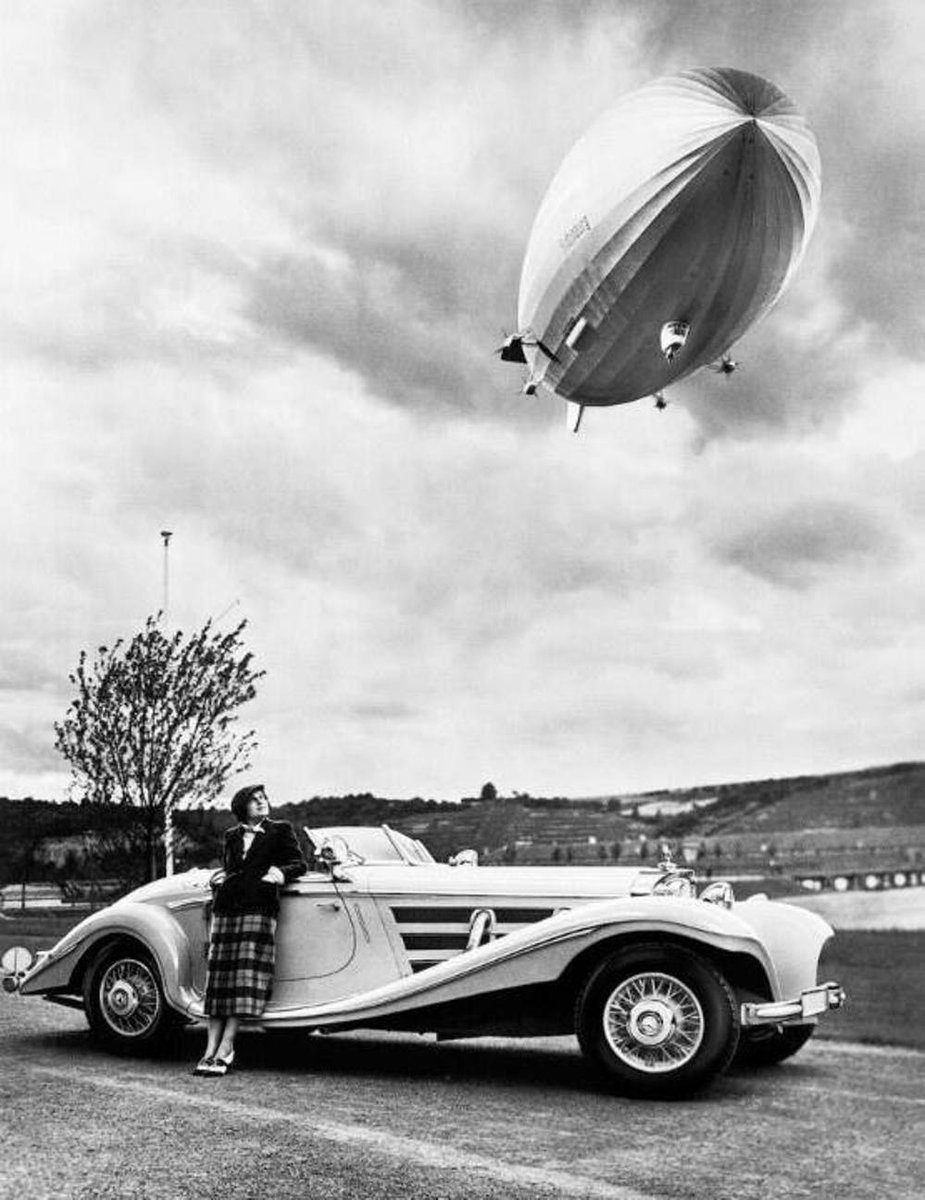
¿Me engañan mis ojos?
Ah no, es un Mercedes-Benz 500K Spezial Roadster de 1936.
Diseño: Friedrich Geiger.
#Diseño
8
45
1,112

The Starship team is go for prop load

Watch Starship's twelfth flight test x.com/i/broadcasts/1pKkOykQR…
533
1,804
8,563
1,705,452
Pyramid of Khaba and the Great Pit of Zawiyet el Aryan 1
The third pyramid was built at Zawiyet el Aryan 9km northwest of the first two and with ‘The Great Pit’ 1235m northwest of it, give or take a metre.
Maybe it’s 1234?
I have no problem with people saying the Pyramids are tombs, even though some are not, I have a problem with people saying they are ‘just tombs’.
These people do plenty of reading and ‘riting but cannot do ‘rithmetic.
3
2
8
866
Links to References
Layer Pyramid Barsanti
archive.org/details/annalesd…
archive.org/details/annalesd…
Zawiyet el Aryan Barsanti 1906 and 1912
archive.org/details/annalesd…
archive.org/details/annalesd…
archive.org/details/annalesd…
Pyramid of Khaba
archive.org/details/Maragiog…
Great Pit of Zawiyet el Aryan
archive.org/details/Maragiog…
archive.org/details/Maragiog…
G.A. Reisner and C.S. Fisher: "The Work of the Harvard University - Museum of Fine Arts Egyptian Expedition" (pyramid of Zawiyet el-Aryan), Bulletin of the Museum of Fine Arts (BMFA) 9, Boston, No. 54 Vol. IX (December 1911)
gizapyramids.org/static/pdf%…
Excavations at Giza 1949-1950 Cairo, Government Press, 1953
Abu Bakr, Abdel Moniem.
Digital Giza
giza.fas.harvard.edu/pubdocs…
The Layer Pyramid Zawiyet el-Aryan A Layman's guide
Keith Hamilton
academia.edu/125836429/The_L…
The Great Pit of Zawiyet el-Aryan A Layman's guide
Keith Hamilton
researchgate.net/publication…
Plutarch Moralia
archive.org/details/plutarch…
1
82
Once you see it,
You can't unsee it.
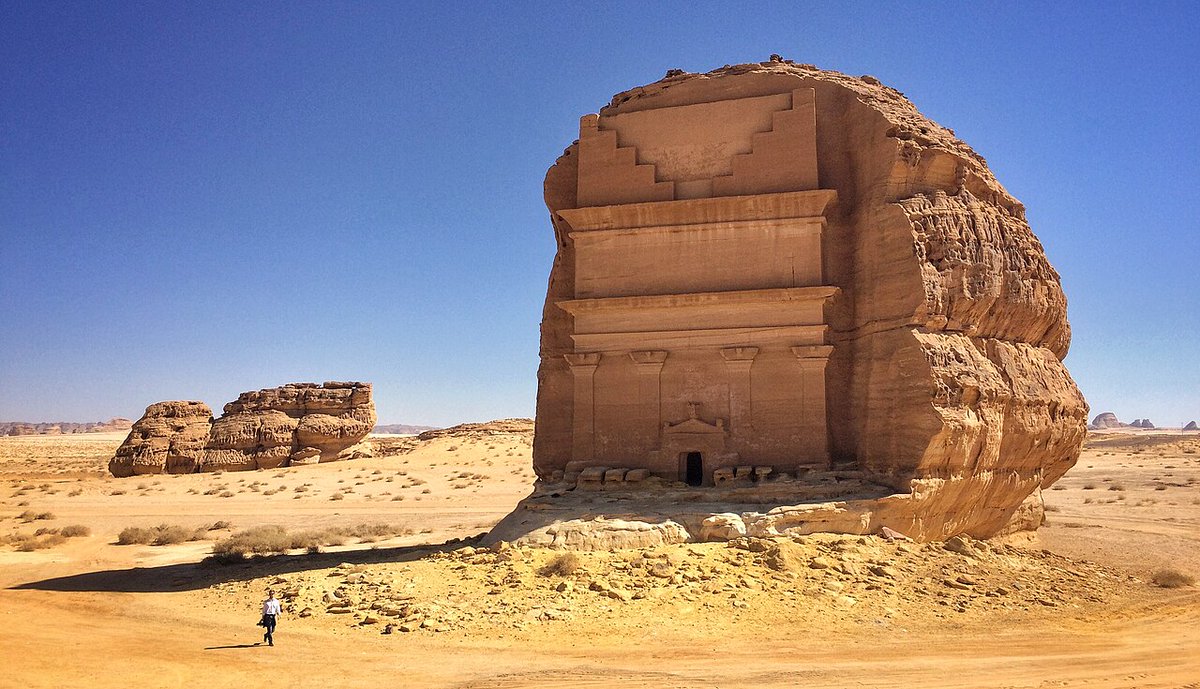
ALT Hegra-Meda'in Saleh Saudi Arabia commons.wikimedia.org/wiki/Category:Meda'in_Saleh
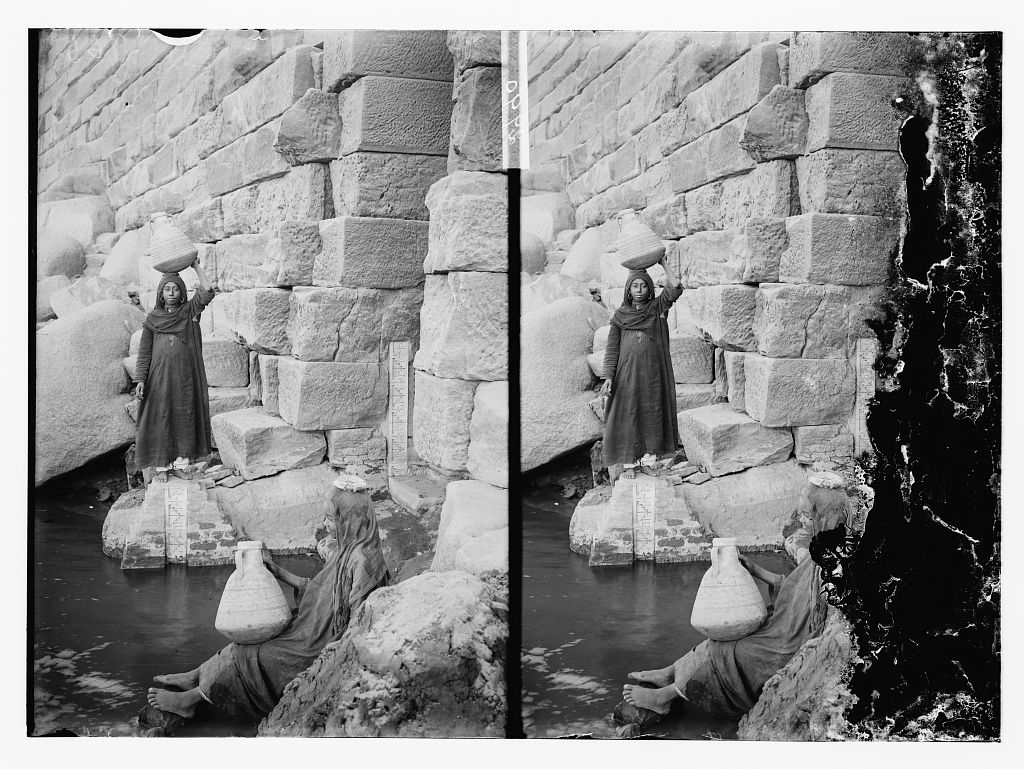
ALT The Nilometer on Elephantine Island Egypt www.loc.gov/resource/matpc.11418/
1
2
102
paganchristianmathematician retweeted

Rockets need a hug too!
Starship becoming fully reusable is our ticket to Kardashev civilization.
422
1,095
5,322
598,089
paganchristianmathematician retweeted

May 16
The Phaistos Disc is a fired clay artifact from roughly 1550 BC found in Crete during a 1908 excavation. Its precise symbol combinations look more like a structured data format or a ritual score than a standard written language. The actual meaning of these characters remains completely unsolved.
7
22
130
5,544