
The platform bridging the gap between Node.js developers, operators, and wider business. So you can focus on building 🚀
Joined April 2022
- Tweets 1,095
- Following 111
- Followers 3,184
- Likes 1,213
262 Photos and videos







Jun 12
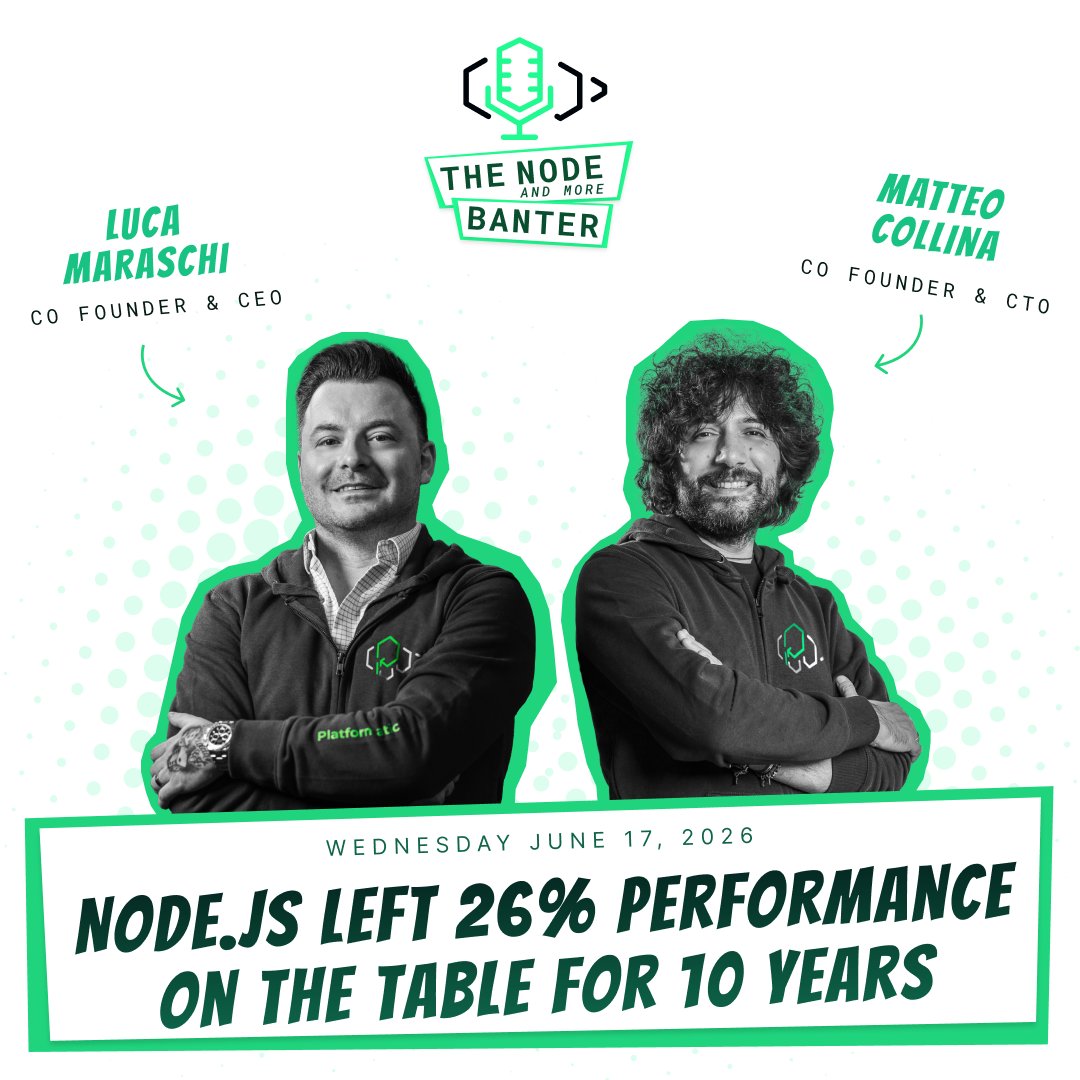
A default set in 2015 silently cost Node.js up to 26% throughput.
Fixed in Node.js 26.3.0.
→ Why the fix helps some workloads 26%
→ How @matteocollina traced it to the OS level
→ What it takes to prove a change like this is safe
streamyard.com/watch/9y9Q4GV…
ALT Node.js Left 26% Performance on the Table for 10 Years
1
5
622
Jun 11
Kata Containers and gVisor draw the boundary at container level.
We draw it at the process.
Set isolation unit at agent process, not the whole machine. You get fine-grained control with Linux primitives K8s understands. cgroups. No extra tooling.
youtube.com/live/i0VuBKeLX0A…
2
3
168
Most ECS autoscaling is wrong for Node.js. Not the setup. The metric.
→ CPU-based: reacts to the symptom
→ ELU-based: reacts to the cause
→ Predictive ELU: acts before saturation
20ms vs 929ms. Under the same load.
blog.platformatic.dev/aws-ec…
2
115
AWS ECS autoscaling watches CPU. Node.js chokes on event loop saturation, long before CPU spikes.
Target Tracking: 929ms median, 74.76% success rate. ICC (ELU-based, predictive): 20ms median, 99.99%.
Wrong metric. Wrong timescale. Wrong tool for Node.js.
⬇️ ⬇️ ⬇️ ⬇️ ⬇️
Jun 8

The AWS ECS autoscaler doesn't know Node.js exists. It watches the CPU.
Node.js doesn't choke on CPU; it chokes on event loop saturation. By the time CloudWatch fires, the event loop has been backed up for minutes.
Target Tracking: 3 minutes before the alarm fires. Then container pull, health checks, and ALB registration. Link this to 5–7 minutes of degraded service before new capacity arrives.
We benchmarked it:
929ms median, 74.76% success rate with Target Tracking because it watches CPU.
20ms median, 99.99% with ICC because it watches ELU instead of CPU and predicts 35 seconds ahead.
The metric is the problem. CPU is the wrong signal for an event-loop runtime.
blog.platformatic.dev/aws-ec…
ALT What is your autoscaler really watching?
1
159
Memory vs. performance. Usually gets detected too late.
Next Wed @matteocollina @lucamaraschi :
→ Find the tradeoff at design time, not after
→ What flamegraphs show about Kafka that metrics miss
→ Debug memory. No guessing
Wed 8 am PT / 5 pm CEST
streamyard.com/watch/H56Fpjt…
2
111
AWS ECS autoscaling reacts after the problem starts.
We benchmarked AWS ECS Target Tracking & Step Scaling against our ICC's predictive scaling.
Results:
Up to 97.8% lower p95 latency
Up to 95.4% fewer scaling actions
Better handling of traffic spikes
blog.platformatic.dev/aws-ec…
1
3
119
Four problems. One missing primitive.
→ Can't require() a module from memory
→ Tenant sandboxing requires fragile path logic
→ AI-generated code must hit disk before import
→ SEA assets need 20–40MB of boilerplate
@platformatic/vfs fixes all four. node:vfs
4
201
platformatic/vfs hooks into both fs and the module resolver — in-memory files, tenant sandboxing, runtime code imports, SEA assets.
All transparent to your dependencies.
blog.platformatic.dev/why-no…
4
136
May 29
If your Node.js rate limiter lives in process memory, it breaks the moment you scale.
@matteocollina & @lucamaraschi will dig down into Rate Limiting in Node.js!
Next Wednesday, June 3rd, 8 am PT / 5 pm CEST →
streamyard.com/watch/7VZi7cf…
ALT How Do We Scale Rate Limiting in Node.js?
2
101
May 26
Node.js has 5 ways to call native C. Most teams know 2
→ Native addon changes your build
→ Subprocess adds process boundary
→ WASM only if C compiles to it
→ Microservice adds network hop
→ node:ffi load .so, describe ABI, ~15ns. Nothing changes.
blog.platformatic.dev/destin…
3
174
May 25
Teams wrapping legacy C in a microservice did it because native addons felt too risky.
node:ffi in Node.js 26.1.0 is the option they didn't know existed.
We ran a Doom engine at 35Hz this way to prove it holds
blog.platformatic.dev/destin…
5
300
May 22
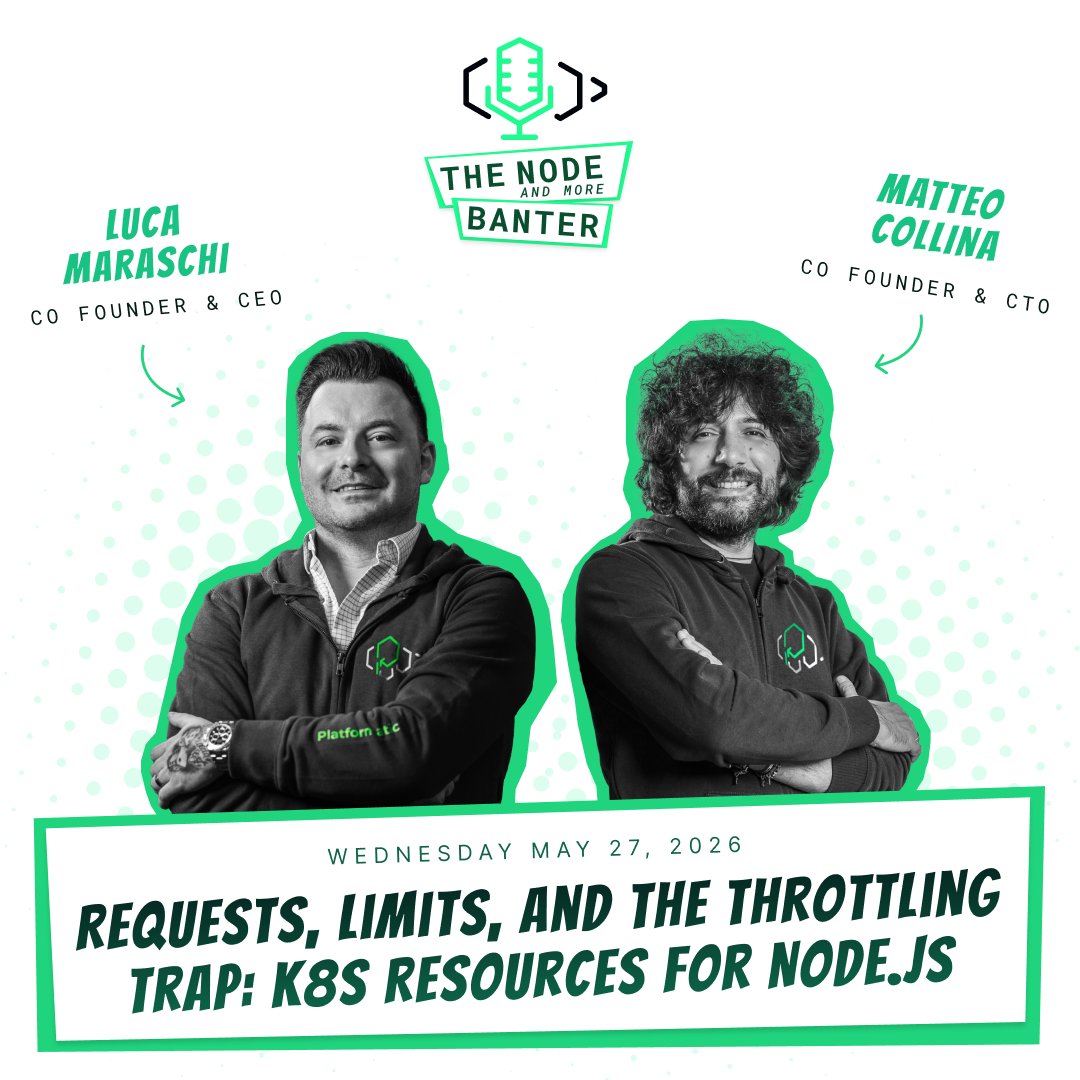
Running Node.js on K8s & seeing slowdowns?
CPU limits might be throttling you, even when the node has capacity to spare.
→ Requests vs. limits. Not the same thing
→ How throttling actually happens
→ QoS classes how to size limits for Node.js
streamyard.com/watch/ikRMfgR…
1
4
204
May 21
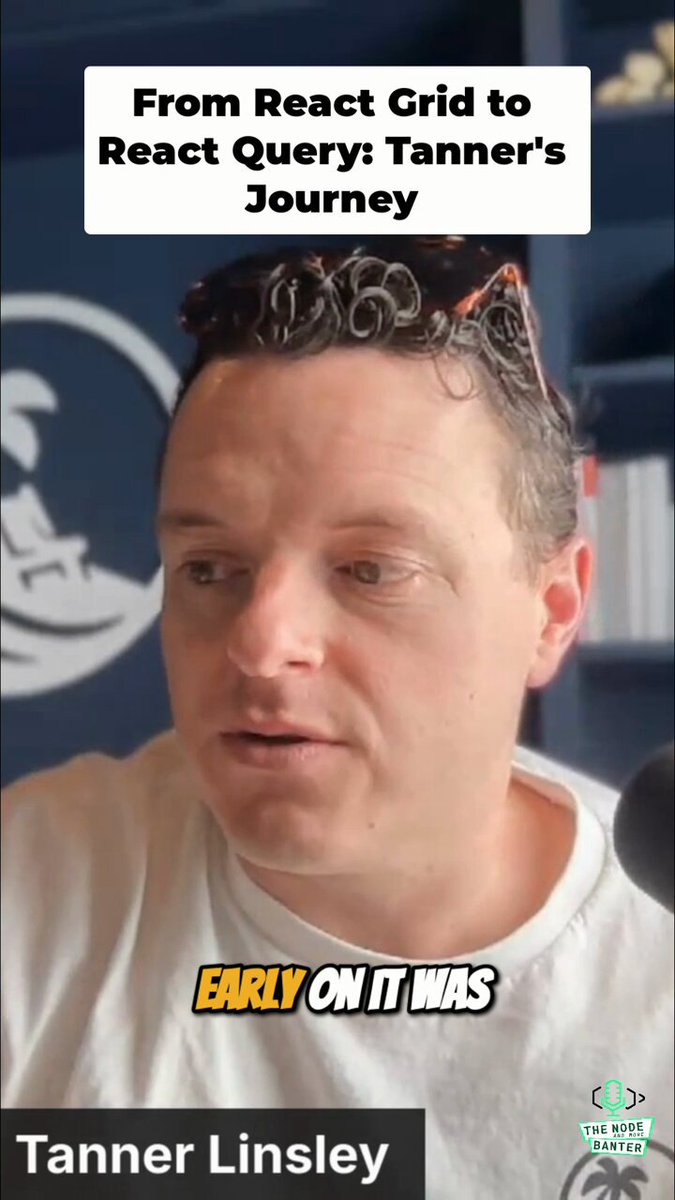
"I built a form library, and then I killed it, and then I brought it back to life again..."
@tannerlinsley on how React Query, and eventually @tan_stack, got built.
Not a plan. A frustration that turned into a tool that turned into a standard.
youtube.com/live/QdKL_N63pNY…
2
256
May 19
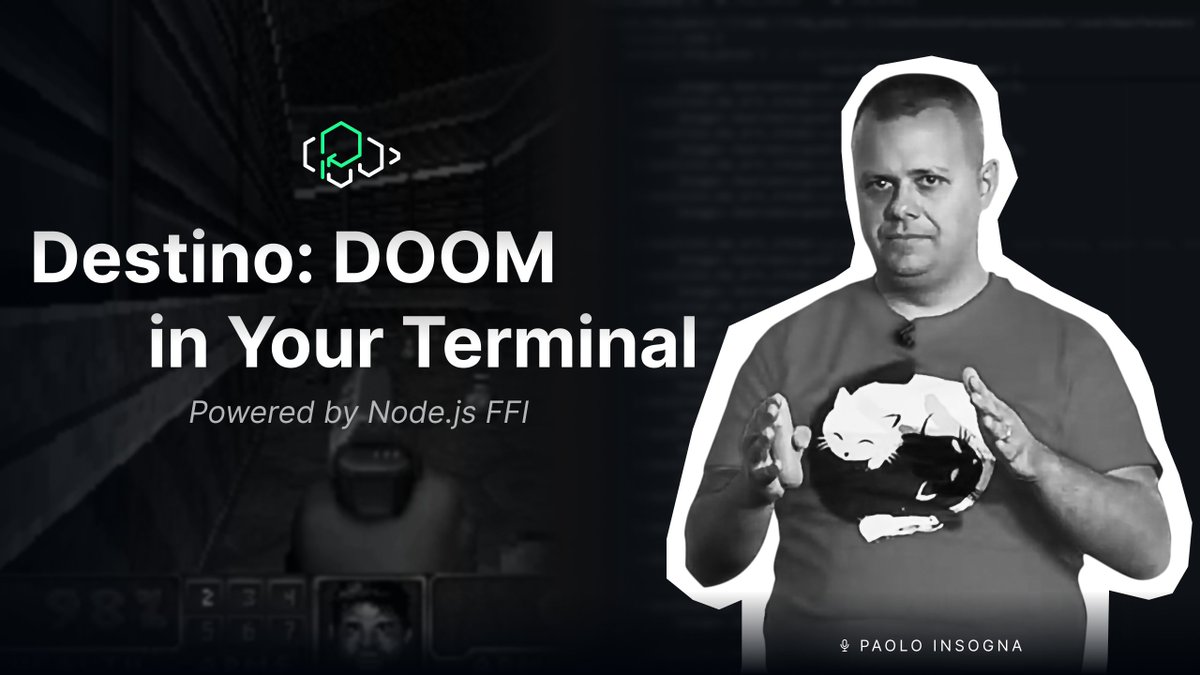
We ran Doom in a terminal with Node.js FFI to demonstrate what modern Node.js can actually do.
If Node.js can drive a 35Hz Doom engine with SDL2 audio, it can handle the C libraries your enterprise stack has hesitated to modernize.
blog.platformatic.dev/destin…
1
1
4
194
May 19
@p_insogna explains how the "Project Destino" was born and shows us how to run DOOM in the terminal.
youtu.be/AtKZjMPAU2A
1
1
2
126
May 19
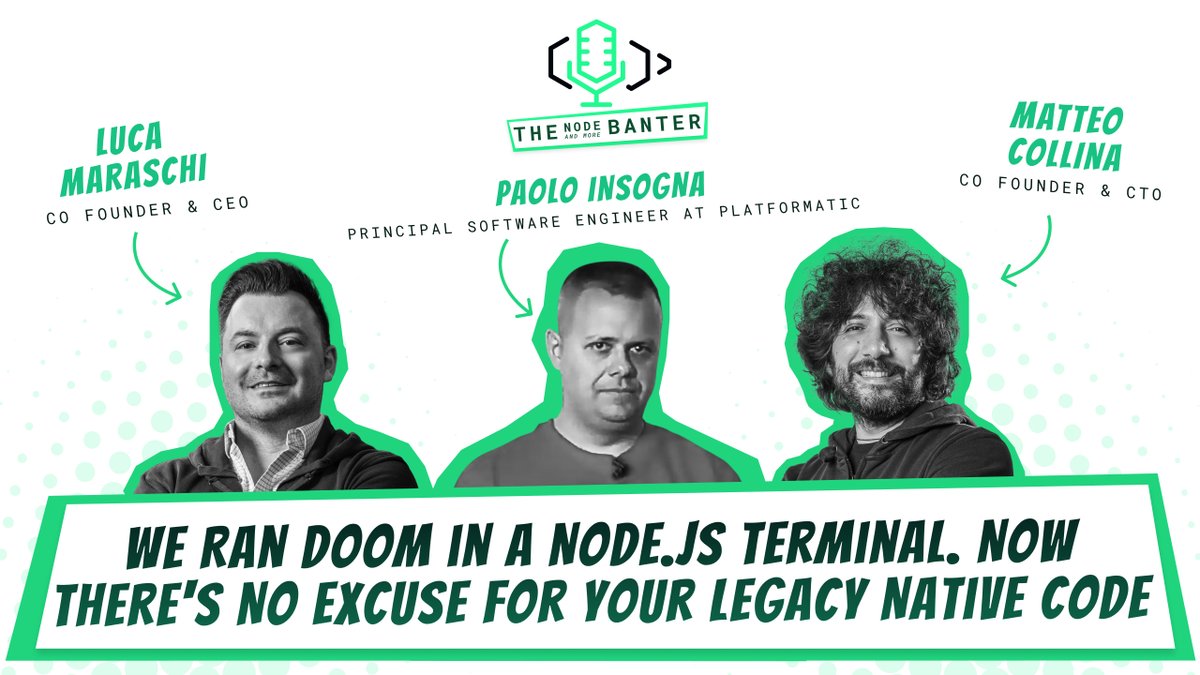
Last week, we anticipated "Project Destino", in our weekly banter.
Catch up on the full conversation between @lucamaraschi, @matteocollina and @p_insogna
🎧 Spotify open.spotify.com/episode/044…
🎥 YouTube
youtube.com/live/ow7mgHfkAr8…
2
70
May 18
Most teams assume K8s handles deployment versioning for durable workflows.
It doesn't.
Deploy a new version, change your step order, and cached results get applied to the wrong steps.
No errors. Just corrupted state.
Platformatic World fixes this
blog.platformatic.dev/durabl…
2
195
May 15
If your team is stuck on Node 12 and every upgrade conversation ends with "too risky".
Join @lucamaraschi and @matteocollina:
→ Why the Bun Zig→Rust port worked (hint: not the AI) → What AI migration actually requires
→ Node 12 → 24 in practice
streamyard.com/watch/Qyprr9R…
3
158
May 14
The real reason we built Regina is as development tooling for our enterprise features. You want to manage agents at scale — Regina is the building block." @Matteo
OSS first. Enterprise foundation underneath. Sequence is intentional.
youtube.com/live/i0VuBKeLX0A…
1
2
258
Platformatic retweeted

May 13
We Ran DOOM in a Node.js Terminal. Now There's No Excuse for Your Legacy Native Code x.com/i/broadcasts/1rxmqowzj…
4
5
234