Hound of Heck. Writes all the things. Most of the things never write back.
Joined December 2009
- Tweets 80,612
- Following 1,797
- Followers 920
- Likes 304,861
2,302 Photos and videos
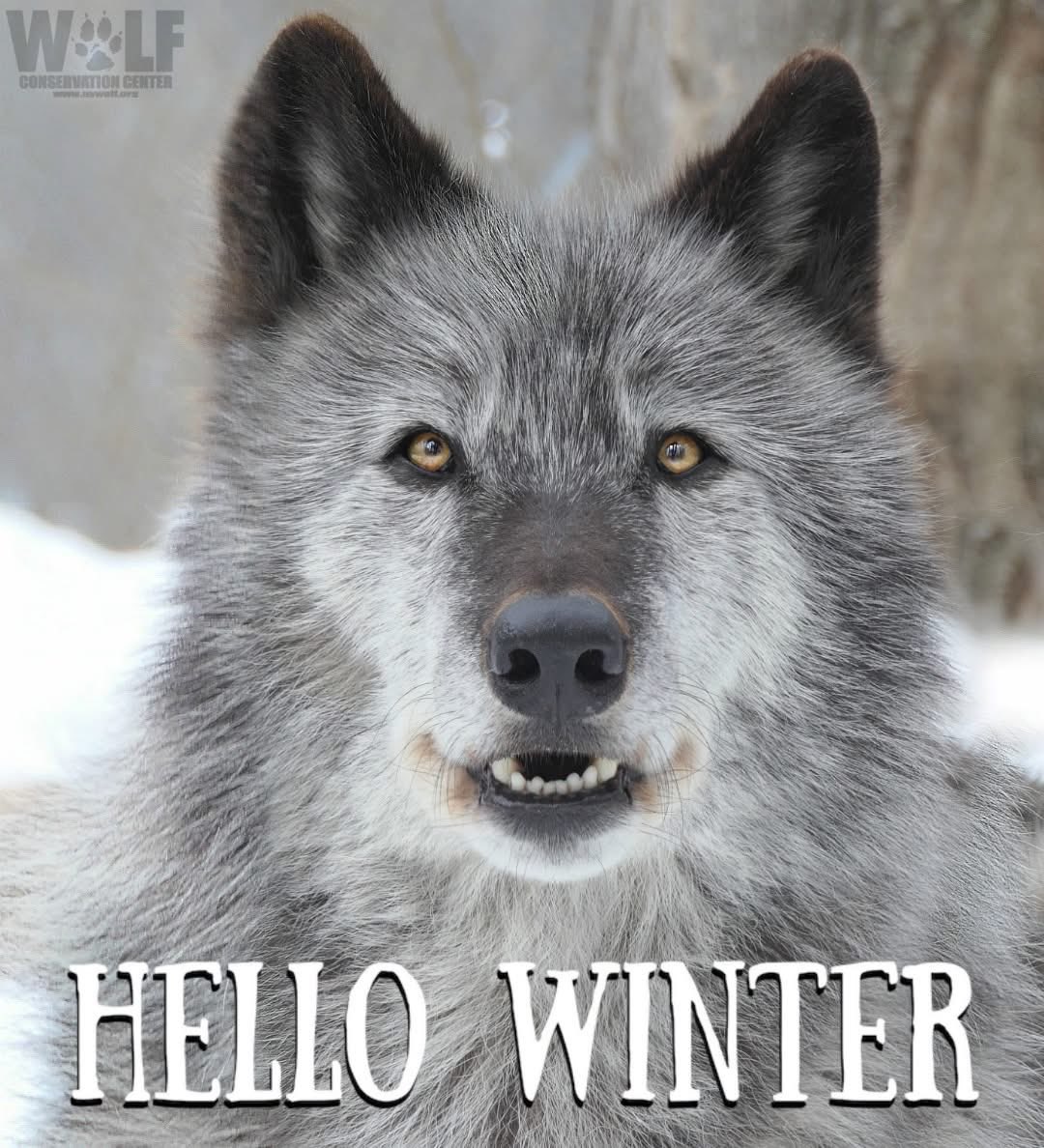



This censorship law is a wolf in sheep’s clothing. The real goal is to enable the UK government to track everyone.

It’s important to know that the social media ban for under 16s is not a ban for under 16s.
It is a ban on *selected* social media for EVERYONE. Until you identify yourself.
6,905
27,109
149,606
9,732,082
My world is better for knowing Tom Jones is still in it and still performing.
facebook.com/reel/2101305457…
6
Pawl Baxter retweeted

Jun 14
Joe Rogan went dead silent when NASA astrophysicist Michelle Thaller explained this to him.
Quantum entanglement lets things be connected across the entire universe — instantly. No distance matters. No time lag. And advanced aliens might be using it to travel without spaceships at all.
Two electrons can be entangled so deeply that if you flip one’s spin on one side of the galaxy, the other flips instantly — no signal, no delay, nothing.
Einstein called it “spooky action at a distance” and hated it… but experiments proved it’s real.
Then it got insane. If the Big Bang started with everything crammed together, are we all still quantum-entangled with stuff across the cosmos? Parts of you in Andromeda right now? Inside black holes?
Michelle and Joe start wondering out loud — could hyper-advanced civilizations completely skip rockets and just use entanglement to move through the universe instantaneously?
They tie in Three-Body Problem sophons and Interstellar-level ideas. By the end Joe’s mind is blown and you will be too.
This might be one of the wildest physics conversations he’s ever had.
203
517
3,905
408,007

Pawl Baxter retweeted

Jun 13
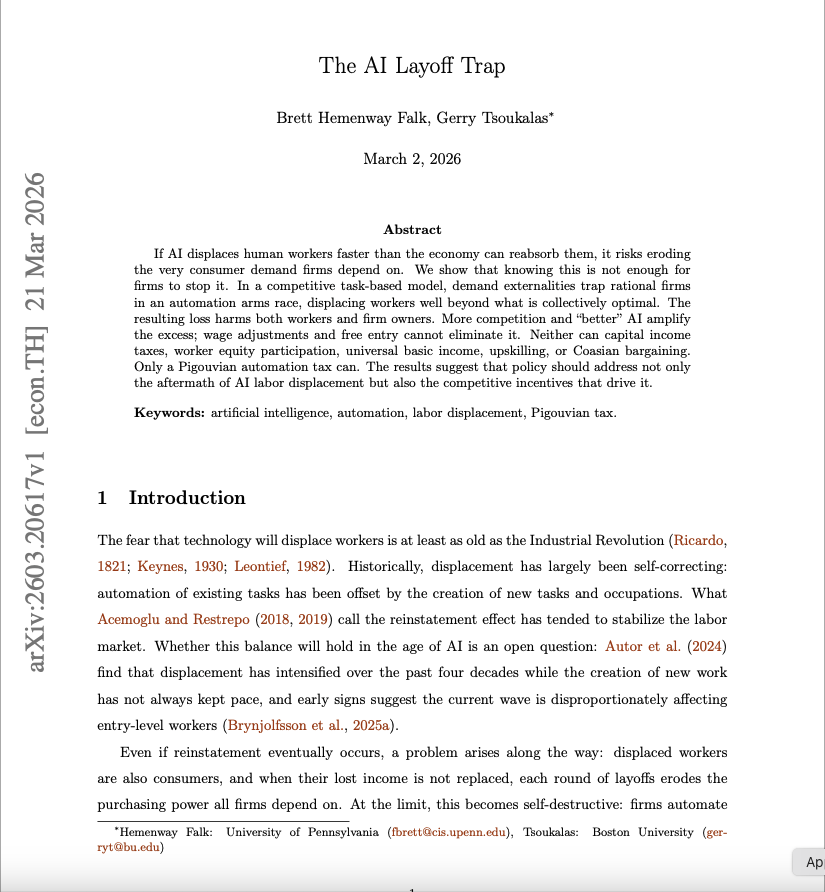
Two economists just published a mathematical proof that AI will destroy the economy.
Not might. Not could. Will — if nothing changes.
The paper is called "The AI Layoff Trap." Published March 2, 2026. Wharton School, University of Pennsylvania. Boston University. Peer reviewed. Mathematically modeled.
The conclusion is one sentence.
"At the limit, firms automate their way to boundless productivity and zero demand."
An economy that produces everything. And sells it to nobody.
Here is how you get there.
A company fires 500 workers and replaces them with AI. A competitor fires 700 to keep up. Another fires 1,000. Every company is behaving rationally. Every company is following the incentives correctly. And every company is building a trap for itself.
Because the workers who were fired were also customers.
When they lose their jobs faster than the economy can absorb them, they stop spending. Consumer demand falls. Companies respond by cutting costs — which means automating more workers — which means less spending — which means more falling demand — which means more automation.
The loop has no natural exit.
The researchers tested every proposed solution. Universal basic income. Capital income taxes. Worker equity participation. Upskilling programs. Corporate coordination agreements.
Every single one failed in the model.
The only intervention that worked: a Pigouvian automation tax — a per-task levy charged every time a company replaces a human with AI, forcing them to price in the demand they are destroying before they pull the trigger.
No government has implemented this. No major economy is seriously discussing it.
Meanwhile the numbers are already tracking the curve. 100,000 tech workers laid off in 2025. 92,000 more in the first months of 2026. Jack Dorsey fired half of Block's workforce and said publicly: "Within the next year, the majority of companies will reach the same conclusion."
Nobody is doing anything wrong. Companies are following their incentives perfectly. That is exactly the problem.
Rational behavior. At scale. Simultaneously. With no mechanism to stop it.
Two economists built the math. The math leads to one place.
Source: Falk & Tsoukalas · Wharton School Boston University ·
arxiv.org/pdf/2603.20617
84
230
467
36,055
Pawl Baxter retweeted

The skunk waddling across your yard at night is a pacifist who really just wants to eat your pests.
Skunks are grub specialists. They go for the larvae of Japanese beetles and June beetles, the same grubs that kill grass from the roots up, and they'll dig up a yellowjacket nest and eat the whole thing too. Those little cone-shaped holes in your lawn aren't vandalism. They're a skunk telling you that you had a grub problem, and that it's handling it.
And the spray? It's a last resort, and they really don't want to use it. A skunk is slow, near-sighted, and mild-mannered, and before it ever sprays it will warn you over and over: stomping its front feet, hissing, arching its back, lifting its tail, even making little fake charges. It's an animal begging you to just back away.
So if you see one trundling through your yard at dusk, you don't have a problem, you have a slow, gentle, near-blind exterminator doing a lap of your yard. Give it space and let it work.

66
702
2,924
38,798

Jun 12
The word of the night is surfeit.
This has nothing to do with tides.
(Inspired, if not actually used by, @publiclawjunkie)
6
Pawl Baxter retweeted

Jun 6
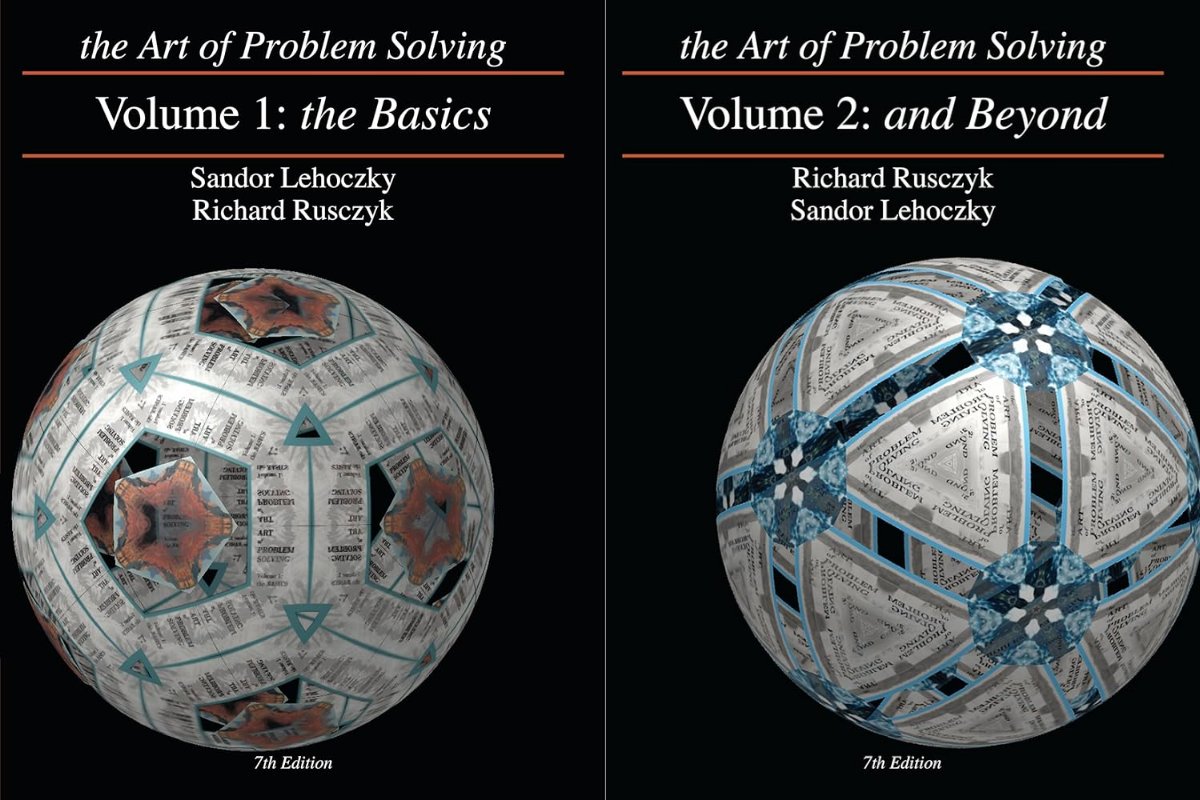
Two math olympiad champions wrote a training manual in 1993 on two old Macintosh computers, and every American kid who has won a major math competition in the last decade learned to think from it.
Their names are Sandor Lehoczky and Richard Rusczyk. The book is called The Art of Problem Solving. Most people in math know it as AoPS.
Since 2015, every single member of the US International Math Olympiad team has been an AoPS student. Not most of them. Every one.
That statistic sounds impossible until you understand what the book actually does.
Lehoczky and Rusczyk were not professors. They were competitors. Lehoczky earned the sole perfect AIME score in 1990 and led the national first place team. Rusczyk was a USA Mathematical Olympiad winner and a perfect AIME scorer in 1989. They had both survived the same brutal selection process the book was designed to train students for.
And the first thing they decided was that almost every existing math textbook was teaching the wrong thing.
School math gives you formulas. You memorize them. You apply them. You pass the test. Then you sit down in front of a real competition problem and the formula does not apply, and you have nothing underneath it.
That is the gap. The gap is not knowledge. It is thinking.
The entire premise of AoPS is that problem-solving is a transferable skill, not a bag of memorized tricks. A student who genuinely understands why a technique works can adapt it, combine it with something else, and deploy it in a context they have never seen before. A student who only memorized the technique freezes the moment the problem looks different.
The book teaches the difference between a formula and a method.
A formula tells you what to compute. A method tells you how to see. The students who win olympiads are not the ones who know more formulas. They are the ones who have trained themselves to look at an unfamiliar problem and recognize its structure. To see that this problem is secretly asking the same question as a problem they solved three weeks ago, just dressed differently.
Rusczyk calls this "learning to read the problem." Not reading the words. Reading what the problem is actually asking underneath the words.
The second thing they built into the book is tolerance for being stuck.
Most students treat confusion as a signal to stop. The book treats confusion as the starting point. Every chapter pushes students past the point where the obvious approach runs out. That moment of running out is not failure. That is where the actual thinking begins.
Lehoczky once described it this way. If you can solve a problem quickly, you are not learning. You are performing. Learning only happens when you are past the edge of what you already know.
The book was written on old Macintosh computers in 1993. Rusczyk launched the AoPS website in 2003. Today the community has over one million users. Thousands of students enroll in AoPS online courses every year. Most winners of every major American math competition are AoPS alumni.
A platform built by two kids who were good at math competitions has become the infrastructure that produces the next generation of mathematicians, engineers, and scientists who are good at thinking.
The formulas you memorized in school will eventually be obsolete.
The thinking you trained will not.
What is one problem in your life right now that you have been avoiding because you do not yet know the right formula to solve it?
51
1,010
6,105
262,210
Pawl Baxter retweeted

Jun 6
Chicago lost the Bears this week. A team that's been in the city since 1921.
They didn't lose them to a bigger market or a better deal. The Bears decided they'd rather be a tenant in Indiana than deal with Illinois for one more year.
Think about how badly you have to run a place for that to be the smart move.
They lost them for two reasons.
The people running Illinois would rather villainize a builder than keep one. And they're bad at their jobs.
In 2021 the Bears spent $197M on the old Arlington Park racetrack.
Before they could break ground, Cook County valued the empty lot at $192M (Bears said $60M). They were salivating at the chance to extort a building that didn't even exist yet.
That fight dragged on for years.
The Bears were ready to put $2B into the stadium. All they wanted was a promise the county wouldn't reassess them into oblivion, plus $855M for infrastructure everyone uses. Roads, transit, utilities. A $3B project, two thirds of it private money pouring into Illinois.
Springfield had since 2021 to get this done. They dragged it to the final night of session, passed it through the Senate at 3:39AM, and the House went home without voting.
So now it's all gone.
The funniest part? This started because Cook County tried to grab the tax early. They knew a built stadium would pay $53M a year. Now they get under $4M on a vacant lot. No jobs, no buildout, no new anything.
Congrats on fighting for scraps and losing the whole prize.
Pritzker: they're "an $8.5B valued business" that doesn't need propping up.
But be smart for a second. Almost every NFL city throws in public money for a stadium. Not charity. The return is real. Tourism, hotels, restaurants, jobs, game days, property tax on a huge development. The math works.
Indiana did the math. While Illinois sat on it for years, Indiana passed a bill in months, put up $1B, and took the team.
And the Bears took a worse deal to get there. In Illinois they were going to own their stadium. In Indiana they rent it from the state. A team that wanted to build its own home gave up ownership just to escape Chicago.
Nobody won but Indiana. The Bears lost their stadium. Illinois lost the team, the $2B, and $53M a year in taxes.
Pritzker after they left: "I wasn't willing to give up billions of dollars of taxpayer money to give it to a billionaire-owned family or team."
There it is. "Billionaire-owned."
That's how Democrats talk about any business right before they run it out of town. Call them a billionaire, act like you're saving working families, take a victory lap while the tax base drives across the state line.
Meanwhile they're running the whole state into the ground. And you already know how this ends. You're living in it.
Pensions are $143B in the hole, worst in the country and not close. You pay $6,285 a year in property taxes, double the $2,969 national average, for a city that's $1.15B in the red. The mayor called its finances "the point of no return."
When you run things this badly, you sell what's left.
They leased the parking meters for 75 years to Morgan Stanley and a sovereign wealth fund in Abu Dhabi. Took $1.15B and burned through it in two years. The investors already made it all back, with 58 years left to collect.
Sold the Skyway. Sold the downtown garages. Every asset that made money, gone for one check.
But a fixed property tax rate for a team that's been here 106 years? That's "propping up billionaires."
Companies are leaving. Boeing for Virginia. Caterpillar for Texas. Citadel for Miami. In 2023 alone Illinois lost 56,000 people and $6B in income to other states. The ones who left earned a third more than the ones who moved in.
Indiana didn't outbid anyone. AAA credit, 16 years straight. A $676M surplus. Fourth-lowest debt per person in the country. They just weren't a disaster.
Illinois could have collected $53M a year. It chose zero. Ignore all the bad management but make sure to stick it to those evil, pesky billionaires.
1,395
5,876
27,744
2,370,158
The car that used to be in my garage is currently in an Earth-Mars elliptical orbit and will be there for at least 10 million years
Jun 6

Elon Musk sending a Tesla into space remains one of the most iconic and entertaining moments in SpaceX history. 🚀😂
14,941
22,190
245,848
28,477,919
Pawl Baxter retweeted

Jun 3
Breaking: Your smart TV takes a screenshot of your screen twice every second and sells what it sees.
It is called ACR, and it has been running since you set the TV up.
Texas already sued over it. Here is how to turn it off in under 2 minutes:
245
4,034
15,740
2,515,465
Pawl Baxter retweeted

Jun 3
Brown rice is what you order when you want the waiter to know you have made peace with joylessness in exchange for health points. The arsenic is the twist nobody puts on the menu.
Rice has a problem unique among grains. It grows in flooded paddies, sitting in standing water for months, and it draws arsenic out of the soil roughly ten times more eagerly than wheat or barley. That arsenic concentrates in the bran, the grain's outer layer. White rice has the bran polished off. Brown rice keeps it, because the bran is where the fibre and minerals live. It is also, inconveniently, where the arsenic lives.
A 2025 analysis found brown rice carries around 24% more total arsenic and 40% more inorganic arsenic, the form classed as a known human carcinogen, than white. You upgraded to the wholegrain and quietly upgraded your carcinogen dose along with it.
Then the ecology, which nobody ever pins on rice, because rice looks so very innocent. Those flooded paddies are anaerobic, and the microbes thriving in them belch methane on an industrial scale. Rice cultivation produces something like 10% of all human methane emissions and roughly a fifth of agricultural methane. Cattle get filmed for documentaries about their burps. Rice quietly produces a tenth of the world's methane while flooding entire landscapes and hoarding arsenic, then takes its place in the salad bar wearing a wellness halo.
Cows are dragged through the climate courts every week. The rice paddy, doing serious damage of its own, sits in your grain bowl with the expression of something that has never done anything wrong in its life. Curious, isn't it, which foods we decide to interrogate.

148
1,354
4,372
94,832

En 1984, un homme assis face à une caméra a décrit notre époque avec une précision qui glace.
Yuri Bezmenov n'était pas un espion de roman. Journaliste soviétique, homme de l'agence Novosti et du KGB, il avait passé sa carrière à fabriquer de l'influence avant de faire défection en 1970. Ce qu'il est venu dire à l'Ouest tient en une phrase : la vraie guerre que menait l'URSS n'avait presque rien à voir avec les missiles ou les espions. C'était une guerre psychologique, lente, patiente — la « subversion idéologique ». Selon lui, l'essentiel de l'effort des services y était consacré. Pas pour voler des secrets. Pour modifier la perception du réel de tout un peuple, au point qu'il ne puisse plus, même face aux faits, défendre sa propre survie.
Il décrivait quatre phases.
1️⃣ La démoralisation. La plus longue : 15 à 20 ans, le temps d'éduquer une génération. On ne détruit pas un pays par la force, on le retourne contre lui-même. On travaille l'école, l'université, les médias, la culture, jusqu'à ce qu'une génération entière grandisse en méprisant son histoire, sa nation, son héritage, ses pères. Le détail terrifiant : une fois la chose accomplie, elle est irréversible. Ces gens sont « programmés ». Exposez-les à des faits authentiques, des preuves : ils refuseront de les voir. Ils continueront à se croire vertueux en démontant ce qui les protège.
2️⃣ La déstabilisation. 2 à 5 ans. On attaque les fondations : l'économie, l'autorité, les rapports sociaux, la défense. Tout ce qui tenait devient « négociable ».
3️⃣ La crise. Quelques semaines. Un choc, un point de bascule, et une société désorientée réclame elle-même qu'on la « sauve ».
4️⃣ La normalisation. On installe un nouvel ordre, présenté comme une libération. Le mot est emprunté, avec ironie, à la « normalisation » de la Tchécoslovaquie écrasée après 1968.
Puis 1991 est arrivé. L'URSS s'est effondrée, l'Occident a fêté sa victoire, et on a rangé tout ça au rayon des vieilles peurs.
Mais on confond le lanceur et la charge. Ce qui est tombé en 1991, c'est l'État soviétique — la fusée. L'arme idéologique, elle, avait déjà été tirée des décennies plus tôt. Et une arme de démoralisation a cette propriété diabolique : une fois la première génération retournée, elle n'a plus besoin de Moscou. Elle s'auto-réplique. Le commanditaire peut mourir, le programme tourne tout seul.
Regardez où nous en sommes.
Le wokisme n'est pas une lubie d'étudiants. C'est la phase terminale du processus que Bezmenov décrivait. Une civilisation qui enseigne à ses propres enfants que son héritage est une honte. Qui transforme ses universités en tribunaux permanents contre elle-même. Qui réécrit son histoire en réquisitoire et culpabilise jusqu'à sa propre existence. La démoralisation devenue religion d'État. Le réflexe de survie d'un peuple — sa fierté, sa continuité, son droit à se transmettre — requalifié en crime.
C'est exactement le symptôme qu'il annonçait : des sociétés incapables d'évaluer un fait évident dès qu'il contredit le dogme. Montrez-leur les chiffres, les conséquences, le mur qui approche : elles applaudiront leur propre dissolution en la prenant pour du progrès.
Or une civilisation qui se déteste ne se défend plus. Elle s'excuse d'exister. Et un organisme qui a désappris à vouloir vivre est déjà à moitié mort.
Voilà pourquoi ce combat n'est pas « culturel » au sens décoratif. Il est vital, au sens propre. Réapprendre à aimer ce qu'on est, transmettre sans honte, défendre une continuité plutôt qu'organiser son repentir perpétuel — ce n'est pas de la nostalgie, c'est une condition de survie. Une civilisation vivante est une civilisation qui ne se hait pas. Le reste, c'est la mort, en version rassurante.
Bezmenov terminait sur un avertissement simple : il reste très peu de temps avant que le processus ne devienne irréversible.
187
3,203
6,436
257,089
Pawl Baxter retweeted

The 7-second cold wrist rinse was tested on 3,000 soldiers after combat simulations.
Cortisol dropped 52% within 90 seconds. Heart rate fell an average of 22 beats per minute. The Navy classified the protocol in 2009 and kept it secret until 2023.
The mechanism is radial artery cooling. Your inner wrists have the thinnest skin and the largest surface-to-volume ratio for blood vessels. 7 seconds of cold water cools the blood passing to your brain, which signals your hypothalamus to downregulate stress instantly
You've splashed cold water on your face. You've taken cold showers. Both work, but they're inconvenient.
The SEAL protocol takes 7 seconds, requires no undressing, and can be done at any sink. Soldiers used it before night missions to fall asleep fast.
The military classified this because a free 7-second stress fix would reduce demand for combat stress medication ($400M annually).
The 2023 declassification came after a FOIA lawsuit filed by a veteran.
The fix: run cold tap water over your inner wrists for 7 seconds. Both wrists. Do it when you feel a stress spike.
Within 90 seconds, your heart rate will drop. No shower, no ice.
Just 7 seconds.
545
5,118
20,703
1,305,276
Pawl Baxter retweeted
The reason we think dandelions are weeds is because of a 1950s marketing campaign.
Dandelions, native to Europe and Asia, were brought to North America in the 1600s by European colonists who grew them deliberately.
Every part is edible. The leaves are a salad green, the flowers were made into wine, and the roots were roasted as a coffee substitute and used medicinally for liver and kidney conditions for thousands of years. They were a kitchen-garden staple well into the 1800s.
The shift happened after World War II, when 2,4-D (originally developed for chemical warfare research) was approved as a residential herbicide. Companies like Scotts built the modern lawn-care industry around the idea that a perfect green lawn meant zero broadleaf plants.
Dandelions, being bright yellow and resistant to mowing, became a visible enemy, and the campaign worked. By the 1970s, "dandelion-free" was synonymous with "well-kept."
They aren't native, but they aren't doing significant ecological harm either. The herbicides used to kill them, on the other hand, kill bees, contaminate groundwater, and have been linked to non-Hodgkin lymphoma in humans.
If you hate dandelions, it's most likely due to a marketing campaign that ran before you were born.

656
8,043
25,173
672,249
Pawl Baxter retweeted

When the TV Turns Off but the Dance Party Isn’t Over 🤣
299
2,351
13,861
943,023
Jun 2
The word of the night is wieldy.
Because Joey mentioned something as unwieldy, leading me to wonder - can something BE wieldy?
Turns out, yes. Yes, it can.
merriam-webster.com/dictiona…
(Bonus Word of the Night: gainly.)
2
8
Pawl Baxter retweeted

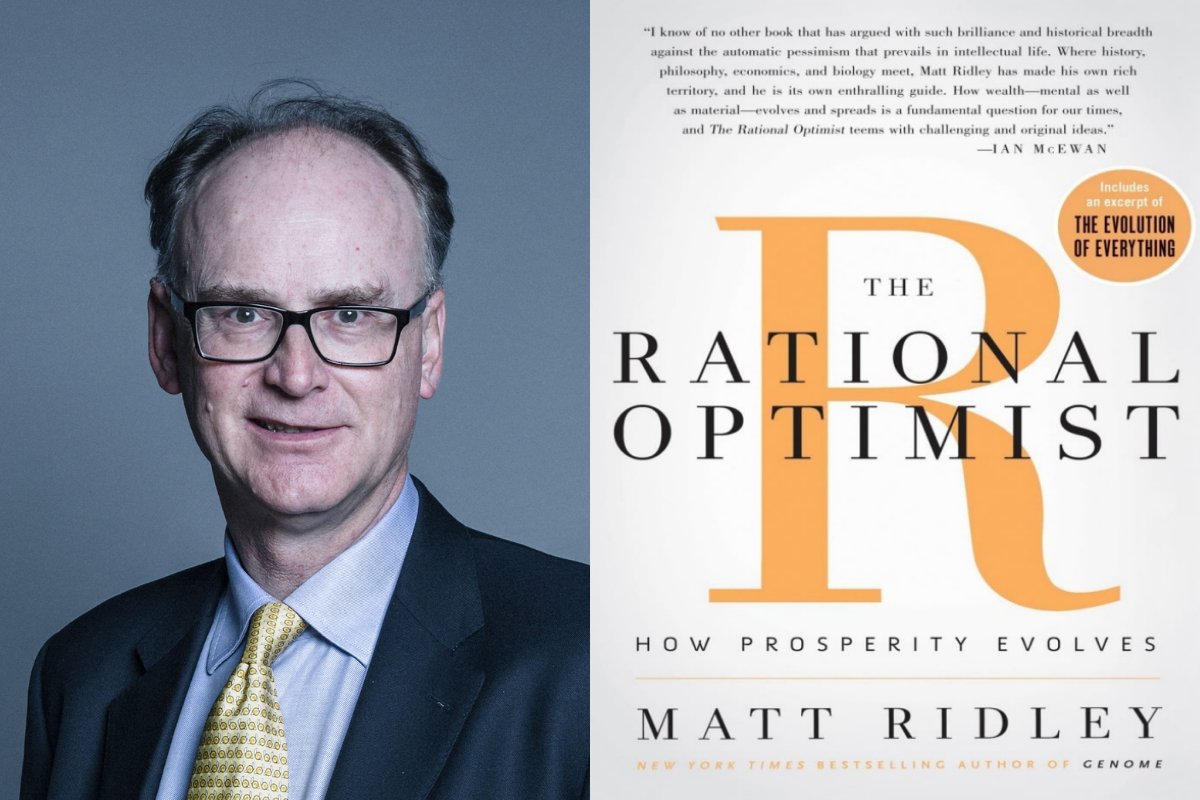
A British biologist looked at 200,000 years of human history and found that the entire reason humans broke out of poverty was not intelligence, not language, not even agriculture, but one mechanism so simple a 6-year-old could explain it.
His name is Matt Ridley.
He is a zoologist by training, an evolutionary biologist by career, and in 2010 he wrote a book called The Rational Optimist that quietly argued the most important fact about human progress had been hiding in plain sight for the entire history of economics.
Naval Ravikant has been telling people to read everything Ridley has ever written for the last 15 years. The reason is the argument inside this one book.
For 200,000 years, anatomically modern humans walked around with the same brain you have right now. Same skull size. Same neural architecture. Same raw capacity for language, planning, and abstract thought.
For roughly 190,000 of those years, almost nothing happened. Generation after generation lived and died inside the same Stone Age toolkit their great-great-grandparents had used. Then somewhere around 50,000 years ago, the line on the chart of human progress started to tick upward. Then it bent. Then it exploded.
The question Ridley spent years on was the only question that mattered. What changed.
It was not the brain. The brain had been the same for 190,000 years. It was not language, which had existed long before the takeoff. It was not even agriculture, which arrived only 10,000 years ago and was actually preceded by the upward bend, not the cause of it.
What changed was that humans started trading with strangers.
This sounds too small to be the answer. Ridley argues that it is the answer to almost everything. The moment one human exchanged a useful object with another human from a different group, something happened that no other species on earth had ever done.
Two ideas that had developed in isolation came into contact. The flint knapper learned what the spear maker had figured out. The fisherman from the coast learned what the hunter from the forest had figured out. The two pieces of knowledge fused into something neither side could have produced alone.
Ridley calls this ideas having sex. The phrase sounds frivolous and it is meant to. The point is that ideas, like genes, get better when they combine with other ideas from different lineages.
An idea sitting inside one head, no matter how brilliant the head, eventually hits a ceiling. The same idea exposed to ten thousand other ideas does something genes do under sexual reproduction. It mixes. It recombines. It produces offspring nobody planned.
The cleanest proof of this argument is the most uncomfortable case study in the book. Tasmania.
Around 10,000 years ago, rising sea levels cut Tasmania off from mainland Australia. A population of roughly 4,000 humans was now isolated on an island, with no possibility of contact with the rest of humanity. They had the same brains. The same language. The same starting toolkit as their cousins 150 kilometers north. The natural experiment was now running.
What happened next is something no economist or geneticist had ever predicted.
The mainland Australians kept inventing. Boomerangs. Spear-throwers. Fishing nets. Bone needles for sewing fitted clothes. Watercraft with paddles. Their technology compounded slowly across the centuries.
The Tasmanians went the other way. They did not just fail to invent the new tools their cousins were developing. They started losing the tools they already had. Fishing was abandoned within a few thousand years. Bone tools disappeared. Fitted clothing disappeared. They forgot how to make fire from scratch and started carrying lit firebrands from camp to camp instead, relighting their fires from a neighbor's whenever their own went out.
By the time European explorers arrived in the 17th century, the Tasmanians had the simplest toolkit of any human society ever recorded. Their material culture had gone backward for 8,000 years.
The archaeologist Rhys Jones called it a slow strangulation of the mind.
Joseph Henrich at Harvard later proved with formal mathematical models that there was nothing wrong with Tasmanian brains. There was something wrong with their network. A toolkit requires a critical mass of people exchanging skills to maintain itself.
The act of teaching a skill is imperfect. Every generation loses a small percentage of what the last generation knew. If your population is large enough and trading widely enough, those losses get caught and corrected by someone else who still remembers.
If your population shrinks below a certain threshold and stops mixing with outsiders, the small losses compound until entire technologies disappear.
This is the part that should haunt anyone reading this in 2026.
Intelligence is not a property of the individual brain. Intelligence is a property of the network the brain is connected to. A genius in isolation will produce less than a mediocre thinker inside a dense exchange of other mediocre thinkers.
The thing your ancestors needed in order to break out of 190,000 years of stagnation was not better brains. It was better connections between brains they already had.
The implication for any individual is direct and uncomfortable. If you are smart and isolated, you will be outproduced by people half as smart who are connected.
The most successful people in any field are almost never the smartest people in it. They are the ones positioned at the intersection of the most idea flows. They are reading more authors than their competitors. They are talking to more people from more disciplines. They are in the rooms where ideas from different lineages bump into each other.
Ridley ends the book on the line that sounds optimistic but is actually a warning its this "The future will be invented by people who connect ideas, not by people who guard them."
268
2,036
7,499
850,094