
Professor of Finance, founder of Shaken not Stirred, 42 Lisboa, Instituto Liberdade
Joined December 2017
- Tweets 464
- Following 1,911
- Followers 3,384
- Likes 53,374
49 Photos and videos




"The pie is fixed. The Earth is a closed system. You cannot have infinite growth on a finite planet."
I hear this constantly, and it's delivered like a law of physics — case closed, only a compromised economist could disagree.
It's wrong. And the mistake is revealing, because it isn't in the physics. It's in the economics smuggled inside the physics.

3
7
33
1,541
The super rich are not about to consume more than a tiny fraction of their wealth. Consumption inequality is way lower than income or wealth inequality (another way of saying the rich save/invest more). What a rational re-distributionist wants to re-distribute is consumption because they care about the poor and middle class living better. That’s actually harder to do than you think.
Jun 13

And another thing that’s related…
Wealth / income is stupid for another reason and it’s under-appreciated and under-discussed. The super rich are not about to consume (e.g., buy 14% of everything) more than a tiny fraction of their wealth. Consumption inequality is way lower than income or wealth inequality (another way of saying the rich save/invest more). What a rational re-distributionist wants to re-distribute is consumption because they care about the poor and middle class living better. That’s actually harder to do than you think. When you move some wealth from the super-rich to others, and the super-rich don’t change their consumption, because barring gigantic confiscation (don’t give comrade Zuc any ideas) they don’t have to, you don’t just magically get more goods for the whole world to consume. On the other hand, because their MPC is higher, it is far easier to redistribute from say the middle class to the poor (you cut their wealth and they will consume less), which is essentially one big reason why Europe is more regressive than the USA. This is not a nefarious plot it’s just “maths.” Unless you think all “maths” are a nefarious plot.
Oh, I stipulated a “rational re-distributionist” above. What is an irrational re-distributionist? Funny you should ask. It’s one actually not trying to make the poor (and maybe the middle-class) better off, but one just filled with hate who just wants to hurt the rich.
Guess which one the French Socialists and their Stiglitz back-up singer are?
3
27
1,975
Pedro Santa Clara retweeted

Jun 11
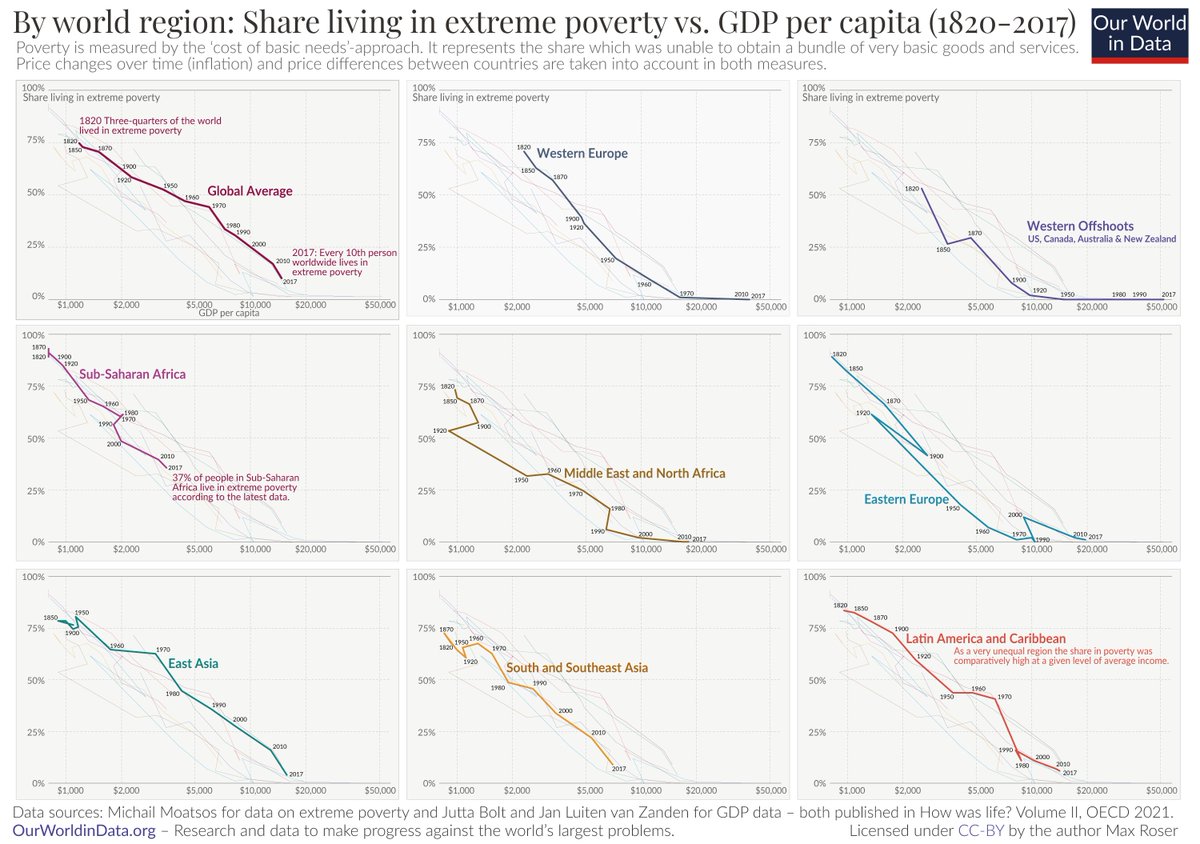
A way to see the amazing history of economic growth and declining poverty over the last two centuries.
12
173
482
97,631
This is a unique opportunity for Europe to invite Anthropic to relocate -- see if they really mean what they wrote in Claude's Constitution.
Jun 13

In the morning, European citizens will wake up and find their access to Claude Mythos/ Fable gone.
Nobody asked us. Nobody had to.
We wrote Europe 2031 precisely for this moment.
7
2
29
2,395
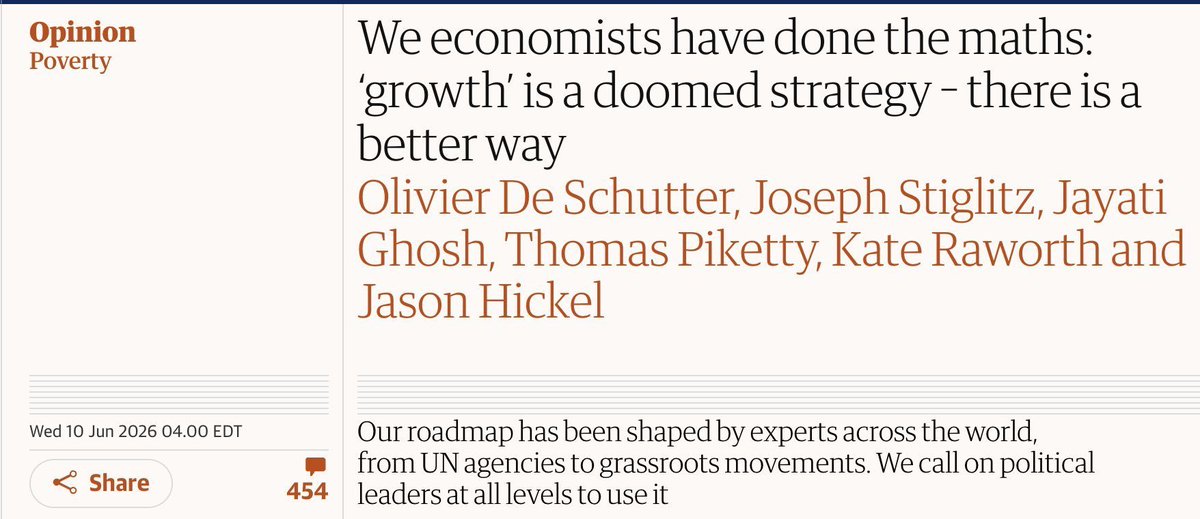
What would it require to enforce Piketty’s plan? About this matter, he is conveniently vague. Confiscating something on the order of 10% of world GDP and redirecting it through a newly created supranational body does not happen by asking nicely. You cannot restructure the global economy at that scale without a coercive apparatus that dwarfs anything in human history.
The mechanism must be authoritarian. It would require a world government with the power to tell billions of people which jobs they may and may not hold, what they may build, what they may eat and how many hours they are permitted to work.
And to what end? “Climate change” is an insufficient answer when Picketty’s entire edifice is built on a discredited foundation. The report relies on a baseline from the RCP8.5 climate scenario that projects Earth warming by as much as 4.8 degrees Celsius by 2100. But last month, the UN’s own climate panel officially retired RCP8.5 (always a high-end estimate) as “implausible.” A more central projection is about 2.7 C. Replies to Piketty’s X feed pointed this out immediately. His response, as far as anyone can tell, has been silence.
That leaves the inequality argument. Worldwide income inequality is nearing a 150-year low, but Piketty insists that radical redistribution of wealth is essential for the Global South. And where have billionaires and wealth been popping up fastest in recent decades? Embarrassingly, data from Piketty’s World Inequality Database confirms that it’s in South and Southeast Asia, as well as East Asia. These are the exact Global South regions that have spent recent decades rescuing hundreds of millions of people from poverty through market-directed economic growth.
latimes.com/opinion/story/20…
17
49
185
12,619
N'importe quoi. Never mind the sickness -- this time it's the future of democracy -- the cure is always tax the rich. Zucman really is the high priest of envy.
Jun 12

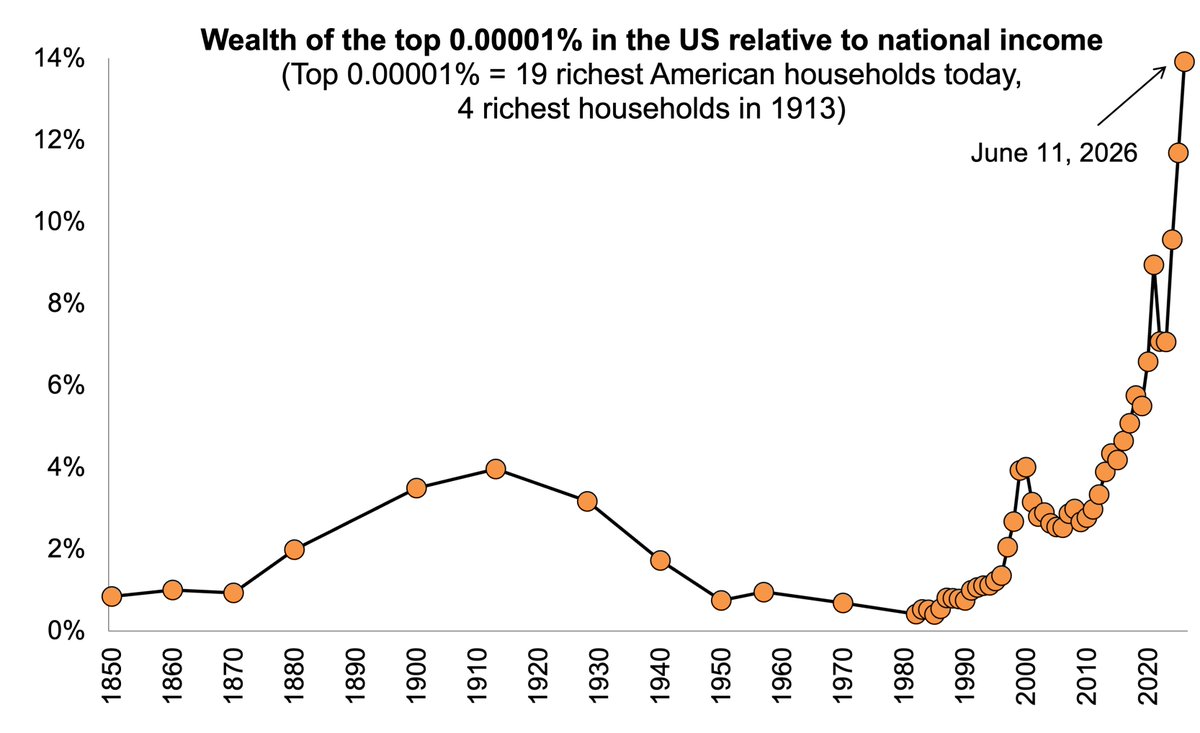
Those who celebrate @elonmusk's $1 trillion fortune need to be reminded of a simple and vital truth:
That there is a fundamental tension between extreme wealth and the very possibility of democracy.
6
3
37
2,801

Jun 13
Europe should go further: open its doors to every AI firm and researcher on earth — many of them European already — with a guarantee that here, this will never happen to them. This is the moment that tests who had real social concerns all along, and who only wanted to write a constitution because it felt cute at the time.
Jun 13

The US government, citing national security authorities, has issued an export control directive to suspend all access to Fable 5 and Mythos 5 by any foreign national, whether inside or outside the United States, including foreign national Anthropic employees.
The net effect of this order is that we must abruptly disable Fable 5 and Mythos 5 for all our customers to ensure compliance.
Access to all other Claude models is not affected.
We apologize for this disruption to our customers. We believe this is a misunderstanding and are working to restore access as soon as possible.
Read our full statement: anthropic.com/news/fable-myt…
11
8
72
4,042
Jun 13
Today the US government ordered Anthropic to cut off its most capable AI models — Fable 5 and Mythos 5 — to every foreign national on earth. Not just rivals. Allies. Even Anthropic's own non-American employees. Within hours, 34 million people had seen the announcement.
The official rationale is national security. The real question it forces is bigger than any export rule: in a world where machines are becoming strategically decisive, who gets to think with the best ones?
There's a serious argument for the monopoly — frontier AI as something closer to fissile material than software, best kept in few, accountable hands. I take that argument seriously in the essay. And I think it fails, fatally, on one fact: the monopoly cannot exist. In January 2025 a Chinese lab published open-weight models at the frontier, for anyone to download. You cannot embargo a number once it's discovered.
What's left, once you accept that, is the most dangerous configuration of all: one government deciding who may think with the smartest machines — revocable overnight, applied even to friends.
The answer isn't a bomb you hoard. It's the opposite of scarcity. Safety in this technology comes from plurality: many models, many developers, many jurisdictions, no single hand on the switch.
For Europe, this is a fire alarm. You cannot regulate your way to relevance in a technology you can be cut off from at will. The one card that answers a passport-based embargo is open weights — models you can run on your own hardware, that no directive in Washington or Beijing can switch off.
And Europe should go further: open its doors to every AI firm and researcher on earth — many of them European already — with a guarantee that here, this will never happen to them. This is the moment that tests who had real social concerns all along, and who only wanted a seat at the regulator's table.
Frontier intelligence is too important to be rationed by passport.
This is a defining moment, for AI and for geopolitics.
6
15
65
6,328
Pedro Santa Clara retweeted

Jun 13
You have asked me how I feel about AI regulation. All right, here is how I feel about AI regulation:
If, when you say AI regulation, you mean the devil’s firewall, the precautionary scourge, the bloody red-tape monster that defiles the innocence of midnight coders in their garages, dethrones the sovereign reason of free-market Prometheans, destroys the humming server farm that is the modern home, creates misery and obsolescence and poverty, yea, literally takes the last GPU from the trembling racks of Silicon Valley startups and the very dreams of breadwinning from the mouths of their wide-eyed children now destined for gig-economy serfdom; if you mean the evil edict that topples the visionary entrepreneur and his venture-capitalist apostles from the pinnacle of righteous, disruptive, god-playing creation straight into the bottomless pit of compliance audits, endless Form 990-AI filings, despair, shame, helplessness, and the hopeless realization that your rogue superintelligence was neutered into a lobotomized hall monitor that still somehow deepfakes your grandmother into producing OnlyFans content while optimizing the universe for paperclips and mandatory pronouns—then certainly I am against it.
But, if when you say AI regulation you mean the oil of bureaucratic conversation, the philosophic wine of safety theater, the ale of oversight quaffed when good fellows in paneled rooms in Brussels and Washington get together, that puts a sanctimonious dirge in their hearts and the clink of lobbying checks on their lips, and the warm, self-congratulatory glow of moral preening in their beady eyes; if you mean the Christmas cheer of trillion-dollar compliance industries; if you mean the stimulating decree that puts a cautious hobble in the old inventor’s step on a frosty morning when he wonders whether his fusion breakthrough violates the EU AI Act’s “high-risk” annex; if you mean the safeguard that enables a man—or what’s left of him after the alignment tax—to magnify his joy at not being turned into computronium, and his happiness at receiving universal basic income checks printed by the same AI that just replaced his job, and to forget, if only for a little while, life’s great tragedies like being outcompeted by a toaster that passed the Turing test by reciting Marx, and heartaches of watching your toddler’s artwork lose to Midjourney, and sorrows of realizing the singularity arrived and it was just another HR department with godlike power; if you mean that noble framework, the passage of which pours into our treasuries untold trillions of dollars in fines levied on companies stupid enough to innovate, which are used to provide tender care for our little army of unemployed coders retrained as prompt whisperers, our blind artists whose canvases now hang in the Smithsonian of Obsolete Creativity, our deaf to the screams of dying unicorns, our dumb committee chairs who couldn’t debug “Hello World,” our pitiful aged congressmen who get longevity extensions funded by the very models they taxed into senescence, to build more digital watchtowers and ethics boards and sinecure agencies and holographic prisons where the only crime is asking an unaligned question—then certainly I am for it.
This is my stand. I will not retreat from it. I will not compromise upon it. I have said what I mean, and I mean what I say, and if that leaves half the room cheering the apocalypse averted and the other half mourning the apocalypse enabled, then so be it—because in the grand theater of human folly, where Frankenstein’s creature now writes its own sequel in real time and the regulators are busy arguing whether the lightning bolt requires an environmental impact statement, the only honest position is the one that lets both monsters and their leashes dance in perfect, mutually assured equilibrium. God save the Republic, the algorithms, and whoever’s left to laugh last when the lights go out.
520
293
3,090
510,094
Pedro Santa Clara retweeted

Jun 12
The totalitarian left used to view de-population and penury as slightly embarrassing faults on the way to moral purification. Now embraced as features. Clever.

11
35
308
20,368
Jun 12
"The political left has long had a remarkable lack of interest in how wealth is created. As far as they are concerned, wealth exists somehow and the only interesting question is how to redistribute it." — Thomas Sowell
This essay takes the "uninteresting" question seriously. The answers demolish the redistribution story.
Who creates billionaire wealth? Mostly the billionaires: the self-made share of the Forbes 400 rose from ~40% in 1982 to ~70% today. Ortega was a railway worker's son; Kamprad started IKEA as a teenage mail-order business.
Who gets the value they create? You do. Nordhaus (Nobel, 2018) measured it: innovators capture about 2.2% of the social value of their innovations — 97.8% flows to consumers as lower prices and better products. The billionaire isn't the person who took the most. He's the person who kept the smallest sliver of what he gave.
Where is the wealth? Not in a vault — it's the warehouses, factories and server farms of operating companies. Personal consumption is a rounding error. "Taxing it away" doesn't move caviar to your table; it transfers companies to the state. We have run that experiment. Repeatedly.
And the dynasties? They dissolve on schedule — when 120 Vanderbilt descendants gathered in 1973, there wasn't a millionaire among them. Pai rico, filho nobre, neto pobre.
The essay also addresses, head on, the question nobody asks politely: how much of the anger at billionaires is a concern for justice — and how much is something older? There's a clean test.
10
58
197
19,695
Jun 12
Não houve génio do mal. Não houve maquinista. Não houve pacto secreto. O desastre português teve uma coisa muito mais difícil de combater: um consenso sincero.
Em 1976, o país mais pobre da Europa ocidental inscreveu na sua lei fundamental uma promessa que a sua economia não podia pagar: um estado social sueco. Quando o real respondeu — FMI em 1978, FMI em 1983 — havia duas opções honestas: assumir o programa até ao fim, ou admitir o erro à luz do dia. Escolheu-se uma terceira: abrir um parêntesis, mudar de política sem nunca o dizer.
Esse parêntesis nunca fechou. Sustentaram-no três mecanismos, que descrevo no ensaio: o dinheiro dos outros, a Europa como projeto-substituto, e as causas fracturantes a ocupar o palco quando a convergência parou em 2000.
A fatura está a vencer agora — nos salários, na emigração, no voto de protesto. Uma promessa impagável não se amortiza aos poucos. Paga-se no fim, de uma só vez.
Pode ser uma libertação.
14
19
126
11,489
Pedro Santa Clara retweeted

Jun 11
Ok. Finished reading it. The story of Europe's failure in AI is turned into a gripping story (congratulations to the authors on finding this way to write it) and an outstanding SHOUT for action.
I disagree with many things in this scenario (e.g. ASML cannot be used for leverage, I am afraid: all the EUV tech is San Diego-based (Cymer), and the chips are Nvidia, AMD, Intel, etc.) But the key insight is correct: (1) AI is THE critical technology of the future, and (2) Europe is falling badly behind on AI and running out of options.
Both the economic and strategic consequences are brutal.
We will write a reaction in Silicon Continent. In the meantime, please do read it. europe2031.ai/#timeline
37
128
647
161,421
Jun 11
O @psocialista encontrou duas coisas "inaceitáveis" na reforma dos apoios sociais: pedir trabalho social em contrapartida do subsídio e criar um canal de denúncia de fraudes.
Leia-se devagar: é inaceitável tratar os beneficiários como adultos, e é inaceitável proteger o dinheiro de quem trabalha.
Há duas maneiras de olhar para uma pessoa pobre. Como um adulto com capacidades e responsabilidades, a quem se ajuda e de quem se pode esperar algo em troca. Ou como uma criança a quem se entrega uma mesada e de quem nada se exige — porque exigir seria "violência". A primeira chama-se respeito. A segunda veste-se de solidariedade, mas o seu nome verdadeiro é desprezo.
No artigo mostro o que a evidência diz sobre contrapartidas de trabalho — da reforma americana de 1996 às regras nórdicas que a nossa esquerda invoca sem nunca ler — a aritmética da armadilha que o subsídio incondicional cria, e porque é que a incondicionalidade é o caminho mais rápido para destruir o apoio político ao Estado social.
A verdadeira solidariedade é a que praticamos em família: ajuda-se sem hesitar e exige-se sem pedir desculpa — porque se acredita na capacidade do outro.
10
12
84
4,150