✍️ New article: Tracking historical progress against slavery and forced labor: a long-run data view
For much of history, forced labor was widespread and brutal. Tens of millions of people were made to work under the threat of violence or punishment. The situation today is very different.
Many governments have ended their own use of forced labor, changed laws, and now prosecute those who use it. Some forms of forced labor and human trafficking still exist—but they are much less common than in the past.
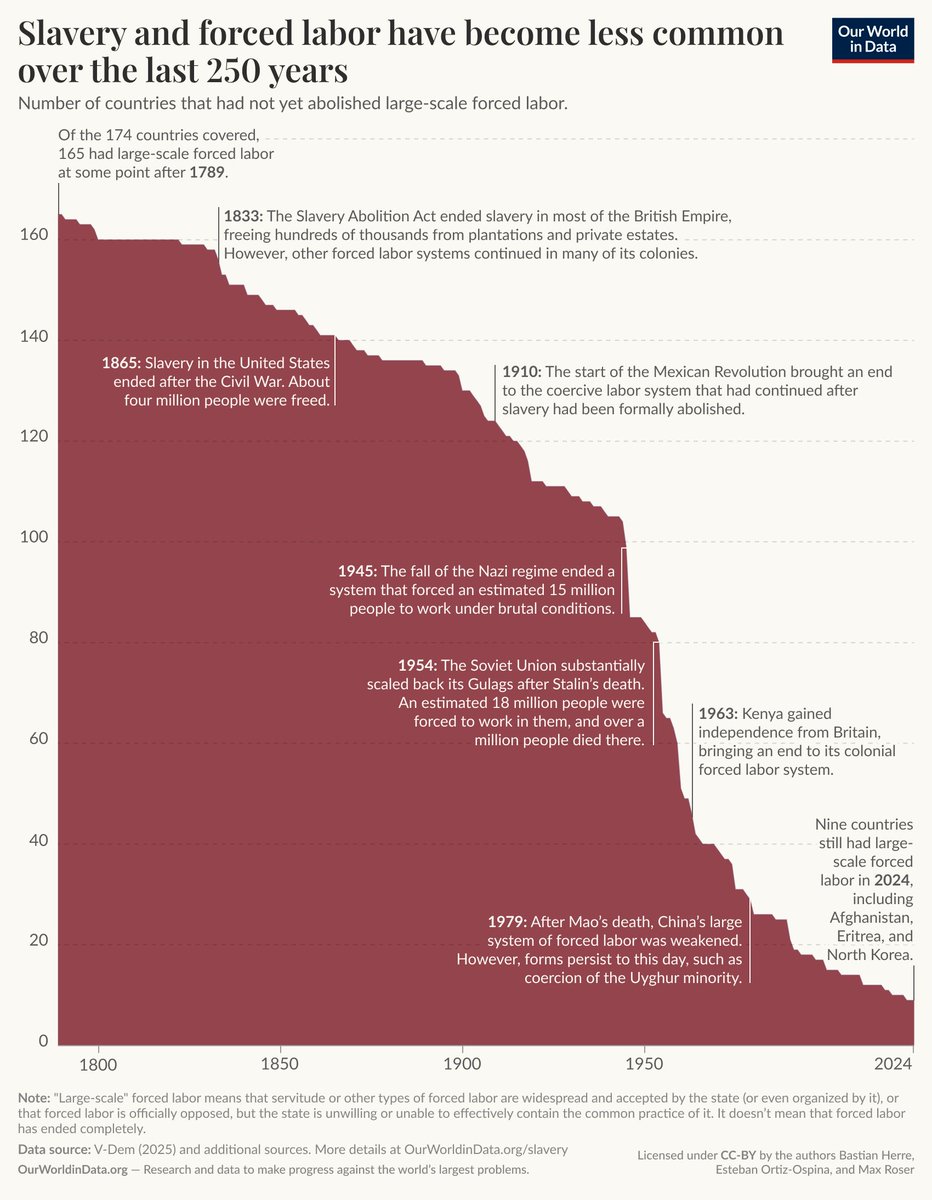
The chart summarizes how these massive changes unfolded across the globe.
It shows for each point in time how many countries had not yet abolished “large-scale” forced labor, meaning forced labor that was common and entrenched—tolerated, enabled, or imposed by authorities, rather than isolated abuse.
To measure this specific form of large-scale forced labor, we rely on expert assessments from the Varieties of Democracy (V-Dem) project, based at the University of Gothenburg, in Sweden.
What the chart shows has been well documented in the many excellent books by historians and social scientists. What we add to this is a quantitative, bird’s-eye perspective on the global history of slavery and forced labor.
The decline of forced labor is one of the biggest social and economic changes in history. It gave many millions of people much more freedom to live their lives. This shows that large changes to our societies and economies are possible—even those that were once unimaginable.
Summarizing changes of this scale in a single chart is challenging. Forced labor can take many different forms; legal rules and real-world practices often don’t match, and no country is completely free from forced labor.
ALT Slavery and forced labor have become less common over the last 250 years.
Line chart of the number of countries that had not yet abolished large-scale forced labor.
In 1789, 165 of the 174 countries covered had not yet abolished large-scale forced labor. In 2024, it was 9 countries.
Annotations on important cases, such as China, the Soviet Union, and the United States, say more about the history of slavery and forced labor.