
Writing about AI infrastructure at substack.com/@sectorplaybook
Joined December 2023
- Tweets 304
- Following 92
- Followers 45
- Likes 18
5 Photos and videos

I don’t own the neoclouds because the whole story comes down to GPU useful life and selling us the wrong metric EBITDA.
$CRWV , $NBIS, $IREN all look much better on adjusted EBITDA because D&A and interest sit below the headline. open.substack.com/pub/sector…
95
I analyzed what would need to happen for Reddit to reach a $300B market cap by 2030.
For $RDDT to get there, the math requires:
• ~$15B revenue
• ~50% adjusted EBITDA margins
• ~$6B free cash flow
• The market still paying ~20x EV/Sales
open.substack.com/pub/sector…
96
$MSFT at 21x forward earnings with 19% revenue growth and $625 billion in contracted obligations. The CapEx panic has compressed the multiple to levels not seen since 2016. Copilot is 3.3% penetrated across 450 million seats. I see huge upside in MSFT if Copilot seats grow a bit
59
There is a number that explains the entire copper bull-bear debate: 12 vs 27 tonnes of copper per megawatt of data center capacity. One counts what is inside the building. The other counts what it takes to power it. The gap between them is 450,000-840,000 tonnes per year of "hidden" demand. open.substack.com/pub/sector…
38
The EIA’s March oil forecast is $21/barrel higher than February’s — and it already assumes the Strait of Hormuz reopens by April. The market at $94 disagrees. Traced what that means for hyperscaler margins, the Fed, and your portfolio:
substack.com/@sectorplaybook…
57
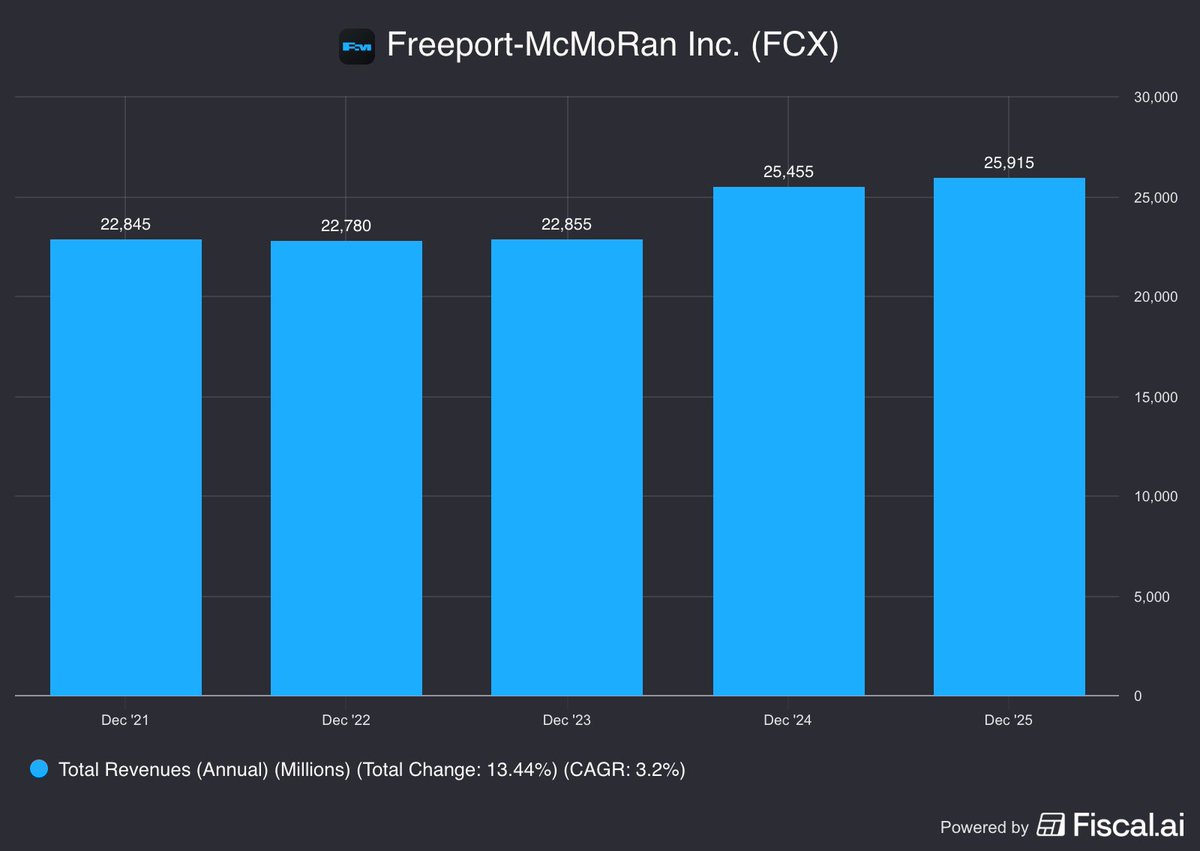
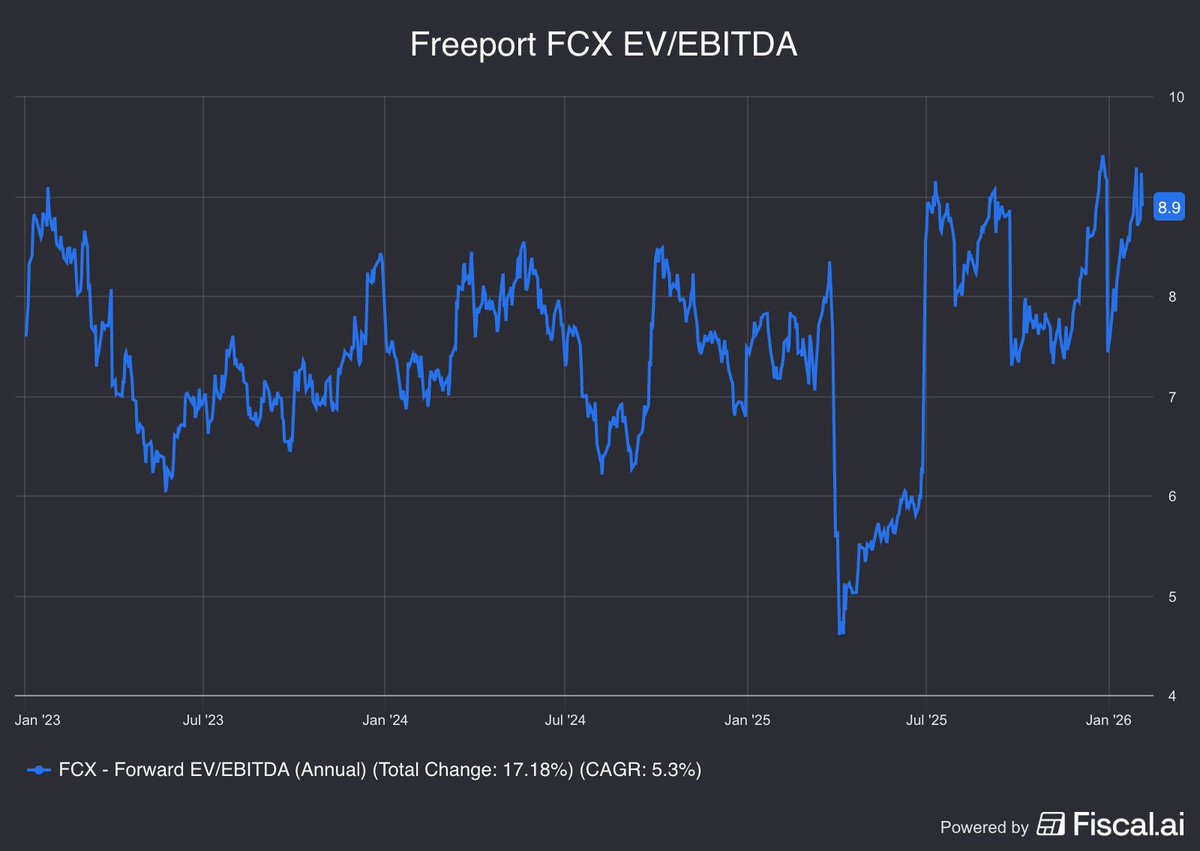
$FCX made $25.9B in revenue last year at an average copper price of $4.75/lb, while its biggest mine was literally buried under mud.
The Grasberg mud rush in September 2025 knocked out 20% of FCX's copper production. Output fell from 4.2B lbs to 3.4B lbs. And revenue still grew.
Now Grasberg is restarting. Copper is at $5.90/lb. And nobody seems to be doing the math.
Production was flat for three years, then dropped 20%. Revenue didn't care because the copper price kept climbing.
The gap between today's spot ($5.90) and last year's realized price ($4.75) is $1.15/lb. On normalized production, that's roughly $3.8B in incremental annual cash flow that hasn't shown up in a single quarterly earnings print yet.
Grasberg at full capacity is the lowest-cost copper operation on the planet. It also produces 1.3 million ounces of gold per year. At $4,000 gold, that's another $5.2B in revenue from a single asset.
Sometimes the most interesting setup is just a company getting back to normal.
2
202
$CRWD spent years being told Microsoft would eat their lunch by bundling security "for free."
This week Satya Nadella and George Kurtz spoke to CrowdStrike's sales team together. Falcon is now on the Azure Marketplace.
The most dangerous competitor became a distribution channel.
82
$RIO2 doubled in 6 months and trades at 4.0x forward EBITDA on consensus gold/copper. Fairly valued? At consensus, sure. But consensus has gold at $4,742 while spot is $5,293. substack.com/@sectorplaybook…
44
The gap between "AI can answer a question" and "AI can run a process that requires mid-stream judgment in a regulated environment" is measured in years, not quarters. Most CFOs are not going to bet their payroll system on closing that gap early. substack.com/@sectorplaybook…
28
$NOW The underappreciated problem with SaaS companies selling AI features: every AI action has a real inference cost paid to hyperscalers. Old model was zero marginal cost per user. New model has variable costs the company doesn't control. That's a permanent change in business quality, not a temporary margin headwind. sectorplaybook.substack.com/…
1
102
Wall Street says $700B in hyperscaler AI capex is the riskiest bet in tech. I think it's the safest. Here's why the risk calculus is completely inverted. (1/6)
1
28
Full piece on why the hyperscalers are the tollbooth, not the toll, and why the SaaSpocalypse is the best demand proof point they've ever had: sectorplaybook.substack.com/… (6/6)
20
Hyperscalers like $MSFT, $AMZN or $GOOGL are the safest AI investment because they control the only infrastructure where all AI agents will run. See my full thesis to understand my logic behind this statement: open.substack.com/pub/sector…
2
123
$ALAB There's a paradox in hyperscaler supplier warrants nobody talks about, like the in the warrants that ALAB granted $AMZN: if the stock goes up, the warrant's fair value increases, which makes the contra-revenue charge bigger (i.e. less revenue reported). The better the market thinks the business is doing, the worse the reported margins look.
101
$CRDO went from 67% single-customer revenue dependency to four hyperscalers each above 10% in just two quarters — while growing 272% YoY. The concentration risk everyone cites is actually solving itself faster than almost any semiconductor company I’ve tracked. Add in the Amazon warrant structure that creates economic switching costs invisible to traditional analysis, and the risk profile looks very different from the headline number.
1
1
97