Multiple award-winning intl journo. Words @newyorker ex-WaPo, ex-WSJ & others. Ex Buro Chief/FC in Baghdad, Kabul, Nairobi, Cairo, Barcelona, Joburg, Madrid.
Joined January 2012
- Tweets 5,297
- Following 1,807
- Followers 12,875
- Likes 5,260
158 Photos and videos







Sudarsan Raghavan retweeted

Jun 5
My latest, for @ForeignPolicy: The journey of Iran’s World Cup team sets a dangerous precedent for international soccer.
Gift link: foreignpolicy.com/2026/06/05…
4
5
916

My latest in @NewYorker on how Pakistan Is using the Iran War to reinvent Itself from near pariah status to reliable peacemaker. W/ great insight from @Michaelkugelman, Ryan Crocker, @Lodhimaleeha, Farzana Shaikh & @Rabs_AA newyorker.com/news/the-lede/…
4
5
16
2,348
Sudarsan Raghavan retweeted

Jun 5
As Pakistan receives praise from Trump and other leaders for its role in mediating the war between the U.S. and Iran, the Pakistani military is using its newfound power to increase political repression at home.
newyorker.com/news/the-lede/…
1
8
13
9,988
Sudarsan Raghavan retweeted
Jun 4
Last year, Donald Trump invited the Pakistani Army chief, Asim Munir, to a private lunch at the White House. He repeatedly called Munir “my favorite field marshal.” Now Pakistan is mediating the war between the U.S. and Iran.
newyorker.com/news/the-lede/…
1
4
13
9,827
Sudarsan Raghavan retweeted
Jun 4
Pakistan has stepped into the role of mediator between the U.S. and Iran. Now it must navigate the competing demands of the involved nations—who all want to end the war, but on different terms—without taking a side.
newyorker.com/news/the-lede/…
4
19
13,671
Critics of the government and military fear that Pakistan will see the worldwide praise of its US-Iran mediation role “as a carte blanche to crack down even more.” @MichaelKugelman
#iranwar #trumpiran #pakistan
newyorker.com/news/the-lede/…
171
Political repression has reached levels not seen in years. With Pakistan’s new relevance, the military knows “the intl community will not be on its back, won’t be pressuring it, and it won’t be scrutinizing Pakistan for these policies” @Michaelkugelman newyorker.com/news/the-lede/…
142
“In Pakistan, what is Pakistan’s gain is always seen as India’s loss.” In India, “there has been a bit of sullenness, a bit of disappointment. Like, look at those guys, how did they manage to pull it off? And look at us, we’re sitting here as losers.” newyorker.com/news/the-lede/…
129
On its Trump Nobel Peace Prize nomination: “Pakistan understood that this was something that they could seize as an opportunity,” said Farzana Shaikh of @chathamhouse “It is a dazzling reinvention but one not crafted entirely of its own making.”
#trumpiran newyorker.com/news/the-lede/…
144
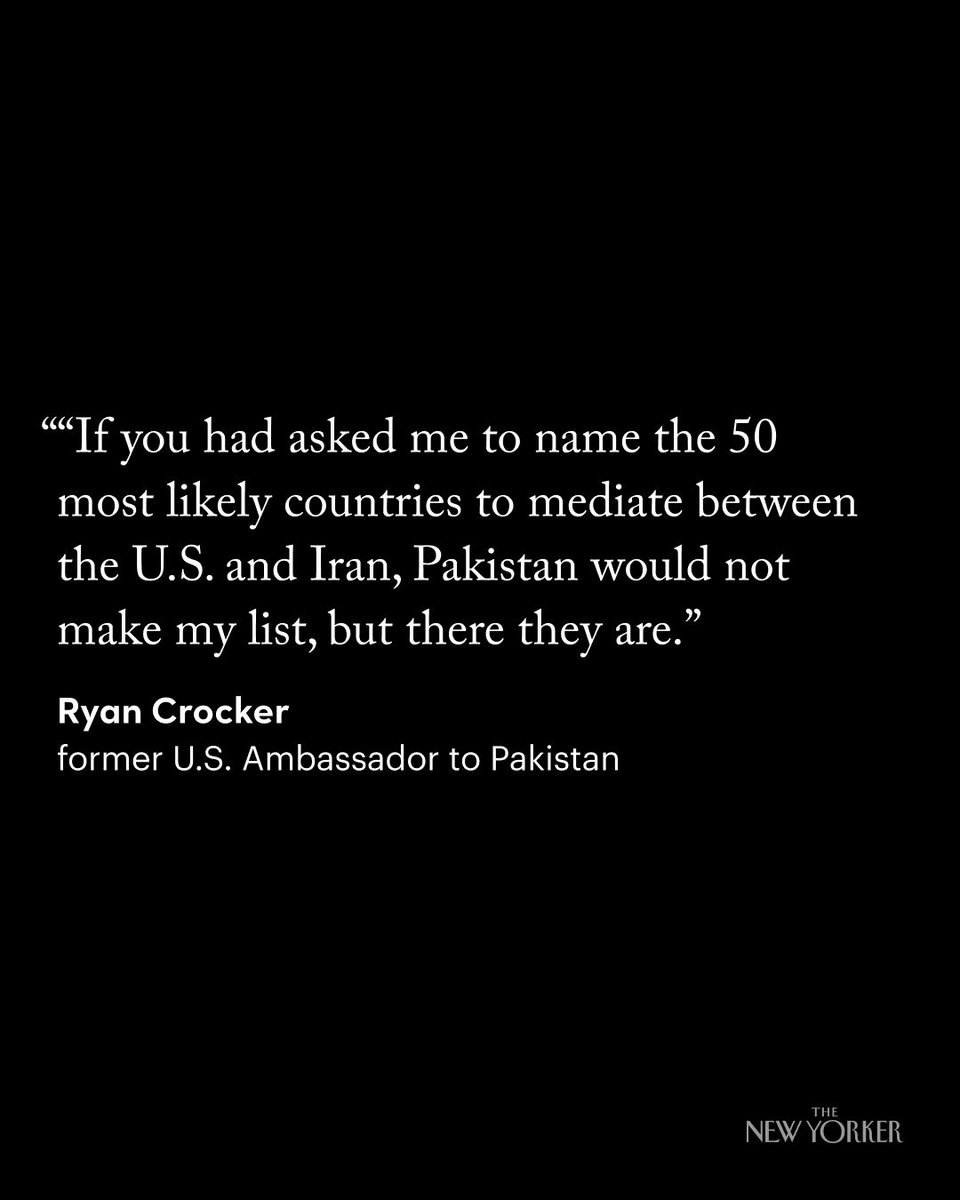
“The Pakistanis have figured out how the game is played with Trump, and they have played it extremely well,” said former Amb Ryan Crocker. “Do things he likes, flatter him shamelessly…It helps if you’re a strongman wearing a uniform.”
#trumpiran #iran newyorker.com/news/the-lede/…
157
“Even if the talks were to collapse, and there was not a deal, Pakistan will still be a winner…It’s a remarkable turnaround, because it does appear to have evolved from something close to a pariah to a peacemaker.” @MichaelKugelman newyorker.com/news/the-lede/…
138
Wondering why Trump says the ceasefire is still holding with Iran despite frequent attacks and exchanges of fire? 👇🏼
The Art of the Ceasefire
@NewYorker
#iranwar #trumpiran #middleeast
newyorker.com/news/the-lede/…
162
Wondering why Trump says the ceasefire is still holding with Iran despite frequent attacks and exchanges of fire? 👇🏼
@NewYorker
#iranwar #trumpiran #middleeast newyorker.com/news/the-lede/…
163
Sudarsan Raghavan retweeted
Jun 3
After traditional mediators—such as Qatar and Oman—were targeted by retaliatory Iranian missiles and drones, Pakistan has emerged as an unlikely mediator between the U.S. and Iran.
newyorker.com/news/the-lede/…
1
4
4
9,764
Sudarsan Raghavan retweeted
Jun 3
Pakistan is facing a delicate balancing act after emerging as an unlikely liaison between Donald Trump and Tehran—and taking advantage of a new transactional model of diplomacy under the U.S. President. newyorker.com/news/the-lede/…
2
25
60
41,849
Sudarsan Raghavan retweeted

Jun 3
Spoke to @raghavanreports for his story on Pakistan's mediation in @NewYorker : “A moment of U.S.-Pakistan warmth will not erase the structural depth of U.S.-India ties...What it can do is create more balance in Washington’s imagination of South Asia.”
Jun 3

Pakistan is facing a delicate balancing act after emerging as an unlikely liaison between Donald Trump and Tehran—and taking advantage of a new transactional model of diplomacy under the U.S. President. newyorker.com/news/the-lede/…
6
21
2,153
How Pakistan Is Using the Iran War to Reinvent Itself
The country’s emergence as an unlikely mediator between the U.S. and Iran illustrates how diplomacy has become more personal and transactional under President Trump. #iranwar
My latest in @newyorker
newyorker.com/news/the-lede/…
213
Powerful, essential reporting on the Ebola crisis via @declanwalsh @ArletteBashizi
May 30

I traveled with @ArletteBashizi to Mongbwalu, the gold mining town at the epicenter of the Ebola outbreak that is sweeping northeastern Congo. This is what we found.
nytimes.com/2026/05/30/world…
3
329
Sudarsan Raghavan retweeted

May 26
My @NewYorker analysis "The Epic Disaster of Epic Fury. newyorker.com/news/the-lede/…
5
108
315
51,078
Sudarsan Raghavan retweeted

May 23
Like many, I tore through Belle Burden’s “Strangers” and was flabbergasted by the emotional and financial betrayal. Jessica Winter has new reporting from court documents that complicates the story. newyorker.com/books/page-tur…
1
3
36
30,976