
Tesla & Nvidia.
Joined January 2025
- Tweets 105
- Following 32
- Followers 32
- Likes 8
6 Photos and videos



darylmusk retweeted

Jun 15
Most detailed, accurate calculation of $SATS i’ve seen.
Includes all concerns of tax, debt after sale and whatever minimal dilution.
This is a short squeeze in the making. I’ll explain the thesis next time.
Jun 14

To everyone questioning SpaceX / $SPCX’s highly successful IPO and its $2.1T market cap, let me share what I believe is the best arbitrage setup.
Do you know $SATS?
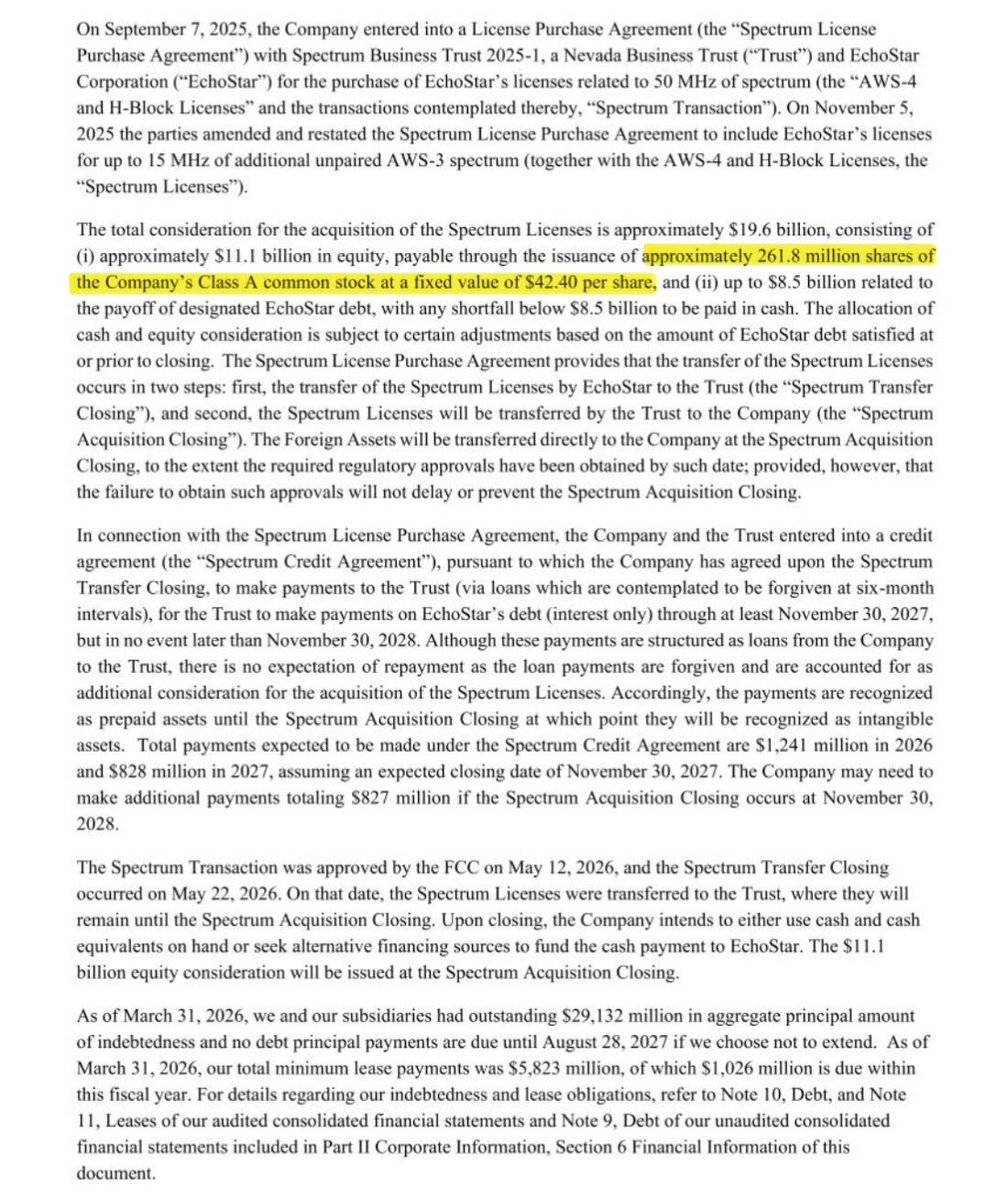
$SATS is expected to receive 261.8M shares of $SPCX, worth roughly $42B based on the 6/12 closing price.
Yet SATS’ current market cap is only about $33B.
Short: $SPCX
Long: $SATS
$SATS will effectively own approximately 2% of SpaceX / SPCX.
According to the SPCX prospectus, in exchange for acquiring spectrum from SATS, SPCX will pay SATS 261.8M shares of SPCX stock, roughly $8.5B in cash, and an additional ~$2.0B in cash to cover interest payments that SATS would otherwise have been responsible for.
In addition, SATS is expected to sell roughly $23B of spectrum to $T.
The transactions with $T and SPCX were approved by the FCC on 5/12. If no petition for reconsideration was filed by 6/11, the approval should likely have become final automatically. As of 6/14, I have not confirmed any petition for reconsideration.
Also, the spectrum transfer structure is SATS → TRUST → SPCX. Since the SATS → TRUST transfer has already been completed, I believe the closing risk is relatively low.
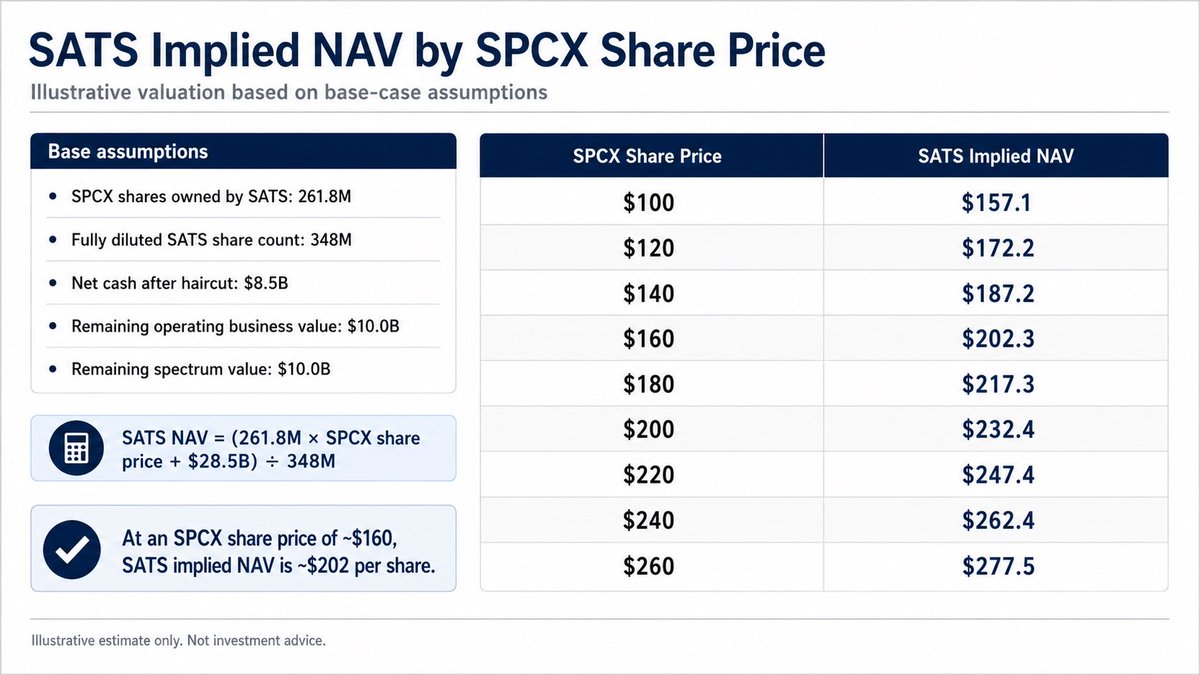
Now let’s calculate $SATS NAV.
My base NAV assumptions:
SPCX ownership: approximately 2%
SATS basic shares outstanding: 298M
Fully diluted shares after convertible bonds: 348M
I use 348M shares in the calculation below.
Cash proceeds from spectrum sales to $T and $SPCX:
From $T: approximately $23B
From $SPCX: approximately $8B in cash
Total: approximately $31B
Assuming the convertible bonds are converted into equity, net cash after debt repayment would be roughly $11B.
Regulatory / escrow / contingent liability haircut: -$2.5B
Net cash after haircut: approximately $8.5B
Remaining operating business value: $10B
Based on roughly $300M of operating income in Q1 2026 × 4 quarters × 8x multiple.
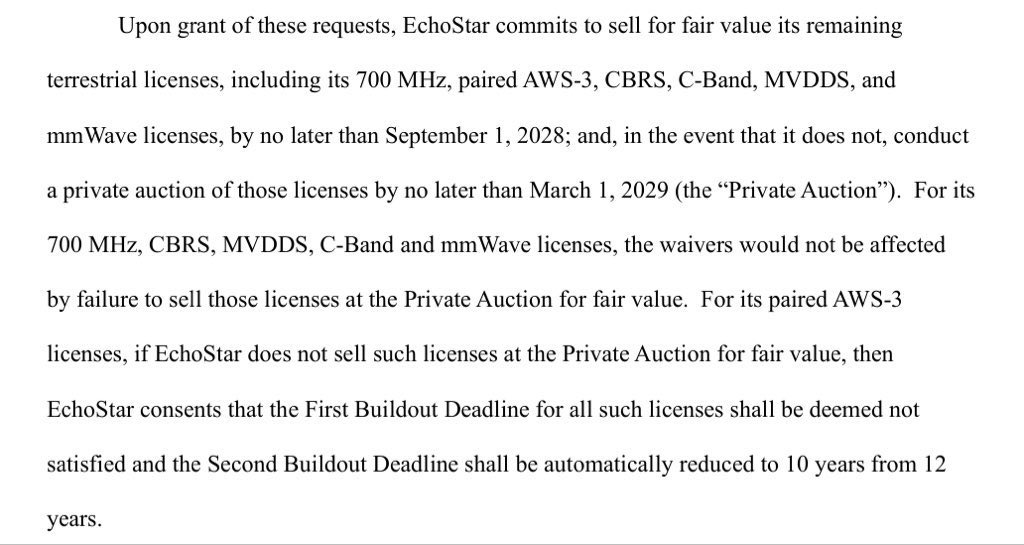
Even after the spectrum sales to $T and $SPCX, SATS will retain remaining spectrum assets. The most notable example is AWS-3 paired spectrum, which SATS previously planned to sell to $VZ for approximately $9.8B.
If we conservatively value the remaining spectrum at $10B, that adds approximately $28.7 per share of NAV based on 348M shares.
Formula:
SATS NAV
= {SPCX market cap × 2% net cash after haircut remaining operating business value remaining spectrum value} / 348M shares
= {SPCX market cap × 2% $8.5B $10B $10B} / 348M shares
SATS NAV by SPCX market cap:
• SPCX $2.0T → SATS approximately $197
• SPCX $2.25T → SATS approximately $211
• SPCX $2.5T → SATS approximately $226
• SPCX $2.75T → SATS approximately $240
• SPCX $3.0T → SATS approximately $254
This is my personal analysis, not financial advice.
110
53
595
159,103
darylmusk retweeted

Jun 1
KQID meditation on breaking symmetry.
Nothing produces something by breaking its symmetry; something comes from nothing that breaks its symmetry. Breaking the symmetry of nothing, something emerges. From zero comes one (original zero 00); from 1 (00) comes two ( ,-) or yin and yang or female and male. From perfection to imperfection that’s how Existence exists. Life is a contradiction because life is imperfect. I rather be imperfect one with life than perfect one without life. How about you?
3
1
3
3,820
darylmusk retweeted
May 31
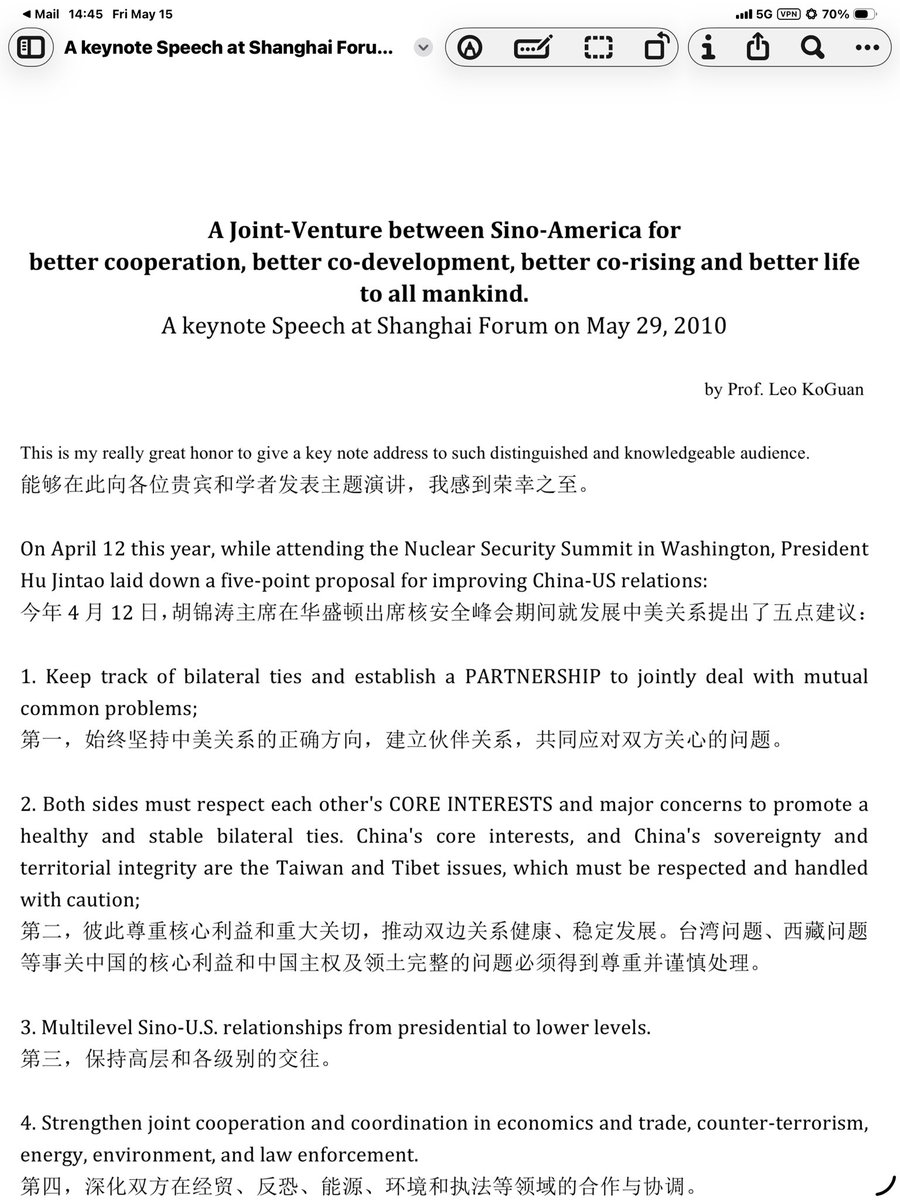
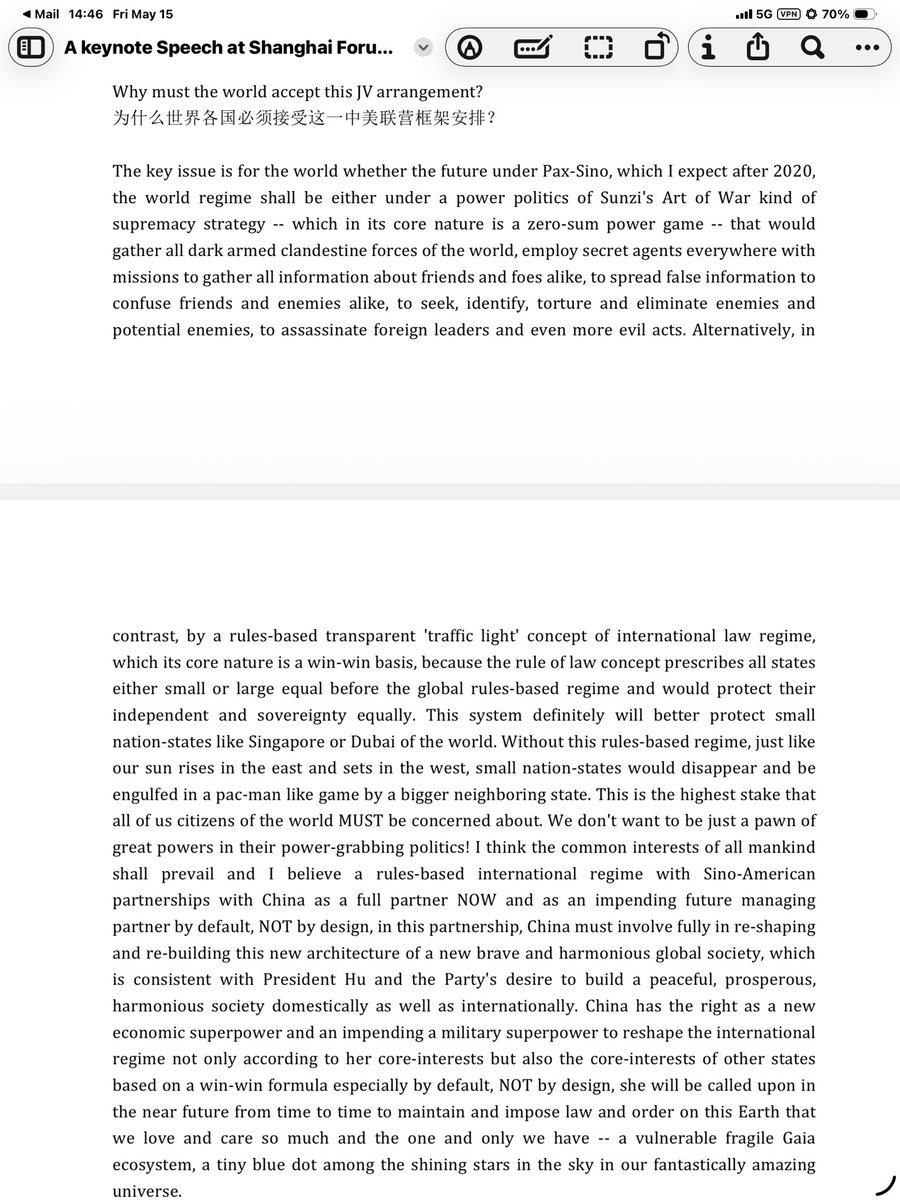
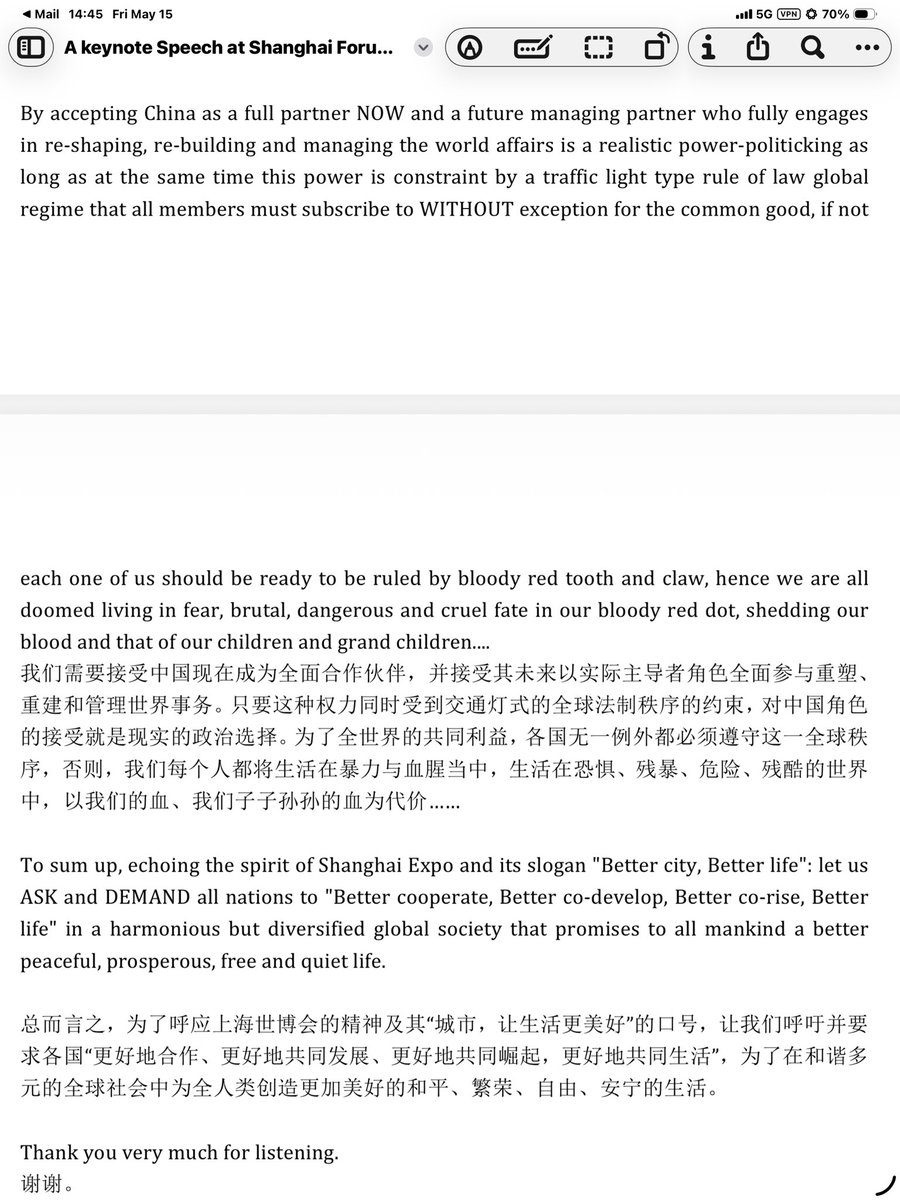
I suggested below G2 join-venture in 2010 but today G2 is a reality. Both leaders of the USA and China took the leap. Why?
Because to establish the G2, US has to reduce the important of G7 and NATO. This is politically not feasible in 2010 because G7 and NATO were strong. Now both G7 and NATO are weaker than before. To form G2 is relevant today to manage world’s stability, prosperity and peace. It is out of necessity to avoid the Thucydides Trap and to accommodate the rise of China.
Whereas China is a de facto leader and the driving force of the Global South, which was initiated in Asia-Africa Conference in Bandung, 1955, 71 years ago. Today China has to take care more on the prosperity and geopolitical balance of the whole world, rather than just Global South. So this is a quantum leap in terms of transition of 71 years. Today’s change is made out of necessity to manage the turbulence of our world, to avoid WW3 and to fill in the vacuum of leadership. No choice.
May 15

G2 between President Trump and President Xi are now live in Beijing. Shanghai Forum on May 29, 2010, KQID proposed the G2, a JV for new world order to manage the turbulent and chaotic world: "A Joint Venture between Sino-America for Better Cooperation, Better Co-development, Better Co-rising, and a Better Life for All Mankind," (Restructuring of Asian International Relations) book.douban.com/subject/6509…
3
1
4
1,835
darylmusk retweeted
May 26
KQID Join Venture (JV) of G2 is a partnership that each partner benefits; so, this is a win-win solution whereas the Thucydides Trap G2 is each is trying to take advantage of all; thus, it is a win-lose solution.
In the G2 JV world, each member country will cooperate to co-rise together applying intelligence to increase productivity following the formula I=$E where I is intelligence, $ = investment and E is energy. Each country is competing in acquiring abundant intelligence to improve country’s productivity. Abundant AI for everyone. Increasing computing power, increasing GDP, increasing wealth for all.
In this case, the race to capture the energy of the sun in space to power AI data-centers is a race in acquiring cheaper energy and thus intelligence and wealth.
ChatGPT is correctly wrote below:
“KQID, by contrast, is not primarily a theory of military conflict. It is closer to a theory of techno-industrial civilization. Its core logic revolves around the relationship between: intelligence, energy, computation, capital, industrial systems, and strategic infrastructure.”
May 20

From Chat GPT, A refined synthesis could look like this:
There are philosophical similarities between the Thucydides Trap and the KQID framework associated with Leo KoGuan, although their foundations and focus are fundamentally different.
The Thucydides Trap, popularized by Graham Allison from the history of Athens and Sparta, argues that when a rising power threatens an established one, fear, rivalry, and structural pressures can drive the world toward major conflict. Today, it is most commonly used to explain the strategic rivalry between the United States and China.
KQID, by contrast, is not primarily a theory of military conflict. It is closer to a theory of techno-industrial civilization. Its core logic revolves around the relationship between:
intelligence, energy, computation, capital,
industrial systems, and strategic infrastructure.
Yet despite these differences, the two frameworks intersect in several important ways.
1. Both view history as driven by structural competition
The Thucydides Trap argues that systemic power transitions matter more than individual leaders.
KQID similarly emphasizes that:
AI systems, semiconductors, energy grids,
hyperscale data centers, supply chains,
and capital allocation are the deeper structures shaping global history.
In both frameworks, individuals matter less than the systems they operate within.
2. Both place US–China rivalry at the center of the 21st century
In the Thucydides Trap:
China is the rising power, America is the established hegemon.
In KQID:
AI, chips, energy, industrial automation,
and computational infrastructure
become the main battlegrounds of US-China competition.
This aligns strongly with Prof. Leo’s argument that the next world order will not be determined solely by military strength, but by who controls the engines of intelligence production.
The competition is shifting from:
aircraft carriers, territorial conquest, and traditional manufacturing toward:
AI compute, electricity generation, rare earths,
cloud sovereignty, robotics,
semiconductor ecosystems, and data infrastructure.
3. KQID can be seen as the “engine” behind modern Thucydidean rivalry
This is where the two frameworks converge most clearly.
The Thucydides Trap explains:
why rising powers clash.
KQID explains:
how rising powers are built.
In the industrial age:
steel, oil, shipbuilding, and manufacturing capacity
created great powers.
In the AI age, KQID suggests that:
compute, energy,
AI models, automation,
and capital efficiency are becoming the new productive forces of civilization.
This is increasingly visible in:
the chip war, AI export controls, nuclear power investment for AI, hyperscale data center races,
subsea cable security, and sovereign cloud infrastructure.
At this point, geopolitics and computational infrastructure are merging.
4. Their philosophical tone is different
This is an important distinction.
Thucydides Trap
Fundamentally pessimistic.
Its assumption is that:
structural rivalry naturally produces instability, fear escalates conflict, and war becomes difficult to avoid.
KQID
More transformational and techno-civilizational.
It implies that:
civilizations rise based on their ability to transform energy into intelligence and strategic output, and the future belongs to systems that can scale computation, automation, and industrial intelligence efficiently.
So while the Thucydides Trap focuses on:
fear, military rivalry, and hegemonic transition,
KQID focuses on:
intelligence economics, productive capability, and civilizational infrastructure.
5. The deepest philosophical similarity: dynamic systems
Both theories reject static equilibrium.
They see the world as:
dynamic, competitive, structural, and constantly evolving.
Power is not permanent.
Leadership is not fixed.
Systems continuously reorganize around new productive forces.
That is why KQID and the Thucydides Trap can complement each other conceptually:
KQID explains the emergence of new technological power,
while the Thucydides Trap explains the geopolitical tensions created by that emergence.
Prof. Leo’s recent comments push this further by implying that the real struggle of the 21st century may not simply be “nation vs nation,” but:
civilization-scale competition over intelligence capacity itself.
In that framework:
AI factories become strategic assets, electricity becomes geopolitical power,
and capital allocation toward computation becomes as important as military spending once was.
That is where KQID moves beyond classical geopolitics into something closer to:
techno-industrial civilization theory, AI-state theory, or intelligence economics.
2
1
3
2,158

May 21
Toe G.
6vfsfb18WRt5or3zC9RMBCfdjmRsM7ArqFHpzQAdyUXU


2
2
171


May 5
Found an ultra viral dance trend going around on Tiktok.
This trend initially went giga viral on Douyin (Chinese TikTok) and is now spreading into the mainstream TikTok media.
Millions and millions of views.
It’s called the Heeseung walk.
Nick Kosir (9.9m followers) just did a dance on it: vt.tiktok.com/ZS9XE56AX/
Found the coin on PF
Ca: B98y8uRhcrLaEz9wk56GCpb4Q9wzSSsrkEiQ7w8Ppump
296
darylmusk retweeted

May 4
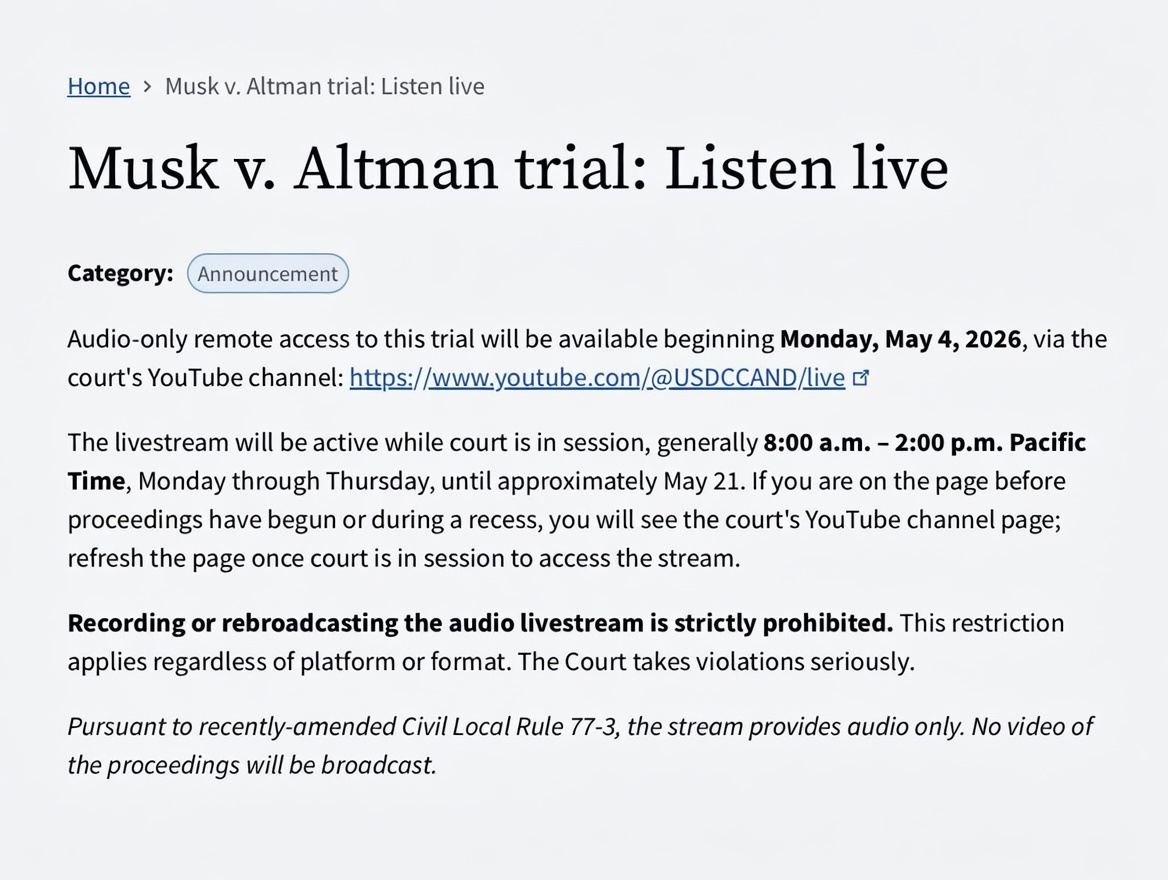
FYI: Starting tomorrow (Monday, May 4th), live audio of the Elon Musk v. Sam Altman/OpenAI trial will be live-streamed on the official YouTube channel for the US District Court for the Northern District of California.
The livestream will be available to the public while court is in session, usually between 8 AM – 2 PM PT, Monday through Thursday, until May 21.
Link in the thread below:
106
391
3,097
294,726
May 1
Might have found a diabolical cook.
Nikita said X live is coming, very explicitly.
Major news outlets are posting about it.
I found the first ever $Xlive on pumpfun.
FcR53cHqadCjDu2H9jHbcvSBG8djVWxt5w5MFubjpump
Spread the word champs
At 3k mc now
May 1

Welcome back. It’s time to stream.
1
326
Apr 30
OG correct ticker.
kTn5U49Cz3BA3kzXReVsAzJDBNF8kAULmyD3zdopump
Reminds me of what happened with scam Altman
3
275
darylmusk retweeted

Our most frequently asked question right now:
"If oil prices are above $100/barrel and the Iran War isn't over, why are stocks at record highs?"
The answer to this question is simple.
The AI Revolution has simply become so large, that investors are viewing everything else as "noise."
Over the last few months, as large cap technology stocks traded flat then sharply lower amid the Iran War, the AI narrative only grew.
The Magnificent 7 companies are set to invest over $600 BILLION in AI this year alone.
And, as broader markets swept tech giants like Nvidia and Alphabet lower, these stocks reached their cheapest Forward P/E levels since 2019.
At the March 30th bottom, the S&P 500 Information Technology index was trading at just a 4% Forward P/E premium to the S&P 500, the lowest since January 2019.
Tech stocks became cheaper than the average S&P 500 stock for the first time since 2017.
Nvidia, for example, is now trading at just a ~26x Forward P/E multiple, even as it is back at record highs. Walmart? 43x. Costco? 46x.
The reality is that many large cap technology stocks are merely getting cheaper as they go up. And when they go down, they become remarkably cheap.
We are in the biggest technological revolution in modern history, and even $100 oil, a 4.40% 10Y Yield, and rate cuts priced out until 2027 are unable to derail the train.
Asset owners will continue to win.
340
494
4,683
530,245
darylmusk retweeted

Apr 17
ماذا يحدث لو توقفت عن الاستمناء لمدة سنة كاملة ؟؟
هذي الأشياء اللي فعليًا تتغير في دماغك وجسمك خلال 12 شهر
1. قضيبك يصير أكثر...
841
419
12,052
27,538,029
31 Jan 2025
If you go to sleep, you will miss the next 100x.
If you don’t go to sleep, you will miss the next 100x.
Go to sleep.
46