
DeFi Pro: Helping clients grow wealth safely w/passive DeFi strategies. All Funds stored in multi-sig wallet for added security. Learn more: defipath.com
Joined August 2024
- Tweets 1,313
- Following 271
- Followers 146
- Likes 525
122 Photos and videos









Jun 12
AI agents are live on ETH Main.
Fidelity chose Uniswap for liquidity trading.
32% of all ETH is staked and earning on the network.
Privacy upgrade coming to ETH soon.
Vitalik proposes liquidation free DeFi based on options.
How do you not see ETH as the future?
1
1
38
Nick retweeted

Jun 11
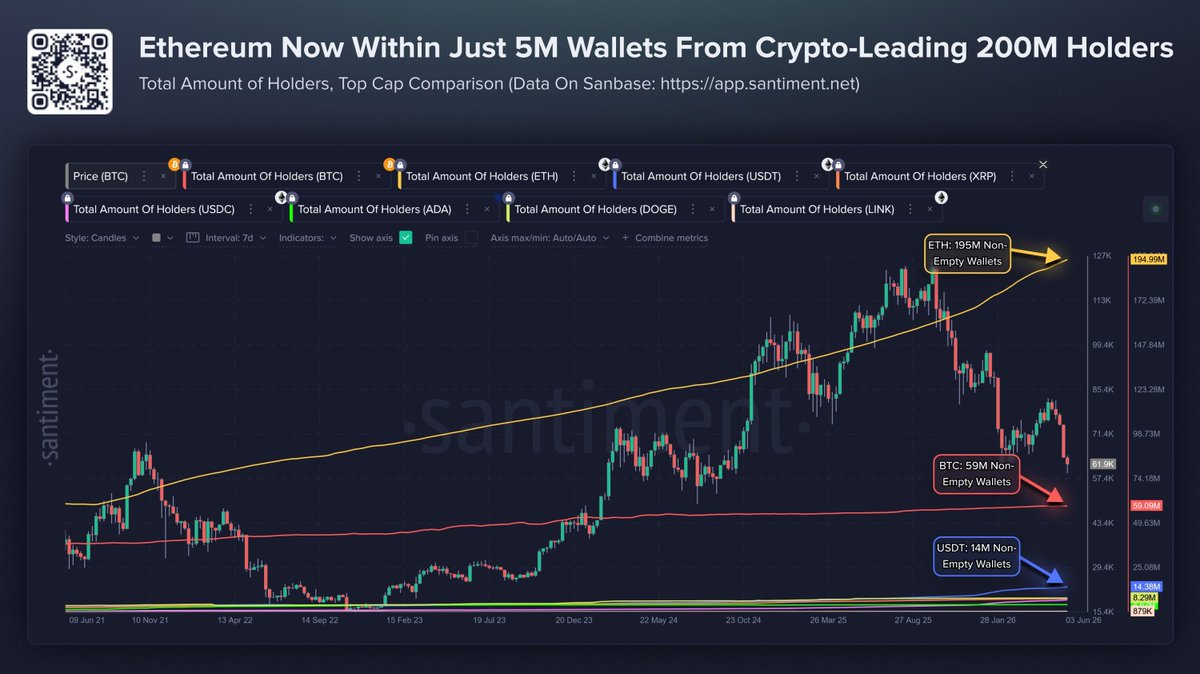
🚨 UPDATE: Ethereum is just 5M wallets away from hitting 200M non-empty addresses, now boasting 230% more holders than $BTC despite bearish sentiment, per Santiment.
88
142
517
33,623
Jun 11
The headlines this month have been about money leaving crypto. The more interesting story is how much stayed — and what it's doing.
Two data points the daily price chart won't show you:
1) A record share of Ethereum is now locked up.
About 32.5% of all ETH in existence is staked — committed to securing the network and earning yield — an all-time high. And it's not a revolving door. To start staking right now, you join an entry queue that's roughly 60 days long, with more than 3.5 million ETH waiting in line to get in. Nobody waits two months to enter a position they plan to flip tomorrow. A line that long is a demand signal: capital choosing to lock up and earn rather than sit on an exchange ready to sell. Roughly a third of the supply is effectively off the market.
2) The Bitcoin ETFs held the line.
Yes, U.S. spot Bitcoin ETFs just went through a record redemption stretch — about $4.4 billion out over 13 trading days. But put that against the base they're pulling from: those ETFs still hold roughly 1.28 million BTC and about $75 billion in assets — close to 7% of all the Bitcoin that will ever exist — with $58.7 billion in net inflows since launching in early 2024. The outflow was a ripple on an ocean that stayed put.
And by number of holders, the overwhelming majority never flinched. BlackRock noted that only about 0.2% of its ETF holders redeemed during the worst of the volatility. The big dollar outflows came from a handful of macro-driven institutions making tactical moves — not the broad base of long-term holders heading for the exits.
Here's the takeaway: price action measures sentiment day to day. Supply tells you about conviction. Right now, a record share of ETH is being locked away to earn, and the vast majority of ETF capital is staying put through one of the roughest stretches the market has seen this year.
That's not what the top of a cycle looks like. It's what a floor being built looks like.
2
1
52


Nick retweeted

Jun 5
Bitcoin price may be crashing, but behind the scenes the banks are hiring for digital assets, tokenization, custody, collateral, capital markets, and settlement finality.
Those are Bitcoin use cases. There is nothing else with a capped supply and no counterparty risk.
Banks don’t build job functions around dead assets. They build around where the rails are going.
Price is noise. Building infrastructure is signal. Don’t get shaken out.
3
6
84
4,067
Nick retweeted

Jun 4
Fun fact
$ETH exists today because World of Warcraft deleted a spell and made Vitalik cry.
In 2010 a 16-year-old Vitalik Buterin discovered his favourite Warlock ability had been quietly removed by the developers.
He wrote about it years later.
His exact words were “I cried myself to sleep, and on that day I realized what horrors centralized services can bring."
He quit the game and never went back.
A year later his dad showed him Bitcoin but he could not afford to buy any and could not mine it either.
He co-founded Bitcoin Magazine at 17 and applied for a job at Ripple at 18.
They accepted him but could not sponsor his visa.
At 19 he proposed major improvements to Bitcoin.
The community said no.
So he wrote his own whitepaper instead.
And called it Ethereum.


Ethereum Perpetuals are now live for trading.
American Perpetuals.
Only on Kalshi.
61
29
417
82,773
Nick retweeted

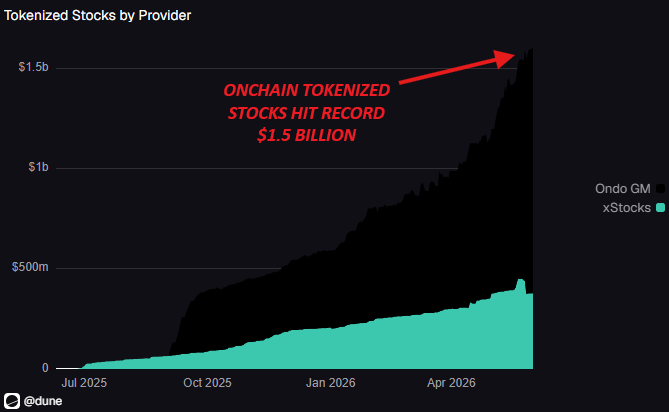
Tokenized stocks are rapidly expanding.
The total market cap of onchain tokenized stocks is now up to a record $1.6 billion.
This marks a 240% increase year-to-date as tokenization gains popularity and equity markets have experienced a historic rally.
Additionally, trading volume is also gaining momentum as xStocks and Ondo, two of the most active spot providers in the space, have both posted ~200% growth in monthly active trading volume this year.
Amid this growth, Jupiter, the largest onchain platform, has processed over $400 million in onchain tokenized stock spot volume, becoming a key venue for tokenized spot trading.
Meanwhile, in a sudden shift, Bloomberg reported that the SEC is now preparing a framework for the trading of tokenized stocks.
Tokenization is accelerating.
155
176
1,149
149,680
Nick retweeted

May 29
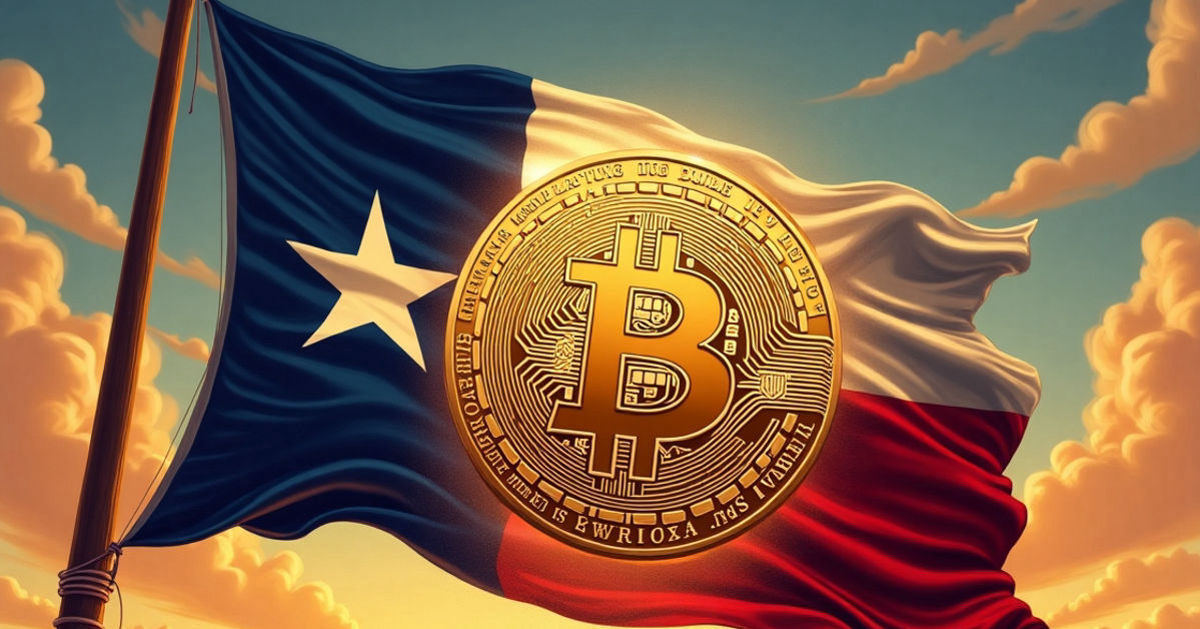
Texas is pivoting from buying Bitcoin ETFs to buying spot BTC held in cold storage for their Strategic Bitcoin Reserve 🇺🇸
Love to see it 👏
174
431
3,076
71,363
Nick retweeted

May 29
Every bank will have crypto custody.
Every bank will access to DeFi.
63
60
469
25,696
May 28
Things That Are Scarce & AI Can't Print:
- Land
- BTC
- Gold
- Time
- Attention
- Trust & reputation
Things That AI Makes Cheaper & Are Easily Produced:
- Fiat Currency
- Labor
- Content
- Code
- Images & art
- Information
What's wild is that BTC rolls all three of those scarce things into one asset.
Time. Every block is literally proof of time and energy spent. The whole system runs on work that can't be faked or rushed. And the longer Bitcoin survives, the more trusted it gets — 16 years and counting with no downtime. You can't shortcut that. A new chain can copy the code but it can't copy the years.
Attention. Bitcoin is the most watched, most covered, most liquid crypto asset on the planet. Every other coin fights for scraps of attention. BTC already has it. That attention is what turns into liquidity, adoption, and a price floor that keeps getting higher over the cycles.
Trust. This is the big one. You don't have to trust a bank, a CEO, or a government to hold BTC. You trust math and a network nobody controls. No one can print more. No one can freeze it. No one can change the rules on you. In a world where fiat depends on trusting people who keep breaking that trust, BTC is the first money where trust is built into the code.
Land has scarcity but no attention or portability. Gold has scarcity and some trust but no real attention anymore. Fiat has all the attention but zero scarcity and crumbling trust.
BTC is the only one that has all three at the same time.
The gap between these two lists is where wealth gets built over the next decade.
Own the things that can't be copied, printed, or generated. Everything else is getting cheaper by the day.
13
May 26
For me it comes down to BTC and ETH. I am a big fan of utility and narrative. I know the BTC maxi's don't like ETH but for the life of me I can't understand.
If BTC could do everything then fantastic, BTC only, but that's not the case. BTC has its limits on running complicated smart contracts and this is where ETH fills that hole.
I think the writing is on the wall that tradfi is changing dramatically. The use of AI agents, instant settlement, open internet blockchain (ETH Main), 24/7 access via the chain...the list goes on.
BlackRock is already tokenizing funds on Ethereum mainnet. The infrastructure is being built whether the price reflects it yet or not.
The changing landscape is hard to deny at this point. This is why running a business is changing too. Your business needs strong collateral that can earn yield, be borrowed against without selling, and be managed at any time from anywhere.
No banker's hours. No waiting 3 days for settlement. No asking permission to access your own capital.
The businesses that figure this out now are going to have a massive edge over the ones still parking everything in a checking account earning nothing.
17
May 23
Three macro conditions need to resolve before the end of 2026.
All three point in the same direction for crypto. The pressure to get these resolved isn't political — it's structural.
Midterm elections are coming. Whoever is in power needs the economy feeling good or they lose seats. That means gas prices voters can stomach, stable foreign policy, and borrowing costs that don't choke out businesses and homebuyers.
Every administration faces this same clock. The midterm economy is the report card. Middle East tensions need to cool off.
Every time Iran escalates, oil spikes, markets go risk-off, and capital runs to treasuries. Doesn't matter what BTC fundamentals look like — when geopolitical fear takes over, people sell everything that isn't a bond or a bunker.
A resolution or de-escalation removes a massive overhang from every risk asset including crypto. Gas prices need to come down. Gas is the tax everyone feels.
When it's high, consumer spending drops, inflation stays sticky, and the Fed has no room to cut. When it drops, the whole chain reverses.
Lower gas means lower CPI prints. Lower CPI gives the Fed cover to cut rates. Rate cuts push capital into risk assets.
BTC and ETH have historically ripped in rate-cut environments.
Bond yields need to get well under 5%. Right now the 10-year is hovering near 5%. At that level, big money has no reason to go anywhere near crypto.
Why take the risk when you can get 5% risk-free? But when yields drop to 3.5-4%, the math changes. Institutions start looking for higher returns.
That's when capital rotates into BTC, ETH, and on-chain yield. These three things are connected.
Geopolitical stability brings oil down. Oil coming down brings gas and inflation down. Inflation coming down brings yields down.
Yields coming down brings institutional capital into crypto. It's a domino chain. And right now the first domino is wobbling. You don't need to predict which way it falls.
1
21
Nick retweeted

May 16
BREAKING:
Three of Europe's most powerful financial institutions just chose Ethereum.
UBS. Société Générale. Banque de France. Repo markets. On-chain.
$12.5 trillion market.
1% on-chain is $125 billion on Ethereum.
Institutions are not experimenting.
They're transitioning.
Vitalik called it the secure chain.
Three central banks just confirmed it.
29
107
640
44,858
May 7
ETH Is About to Stop Being Bitcoin's Shadow.
For years, ETH has traded like a leveraged BTC bet. Bitcoin goes up 10%, ETH goes up 14%. Bitcoin dumps, ETH dumps harder. Every cycle. Same story.
That's about to change.
The CLARITY Act is moving through Congress right now. If it passes, ETH gets something it's never had — a legal identity. Not a security. Not a "we'll get back to you." A real regulatory framework that lets institutions deploy capital without their compliance team losing sleep.
And that changes everything about how ETH gets priced.
BTC trades on narrative. Digital gold. Store of value. You either believe in it or you don't. There's nothing to model.
ETH has actual financials.
$2-3B a year in fee revenue. A burn mechanism that shrinks supply every time someone uses the network. Staking yield paid out to holders. You can run a DCF on this thing.
Nobody does — because the SEC could still call it a security on any given Tuesday. So institutions sit on the sidelines and ETH keeps trading like BTC's little brother.
Remove that overhang and watch what happens.
ETH stops trading on BTC's mood. It starts trading on its own fundamentals.
Fee growth. TVL. L2 adoption. Burn rate. Real metrics. Real multiples.
It's like a company going from pre-IPO to post-IPO. Before the filing — vibes and comps. After — audited numbers, institutional coverage, and a real valuation framework.
The CLARITY Act is ETH's IPO moment.
Now add this: if institutional adoption doubles on-chain activity, fees go up and supply goes down at the same time. Increasing demand. Decreasing supply. That's a setup most assets on Wall Street will never have.
ETH doesn't need Bitcoin's permission anymore.
This is not financial advice.
79
Apr 30
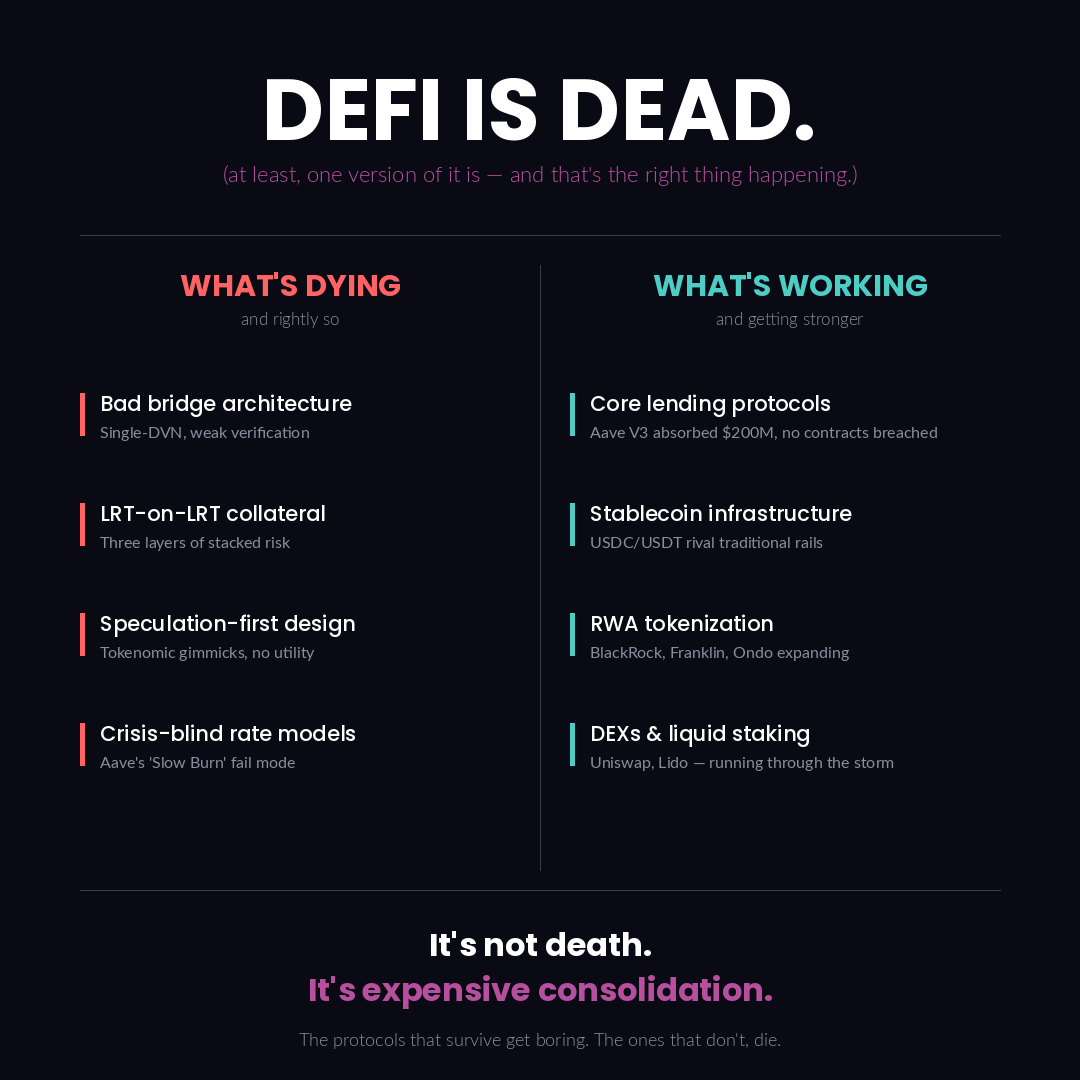
DEFI IS DEAD.
(At least, a specific version of it is. And that's exactly the right thing happening.)
Here's what's actually dying:
Bad bridge architecture. LayerZero single-DVN setups. Multichain. Wormhole's earlier design. Ronin. The pattern is clear — insufficient verification redundancy creates exploitable entry points that cascade damage downstream. Wormhole ($325M), Ronin ($625M), BNB Bridge ($570M), and now Kelp DAO ($292M). The industry is being forced to abandon weak cross-chain designs. About time.
Complex derivative-of-derivative collateral. rsETH was a liquid restaking token built on a liquid staking token built on ETH, custodied across cross-chain bridges.
Three layers of risk stacked for incremental yield. That experiment is over. Major lending protocols are already drafting frameworks to delist this category of asset.
Speculation-first protocol design. Anything that ran on tokenomic gimmicks or memetic momentum without underlying utility. Already dying for years. This just accelerates it.
Here's what's actually working:
Core lending protocols. Aave V3's smart contracts didn't fail in the latest crisis. The protocol absorbed a $200M exploit and is resolving it through $320M in coordinated multi-protocol capital.
That's a stress test passed, not failed.
Stablecoins as financial infrastructure. USDC and USDT now operate at a scale that rivals traditional payment rails. Circle's CEO publicly intervened in Aave governance during this crisis — that's a regulated player behaving like a systemic stakeholder.
RWA tokenization. BlackRock's BUIDL grew this year. Franklin Templeton's BENJI expanded. Ondo, Centrifuge, Maple all continue building. Real institutions have not pulled back from on-chain treasuries and credit markets — they've doubled down.
DEXs and liquid staking. Uniswap, Aerodrome, Lido — operating reliably through the storm.
The pattern across every incident:
peripheral infrastructure fails → core protocols absorb the damage → ecosystem coordinates a response. That's maturation, not collapse.
DeFi is going through its 1907 banking panic moment. Every financial system has one. The 1907 panic created the Federal Reserve. 1933 created FDIC. 2008 created Dodd-Frank.
The 2026 DeFi incidents will create better cross-chain verification standards, isolated-market lending designs, and crisis-mode operational protocols that actually function under stress.
The DeFi that exists in 2028 will be smaller in protocol count. Larger in TVL.
More institutionally integrated. Structurally safer than what came before.
Less interesting to retail speculators. More interesting to allocators.
What you're watching isn't death.
It's expensive consolidation.
The protocols that survive get boring. The ones that don't, die.
That's the system working.
1
2
88