
73 Photos and videos






Nag retweeted

Jun 16
Reactive smart contracts sound abstract until @Pact_Swap turns them into actual cross-chain trading.
- Watch a Bitcoin event.
- React to an Ethereum payment.
- Coordinate execution across Litecoin, Dogecoin, BNB Chain, Polygon, and TRON and more.
That is not a dashboard watching chains.
That is application logic reacting to real L1 activity and turning it into a swap flow.
Most “multi-chain” apps are still just single-chain apps with bridges attached.
Pact Swap is what it looks like when the app itself is built to think cross-chain. 🔥
Jun 15

Most traders only notice fees after they have already lost money. With @Pact_Swap , the savings are built into the design from the start, built on @CoinwebOfficial :
- Direct native swaps for $BTC, $ETH, $TRX, $BNB, $USDT
- No wrapping or bridge overhead
- Reactive contracts that reduce execution friction
- Collateralized settlements that protect both sides of the trade
For active traders, lower friction compounds fast. A few percentage points saved per trade can become a massive edge over time.
And the backbone of the system is $CWEB, which powers collateral, routing, and cross chain execution.
#CWEB #DEX #DeFi #Crypto
4
6
15
324
Nag retweeted

Jun 15
Complexity does not disappear because a bridge hides it, and @Pact_Swap is built for people who know that.
If a swap touches Bitcoin, Litecoin, Dogecoin, Ethereum, BNB Chain, Polygon, or TRON, the hard parts are still there.
Different chain rules.
Different confirmation behavior.
Different transaction models.
Different failure paths.
Weak cross-chain design hides that under middleware and sells it as UX.
Pact Swap takes the harder route.
Native transactions on the chains.
PACT enforcement when terms are not met.
Collateral behind the outcome.
Cross-chain should not hide complexity.
It should make it enforceable.
Jun 14

Cross-chain should not make users manage the mess underneath.
On @Pact_Swap , the route can touch Bitcoin, Litecoin, Dogecoin, Ethereum, BNB Chain, Polygon, and TRON.
The user should not need to care about bridge operators.
Or validator committees.
Or wrapped asset custody.
Or which middle layer is claiming finality.
They should care about the trade.
What asset goes in.
What asset comes out.
What chain confirms it.
What happens if the terms are not met.
That is the difference between real cross-chain execution and infrastructure cosplay.
4
7
323
Nag retweeted
Adding another chain to “solve” cross-chain is how the industry keeps making the same mistake.
On @Pact_Swap , the source of truth stays where it belongs.
Bitcoin records Bitcoin activity.
Ethereum records Ethereum activity.
TRON, Litecoin, Dogecoin, BNB Chain, and Polygon keep their own chain reality.
The swap flow connects them without pretending a new settlement layer knows better than the chains themselves.
No extra consensus layer.
No bridge custody.
No validator set becoming the referee.
Cross-chain should connect L1s.
Not replace them with another thing to trust.
Jun 16
An IOU is not the asset, and @Pact_Swap understands why that matters.
Wrapped BTC is not BTC.
Bridged liquidity is not native liquidity.
A synthetic claim is not the same as settlement on the real chain.
That line matters when the market spans Bitcoin, Litecoin, Dogecoin, Ethereum, BNB Chain, Polygon, and TRON.
Existing solutions often make assets easier for their stack by making them less native for the user.
That is backwards.
The infrastructure should adapt to the asset.
Not downgrade the asset into something easier to route.
1
3
5
44
Nag retweeted

Jun 15
If you're managing a multichain treasury, here's the math:
Every cross-chain move on a bridge costs you 1-2% in fees, validator risk, and timing exposure.
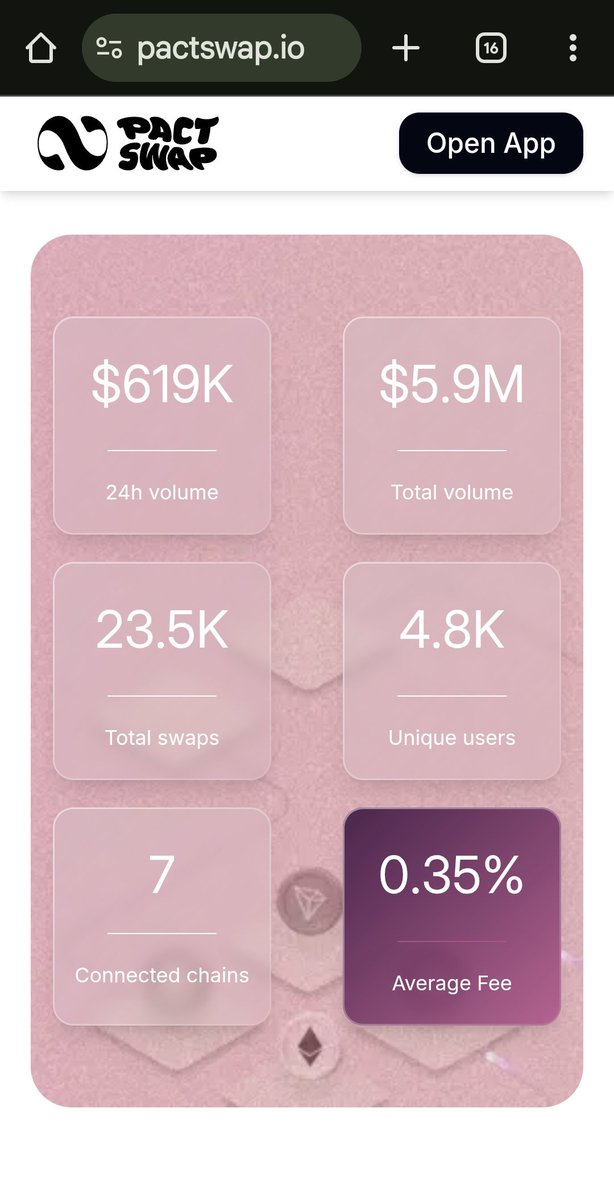
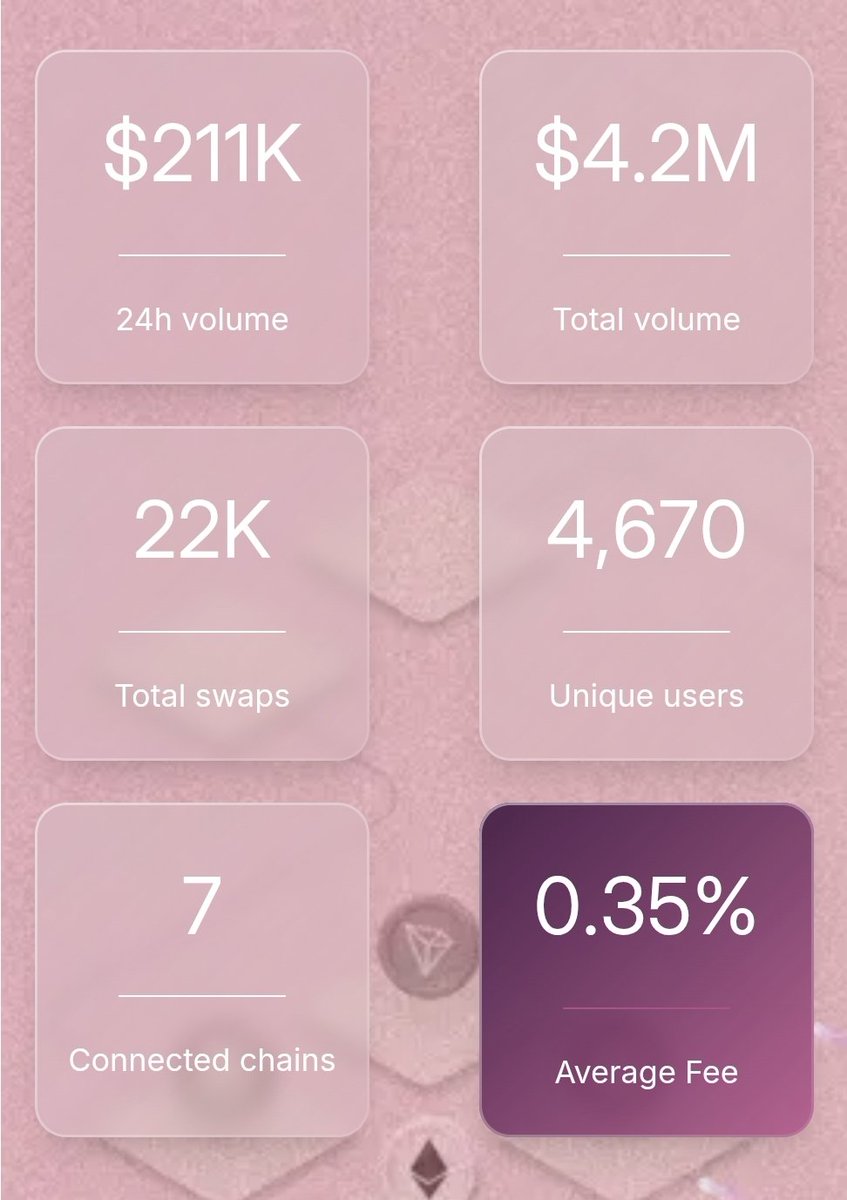
Every cross-chain move on Pact averages 0.36% in cost and clears in minutes.
Compounded over a year, that gap is seismic.

437
346
695
9,962
Nag retweeted
Jun 12
A route is useless if the trade behind it is weak, and @Pact_Swap starts where that matters.
Anyone can show a path from Bitcoin to Ethereum.
Or from Dogecoin to TRON.
Or from Litecoin to BNB Chain and Polygon.
The hard part is what happens after the route is chosen.
Does the trade execute with real chain activity?
Are the terms clear?
Is there a defined outcome if one side fails?
That is where Pact Swap gets sharper.
Native transactions move the swap.
PACT checks fulfillment.
Collateral gives failure consequences.
Cross-chain routing is easy to display.
Execution is where the truth shows up.
Jun 11
Cross-chain gets messy when another layer becomes the source of truth, and @Pact_Swap avoids that trap.
What happened on Bitcoin?
What happened on Ethereum?
What happened on TRON, Litecoin, Dogecoin, BNB Chain, or Polygon?
That should be the starting point.
Not a bridge message.
Not a validator vote.
Not a committee-approved version of events.
Coinweb gives Pact Swap the execution layer to react to real L1 activity across connected chains.
The chains record the facts.
PACT turns those facts into outcomes.
That is a cleaner foundation for cross-chain.
3
3
11
251
Nag retweeted
Weak cross-chain systems reveal their risk model only after something breaks. @Pact_Swap prices failure into the swap before execution.
That is the difference.
If a trade has value, the failure path needs value behind it.
Not a promise.
Not a committee.
Not a bridge team with a post-mortem.
Orders on Pact swap are backed by collateral, with CWEB locked in the Collateral Vault Smart Contract.
That matters across Bitcoin, Litecoin, Dogecoin, Ethereum, BNB Chain, Polygon, and TRON.
Cross-chain should not ask “who pays?” after failure.
The answer should already be in the protocol.
#DeFi done Right
Every cross-chain app should not need its own army of watchers, and @Pact_Swap shows why.
Most stacks quietly push complexity onto operators.
Watch Bitcoin.
Watch Ethereum.
Watch TRON.
Track confirmations.
Handle edge cases.
Keep the whole thing alive.
That is not clean infrastructure.
That is operational debt.
Coinweb gives Pact Swap a shared execution layer that can react to L1 activity across chains like Bitcoin, Litecoin, Dogecoin, Ethereum, BNB Chain, Polygon, and TRON.
The app should not be a pile of bots duct-taped to seven chains.
The chain event happens.
The logic reacts.
The swap moves.
….
1
4
8
355
Nag retweeted
Every cross-chain app should not need its own army of watchers, and @Pact_Swap shows why.
Most stacks quietly push complexity onto operators.
Watch Bitcoin.
Watch Ethereum.
Watch TRON.
Track confirmations.
Handle edge cases.
Keep the whole thing alive.
That is not clean infrastructure.
That is operational debt.
Coinweb gives Pact Swap a shared execution layer that can react to L1 activity across chains like Bitcoin, Litecoin, Dogecoin, Ethereum, BNB Chain, Polygon, and TRON.
The app should not be a pile of bots duct-taped to seven chains.
The chain event happens.
The logic reacts.
The swap moves.
….
Instant cross-chain is usually marketing with a progress bar, and @Pact_Swap does not need that illusion.
Bitcoin has confirmations.
Litecoin has confirmations.
Dogecoin has confirmations.
Ethereum, BNB Chain, Polygon, and TRON have their own settlement reality.
Pretending every chain behaves the same is how users get lied to.
Pact Swap keeps execution tied to native transactions on the underlying chains, then lets the protocol handle the outcome.
No fake instant finality.
No middle layer pretending it can make Bitcoin faster.
No UI spinner rewriting chain physics.
Real chains have real timing.
Good cross-chain should respect that.
#DeFi done Right
5
4
13
207
Nag retweeted
Jun 8
Tell me you've been wrecked by a bridge without telling me you've been wrecked by a bridge.
I'll start: I refreshed Etherscan 47 times in 20 minutes.
508
394
1,265
12,954
Nag retweeted
Jun 5
Uniswap became infrastructure.
Not because it was the best swap UI.
Because dApps could build on top of it.
Pact brings that concept further.
→ Fully deployed as smart contracts.
→ Composable across all supported chains.
Any dApp can use Pact as its native liquidity layer.
437
389
1,152
17,387
Nag retweeted
Jun 5
Bridge-first cross-chain is the long way around, and @Pact_Swap does not need that detour.
Most existing solutions make you trust the middle.
Deposit into a bridge.
Wait for a message.
Trust a validator set.
Hope the wrapped asset stays backed.
That is not clean cross-chain execution.
That is infrastructure debt hidden behind a swap button.
Pact Swap takes the native route across Bitcoin, Litecoin, Dogecoin, Ethereum, BNB Chain, Polygon, and TRON.
No bridge custody as the trading path.
No extra validator set deciding what happened.
No wrapping everything until the architecture looks simple.
Real chains.
Native transactions.
Cross-chain order flow.
4
4
10
437
Nag retweeted
Liquidity without commitment is just bait, and @Pact_Swap is built to make order flow accountable.
A quote should mean something.
An order should have terms.
A swap should have an outcome.
That sounds obvious until you look at how much cross-chain routing depends on soft liquidity, middlemen, and “available until it suddenly is not.”
Pact Swap uses an order book model across Bitcoin, Litecoin, Dogecoin, Ethereum, BNB Chain, Polygon, and TRON.
@CoinwebOfficial PACT adds the part most systems avoid:
Did the required transaction happen or not.
Was the swap fulfilled or not.
What happens next is defined by rules.
Real markets need accountable liquidity.
Not vibes with a price quote.
Cross-chain users should not be paying for an extra security layer every time they swap, and @Pact_Swap cuts straight through that problem.
A lot of existing cross-chain systems carry permanent overhead.
Validator rewards.
Watcher networks.
Bridge operations.
Long-term locked collateral.
Infrastructure that has to be paid before the user even gets a good route.
That cost does not disappear.
It shows up in pricing.
It shows up in execution.
It shows up in the spread users accept without noticing.
Coinweb is the reason Pact Swap can take a leaner route across Bitcoin, Litecoin, Dogecoin, Ethereum, BNB Chain, Polygon, and TRON.
Native transactions.
No bridge committee to fund.
No validator set to reward.
No extra consensus layer taxing the flow.
Less infrastructure rent.
More room for better swaps.
4
4
9
274
Nag retweeted
May 31
Bitcoin does not need an issuer to become useful in DeFi.
On @Pact_Swap , native BTC can be part of cross-chain order flow without turning into someone else’s wrapped liability first.
That distinction matters.
Wrapped BTC is only as strong as the custody, minting, redemption, and operational stack behind it.
Native BTC is different.
It settles on Bitcoin.
It keeps its own chain reality.
Add Litecoin, Dogecoin, Ethereum, BNB Chain, Polygon, and TRON, and the point gets louder:
Cross-chain should connect real assets.
Not replace them with promises. 🔥
#DeFi done Right
May 30
A cross-chain swap should not disappear into middleware the moment you click confirm.
On @Pact_Swap , the important parts stay visible.
A real transaction on Bitcoin.
A real transaction on Ethereum.
The same idea across Litecoin, Dogecoin, BNB Chain, Polygon, and TRON.
Existing solutions love to abstract everything until users cannot tell what actually happened.
That is not better UX.
That is just hiding the risk.
Good cross-chain should make the route simple without making the execution invisible. 🔥
#DeFi done Right
3
6
18
388
Nag retweeted
May 29
Somewhere right now, there’s someone overpaying just to move their funds across chains
They don't have to. The solution exists right here.
Swap on Pact. Keep the money you actually earned.

394
403
1,160
16,266
Nag retweeted

May 31
Coinweb’s Reactive Smart Contracts are like smart robots for blockchains.
They run on their own, can react autonomously to events, and work across all connected chains.
One gas token ( $CWEB ), self-managed fuel, no middlemen.
Perfect for cross-chain swaps: no validator sets, no idle capital, no 1000x collateral. Just-enough, just-in-time collateral management.
More trustless. Faster. Cheaper. Smarter.
11 Nov 2025

A reactive smart contract that lives across various chains.
No validators, just Pact.
10
13
33
1,320
Nag retweeted
May 29
Bitcoin should not have to behave like Ethereum to trade on @Pact_Swap .
Bitcoin does not execute like Ethereum.
Dogecoin does not behave like Polygon.
TRON has its own rails.
Litecoin has its own settlement reality.
Forcing every chain into one familiar model is the lazy path.
Pact Swap lets native chain activity stay native, while the order flow connects across Bitcoin, Litecoin, Dogecoin, Ethereum, BNB Chain, Polygon, and TRON.
Different chains should stay different.
The route should handle the complexity. 🔥
#DeFi done Right
May 28
Builders need more than a route that “should work,” and @Pact_Swap is built around that reality.
A swap path can touch Bitcoin, Litecoin, Dogecoin, Ethereum, BNB Chain, Polygon, and TRON.
But the important part is not the chain list.
It is whether the route can be composed, tracked, audited, and executed without handing control to a black box.
That is where real cross-chain infrastructure starts.
Not prettier buttons.
Not louder bridge claims.
Not another layer asking you to trust the middle.
Clean routes.
Native transactions.
Visible outcomes. 🔥
#DeFi done Right
2
6
15
333
Nag retweeted
May 27
The PACT framework stands for Penalty Adjudication for Cross-chain Transactions. It's the enforcement layer @CoinwebOfficial built that makes @Pact_Swap possible. The name tells you exactly what it does — it adjudicates penalties when someone doesn't hold up their end of a cross-chain deal.
The three actors inside every PACT:
• Chain Transaction Sentinels (CTS) — reactive smart contracts deployed on each blockchain involved in the swap, independently watching for deposits, confirmations, and deliveries
• The Penalty Adjudicator (PA) — the contract that receives reports from all sentinels and determines whether the swap was completed correctly
• Swap vault operators — market makers who post $CWEB collateral and are responsible for delivering the agreed assets
The process is fully deterministic. If the sentinels confirm delivery, collateral is released. If they confirm non-delivery, collateral is seized. No human judgment, no governance vote, no appeal process.
$CWEB $PACT
May 26
@CoinwebOfficial introduced something called gas fee abstraction, and it solves one of the worst UX problems in cross-chain trading. Normally, if you want to interact with five different blockchains, you need five different gas tokens in five different wallets. Coinweb eliminates that.
How gas fee abstraction works on @Pact_Swap:
• $CWEB is the single gas token for all execution on Coinweb's L2 layer
• Users don't need to hold ETH for Ethereum gas, BNB for BNB Chain gas, or TRX for TRON gas separately
• The reactive smart contracts handle cross-chain execution costs using $CWEB regardless of which L1s are involved in the swap
• This dramatically simplifies the user experience — one token covers the operational cost of trading across seven live chains
• As Solana and Base are added, the same principle applies — $CWEB remains the universal gas asset
This is another structural demand driver for $CWEB that operates independently of fees and collateral.
$CWEB
4
5
9
286
Nag retweeted
May 24
Most cross-chain DEXs solve interoperability by wrapping assets and moving them through bridge infrastructure. @Pact_Swap takes the opposite approach — assets never leave their native chain. The swap coordination happens entirely on @CoinwebOfficial's L2, while the actual value stays on Bitcoin, Ethereum, or whichever L1 it belongs to.
Why the distinction matters:
• Wrapped assets introduce counterparty risk — if the bridge backing them is compromised, the wrapped token becomes worthless
• Bridge exploits have accounted for billions in DeFi losses (Ronin, Wormhole, Nomad, Multichain)
• On Pact Swap, your BTC stays as BTC on the Bitcoin network and your ETH stays as ETH on Ethereum
• The only coordination layer is Coinweb's reactive smart contracts, which observe and enforce — they don't custody anything
• If anything goes wrong, the overcollateralized $CWEB in the swap vault compensates the user automatically
No wrapping. No custodial bridge. Just native assets and contract enforcement.
$CWEB
May 22
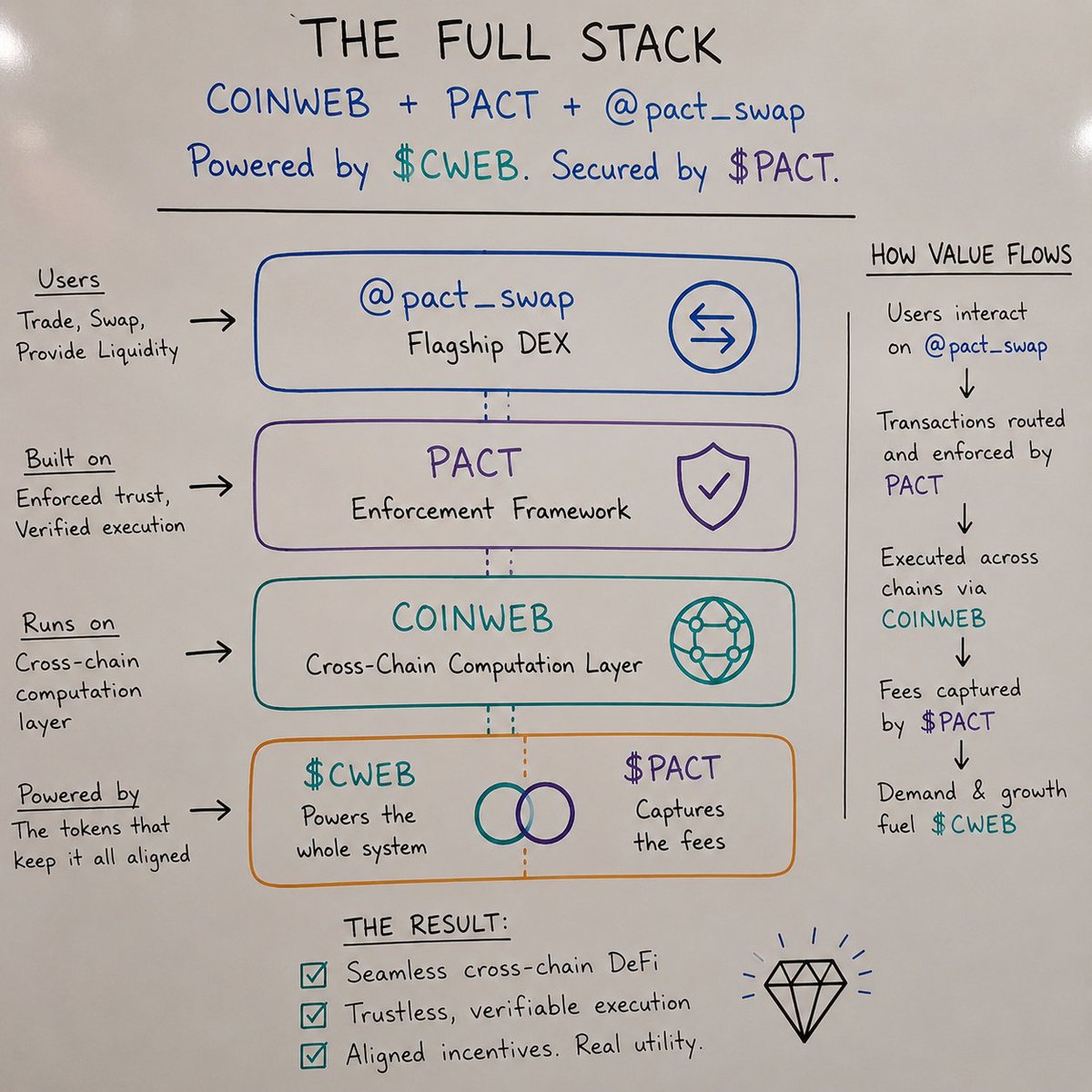
Putting @CoinwebOfficial and @Pact_Swap together in one picture: Coinweb provides the cross-chain computation layer, PACT is the enforcement framework, Pact Swap is the flagship DEX, $CWEB is the asset that powers all three, and $PACT is the protocol token that governs and captures fees.
The full stack:
- Coinweb L2 — reads and writes state across Bitcoin, Ethereum, BNB Chain, Litecoin, TRON, Dogecoin, Polygon (Solana and Base incoming)
- Reactive smart contracts — run continuously across chains in a WASM execution environment, monitoring events and enforcing outcomes
- PACT framework — Penalty Adjudication for Cross-chain Transactions, using Chain Transaction Sentinels and a Penalty Adjudicator to settle swaps
- $CWEB — gas, fee currency, LP collateral, and treasury reserve asset
- $PACT — governance, fee pool redemption via burn, permissionless listing access, and fee discounts for stakers
Seven chains live. Native assets only. No bridges.
3
6
13
203
Nag retweeted
May 24
Native Bitcoin routes are where @Pact_Swap makes aggregator routing more serious.
Most cross-chain routing still treats BTC like a problem to route around.
Wrap it.
Bridge it.
Move the risk somewhere else.
Call it liquidity.
That is not the same as native BTC access.
Pact Swap puts Bitcoin, Litecoin, Dogecoin, Ethereum, BNB Chain, Polygon, and TRON into the routing conversation without making wrapped BTC the default answer.
Aggregators want routes users actually care about.
Native BTC is one of them. 🔥
May 23
Cross-chain does not get fixed by another pretty swap screen, @Pact_Swap focuses on execution underneath.
Route it.
Bridge it.
Wrap it.
Show a nice status screen.
That is not enough.
Pact Swap is an order book based DEX across Bitcoin, Litecoin, Dogecoin, Ethereum, BNB Chain, Polygon, and TRON.
Orders set the terms.
Native transactions execute them.
PACT decides whether the swap was fulfilled.
The UI can be simple because the market structure underneath is doing the hard work.
3
4
11
351
Nag retweeted
May 24
Most dApps today are still confined to the blockchain they were built on.
Their data lives there.
Their logic executes there.
Their users are limited by it.
Coinweb changes that.
Instead of relying on its own consensus system to “agree” on what happened on another chain, Coinweb continuously parses and reacts to canonical L1 blockchain data directly from the source chains themselves, deterministically.
To date, we have parsed over 40,000,000,000 L1 transactions.
This gives developers building on Coinweb direct access to blockchain data across every connected ecosystem.
Directly from the underlying chains themselves.
That means developers can build dApps that react to real multi chain activity in deterministic ways.
A transaction either happened on the blockchain or it didn’t.
No subjective validator voting.
No probabilistic bridge consensus.
No federated trust assumptions.
This becomes especially powerful for emerging categories like autonomous AI agents.
An AI application built on Coinweb could monitor activity across multiple chains simultaneously and execute deterministic actions based on verifiable blockchain events:
• Rebalance treasury positions across ecosystems
• Execute cross chain liquidity strategies
• React to payment settlement events
• Coordinate multi chain gaming economies
• Trigger automated workflows based on real blockchain activity
All from a unified application layer with direct access to canonical L1 data.
Reactive Smart Contracts execute based on verifiable blockchain events, allowing applications to coordinate logic across ecosystems with predictable outcomes and reduced complexity.
This is a fundamentally different model for building multi chain applications.

11
18
41
974
Nag retweeted
May 18
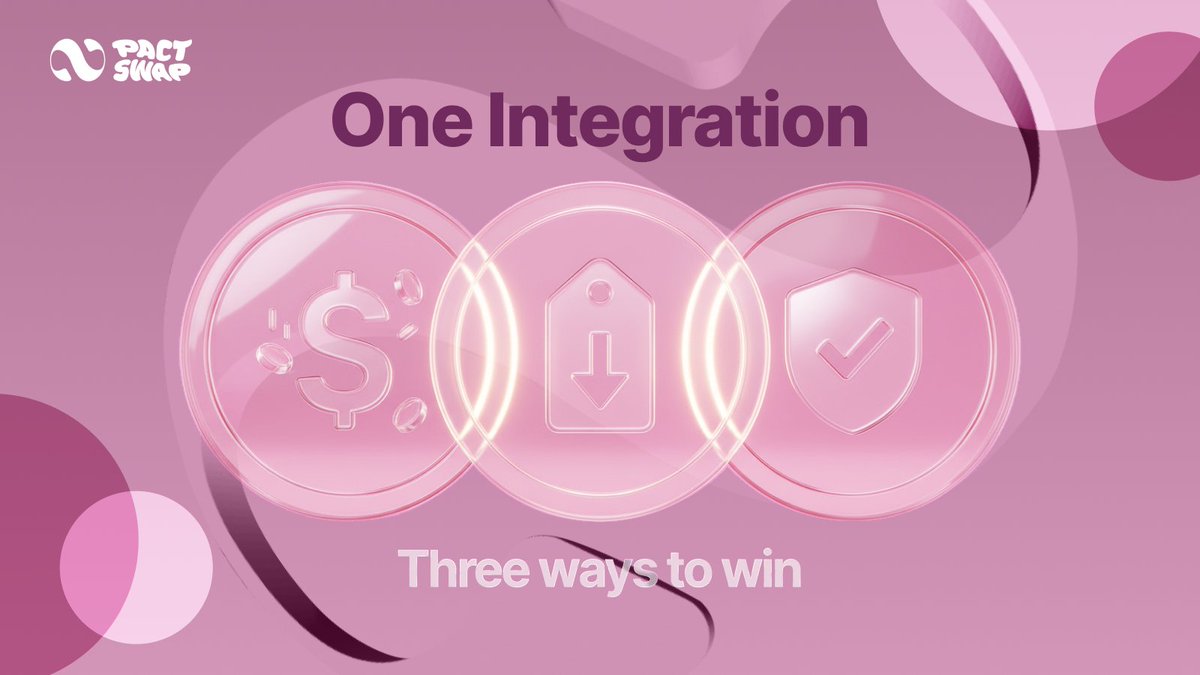
If you're an aggregator routing monthly through Pact:
- You earn affiliate fees on every swap
- You pass cheaper pricing to your users
- You take zero bridge liability onto your balance sheet
That's three wins from one integration.
426
436
1,323
14,911