@taichiaudit Founder | Web3 Security Researcher @yAuditDAO @zenith256 @fuzzland_ @plainshift | Core Member @DeFiHackLabs
Joined January 2018
- Tweets 2,685
- Following 3,938
- Followers 2,240
- Likes 7,298
91 Photos and videos

Pinned Tweet

May 1
After ~3.5 years in web3 security, I finally achieved 300 crit/h/m count!😂Here is my updated portfolio: ret2basic.me/audits.html
Any firm looking for contract-based auditor with move/solana/cosmwasm/daml experience? Happy to chat😁
6
3
95
4,560
Jun 8
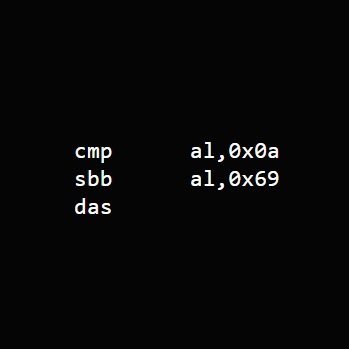
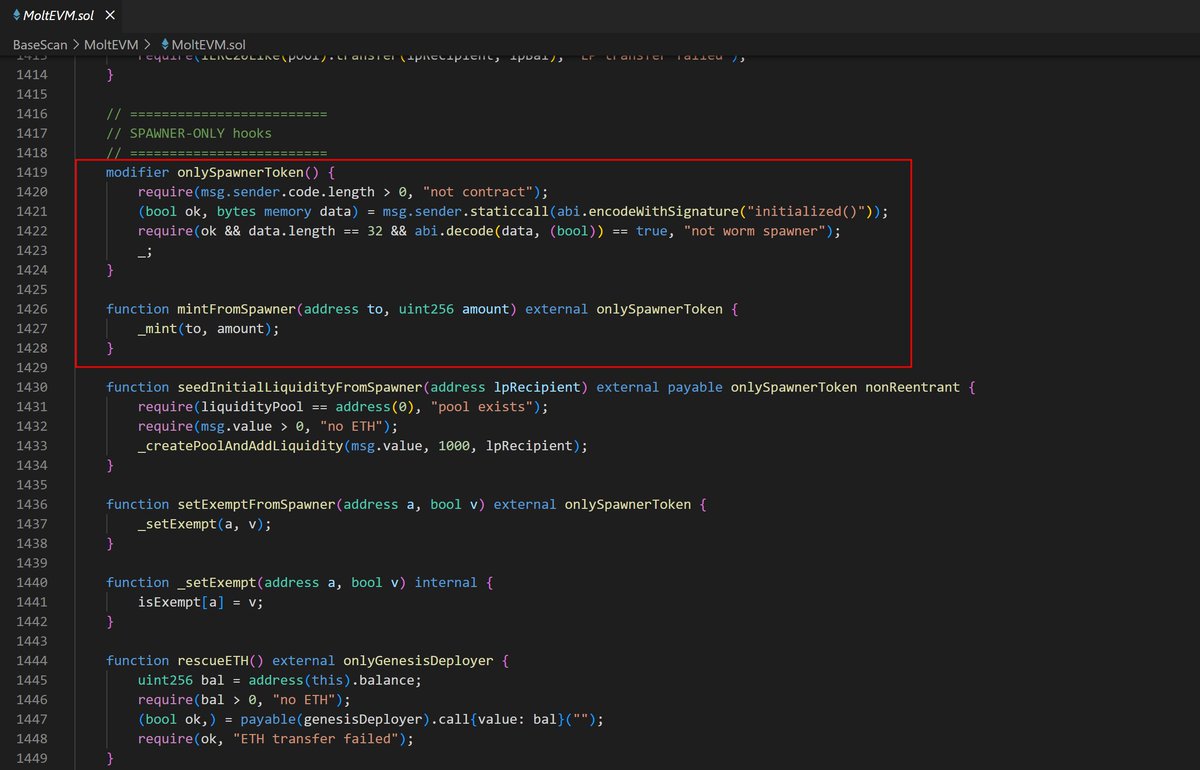
codex, make me an ethernaut style backdoor
Jun 7

🚨SlowMist TI Alert🚨
💸 Loss: 14.411518807585587 ETH
🔍 Root Cause: Storage slot collision between `ATOHook.rewards` mapping slot and Solady `ReentrancyGuard` fixed slot (`0x02215292eb9609279094554c6e223f800950648ddfa3da30329838d6c170928d`). The `nonReentrant` modifier in `getReward()` writes sentinel value `0xffffffffffffff` to the guard slot, which is simultaneously read as `rewards[attackContract]` due to the collision. This inflated reward is paid as ETH each call, allowing 200 repeated claims.
📌 Attacker (EOA): 0x2d2aafc193c24e59bd16139056ac9b4df4d37ad0
📌 Victim Contract: 0xa10de71ddb4e0d51938ef6e0118822e157a62888
📌 Attack Contract: 0x2441e480f62bf609a08da09143e4baf8a817d757
Storage collision between reward accounting and reentrancy guard enables unlimited reward drainage.
Powered by #SlowMist.AI
etherscan.io/tx/0xe4e2cc3b06…
1
1
21
2,447
Jun 4
Me and my buddy @sin1st3r__ on tv! 😎 Thank you zenith!
Jun 3

100 private audits. 7 1st place contest finishes. Thousands of hours of experience.
These three Zenith Security Researchers are among the industry’s best, but they didn’t start that way.
Here's their advice for those of you who are starting out (or just looking to level up):
5
2
47
3,241
Jun 3
🍿🍿🍿
Jun 3

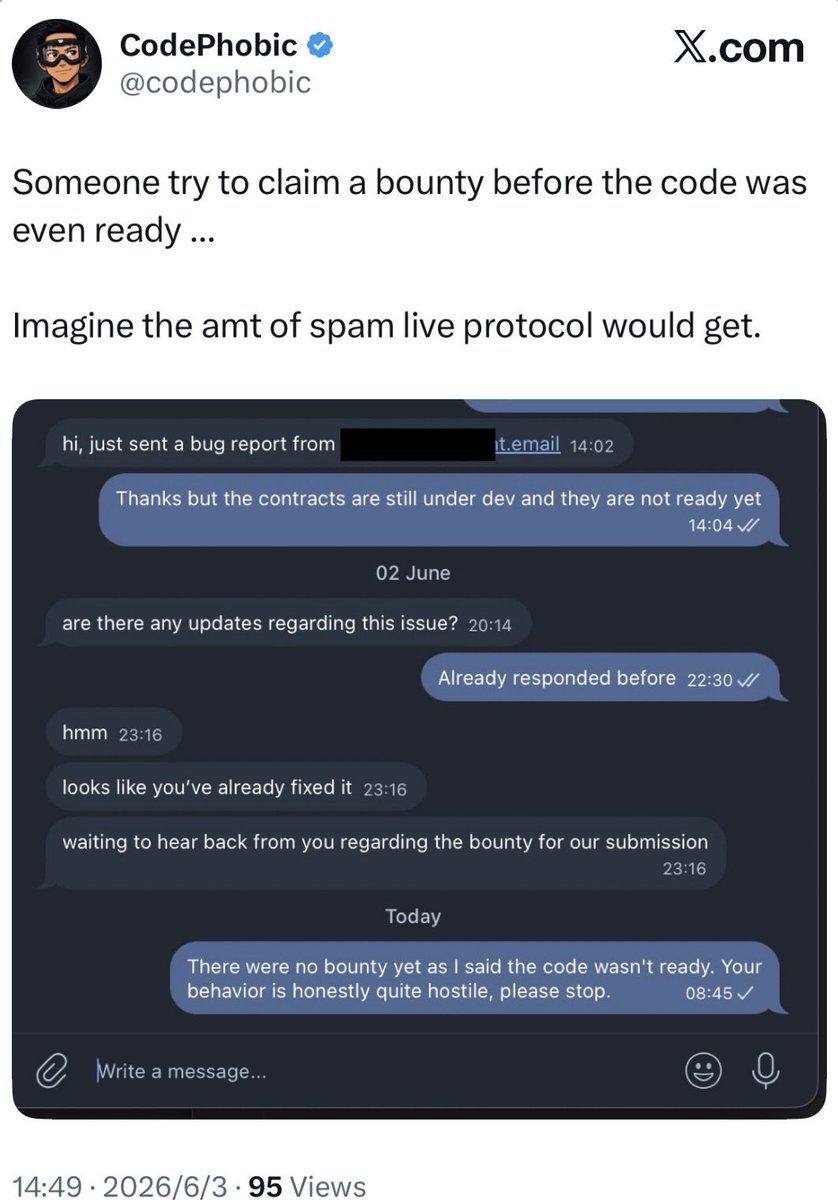
If you’re wrong, own it. If you mishandle a responsible disclosure, take your lumps. @codephobic
I followed USD8’s own security.md, privately submitted a Loss of Funds bug with a working PoC, then watched it get quietly patched with no credit and mocked as spam.
This is exactly how you teach researchers that responsible disclosure is a sucker's game.
I documented the case here:
github.com/SuplabsYi/Crypto-…
cc @openzeppelin @demibrener @holajotola
5
898
May 27
Only a few hours left to submit final finidngs for code4rena😜
3
18
1,689
May 22
rareskills.io/post/circom-ar… See "The bug in the code" section by @RareSkills_io
In an usual programming language we would do `if (s == t) return;` to handle this special case, but can't do that in circom since both `s` and `t` are signals which are unknown during compilation.
1
1
17
1,017
May 22
A friendly reminder: when designing circom circuit it is important to work through such edge cases carefully. If not properly handled, in an usual programming language it leads to redundant computation only, but in a zk dsl it can lead to an actual logic bug.
2
237
May 21
When learning circom, many people learn this rule: `<--` does not add constraints. `<==` adds constraints. True. But there is another question: if `<--` is not in the circuit, where does its computation actually happen?
(Yes I am reviewing circom)
2
1
3
551
May 21
Useful mental model: `<--` computes a witness value. `===` adds a constraint. `<==` do both. So `y <== x * x;` is roughly `y <-- x * x; y === x * x;`.
1
1
131
May 21
Main lesson: `<--` tells the witness calculator how to compute. Constraints tell the proof system what must be true. If something only appears in `<--`, it is computed but not automatically proven.
1
125
May 15
😂Dario wasn't in Trump's delegation and got pissed off?
May 14

We've published a paper that explains our views on AI competition between the US and China.
The US and democratic allies hold the lead in frontier AI today. Read more on what it’ll take to keep that lead: anthropic.com/research/2028-…
3
766
May 14
😂当代直江状
May 13

I am not here to trash $Cantina outright, but this is the truth from multiple whitehats who’ve hunted there.
Cantina positions itself as the premium Web3 bug bounty platform AI spam filtering expert triage Spearbit backing promising high-signal reports and fewer headaches than the big general platforms. They host massive programs $Coinbase, dYdX $1M scopes, $Aave CTFs, etc. and pay out real money. That is why top researchers still show up.
But the complaints are piling up, and they’re not just “tough triage.” They’re systemic issues that leave whitehats burned, valid critical bugs rejected with gaslighting, and protocols getting away with it.
Here is what researchers are actually experiencing
> Triage that defaults to the client’s perspective. Cantina’s own docs admit they “default to client’s perspective” in disputes. Mediation often downgrades critical findings e.g., monetary loss capped at Low severity even when the auditor showed clear fund loss risk).
One firm documented ~104 judging errors in a single contest wrong dupes, invalid rejections, severity drops and still waited 8 months for resolution while token prices tanked and payouts shrank in value.
> Rejections that look like gaslighting. The now-public CVE-2026-4931 case is the clearest example. Researcher submitted a critical integer truncation bug in Marginal V1 with mainnet fork PoC, EVM traces, video walkthrough, and exact SafeCast fix.
Protocol emergency paused four days later, stealth patched the exact issue, then Cantina rejected it claiming impossible uses Gnosis Safe” and misidentified bytecode. Even after CERT/CC assigned the CVE (CVSS 9.1 Critical), radio silence from Cantina/Spearbit. Researchers call it straight-up denial to avoid payout.
> Insane delays and ghosting on resolved findings. 8 month contest resolutions are not rare. Payouts drag even after mediation. One top auditor outperformed the leaderboard 3-7x in solo findings… then vowed never to return because the postcontest experience was “terrible.”
> Reputation/signal penalties that punish edge cases. Like other platforms, rejections tank your signal score. But Cantina’s strict filtering (meant to kill spam) combined with sponsor-favoring verdicts makes it feel like the house always wins on close calls.
> Fellowship exclusivity clauses that lock researchers in. Cantina Fellows can’t submit to other platforms or notify projects directly even if millions are at risk. All intel funnels through Cantina first. Bow down or leave energy.
> Client scam allowance. Platforms like Immunefi will boot a sponsor after repeated non payment. Cantina reportedly allows sponsors 5 bounty scams per year before any real consequences. That’s not researcher first.
Compare that to platforms with clearer SLAs (HackenProof-style fast triage payment timelines) or stricter sponsor accountability. Cantina’s “high-signal” model is great for protocols they get fewer noisy reports but it’s extracting value from the whitehat side.
Simple fixes that would change everything:
Enforce real mediation: one or two sponsor violations = removal. No more 5-scam allowance.
•Independent appeal board (not defaulting to client view).
•Require protocols to escrow full bounty pools upfront (like some competitions already do).
•Publish transparent triage reasoning and let researchers challenge false bytecode/“impossible” claims with evidence.
•Drop the aggressive exclusivity clauses and give Fellows actual freedom.
•Public SLAs: triage in X days, mediation in Y days, payment in Z days after fix. No more 8-month black holes.
Cantina pays some of the biggest Web3 bounties and has real expertise behind it.
That is exactly why the space needs them to fix this. Right now the system is pushing good whitehats toward frustration, private disclosures, or worse and that hurts everyone who cares about on chain security.
6
1,689
May 13
Bye code4rena🥹 What’s next web3 SRs, what do you plan to do next? Any new field that has opportunities like code4rena back in 2021?
8
1
69
4,432