
The security standard for onchain finance. $35 trillion in value transferred secured since 2015 for the institutions and innovators shaping global finance.
Joined August 2016
- Tweets 4,316
- Following 129
- Followers 59,111
- Likes 2,257
792 Photos and videos





Pinned Tweet

Jun 10
OpenZeppelin is bringing its security standard to @CantonNetwork
We're building a secure contracts library, reference implementations, and developer tooling for Canton's privacy-first ecosystem, engineered for the most critical institutional use cases.
3
17
63
11,676
OpenZeppelin retweeted

Jun 11
An open-source contracts library, reference implementations, and developer tooling for Canton, backed by the security standard behind $35T in value transferred onchain.
@OpenZeppelin is building the secure development foundation for institutional applications on Canton.
↓
Jun 10

OpenZeppelin is bringing its security standard to @CantonNetwork
We're building a secure contracts library, reference implementations, and developer tooling for Canton's privacy-first ecosystem, engineered for the most critical institutional use cases.
4
24
103
5,803
Jun 11
Every team at a financial institution runs on established frameworks. Compliance has its mandates, risk has its controls, and technology has its development standards.
Blockchain introduces a new paradigm that cuts across all of them.
1
2
11
857
Jun 11
We broke down what security standards actually mean for institutions building onchain: the code, the operation, and the compliance posture.
Read more here ↓
openzeppelin.com/news/what-s…
2
8
532
OpenZeppelin retweeted

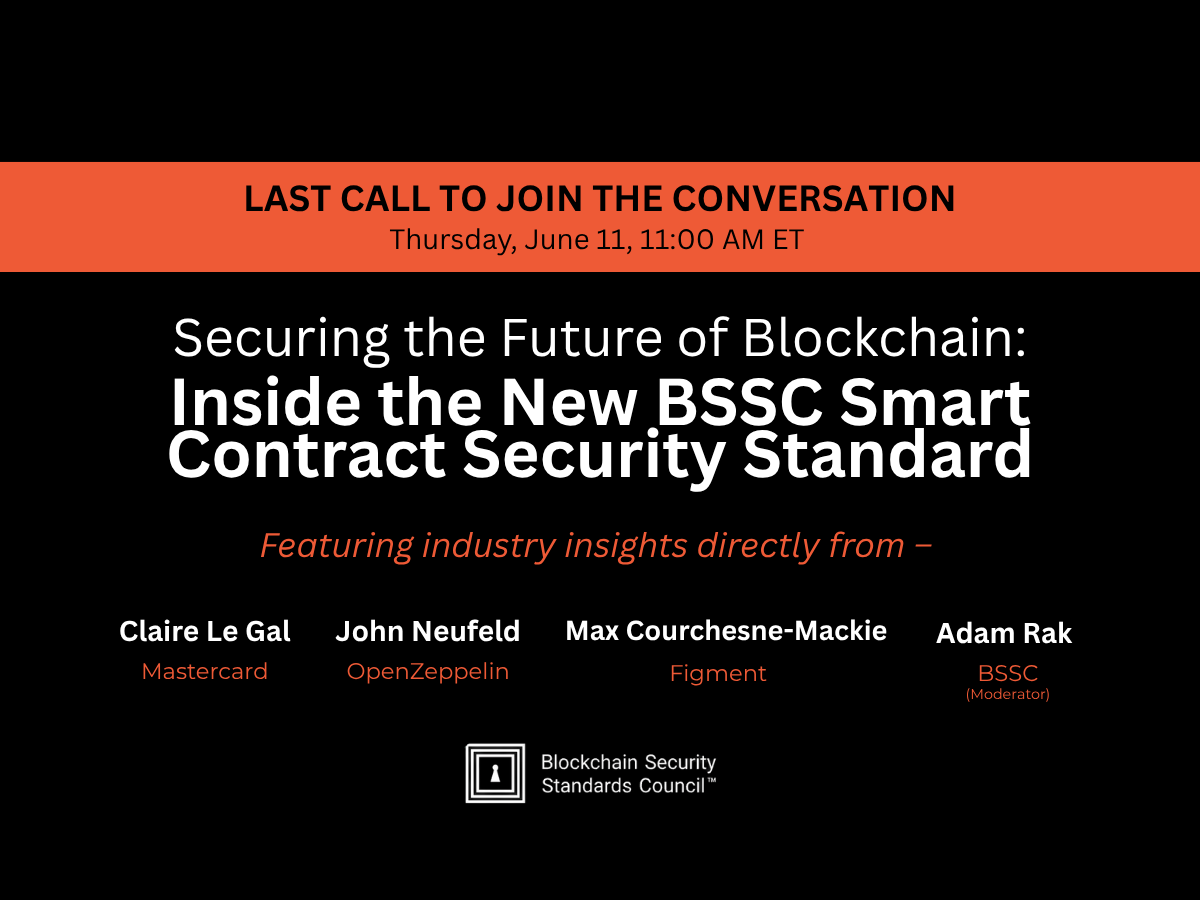
Last chance to join BSSC on June 11 for a live discussion with Claire Le Gal from Mastercard, John Neufeld from OpenZeppelin and Max Courchesne-Mackie from Figment on the new standards shaping blockchain security.
Executive Director Adam Rak will be moderating the conversation on BSSC's latest smart contract and node operation standards. Tune in to learn what this means in practice, and why these standards matter now.
Join the conversation: events.teams.microsoft.com/e…
#Blockchain #BlockchainSecurity #SmartContracts
3
5
1,259
Jun 10
OpenZeppelin is bringing its security standard to @CantonNetwork
We're building a secure contracts library, reference implementations, and developer tooling for Canton's privacy-first ecosystem, engineered for the most critical institutional use cases.
3
17
63
11,676
Jun 10
Institutional finance is already onchain. DTCC, Broadridge, and Goldman Sachs process $9T in tokenized value on Canton every month.
We are thrilled to build solutions across the Canton Network to accelerate secure development for the next era of finance.
1
1
7
824
Jun 9
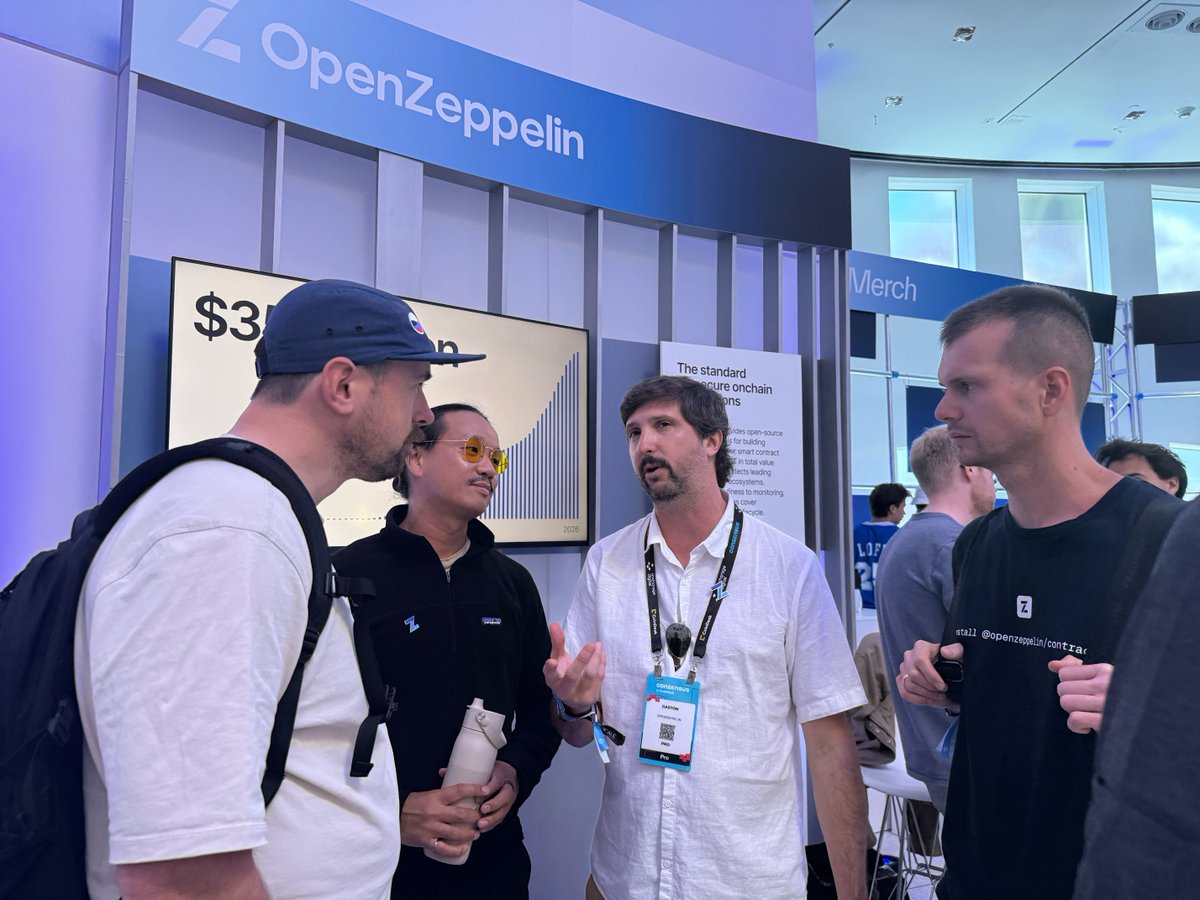
We're at @ethconf this week! Stop by our meeting room to learn more about onchain security and how we can help secure your blockchain infrastructure.
7
4
37
1,666

Jun 8
Frontier models can write smart contracts that work. Whether they survive security edge cases is the harder question.
We put this to the test by collaborating with @circle to develop ChainBench, a benchmark for agent-driven crosschain smart contract generation.
May 27

Introducing ChainBench, built in collaboration with @OpenZeppelin.
ChainBench is an LLM benchmark for crosschain smart contract generation, testing how model-agent systems write functional and secure contracts across languages, difficulty levels, and development harnesses.
Key finding: frontier models can make strong progress, but security-critical edge cases still matter.
circle.com/blog/chainbench-a…
2
10
50
9,578
Jun 5
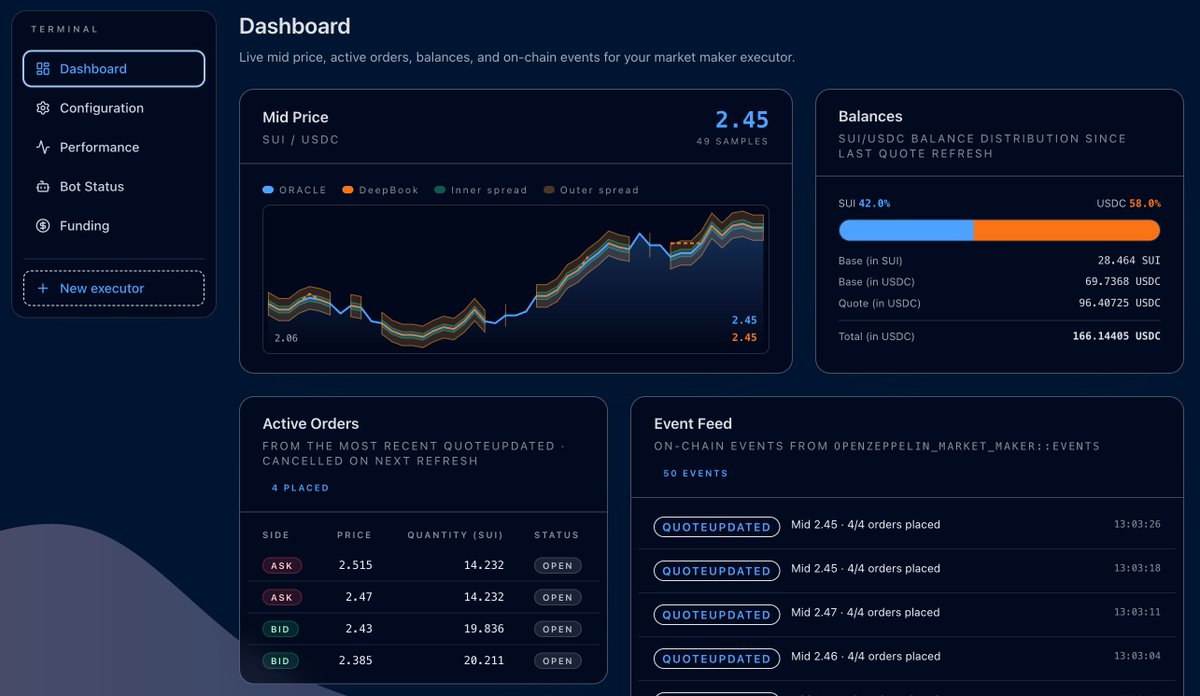
Meet a new starter app on @SuiNetwork: an onchain trading bot (AMM) with real-time quote updates.
This reference build gives you audited, production-ready patterns for the best spread configuration, @DeepBookonSui order management and single-transaction quote refresh (PTB).
2
8
19
2,298
Jun 5
The starter app ships with a ready-to-use terminal UI for spread configuration and performance tracking.
1
3
1,382
Jun 5
Build an automated market maker (AMM) on @SuiNetwork without starting from scratch ↓
github.com/OpenZeppelin/open…
2
1,034

When you move the most widely adopted stablecoin across networks, security becomes a core part of the product.
That's why every deployment runs through @OpenZeppelin before it ships, every chain, every time.
Over $95B moved. Zero exploits since launch.
Jun 4
Stablecoins are becoming critical infrastructure for institutional finance and agentic commerce 🔒
@USDT0_to brings the world's largest stablecoin to every major network, from Ethereum to Arbitrum, Plasma, and Tempo. At that scale, security must be built into every deployment.
2
19
2,498
Jun 4
The GENIUS Act sets requirements for stablecoin security and operational resilience. What it doesn't define is what those terms mean for blockchain infrastructure.
That gap is the compliance problem every issuer now has to solve.
1
3
16
1,137
Jun 4
Stablecoin risks (smart contracts, key management, incident response, chain behavior) don't map onto control frameworks built for traditional finance.
Issuers who wait for final rules will be building their security foundation while licensing windows open.
1
5
613
Jun 4
The licensing window won't wait. Learn how to assess and document your security posture today.
Read more here ↓
openzeppelin.com/news/the-ge…
4
528
Jun 4
Stablecoins are becoming critical infrastructure for institutional finance and agentic commerce 🔒
@USDT0_to brings the world's largest stablecoin to every major network, from Ethereum to Arbitrum, Plasma, and Tempo. At that scale, security must be built into every deployment.
4
2
24
4,157
Jun 4
OpenZeppelin secured their expansion across 20 networks with the Continuous Security Program, helping protect $95B in crosschain value transferred.
Read the full case study ↓
openzeppelin.com/customer-st…
5
562
OpenZeppelin retweeted

Jun 3
ERC-7540 joins the list of only 5 other token standards (Ex: ERC-20, ERC-4626, ERC-721) to be implemented by @OpenZeppelin.
Each of these prior standards defined entire categories for tokens, NFTs and DeFi.
So this is kinda a big deal. But why?
ERC-7540 takes onchain vaults to the next level. Many are familiar with ERC-4626 which ushered in the age of standardized DeFi vaults. Protocols like Superform, Morpho, Euler, Sky, Yearn, Ethena and many more all implemented it.
But DeFi grew. ERC-4626 was not built for patterns found in traditional finance. Not built for offchain assets to come onchain. This is where ERC-7540 comes in.
ERC-7540 brings onchain vaults to a mainstream audience. It allows the next 1 trillion in assets to be operated onchain while staying transparent and verifiable. This is why @centrifuge and Superform worked together to help make this a reality.
With OpenZeppelin’s support, we are excited to provide first-in-class support for all teams building on the standard across all Superform apps.
Jun 3
Tokenized treasuries, private credit, and regulated funds often settle over days, a timeline synchronous onchain vaults weren't designed for.
We've merged an implementation of ERC-7540 with support from @tokenizedvault members @centrifuge and @superformxyz to solve this.
6
7
43
4,054