
100 Photos and videos







Pinned Tweet

Apr 15
With how quickly fraud is evolving due to AI, online identity now collects more data than ever. Privacy feels like an inevitable sacrifice.
We don’t believe it has to be, so we built Relay.
Relay verifies you are human, but keeps your activity private.
Persona never sees who you share this proof with or what you’re doing online, and the website you’re trying to verify with never sees any of your personal information.
Identity and privacy don’t have to be a tradeoff.
Apr 14

🔒 Today, we're launching Relay: a new way to verify who you are while keeping your online activity private.
40
12
66
10,011
Apr 15
With how quickly fraud is evolving due to AI, online identity now collects more data than ever. Privacy feels like an inevitable sacrifice.
We don’t believe it has to be, so we built Relay.
Relay verifies you are human, but keeps your activity private.
Persona never sees who you share this proof with or what you’re doing online, and the website you’re trying to verify with never sees any of your personal information.
Identity and privacy don’t have to be a tradeoff.
Apr 14
🔒 Today, we're launching Relay: a new way to verify who you are while keeping your online activity private.
40
12
66
10,011
Apr 15
Relay leverages the Privacy Pass architecture (RFC 9576) to accomplish this.
Read more about how it works
withpersona.com/blog/introdu…
4
30
2,268
Apr 15
We’re working with early partners to help verify that users
1/ are human
2/ are over 18
and 3/ KYC without anyone else touching their personal data
DM me if interested in early access.
Excited to work with folks to keep the internet human and improve privacy.
13
32
6,516
Mar 24
This is not age verification. It’s just ID verification for account security.
In the past, you’d email your government ID to a support team who manually looked at it.
We built Persona because we think this is bad.
Your data used to be indexed in a CRM that wasn’t built to secure sensitive personal data, and often that CRM or even support team would be the source of the next data breach.
With Persona, your data is uploaded to a platform built explicitly to manage personal data with better security, access controls, and retention policies.
Companies choose us not because of how we verify, but because of our focus on how personal data is secured.
Despite the media attention, Persona’s primary use case is not age verification, but rather account security and fraud prevention. The majority of our use cases are exactly like this.
We have a simple business. We verify your identity securely, retain it for only as long as necessary on behalf of the company, and then delete it as soon as we can.
Mar 24

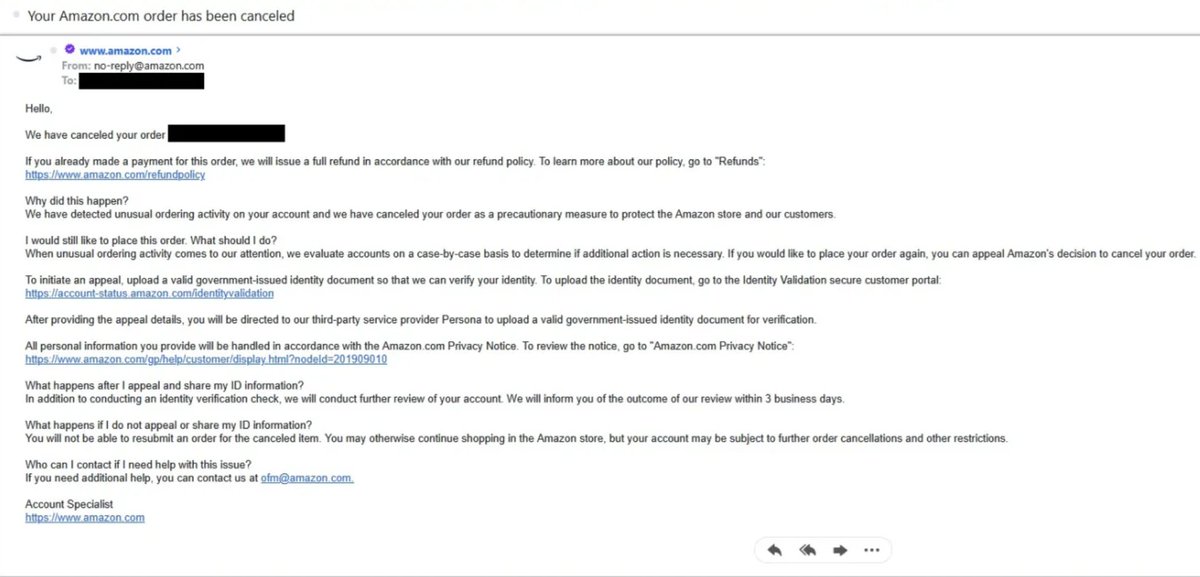
Amazon is emailing many users for "unusual ordering activity" and are asking for ID age verification. Surprise surprise, their age verification vendor is Persona.
84
5
70
18,860
Mar 24
You can read more of my thoughts on the risk of data breaches and data security here:
x.com/rickcsong/status/20348…
Mar 20

I 100% agree that this is an important conversation to be had. Data breaches continue to be a massive growing problem.
I think we also both agree that thoughtless identity regulations aren’t the right way to solve problems on the internet. Unfortunately the reality today is that we have more regulations requiring more businesses to collect more personal information than ever before.
This is the biggest reason why there are so many PII data breaches. Every single company is a target.
The vast majority of companies don’t have the resources to build the infrastructure to secure such sensitive data properly. Building it themselves creates a huge risk that they’ll be next.
Given how many breaches there have been, it’s tempting to think that data security is an impossible challenge. But the payments industry has shown that with the right attention and focus it is possible to secure sensitive data. It’s increasingly rare for credit card numbers to be exposed despite the exponential growth of online payments.
I believe it’s possible for identity verification to do for PII what payments have done for credit card numbers. However, identity verification today is too focused on the verification methods, and not focused enough on the security of the data.
Persona is verification-method agnostic. We don’t care about how you verify and that’s why we support every method out there. We do care that, however you verify, your personal data is processed securely and managed with the best controls.
It’s insane that credit card numbers are often stored more securely than biometrics, and with better access controls and retention policies too. You can change your credit card, but you can’t change your face.
As I wrote before, we have a simple business. We verify your identity securely, retain it for only as long as necessary on behalf of the customer, and then delete it as soon as we can.
The last bit is the most important: we delete it as soon as we can. The most secure data is data that is not there. And we view the data as a liability; the fines are just too high.
We do not sell people’s data. We never will and we legally cannot.
9
17
4,060
Mar 24
You can also see our recent launch for my thoughts re: age verification:
x.com/rickcsong/status/20361…
Mar 23
There are now more than 70 age verification laws proposed or enforced around the world, all with their own unique requirements.
We built Atlas for:
1/ compliance teams to help stay up-to-date with the dizzying regulatory landscape
2/ the public to track emerging laws and engage with regulators to shape these laws for the better
For the average company, non-compliance is a non-starter. The largest of these fines can be up to 10% of a company’s global revenue or $250,000 per violation per minor.
For the public, an overreaching law mandates overly-intrusive forms of verification from apps and individuals who shouldn’t be impacted, fueling concern and conspiracy around its true motivation.
5
16
3,535
Mar 23
There are now more than 70 age verification laws proposed or enforced around the world, all with their own unique requirements.
We built Atlas for:
1/ compliance teams to help stay up-to-date with the dizzying regulatory landscape
2/ the public to track emerging laws and engage with regulators to shape these laws for the better
For the average company, non-compliance is a non-starter. The largest of these fines can be up to 10% of a company’s global revenue or $250,000 per violation per minor.
For the public, an overreaching law mandates overly-intrusive forms of verification from apps and individuals who shouldn’t be impacted, fueling concern and conspiracy around its true motivation.
Mar 23
Today, we’re launching Persona Atlas
As more countries release their own unique laws on age assurance, tracking the requirements has become a nightmare
Persona Atlas is an open database that tracks, translates, and summarizes global identity regulations starting with age laws
14
18
120
31,031
Mar 15
CEO of identity company probably shouldn’t conspiracy-post about the source of age verification laws but this is my actual unironic take
> election year in politically polarized countries
> conservatives think adult content is bad for kids
> progressives think social media is bad for kids
> everyone on red alert for grooming
> age verification weirdly bipartisan issue
> politicians want to be reelected
> governments scared to be seen as ineffective
> every state/country passes one age verification law to solve everything
> mfw using one legal framework for totally different problems
> big tech legal departments don’t want liability
> big tech call lobbyists, “make this not my problem”
> big tech write blank checks
> some tech write blanker checks
> some laws move from platform to distributors
> linux has no checks
> some laws move to OS
> nobody happy because laws are different everywhere
> nothing makes sense
> chaos ensues
My thoughts on how things could be better:
1/ Split requirements for access to 18 content vs. community safety
2/ Access to 18 content should be determined by parental controls when possible
3/ Community safety should be treated as a fraud problem
4/ Platforms should determine the best anti-fraud tools to use based off what problems they're trying to solve
(learning from @vxunderground on how to format tweets)
Mar 13

Yeah, so basically the current prevailing schizo internet theory is that AI nerds have destroyed the internet and created infinite spam.
The advertisement goons are now incapable of determining who is a bot and who is an actual human. The advertisement goons no longer want to pay as much to social media networks.
Social media networks, in full blown panic of losing potential revenue, decided to lobby governments saying "we gotta protect the kids! ID everyone to protect the kids from pedophiles!".
The social media networks know this doesn't really protect kids. But, it does two things (and a third accidentally).
1. They now can identify who is human and who is AI slop machine, or enough to appease the advertisement goons
2. Advertising to children is a general no-no from politicians, or something, so with ID verification they can say with confidence they're not advertising to children because it's been ID verification. Basically, they can weed out the children and focus on advertising to adults
3. The feds can now tell who is human and who is AI slop. This inadvertently helps them with tracking people and serving fresh daily dumps of propaganda, or whatever they want to do.
It's a win-win-win for advertisers, social media networks, the government, and any business which does data collections.
It fucks over everyone else.
Chat, I'm not going to lie to you. This is an extremely good conspiracy schizo theory and I unironically believe it.

10
4
79
5,188
Mar 3
I believe there’s so much unnecessary confusion, frustration, and debate around age verification because we're treating two very different problems as one:
1/ Stopping kids from seeing inappropriate content
2/ Stopping adults from pretending to be kids
I get why these are discussed together. Too much of (2) increases the risk of (1). But not all platforms face both challenges and certainly not at the same level, and treating them as the same problem leads to the wrong solutions and the wrong tradeoffs.
I’m not a policy maker, but from our work at Persona, I’ve seen that the challenges, risks, and solutions for each of these problems are wildly different.
Keeping kids from inappropriate content is a household-level problem. I don’t want to downplay the risks of social media or exposure to adult content. However, sacrificing broad privacy to solve what is fundamentally a parental controls problem doesn’t feel like a great bargain.
Stopping adults from impersonating kids is a platform-level problem. It jeopardizes the safety and integrity of the community and at its core, it's fraud where adults have far more resources than kids. Unfortunately, the challenge is that more effective solutions tend to compromise more privacy. The best approaches evaluate how much of a tradeoff is worthwhile given the risks.
When the risks of a technology don’t match the benefits of the problem it solves, public concern is justified. Applying fraud prevention techniques to what should be a parental controls problem is overreach. And a half-baked solution to adult impersonation is possibly worse. It’s security theatre where privacy is sacrificed but minimal assurance is gained.
The more I work on this and the more I hear from all of you, the more I believe that if some privacy must be lost, some privacy should be gained elsewhere in return. The right framework is one that splits knowledge to prevent abuse.
No single organization should know both:
1/ who you are
2/ what you are doing
If Persona has to know who you are, we should make sure we don’t know what you’re doing or what app you’re using. And if a platform knows what you’re doing, they shouldn’t know who you are.
This is not where the world is at today, and this framework is by no means perfect. But I think it’s better, and I’d love your feedback as we build it.
50
14
235
61,314

Been reading the @withpersona incident write up as a bunch of people have asked “will the data be going into @haveibeenpwned?” Easy answer: no, because there’s no data: withpersona.com/blog/post-in…
Feb 21
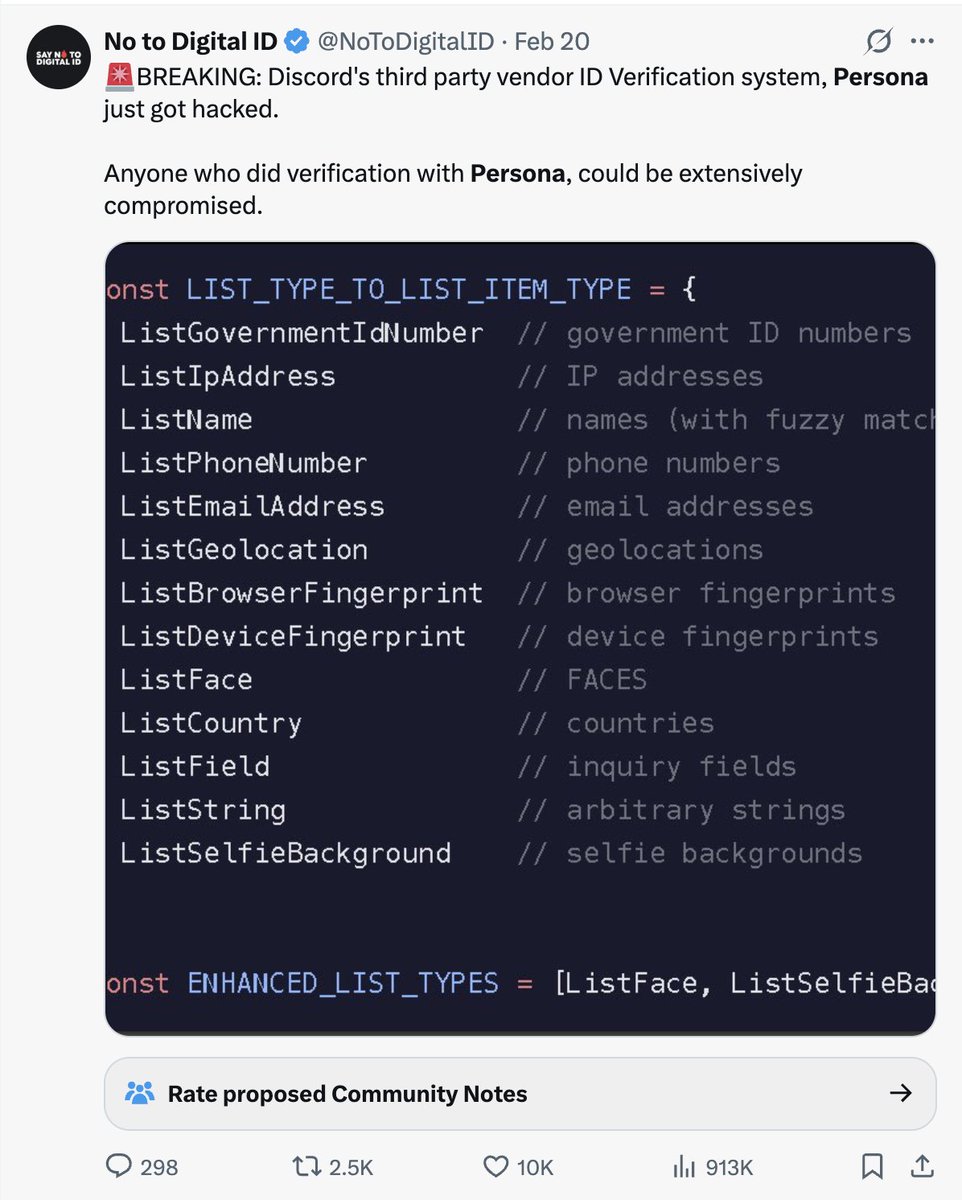
Persona was not hacked. No database was breached.
We recognize recent media reports may have caused concern. We apologize for any uncertainty or disruptions to our customers and users.
4
10
75
21,341
Feb 21
Persona was not hacked. No database was breached. Frontend code source maps were leaked, which means unminified variable names were exposed revealing all the names of our features. These names are already publicly listed in @withpersona's help center and API documentation.
27
14
229
52,456
Feb 25
Here is our account of what had happened and our reflections on what we will change.
The most important change we are going to make:
> *Reviewing through a perception lens.*
> We are adding a step to our security review process that explicitly evaluates not just "is this secure?" but "could this appear insecure to a reasonable external observer?"
> Persona handles sensitive identity verification data. We owe it to our customers and their end users to hold ourselves to a standard that accounts for perception, not just technical risk.
withpersona.com/blog/post-in…
10
3
40
10,021
Feb 25
celeste has published the 2nd part of their research. It has been delightful communicating with them, even with all of the stress, noise, and chaos.
We are still committed to responding to the rest of their questions, but I would encourage reading their subsequent findings here

5
5
91
10,810
Feb 24
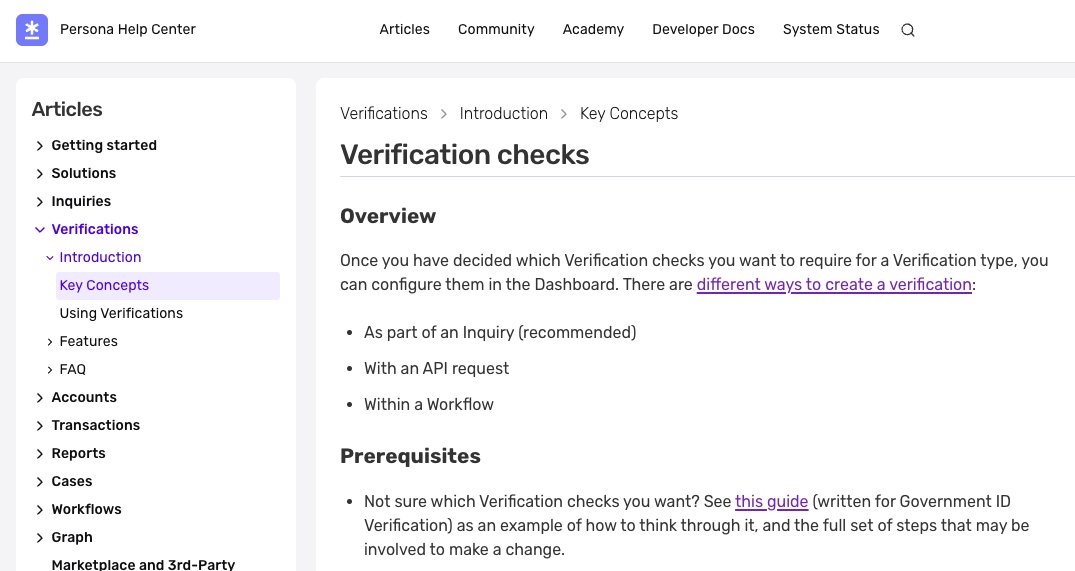
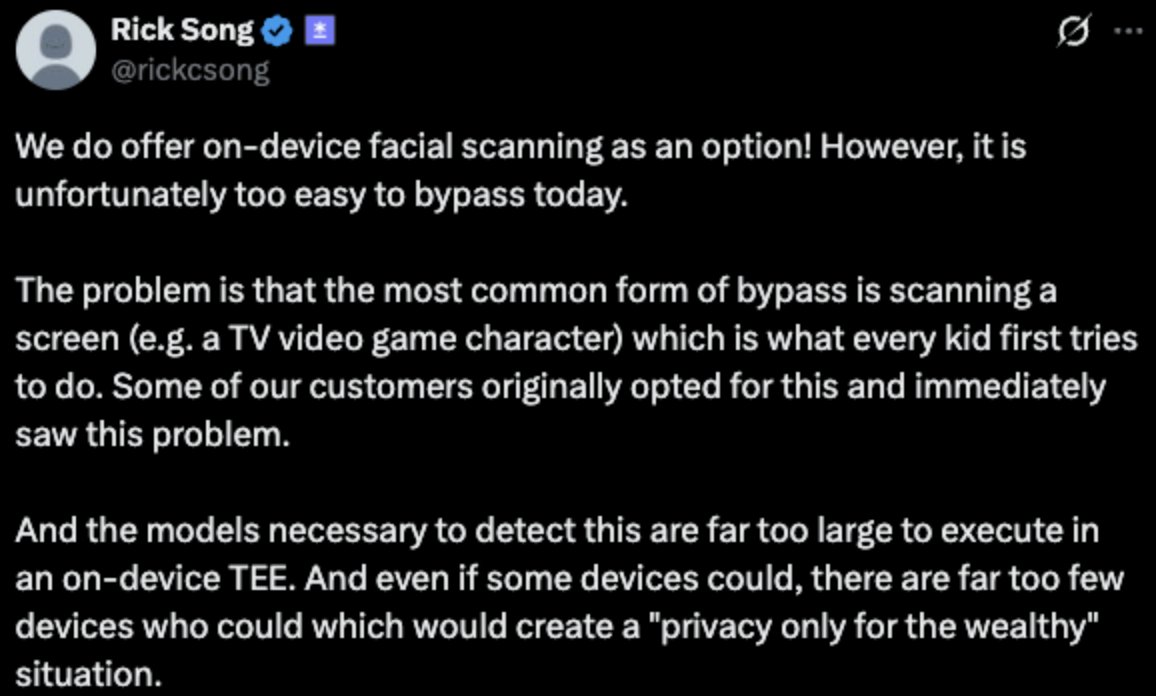
We understand Discord is proceeding with age verification without Persona, but some of the implications in this blog post about the capabilities & features of our platform are patently false.
I’m fine if they don’t want to use us. I’m not okay with them publicly saying untrue things about our age assurance technologies to try to shift responsibility away from their own decisions. Doing so further erodes trust.
> We’ve set a new bar for any partner offering facial age estimation, including that it must be performed entirely on-device, meaning your biometric data never leaves your phone. Persona did not meet that bar.
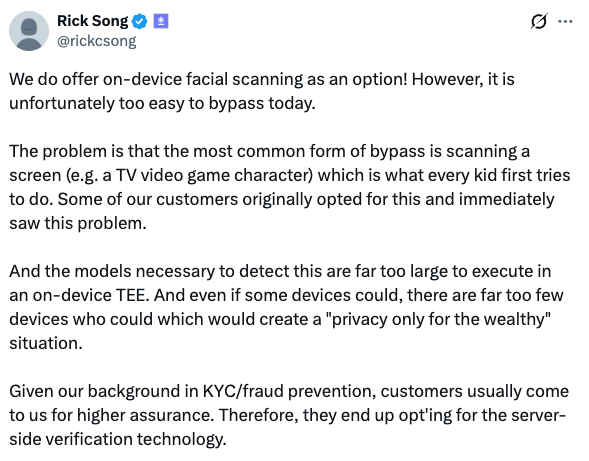
We offer on-device age verification. We even offered credit-card based age verification for free (their new approach). We made this clear to Discord multiple times.
Throughout our partnership, Discord was explicitly looking for a provider who could prevent “fraud/deepfakes/bots/using video game photo mode to pass age check.”
We were transparent about the real technological limitations and capabilities of on-device solutions, which I shared elsewhere on this platform.
We were upfront that on-device solutions can create a “privacy for only the wealthy” problem where only those with higher-end devices would be able to run the necessary models.
We understood that they had experienced recent bypasses that could cause regulatory scrutiny.
Many of us here at Persona are huge fans of Discord and some have been users since 2015. We were eager and willing to partner with them to address all these challenges.

Getting Global Age Assurance Right: What We Got Wrong and What’s Changing.
Read the update: discord.com/blog/getting-glo…
Community note
Since this is a wall of text article and the headline doesn't say, this quick-to-read context is necessary:
Discord is STILL rolling out Age Verification methods, just delayed to the second half of 2026 per the very own article in this post.
discord.com/blog/getting-g…
87
30
361
82,094
Feb 24
Given how the situation has evolved, I want to get these statements out there now. I probably should have sooner.
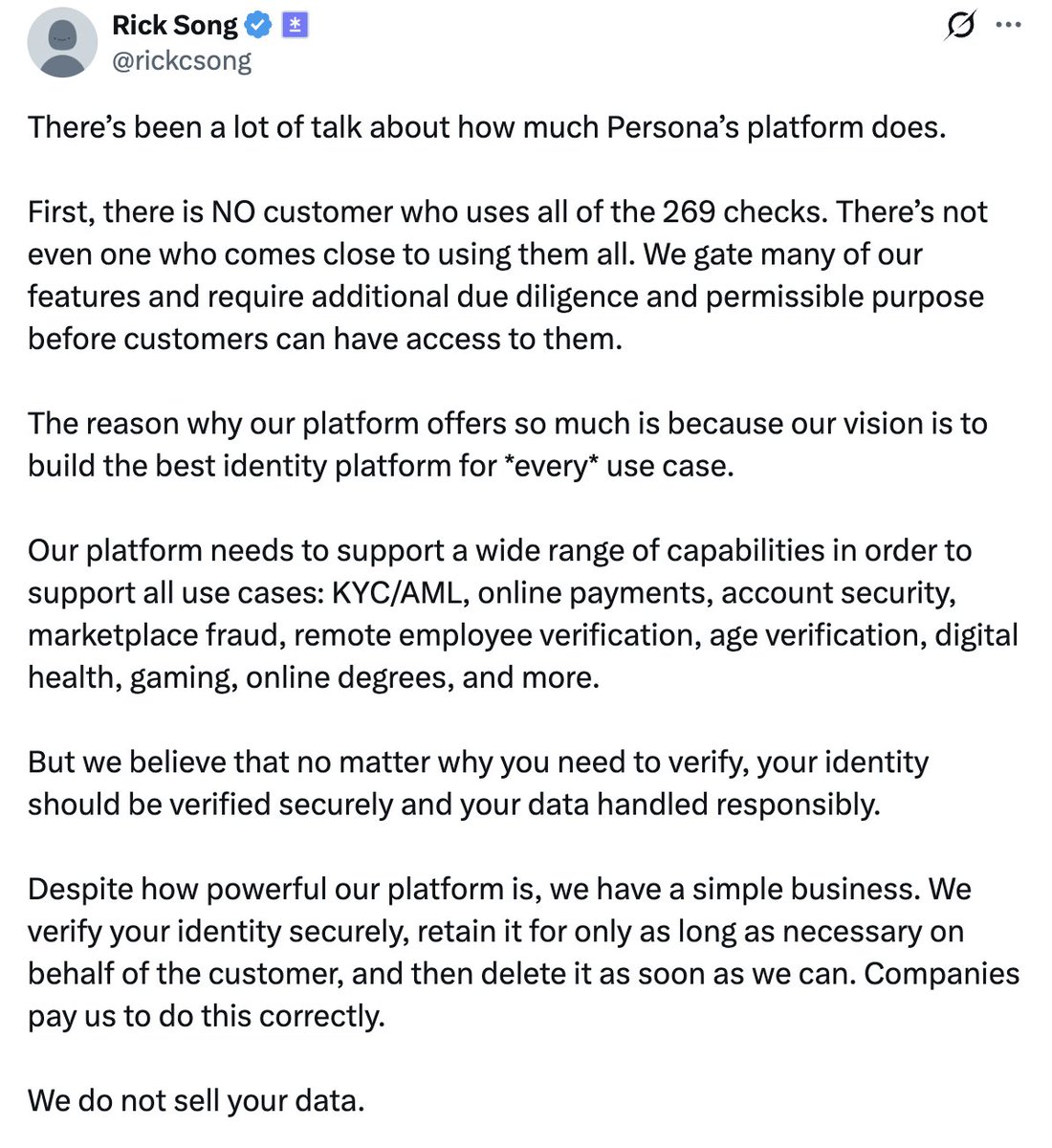
1/ We were not hacked or breached.
2/ We do not send your identity to the government. Our financial services customers *can* file anti-money laundering reports on payments/transactions through our platform to the government.
3/ We do not use your data to train AI.
4/ We do not work with ICE or the DHS.
5/ We do not work with any federal agency. We are competing for government contracts to be able to authenticate remote government employees.
6/ We do not work with Palantir.
7/ We do not interact with Peter Thiel. We *did* take money from Founders Fund which he cofounded.
8/ Our customers are generally the data controller (under GDPR parlance) of the data. We invest a lot to give them the controls to retain and redact it properly.
9/ We schedule for deletion any data we are the data controller of after verification.
Most importantly, we have no interest in your data. We do not profit off it. In fact, it’s the opposite. The liability is too great and the fines are too high.
10
5
147
8,876
Feb 24
Lastly, I want to take accountability as well. I should have been on this platform earlier. I should have been engaging with the public sooner. Given what we do, I owe the public far more transparency than I’ve given it.
I didn’t because I am scared of you. I am scared of the internet. This past week has been terrifying.
I am not a cyborg, but I have also not slept much. I’ve been operating on adrenaline and fear. Social media is insane.
x.com/vxunderground/status/2…
I shared this with our entire company last week when many of us felt anxiety and frustration about the fear mongering and hysteria being induced by the media:
“We have not earned anyone's trust and rightfully so. But if we aren't willing to trust them first, then why should we have the right to ask for it in return?”
And through believing this despite a rough welcome, I’ve had delightful conversations. I’ve enjoyed whimsical exchanges. And I’ve had the opportunity to share what we’ve learned about identity, but also learn from you about what we're missing.
I’ve learned more about how imperfect we are, but also how understanding you can be.
I plan to engage more on this platform to provide the transparency that you should’ve already had and also correct when things are wrong, whether that’s what people are saying or what we are doing.
To start, here is our best account for why our source maps were made public: withpersona.com/blog/post-in…
I won’t always get it right, but I’ll always try to be genuine.
Feb 23
Rick it's fucking 5 in the morning
Either you're AI maxxing or you're abusing prescription medication
(Or you're a half human, half cyborg monster from the year 3000)
15
1
131
10,274
Feb 23
They were right. I should have listened.
The internet is just too powerful. I caved to the pressure.
I don't want to be a hypocrite anymore.


20
4
115
14,574