
investment & research @ambergroup_io
Joined May 2022
- Tweets 1,489
- Following 1,735
- Followers 2,336
- Likes 12,057
151 Photos and videos








1
22
648
im writing a report on programmable privacy. i realized comparing projects is sort of dumb.
for example, a nockapp on @nockchain will have private txs, but probably still wants FHE from @octra when users need to compute over each other's private data
report soon
8
5
54
2,734
i don’t care if you don’t believe me but i believe this year some of my most important connections will be made on the @praxisnation mobile app
5
27
4,254
all the best teams eventually leave bittensor. learned this from nous leaving their subnet and wombo leaving their subnet.
RIP the best narrative bittensor had in awhile

3
2
22
4,630
you always see many companies building "AI agents for finance" but very few are building the stack that makes them actually work at institutional scale
that's what amber is doing
Apr 2

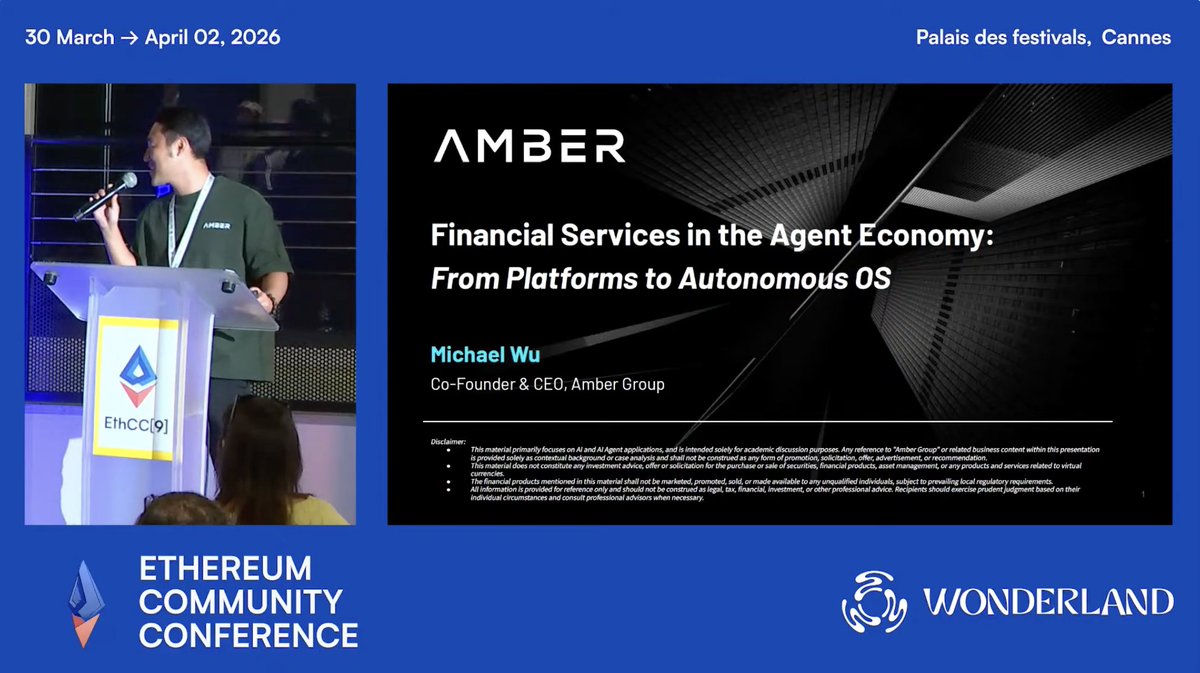
"In the AI agent economy, financial services will inhabit agent-native OS just as web apps rely on the cloud today. Crypto is the economic rail embedded in this architecture."
@MichaelWuAmber at @EthCC 2026: "We aren't just adding AI; we're building the financial stack for what comes next." 🧵👇
1
11
700
meeting people in nyc it’s increasingly clear that there is a new generation of free thinkers who will run laps around the old generation
imagine being a grey haired unc who is ideologically short hype and still doesn’t even know what bittensor subnets are because you are never online
2
11
433
looking back at this report its clear to me that proof of work coins, whether or not fully true, provide a perception of fairness in an industry plagued by max extractors. when the average person sees "mineable" they think Bitcoin. they think fair launch. they think nobody got a premine. that perception alone is worth something in a market where every new token launch is some variation of insiders dumping on retail.
bringing out the history books with ERC-918: eips.ethereum.org/EIPS/eip-9…
after the first ever ICO wave, many smart people of the time of the time realized that ICOs had largely cooked retail. the token deployer controls the entire supply, raises millions, and retail is left holding the bag hoping the team delivers. their solution was a mineable token standard. basically ERC-20s you could mine. an "Initial Mining Offering" instead of an ICO, where the deployer is "just another user" and tokens are distributed through proof of work, not through a presale allocation spreadsheet.
their idea was largely correct. at a high level this would be a more fair way to launch tokens. but i've done research into how we could bring this back, and their implementation was stupid. you had to call the mine() function in the smart contract every single time you wanted to earn tokens. that means every solution required an on-chain transaction. at that point you are just exchanging gas fees for tokens. sure you accomplished the fairness goal but the work itself is meaningless.
BUT SINCE 2018 WE HAVE EVOLVED. the work can now be useful. AI inference, model training, ZK proof generation, these are all workloads that actually demand real computing power. and we are starting to understand how to coordinate this computation in a distributed manner akin to Bitcoin, which was always the original vision behind something like ERC-918.
i imagine we will find ways for this distributed computing power to be genuinely valuable. not just burning cycles to prove you burned cycles, but producing outputs that people actually pay for. i also imagine a world where speculating on a token inadvertently creates real demand for that token, because buying and holding it means someone is mining it, and mining it means compute is being contributed, and compute being contributed means the network is actually doing something. speculation and utility become the same loop. that's the version of ERC-918 that should have existed from the start.
1 Jul 2025
12/ Read the full deep dive → “Proof of Useful Work”
Written by Amber Researcher @robcrt
ambergroup.medium.com/proof-…
If you are building something related to Proof of Useful Work—we want to talk.
#PoW #ZK #AI #AgentFi #AmberGroup
3
2
26
1,218
prediction markets and equity perps prediction markets and equity perpsprediction markets and equity perpsprediction markets and equity perpsprediction markets and equity perpsprediction markets and equity perpsprediction markets and equity perps maybe ai
this is crypto now
2
9
329