building trysaffron.ai (YCX26) || prev. math/cs @ mit
Joined September 2022
- Tweets 38
- Following 28
- Followers 65
- Likes 79
1 Photos and videos
Pinned Tweet

May 13
we’re doing something dumb on purpose.
introducing the saffron tour: we fly out to 5 series A companies, embed for a week, design ai-native assessments on your codebase, run them on your candidates, and walk you through every result.
zero cost. first five only. ⬇️
4
2
10
2,631
Jun 7
the time it takes to build and iterate is now almost negligible compared to what it was when stripe was being built, so it should take much shorter to build initial momentum

How could this be perceived as anything but a massive failure in today’s world? Would Stripe even be investable today? Which investors would ever think that only launching after two years of work and with 50 users would ever be the beginning of something gigantic?
I can’t see how anybody would be happy with this today. And yet, almost imperceptibly, Patrick and John were painstakingly laying the foundation for something that was built to last and built to grow strong and immovable like a Sequoia. How can mushroom growth rates produce anything other than mushroom longevity?
I’m not saying that real value CAN’T be built quickly. But I think it’s far more common than we like to talk about that founders work for two, three, four, seven, even fifteen years before something extremely valuable is born into the world and really takes off.
James Dyson worked on the design of his vacuum cleaner for 5 years before he got to a working prototype and 8 years before it became a commercial product.
Dylan Field worked on Figma for four years before launching a *closed* beta.
Tim Leatherman worked on his idea and prototype for 8 years before he had his first multitool design that was ready to sell.
Palmer Luckey spent about 7 years from the time he began working on VR prototypes before Oculus released the first consumer headset.
Jensen Huang started Nvidia in 1993 and it wasn’t until 4 years later in 1997 that they had their first major commercial success with the RIVA 128.
Steve Wozniak was the fastest and went from an idea for a personal computer in 1975 to the Apple II release 2 years later in 1977.
Time and again the reality is that great things take time to build. I’m not saying it doesn’t take hard work. I’m definitely not saying it doesn’t take determination and extreme focus. But it does take time. I think we try and pretend that it doesn’t take time and lift up the seeming exceptions to the rule.
Why not be honest and instead focus on the determination and extreme grit that it takes to keep building for years before any outward success arises or glory is received?
I hope we can be honest with young founders and repeat these stories again and again so that they learn to work thanklessly for years before the outward vindication comes, because that’s what it really takes.
1
70
Jun 5
with names and details is crazy 😭
Jun 5

Two of our worst VC stories:
1. A Sequoia partner passed on Cloudflare because he didn’t think a woman could lead a security infrastructure company. Seriously. 🙄
2. I got introduced to @pmarca. Meeting got scheduled for a Monday, which should have been a clue. I thought it was just a casual meeting. He thought it was a pitch and brought the whole @a16z partnership team. Hilarity ensued. 🤪 At one point one of them said: “You don’t seem very prepared.” Which was true because I wasn’t. I framed the rejection letter they sent.
129
May 19
engineers cost $600k-$1M in total comp now.
every CEO will soon be asking the same question: why am i paying this much when half my team uses Claude like an autocomplete and the other half ships with 100x efficiency?
2
1
2
191
May 13
we’re doing something dumb on purpose.
introducing the saffron tour: we fly out to 5 series A companies, embed for a week, design ai-native assessments on your codebase, run them on your candidates, and walk you through every result.
zero cost. first five only. ⬇️
4
2
10
2,631
May 13
two reasons we’re doing this:
1. companies like sierra and meta are completely rethinking their own interviews and having teams build a solution in-house. everyone else needs to catch up
2. the only way to build the right product is to be embedded with teams figuring this out in real time
2
186
May 13
you have to be:
- series A hiring 25 engineers in the next 6 months
- using AI tools heavily across your eng org
- already trying to figure ai-native assessments yourself
- in sf, nyc, boston, or another major hub
1
2
229
May 13
over one week, on-site, we’ll:
-audit your current hiring process and identify what works
-design custom questions in your domain
-run then on your live candidates
-walk you through all our metrics
-build you an internal evaluation rubric you can use to continually benchmark
1
268
May 5
three years ago this question would’ve sounded like nonsense lol
today it’s the most important question in technical hiring
4
1
7
484
Apr 28
i left school four months ago because hiring was broken. today YC is launching us. surreal.
Apr 28

Are you missing out on the next 10x engineer? Saffron (@trysaffron) lets companies evaluate how well software engineers code with AI tools.
Congrats on the launch, @roblukan, @kazumachoji and @_mjyao!
ycombinator.com/launches/Q5b…
2
8
339
Apr 24
Sierra just killed the coding interview. Every engineering team that hasn’t caught up is about to look very out of touch
Apr 22

As coding agents have become the standard for developing software, we've transformed Sierra's engineering interview process to be AI-native. We've documented our lessons here, and very curious how others in the industry are navigating sierra.ai/blog/the-ai-native…
7
2
6
1,320
Apr 24
we’ve been building saffron for exactly this. candidates get a real codebase, ai tools of their choice, and a timed build. we score the full session automatically so any team can run what sierra just described, not just the companies with sierra-sized engineering budgets
trysaffron.ai
2
3
148
Apr 24
here’s the thing almost everyone will miss about this post. sierra has the eng. bandwidth to run custom onsites, write rubrics, calibrate across interviewers, pair reviewers for consistency.
most companies don’t. most companies will read this, nod, and change nothing.
1
116
Apr 24
So Sierra rebuilt their onsite:
- 2 hour build session with AI tools of their choice
- Candidate defines scope, pivots when stuck, ships something real
- Reviewers debate the product flows and technical judgement
Sounds familiar? It should. It’s how actual engineering works now
1
82
Apr 24
their argument is simple: interviews have been testing mechanics (syntax, algorithms, etc.). That signal used to matter. In the age of Codex and Claude Code, it doesn’t. The real skills are scope, tradeoffs, judgement, and shipping. Why don’t interviews test those?
1
90
Apr 1
“quick they’re taking a picture lock in”
Mar 30

People ask if we're crazy for betting on college dropouts. One of those bets just got acquired by @DoorDash for the best IRR in our fund history. Metis 🔥
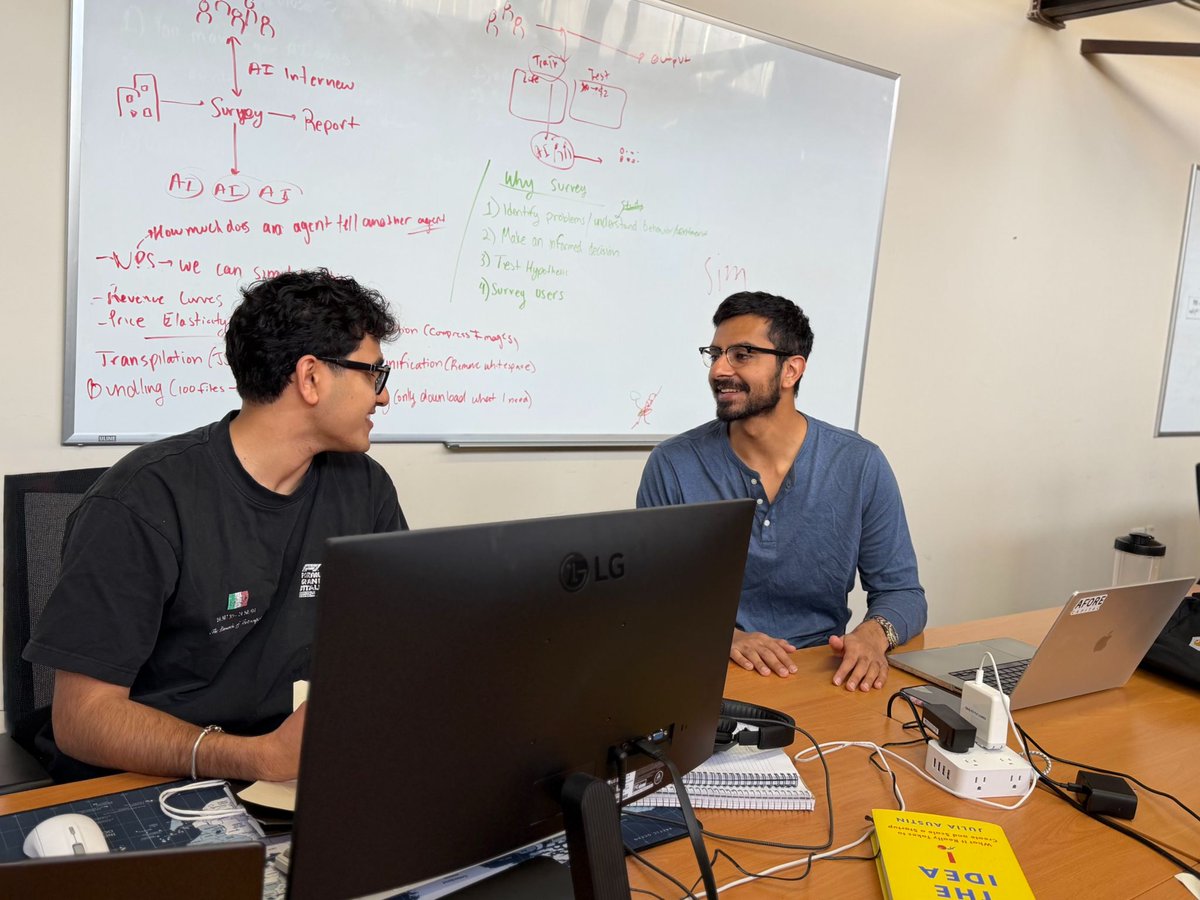
Aryan started as a campus scout, that's how we first met him. We backed him as one of our first college dropout founders, very early stage. Marcus and Aayush built alongside him.
Stories like theirs are exactly why we started FIR U.
𝐅𝐈𝐑 𝐔 𝐢𝐬 𝐀𝐟𝐨𝐫𝐞'𝐬 2-𝐦𝐨𝐧𝐭𝐡 𝐟𝐨𝐮𝐧𝐝𝐞𝐫 𝐩𝐫𝐨𝐠𝐫𝐚𝐦 𝐟𝐨𝐫 𝐬𝐭𝐮𝐝𝐞𝐧𝐭𝐬, 𝐝𝐫𝐨𝐩𝐨𝐮𝐭𝐬, 𝐚𝐧𝐝 𝐫𝐞𝐜𝐞𝐧𝐭 𝐠𝐫𝐚𝐝𝐬. 𝐖𝐡𝐚𝐭 𝐲𝐨𝐮 𝐠𝐞𝐭: investment, 2 months in San Francisco, office space and 1:1 mentorship, sales, product, and fundraising support, and an investor showcase in front of 200 VC firms. You don't need a co-founder. You don't need to drop out. You just need to be ready to build.
Apply now: afore.vc/students
Can't wait to see you in the office!

4
105
Mar 18
swes hired in the last 6 months can't code.
they can get ai to produce something that looks right. but the moment something breaks (spoiler: it always breaks) they're stuck.
the coding interview is now a test of how well you prompt claude, not how well you understand software. nobody has figured out what to replace it with yet.
2
3
11
475
Robert Chondro retweeted

1 Aug 2025
Think I may have been top 10 oldest people in this room somehow. Since when are 15-year-olds working at Jane Street?
1
3
17
4,058